The Tattooed Biker Seemed to Take a Paralyzed Father’s Place at His Daughter’s Wedding — Until Five Shaking Steps Revealed What Both Men Had Hidden for Six Months
Part 2
Ray Lawson moved into the house across from the Millers fourteen years before Grace’s wedding. He arrived alone with a black Harley Road King, a dented red toolbox, and enough lumber to rebuild the garage before he unpacked his kitchen.
Neighborhood children watched from bicycles.
Their parents watched through blinds.
Grace was fourteen and the first person to speak to him.
Her bicycle chain had slipped near his driveway. Ray crouched beside it, reset the chain, aligned the rear wheel, and wiped his hands on a rag. Grace offered him three dollars from her backpack.
“Keep it,” he said.
“Why?”
“Your dad will feed me eventually.”
Thomas did.
That Saturday he carried two plates of ribs across the street, and a friendship began without either man admitting it. Thomas was a wrestling coach who filled silence with stories. Ray repaired industrial elevators and preferred silence because words had failed him before.
They met in the middle over engines, bad coffee, and the belief that a promise was work, not language.
Ray became part of the neighborhood by doing things no one saw him volunteer to do. He replaced Mrs. Alvarez’s porch rail after she fell. He drove Grace home when her college car died outside Macon. When Thomas’s mother entered hospice, Ray mowed both yards for eleven weeks and never mentioned it.
His club, the Iron Lantern Riders, understood that this was simply how Ray moved through the world. They were electricians, veterans, mechanics, and delivery drivers. Their leather cuts frightened people; their weekends often involved wheelchair ramps, funeral escorts, and roofs repaired for families who could not pay.
Ray had no children.
He and his wife, June, had prepared a nursery once. Their daughter was stillborn at thirty-two weeks. June died from ovarian cancer seven years later.
After that, Ray removed the passenger seat from his Harley and stopped attending weddings.
Grace’s invitation sat unopened on his workbench for nine days.
Thomas crossed the street in his wheelchair and placed it in Ray’s hand.
“She wants you there.”
“I’ll be there.”
“Not in a pew.”
Ray looked at him.
Thomas explained that he could not escort Grace. His brother had offered, but Grace wanted someone her father chose—someone who would understand that the walk belonged to Thomas even if another man supplied the legs.
Ray refused first.
“I’m not taking that from you.”
Thomas rolled closer. “Then help me take some of it back.”
The sentence hung between them.
Thomas had been injured when a pickup crossed the center line on Interstate 16. His spinal cord was incomplete, meaning some signals survived, but progress had stalled. With braces, parallel bars, and a therapist, he could stand for twelve seconds on a good day. He could shift one foot half an inch.
Doctors warned him that a fall could break a hip or undo months of work.
Walking five steps was not impossible in the clean way death is impossible.
It was worse.
It was close enough to tempt him and dangerous enough to frighten everyone who loved him.
Ray read the invitation again.
“When do we start?”
They kept the plan from Grace. Thomas did not want her wedding built around a medical gamble. If training failed, Ray would escort her all the way. If Thomas managed only to stand, that would be enough.
If he managed five steps, the final five would be his.
Every Tuesday and Thursday after dark, Ray closed his garage door. Inside, he had welded parallel bars from steel pipe and laid a strip of dark carpet between them.
At one end he taped a photograph of Grace at age eight, missing her front teeth.
At the other, he placed the wedding invitation.
Five steps lived between them.
Part 3
Training began with standing.
Ray locked Thomas’s wheelchair, moved the footplates, and positioned the braces exactly as the physical therapist had shown him. He never lifted Thomas under the arms. He supported at the belt, counted breathing, and stopped the instant Thomas’s left knee buckled.
The first night, Thomas stood for four seconds.
The second week, nine.
By the end of the first month, he could remain upright long enough to look across the garage at Grace’s invitation. Then his legs collapsed and Ray lowered him into the chair.
Thomas struck the wheel with one fist. “Again.”
“Tomorrow.”
“Again.”
Ray crouched until they were eye level. “You break tonight, you don’t walk that day.”
Thomas hated him for being right.
That was part of why he had chosen Ray.
The Iron Lantern Riders discovered the training when Miguel Santos came to borrow a torque wrench. Ray made him swear silence. Within a week, the club had quietly divided the work. Miguel found a retired physical therapist willing to advise them. Curtis built a safer support belt. A welder named Deacon added adjustable rails.
None of them told Grace.
Brotherhood was tested when Thomas fell during month three.
His left foot caught. Ray moved to support him, but Thomas twisted and struck the carpeted floor hard enough to bruise his hip. The doctor ordered two weeks without standing. Grace found the bruise while helping him dress and demanded an explanation.
Thomas lied that he had slipped during a transfer.
Grace blamed herself for not being there.
Ray heard this and wanted to end the secret immediately.
“She thinks she failed you.”
“If I tell her, she cancels the wedding walk.”
“Maybe she gets that choice.”
Thomas looked toward the invitation on the garage wall.
“All her life, every hard thing in this family became hers to manage. Her mother’s surgery. My accident. The insurance. The ramps. Let me carry one surprise without making her carry the fear.”
Ray understood more than Thomas knew. June’s illness had turned love into schedules, pill bottles, and bad news delivered in parking lots. He remembered how every hope became another job for the person already hurting.
So they continued, but under stricter rules.
In month four, Thomas made one step.
It was barely a step: the right shoe lifted, moved three inches, and landed crooked. Yet Ray turned away afterward, pretending to adjust a wrench because his eyes had filled.
By month five, Thomas could make three steps between the bars.
The fifth step would not come.
His body anticipated the loss of support. His shoulders tightened. The left knee locked too early. Each attempt ended with Ray catching the belt and guiding him back.
One night Thomas asked why Ray had agreed.
“Because you asked.”
“That’s not all.”
Ray sat on an overturned bucket. For years, the neighborhood had known about June. Almost nobody knew about the child they had lost before her.
“I had a daughter,” Ray said. “Never got to carry her farther than one hospital hallway.”
Thomas went still.
Ray rubbed the heel of one scarred hand.
“I’m not walking Grace because I think she’s mine. I’m walking her because she’s yours—and you trusted me with the distance you couldn’t cover.”
The next attempt, Thomas reached step five.
Neither man celebrated.
Ray marked the floor with black tape. Thomas sat breathing hard, staring at it as if five strips of carpet had become a road home.
At the wedding rehearsal, however, he could not stand at all.
His legs shook before they took weight. Pain traveled through his lower back. After three failed attempts, Ray removed the braces and said nothing.
Thomas looked toward the sanctuary.
“It’s gone.”
“No.”
“You saw it.”
Ray folded the five-count card and placed it inside his vest.
“I saw one bad day.”
The next day would decide whether six months of secret work ended in five steps—or in Ray carrying the promise alone to the altar.
Part 4
On the wedding morning, Thomas woke before sunrise and could not feel his left foot.
He told nobody except Ray.
The biker arrived at the Miller house at 6:10 a.m., still wearing his work jeans. His Harley idled once in the driveway, then went quiet. Inside, Thomas sat on the edge of his bed with braces laid across his lap.
“Call it,” Thomas said.
Ray checked the straps, then knelt to lace the polished shoes. “Your call.”
“I just made it.”
Ray nodded. He did not offer false hope. They had agreed that Thomas could stop at any moment without apology.
Then Thomas looked at the framed photograph on his dresser: Grace at eight, front teeth missing, wearing a towel as a wedding veil.
“Put them on anyway.”
At the church, Ray placed the black mark exactly five steps from the wheelchair. He measured using Thomas’s trained stride, not his own. That was why the mark sat near the middle rather than closer to the altar.
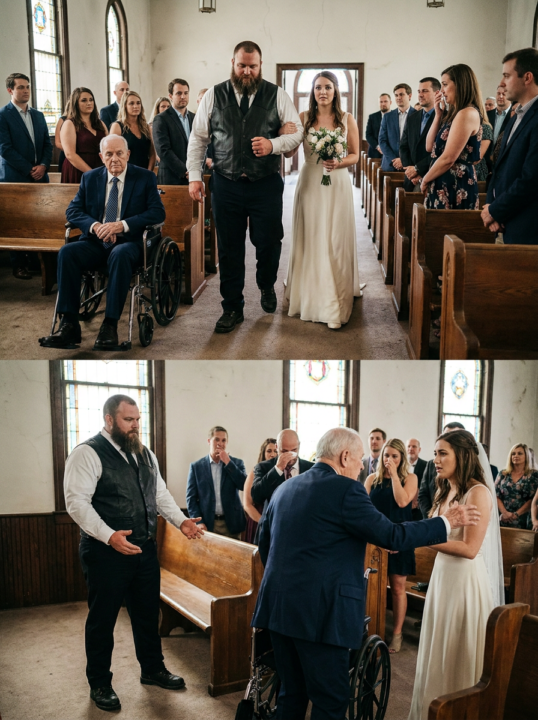
When Grace entered on Ray’s arm, Thomas felt nothing below his left ankle.
He counted their progress.
One. Rest.
Two. Rest.
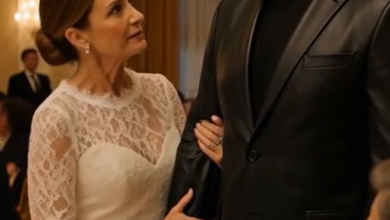
Ray’s pace gave him time to breathe. Guests mistook the slowness for solemnity. Grace smiled toward her father, unaware of the braces hidden beneath his suit or the support belt beneath his jacket.
At the black tape, Ray stopped.
He released Grace and stepped back.
“Your five steps, brother.”
Thomas moved the footplates aside. His wife, Linda, realized what was happening and whispered his name with fear rather than encouragement.
“Tom, you don’t have to.”
He looked at Grace. “I know.”
That answer mattered.
He was not standing because a wedding demanded a performance. He was standing because six months of work had given him ten seconds he wanted to spend himself.
Ray positioned one hand near the support belt but did not touch it. Thomas planted his right foot. The left remained distant, almost theoretical.
“One,” Ray said. “Breathe.”
Thomas pushed through both arms and rose from the wheelchair.
The first sound in the church was Linda’s breath breaking. Then a pew creaked as someone stood. Thomas’s legs trembled visibly beneath the navy trousers. His face drained of color.
Grace covered her mouth.
“Dad.”
Thomas locked his right knee.
“Two,” Ray said. “Hold.”
He shifted his weight forward. The left shoe scraped the carpet but moved.
First step.
The congregation began to rise, not cheering, simply unable to remain seated.
Second step.
Thomas’s shoulder dipped. Ray moved closer, scarred hands open, ready to catch him. Thomas shook his head.
Third.
Grace dropped her bouquet. Flowers struck the runner softly.
Fourth.
Thomas’s left knee buckled. A sound passed through the room. Ray caught the support belt for less than a second—not lifting, only returning Thomas’s balance to center.
“Look up,” Ray said.
Thomas looked at his daughter.
The fifth step landed between the fallen flowers.
Ten seconds had nearly passed. Thomas reached Grace and placed one shaking hand around hers. Ray moved the wheelchair forward behind him, but Thomas remained standing long enough to turn toward Evan, the groom.
His voice came out thin.
“I brought her as far as I could.”
Evan’s eyes filled. “I’ll meet her the rest of the way.”
Thomas gave Grace’s hand to him.
Only then did his legs release.
Ray caught him under the support belt and lowered him into the wheelchair. The church erupted—not with applause at first, but with sobbing, the uncontrolled kind people make when hope arrives after they have already trained themselves to live without it.
Through my camera, I saw Grace kneel in her wedding dress and press her forehead to her father’s.
Then I saw Ray.
He had stepped behind the last pew, outside the family circle. Tears were already moving through his beard. No one noticed because every face had turned toward Thomas.
Ray wiped his eyes with the back of one tattooed hand, picked up Grace’s bouquet, and placed it beside her without entering the photograph.
He had delivered both father and daughter to the same point.
Then he backed away.
Part 5
The ceremony paused for seven minutes.
Thomas needed water and time for the tremors in his legs to settle. Grace refused to stand until the color returned to his face. Evan knelt beside them, one hand resting on the wheelchair frame. Ray remained at the end of the pew, checking the brace straps with the quiet efficiency of a mechanic listening for damage.
When Thomas nodded, Grace rose. She kissed his cheek, retrieved her bouquet, and walked the remaining distance with Evan.
The ceremony continued.
Nothing after that felt ordinary, though everyone tried. The minister read the vows. Rings were exchanged. The church laughed when Evan put Grace’s ring on the wrong hand.
Yet the black mark remained visible on the aisle behind them—the small place where the plan had changed direction.
At the reception, the band announced the father-daughter dance, then hesitated. Thomas rolled onto the floor while Grace knelt beside him, and they moved in a slow circle with her hand resting on his shoulder.
Ray watched from behind a support column.
When Thomas found him, he lifted two fingers—the signal they used in the garage for one more controlled attempt. Ray answered by pressing a fist once against his vest, but he did not enter the dance.
This distance belonged entirely to them.
Guests surrounded Thomas afterward and praised his courage. He corrected them each time.
“Training,” he said. “And a stubborn coach.”
He pointed toward Ray, who had escaped to the parking lot.
I found the biker beside his Harley, loosening his tie. The afternoon heat lifted gasoline and warm asphalt into the air. His leather vest hung from the handlebar. The five-count card remained in its pocket.
“You missed the toast,” I said.
“Heard enough talking.”
“Grace is looking for you.”
Ray stared across the lot. “Family picture time.”
“She says you’re family.”
His jaw shifted. “Not the same.”
That was when Grace came outside, still in her wedding dress, carrying two glasses of iced tea. She handed one to Ray.
“Why did you leave?”
“Crowded.”
“Liar.”
Ray glanced at me, perhaps hoping I would rescue him.
I did not.
Grace touched the edge of his vest. “Dad told me about the garage.”
Ray looked toward the church doors.
“He wasn’t supposed to.”
“He also told me you missed six months of Thursday rides, built parallel bars, learned how to fit braces, and slept on their couch after he fell because you were afraid the bruise would get worse.”
Ray drank his tea.
Grace continued. “He told me why you agreed.”
The biker went still.
She did not mention the daughter he had lost. She simply placed both hands around his scarred right hand.
“You didn’t take Dad’s place.”
“Wasn’t trying to.”
“I know. You protected it until he could reach me.”
Ray looked away, but there was nowhere to hide in an open parking lot.
Grace led him back inside.
The photographer in me had spent the day arranging people by bloodline: bride’s family, groom’s family, parents, siblings, grandparents.
Grace changed the order.
She placed Thomas in the center, Linda beside him, Evan on the other side, and Ray directly behind the wheelchair.
Ray objected.
Thomas reached backward and caught the biker’s wrist.
“Five steps,” he said. “One picture.”
Ray stayed.
In the photograph, Thomas is laughing, Grace is crying, and Ray looks as if he would rather rebuild an engine in a thunderstorm than face my lens.
But his hand rests on the wheelchair handle.
Thomas’s hand covers it.
The black tape appears at the bottom edge of the frame.
It explains everything without saying a word.
Part 6
Thomas did not continue walking after the wedding.
That surprised people who had transformed five steps into a medical breakthrough. His body had spent nearly everything it could safely spend. For several weeks, pain increased and therapy returned to basic transfers and balance work.
He did not call the wedding a setback.
“I bought ten seconds,” he told Ray. “Spent all ten.”
The garage rails remained.
At first Ray planned to dismantle them, but Thomas refused. Other people in the neighborhood had injuries, surgeries, and bodies learning old movements again.
With guidance from Thomas’s therapist, the Iron Lantern Riders opened the garage twice a month for free mobility practice. They did not pretend to be clinicians. They repaired walkers, adjusted ramps, brewed coffee, and gave families a place where slow progress was not treated as failure.
Grace and Evan visited on the first Sunday of every month. She brought photographs from the wedding, including one image of Ray walking beside her.
Thomas kept that picture near the workbench—not because Ray had replaced him, but because the photograph showed the first half of a shared promise.
The black tape stayed on the floor.
Ray painted a thin white line beneath it so the place would remain after the adhesive failed. He never added a plaque.
Anyone who asked was simply told, “That’s where five became enough.”
Every anniversary, Thomas rolled his wheelchair to one side while Ray stood at the other. Grace walked the five-step distance between them and hugged both men.
Some years they laughed.
Some years nobody said much.
Ray eventually reinstalled the passenger seat on his Harley. He did not explain why. On Sunday mornings, he sometimes rode to the cemetery where June and their daughter were buried, carrying two flowers from Grace’s wedding bouquet that she had dried and given him.
He never called Grace his daughter.
He called her “kid,” the same thing he had called her at fourteen beside a broken bicycle.
It was enough.
Part 7
Five years later, I photographed Grace and Evan again, this time outside the same church with their little boy between them.
Rain had passed an hour earlier, leaving the live oaks dripping and the church steps dark. Ray arrived last, his Harley’s V-twin rolling through the square before settling into silence.
He carried no bouquet now, only the little boy’s forgotten jacket folded across one tattooed arm.
Thomas remained in his wheelchair. Ray remained enormous, tattooed, and uncomfortable in formal clothes. The child climbed onto his boot as if it were a step and demanded to see the motorcycle.
Before we took the photograph, Grace walked into the sanctuary and returned with a small roll of black tape. She placed one strip across the aisle where the old mark had been.
Thomas noticed first.
“Still five?” he asked.
“Always five,” she said.
Ray stood behind the wheelchair. Thomas reached back without looking, and the biker closed one scarred hand around his friend’s wrist.
My camera caught them that way: the father who had walked the final five steps, the man who had carried the first half of the promise, and the daughter who had never needed to choose between them.
Outside, Ray’s Harley cooled in the Savannah heat, metal ticking beneath the live oaks. Inside, a little boy counted the tape marks on the floor.
One. Two. Three. Four. Five.
Follow the page for more stories about bikers whose quiet promises reveal the people beneath the leather.
Nobody had taken a father’s place.
They had brought him to it.