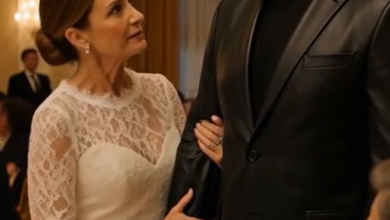
A Biker Rode Down My Wedding Aisle and Took Me From the Altar, but the Person Who Arranged My Daughter’s Future Wasn’t the Man Waiting to Marry Me
My mother didn’t look at Grant.
She looked at me.
That frightened me more than his answer.
Around us, guests were still standing between white chairs. Somewhere behind the arbor, a violinist kept playing the same unfinished phrase.
“Arrangement?” I asked.
Mother reached for my elbow.
I stepped behind my father’s shoulder.
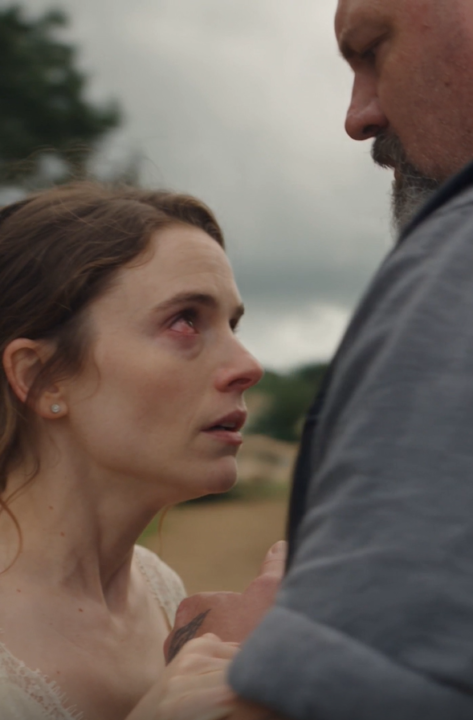
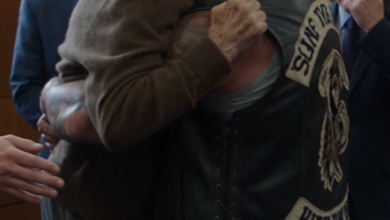
The leather at his back was warm from the sun. A tiny blue bird was stitched crookedly inside his vest, visible where the lining had folded outward.
I knew that bird.
I had sewn it there when I was nine.
“Margaret,” Mother said, “you’re making a scene.”
“Then let me make it.”
My voice sounded borrowed.
Grant took one step toward us, then stopped when Dad raised an open palm.
No fist.
No threat.
“Ask her,” Dad said.
Grant looked at me.
“Do you want to leave?”
“Yes.”
The word came out so quickly that several people turned.
An older woman in the front row sat down and folded the ceremony program. I didn’t know her name. I remembered her afterward because she was the first person who stopped looking at me as though I owed everyone an explanation.
Mother’s mouth tightened.
She was wearing pale green, the color we had spent three Saturdays choosing. She had cried when I tried on my dress.
I remembered those tears.
I hated that I remembered them.
A venue employee moved the chairs nearest the service opening. Dad’s motorcycle stood there with its engine off, angled away from the guests.
It had sounded as though he had charged through the wedding.
He had actually followed the empty gravel service lane into the back of the aisle, stopped short of the occupied rows, and come the rest of the way on foot.
Nobody had expected the groom to be the person asking permission.
Nobody had expected the bride to say yes.
“Where’s Lily?” Dad asked.
My stomach dropped.
My seven-year-old had been with the younger attendants when the ceremony began.
Grant looked toward the house.
Mother answered first.
“Resting.”
“Where?”
“With people who love her.”
Dad turned slightly so I could see his face.
“Who has her, Maggie?”
I couldn’t answer.
An hour earlier, Mother had taken my phone and said I didn’t need distractions. I had surrendered it because resisting every small thing had become exhausting.
Now I couldn’t call the woman watching my child.
A security employee approached.
Grant spoke before Mother could.
“She’s leaving voluntarily. Please keep everyone back.”
For one second, I wondered whether I had misunderstood him completely.
The man I had been afraid to marry was helping me leave.
Then Mother opened her little green handbag.
Inside were my phone, my car keys, and a courthouse envelope.
I stared.
“What is that?”
She pulled the bag closed.
“Something we can discuss when you’ve calmed down.”
Dad asked the employee to call police because a child needed locating and the adults were giving different accounts.
Mother’s face changed.
Not panic.
Calculation.
She moved close enough that only I could hear.
“You remember the motel, don’t you?”
I did.
The damp carpet.
The dead phone.
Thirty-six missing hours after Ben’s funeral.
My hand fell from Dad’s sleeve.
Mother watched it happen.
If part of what she said about me was true, did I still have the right to take my daughter home?
The blue bird in Dad’s vest came from a summer when nobody had started choosing sides.
I was nine.
He had parked his Harley beneath the maple tree and spread the lining across our picnic table while I stabbed at it with a sewing needle.
“Looks like a potato,” I said.
“Fastest potato in Pennsylvania.”
Mother brought lemonade.
For once, she sat with us.
She was filling out a camp form and wrote Margaret Elaine Hart.
Dad looked over.
“June.”
Mother sighed.
“Her grandmother knows who she is.”
“So should the form.”
June was his sister, who had died before I was born.
He pointed to my crooked bird.
“You get your whole name, kid.”
Later, Mother tied the ribbons on my camp bag. Left loop first. Two hard little knots.
Dad pretended he couldn’t undo them.
I laughed until lemonade came out my nose.
For years, I remembered that afternoon as proof we had once been an ordinary family.
The bird stayed inside the vest.
The wrong middle name kept appearing on forms.
I stopped correcting it when correcting Mother became more tiring than explaining myself to strangers.
That memory came back while Dad stood between me and the wedding arbor.
A female officer took me aside when she arrived.
She asked whether I wanted Dad beside me.
“Yes.”
Whether I wanted Grant.
“No.”
Whether I wanted Mother.
“Not right now.”
Each answer made the next one easier.
I explained the hand signal.
At a community workshop the previous year, Dad had shown me a silent way to indicate I needed help. He had asked a second question afterward: did I want someone to get me out?
Yesterday, using my cousin Tess’s phone, I had asked him to come to the venue and stay near the service entrance.
I hadn’t told him why.
I hadn’t yet admitted it to myself.
During the vows, Grant squeezed my hand when the officiant mentioned family.
I looked toward Lily’s empty chair.
Then toward Dad beyond the last row.
Thumb folded.
Fingers closed.
He saw me.
The officer listened without treating the signal as the entire explanation. She asked what had happened before it.
That was harder.
The papers.
The threats.
Mother telling me that if I refused to marry, someone would finally explain to a judge what kind of mother I was.
I told her about the motel.
Not every detail.
Enough.
She wrote it down.
I watched the pen move. Mother had always been the person who explained me to teachers, employers, doctors. Hearing my own account reach the page without her correcting it made me realize how little practice I had speaking uninterrupted.
Then she asked who had arranged Lily’s care.
Tess joined us, still wearing her catering apron beneath a cardigan.
“I thought Elaine had cleared it with Maggie.”
My mother had told the sitter to take Lily to a guest cottage behind the reception house.
The sitter answered Tess’s call immediately.
Lily was eating crackers and watching cartoons.
Safe.
Nearby.
The relief made my knees shake.
Dad put a chair behind me without pushing me into it.
Then the officer asked about the courthouse envelope.
Mother said it contained routine family paperwork.
Grant looked at the ground.
Why was the only person willing to call it routine the one who wouldn’t let me open it?
Grant didn’t try to stop me seeing Lily.
He gave the officer the cottage number and asked the venue manager to unlock the connecting garden gate.
Mother said we were upsetting the child.
Lily came out holding a paper cup of apple juice.
“Did I miss the kissing?”
I crouched despite the dress.
“No, baby.”
She touched my face.
“Why’s your makeup doing that?”
I laughed once.
It hurt.
Dad stood back while I held her. He hadn’t seen her in fourteen months, except in pictures Tess secretly forwarded.
Mother had said his drinking made him unreliable.
He had been sober four years.
I had never checked.
That fact would wait beside everything else I owed him.
For now, I kept one hand on Lily’s back while the officer spoke to Grant.
He retrieved the folder from beside the officiant’s table.
Not a marriage certificate.
A proposed consent to a guardianship arrangement, a draft household agreement, and copies of a petition already filed with the court.
The filing had happened yesterday.
I hadn’t been served yet.
My name appeared in places where I had never written it.
Mother said the wedding had confused the timing.
Grant said, “Elaine, stop.”
It was the first time I heard him use that voice with her.
He told the officer he had believed the arrangement was agreed upon.
Marriage first.
Then a separate request asking the court to approve him as guardian of Lily.
He knew marrying me would not automatically give him that authority.
I hadn’t known how carefully the two things had been packaged together.
Mother had said husband and guardian as though they were one word.
Grant opened his phone.
There were messages apparently from me.
I’m ready.
I want someone else handling Lily’s money.
Please talk to Mom about the details.
I stared at the screen.
Mother knew my passcode.
She also knew how I wrote.
Short sentences. No punctuation when I was tired.
For a moment, Grant looked less like a man arranging a trap than someone discovering he had been standing inside one.
“I asked you twice,” he said.
“At dinner?”
“You nodded.”
Mother had answered every actual question.
He had accepted that.
I thought of all the dinners where he had asked whether I wanted another drink and waited for an answer. Such a simple courtesy. Somehow he had managed it with a glass of water and failed to offer it about my child’s future.
We both remembered.
He didn’t try to make it sound better.
“I should have asked when she wasn’t there.”
Then he slid the folder toward me.
Across the top page was a name that made me go cold.
Margaret Elaine Hart.
Not June.
My father saw it too.
He didn’t speak.
Lily slipped her hand into his.
For a second, the three of us looked like strangers waiting for the same bus.
The officer helped arrange for me to take Lily with Tess. Dad would follow in his truck after a friend brought it from his shop.
We were not riding away in a wedding dress with a child balanced between us.
Real leaving required car seats, bags, and a destination Mother didn’t control.
Grant stood beside the gate.
“I’m sorry,” he said.
I believed he was sorry.
Then his phone lit up with a message about an overdue investment payment.
Why was a man who claimed he only wanted to help my daughter already discussing what her guardianship would be worth?
The lawyer Tess found for me wore flat shoes and kept spare reading glasses in every room.
Nina Alvarez.
She asked me to bring everything, including material that made me look bad.
I nearly didn’t return.
Then I looked at Lily sleeping across Tess’s couch with one sock missing.
I called Nina back.
Ben had died in a road accident three years earlier. Some money from the resulting settlement had been placed under arrangements intended to protect Lily.
It wasn’t a suitcase anyone could collect by marrying me.
There were restrictions.
Records.
People whose approval mattered.
But control over Lily’s affairs could create opportunities to propose expenses, change living arrangements, and ask for payments supposedly benefiting her.
That was where the scheme had room to breathe.
Nina explained it without promising that a judge would agree with every conclusion we drew.
Grant ran a small financial-services business.
Mother had invested money she couldn’t afford to lose in a property project he had recommended.
The project was failing.
She had borrowed against her house to put in more.
Now her house, my dependence on it, and Grant’s overdue obligations were tangled together.
I learned the shape slowly.
Bank letters.
Emails Grant supplied through his attorney.
A draft budget for Lily’s proposed new household.
It included housing payments to Mother and consulting payments to a company connected to Grant.
Some expenses might have been legitimate in another context.
Others appeared inflated.
Several were described as already agreed upon.
I hadn’t seen any of them.
There were messages in which Mother discussed how a marriage would make the proposed arrangement look stable.
The language was ordinary.
School continuity.
Family support.
Long-term planning.
Then, lower down, a sentence about my refusal.
She’ll do it if the alternative is losing the child.
I read that line while Nina put a box of tissues within reach.
I didn’t take one.
“She wrote that?”
Nina nodded.
I thought of Mother pressing a cool cloth to my forehead after Ben died.
Holding Lily while I couldn’t stop shaking.
Driving us home from the cemetery.
There had been kindness.
There had been a bill coming due inside it.
At Tess’s, I began making a list of what I actually owed. Money borrowed. Childcare provided. Promises freely made. Whenever I reached the word obedience, I crossed it out. Then I wrote it again, because crossing it out didn’t yet make me believe it.
Grant’s documents did not make him innocent.
He had seen messages about pressure.
He had continued discussing payments.
His attorney said some remarks had been taken out of context. Nina said the records could be examined in full.
I was learning not to decide everything from the sentence I most wanted to believe.
Dad came to Tess’s that evening with Lily’s booster seat.
He had bought the right size after asking Tess what we used.
“Keep the receipt,” I told him.
“Already did.”
Then he set a brown envelope on the table.
Inside were copies of letters he had sent me after Ben died.
Mother had told me he hadn’t written.
Some envelopes had been returned.
Others had disappeared.
On one returned envelope, my refusal appeared in handwriting that looked almost like mine.
Had my mother only planned a marriage, or had she spent years choosing which people I was allowed to lose?
By Monday, the wedding video had escaped the family.
It began with Dad’s motorcycle entering the back of the aisle.
It ended before anyone heard me say I wanted to leave.
A caption called it a kidnapping.
Another called me drunk.
I was drinking water in every clear frame.
That didn’t help much.
Mother sent relatives an account of the motel incident and said Dad had encouraged me to disappear again.
One aunt called Tess.
“Just bring Lily here until Maggie settles down.”
Tess looked at me before answering.
“No.”
I cried in her laundry room afterward.
Not because I wanted my aunt’s help.
Because she had offered to take my daughter without asking what had happened.
Mother also canceled the phone plan I was still using.
My device worked on Tess’s wireless network, then stopped whenever I stepped outside.
Nina helped me prioritize.
New number.
Copies of documents.
A written account while details were fresh.
A plan for Lily’s school and pickups.
I had imagined escaping a wedding as one large act.
The dress hung from Tess’s shower rail because we had nowhere else for it. Every morning, I moved the hem to wash my face. I stopped seeing a ruined wedding in it and started seeing fabric I needed to put away.
It turned out to be a hundred small ones.
Finding my insurance card.
Buying underwear.
Explaining to a teacher why two adults who used to collect my child should not simply be assumed welcome to do so now.
We followed the school’s procedures and the lawyer’s advice.
Nobody waved a wedding video and solved everything.
Then Mother amended her filing.
The new material described my departure from the ceremony as evidence that I was unstable.
There were photographs from the motel.
A statement about abandoned childcare.
Messages attributed to me.
Nina showed me the pages privately before the next meeting.
I couldn’t breathe properly.
Dad was waiting in reception.
I asked her not to tell him yet.
She said we needed to discuss what information would matter and who was helping me, but she would not turn a painful conversation into a surprise.
That was different from Mother.
So different it almost hurt.
That evening, Grant asked to meet through our attorneys.
He offered additional messages.
He also wanted me to say publicly that he had not forced me.
Nina declined that condition.
If he had relevant records, he could provide them without buying a statement from me.
He did.
Among them was a draft message Mother had prepared in my voice.
Dad showed up drunk. I was afraid to say no.
He had not been drinking.
He had stopped drinking before Lily could read.
I looked through the kitchen doorway at him helping her make toast.
She was explaining why triangles tasted better.
He listened as if this were useful information.
I realized Mother wasn’t only trying to recover control.
She was building an explanation for why I should never be believed again.
Then Nina called.
The motel photographs had dates.
The same weekend appeared in a medical record I had never told anyone about.
What would happen when the truth I was hiding became more damaging than the lie Mother was telling?
I told Dad on Tess’s back steps.
The porch light attracted little moths. He brushed one from his sleeve and waited.
“After Ben died, I didn’t just need sleep.”
He didn’t move.
“I took pills that weren’t prescribed to me.”
His jaw tightened.
I kept going before his silence could become permission to stop.
There had been a woman from a grief group. A few tablets. One night that became another.
Then a weekend.
I left Lily with Mother and said I had a job-training trip.
There was no trip.
I checked into the motel because I wanted to stop being someone’s mother for a few hours.
Thirty-six hours passed.
When I came back, Mother took me to a clinic.
She paid.
She kept Lily while I attended treatment.
She had done those things.
I would not erase them because of what came afterward.
Dad looked at his boots.
“Are you using now?”
“No.”
“How long?”
“Two years. I can document it.”
He nodded.
A moth landed on the porch bulb and stayed there. From inside, we could hear Lily asking Tess whether toast counted as dinner. Ordinary sounds. I held on to them while waiting to find out whether my father would stand up and leave.
Then he asked why I hadn’t called him.
The question hurt because the answer was ugly.
“Because she said you’d tell everyone I was just like you.”
He flinched.
I had wanted him to.
Some part of me was still a child, throwing the pain back toward whoever could catch it.
But there was more.
Mother had asked me to sign a statement describing Dad as unsafe around Lily.
I signed it.
I knew I hadn’t actually seen him intoxicated in years.
I signed because I wanted treatment kept private, and she said the statement was necessary to keep things quiet.
“I’m sorry.”
He rubbed the old scar behind his ear.
I remembered the kettle.
His arm under mine at the sink.
His voice telling me not to touch the metal.
For a long time, he looked out into Tess’s yard.
Then he said, “I did leave you with a lot to believe.”
His drinking had been real.
So had his recovery.
We had both accepted the part of the story that required less courage.
Nina helped me obtain the records and give a complete account through the proper channels.
I did not publish them to defend myself online.
Lily did not need her mother’s worst weekend becoming entertainment.
The clinic records supported treatment followed by continuing recovery.
The motel pictures were old.
Mother’s new statement described them as recent.
That was not a small difference.
Grant supplied an earlier version of the same attachment, with dates visible. His messages showed Mother discussing whether the older material would still “carry weight.”
The case now contained a frightened mother who had once needed help and a grandmother using that true history to describe a different present.
It was harder to explain than a story in which I had never failed.
It was also the only story I could tell under oath.
The night before the hearing, Dad asked whether I still wanted him beside me.
“Yes.”
He nodded.
Then he left me the choice of when to hug him.
Could I ask a court to believe in my recovery after refusing for so long to believe in his?
The hearing was open, but it did not feel like a performance.
No wedding guests.
No aisle.
A few relatives sat behind Mother. Tess sat behind me.
Before we went in, she handed me a packet of crackers. I hadn’t eaten breakfast. Mother used to tell me nerves would settle once I stopped being dramatic; Tess simply noticed I was hungry and gave me something to eat.
Dad wore a plain shirt beneath his vest.
He had offered to leave the vest in his truck.
I asked him not to.
Nina began with the immediate question: whether the evidence supported the emergency restrictions Mother was requesting.
There would be no shortcut from a dramatic wedding video to a decision about Lily’s life.
The judge asked about service, existing arrangements, and the documents being relied upon.
Mother described me as overwhelmed.
Some of that was true.
She described helping after Ben’s death.
That was true too.
Then Nina asked about the dates on the motel photographs.
Mother said she couldn’t remember every date.
The original attachment was shown.
So was the later version.
The descriptions had changed.
The pictures had not.
Grant testified about the proposed marriage and the separate guardianship plan. He admitted he had expected a paid role in the household’s financial arrangements.
His attorney had advised him to answer the questions.
For once, he did.
He acknowledged receiving messages about pressure.
He also acknowledged accepting my mother’s assurances instead of speaking to me alone.
I watched him turn his ring between two fingers.
He had never put it on.
Then came the consent document.
Margaret Elaine Hart.
Nina asked Mother who had prepared it.
“A family planning service.”
Who had supplied the information?
“I helped.”
Had I reviewed the version presented to Grant?
Mother said she believed so.
Nina asked why my middle name was wrong.
“She uses both.”
“I don’t,” I said.
My voice was quiet enough that the judge asked me to repeat it.
“June. My middle name is June.”
Mother looked toward Dad.
There it was.
The same look from the picnic table.
The same irritation at a name she couldn’t quite erase.
Nina placed an email beside the form. Mother had attached the draft herself.
Then she asked whether Mother had instructed anyone to obtain my signature separately on its final page.
“It wasn’t meant to frighten her,” Mother said.
“That wasn’t my question.”
Mother’s hands closed around a tissue.
“She would never agree if she saw everything at once.”
Nobody moved.
The judge asked her to clarify.
Mother looked at me.
“I kept your child safe when you couldn’t even answer a phone.”
I nodded.
“You did.”
“I paid for everything.”
“You helped.”
“And he was going to give you a home.”
“I already had a home. You made staying there conditional.”
Her face crumpled.
For a second, I saw grief rather than strategy.
Then she said, “I couldn’t lose the house because you decided to be difficult.”
The room went very still.
Not because that sentence proved every disputed fact.
Because it placed her house beside my child in a way she could no longer hide behind concern.
The judge asked counsel to address the financial records.
Mother stared at the table.
I looked at the woman who had taught me to tie ribbons.
When had keeping us close become something she believed entitled her to own us?
The court did not hand me a perfect ending.
It declined the emergency restrictions Mother had requested on the record presented and set out what further proceedings would require.
My recovery history was considered.
So was the current evidence.
So were the inconsistencies in her filings.
There were questions about the altered documents that did not disappear when the hearing ended.
Those went forward through people whose work was to examine them.
Grant did not become Lily’s guardian.
There was no wedding to undo because we had stopped before the marriage was completed.
The financial arrangements he expected never began.
His business problems remained his business problems.
Mother’s house was eventually sold.
Not the next day.
Not as punishment ordered for hurting me.
The debts had existed before I stood beneath the arbor. The wedding had been her imagined way out.
When that way closed, the debts stayed.
I did not attend the sale.
Tess brought me a box of things from my old room.
Camp ribbons.
School photographs.
A certificate with my middle name written correctly.
I put that one on the counter and cried while the kettle boiled.
Dad repaired a small rental house for another customer and told me when it became available.
He did not sign the lease for me.
He came when I asked him to check the windows.
I paid the deposit from my own earnings and the assistance I was entitled to receive. Nina helped keep Lily’s protected money separate from the bills I was responsible for.
It was less convenient than letting someone else handle everything.
That was part of its value.
Lily wanted her bedroom yellow.
Not pale yellow.
“Toast yellow,” she said.
Dad brought paint samples.
She rejected all of them.
He came back with more.
On the second evening, she asked whether the wedding was her fault because she had wanted a new dad.
I sat on the floor beside her mattress.
“No.”
“Because I like Grandpa?”
“No, baby.”
“Because I went to the cottage?”
I put the roller down.
“Nothing you did made the adults do those things.”
She watched my face.
I let her take her time.
My mother wrote twice.
The first letter explained.
The second apologized for parts she could name.
I kept both.
I did not leave them where Lily could find them. She was allowed to remember a grandmother who made good pancakes without being handed the job of deciding which adults were telling the truth. That work belonged to us.
I answered only after discussing what contact would be safe and manageable, and I did not ask Lily to carry messages.
Dad and I went slowly too.
Sometimes he didn’t answer a question because he was afraid of upsetting me.
I told him silence was no longer the kind thing.
Sometimes I apologized until he had to ask me to stop.
We were learning.
One Saturday, I found the blue bird in his vest coming loose.
The old thread had frayed beneath one wing.
I sat at our kitchen table and repaired it while Lily watched.
“Still looks like a potato,” I said.
Dad smiled.
“Fastest one in Pennsylvania.”
Lily rested her chin on the table.
“Can I make one?”
I gave her a square of blue cloth.
Outside, the motorcycle waited in the driveway.
Inside, nobody was counting down.
Dad held out the lining, steady beneath our hands.
“Where do you want yours?”