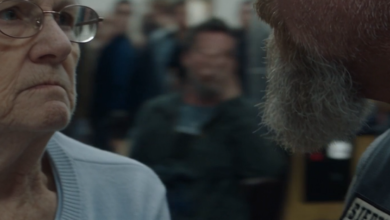
A Biker Carried His Father Out of a Courtroom, but the Doctor Calling Him Incompetent Had a Secret Connection to the Son Waiting to Sell His Home
The doctor looked at my son, then at the judge.
“I disclosed a social acquaintance.”
Not denied.
Disclosed.
That should have made me feel vindicated. Instead, I wondered whether I had forgotten another conversation everyone else remembered.
Judge Elaine Porter asked my attorney to identify the disclosure in the report. Mrs. Shah turned pages while the air conditioner clicked above us.
My hearing aid whistled.
I reached for it, missed, and knocked my water cup sideways.
Daniel caught it.
My older son. Navy suit. Clean fingernails. The person asking the court to put my money and decisions under his control.
“Dad, let me.”
For a terrible second, I wanted to.
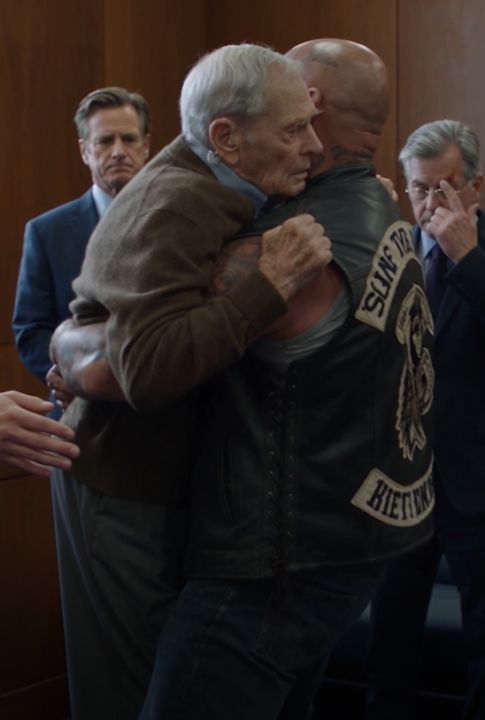
My right knee folded when I tried to stand. Luke caught me beneath the arms before the bailiff reached us.
“Don’t lift him,” Daniel said.
“Then bring a chair.”
It came out rough. Everything Luke said sounded rough beside Daniel.
The judge called a recess and told us to remain available. Mrs. Shah asked whether I wanted medical assistance.
“No ambulance. My knee does this.”
The bailiff cleared the short route to the hallway bench. Luke crouched in front of me.
“Arms around my shoulders.”
People stared as he carried me out. My shoes bumped his thighs. A man who looked capable of breaking a door stopped twice to ask whether his grip hurt.
That was what they remembered afterward.
The tattoos.
The boots.
Not the permission.
Not the knee.
On the bench, Luke lowered me as carefully as he used to lower engines onto blocks.
“Breathe, Dad.”
I could smell rain in his leather vest.
Daniel followed us, holding my coat.
He looked genuinely frightened.
That made everything harder.
“If he leaves, we lose the buyer,” he said.
Mrs. Shah turned.
“What buyer?”
Daniel closed his mouth.
“The property needs maintenance. There have been inquiries.”
“Which property?”
He handed me my coat instead of answering.
My house stood on eleven acres outside Marion, Ohio. Behind it were the remains of the machine shop my wife and I had built. Daniel called the land underused.
I called it home.
Daniel had paid the property taxes for me the previous autumn, using money from my account. I had thanked him with a pie. Now I couldn’t remember whether I had ever asked to see the receipt.
Mrs. Shah asked him to speak through his attorney.
Then she sat beside me.
“Mr. Bell, I need to ask you something without either son answering.”
They moved away.
“What day is it?”
I knew.
I could see the date on the notice folded in my pocket.
But the question had become a trap in my head. Wednesday sounded wrong. Thursday sounded like surrender.
“I don’t know,” I said.
She waited.
The hallway clock ticked.
“It’s Wednesday. I do know. I just…”
“I understand.”
“No, you don’t.”
My hands started shaking. Not dramatically. Enough to make the paper rustle.
I was eighty-one. Some mornings I forgot whether I had taken a pill. Once, I left a pan heating until the smoke alarm sounded.
Those things were real.
So was the golf trophy Luke had recognized in Dr. Voss’s photograph.
Mrs. Shah held out her hand for the court notice.
“We can investigate both,” she said.
Across the hallway, Daniel and the doctor stood with their heads close together.
Why did being right about them still leave me so afraid I was wrong about myself?
Before Margaret died, our family could still fit around the picnic table without choosing sides.
That was three summers earlier.
Daniel brought Dr. Voss to my birthday cookout. They arrived in the same golf cart from the neighboring course, arguing cheerfully about a ball lost near the ninth green.
Margaret put a bowl of potato salad between them.
“Eat before you start lying.”
Voss laughed.
He had a pale scar through his left eyebrow. Daniel called him “Doc,” and Voss called Daniel his regular Saturday partner.
Luke arrived late from the shop.
His knuckles were scraped. Margaret kissed the clean side of his face.
Then my hearing aid battery died.
She fetched the red tobacco tin where I kept spare batteries. Before replacing one, she touched my right shoulder.
“Best side, Walter.”
My left ear had been nearly useless since a press failed at the factory.
Margaret moved Dr. Voss’s chair to my right.
“Otherwise he’ll smile and agree to absolutely anything.”
Everyone laughed.
Including the doctor.
That afternoon, Luke repaired the picnic table with screws from his saddlebag. Daniel promised to organize my insurance papers.
Both sons were useful.
I thought that meant both were safe.
The memory ended when Luke set a paper cup of coffee on the hallway bench.
“You okay?”
“No.”
“Good. Honest answer.”
He sat beside me, knees apart, hands hanging between them.
I asked how he remembered Voss.
“Eyebrow. Golf story. He spilled mustard on Mom’s tablecloth.”
I remembered that too.
What frightened me was how much clearer mustard looked than the morning’s questions.
Mrs. Shah returned from speaking with the clerk. The hearing would continue long enough to set temporary arrangements, then resume after an independent evaluation and further records.
No one was handing Daniel permanent control that day.
I loosened my grip on the coffee.
Then she asked about the assessment at my house.
Who had been there?
A woman with a laptop. Daniel. Me.
The woman wore a clinic badge and spoke from the dining-room doorway while Daniel searched for my medication bottles.
Had Dr. Voss attended?
I tried to find his face in the room.
Nothing.
Perhaps he had come another day.
Perhaps I had been asleep.
“Dad,” Luke said softly, “don’t fill the hole just because somebody wants an answer.”
Mrs. Shah wrote that down differently.
Unable to confirm physician’s presence.
I hated seeing my uncertainty become a sentence.
On the next bench, a woman sorted parking coins into her husband’s palm. Such an ordinary kindness. I watched them longer than I should have, wondering when help in my family had begun to require an audience.
Daniel returned carrying the red tin.
“Found this in the car.”
My hearing aid had stopped working the morning before. He had said he couldn’t find the batteries.
Now he set them beside me.
The lid still held Margaret’s faded address sticker.
I replaced the battery with Luke steadying the tin.
The hallway changed.
Shoe soles. Elevator bell. Someone coughing behind a door.
I had forgotten how much sound I was missing.
Mrs. Shah watched my face.
“Was your hearing aid working during the assessment?”
“No.”
Daniel opened his mouth.
I turned toward him.
“You knew that.”
He looked at the tin instead of me.
How much of my supposed confusion had happened in a room I could barely hear?
Dr. Voss answered that question with paperwork.
His attorney supplied a disclosure stating that he knew Daniel socially. There was also a clinic policy describing assessments performed by trained staff and reviewed by a supervising physician.
At first glance, it explained almost everything.
The woman with the laptop had conducted the home visit.
Voss had reviewed her findings.
A social connection did not, by itself, mean the findings were invented.
Mrs. Shah explained this in her office with the window open because the heating system had stuck on.
Luke stood near the filing cabinet.
“So it’s fine?”
“I didn’t say that.”
“You’re making it sound fine.”
“I’m separating what we dislike from what we can establish.”
He shut his mouth.
I admired her for saying it. I resented her for making it necessary.
The preliminary report described missed medication, an unattended stove, and difficulty answering questions. Daniel had supplied photographs.
There was my scorched pan.
There were pill bottles beside the toaster.
There was a utility shutoff warning.
I remembered the warning.
I had put it under a catalog because I didn’t want to call Daniel again.
“You told me you paid that,” Luke said.
“I thought I had.”
His face changed.
Not accusation.
Recognition.
My son was realizing that some of the petition was true.
I looked away first.
Then Mrs. Shah opened the attachment identifying the home visitor.
Catherine Bell.
My granddaughter.
Daniel’s daughter, twenty-seven, working as a clinical assistant while applying to graduate school.
I had known she worked at the clinic. I hadn’t known her notes were part of the evaluation.
“She said she was checking how I was doing.”
Luke looked at the wall.
He had driven Catherine to school for two years while Daniel traveled for work.
“Cat wouldn’t do that.”
I wanted to believe him.
That evening, Catherine came to my house wearing hospital scrubs and holding a grocery bag she never unpacked.
“I should’ve explained,” she said.
“Did you decide I couldn’t handle my money?”
“No.”
“Then why does the report say you did?”
She put the bag down.
“I’m not qualified to decide that.”
Her hands shook when she opened her phone.
She had written observations for Voss to review. Her original notes described hearing difficulty, grief, and the need for a formal assessment with functioning hearing equipment.
The report in court used stronger language.
Unable to understand.
Unable to retain.
Unable to manage.
Catherine showed us an email requesting clarification after she saw the final version.
It had gone unanswered.
“Why didn’t you tell us?” Luke asked.
“Dad said the lawyers were handling it.”
She began crying then, quietly and angrily.
“I thought I was helping Grandpa stay home.”
Her original file carried a time stamp from the home visit. Mrs. Shah asked her to preserve it and speak through her own counsel if she needed advice about her role.
We did not photograph it and declare victory.
We waited.
The waiting was harder for Catherine than either of us understood. She still worked beneath people whose decisions she was questioning. Each morning she checked her email before getting out of bed, afraid of what might be waiting there.
At the door, Catherine caught my sleeve.
“There’s another thing.”
She looked toward Daniel’s driveway across the field.
“He asked me whether your house was worth more empty.”
What kind of help began by calculating the value of my absence?
The first document that frightened Daniel was not a medical record.
It was a purchase proposal.
Mrs. Shah obtained it after asking questions about the buyer he had mentioned in the hallway. The proposal concerned my house, the shop parcel, and the narrow strip reaching the county road.
A developer wanted the road access.
Without it, the larger neighboring property was harder to use.
I read the offer three times.
Not because I couldn’t understand.
Because the price made my mouth dry.
“That’s more money than Margaret and I ever saw together.”
Luke stared through the office window.
“That’s why.”
Daniel had signed a preliminary acknowledgment as the proposed seller’s representative.
Not a completed sale.
Not authority he already possessed.
An arrangement that depended on authority he was asking the court to give him, and on whatever further approval a sale required.
His attorney stressed those distinctions.
Mrs. Shah agreed they mattered.
Then she asked why nobody had shown me the proposal.
Daniel said discussions were preliminary.
I asked him directly the following afternoon.
We sat at my kitchen table, where he had once practiced multiplication using dried beans.
Before he sat, he moved the stack of mail away from his sleeve. I noticed an envelope addressed to me had already been opened. Nothing important inside, just insurance advertising. Still, I folded it shut.
“You could have asked.”
“I have asked, Dad.”
“You asked whether the roof leaked.”
“I asked whether you could keep living here.”
“That isn’t the same question.”
His eyes moved toward the hallway, where Margaret’s coat still hung.
For a moment, his face softened.
Then he said, “You won’t even clean out her closet.”
That landed.
He knew it would.
A few days later, additional records explained why the buyer could not wait.
Daniel’s contracting company had debt coming due. His interest in a nearby development had become expensive to carry. The proposed land sale would solve problems he had not mentioned in his petition.
There were emails.
No villain’s confession.
Schedules. Financing deadlines. A request to “get the family side settled.”
Then a message to Voss about whether the report would be ready before the next hearing.
The doctor replied that it would.
Their golf correspondence ran through the same thread.
Saturday tee times.
Dinner afterward.
Years of familiarity reduced in court to a social acquaintance.
I touched the edge of the printed page.
The doctor had sat beside Margaret’s potato salad.
He knew which side I could hear from.
Yet his report adopted failures from an interview conducted without a working hearing aid, and made broad conclusions Catherine’s notes had not supported.
Mrs. Shah would challenge it.
An independent clinician would examine me.
Nobody promised an outcome.
That evening, Daniel came over without knocking.
He saw the papers.
“Luke’s turning you against me.”
I looked toward my younger son, who was replacing a bulb above the sink.
Luke stepped down from the chair.
“Tell him about the loan.”
Daniel didn’t answer.
“What loan?” I asked.
The kitchen clock clicked loudly in the space between us.
Then Daniel looked at Luke with something harder than embarrassment.
“You really want Dad’s old records opened?”
Luke went pale.
For the first time since court, he put down his tools without finishing the job.
What was in my old records that could frighten the son who had come to save me?
Daniel did not threaten me again in words.
He became efficient.
My online account stopped opening because the password had changed. The grocery delivery I had canceled arrived anyway. The clinic told Luke he was not listed as someone they could discuss my appointments with.
Some of those arrangements had existed for months.
That was what made them hard to challenge.
Daniel had helped me set them up.
Now every convenience had a locked door inside it.
Mrs. Shah contacted the people she needed to contact. She explained the temporary court arrangements again, in writing, and helped me work through access to my own records.
It took time.
Meanwhile, Daniel circulated an old newspaper clipping.
He didn’t post it publicly himself.
He sent it to relatives with a message about why he was worried.
Luke Bell sentenced in business check case.
Twenty-two years old.
The photograph showed my younger son without his beard, eyes narrowed against a courthouse flash.
He had gone to prison.
I had not visited.
When a cousin called to ask whether I understood who was influencing me, Luke was standing at my stove making oatmeal.
He heard enough.
Afterward, he scraped both bowls into the trash.
“Luke.”
“Not hungry.”
I hadn’t asked whether he was hungry.
Neither of us mentioned that.
Two days later, Daniel requested stricter limits on Luke’s involvement, citing the conviction and what he called the courtroom removal.
The statement made the piggyback ride sound like an abduction.
Our attorney obtained the hearing recording and identified the recess, the conversation, and the bailiff helping clear the way.
Even so, I lost a night wondering whether the judge would see tattoos before she heard words.
Luke stayed away while the request was pending.
He said it would make things simpler.
The house became enormous.
I started leaving the radio on in rooms I wasn’t using. At lunchtime, I set out two spoons before remembering there was no reason to. I washed the extra one anyway, ashamed of needing company that badly.
I could hear the refrigerator from my bedroom.
Catherine came after work, but she would not discuss her father. She checked the stove, filled the pill organizer according to the current instructions, and left sandwiches in clear containers.
I thanked her too much.
She finally said, “Grandpa, you don’t have to earn lunch.”
That nearly undid me.
One evening, a medication refill did not arrive as expected.
I called the pharmacy myself. We found that messages had gone to Daniel’s old contact number. The pharmacist helped correct it, and Catherine collected the refill.
It could have been an old administrative mistake.
It also showed how completely I depended on arrangements somebody else controlled.
I told Mrs. Shah.
“I need help,” I said. “Just not help that disappears when I disagree.”
She asked me to write that down.
Luke called that night.
He didn’t ask about the hearing.
“Cat says you’ve got enough groceries.”
“Yes.”
“Heat working?”
“Yes.”
A pause.
Then I said his name.
He waited.
“The check case. There’s something I need to tell you.”
His breathing changed.
In the background, a motorcycle engine shut off.
“Dad,” he said, “if you’re about to say you did your best, don’t.”
What apology could I offer when my best had been the excuse that let me abandon him?
Luke came the following morning.
He kept his jacket on.
There was a pale square on the wall where his graduation photograph had hung. Margaret had taken it down after the sentencing, not from shame, but because looking at it hurt. We never found another place for it.
I placed the old shop ledger between us. The cover smelled of damp cardboard from years in the basement.
He looked at it without touching it.
“I did sign those checks,” he said.
“I know.”
“I took the money. Don’t rewrite that part.”
Eighteen thousand dollars.
He had been twenty-two, drinking too much, trying to keep a failing repair business alive. He used checks from my shop without permission.
When I discovered it, I called the police.
That was the version everyone knew.
There was another shortage in the books that year.
Ninety-six thousand dollars routed through invoices connected to Daniel’s first contracting venture.
I had found it before Luke’s theft.
I had let Daniel repay part of it quietly.
Then I helped him describe the rest as disputed business expenses while I gave investigators Luke’s checks.
Luke stared at the ledger.
A truck passed outside.
The windows rattled.
“You knew?”
“Yes.”
“All these years?”
“Yes.”
I had told myself Daniel had a wife, a baby, employees.
Luke had a motorcycle and trouble.
I had made one son’s future something to protect, and the other’s something to teach a lesson with.
The words sounded uglier spoken aloud.
They should have.
“I thought prison would stop you,” I said.
“It stopped a lot.”
He looked toward the hallway.
“Mom knew?”
“Not about Daniel.”
He rubbed both hands over his face.
For a long time, he said nothing.
I did not reach for him.
That would have asked him to comfort me.
Finally, he stood.
“You let me think I was the only one who hurt this family.”
I nodded.
He picked up the ledger.
“Your lawyer needs this.”
The truth complicated everything.
Daniel’s attorney argued that my account of old events was unreliable and that Luke now had a financial reason to resent his brother.
Mrs. Shah did not tell me to become more sympathetic.
She asked for records.
Bank statements I had saved. Letters from the accountant. Partial repayments recorded in Daniel’s name.
An independent evaluator spent time with me over more than one appointment. My hearing aid worked. Questions were repeated when necessary without answers being supplied.
The findings were not a certificate of perfect health.
I had memory difficulties.
I needed a safer medication routine and help reviewing financial documents.
But those findings did not support taking every decision away from me.
I read the report slowly.
Then I read the paragraph about assistance again.
There was relief in it.
And grief.
I wasn’t imagining every weakness.
I wasn’t the helpless man Daniel had described either.
Before the resumed hearing, Luke returned my ledger.
“I’ll drive you,” he said.
“You don’t have to.”
“I know.”
He put my red battery tin beside the court folder.
Then he placed the faded clipping about his conviction on top.
“Both,” he said. “They get both.”
Could I finally tell the truth about one son without sacrificing the other?
At the resumed hearing, nobody carried me.
Luke walked on my right.
Catherine walked on my left, holding a spare hearing aid battery in her palm like something fragile and alive.
Daniel sat beside his attorney.
Dr. Voss waited behind them.
I felt the old urge to make everything easier.
Smile.
Apologize.
Say perhaps there had been a misunderstanding.
Then Mrs. Shah opened Catherine’s original notes.
The differences appeared one sentence at a time.
Recommended further evaluation became evidence of lasting inability.
Difficulty hearing questions became inability to understand them.
A family report about unpaid bills became a broad conclusion about managing property.
Voss described clinical judgment.
Mrs. Shah asked what direct examination supported that judgment.
He referred to his review.
She asked about his relationship with Daniel.
Occasional golf, he said.
The correspondence showed regular Saturday games and a weekend trip.
His attorney objected to the implication.
The judge allowed questions about the relationship and the report’s preparation.
Nobody shouted.
That made each answer easier to hear.
Behind us, someone unwrapped a cough drop with painful slowness. I fixed my eyes on the witness chair and let the tiny crackling sound finish. For once, nobody was rushing to supply the answer before I heard the question.
Mrs. Shah asked whether he had known about my hearing loss before reviewing Catherine’s visit.
“Not in any clinically significant detail.”
She asked whether he had ever socialized at my home.
“Once or twice.”
“Did you see me using a hearing aid?”
My question escaped before I remembered not to speak.
The judge looked at me.
Mrs. Shah touched the table.
I stopped.
Voss looked irritated.
“Mr. Bell was perfectly able to converse at that barbecue after his wife moved my chair to his right.”
Silence.
I could see Margaret’s hand on my shoulder.
Best side, Walter.
Mrs. Shah waited a beat.
“So you remembered that accommodation?”
Voss straightened his papers.
“In a social setting.”
“And when you reviewed an assessment noting that his hearing aid was not functioning?”
He began an answer about multiple sources.
She asked him to identify where the final report accounted for that limitation.
He turned pages.
Kept turning.
That was the moment.
Not a confession.
A missing explanation that everyone could see him looking for.
Catherine testified about her notes and the unanswered correction email.
Then financial records established Daniel’s interest in the proposed sale.
The judge asked whether an independent representative could have evaluated any property transaction without giving Daniel control over me.
His attorney answered carefully.
Daniel’s jaw moved.
When my turn came, I admitted the pan, the bill, and the pills.
Then I admitted what I had done to Luke.
Daniel stared at the table.
I did not ask the judge to decide which son was better.
I asked her to consider what help I actually needed, who stood to profit, and whether those were being treated as the same question.
The court took the matter under advisement and continued limited protections around significant transactions.
There was no instant ruling to carry home like a trophy.
Outside, Daniel caught up with us.
“Dad, I was trying to stop you losing everything.”
I looked at the son whose shortages I had once hidden.
“What were you afraid I’d lose,” I asked him, “and what were you afraid you’d have to give back?”
The final order arrived on a Tuesday.
Mrs. Shah asked me to come to her office so we could read it together.
Luke drove.
He waited while I finished tying my shoes instead of doing it for me.
That small thing mattered.
The court denied the broad authority Daniel had requested. Arrangements were made for independent help with the areas where the evidence showed I needed support.
The land would not pass into my son’s hands because he had called my grief an emergency.
Any future sale would be my decision within the protections the court had ordered.
I did not understand every sentence the first time.
Mrs. Shah explained.
I asked again.
Nobody marked that against me.
The judge’s findings addressed the weaknesses in Voss’s report and the conflict surrounding its preparation. Copies went where they needed to go for further review.
I learned later that the clinic suspended his assessment work while complaints were examined.
That process continued after our case.
I did not invent an ending for it just because I wanted one.
Daniel lost the authority he had expected.
He also lost the chance to use my land to solve his company’s problems.
Creditors did not wait because our family was hurting.
There were sales.
An office closed.
A truck disappeared from his driveway.
I watched from my kitchen window and felt anger, then sorrow, then anger again.
None of those feelings canceled the others.
We communicated through people who could keep the conversations clear.
For a while, that was the only way.
Luke did not move in.
I had imagined he might.
A foolish little reward I had planned for myself after telling the truth.
He kept his apartment and his shop.
He came Wednesdays to review bills with me and sometimes stayed for dinner.
Other weeks, he left early.
I learned not to punish him with disappointment.
Catherine helped arrange a practical routine with a nurse and the people involved in my support plan. Pills went into an organizer. The stove got a timer. Important paperwork went into one cabinet instead of six drawers.
The cabinet key stayed with me.
When a statement arrived that I couldn’t follow, I put a pencil mark beside the confusing line. Wednesday became a list of questions instead of a pile of unopened envelopes. Sometimes Luke needed to make a phone call too.
I put the red tobacco tin beside the kettle.
Inside were batteries.
Nothing hidden underneath.
One afternoon, Luke found me trying to repair the loose hinge on the porch gate.
He watched for a moment.
Then he held out his hand.
“Want help?”
I almost said I could manage.
I almost handed him the entire job.
Instead, I gave him the screwdriver and held the hinge steady.
We finished before rain.
At dinner, he asked about Margaret’s coat.
I told him I wasn’t ready.
He nodded.
No diagnosis.
No deadline.
Later, he brought out the old picnic table. One leg still held the screw he had fitted on my birthday.
He tightened it while I wiped leaves from the boards.
We sat on opposite sides with coffee.
I put my hearing aid in.
Luke noticed.
For the first time in years, neither of us needed to raise his voice.
When he stood to leave, he touched my right shoulder.
Exactly where Margaret used to.
Then he nodded toward the chair beside mine.
“Save me this side?”