A Biker Knocked the Champagne From My Hand at My Wedding, but My Husband Was Waiting Upstairs for Something Far More Valuable Than the Vows We Had Just Exchanged
Adrian’s hand stayed on the microphone.
For a second, I thought he hadn’t heard his brother.
Then he lowered it.
“The papers aren’t what you think.”
Champagne soaked the hem of my dress. Cal stood beside the table with his hands open while two guests told him to get away from me.
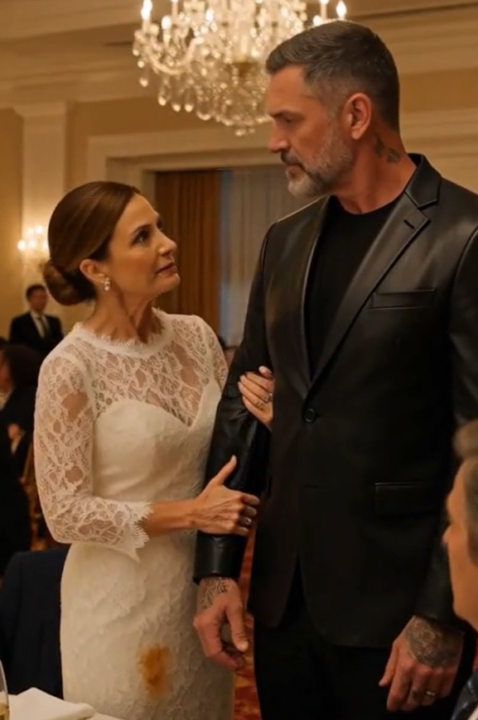
My brother didn’t move closer.
He didn’t defend himself.
“Did you drink any?” he asked.
“No.”
“Certain?”
“Yes.”
I looked at the glass lying in the folded table linen.
The stem had snapped.
A server reached for it.
“Please leave that,” Cal said. “Call your manager.”
Adrian put his arm around my shoulders.
I stepped out from under it.
The chair behind me scraped the floor. A woman I barely knew caught my bouquet before it fell into the spill and held it awkwardly against her purse. I remember wanting to thank her. Even then, with Cal asking about the drink and Adrian touching my shoulders, some trained part of me was still worried about making other people uncomfortable.
People noticed that more than they had noticed the glass.
Only a few hours earlier, we had signed the marriage license.
I had smiled beside him.
There were photographs.
My son had straightened Adrian’s tie.
Now Evan, the best man, was staring at his own hands as though they belonged to someone else.
“He saw it wrong,” Adrian said.
Cal looked at Evan.
“Then tell her what you put in.”
A little murmur moved through the room.
Someone laughed, waiting for a joke to rescue us.
Evan said nothing.
The manager arrived with our wedding coordinator, Marisol. She asked whether I needed medical assistance and whether anyone should call police.
“Yes,” I said.
I hadn’t planned the answer.
It came from somewhere beneath all the manners my father had taught me.
Marisol moved us away from the table. Staff kept guests clear of the broken glass and stopped clearing that section.
Cal stayed where the manager asked him to stay.
Adrian kept saying my name.
Not loudly.
The voice he used when a restaurant had lost our reservation.
“Rachel. Let’s not turn this into something.”
My son Noah appeared beside the cake table.
Sixteen.
Too tall for the suit we had bought in August.
“Mom?”
I went to him.
Behind his ear was a fold in his hair that never stayed flat.
Cal saw it too.
His face changed before he looked away.
I put my hand on Noah’s shoulder.
“Stay with Marisol a minute.”
“No. What’s happening?”
“I don’t know yet.”
That was the first honest thing I had told him all evening.
The manager asked who had arranged the upstairs appointment.
“What appointment?”
Adrian spoke quickly.
“Household paperwork. Insurance. Nothing urgent.”
Marisol checked her schedule.
“Ten forty-five. Library. Private signing.”
I stared at her.
She looked back, realizing I hadn’t known.
Then I remembered the message Adrian had shown me the night before.
It had come from my own email address.
Everything approved. No changes needed.
I had sent something like that about the seating chart.
Had I approved something else while I was tired, or was my husband counting on me being too embarrassed to ask?
Before my father died, Room Eight wasn’t a room number.
It was a joke.
Cedar Lantern Lodge had seven rentable rooms and one crooked apartment above the kitchen, where Noah and I lived.
Dad called ours Eight because he hated leaving anything uncounted.
One autumn afternoon, Adrian joined us while we repaired the porch railing.
Cal was underneath it, passing screws up through the boards.
Noah sat beside Dad with a blue carpenter’s pencil.
“What’s this one worth?” Adrian asked, pointing toward our apartment window.
“Not for sale,” Dad said.
He drew a rough boundary on the property sketch.
KEEP EIGHT.
Noah added a crooked circle around it.
Dad handed me the pencil.
“Read every page before you celebrate.”
Cal knocked twice beneath our feet.
“Especially the little words.”
We all laughed.
At dinner, Adrian picked splinters from his thumb while Dad poured coffee into the chipped blue mug he’d used for thirty years.
Cal didn’t come inside.
I told Adrian my brother preferred his own company.
That wasn’t entirely true.
It was just easier than explaining the distance I had helped maintain.
The pencil stayed in Dad’s kitchen drawer after he died.
A paramedic asked me what I had consumed.
I described dinner, water, and half a glass of wine much earlier.
Not the champagne.
She asked whether I felt unwell.
“Just scared.”
She didn’t call that nothing.
An officer spoke to me away from Adrian and Cal. Another spoke with the manager.
I told them what I had seen.
Cal striking the glass.
Evan beside the tray.
My own husband looking toward the stairs.
I had not seen anything put into the drink.
I said that clearly.
Cal gave his account separately.
He had been standing near the service door because he didn’t want to block photographs.
He saw Evan handle my glass while Adrian watched the room.
He couldn’t identify the substance.
He wasn’t pretending he could.
Then he saw the glass brought directly to me.
That was why he moved.
Not because of a taste.
Not because of a smell nobody else could detect.
Because of what he had witnessed.
I watched him speak to the officer.
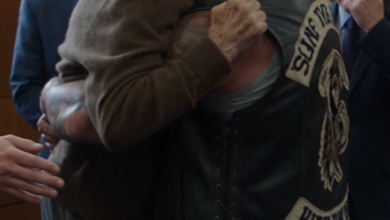
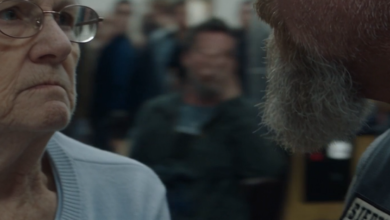
His leather vest creaked when he shifted. He wore a clean black shirt beneath it because Noah had asked him to dress up.
I had nearly told Noah not to invite him.
Cal had arrived in his truck with the motorcycle on a small trailer because rain was forecast and he needed to bring tools. The lodge’s back gate wouldn’t latch. He fixed it before changing his shirt. Half the people now calling him disruptive had walked through that gate without noticing why it closed properly behind them.
The thought made me feel sick.
Marisol brought my phone from the bridal suite.
There were messages from the upstairs signing service.
Notary confirmed.
Bring photo identification.
Adrian saw the screen.
“Routine,” he said.
I moved the phone away.
His smile vanished for half a second.
Then Evan’s wife arrived holding a small packet of decorative sugar used by the caterer.
She said Evan had only been helping with the toast.
For the first time, Cal’s certainty had something ordinary standing against it.
What if my brother had broken my wedding over something harmless?
The packet was labeled for food.
The caterer recognized it.
Several drinks had been decorated earlier for photographs.
Evan’s wife, Melissa, explained this while clutching the packet so tightly the paper wrinkled.
“He was helping because they were behind.”
The caterer confirmed they had been short a server.
An officer asked Melissa to stop passing the packet around and explain where she’d found it.
On the preparation counter.
Not in Evan’s hand.
That difference mattered.
But I had already felt the relief.
I wanted it.
I wanted Cal to have misunderstood a movement, Adrian to be embarrassed, and my evening to be recoverable.
I looked toward my brother.
He knew.
I could tell by the way he stepped back before I said anything.
“You’ve been wrong before,” I whispered.
“I have.”
He didn’t argue.
That made it worse.
Adrian put a hand against his brother’s back.
“Evan, tell them.”
Evan stared at the carpet.
“I thought it was part of the setup.”
“What was?” the officer asked.
Adrian began answering.
The officer stopped him.
“I asked your brother.”
Marisol took Noah into the office, where the reception noise wouldn’t follow him so closely.
He looked back at me once.
I nodded.
I hated that I was asking him to trust a face I could barely hold together.
The upstairs notary arrived downstairs carrying her closed case.
Her name was Denise.
She had been booked through a legitimate mobile service. The information she’d received described a private signing after a family event.
She had not been told anyone might be impaired.
Denise looked from my wet dress to the manager’s face. She didn’t ask me to prove I was sensible by signing something in front of her. She simply closed the conversation about proceeding. I found myself staring at that ordinary professional boundary, wondering why it felt more protective than anything my new husband had said all evening.
When I explained why police were there, she put her case on a chair.
“I won’t be conducting a signing tonight.”
Adrian looked irritated.
Then worried.
Then carefully neutral.
Denise supplied the booking messages she had received.
They weren’t from Evan.
They were from Marisol.
I turned toward the woman who had taken my son somewhere quiet.
My stomach dropped.
“She had the timeline,” Adrian said.
There it was.
An answer offered before anyone accused her.
Marisol returned when an officer called her.
She looked at the messages.
Then at me.
“Your husband asked me to arrange a professional appointment. He said you’d already reviewed the documents.”
“Did you see them?”
“No.”
“Did you tell him I agreed?”
“No.”
She produced the original request.
The attachment came from Adrian.
The line about my approval came from him too.
A photographer approached then, holding her camera against her chest.
She had been taking candid pictures during the toast preparations.
Not a recording of every second.
Enough to show that the decorative drinks were served earlier.
And that Evan had been holding something different beside the glass set aside for me.
Melissa stopped speaking.
Cal didn’t look pleased.
He looked older.
Why had Adrian been so eager to explain an innocent mistake before anyone had established what his brother had done?
The documents reached me through the officers that night and through my attorney afterward.
I did not climb the stairs and conduct my own search.
I did not open Adrian’s phone.
Other people handled what they had authority to handle.
What I saw first was enough.
A proposed transfer involving Cedar Lantern Lodge.
My signature line.
His company.
A property description that included our apartment.
Room Eight had not been kept.
The little blue boundary from Dad’s sketch appeared in an earlier planning attachment, then disappeared from the version prepared for signing.
I stared at those pages in a borrowed sweatshirt while my wedding dress hung over an office chair.
Adrian called it financing.
He said the company would manage renovations and protect me from liability.
I had agreed to discuss a renovation loan.
I had not agreed to give him control of the property.
I remembered discussing kitchen equipment, accessible bathrooms, and replacing a roof that leaked above Room Three. Adrian had listened, asked about costs, and written numbers on the backs of envelopes. Those conversations had been real. Now I could see how easily my memory of agreeing to necessary repairs could be used to suggest I had agreed to something entirely different.
That distinction had become very profitable for someone else.
My attorney, Judith Ames, explained the documents carefully the following morning.
A signature wasn’t magic.
Neither was a notary’s stamp.
Documents obtained through fraud or signed without genuine understanding could be challenged. That did not make a fraudulent filing harmless.
It could create expense, delay, and a fight over a home that had been mine before the wedding.
Adrian had apparently planned to describe any later objection as regret.
Too much champagne.
An emotional bride.
A difficult brother.
Not an agreement she had never knowingly made.
The financial records took longer.
His company had commitments he hadn’t disclosed to me.
A proposed buyer wanted the lodge’s lake access and parking rights. Adrian stood to receive money if he could deliver the property arrangement.
There were deadlines.
There was pressure from people who didn’t care about our wedding photographs.
And there was an email saying the signing would be easier once the celebration had “taken the edge off.”
Judith did not ask me to decide what that sentence meant alone.
It would sit beside the other evidence.
Evan eventually gave investigators an account through his attorney.
He admitted putting a substance Adrian supplied into the drink.
He said he’d been told it would calm me.
He also admitted knowing I hadn’t been asked.
Whatever he claimed about the purpose, that part didn’t change.
I hadn’t consented.
Noah stayed with my friend Bev while I met Judith.
Cal drove me and waited outside.
On the passenger seat was Dad’s chipped blue mug, wrapped in a dish towel.
“I brought coffee,” he said.
“It’ll spill.”
“Lid’s on the travel cup. Mug’s just yours.”
I held it anyway.
Then Judith called me back into the office.
There was another attachment.
A statement describing Cal as unreliable, financially motivated, and unwelcome around Noah.
It bore my signature.
This time, I couldn’t say I hadn’t written it.
How could I ask my brother to keep protecting me when I had already helped someone build a case against him?
Adrian’s lawyer contacted Judith before I was ready to hear his name again.
He wanted access to clothing and business materials left at the lodge.
Those practical matters had to be handled.
I learned that safety and paperwork did not take turns.
They arrived together.
Judith helped arrange communication and retrieval without private meetings between us. I changed the lodge’s business passwords with help from the people who maintained the systems.
Some accounts still depended on Adrian’s number.
He had made himself useful during Dad’s final illness.
He knew which supplier needed a reminder and which guest always asked for an extra blanket. He brought soup when I forgot dinner. I had mistaken the relief of having someone share my workload for proof that I could stop checking where the work led. That realization made me angry at him, then briefly at every kindness I could still remember.
I had called that partnership.
Now it took days to untangle.
Then the wedding video appeared.
Only the glass.
Cal’s arm.
Me recoiling.
A headline called him a jealous relative.
Another account mentioned his old assault conviction.
That conviction was real.
He had fought a man outside a bar nineteen years earlier and served time.
People who had never met him knew exactly what he was by breakfast.
Adrian released a statement through his representative describing a family dispute and denying wrongdoing.
He did not mention Evan.
He did not mention the upstairs appointment.
Guests began remembering the evening differently.
One cousin said I had seemed drunk.
Another said Cal had been angry all day.
He had spent the afternoon carrying folding chairs because the rental crew was short.
I had watched him.
I said so.
My cousin answered, “You’re under stress.”
There was the door closing.
Every answer I gave could be used as another reason not to listen.
Noah stopped going online after someone sent him the clip at school.
He put his phone facedown at dinner.
“Did Uncle Cal hate Adrian?”
“I don’t know what he felt.”
“Did he hate us?”
“No.”
“Then why does everybody act like he did?”
I couldn’t answer without talking about myself.
So I cleared plates I should have left alone.
Cal offered to stay away until things settled.
I told him not to.
He studied my face.
“Because you need me here, or because you want me here?”
I opened my mouth.
Closed it.
He nodded as if I had answered.
The next morning, a prospective buyer’s representative called the lodge asking about access for an inspection.
A proposal had already circulated with photographs of Noah’s bedroom.
I hadn’t supplied those photographs.
Adrian had taken them while measuring for new windows.
Judith asked that all future contact go through her.
The documents had not become a completed transfer, but the machinery around it was already moving.
That frightened me almost as much as the glass.
Late that afternoon, the investigator called.
Testing had identified a sedating substance in the preserved drink.
Noah was in the hallway when I repeated the news.
He looked at Cal.
Then at me.
“Why did you tell Adrian Uncle Cal wasn’t allowed to know about me?”
What could I tell my son when the most dangerous secret in the room had been mine before Adrian ever arrived?
I asked Noah to sit with me.
He remained standing.
Cal stayed by the doorway, one hand on the frame.
My brother’s face had gone gray beneath his beard.
For years, I had imagined this conversation happening on a good day, after a birthday or a graduation, when the truth could arrive wearing something gentle. That was another excuse. Good days had come and gone. I had used each one as a reason not to disturb what we had, without asking who was paying for the quiet.
“Noah,” I said, “Ben was your dad.”
“I know.”
“He loved you. He raised you.”
“I know that too.”
I looked at Cal.
He didn’t rescue me from the sentence.
“He wasn’t your biological father.”
Noah’s eyes moved between us.
The kitchen clock clicked.
Outside, someone dragged a trash bin over gravel.
Then he understood.
“Uncle Cal?”
Cal nodded once.
I had adopted Noah with Ben when he was a baby.
Cal and Noah’s birth mother had consented during a period when neither could provide the stable home they wanted for him. Those decisions had paperwork, counseling, grief, and consequences that didn’t fit the version our family told at holidays.
The adoption wasn’t the secret I was ashamed of.
The lies afterward were.
Cal had wanted Noah told in an age-appropriate way.
I kept postponing it.
Then I told Cal that Noah knew and didn’t want contact beyond being an uncle.
That was why he stood back.
That was why he didn’t come inside after repairing the porch.
That was why every birthday card sounded careful.
Noah looked at me.
“You said he didn’t like kids.”
I closed my eyes.
“I know.”
“You said he missed things because he didn’t care.”
“I know.”
Cal’s fingers tightened on the doorframe.
“I missed some because I was a mess,” he said. “That’s on me.”
He looked directly at Noah.
“The rest, I thought I was respecting what you wanted.”
My son sat down.
Not beside either of us.
At the far end of the table.
When Adrian began discussing the lodge, I told him the truth because I thought husbands shouldn’t have secrets.
Then I asked him not to tell Noah.
He helped me write the statement about Cal.
I signed it because I was afraid Cal might finally stop waiting.
Adrian had not created that fear.
He had found it and put it to work.
Noah asked whether the lodge was meant to become his someday.
“Yes.”
“Does that matter more than telling me who I am?”
“No.”
He stared at me until I stopped trying to add anything.
We arranged counseling with someone experienced in adoption and family relationships.
Not because one conversation could repair this.
Because none of us knew how to begin the next one safely.
Judith needed the statement’s history too.
Adrian could use it to attack Cal’s credibility, but concealing the truth would only give him another weapon.
I told her everything.
Cal drove home before dinner.
He said he needed time.
I didn’t ask whether he forgave me.
That night, Noah left his bedroom door open.
I sat in the hallway without going in.
Could I give my son the truth now without asking him to make me feel better for finally telling it?
The first public confrontation happened at a hearing about the property dispute.
The criminal case was moving separately.
Judith made that distinction every time I confused one with the other.
We were there to protect the lodge while the competing claims and proposed transactions were examined.
Not to settle everything that had happened at the wedding.
Adrian wore the charcoal suit I’d helped him choose.
Seeing it made my hands cold.
The cuffs were a little too long. I had said so at the fitting, and he had laughed because I noticed details. Sitting there, I understood that noticing a sleeve and reading a property agreement required the same thing I had stopped giving myself: permission to interrupt when something didn’t fit.
Cal sat behind me.
Noah was at school.
We had agreed that he didn’t need another room full of adults discussing his life as though he were absent from it.
Adrian said I had understood the renovation plan.
He described the signing appointment as routine.
He said the wedding interruption had changed my mind.
Judith asked which version I had reviewed.
He named an earlier proposal.
The one showing my apartment retained.
Then she placed the later transfer package beside it.
Different description.
Different rights.
Different consequences.
He said the wording reflected financing requirements.
“Did you explain those changes to Rachel?”
“We discussed the whole project.”
“That wasn’t my question.”
I watched his thumb rub the inside of his wedding ring.
Judith showed the sketch.
Dad’s blue pencil.
KEEP EIGHT.
Noah’s crooked circle.
Adrian smiled sadly.
“Her father was sentimental about that apartment.”
I could hear Dad beneath the porch roof.
Read every page before you celebrate.
Judith asked whether Adrian understood that I intended to keep my home.
“Of course.”
She asked why the later documents did not preserve it.
He leaned toward the microphone.
“You can’t promise the buyer full control and leave Eight out.”
The words settled between us.
Judith waited.
“What buyer?”
He looked at his attorney.
Not at me.
The emails were already in the record.
That answer connected the promise he had made to them with the promise he had made to me.
They were not the same promise.
The judge asked him to answer the question.
He did.
There was a proposed buyer.
There was compensation he expected.
There was a deadline that had made the wedding-night appointment important.
He did not admit arranging the drink.
That was for another proceeding and other evidence.
But the description of a harmless household signing no longer survived his own explanation.
When I testified, I admitted the renovation discussions.
I admitted signing the statement about Cal.
I described what I had agreed to and what I hadn’t.
Judith didn’t make me sound perfect.
She made me be specific.
Afterward, temporary restrictions protected against disputed transfers while the case continued.
Outside, Adrian approached only as far as our attorneys allowed.
“You needed help,” he said.
I looked at the man I had married beneath strings of borrowed lights.
“Yes.”
“I was trying to save the place.”
“Then why did saving it require me not understanding what I was signing?”
For once, he didn’t reach for my arm.
Cal stood beside the courthouse steps holding Dad’s blue mug in a paper bag.
I looked at my brother.
How many people had called their control of us help because they knew we were frightened of needing it?
The lodge stayed mine while the cases moved forward.
That did not mean life returned.
Reservations canceled.
One woman called to ask whether the lodge was safe. I explained that the property was operating normally and that the people involved in the wedding incident were no longer there. After a pause, she kept her booking. I wrote her arrival date on the calendar and stood looking at it for longer than necessary.
A plumber wanted payment I had forgotten to schedule.
The cake deposit was gone, and the reception florist still needed the balance.
I paid what I owed.
I disputed what I needed to dispute.
Some mornings justice looked like sitting on hold until a real person answered.
The property claims were eventually resolved without Adrian gaining the rights described in his documents.
The marriage ended through the legal process my attorney advised.
A ring in a drawer did not dissolve it.
Neither did my disgust.
The criminal proceedings took longer.
Preserved evidence, photographs, messages, and witness accounts mattered.
So did the substance identified in the drink.
Evan’s claim that he hadn’t understood the full purpose did not erase what he had admitted doing without my consent.
Adrian’s denials were tested against the records and testimony.
Both men eventually entered guilty pleas to charges arising from their roles.
I attended one hearing.
I didn’t attend every one.
Judith told me what I needed to know.
The people online who had called Cal dangerous did not all return to correct themselves.
A few did.
One cousin sent a message that began, We only knew what we saw.
I left it unanswered for a week.
Then I wrote, You saw what someone chose to show you.
Cal didn’t ask for public praise.
He asked whether Noah wanted to go fishing.
Noah said no.
Two weeks later, he asked what kind of fish.
That was how it began.
Not father and son on command.
Two people making room for information they hadn’t chosen to receive so late.
Ben’s photograph stayed on the mantel.
Noah moved another frame beside it.
An old picture of Cal repairing the lodge roof.
Nobody replaced anybody.
I kept attending counseling.
Sometimes Noah wanted me in the room.
Sometimes he didn’t.
I learned to wait without turning waiting into a speech about how much I loved him.
Cal came for dinner in November.
He sat at the kitchen table instead of taking his plate outside.
I placed Dad’s blue mug before him.
He ran his thumb over the chipped rim.
“You sure?”
“Yes.”
After dinner, Noah brought out the property sketch.
He had found it in the folder Judith returned.
The blue circle still wobbled around Eight.
“Can we paint the apartment?” he asked.
I looked at the patch by the stairs where Dad’s last attempt at yellow still showed beneath cream.
“Pick some samples.”
Cal offered to help.
Noah shrugged in the careful way sixteen-year-olds accept something they want badly.
“Saturday?”
Cal nodded.
That evening, I put the wedding pen in a box with the rest of the evidence copies.
Then I took Dad’s carpenter’s pencil from the drawer.
It was short enough to disappear in my palm.
At the table, I wrote the repair list slowly.
Noah leaned over one shoulder.
Cal looked over the other.
No one hurried my hand.
When I finished, my brother tapped the bottom of the page.
“Anything else you want to keep?”