A Biker Flipped the Bingo Table at Our Senior Center, but When the Sheriff’s Wife Demanded His Arrest, My Dead Husband’s Name Changed Everything
Claire lowered her phone, but the call stayed connected.
“Ruth,” she said, “sit down before you hurt yourself.”
It sounded kind. That was the trouble with Claire. Even her orders arrived wrapped in concern.
Eli pulled a chair toward me with his boot. He kept the registration form folded inward so nobody could read my number.
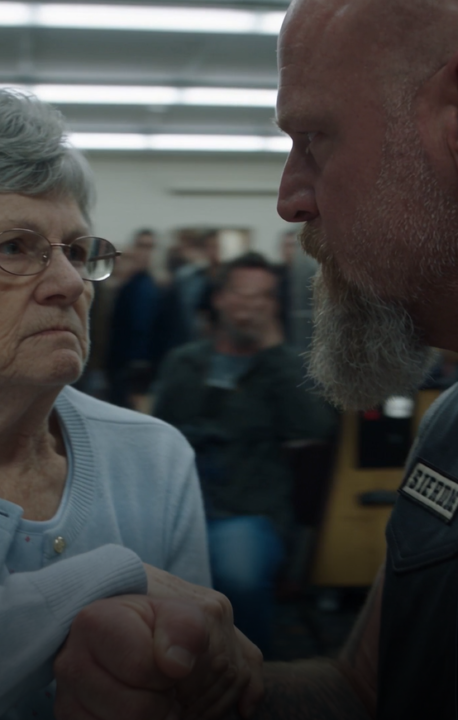
“Don’t touch anything else,” I told him.
He looked at the overturned table, then back at me.
“Little late.”
A few people laughed nervously. Mrs. Alvarez didn’t. She was searching the floor for her own paperwork.
I had mentioned Frank’s credit card because Eli had shown me an envelope that morning. It had arrived at my house addressed to my husband, who had been dead eighteen months.
I’d assumed junk mail.
Eli had opened it with my permission.
There was a balance.
Purchases.
Late fees.
I hadn’t wanted to believe any of it. Believing it meant admitting I could no longer recognize trouble when it offered me a ride to bingo.
Claire held out her hand.
“That information belongs in the locked office.”
“My information belongs with me,” I said.
My voice surprised us both.
Eli set the form on my lap. Beneath the full Social Security number, my signature slanted uphill exactly as it always did.
Then I saw the sentence above it.
I authorize assistance with financial eligibility and related applications.
I had signed that too.
For a moment, everything inside me shifted toward Claire.
Perhaps she had explained it.
Perhaps I’d forgotten.
There had been three appointments that week, a leaking sink, and a prescription I couldn’t get covered. I remembered signing something while Claire told me the coffee was getting cold.
“Mom?”
Eli had seen my face.
“I signed it.”
“That doesn’t explain Dad.”
“You don’t know what it explains.”
The room went quiet again.
A deputy arrived first. Young man. Damp collar. He looked at Eli’s arms, the table, and Claire, in that order.
“Mr. Bennett, step away from Mrs. Mercer.”
Eli did.
He didn’t argue when the deputy asked him to keep his hands visible. He laid Frank’s envelope on the chair beside me instead.
Claire reached toward it.
The deputy stopped her.
“Let’s leave everything where it is.”
That was the first thing that afternoon that made me breathe easier.
Sheriff Mercer arrived several minutes later. He stayed by the doorway while Claire went to him, speaking too softly for me to hear.
Then he approached us alone.
“Eli. Ruth. We need to handle this calmly.”
“Then call somebody who doesn’t sleep beside the person collecting these forms,” Eli said.
The sheriff’s jaw tightened.
For a second, I thought my son had finished getting himself arrested.
Instead, Mercer asked the deputy to photograph the table and collect the forms in separate envelopes.
He didn’t touch them himself.
Then he looked at me.
“Did Hannah ever help you with your bills?”
My daughter.
Three hours away, working evenings at a rehabilitation clinic.
“Yes,” I said.
Mercer nodded toward Frank’s envelope.
“Her name appears on another application.”
I looked down at my signature again.
What else had I agreed to without understanding it?
Before Frank died, Thursday evenings belonged to the center.
He drove the shuttle when the regular driver couldn’t. I buttered rolls. Eli sometimes came late from his repair shop, smelling of warm oil, and Frank always saved him a plate beneath another plate.
One spring evening, Claire sat at our kitchen table assembling forms for a transportation grant.
She carried a gold pen that clicked twice before she wrote.
Click. Click.
Frank said it sounded like a beetle trapped in a jar.
Claire laughed and showed me how the forms separated: white on top, yellow underneath, both catching the same handwriting.
“Always keep the yellow, Ruth.”
Frank tucked our copy beneath the loose bottom of my blue recipe tin. The lid had a dent from the year Eli dropped it stealing Christmas cookies.
“Best filing cabinet in the house,” Frank said.
At the center afterward, Claire wore an apron and washed every roasting pan herself.
I liked that about her.
People with important husbands didn’t always stay for the dirty work.
That was the woman I remembered while the deputy sealed our bingo registrations.
The memory lasted less than a minute.
Long enough to hurt.
My yellow copy would still be in the tin. I rarely threw anything away, particularly anything Frank had touched.
I told Eli.
He glanced toward Claire, then stopped himself.
“Don’t tell anybody else where it is.”
The sheriff heard that.
He looked tired rather than offended.
“I’ve asked for an outside investigator,” he said. “Someone will contact you.”
Claire’s head lifted.
“Daniel, this is a misunderstanding.”
“Then the records will show that.”
He said it quietly. She stepped back as though he had raised his voice.
Outside, rain ticked against Eli’s helmet where it hung from his handlebar. He guided me toward his truck instead; he’d brought the Harley home at lunch and borrowed the truck when he decided to collect me.
I remembered being irritated by that too.
He had been planning for trouble while I was worrying about appearances.
We sat with the heater running.
I called Hannah.
Voicemail.
Eli called.
Same result.
“She’s working,” I said.
“Probably.”
“You don’t sound like you believe that.”
“I’m trying not to decide anything yet.”
That stung because I already had.
Hannah had managed our online bills while Frank was sick. She knew birthdays, account numbers, the answers to security questions about pets we’d buried thirty years ago.
After the funeral, she and Eli stopped speaking.
He said she kept asking me for money.
She said he only appeared when something broke.
I had let them both believe I agreed.
At home, the blue tin waited beside the flour canister.
Eli lifted the recipe cards while I held the loose bottom.
There was the yellow form.
There was also an envelope I didn’t remember putting there.
Inside was a printed notice from a lender, folded around a clinic pay stub.
Hannah’s pay stub.
Across the notice, in my daughter’s handwriting, were six words:
Mom, please don’t tell him yet.
What had she been afraid Eli would discover?
Hannah called while Eli was reading the notice.
He answered my phone before I could reach it.
“What did you put in Mom’s recipe tin?”
I closed my eyes.
There it was. Twenty years of arguments, reduced to one opening sentence.
“Give her the phone,” Hannah said.
“Answer me.”
“Give. Her. The phone.”
He handed it over.
My daughter’s breathing sounded wrong. Not guilty. Winded.
“I’m in the supply room,” she said. “I have seven minutes.”
I asked about the pay stub.
She went silent.
Then she told me to turn the notice over.
On the back were dates, initials, and a phone number. She had written them down during a call disputing an account.
Her account.
Someone had used her old clinic employment information to support an application she hadn’t made.
“I left it with you because you said Dad kept important papers there.”
“You could have told me.”
“I did, Mom.”
I remembered her standing at my sink two months earlier, holding an envelope while I asked whether she wanted leftover chicken.
I’d said we would sort it out after bingo.
We never had.
Eli pulled out a chair and sat down.
“What does Claire have to do with it?”
Hannah heard him.
“She helped me apply for emergency assistance when my hours got cut. She copied my ID and pay stub.”
That still didn’t prove anything.
Claire had helped dozens of families. The center had hired a temporary bookkeeper. Forms had passed through volunteers’ hands.
By evening, Hannah had emailed the disputed application.
The employment section listed a clinic where she no longer worked. Her signature looked close until she showed us the capital H.
“I haven’t signed it that way since high school.”
Attached was a processing record bearing her old volunteer login from the center.
Eli leaned back.
“You worked there?”
“Saturday mornings. Before Dad got worse.”
“You never said.”
“You never asked.”
I put my palm flat on the table.
“Enough.”
The next morning, an investigator named Dana Ortiz called. She worked outside our county and wanted separate accounts from each of us.
She asked us to preserve the papers, photograph how we found them, and stop passing originals around.
Eli listened.
For once, he didn’t try to fix something himself.
Ortiz visited that afternoon. She examined Frank’s envelope without promising what it meant.
A name on a bill wasn’t proof of who had opened an account, she explained.
Neither was a login.
Hannah joined us by video from her car.
“The computer remembered my password,” she said. “I told Claire it needed changing.”
“When?”
“The day I stopped volunteering.”
Ortiz wrote that down.
Then Hannah said something that made Eli lift his head.
“Claire told me not to worry. She said everything went through the bookkeeper anyway.”
For the first time, Claire sounded like another person who might have trusted the wrong employee.
I wanted that explanation.
I wanted it so badly I nearly stopped listening.
Then Ortiz asked about the company receiving the application fees.
Hannah turned her phone toward a transaction statement.
The name was Mercer Household Solutions.
Why had Claire’s household company been paid to process my daughter’s supposed loan?
The company name did not settle it.
Ortiz made that clear.
People could share surnames. Payments could be legitimate. Documents could be incomplete.
She took copies, logged the originals we voluntarily provided, and left us with a receipt.
By then, Eli had straightened my kitchen chairs three times.
He repaired things when he couldn’t bear waiting.
“Leave the chair,” I told him.
“It rocks.”
“It’s rocked since 1998.”
He put it down.
Over the following week, the center suspended registration activities. Volunteers called members, including people who never attended bingo but had signed up for meal deliveries.
Mrs. Alvarez found an unfamiliar account.
So did a retired bus driver.
Another man found nothing and accused Eli of frightening everybody for attention.
Eli listened to the voicemail twice.
Then he deleted it.
I asked whether he was all right.
“Guy’s scared.”
That was all.
Hannah came Saturday carrying a grocery bag and the expression she wore before a difficult conversation.
She didn’t hug Eli.
She put milk away.
Then she sat beside him and opened her laptop.
They compared dates while I made coffee.
Frank’s application had been submitted eleven months after his death. Hannah’s followed two weeks later.
Both listed the same assistance office.
Both included information originally collected at the center.
The pages weren’t enough for us to see the whole route. Ortiz later told us what investigators found when they obtained records from the businesses involved.
Applications had been submitted for small credit accounts. Some purchases were delivered elsewhere. Other accounts were abandoned after fees and early charges accumulated.
Mercer Household Solutions received payments described as administrative assistance.
Claire controlled the company.
The temporary bookkeeper had entered legitimate donations and payroll. She had no access to the outside accounts.
When I heard that, I remembered every time I’d accepted Claire’s explanation because she said it smoothly.
I had mistaken confidence for evidence.
But there was still the question of why.
Not hunger.
Not unpaid rent.
Claire lived in the brick house with the long porch, where the sheriff’s campaign signs appeared every election year.
Hannah knew part of the answer.
During her assistance appointment, Claire had complained about a private loan tied to her brother’s contracting business.
“She said Daniel couldn’t know how bad it was.”
“Why didn’t you tell anyone?”
Hannah looked at me.
“Because people are allowed to be embarrassed, Mom.”
Ortiz never gave us an inventory of Claire’s finances. That came later, through records introduced in court.
At the time, we knew only that money had moved where help was supposed to be.
Then Hannah noticed a date on Frank’s application.
“That’s the day she brought you soup.”
I remembered the soup.
Chicken and rice. Too much pepper.
Claire had sat at my table while I searched for a photograph of Frank in his shuttle-driver jacket.
My recipe tin had been open beside her.
Eli looked toward it.
The dented lid shone under the kitchen light.
Had she come to comfort me, or to see what Frank had left behind?
On Monday, the shuttle stopped coming.
The coordinator sounded embarrassed.
“Transportation’s being reviewed.”
“Everyone’s?”
A pause.
“Yours is marked family support available.”
I looked through the window at Eli’s truck. He had taken three afternoons off work already.
That was how it started.
Small enough to sound reasonable.
The next call concerned the frozen meals delivered every Friday. A volunteer had been told I no longer wanted them.
Then someone posted the bingo video online.
It began with the crash.
No questions about Social Security numbers. No shredder. Just my son, the overturned table, and elderly people recoiling.
By supper, strangers knew what kind of man he was.
They had decided from eleven seconds.
One customer canceled a repair. Another asked whether his motorcycle was safe at Eli’s shop.
Eli told him to collect it whenever he liked.
“Don’t do that,” I said afterward.
“Do what?”
“Make it easier for them to leave.”
He rubbed the back of his neck.
I had never seen him look so much like Frank.
Claire called me that evening.
She used my landline.
“Ruth, this has become cruel.”
I said nothing.
“Daniel’s sleeping in the guest room. Volunteers are being questioned. Your son could still explain that he overreacted.”
“He did overreact.”
Beside me, Eli went very still.
“But he asked a question,” I continued. “You still haven’t answered it.”
Claire’s breathing sharpened.
Then her voice softened again.
“There are things in those records that could embarrass Hannah.”
I gripped the receiver.
“What things?”
“I’m trying to protect your family.”
When I told Ortiz, she asked for the date, time, and exact words I remembered. She did not tell me to call Claire back or try to make her repeat it.
She also contacted the center about preserving service records.
The shuttle returned Thursday.
I wish that meant the fear disappeared.
It didn’t.
That night, Eli found a notice tucked beneath his shop door demanding payment for damage at the center. Attached was a photograph of a broken cabinet nowhere near the table he had tipped.
He took pictures and forwarded everything to his insurer and attorney.
Then he sat in his truck without starting it.
I went outside in my slippers.
“Come in.”
“Minute.”
“You’ve been out here twenty.”
His hands stayed on the wheel.
“Maybe I should’ve just taken the form.”
“Yes,” I said.
He looked at me.
“You should have.”
He nodded once.
I opened the passenger door and climbed in.
“But that doesn’t make her right.”
We sat until the windshield fogged.
The next morning, Ortiz asked to speak with me alone.
She had found an older application.
Earlier than Frank’s.
Earlier than the bingo registrations.
It carried Hannah’s name and a signature I recognized immediately.
What would my son do when he learned that the first lie had been mine?
I asked Ortiz whether I could tell my children myself.
She said she could not advise me about what to say. She suggested I speak with my own attorney before answering further questions about that application.
That frightened me more than any accusation would have.
I made the call.
Then I asked Eli and Hannah to come Sunday.
No food first.
No coffee to delay things.
“I signed Hannah’s name,” I said.
My daughter stared at me.
Eli’s chair scraped backward.
“On what?”
“A financing application. For the furnace.”
Hannah put both hands beneath the table.
I remembered doing the same thing as a child when I was afraid someone would notice they were shaking.
Frank had been sick. The furnace had failed. Hannah had offered to help us arrange financing, then been called into an extra shift.
Claire said we could finish the paperwork while she was away.
“She said you’d already agreed.”
Hannah’s voice came out thin.
“I agreed to look at it.”
“I know.”
“Did you?”
That was the question.
At the time, I had known there was a difference. I had stepped over it because the house was cold and Frank needed somewhere warm to recover.
Claire hadn’t held my hand.
She hadn’t forced the pen.
I had written my daughter’s name and let myself believe family permission was something I could assume.
The furnace loan was real. We had made payments.
The later applications were different, but that did not wipe away what I had done.
“Why didn’t you tell me?” Eli asked.
“Because you’d have paid.”
His mouth tightened.
“And that would’ve been terrible?”
“You were keeping the shop open with borrowed money.”
“So you used Hannah.”
He didn’t shout.
That made it worse.
Hannah stood and went to the sink. There were no dishes there. She ran water anyway.
I stayed seated.
For once, I didn’t ask her to understand before she had finished being hurt.
Later, she came back.
“Claire kept copies of everything from that appointment?”
“Yes.”
“My ID?”
“Yes.”
“Dad’s papers too?”
I nodded.
She turned off the faucet.
“Then that’s when it started.”
My confession did not prove it. It gave investigators somewhere earlier to look.
Through my attorney, I provided the original furnace documents and explained my part. Hannah gave her own account. I also began arranging repayment of the remaining furnace balance without asking her to rescue me from it.
There was no quick forgiveness.
Eli came by less often for a while.
Hannah answered practical messages and ignored the ones where I tried to sound cheerful.
But she helped locate an old email from Claire.
Attached was the first assistance form.
The same broad authorization language.
The same promise that copies would stay secure.
At the bottom, Claire had written: Ruth has the yellow household copy.
My yellow copy was in the recipe tin.
Or so I thought.
When we checked again, we found the transportation form Frank had saved.
The furnace copy was missing.
In its place lay a grocery receipt dated the day Claire brought soup.
Had she taken the one paper that could show what she changed?
The county commissioners scheduled a public meeting about the center’s management.
It was not a trial.
Ortiz reminded us of that when Hannah asked whether we should bring the documents.
The criminal investigation would follow its own course. The meeting concerned suspended services, oversight, and who should hold the center’s keys.
Claire came anyway.
Cream jacket. Neat hair.
Gold pen.
She sat two rows ahead of us beside an attorney. Sheriff Mercer was absent. His office had issued a short statement confirming that outside investigators were handling the matter.
People whispered when Eli entered.
He wore a clean denim shirt under his leather vest and carried nothing but a folder.
He sat between Hannah and me.
The commissioners listened to complaints about missed meals and canceled rides. Mrs. Alvarez described spending a morning on the phone disputing purchases she hadn’t made.
Her voice shook.
She finished anyway.
When Claire spoke, she called the center her life’s work.
Some of that was true.
That was what made listening difficult.
“I made administrative mistakes,” she said. “But private family arrangements are being presented as something sinister.”
Her eyes moved toward us.
I felt Hannah stiffen.
My name was called.
At the lectern, I could see the shine on Claire’s pen.
“I signed something I should not have signed,” I said. “I have given my account of that through my attorney.”
A commissioner shifted forward.
I kept going.
“That does not explain an account opened for my husband after his funeral. It does not explain why people who asked for bingo cards were asked for their Social Security numbers.”
Claire clicked her pen.
Twice.
For a second, I was back in my kitchen with Frank making his beetle joke.
I set a photocopy on the document camera.
My attorney had approved the redacted page. It showed the center’s form layout without exposing anyone’s private information.
“The copies matter,” I said. “Some of us were told to keep them.”
Claire leaned toward her microphone.
“The yellow furnace copy was never taken from your blue tin.”
The room changed.
Not loudly.
A chair stopped creaking.
Hannah’s fingers closed around Eli’s sleeve.
I had said copies.
I had not mentioned a furnace.
Or a tin.
Claire’s attorney touched her arm.
She looked at him, then at the commissioners.
“I mean, obviously, I don’t know where she keeps things.”
Nobody applauded.
Nobody needed to.
Her sentence had done what our anger couldn’t.
It placed her in a kitchen she had claimed had nothing to do with her work.
The commissioner asked her to stop speaking until her attorney had advised her.
Afterward, Ortiz requested the meeting recording.
She already knew about the tin from us. Now she had Claire discussing the missing document publicly.
It was not the whole case.
It was a piece that fitted the records, visits, and applications investigators were already examining.
Outside, Eli stood beside me on the courthouse steps.
“Dad would’ve hated this,” he said.
“Yes.”
He looked down at my hands.
“Would he have forgiven you?”
“I don’t know,” I told him.
It was the first honest answer I had given to that question, even inside my own head.
Eli nodded.
Then he offered his arm for the steps.
The case took months.
Long enough for outrage to get bored.
Long enough for some people to decide that if nobody had been arrested immediately, nothing serious had happened.
We stopped explaining it at the grocery store.
We answered investigators. We kept appointments. Hannah maintained a folder of disputes and letters, and Eli drove me when I couldn’t manage another waiting room.
The records mattered more than Claire’s sentence at the meeting.
Account submissions. Payments. Delivery information. Documents retained outside the center’s authorized system.
The yellow furnace copy was eventually recovered among papers seized from her office.
It showed narrower language than the version later attached to the electronic records.
My signature had not authorized what Claire said it had.
That helped the investigation.
It did not excuse my signing Hannah’s name.
Those were separate wrongs, and learning to say so became part of living with my children again.
Claire later entered guilty pleas to charges arising from the scheme. I attended the hearing with Hannah.
She did not look at us.
I had imagined I would want her to.
When the moment came, I was grateful she didn’t.
Sheriff Mercer remained a subject of questions in town. The investigation did not establish that he had participated in his wife’s scheme. His early involvement was reviewed, and he had to live with the fact that his name had helped her silence people even when he wasn’t in the room.
He came to my house once.
No uniform.
He stood on the porch and apologized for asking about Hannah before he had asked whether I was all right.
I accepted the apology.
I did not invite him in.
The center reopened under new management.
Registration took one page.
Name. Emergency contact. Transportation needs.
Mrs. Alvarez read every line before signing.
So did I.
Eli paid for the table he had damaged. The unrelated cabinet claim went nowhere after photographs and witness accounts were reviewed.
He also apologized to the members he had frightened.
No speech about good intentions.
“I should’ve handled it better,” he said.
Some accepted that.
One man still moved seats when Eli came near.
My son let him.
At home, I gave Hannah the blue tin.
She held it for a long time.
“Mom, I don’t want your recipes.”
“Keep the papers, then.”
She looked at me.
“What papers?”
“The ones I should have shown you.”
She took the tin home.
Three weeks later, she brought it back with labeled folders inside and Frank’s cookie recipe on top.
We weren’t finished.
We were sitting at the same table.
That was enough for that Sunday.
On the next Thursday, Eli arrived early. He helped me into his truck, set my blue coin purse in my palm with the zipper facing left, and waited while I checked that I had my glasses.
At the center, he unfolded a chair beside mine.
Then he placed a fresh bingo card between us.
“Same time next Thursday?”