THE LANDLORD FLIPPED A BIKER’S COFFEE CUP UPSIDE DOWN, THEN THE BIKER REMOVED ONE GLOVE AND SLID A FOLDER PAST HIM
Part 1
THE LANDLORD FLIPPED THE BIKER’S COFFEE CUP UPSIDE DOWN, THEN RUTH SAW HIM SLIDE A FOLDER ACROSS HER DINER COUNTER.
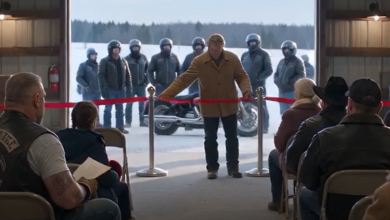
At four on the Juniper Mile Diner’s last Friday, Ruth Bell had fourteen eggs left and enough pancake batter for maybe six orders. Beyond the windows, traffic on the highway outside Hartwell Gap, Indiana, went by as usual. Ruth had taped her permanent closure notice to the glass that morning. Now forty motorcycles were filling the gravel lot, and she had caught herself counting them because counting eggs made her feel worse.
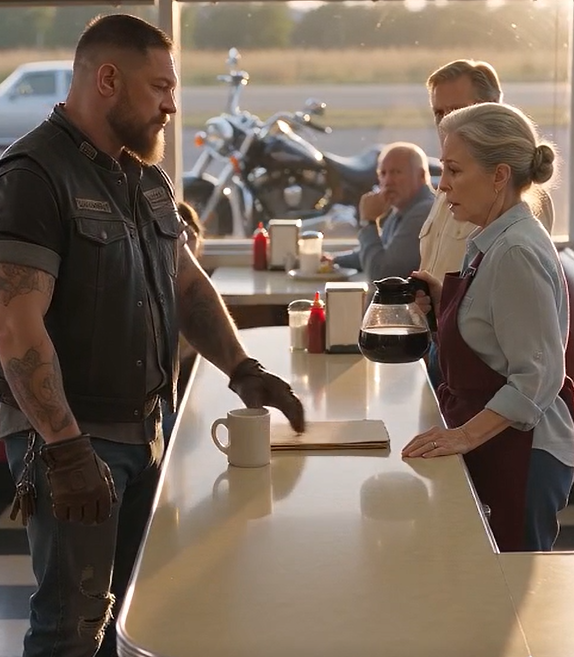
The man who came in first had close-cropped dark hair, a full brown beard and shoulders that filled the doorway. Ruth set a clean cup at the counter. Before she could pour, Cal Price flipped it upside down with two fingers.
“Take your club somewhere else,” he said. “She’s got a business to close.”
Cal managed the property. He’d come to count the keys, including the little brass one for the paper towel dispenser. The regulars at the window stopped talking. Mia Ortiz, eleven and still wearing her denim jacket indoors, left a stack of paper placemats half straightened.
The biker took his hand off the back of a stool. His black short-sleeved leather jacket smelled of road dust, and the patch across the back showed a silver socket inside a broken circle. Ruth could see a tattoo of a small house near his left wrist. He had old brown gloves on, the leather worn smooth across both thumbs.
Cal looked around at the regulars. “I’ve been the one trying to make this easy for her. Now I’ve got forty bikes on a lot I’m supposed to hand back empty.”
One man reached for his wallet. Ruth could see him preparing to settle up and let her get on with it. For a second she nearly told the biker to come back tomorrow. Then she remembered there wasn’t going to be a tomorrow for the diner.
The biker pulled off one glove, finger by finger. He set it on the stool instead of on the clean counter. Then he laid down a thick cream folder and pushed it toward Ruth with his bare hand.
Cal reached for it. The biker kept two fingers on the cover.
“That’s for Ruth,” Mia said.
Cal took his hand back. Through the window, Ruth could see riders setting their helmets on their seats. One woman pointed another rider toward the gravel so he wouldn’t block the diner ramp. The man with his wallet out slid it back into his pocket.
“I heard it was your last day,” the biker said.
Ruth looked at his face again. If he’d been in the diner before, he ought to know that people usually left their helmets on the empty booth by the door. His was already there. She reached for the coffee pot and asked if he’d come all this way for lunch.
“Eggs. Bacon. Pancakes,” he said.
Ruth kept her hand on the handle of the pot. It was a breakfast order she’d heard a thousand times, but he said it as if there were a fourth thing on the list. His eyes went to the little syrup pitcher behind her.
“No syrup.”
Part 2
Ruth set the coffee pot down before she let herself look at his face again.
“On the same plate?” she asked.
“If you still have the big ones.”
His beard had hidden the dimple in his chin until he moved his mouth like that. She looked at the hand on the folder. The thumb bent backward at the first joint. She remembered a boy trying to flatten a damp dollar bill against the counter with a thumb that did exactly that.
“Danny?”
He nodded once.
Twelve years earlier, he’d sat in the third booth from the door for nearly an hour with a glass of water and the breakfast side of the menu open. There’d been a little motorcycle outside with a cracked rear fender and a milk crate tied to the seat. He’d checked on it every time headlights swept the window.
“You waiting on somebody?” Ruth had asked.
“No, ma’am.”
“Want me to give you a minute?”
“Yes, please.”
She’d given him twenty. The ice in his water had melted before she went back. He hadn’t turned the menu over. He was looking at the price under the picture of the eggs.
In the kitchen, Ruth asked Donna to put on two eggs, three strips of bacon and a short stack.
“Your break’s in an hour,” Donna said.
“Put it on a big plate.”
Ruth carried it out herself. She put the bacon where it wouldn’t sit in the eggs and gave him a fork she’d run under hot water because it had come out of the drawer with a spot on it.
“Kitchen made extra,” she said.
“I didn’t order it.”
“I know. Can you do something with it?”
He looked at her for a second before he picked up the fork.
Afterward, she’d found half a pancake gone and the waxed paper from the bread basket missing. The next afternoon she watched him wrap the leftover pancake around a strip of bacon and slip it into his jacket pocket.
“You forgot your syrup again,” she said.
“It’s better dry if you’re taking it with you.”
She’d stopped bringing the pitcher after that. For three weeks she took the price of his plate out of the cash she counted at the end of her shift. Donna rang it through like any other order. Once Ruth came up short and borrowed the difference from the quarters she kept in her coat for the laundromat.
Now the boy was sitting across from her with shoulders wider than the back of the stool. He’d put on enough weight that she wouldn’t have recognized him from ten feet away. But she could still see the part of him that waited until she said it was all right to eat.
“How’d you know I was closing?” she asked.
“Donna called my shop.”
Ruth looked toward the service window. The grill was on. Donna’s spatula was sitting where she always left it, handle pointing out. For the first time all afternoon, Ruth noticed Donna had brought in a second pot of coffee.
“Why would Donna have your number?”
Danny opened the flap of the folder. From the inside pocket he drew a receipt, softened at the folds.
“She gave me this the night I left.”
Part 3
Ruth recognized Donna’s handwriting on the back. The long tail on the seven dipped into the line below it. The number was the diner’s, back when the last four digits had been painted on the pie case so people could call ahead for a whole one.
“Why’d she give you the number?”
“She said if I got where I was going, I could call the kitchen and let you know.”
“You never did.”
“No.”
He smoothed the receipt with his thumb. Ruth could see a line for the breakfast plate and, beneath it, a register entry for cash. There was a handwritten R beside the total. She’d forgotten Donna used to initial those slips so the owner would know whose money went into the drawer.
“You knew I paid?”
“Not until she gave me that.”
Ruth glanced toward the grill again. Donna had been twenty-four when the two of them started working together. She was the person who could tell from a ticket whether Ruth had put somebody’s meal on her own tab. For years she’d said nothing about those plates except once, when she held up a pair of bills and asked if Ruth was planning to leave herself enough gas money.
“I could’ve helped you get somewhere,” Ruth said.
“You did.”
The last night he’d come in, he’d eaten the eggs and folded both pancakes into a napkin. His hair was wet at the back. He’d told Ruth his jacket dried faster if he wore it. She’d put a clean dish towel on the table and pretended she needed him to move his glass so she could wipe underneath it.
She hadn’t known his last name. She knew he’d been sleeping somewhere that made him keep his boots on. One evening he’d nodded off in the booth and woken with both feet planted so hard under the table that the water jumped out of his glass.
That last night Ruth had taken his plate away and said the only thing she’d been sure enough to say.
“Somebody’s worried about you.”
He’d stared down at the little stack of unused sugar packets.
“You don’t know that.”
“No,” she’d said. “But I think you do.”
For three weeks after he disappeared, she looked toward the third booth whenever she brought out a breakfast plate. Then the looks got farther apart. Every once in a while a skinny kid would come in alone, and her eyes would go straight to the parking lot before she could help herself.
Ruth turned the receipt over again.
“You could’ve called and asked for me.”
“I picked up the phone twice.”
“What stopped you?”
“I thought you’d ask if I was all right,” he said. “And I’d say yes and hang up. I wanted to tell you better than that.”
At the other end of the counter, Mia put the placemats down and wiped her palms on her jeans. Cal checked his watch without lifting it high enough for anybody to mistake the gesture.
Ruth heard herself ask the question she’d been carrying since the boy stopped coming in.
“Where did you go that night?”
Danny looked toward the glass door.
“I turned the bike around,” he said.
Part 4
“Where were you headed before you turned around?”
“West. I had a friend who said there might be work.”
“Might be?”
“That was plenty when I was seventeen.”
Ruth looked at the worn glove on the stool. The seams had been repaired with thread a shade too light for the leather. She had the same kind of stitching on one pocket of her apron. When she looked up again, he was watching her wait for the rest of his answer.
“I went home, Ruth.”
She let go of the coffee pot. There were things she’d imagined happening to him over the years and things she’d stopped herself from imagining. She’d never pictured him making it home before midnight.
“Did you finish school?”
“Eventually.”
“That sounds like a story by itself.”
“Most of it was getting up on time.”
He’d finished school while working afternoons at a repair shop. The owner let him have a bench at the back if he swept the bays and put every borrowed tool back where he’d found it. He bought the shop years later when the owner retired. Two more followed, one in a former tire store and one where he and a partner had worked out of a single rented bay until they could take the second one.
Ruth had seen the name Reed Motor Works on the side of service trucks. She remembered one parked out here on a wet Tuesday when somebody couldn’t get a starter to turn over.
“That was one of yours?”
“Luis. He was here for a sandwich. He got the van going so he could get out of the space.”
“Never even told me who fixed it.”
“Sounds like Luis.”
Ruth looked through the window. A rider in a sun-faded denim shirt was leaning on the ramp rail. She recognized him now. He’d come back in that Tuesday and asked if the man with the van had eaten yet.
“And the forty out there?” she asked.
“County Line Socket Club. They call me Socket.”
Ruth almost laughed. “Because you own garages?”
“Because I dropped a ten-millimeter down a fairing on my first ride and held everybody up for forty minutes.”
It was the first time he’d smiled all the way. She could see the boy at the booth, trying to keep his face straight when she’d told him a pancake had come off the grill looking like Indiana.
“What did Donna tell you when she called?”
“She’d taken a job starting Monday. She wanted to know if one of my shops would look at her car before she started driving that far.”
Donna’s commute had been six minutes for thirty years. Ruth looked back at the kitchen and wondered when her friend had found the time to interview.
“Then she told me what Cal wanted for rent,” Danny said.
Cal took a step closer to the counter.
“You can catch up with Ruth after she hands me the keys.”
Danny moved the cream folder the last inch toward her.
“That’s what I came about,” he said.
Part 5
Ruth opened the folder expecting to find a lease. She’d seen enough versions in the last two months to know where Cal liked to put the number, low on the first page so your eyes found the term before the rent.
This time the first page said purchase agreement. The buyer’s name was Ruth Ann Bell.
She looked at Danny. “That’s me.”
“I had Donna check the middle name.”
“Why am I on the buyer line?”
“So the land is yours if you decide to take it.”
She turned to the description of the property. It went from the highway frontage to the fence behind the grease bins. It included the ramp, the patch of gravel where Donna’s car leaked a little oil, and the ground under the diner she’d spent nine years paying to own as a business.
“Evelyn signed an offer to sell,” Danny said. “The money for the purchase is with the closing company. They can confirm it themselves. You’d have time to get your own lawyer to look at everything before you decide.”
Ruth went back to the first page. “And your name goes where?”
“On the instructions for the funds.”
“What do you get?”
He took a moment to answer. “Breakfast, if Donna’s still got the grill on.”
Ruth heard the spatula tap twice in the kitchen. Then the room went quiet enough that she could hear the ice settling in the soda machine.
Cal bent far enough to see the top page.
“Evelyn told me she had an offer for the parcel,” he said. “She didn’t tell me it was him.”
“She knows who the buyer is,” Danny said.
“She’s my sister. I’ve managed this property for seventeen years.” Cal looked at Ruth. “You know who you call when the plow leaves a berm in front of your ramp.”
Ruth knew. She also knew the plow bill went to her afterward. Even so, she’d spent two months asking him to carry a message to Evelyn, and he’d always made it sound as if she was asking him to do something hard on her behalf.
“I asked you if she’d take less than triple,” Ruth said.
“And I told you she wouldn’t.”
Danny slid a one-page letter out from under the agreement. Ruth saw Evelyn’s signature again at the bottom.
Cal spoke before she could read the first line.
“She’s eighty miles away. You should ask her what she thinks you told me in March.”
Ruth looked up. “What did I tell you in March?”
“That you were ready to retire.”
Ruth remembered telling him her knees hurt and asking if the owner would give her another three years at a rent she could afford. She remembered exactly where they’d been standing because Donna had stepped past them carrying two crates of tomatoes and asked Cal to move his foot.
Donna was in the service opening now. Her hands were flat on the ledge.
“I heard you ask him for three years,” she said. “I’ve got the other copy of the letter you gave him that morning.”
Part 6
Donna came around the counter with an envelope from the kitchen office. It had a coffee ring on one corner. Ruth remembered typing two copies of her request because the printer jammed when she tried to make a third. She’d handed one to Cal on his way out and left the other under the register.
“Why’d you keep it?” Ruth asked.
“Because he said you’d never put an offer in writing.”
Cal pulled his phone out. “There was no offer. There was a number she wanted me to take over to Evelyn. It was nowhere near market.”
“Did you take it over?” Donna asked.
Cal looked at his screen.
Ruth had paid her rent on time through a winter when the furnace quit and through the summer the state milled the road and left her driveway full of gravel. In March she’d offered an increase big enough that she’d already decided which mornings she’d cover the grill herself. She’d written it down so Evelyn could see exactly what she could pay.
“I found somebody willing to use the whole lot,” Cal said. “They were talking about a new building. There’s a reason I needed a date for vacant possession.”
“How much did they offer?” Ruth asked.
“More than the diner could pay.”
“How much?”
Cal slipped the phone back into his pocket. “We were still working on it.”
Danny asked Ruth if she wanted Evelyn on the phone. Ruth almost said yes just to get an answer before Cal could walk out. Then she saw the papers in front of her and realized she’d spent the afternoon agreeing to things because somebody said there was no time left.
“Can I call her myself?”
Danny took out his phone and set it on the counter with Evelyn’s number on the screen. Ruth copied it onto the back of a clean order slip. She recognized the area code and remembered sending Evelyn a Christmas card the year her husband died. Cal had given Ruth the address for that.
She wanted to ask Danny why he’d brought forty people. It had felt like pressure when she first saw them outside. So she asked him.
“They were coming through on the last Friday ride,” he said. “I asked them to stop for lunch. I told them if you were done serving, we’d go somewhere else.”
Ruth looked through the window. The riders had left enough room around the ramp for Mia’s grandmother to bring a delivery cart in if she’d needed to. A couple of them were passing a bag of pretzels along the row of bikes.
“You figured I’d have enough batter for forty?”
“I hoped you might have pie.”
“We sold the last slice at two.”
“That’s all right.”
She turned over the page Cal had tried to read. It was a separate agreement giving her thirty more days at her existing rent while she reviewed the purchase and decided what she wanted to do.
Ruth traced the date at the top with her finger. Evelyn had signed it that morning.
Then she looked at the keys on the counter. Cal had brought a small paper tag to put on them, and written Vacant before he walked in.
Part 7
Ruth called Evelyn from the wall phone in the kitchen. It had a cord stretched so far out of shape that she could stand beside the flour bin and still reach the counter with her other hand.
“Did you sign something this morning that lets me stay?” Ruth asked.
“Yes,” Evelyn said. “I was hoping you’d call.”
“Cal’s here for the keys.”
There was a pause. Through the service opening, Ruth could see Cal pick up the tag, turn it over and set it back down.
“I asked him to go over the arrangement with you,” Evelyn said. “I sent it to him after I signed it.”
“He told everybody he had to hand back an empty lot.”
“He had a company interested in the property last winter. They quit returning his calls when they found out what the highway entrance work would cost.” Evelyn sighed. “He kept saying he could bring them back.”
Ruth pulled Donna’s copy of the letter from the envelope.
“Did he ever show you what I offered in March?”
“No. He told me you were retiring anyway.”
Ruth read the first sentence of her letter aloud. She heard her own voice catch on the words three more years. She’d picked three because Mia would finish middle school by then. She’d figured a kid ought to know where she’d be doing homework for that long, even if her grandmother changed shifts.
“I should’ve called you myself,” Evelyn said.
“I wish you had.”
“Will you send me a copy?”
“Yes. And the next time you want to know if I’m ready to retire, ask me.”
Evelyn agreed to email the signed extension directly. She also said she’d contact the closing company so Ruth could arrange to verify the funds and have someone review the documents. When Ruth hung up, her hand had left a damp mark on the receiver.
She came out of the kitchen with the letter in her apron pocket. Cal was standing where he’d stood when he flipped the cup.
“Evelyn says you had the extension this morning,” Ruth said.
Cal held her gaze for a few seconds. “I could’ve brought that other deal back if I’d had a clean site to show them.”
“You were going to let me shut down for a deal you didn’t have.”
“They would’ve paid for a new place. I was going to oversee the work. I thought we could all walk away with something.”
Ruth looked at him, waiting for him to say what he’d imagined she would walk away with. He glanced down at the keys.
“Leave those,” she said.
Cal put the paper tag in his pocket. He walked out past the booth where Danny had left his helmet. Through the glass, Ruth watched him give a woman on the ramp room to pass. The woman had a blue cardigan folded over one arm. She stopped outside the door and looked straight at Danny.
He stood up.
“Ruth,” he said, “my mom would like to meet you.”
Part 8
The woman stepped in and wiped her shoes on the mat. There was hardly anything on them. She did it twice.
“I’m Linda Reed,” she said. “I was going to wait until you had a minute.”
Ruth looked at the upside-down cup, then at the folder, then back at Linda. “I think I’ve got one now.”
Linda smiled without showing her teeth. Danny slid out the stool beside him, and she rested her hand on the back of it.
“I looked for him for three weeks,” she said. “I drove past this place twice.”
Ruth thought of the little motorcycle parked on the far side of the dumpster because the boy had asked whether he’d be in anybody’s way there. His mother could have looked straight at the diner and never seen it.
“I didn’t have his last name,” Ruth said.
“I didn’t know he was eating. I kept looking at kids’ hands through car windows. I thought if I saw him, he’d have those same torn gloves.”
Danny put his bare hand flat on the counter. The tattoo near his wrist was a small house with one square darkened in. Ruth had thought it was a window. Linda touched it with the tip of a finger.
“That’s our porch light,” she said.
Danny looked at Ruth. “I got as far as the turn for the interstate that last night. I had the pancakes in my jacket. I kept hearing what you said.”
“Somebody’s worried about you,” Ruth said.
“Yeah. I could think of one person it might be. I thought I ought to find out.”
Linda pulled the cardigan closer around her arm. “It was late. I was on the phone with my sister. I said I’d call her back because there was a motorcycle outside, and then I couldn’t stand up for a second. I could see him through the screen door.”
“I thought you’d yell,” Danny said.
“I was going to. Then I saw how tired you were.”
Ruth looked down at the receipt between them. She remembered the nights she’d brought home too little tip money and told herself she’d do better on Saturday. On one of those nights, she’d sat in her car outside the laundromat trying to decide if she could run the washer and let her clothes air-dry. She’d never known who else was sitting in a car that week.
Linda reached across the counter.
“You fed him while I was looking,” she said. “Thank you.”
Ruth took her hand. It was warm and a little floury around the nails. Linda saw her notice and said she’d brought two pies in the support truck, if they were allowed to bring them inside.
At that, Donna pushed through the kitchen door.
“Did you say two?”
“Apple and cherry.”
“I’ve got enough batter for six orders,” Ruth said. “What have you got in the walk-in?”
“Potatoes, onions and more bacon than you think.”
Mia held up her stack of placemats. “Can I put these back out?”
Ruth looked at the purchase papers. She was going to have somebody read them with her. She was going to call Evelyn again in daylight. Those were things she could do on Monday.
“Set the third booth,” she told Mia. “Then see how many people out there like fried potatoes.”
Part 9
The Juniper Mile never closed for good. It did close on Sunday and Monday, as it always had. Ruth spent most of Monday at a lawyer’s office with her reading glasses on, asking what she’d owe every year once the land was hers. Danny waited until she called him. She had two questions about the money, one about the driveway and another about whether he’d expect her to keep working if she wanted to quit someday.
“It’s your place,” he said. “You get to decide when you’ve had enough.”
They closed on the sale a few weeks later. Evelyn ended Cal’s management arrangement, and the final accounting came directly from her. Ruth carried the closing envelope into the diner and put it in the office drawer that used to hold notices about rent.
The County Line Socket Club made the diner the official stop on every ride. Ruth learned to ask for a head count before Donna mixed the batter. In winter the riders came by in cars, sometimes alone. The man who’d reached for his wallet that first afternoon started sitting near the door so he could get up and move the spare high chair when people came through.
Ruth hung a small sign behind the register. A meal paid ahead for any kid who needs one. Donna kept two pads by the till. One was for meals people bought ahead. The other was for meals the kitchen had served. When a teenager came in and asked if the offer was real, whoever was working handed them a menu and asked what sounded good. Ruth watched a boy order toast the first time, then come back two weeks later and ask if he could get eggs with it.
By the first anniversary, Donna had marked off more than nine hundred plates. Mia, now twelve, helped tally the last page after school. She counted one row twice and came up with the same number.
“Can we take the sign down if we fill the whole book?” she asked.
Ruth set a fresh pad beside her. “That one’s for tomorrow.”
Danny came in late that afternoon with Linda. He held the door for a couple of riders behind him, and a woman at the counter pulled her purse closer when she saw the ink on his arms. Ruth watched Danny pause to straighten the mat where the woman’s cane had caught it. The woman moved her purse again, this time so he had a place to sit.
Mia brought him a clean cup and put it right side up. Linda ordered cherry pie and asked for two forks.
“You want me to put syrup on the table?” Mia asked Danny.
He looked at his mother. “I think I’ll eat here today.”
Ruth brought the pitcher herself. On her way back to the kitchen, she saw a boy at the third booth with a glass of water and the menu open to breakfast. He had his backpack between his ankles. She reached for a clean order pad and went over.
When she came back past Danny’s table, he’d pushed his pancakes toward the middle so Linda could have a bite.
Follow this page for more stories about the people who make room at the table.