AN UNCLE SHUT THE CEMETERY GATE ON A BIKER, THEN THE BIKER REACHED INTO HIS SADDLEBAG AND THE GRIEVING TEENAGER FROZE
Part 1
HER UNCLE SHUT THE CEMETERY GATE ON A BIKER, THEN EMMA SAW A LITTLE YELLOW DUCK BILL PEEK OUT OF HIS SADDLEBAG.
At two on a rainy October Saturday, Emma Hayes stood at the entrance to Cedar Hollow Cemetery outside Briar Run, Pennsylvania, trying to pin a funeral program under the clasp of her black coat. The paper was already soft at the corners. Her father’s photograph looked darker where it got wet. Aunt Kate had gone back to the funeral van for an umbrella, but the last one there was missing a handle.
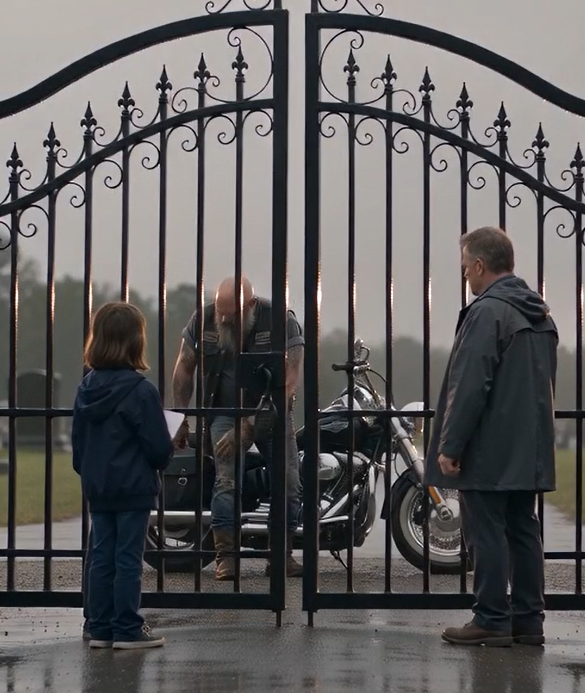
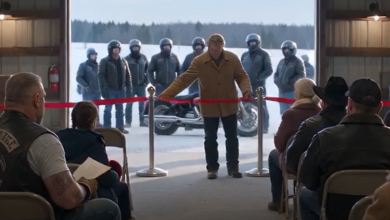
A huge man in a short-sleeved black leather jacket had parked a cruiser beside the entrance. Other riders waited farther back. He was coming toward the gate when Uncle Rick swung it shut from the inside and dropped the latch. The man stopped with one boot on the apron of gravel.
“Take your bikes and go,” Rick said. “This is a funeral.”
A woman in the little knot of mourners pulled her umbrella lower. Another moved close enough to Emma that their coat sleeves touched. Rick had been there since noon, showing people where to park. Most of them looked at him before they looked at her.
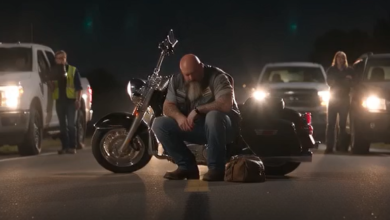
The biker lowered his hands. Rain ran off his shaved head and darkened the ends of his long gray beard. He wore an iron wheel with a compass needle on the back of his jacket. There was a strip of old tape across the knuckle of his left glove. Emma could smell wet leather and the faint exhaust from the cruiser before the rain took it away.
“My niece said no riders,” Rick said. “I’m trying to give her some peace.”
Emma opened her mouth, then shut it again. She’d asked Rick to tell people she wouldn’t be speaking at the graveside. She couldn’t remember anybody asking her about riders. Noah, her ten-year-old cousin, stopped trying to fold his funeral program along the crease.
“She never said that,” he told his father.
The biker waited until Rick turned toward Noah. Then he took a step back to the cruiser and slowly worked one glove loose. He slipped the bare hand under the saddlebag flap. Through the gate, Emma could see the top of a folded yellow umbrella. It was small enough to fit sideways inside the bag. The cloth had gone pale along the creases, and a flat orange duck bill stuck out near the strap.
Rick took his hand off the latch.
“I saw the picture in the paper,” the biker told Emma.
She knew which picture he meant. Kate had asked her to pick one for the obituary, and Emma had chosen the one her father used to keep tucked in the corner of his bathroom mirror. She was seven in it, holding a yellow umbrella while he tried to get his phone out of his pocket before she walked out of the frame.
Emma leaned forward. There was a triangle of blue thread near the umbrella’s strap, crooked like a little sail. Her father had sewn that patch at their kitchen table. She had held the cloth flat for him and complained that the blue didn’t match the yellow.
The man brought the folded umbrella into the rain.
“I kept it.”
Part 2
Emma put her hand on the latch.
“Can I let him in?” she asked.
Rick looked past her toward the turnout. She waited for him to answer. Then she realized she’d asked him out of habit, the way she’d spent the past week asking where to stand and when to get in the car.
She lifted the latch herself.
The man stayed on the gravel until she’d opened the gate wide enough to step back. Then he came through and offered her the umbrella handle first. The handle was still yellow underneath, where a hand would have kept the sun off it.
“I thought I lost it,” she said.
“You gave it away.”
Emma ran her thumb over the blue stitches. She remembered the day now in pieces. Her father had brought grocery-store carnations to her grandfather’s grave. She’d worn rain boots with tights and kept stepping out of one boot because the mud had such a good grip on it. On their way back to the car, she’d seen a man on his knees by a stone.
“I didn’t know where to put my hands,” she said.
The man nodded as if that made perfect sense.
“You put one on my shoulder first,” he said. “Then you gave me the umbrella.”
“I did?”
“Just for a second.”
She could remember running back to her father. He’d opened his coat and held it out like one wing, and she’d tucked herself underneath. From there she’d looked over her shoulder. The man was still kneeling. She’d worried that the umbrella was too small to cover him.
“My name’s Jack Mercer,” he said. “Most of the folks out there call me North.”
“Why?”
“I used to lay out routes for the club. Took a wrong turn once and everybody followed me for eleven miles. The name stuck.”
Emma looked up at him. A little part of his beard had caught in the zipper pull on his jacket. Her father used to do that with the drawstring on his sweatshirt and insist that it was somebody else’s fault for making him laugh. The thought came so quickly that she almost turned to share it with him.
Instead she saw Rick watching the parked vehicles. Behind him, Noah was picking at a wet corner of his program.
“Your dad in the picture?” Jack asked.
“He took it. It’s from before I gave you the umbrella.”
Jack glanced down at the little orange bill. “I thought maybe he’d bought you another one.”
“He offered. I told him I had a good raincoat.”
“Did you?”
“No. I hated the hood.”
Jack gave a small laugh. Then he went quiet again. Emma could hear water dripping off the rear fender of his motorcycle and the uneven tick of metal cooling. She wanted to ask what she ought to have asked when she was seven. It felt different now that she knew how it was to have people waiting for you to say the name first.
“Who were you visiting?” she asked.
He looked up the cemetery hill.
“My daughter,” he said. “She was seven, too.”
Part 3
“Her name was Ruby,” Jack said.
Emma held the umbrella across both palms. The wet cloth was heavier than she’d expected. She looked for the little loop that used to fit around her wrist and found it tucked under the strap.
Jack told her Ruby had died after a car accident. He gave Emma the shortest version he could. She was grateful for that. In the past week, she’d learned that some people asked how her father died and wanted to know things she didn’t want to remember in the produce aisle or beside her locker.
“Was that the day you buried her?” she asked.
“First anniversary.”
“Were you there by yourself?”
“I’d asked my brother to stay in the truck. He was about to come looking for me when you showed up.”
Emma tried to put the man she remembered inside the shape of the one standing next to her. She could do it when he looked down. As a little girl, she’d thought the movement in his shoulders meant he was cold. It had taken her a few steps to hear him over the rain.
“I figured a grown-up would come get it from me,” Jack said. “I sat there a while so you’d have time to come back.”
“What’d you do when I didn’t?”
“Took it home. Left it open in the bathtub to dry.”
“Where’d you keep it after that?”
“Top shelf in the hall closet. In the winter I moved it so I could get my boots down. In the spring I moved it back.”
He’d retired from the county garage three years earlier. He told Emma he’d thrown out two toolboxes’ worth of things when he left, including a coffee mug his crew had signed with a paint pen. The umbrella had stayed put. She understood why he told her about the mug. The two of them stood there looking at something he could have replaced for ten dollars.
“Did Ruby have one like it?” Emma asked.
“No. She would’ve wanted it, though. She liked anything with a face.”
Emma almost asked him what else Ruby liked. Then she decided she could.
“Grapes cut in half,” he said. “She said a whole one took too long to eat. And putting stickers where you’d find them later.”
He turned his bare hand so Emma could see a small tattoo near his thumb. It looked like a five-pointed star with one point folded over.
“That’s how she used to leave them,” he said. “Peel one back and stick it to my keys so I’d have to take her with me to work.”
Emma looked down at the photograph on the funeral program. Her father’s face on the front had started to blur where the ink had gotten wet. She had taken that picture the day he finished repairing her bike. There was grease on his knuckles. He’d made her promise she wouldn’t crop his hands out.
Jack tapped the edge of the program, well away from her father’s face.
“The paper put two pictures up,” he said. “It was what you wrote under yours that made me pick up the phone.”
Part 4
“Dad’s favorite,” Emma said.
“That was it.”
She’d written those words because the obituary form had asked for a caption and she didn’t know what else to put. Aunt Kate had suggested the year. Emma couldn’t remember the year without working backward from her age, but she could remember where her dad had kept the photograph. The corner nearest the bathroom sink had curled from getting splashed every morning.
“He told people about that day,” she said. “All the time.”
Jack turned toward her. “About the cemetery?”
“About the umbrella. He’d tell it when somebody asked if I was a good kid. I’d be standing right there. It was embarrassing.”
“What’d he say?”
“He’d say he took me to visit Grandpa and I gave my umbrella to a man who was crying.” Emma pulled the wet program out from under her coat clasp before it could tear. “People always asked if you were somebody we knew. Dad would say, ‘She never even asked.’”
Jack looked down at the umbrella.
“He wanted to know who you were,” she added. “Once he saw a bike like yours at a gas station. He went in and asked the cashier if the guy ever came through with his family. We got all the way back in the car before Dad remembered he’d gone in to buy milk.”
Jack laughed softly. Emma could picture her father standing at the gas-station cooler, trying to remember which end of the errand he’d started with. She wished she’d asked him more about that afternoon while he was still around to correct her.
“During chemo, the nurse asked if he wanted me out of the room when they changed something on his line,” she said. “He told her that story instead of answering. She let me stay.”
Rain drummed against the leaves above them. A woman next to the gate shifted her umbrella so the water ran behind Emma’s shoes. Emma thanked her. The woman was one of her father’s old coworkers. Emma couldn’t remember if she’d said hello to her yet.
“Who’d you call when you saw the picture?” she asked Jack.
“The funeral home first. I wanted to get the umbrella back to you. Then I called my club.”
“You told them about me?”
“I told them why I had a little duck umbrella in my closet.” He glanced up at the rain. “They asked what else they could do.”
Rick came back from the gatepost. “The family wanted this small,” he said.
Jack looked at Emma. It was the first time anyone had let that statement hang in the air long enough for her to decide if it was hers.
“I wanted it quiet,” she said. “I didn’t say how many people.”
“I thought you’d had enough phone calls,” Rick said.
Aunt Kate was coming up the drive with the funeral director beside her. She carried the umbrella with the missing handle, gripping its metal stem through a handkerchief.
The director looked at Jack, then at Emma. “I owe you a conversation,” she said. “I thought you’d already been asked.”
Part 5
The funeral director’s name was Marcy Lane. She’d been the first person to call Emma by her name after the hospital stopped calling her his daughter. Now she stood under an umbrella with a bent rib and asked if Emma would rather talk by the van. Emma looked at Noah, then at Rick.
“We can talk here.”
Marcy said Jack had offered to bring umbrellas and people to hold them. She’d checked where the cemetery staff could put a group without blocking the service path. Then Rick had called back and said Emma wanted the offer declined.
Emma thought she’d misunderstood one part.
“You knew they were coming to help?”
Rick pressed his lips together. “I knew they wanted to bring a crowd.”
“You told her I said no.”
“You told me you didn’t want people looking at you.”
“I said I didn’t want to stand up and talk while people looked at me.”
Noah was looking down at his shoes now. Emma could see him winding a corner of his program around his finger. She knew what it was like to wait while adults argued over something you’d said.
“You heard me right,” she told him.
He stopped winding the paper.
Aunt Kate handed her umbrella to Marcy. “Rick, go wait by the van for a minute.”
“Kate, I was the one down here getting everybody in.”
“I know. I’ll take it from here.”
He left through the open gate. Emma watched him stop to move a folding parking sign out of a puddle before he went on. She’d always liked that about him. He could see ten small things that needed doing before anybody else saw one. Lately he’d started deciding which things were too much for her to hear, too.
“Did you tell Jack we said no?” Emma asked Marcy.
“I told him we couldn’t add anything without the family’s permission. He said he’d wait outside and bring back the umbrella if you wanted it. That’s where I left it.”
Jack nodded toward the turnout. “They can go. Whatever you’d like.”
“Would they have come anyway?”
“A few would have. They read the paper too.”
Emma looked where he was looking. Riders stood in little groups by the fence, some still wearing rain gear over their black leather. Farther back, people were getting out of pickup trucks and cars. One man pulled a grocery bag over a motorcycle seat, then went to help an older woman out of a passenger door. Emma watched him hold the door steady while she found her footing.
“Were all those people at Ruby’s funeral?” she asked.
“Some. A lot of them joined after.”
“How many came today?”
Jack glanced at Marcy. “Enough to cover the walk, if that’s what you’d like.”
Emma pictured the long stretch from the gate to the grave and the people who had asked her father to put them on the aisle at church because their knees hurt. One of them was waiting inside a car now, checking the rain against the windshield.
Before she could answer, Marcy’s radio crackled. She listened, said she’d check with the family, and lowered it.
“The crew says the tent at the grave is taking water,” she said. “We need another plan.”
Part 6
Marcy sent someone to check whether the small chapel was free. Emma could see it beyond the maples, a low brick building with one yellow bulb over the entrance. She’d been in there once when her father went to ask what flowers he could leave at Grandpa’s stone. He’d wiped his boots so long on the mat that she’d gone inside without him.
“Could we do the service there and just bring immediate family up afterward?” Kate asked.
“We could,” Marcy said. “Or we can wait a little.”
Emma looked toward the row of parked cars. Her dad’s friend Mr. Kline had turned off his windshield wipers, then turned them back on. He was eighty-one and walked with two canes. He’d taken her father to his first appointment with the oncologist because Emma had a chemistry test. She found that out later, when she asked why her dad’s jacket smelled like the peppermint gum Mr. Kline always carried.
“I want him to be able to come,” she said.
Kate followed her eyes. “So do I.”
There were other people Emma wanted there. The nurse who’d let her stay. The woman from the hardware store who’d called ahead when her father needed to sit down between the paint counter and the register. A man Emma barely knew who’d sat on their porch for an hour talking about how to fix a screen door, then gone home without ever bringing up cancer.
She knew why her father had asked to be buried here. The plot next to Grandpa was on level ground. He’d said it would be easier for people to come by when they got old. Now it was the hundred yards between the gate and the grave that felt impossible.
“Does a tent have to cover everybody?” she asked.
“No,” Marcy said. “It covers the chairs and the place where the family stands. It’s the walk up that worries me right now.”
“Can a car get closer?”
“One at a time by the service lane. We can bring Mr. Kline up that way.”
Kate took a breath through her nose and let it out. “I’ll ride with him. He pretends he can’t hear me when I tell him to bring both canes.”
“You can sit with me after,” Emma said.
Kate looked at her for a moment. “I was hoping you’d ask.”
When Emma turned back, Jack had pulled his glove on. He was holding the loose cuff away from the tape so it wouldn’t stick.
“Did you ask the whole club to come because of the umbrella?” she said.
“I asked the club to come because I know what that walk feels like.”
Emma glanced down at the old yellow cloth. “This one barely covers me.”
“I remember,” he said. “I put it over my hands that day. That was plenty.”
One of the riders outside the gate approached with a phone in a clear plastic bag. Jack introduced her as Denise. She asked Marcy where she could put volunteers without getting in the crew’s way. Then she looked at Emma.
“Before we open anything,” Denise said, “do you want to see what we brought?”
Part 7
Denise led Emma as far as the gate. A pickup had backed into the turnout, well clear of Jack’s cruiser. A woman in the truck bed cut the tape on a cardboard carton and passed the first bundle down. Emma saw a curved black handle and a strip of bright yellow fabric.
“Jack said get yellow if we could,” Denise said. “Once people heard why, they kept bringing more.”
The umbrellas came from stores, garages and coat closets. Some were short folding ones with nylon loops. Others were big enough for two people to walk under. One had a strip of masking tape around its handle with a child’s name written on it. Emma thought about the blue stitches her father had put through a tear because she hadn’t wanted a new umbrella.
“How many?” she asked.
“We counted two hundred when we loaded the last box.”
Emma looked past Denise and finally understood how far the turnout went. A few riders had come on motorcycles before the rain got heavy. Most had come in cars and trucks, many of them with three or four people riding together. She could see the same compass-wheel patch on jackets all the way back to the road. Some of the riders had already taken umbrellas from the boxes and were holding them closed like walking sticks.
“Do they have to stand there the whole time?”
“No,” Jack said. “We’ll take turns if we need to.”
“Can you tell them they can put their arms down when I’m past?”
“We can do that.”
Marcy went up the path with Denise and a cemetery worker. They walked back down the other side, checking for soft ground and places where water ran across the paving. Marcy asked the volunteers to leave the junction by the maples clear. The riders nearest it moved without needing to be asked twice.
Emma found Rick beside the van. He had opened the rear door so Mr. Kline could rest his canes on the floor until Kate came for him. Rick looked at the folded umbrella in Emma’s hands.
“Did he really keep that all this time?”
“Yes.”
“I thought they were going to make an entrance.”
“They were waiting for me to say they could come in.”
Rick rubbed his thumb across a drop of water on the door. “What do you want me to do?”
“Help Mr. Kline up to the grave. Then tell Marcy you’re done answering for me.”
“All right,” he said.
Emma went back to the gate. Noah was holding a new yellow umbrella. He hadn’t opened it yet.
“Could I stand with them?” he asked.
“You can walk with me if you want.”
He gave the umbrella handle a little turn. “I think I’d like to hold it for somebody.”
“Okay,” Emma said. “I’ll see you up there.”
She turned to Jack. The wind had picked up enough to blow the rain against one side of his beard. He waited for her to speak.
“Would you walk with me?”
He nodded.
Behind him came the first small click of an umbrella opening. Then another, farther up the hill.
Part 8
From the foot of the path, Emma watched two hundred yellow umbrellas open in the rain. The riders stood in two long rows, close enough for the edges to overlap above the paving. They left gaps where people needed to turn off. The men and women holding the umbrellas got rain down their sleeves while the center of the path stayed dry enough for the mourners to walk.
No one started a motorcycle. No one called her name.
Near the middle, Noah held his umbrella too high at first. A rider beside him lowered hers a little to show him where to put it. When Emma came up to them, Noah shifted his feet, tilted the canopy and said, “Watch that puddle.” She stepped over it. It was exactly the sort of thing her father would have said, which made her smile at Noah when she’d expected to cry.
Jack walked beside her with both hands free. Emma carried the little duck umbrella folded against her coat. By the time they reached the grave, Mr. Kline was seated near Kate. Both canes were tucked against his chair. He lifted one hand when he saw her.
The minister kept the service short, as she’d asked. Emma stood through most of it with her thumb on the blue stitching. Near the end, he said Dan’s family had chosen to leave a little quiet before people went home. Emma had asked for that because she’d been afraid someone might put a microphone in front of her.
There was no microphone. People were listening to rain strike the umbrellas.
Emma leaned toward the minister. “Can I say one thing?”
He moved half a step aside.
“My dad kept a picture of me holding this,” she said. She lifted the umbrella about as high as her ribs. “I always wanted him to use a better one. You couldn’t even see my whole face.”
A few people laughed gently. She saw Kate lower her head.
“He liked it because he knew what happened after he took it. I gave the umbrella to somebody who needed it. Dad used to tell that story so often I stopped listening halfway through.”
She looked at Jack, who was standing just behind the chairs.
“I wish I’d asked him to tell it one more time.”
She sat down beside Kate. Nobody tried to fill the pause. From where she was sitting, Emma could see the yellow line go all the way down to the gate Rick had closed.
After the service, Rick came over with Noah. He stopped far enough away that Emma could turn back to Kate if she wanted.
“I told Marcy you said no because I thought I’d get my way faster,” he said. “You never said it. I told her that, too.”
Emma nodded. She didn’t feel ready to make him feel better. Rick waited a little, then went to help the crew stack the chairs.
By then the rain had eased. Emma found Jack down near the maples, taking an umbrella from a rider whose hand had gone stiff in the cold. She waited until he’d folded it.
“How far is Ruby?” she asked.
He pointed along a row beyond her grandfather’s stone.
“Will you take me?”
Jack looked at the old duck umbrella in her hand. “I’ve been there a lot of Saturdays,” he said. “I don’t think I’ve ever walked up with somebody who already knew what I was going to say.”
Part 9
Ruby’s headstone was small enough for Emma to read from where she stopped. Somebody had left a smooth white stone on top. Jack brushed a wet leaf off it with his thumb.
“October fourth,” Emma said.
“That’s right.”
“My dad died on the eleventh.”
Jack stood beside her while she worked that out. A week apart. Emma had started to think of the eleventh as a day she’d have to get through by herself every year. She looked at the two names she could see from where she stood, Ruby’s in front of her and her grandfather’s a little way down the row.
“Would you mind if I came with you next year?” she asked.
“On the fourth?”
“On the fourth. And if you’re free on the eleventh, we could come up here both days.”
“I can be free.”
She opened the duck umbrella. One rib caught. Jack reached over and eased it past the runner, and the orange bill lifted out of its fold. It looked a little ridiculous above the shoulders of a man his size. Emma remembered why she’d liked it so much.
The Pine Trace Riders started a college scholarship fund for Emma that winter. Denise and the club treasurer met with Kate and Emma at the kitchen table so they could ask questions without an audience. The club put proceeds from its spring benefit ride toward the fund and arranged for the money to go through the college. Emma had been planning to buy all her textbooks used and borrow the ones she couldn’t find. Now she could also afford the bus fare home for weekends.
At the second graveside visit the following October, Jack asked what she was thinking of studying. She’d brought a psychology course catalog along because she hadn’t wanted to leave it on the bus. She took it out and showed him a page she’d folded at the corner.
“I’d like to work with people after somebody dies,” she said. “People my age, maybe. I hated it when grown-ups would ask my aunt how I was doing when I was sitting right there.”
Jack read the page slowly. “You going to tell them that?”
“If they ask.”
“What if they don’t?”
Emma tucked the catalog back into her bag. “Then I might tell them anyway.”
By her sophomore year, she was studying psychology and helping set up chairs for a grief support group through a supervised campus placement. She liked arriving early enough to let people choose their seats. She knew some of them would want the one nearest the door. She left it open until they came.
She and Jack still went to Cedar Hollow twice each October, walking to both graves on both days. On the eleventh that year, it started raining while they were at Dan’s stone. Emma opened the duck umbrella and held it low so the little bill stuck out in front of them.
Jack took it from her when she bent to straighten the flowers. He held it over the back of her neck, where her coat didn’t reach.
Follow this page for more stories about the people who show up when someone needs them.