A BROKER PULLED A ROPE ACROSS A BIKER’S PATH AT A WIDOW’S FARM AUCTION, THEN THE BIKER TURNED HIS PADDLE AND FIFTY RIDERS WENT QUIET
Part 1
THE BROKER PULLED A ROPE ACROSS THE BIKER’S PATH, THEN FIFTY RIDERS STOOD SILENT AS HE RAISED HIS PADDLE AT THE WIDOW’S FARM AUCTION.
At ten on a snowy November Saturday outside Orson’s Bend, Wisconsin, Ellen Porter sat in a folding chair at the open end of her machine shed. She’d been eighty for thirteen days. The auction clerk had put a square of cardboard under her feet to keep the cold from coming through her soles. From where she sat, she could see the porch of the house she’d moved into sixty years earlier.
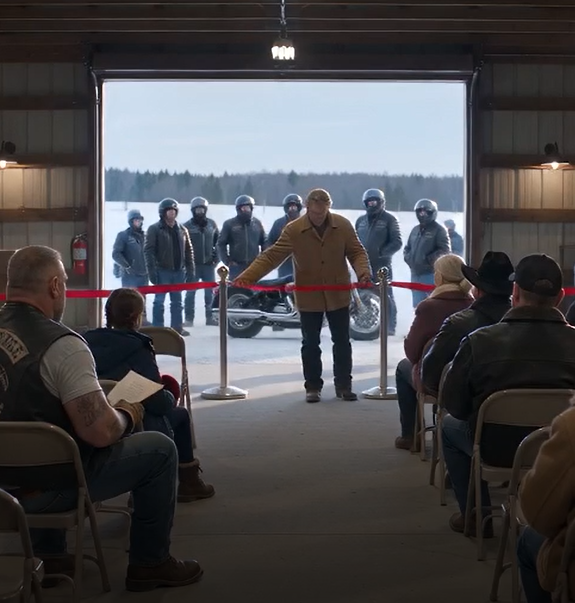
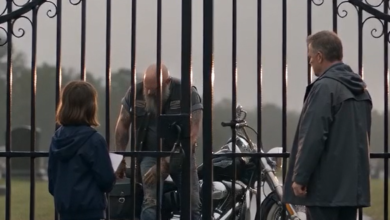
A big man walked in from the gravel, his brown boots white at the toes. He wore a short-sleeved black leather jacket over a gray thermal shirt. Grant Pike stepped in front of the row of chairs and pulled the red aisle rope across the man’s path.
“Bidders in here,” Grant said. “Your club can stand outside.”
Ellen saw a woman with an auction packet stop halfway into her seat. Grant brokered land sales around the county, and people tended to listen when he told them what belonged where. Ellen had seen him show two strangers the porch steps earlier that morning.
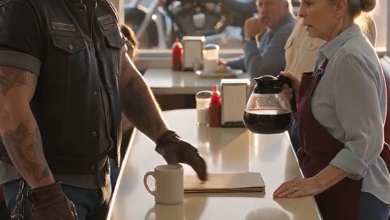
The biker stopped on the other side of the rope. He had close-cropped hair going silver and a short salt-and-pepper beard. A wordless patch on his back showed a split rail inside an iron ring. Ellen could smell cold leather and the coffee someone had spilled on the concrete. The man held one worn brown glove against the other and waited.
“I’m trying to keep an orderly sale,” Grant told the room. “People drove a long way to bid.”
Ellen looked at the investors’ chairs. She knew how far away some of them lived because they’d spent the morning talking about what the drive had cost. She nearly asked the biker to wait by the door. She was tired of people having to raise their voices over a piece of land that used to be hers to walk across whenever she pleased.
Then the biker took a wooden auction paddle out from under his arm. He turned it slowly in his gloved hand so the clerk could see the number.
“He’s got a number,” said June, Ellen’s eleven-year-old great-granddaughter.
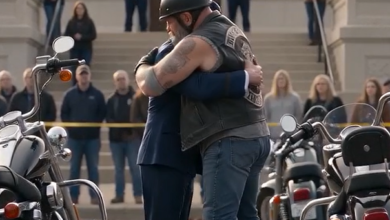
The clerk nodded and unhooked the rope. Grant took a step back. Ellen could see fifty riders standing behind the man, some with work gloves sticking out of coat pockets. One had carried the wet-floor mat out of the snow and laid it flat by the door. None of them moved toward the bidder chairs.
The biker came far enough into the shed for Ellen to get a good look at him. She still couldn’t place his face. He didn’t look up at the rafters or ask where the property line ran. He looked straight at her.
“I’m here for the farm,” he said.
The last investor in the row tucked his packet under his arm and headed for the door. The auctioneer raised his wooden gavel. Ellen held the front of her chair with both hands as the biker lifted his paddle to shoulder height.
Nobody behind him made a sound.
Part 2
The auctioneer looked down the empty row and asked for another bid.
Ellen heard the heater click off behind the clerk. She could hear someone out on the gravel trying to knock snow off a boot. Then the gavel came down.
Sold at the opening price.
The man lowered his paddle. The fifty people behind him stayed where they were while the clerk came over with a pen and showed him where to sign. Ellen watched him take off his right glove. There was a dark line along one fingernail, the kind she’d spent most of her marriage trying to get out of her husband’s hands before church.
“Do I give him the keys now?” she asked the clerk.
“You keep your keys, Mrs. Porter. We still have a closing to get through.”
Ellen knew the papers said she could stay in the house for the rest of her life. Her granddaughter Kara had read that part aloud with her twice. But the farm included the old hay barn, the garden and the lane where she took her evening walk. She’d been trying to figure out how much of a life she could fit inside the lines they’d drawn around the house.
Grant stood by the table, leafing through his packet.
“I don’t know what you think you bought,” he told the man. “There are two roofs in need of work, and you can’t take possession of the house.”
“I read it,” the man said.
“Did you see the pictures of the west roof?”
“I saw the roof.”
Grant looked over at Ellen. “There are places in town where you wouldn’t have to worry about any of this. You could’ve let us find you something.”
“Who told you I wanted to go to town?”
Grant took one page out of the packet and lined up its corners with another. For a moment Ellen thought he was going to show her something. Then he set both pages down.
The biker came over and stopped beside her chair.
“I’m Owen Reed,” he said. “People here call me Ridge.”
Ellen waited for the name to mean something. It didn’t. She looked at June, who was holding the red hat open between her hands.
“Are you going to sell the tractor?” Ellen asked.
“The tractor wasn’t in the sale. It still belongs to you.”
“What about the hay barn?”
“Could we go look at it?”
She glanced toward the house. Kara had said she’d put the kettle on when this was done. Ellen wanted to go up there and sit at her own table while she could still call it that without having to explain anything.
“There’s nothing worth seeing in the barn,” she said.
“Is the side door still the one that sticks at the bottom?”
Ellen looked back at him. The listing photos showed the big sliding doors. You couldn’t see the little side door from the drive. Her husband had put it in so she could get out of the wind when she carried feed from the house.
“How do you know it sticks?”
Owen tucked his glove into his jacket pocket.
“You used to tell me to lift the latch and kick the bottom left corner.”
Part 3
June fetched the red hat from her pocket again and held it out. This time Ellen took it. She pulled it down over her ears and asked Owen to walk on the side where the snow had covered the rut.
He did. He didn’t offer to steer her by the elbow. When she reached for his arm near the barn, he bent it a little so she could get hold of his sleeve.
“You worked here?” she asked.
“Three days.”
“I’ve had people work here for three days and spend two of them telling me how much they knew about farming.”
“I knew how to patch a roof. That’s about it.”
At the side door, he lifted the latch and tapped the bottom left corner with his boot. The door opened on the second try. Ellen remembered thinking she ought to have fixed it years ago. She had a plane in the toolbox that would take care of it. She also had sixty years of knowing exactly how hard to kick.
The air inside smelled of old straw and dry pine. A small stove still stood near the feed room, though Ellen hadn’t lit it for years. She’d had it installed when her husband was alive so they could warm their hands during lambing season. After he died, it seemed extravagant to light it for one person.
Owen looked toward the spot beside it.
“You had a cot right there,” he said.
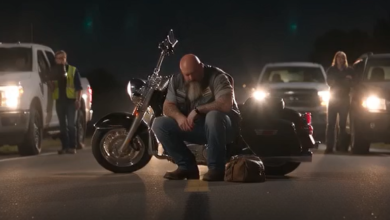
Ellen remembered the cot. She remembered the storm that knocked the county road marker flat and packed snow against the kitchen door. A young man had knocked after dark with ice on his cuffs. He’d put his motorcycle in the ditch trying to get off the road as the snow got heavier. By the time he walked up her lane, his gloves were so wet he couldn’t work his helmet buckle.
“I told you the stove was warmer than the porch,” she said.
“You brought me soup.”
“I’d made too much.”
“You brought a second bowl.”
Ellen remembered that, too. She’d gone back because the first bowl was empty when she brought him the quilt. She put the second one down with a clean spoon and said there was more in the pot if he wanted it. She hadn’t asked where he was going or why he was out in that weather. His hands were shaking badly enough without having to answer questions.
“You were thin,” she said.
“I was twenty-six.”
“You were thin at twenty-six.”
He laughed once, and she caught a little of the man she remembered. In the morning she’d pulled the motorcycle out with the tractor while he worked it upright. He stayed three days to repair a section of the barn roof where the wind had lifted the metal. She’d held the ladder while he worked and told him to come down every time the light got bad.
“Did you ever tell me your name?” she asked.
“I thought I had. Then I got halfway to Eau Claire and realized you’d only ever called me ‘son.’”
Owen walked past the stove and stopped beside a low crossbeam near the feed room. He took out a flashlight and aimed it along the grain.
“Do you still see this when you come in?” he asked.
Part 4
“SOMEDAY I’LL PAY IT BACK.”
Ellen said the words aloud. She’d passed that beam nearly every day for twenty years. Sometimes the late light hit the letters and made them look freshly cut. She’d thought one of the boys who helped stack hay had put them there to make a friend laugh. If her husband had still been around, he’d have asked what they owed each other and whether he ought to keep an eye on the socket set.
Owen tipped the light down. Beneath the sentence, tucked close to an iron brace, was a name she had to lean in to see.
OWEN REED.
“You cut that with a pocketknife?” she asked.
“I did.”
“It’s a good thing you put it somewhere that beam’s still thick.”
“Yes, ma’am.”
June came close enough to look under his arm. “Did you think she’d see it?”
“I hoped she would.”
“Then why’d you put your name so low?”
Owen considered the beam. “Because I was twenty-six.”
That made Ellen laugh. She put a hand against the wood. She remembered him at the kitchen steps the morning he left, wearing a borrowed pair of socks she’d told him to keep. He’d looked as if he wanted to say something before he left. She’d been standing inside with the screen between them, telling him the county plow had gone through.
“Twenty years is a long time to leave a thank-you note,” she said.
“I meant to come back sooner.”
“What stopped you?”
“First I figured I’d wait until I had something worth bringing. After a while I was embarrassed about how long I’d waited.”
Ellen slid her hand down from the beam. She could have told him that people came by with nothing all the time and she’d been glad to see them. She could also remember standing at the sink after he left, listening for the motorcycle to make it up the road. The part she remembered best was how relieved she’d been when it did.
“How’d you hear about the farm?”
“The auction notice. One of the riders sent it around because her sister knew your granddaughter. I saw the side of the barn in the picture.”
“That did it?”
“I could see the patch in the roof. I’d know those screws anywhere. I didn’t have enough of the right ones and you brought me a coffee tin full of whatever your husband had left.”
Ellen looked up. The patch had outlasted two gutters and a section of trim. No one had ever asked her why the screw heads were three different colors.
Owen reached into his jacket. He brought out a brown envelope with the corners bent from riding in his pocket.
“I went to see the bank about the amount you owed,” he said.
“You could’ve told me.”
“I could’ve. I wanted to be sure I could do what I came to do.”
Ellen didn’t take the envelope. “You bought the farm. What else was there?”
He held it out again.
“Putting it back in your name.”
Part 5
Ellen opened the envelope on the feed-room shelf. The first page was a letter from a lawyer Owen had asked to handle the purchase. It said that once the sale was complete and title had cleared, he wanted to transfer the whole parcel to her. It gave a number she could call and said she was welcome to have her own lawyer review everything.
She read the first paragraph again.
“What are you keeping?” she asked.
Owen looked around the barn. “My flashlight, if June hands it back.”
June gave it back without taking her eyes off the envelope.
“The whole farm?” Ellen said.
“Yes.”
“How much of your money is this?”
“Enough that I checked with my partner before I registered.”
He owned a truck repair and fabrication shop with a man he’d started out sweeping floors beside. They’d finished paying for their building the previous spring. He told Ellen there was money set aside for the shop and money he’d been putting away for himself. He’d used the second kind. He said it quietly, looking at the shelf instead of at her.
Ellen folded the letter along its old crease. “I can’t let you buy something this big because I gave you soup.”
“I know what it cost,” he said. “I also know what it meant to get to sleep someplace warm.”
Kara came in through the side door with the auction clerk. The clerk had taken off the bright scarf she’d worn at the sale and wrapped it around her ears. She asked if Ellen wanted to talk in the house, away from the wind.
“What about?” Ellen asked.
“Grant told two people on the way out that the riders ran the other bidders off.”
Owen slipped the flashlight into his pocket. “Nobody spoke to those bidders on my behalf.”
“I know,” the clerk said. “I was at the registration table. One of the women told me exactly why she left.”
Ellen had seen that woman standing on her porch earlier. She’d thought the woman was looking at the roof. Now she remembered her counting the steps with her eyes and asking Grant whether they’d have to redo the ramp if they made the house into a weekend rental.
“The version Grant gave them said the house would be empty at closing,” the clerk continued. “The auction packet we handed out says you can stay. She said that changed what she was willing to pay.”
Kara took a folded page from her coat. “Grant asked me if he could tell the buyers you’d decided to move. I said no. Twice.”
“Why didn’t you tell me?”
“You’d just gotten off the phone with the bank. I figured I’d answered him.”
Ellen knew the feeling. She’d spent months answering the question in ways she thought were clear. People kept coming back to see if her answer had changed.
“Has he gone?” she asked the clerk.
“He’s still in the shed.”
Ellen tucked the letter into her coat. “Ask him to come up to the house,” she said. “And bring the packet he gave those people.”
Part 6
Kara put the kettle on, then sat beside Ellen at the kitchen table. June brought in one more chair and set it down where Grant would have to look across at them. Owen waited by the back door until Ellen told him to sit, too.
Grant laid his packet flat. He said it was a preliminary handout, printed before the lender approved the final terms. Ellen let him finish. Then Kara showed him a message he’d sent her the night before. He’d attached the same handout and asked again if she’d tell her grandmother that a clean handover could bring a better price.
“Was there another offer?” Ellen asked.
“People were interested.”
“Was there a better price?”
“There could’ve been.”
“Would I have had somewhere to live?”
“We would’ve worked that out.”
The kettle began to rattle. Kara got up to turn it off. Ellen watched Grant follow her with his eyes as though she might come back with a way to answer for him.
Grant said the farm had gone downhill and the investors had money for repairs. One group had talked about hiring him to handle the lots if they divided the property later. He’d spent weeks showing them places and had nothing to show for it. Ellen listened until he got to the part where he’d lost money driving out here.
“I’ve lost money here too,” she said. “I still live here.”
The clerk had brought the published sale terms and the sign-in sheet. Every registered bidder had received the same final packet. The row of chairs had been open to all of them. The two people Grant had walked up to the porch that morning had signed for the revised terms, then decided the property no longer fit what they wanted. The clerk told him she would put that in the auction record and forward his handout to the lender.
Grant looked at Owen. “Fifty people is a lot to bring to a sale.”
“It is,” Owen said.
“What did you tell them they were coming to do?”
“Stand with me. Stay clear of the bidders. Help Ellen if she wanted help afterward.”
Ellen thought of the mat laid straight by the door. She’d assumed the person who put it there worked for the auction company.
Before Grant left, he told the clerk he’d send a correction to the people he’d spoken to. Ellen asked him to copy Kara. She watched him take his coat off the back of the chair. This time he asked her where she wanted the handout left.
“Right here,” she said.
After the door shut, Ellen poured four cups of tea. June took hers with enough milk to cool it. Owen let his sit untouched.
“The tax bill will come again next year,” Ellen said. “I knew what it was before the bank started paying it for me. It was more than the hay brought in that year.”
“I know.”
“And I’d like to keep the place working.”
Owen glanced at Kara, then at Ellen. “That’s what the others wanted to talk to you about.”
Ellen looked through the kitchen window. Some of the riders had gone home. Those still outside were passing a snow shovel down the line to clear the steps.
“What, exactly, did you tell them about me?” she asked.
“About what you did when I knocked,” he said. “One of them wanted to know who knocks on your door now.”
Part 7
Ellen had an answer. The mail carrier knocked when a package was too big for the box. Kara knocked once and let herself in. June came through the kitchen door hollering before it shut. But the last person she’d asked for help with the hay had been her neighbor, and he’d gone into the hospital halfway through July.
She said some of that to Owen. He asked whether she wanted the club to come back when the weather warmed up. She told him she had a fence down by the east field and she’d rather see how they handled that before she trusted them with anything that could back up over a person.
A few weeks later, she sat with her own lawyer while the closing company read out the final numbers. The sale covered the delinquent loan balance, including the tax payments the lender had advanced. After Owen’s purchase closed, the lawyers finished the separate transfer back to Ellen. She went in with Kara to see the recorded deed and put her finger on her name.
“Does that say all of it?” she asked.
The lawyer turned the page and showed her the parcel description.
“All of it,” Kara said.
Ellen wanted to see where the description turned past the back field. She asked them to show her on the survey. She’d waited a long time to be sure she could walk the lane without asking anyone. She could wait five more minutes for somebody to point out a line.
The Split Rail Riders helped establish a reserve for the farm’s property taxes while Ellen lived there. Some put in a fixed amount. Others organized a winter supper and a spring ride. Owen agreed in writing to cover any shortfall. Ellen asked that the bills still come to her house so she’d know what had been paid. The first year she stuck the receipt under a magnet on the refrigerator.
In spring, eight riders showed up for the fence. By fall there were enough to bring the harvest in before two days of rain. Ellen found out how many of them knew how to work on a farm and how many had only said they did. She put the second group on sandwiches until the first group could teach them.
June sat on a bale near the barn and dealt cards to whoever came in for water. She still wore the red hat. When one rider took a photograph of the group at the end of the day, June made Ellen get in the middle.
“What’d you do?” Ellen asked afterward, seeing the picture. “Get my whole head?”
“Even your hat.”
“That’s a shame.”
Late that afternoon, Owen brought in the last load. Ellen went to the kitchen to put leftovers away and saw a woman in a parked car at the top of the lane. The woman had her emergency flashers on. She’d turned off the highway looking for somewhere to call a tow truck.
Ellen handed June the bread and went for her coat.
By the time Owen came up to the house, the woman was warming her hands around a mug. Ellen nodded toward the barn.
“Do you think we could get another cot in there?” she asked.
Part 8
They got one more cot in. Then Ellen started asking what it would take to make the barn a place where people could stay safely. At first Owen thought she meant a few riders on the night before a harvest. Ellen meant the woman whose car had broken down. She meant somebody whose truck wouldn’t start in a cold snap, or a family who got off the highway when the roads closed and had nowhere to go.
“People come with children,” she told him one October. “We ought to be able to shut a door so they can sleep.”
Owen brought a builder to look. The man walked the length of the barn twice and asked which timbers Ellen cared about. She pointed to the beam by the feed room.
“That one stays where it is.”
The builder marked it on his drawing. The project would need more than paint and cots. Ellen listened while he talked through the work and asked if there would be a bathroom people could reach without going up a step. Later that afternoon she had Owen measure the kitchen bench. She wanted to know if there’d be room for one like it in the barn.
They brought in the harvest together for eight autumns. The last year, Ellen watched from a chair in the barn doorway with a blanket over her knees. June was nineteen by then and had brought a friend who knew how to back a trailer. Ellen listened to the two of them disagree over which way to turn the wheel. She let them work it out before she went in to put the soup on.
Ellen died at home the following winter, at eighty-eight. She’d lived long enough to see June finish school and Kara stop checking whether the tax receipt was on the refrigerator. She’d kept the old cot folded against the wall, even after her knees made it hard to lift.
After the funeral, Kara unlocked the barn. She had a copy of Ellen’s will and a letter Ellen had asked her to read there. June stood by the beam. Owen and two of the riders took their hats off when Kara opened the envelope. Nobody asked them to.
Ellen had left the farm to the club’s charitable organization on the condition that the barn become a refuge for stranded travelers. She’d worked through the terms with her lawyer years earlier. If the club couldn’t do it, the property was to go to a local nonprofit willing to carry out the same plan.
Kara looked up from the letter. “She said if anybody asks to see a membership card, you’ve misunderstood her.”
One rider laughed into his hat.
Owen took his old flashlight from his coat and aimed it up at the letters in the beam. June had seen him do it so many times she could have found the words by touch.
“How many beds did she want?” he asked.
Kara turned the page. On the back was a floor plan Ellen had drawn on graph paper, with little rectangles down both sides.
“Twelve,” Kara said. “She drew the one by the door wider.”
Part 9
It took more than a year to open the barn. The club raised money for insulation, wiring, heat and plumbing. Volunteers did the work they were qualified to do, and the club paid tradespeople for the rest. The old stove was left in place with its pipe disconnected. June set a photograph of Ellen beside it, taken at the last harvest where she’d been able to stand long enough to argue with the person holding the camera.
The finished barn had twelve beds. There were rooms where families could close a door and a low bench where people could take off wet boots. The bed closest to the entrance had space beside it for someone to move around with a walker. Owen had asked the builder why Ellen drew it wide. The builder showed him where she used to park hers while she sat at the kitchen table.
The club took turns staffing the refuge during road closures and arranged referrals with local dispatchers and tow operators. The first night it filled was a Thursday in January. A delivery driver came in with a wet sock pulled over one hand because he’d lost a glove changing a tire. Two older women shared the room nearest the bathroom. One of them apologized to June for bringing snow in.
“Everybody’s bringing snow in,” June told her. “That’s what the mat’s for.”
Near midnight, a young rider arrived in the cab of a tow truck. The forecast had changed while he was on the road, and his motorcycle had stopped running. He came in carrying his helmet with both hands. When he saw Owen near the door, in black leather with a split rail on his back, he stopped as if he expected to be told where else to go.
“Can I sit here till my brother calls?” he asked.
“You can have a bed if you want one,” Owen said. “There’s soup.”
“Do you need my name?”
“June will get it when you check in. Have something warm first.”
June set a bowl on the table. The young man took one hand off his helmet and tried to work his glove loose with the other. Owen waited until he got it. Then he showed him the bench where he could leave his boots to dry.
As they passed the beam, the young man tipped his head back to read the words. He asked Owen who’d put them there.
“I did,” Owen said.
“What’d you owe?”
Owen looked toward the table. June had put down a second bowl beside the pot and left the ladle where anybody could reach it.
“She let me in,” he said.
Later, when the young man’s brother called, June heard him say he could wait until morning. He’d found somewhere warm. She put another log on the rack by the door for a visitor who liked to sit outside with his coffee, checked that the path was clear, and went back to see if anyone needed a blanket.
Owen turned off the light over the beam. The one above the door stayed on.
Follow this page for more stories about the people who open the door when someone knocks.