A POLICE CHIEF KNELT AND SALUTED THE LEAD BIKER, THEN A TEENAGER STEPPED INTO THE PARADE WITH A SCRATCHED HELMET AND SAID, “I BROUGHT IT.”
Part 1
A POLICE CHIEF KNELT IN FRONT OF THE LEAD BIKER AND SALUTED, THEN A TEENAGER STEPPED INTO THE PARADE HOLDING A SCRATCHED BLUE HELMET.
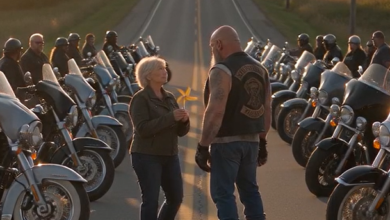
At 11:12 on Veterans Day, Nora Holt stood on Main Street in Alder Crossing, Ohio, with two cups of cider in a cardboard carrier. She’d bought one for her brother, Wade, though she knew he’d say it was too sweet. The color guard had already gone past the courthouse. Now the parade had slowed beside the reviewing stand, and she could hear Wade’s old V-twin idling over the sound of the other bikes.
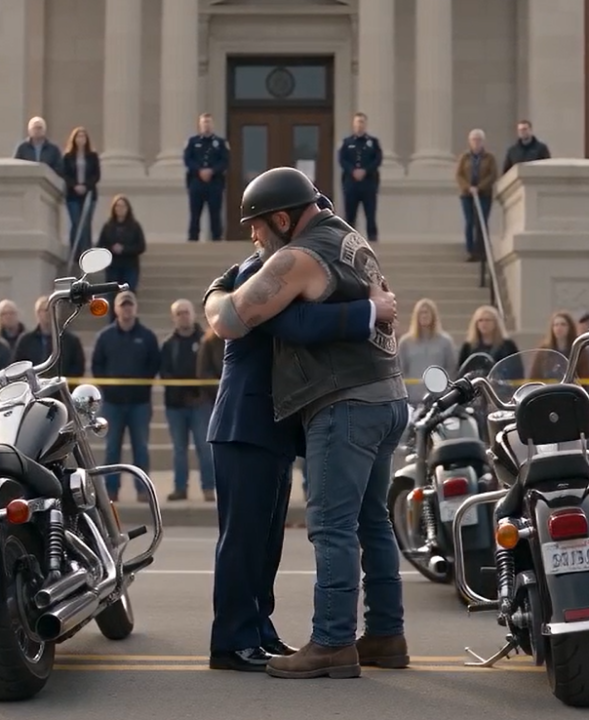
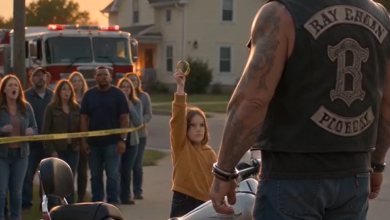
Police Chief Daniel Mercer stepped off the curb. Wade’s front wheel was already still when Mercer went down on one knee in front of it and raised his hand to his brow.
The people nearest Nora stopped clapping.
“What’d that guy do?” somebody asked.
Carl Denning, a parade marshal in a red knit cap, strode along the curb with his clipboard under his arm. “You can’t take over the route because you’ve got the biggest bike on it,” he called. He told the next rider to keep his feet down.
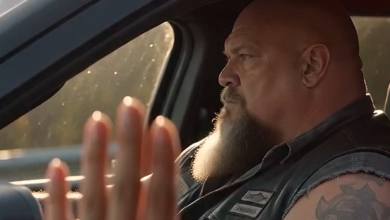
Wade shut off the engine. He was six-foot-four, with a shaved head, a long gray beard, and tattoos down both arms. His black leather cut creaked when he took his hands off the bars. He peeled off one glove and looked over at Nora without saying anything. She’d seen him make the same face when somebody at a birthday dinner began singing before he knew whose cake it was.
Carl looked back at the spectators. “You see why we try to keep these guys moving.”
A woman by the rope said, “He was stopped before the chief stepped out.” Carl lifted his radio as if he hadn’t heard her.
Nora nearly called Wade back to the curb. She could already picture the next rider starting up and leaving him there with a police chief on one knee.
Then Mercer lowered his hand.
He stood, took two steps around the front wheel, and waited while Wade swung a boot off the bike. Nora thought he meant to tell Wade where to park. Mercer put both arms around him instead. Wade kept his bare hand open behind the chief’s shoulder for a second. Then he closed it gently against the navy coat.
Carl lowered his radio. The woman by the rope let go of it with one hand. Nobody asked what Wade had done again.
Wade had only agreed to lead because the club’s usual rider was recovering from knee surgery. Nora had helped him wipe down the chrome that morning. He’d put on the same black leather cut he wore to work on his days off, the silver bridge on the back a little dull where he’d tried to clean it with a damp rag.
Mercer stepped aside. A teenager in a burgundy hoodie came out from behind him holding a child’s blue bicycle helmet. There was a silver dinosaur sticker above the rim. The boy turned the helmet so the sticker faced Wade. He held both ends of the strap to keep it from swinging.
“I brought it.”
Part 2
Wade looked at the helmet before he looked at the boy.
“Did the dinosaur lose its tail?” he asked.
The boy turned the helmet another inch. The sticker ended in a little white tear where the tail should have been.
“It caught on the garage door,” he said. “I told you that part.”
Wade opened his mouth, then closed it. Nora saw him look from the boy to Chief Mercer. His glove was still tucked between two fingers of his left hand. He let it fall onto the saddle so he could take the helmet with both hands.
“Toby?”
“Yeah.”
There was no room beside Nora at the rope. A woman with a folded stroller saw her trying to lean past and moved a foot to the left. Nora set the cider on the reviewing stand’s bottom step.
Mercer had taken off his peaked cap. There was a line across his forehead where it had been sitting.
“He was eight,” he said. “We’d all been tested. Me, his mom, everybody the transplant team wanted to test. They had to look outside the family.”
Nora turned toward the boy. At first she thought Mercer was telling Wade why Toby looked familiar. Then she saw her brother looking down at his own hands around the helmet.
“The coordinator told me you were a kid,” Wade said. “That was about all I knew.”
“You knew I got back on my bike.”
“Somebody wrote and told me.”
“I wrote it.” Toby rubbed one cuff of his hoodie between his fingers. “Mom helped with the words I didn’t know how to spell.”
Mercer’s voice carried farther than Nora expected when he spoke again. “My son had leukemia. Seven years ago, your brother donated the marrow he needed for his transplant.”
He was looking directly at Nora. She’d spent years thinking she could tell what Wade was about to do from the way he held his shoulders. She couldn’t have guessed what he’d done that spring if Mercer had given her a week.
Toby nudged the helmet a little farther into Wade’s hands.
“It’s yours,” he said. “I wore it the first time I could ride again. I only made it to the next driveway.”
“Did you make it back?”
“Mom walked the bike. I was too tired.”
Wade put his thumb over the end of the dinosaur sticker where the tail had peeled away. “Still counts.”
Someone near the reviewing stand began to clap. Nora turned toward the sound and saw the riders behind Wade doing it, gloves and all. One man set both hands on his tank and bowed his head before he joined in. Farther down the route, people started clapping without having heard a word.
The lead marshal signaled for the group to clear into the staging lot. Wade put the helmet into his saddlebag with his glove wrapped around one edge so the buckle wouldn’t scrape it. Mercer offered him a hand with the lid. Wade let him hold it.
As the riders got ready to move, Nora went around the end of the rope to collect the cider. Wade came close enough to ask if one was his.
“Seven years?” she said.
He nodded and picked up a cup.
“Where was I?”
“You drove me home.”
Nora held on to the cardboard tray after he took the cup. She remembered the hospital parking garage, the seat she’d reclined for him, and the name he’d never given her for what they’d done to him upstairs.
Part 3
Nora found Wade in the staging lot after the motorcycles had finished the route. He’d taken off his riding helmet and set it on the bike. Toby’s was on the picnic table in front of him, the strap hanging through a gap between two boards. Mercer and Toby stood a few feet away with Toby’s mother, Leah Brooks, who was opening a packet of hand warmers with her teeth.
Nora sat down beside her brother. “You said it was an outpatient procedure.”
“It was.”
“You had me take the turns so slow the man behind us honked.”
“Yeah. It hurt to sit.”
She remembered Wade buying a pillow at the pharmacy on the way home. She’d thought it was for his back because he spent his workdays leaning over a metal bench. He told her now that the doctors had collected marrow from the back of his pelvic bones while he was under anesthesia. He’d asked for his own clothes as soon as he woke up and then discovered he needed help putting his jeans on.
“Why didn’t you say what it was?” she asked.
“I didn’t know how it was going to turn out.”
Nora understood why he’d stopped there. She also remembered offering to stay with him that night and leaving when he insisted he could get around the house. On her way out she had moved his coffee mug to the bottom shelf. At the time, it had seemed like the only thing he’d let her do.
Across the table, Toby was trying to fit the hand warmers into pockets that already held his phone and a pair of gloves. Leah came over and asked if she could sit.
“We got a little information through the transplant team,” she said. “Enough to know someone had agreed. Nothing that would tell us who.”
“Were you allowed to write?” Nora asked.
“Through the coordinator. They checked that we hadn’t put in anything that could identify us.” Leah looked down the table at Toby. “I kept starting one that said thank you. He wanted to tell the guy he could ride a bike again.”
Toby shrugged. “You already said thank you. I wanted him to know the other thing.”
The family had been able to ask about direct contact after the waiting period. Leah and Daniel had let Toby decide when he was ready. At nine, he’d liked the idea of someone reading his letter. At twelve, he’d asked whether meeting the donor meant he had to make a speech. This fall, when he was fifteen, he asked for the forms himself. Both sides signed, and the coordinator released their names the month before the parade.
Wade had spoken to Leah and Toby briefly on the phone. They’d planned to meet after the parade, when the bikes were parked. He knew Toby was bringing something. He hadn’t known it would be the helmet or that the police chief would be the boy’s father.
“I told Dad you were in the front,” Toby said. “He asked if he could go first.”
Mercer looked down at his cap. “I asked the lead marshal for a moment at the scheduled hold. I had something I meant to say. By the time I got out there, I’d lost most of it.”
Nora expected Wade to say it was fine. Instead, he put both hands on the picnic table and looked at Toby.
“Can I tell you about the boy who got me to put my name down?”
Part 4
“His name was Sam,” Wade said.
Toby sat on the end of the bench. Nora thought he might ask who Sam was. He waited instead, giving Wade the time people usually tried to fill for him.
Nora remembered Sam at nine with his hair growing back in soft patches, refusing to wear a baseball cap indoors because he wanted everyone to see how much had come in. She remembered him at seven with a toy bridge across the hallway, charging her a penny to step over it. When Wade said his name that afternoon, she thought first about the penny. It had been a long time since the first thing she remembered was something that made her laugh.
“He had leukemia, too,” Wade told Toby. “His doctors looked for a donor. They couldn’t find one who was a suitable match in time.”
“How old was he?”
“Nine.”
Toby looked down at the blue helmet. His thumb found the twist in the strap again.
“Did you know I was eight when you said yes?”
“I knew you were a kid. I didn’t know if you liked bikes or hated them. I found out about the bike later.”
Nora had wondered for years what Wade did on the first Saturday after they packed away Sam’s toys. He’d left home before she got there, and when he returned, there was a folding table in the bed of his truck. She’d assumed he had gone to help with a club breakfast because the truck smelled like coffee.
He told her now he’d gone to a registration drive put on by the Milepost Riders. He’d been thirty-four. A nurse showed him how to swab his cheek, then sent him back to the table because he’d forgotten to write down his apartment number.
“I went out to the truck for a pen,” he said. “Sat in it for a while.”
“Did you think you might leave?” Nora asked.
“I did leave. Got to the corner and turned around.”
He stayed on the registry through two moves and a change of jobs. Years later, when a coordinator called about a possible match, she had to wait while he went outside the machine shop to hear her. He remembered pressing his free hand against the brick wall while she explained the next steps. He’d given a blood sample for further testing and gone through the medical evaluation before the team confirmed he could donate.
“What made you turn around at the corner?” Toby asked.
Wade rubbed one knuckle over the wood grain. “I’d wanted somebody to be there for Sam. I could put my name down for the next kid.”
Toby took his hands off the strap. “Do you want the helmet to have his name on it?”
Wade looked at him for a long moment. “This one’s yours. It ought to say what you want it to say.”
“I gave it to you.”
“I know. I’m going to keep it.”
Wade told him that the silver bridge on his vest came from a drawing Sam had made. The boy had put too many beams in it for the little bridge across the creek near their house. When the club had the emblem made, Wade asked them to leave the extra beam in. Toby got up to count it himself.
A phone buzzed on the table. Leah looked down. A parent from Toby’s school had sent her a link to a parade video.
The title said Wade had forced a police chief to stop honoring veterans and salute his club.
Part 5
Nora watched the clip once with the sound on and once without it. It opened on Chief Mercer kneeling. Carl Denning’s voice carried over the crowd, telling the riders they couldn’t take over the route. The video cut before the hug, and nothing in it showed the chief leaving the curb or Wade’s wheel already stopped.
Toby looked over his mother’s shoulder. “Does it show me?”
“No,” Leah said.
“Okay.” He sat back. “It makes Dad look like somebody told him to do it.”
Mercer took out his phone and put it down again. Nora could see him thinking about how a correction would go. If he gave the whole reason in a public statement, the people who knew Toby only as the quiet kid in a burgundy hoodie would know about the transplant by dinner.
“Can you say there was a scheduled stop?” she asked.
“I can. I want the route coordinator to say what she saw, too.”
Wade picked up the bicycle helmet from the table and checked that the strap was clear of the boards. “Start with that. Toby can decide about the rest.”
Nora found Carl by the equipment trailer, stacking traffic cones. He set one down and wiped his palms on his jeans.
“You saw the bikes were stopped before Daniel went out there,” she said.
“I was at the back of the line. All I saw when I came up was a man kneeling in the road.”
“The woman at the rope told you.”
“I heard her.” Carl looked toward the trailer. “I’d had people step into the route twice that morning. One nearly walked in front of a drum cart. I figured if I sounded sure, everybody would stay where they were.”
“You told them Wade took over the route.”
“I did.”
The man who’d posted the video had asked Carl whether the group had held things up. Carl had told him yes without checking the radio log. By the time he heard the lead marshal had cleared the pause, the clip had already been shared by a few local pages. He hadn’t asked the man to correct it.
Nora left him with the cones and went to the reviewing stand. The woman with the stroller was still there, waiting for her granddaughter to come back from the marching band bus. Her name was Darlene. She’d been filming the street so her husband, who couldn’t stand that long, could watch later from home. She offered to show Nora the whole recording before she agreed to send it to anyone.
From the opposite curb, the order was plain. A marshal’s arm went up. Wade stopped with both boots down. The marshal spoke to Mercer and waved him across. The salute came several seconds later.
“That’s the part I’ll give them,” Darlene said. “I’ve got the boy at the end, too. His folks can have that.”
Nora took the short stretch back to Mercer. He watched it with Toby beside him. When it ended, Toby asked if there was a way for people to hear why he’d brought the helmet without having to watch his father kneel over and over.
“What would you want them to do after they heard it?” Mercer asked.
Toby thought for a while. Then he asked Wade, “Could people put their names down here next year?”
Part 6
Wade said he’d find out. Nora had heard him use those words for broken washing machines and shifts nobody wanted. This time he took a folded parade program from his pocket and asked Toby to write down what he meant. Toby wrote a table where people can sign up. Underneath, he put near where everybody already goes.
“That’s two things,” Wade said.
“I know. Can we have both?”
First they dealt with the video. The parade committee posted the wide shot, the timing of the scheduled hold, and a statement from the lead marshal. Carl signed his own correction and called the people he’d spoken to about the riders. He went to see Wade at the machine shop after his shift. Nora was there to drop off a casserole dish Wade had left at her house.
“I said you held up the parade,” Carl told him. “You were following the stop signal. I should’ve checked before I opened my mouth.”
Wade set down the wrench he’d been cleaning. “People were listening to you.”
“Yeah. That’s why I went back and told them myself.”
Carl handed him a printout of the correction. Wade folded it and set it under a paperweight so it wouldn’t blow off the bench when someone opened the bay door. When Carl turned to leave, Wade asked if he still had the club’s portable tables from the year before.
“Six of them,” Carl said. “Two wobble.”
“Bring those first.”
Nora watched Carl write it down.
By February the registry coordinator had walked the family and the club through what a drive would require. They needed trained staff, enough room for people to read the consent material, a separate place for anyone with questions, and a way to track registrations from the partner sites. The reviewing stand could hold a few folding tables. Toby’s second line on the program turned out to be the harder one.
They ended up with the community college field house just off the route, plus partner tables on two nearby campuses and at a veterans’ community center. Mercer handled permits and access. Wade and the riders repaired the wobbly tables and found volunteers to carry supplies. Nora took the phone calls that started with, “I can help, but I can only stay an hour.”
Toby agreed to record a short invitation with his parents’ permission. When the volunteer with the camera asked if he wanted to start with the day he got sick, he shook his head.
“Can I start with the driveway?”
“What driveway?”
“The one I rode to. Mom had to walk my bike home.”
They recorded it at his kitchen table. He held a recent photo of himself on a bicycle. His old helmet stayed at Wade’s house, on the shelf by the front door. Toby asked that the original parade clip stay out of the invitation. Mercer let him read the final version before anyone posted it.
When Nora went to Wade’s one evening with a box of supplies, she found him at the kitchen counter with the blue helmet beside two paper cups of coffee. He’d set one cup out for her.
“Do you think anybody will come who wasn’t going to come anyway?” he asked.
She told him she didn’t know.
Wade pushed the second cup toward her. “I was only there to drop off a table.”
Part 7
On Veterans Day the following year, Nora went to the field house before the parade. One of the tables Carl had repaired still rocked on the uneven floor, so he crouched and folded a piece of cardboard under a leg. A college student offered to hold the table steady while he worked.
“You here to volunteer?” Carl asked.
“I came to sign up. I can stay after if you need somebody.”
Carl looked across at Nora. She pointed to the coordinator, who already had a stack of blank volunteer badges beside the check-in sheets.
The field house opened an hour before the color guard stepped off. A few people came in with cider. Others came through the door and stopped because they were unsure where to go. One woman at Nora’s table had promised her daughter she’d ask what would happen if she ever matched.
“You can take your time,” Nora said. “There’s somebody at that table who can answer questions.”
The woman went over. A half hour later, Nora saw her leave with her daughter’s arm tucked through hers. She didn’t know whether the woman had joined. She was glad the woman had stayed long enough to ask.
Mercer stopped by in uniform. He helped move a box of empty kits away from a door, then went outside to meet the color guard. He’d asked Toby if he wanted him to make a speech that day. Toby had said they already knew what the chief looked like when he couldn’t remember one. Mercer laughed hard enough that Nora heard him from the next table.
Wade rode at the front again. This time the parade moved past the reviewing stand without an extra pause. Nora watched him lift two fingers from the grip when he saw her. After he parked, he came into the field house with the silver bridge on his back and set a stack of fresh forms next to Carl.
“Look at the far door,” Carl said.
A line had reached the hallway. Near the end of it stood the daughter of one of the riders, still wearing the black apron from her morning bakery shift. Behind her was a student who’d volunteered at check-in, gone home to get his roommate, and come back with two more people.
Toby walked in holding a helmet. It took Nora a second to recognize that it was his current bicycle helmet. The blue one was still on Wade’s shelf. On this one, two small white labels sat side by side below the back vents.
TOBY.
SAM.
Wade looked at the names, then at Toby.
“Are you sure?”
“Yeah,” Toby said. “But I’m still the one who gets to complain if it pinches.”
Wade laughed. Nora saw him rest one hand on the bench and leave it there until he could speak.
The coordinator called a few days later with the final number from the parade-day drive and its partner sites. A total of 1,218 people had completed registration. Nora wrote it on the back of an envelope and called Wade at the shop. For several seconds she could hear the compressor running on his end.
“Can you say it one more time?” he asked.
She did. When they hung up, she turned the envelope over. It was the one Toby had used to send Wade a copy of the bicycle photo. He’d written a question under the picture.
When I’m old enough, can I ride beside you?
Part 8
Toby spent the next two parades riding his bicycle with the youth group. Afterward he helped at the registration tables until the coordinator sent him to get something to eat. Wade never hurried him about the motorcycle. When Toby turned eighteen, finished his rider course, and had the proper license, he brought his own motorcycle to Wade’s garage one Saturday. The first thing they did was adjust a mirror that kept moving when he hit a bump.
Nora came by with coffee while they were still working. The garage smelled of gasoline, oiled rags, and the bag of doughnuts she’d set too close to the heater. Toby’s new riding helmet was on the bench. It had the same two names on the back, in small white letters under the edge of the reflective strip.
“Can you read them from behind me?” Toby asked.
“From a few feet away.”
“That’s far enough.”
At the next Veterans Day parade, the lead marshal left room for two motorcycles across at the front. Toby rode beside Wade, with both bikes moving at parade pace and the riders behind them keeping their distance. Nora watched from the same corner near the reviewing stand. Carl was a little farther down, holding a rope steady for a child trying to get a look at the color guard. Mercer stood beside him in his navy coat.
When Wade and Toby passed, Mercer put his hand to his brow. He stayed on the curb this time. Toby had told him the night before to do whatever felt right as long as he didn’t make the motorcycles stop in front of the marching band. Mercer had promised he’d keep out of the tuba player’s way.
After the parade, Nora went to Wade’s house to drop off the leftover cider. The old blue bicycle helmet was still on the shelf. The dinosaur sticker had curled a little farther away from the shell. Next to it was a photograph she hadn’t seen there before. It showed Sam crouched beside his toy bridge, holding up one finger because he wanted a penny before she crossed it. She remembered taking it. She’d been sitting on the floor with her purse open beside her.
Toby came in behind her and set his riding helmet on the bench. He noticed the photograph.
“Which one was the extra beam?”
Wade stepped up beside him. He pointed to the middle of the bridge, where a narrow piece of wood stuck out too far on one side.
“That one. He said it would hold better.”
“Did it?”
“It held a stack of library books.”
“Pretty good, then.”
Nora took the cider cups out of the tray and handed them over. The first time she’d watched a crowd look at Wade’s black leather cut, she’d nearly called him off the street to spare him what people might say. She still noticed the leather when he came through a door. These days, what she looked for next was the extra beam.
Wade took a sip and made the face she’d expected him to make years ago.
“Too sweet?” she asked.
“Little bit.”
Toby reached up and set his riding helmet on the shelf beside the little blue one. He turned it until both names faced the door.
Follow the page for more stories like Wade’s.