A FOREMAN RIPPED A BIKER’S WARNING CONE OFF THE ROAD, THEN A LITTLE GIRL POINTED INTO HIS FLASHLIGHT BEAM AND SAID, “IT JUST STOPS.”
Part 1
THE FOREMAN YANKED THE BIKER’S CONE OFF THE ROAD, THEN FELL QUIET WHEN A LITTLE GIRL SAW WHERE THE TIRE TRACK ENDED.
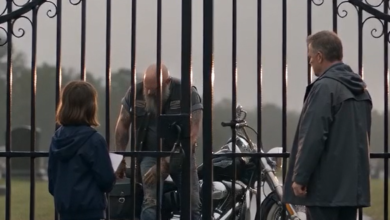
At a little after midnight outside Bell Creek, Ohio, Hank Ellis laid his bike down on Quarry Road. A skinny golden dog had darted in front of his wheel. Hank got up with both forearms scraped, tugged off one worn leather glove, and lifted it to shoo the dog toward the ditch. The dog stayed across his path. It barked into the dark ahead. Hank took a folding orange cone from his saddlebag and set it behind the bike.
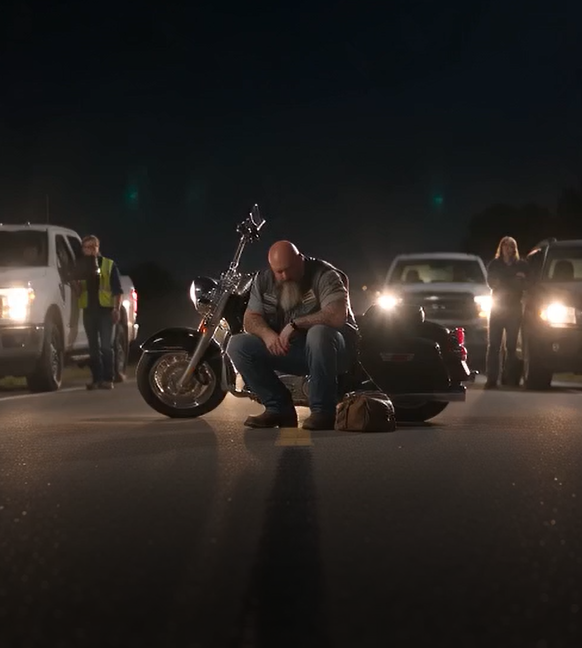
A white work pickup rolled out of a gravel turnout. Wade Mercer got out in a fluorescent vest, walked straight to the cone, and yanked it off the pavement. Two cars and a pickup had stopped behind Hank by then. Their headlights lit the tattoos on his arms and the bare iron wheel stitched across the back of his short-sleeved black leather jacket.
“You dropped your bike, pal. Quit playing deputy.” Wade shoved the cone into the bed of his truck. “The rest of us have places to be.”
Hank could smell gas and hot leather. The engine ticked as it cooled. He pressed the glove against the worse scrape and listened. The dog had gone quiet while Wade talked, but the instant the man stepped toward the centerline, it barked again. Hank looked from its face to the stretch of blacktop beyond it. The dog hadn’t once looked at the fallen bike.
Wade put up both palms for the people watching. “I came back to help him. Now he’s trying to tell me how to run my own road.” Someone behind the wheel of the second car said Hank ought to move the motorcycle. Tessa Miller, who’d stopped first with her nine-year-old daughter beside her, took half a step back toward the driver’s door. She’d seen the bike down. The rest was anybody’s word.
Hank bent slowly, opened the same saddlebag, and brought out a small flashlight. Wade made a show of stepping aside. Hank aimed low. The beam slid over the centerline and picked up a wide tire track in pale construction dust, the sort a truck left when it dragged dirt onto blacktop. Nora Miller stood beside her mother’s front fender on the gravel. She lowered the rabbit she’d been holding against her chin. Wade turned toward the light, one hand still on his truck bed. The driver who’d wanted the bike moved took his foot off the gas.
“I just want to see what he’s barking at,” Hank said.
He’d ridden Quarry Road home from his repair shop for years. Even without a headlight he knew where the shoulder widened and where the pavement dipped. This stretch should have been flat. The beam followed the track about a hundred feet before it reached a straight dark seam.
From the gravel, Nora could see the dusty tread between two pools of headlight. Each print had the same little notch. She lifted one hand toward her mouth as the beam held on the place where another print should have been.
“It just stops.”
Part 2
Hank tilted the flashlight just enough to catch the far wall of the cut.
There was blacktop, then a drop through two layers of gray stone into raw clay. A hundred feet from his front wheel, a trench crossed both lanes. The beam caught a yellow strap down in it and the wet curve of a pipe, low enough that a person standing at the bottom couldn’t have looked out over the road.
He’d been doing forty.
“Turn your hazards on,” he said to Tessa. “Stay where you are.”
He called 911 with his bare hand. The other one kept the light on the cut. He gave the dispatcher the road name and the closest cross street, then had to give both again because he was talking too fast.
“Has anyone gone in?” she asked.
“I can’t see the whole bottom.”
“Stay back from the edge. We’re sending someone to both ends.”
Behind Hank, the car that had crept forward clicked into park. Tessa went to its driver and asked him to put his flashers on, too. He did it without rolling his window down.
Wade was still standing at his truck bed.
“You knew they dug it?” Hank asked.
“I knew where we dug it. The plate crew should’ve been here.”
“You were going to wave us through.”
“I was getting your cone out of the way so I could back up.” Wade glanced toward Tessa. “That’s all I was doing.”
Hank looked at the bed of the pickup. His orange cone lay against a clean rectangle in the dirt, the sort left when something broad and heavy had been sitting there. He’d had enough arguments in his repair shop to know when a man was going to start explaining one sentence at a time. He gave the dispatcher the truck’s location instead.
He’d been coming home from a late job at Ellis Repair. A home health aide needed her starter replaced before her morning rounds, and Hank had stayed to finish it. His club knew him as Wrench. Tessa knew him as the man whose shop used to work on her husband’s pickup, though they’d only met across the counter a couple of times. Wade, so far as Hank could remember, knew him from the back of his jacket.
“Is that dog yours?” Tessa called.
“First time I’ve seen him.”
“Can he come over here?”
Hank lowered himself onto the gravel. It took him two tries. His knee had started to stiffen through his jeans, and both forearms burned where the road had taken the skin off.
The dog watched him sit. Then it crossed the white edge line, settled beside his boot and gave the gravel two little sweeps with its tail.
Nora still had the rabbit under her arm.
“Mom,” she said, “why’s he only limping now?”
Hank looked down. The dog had put all four paws on the ground until he’d reached Hank. Now his left rear foot hovered just above the gravel. Under the road dust, there was a pale line in the fur above the joint.
Then Wade reached into his pickup for his phone.
“I’ve got a picture,” he said. “You ought to see what this road looked like before he got here.”
Part 3
By the time Deputy Amy Brooks came up Quarry Road, another cruiser had blocked the far end. Hank could see the blue wash beyond the trench whenever the nearer headlights dimmed. Under the deputy’s spotlight, the drop looked close to six and a half feet where a section of clay had slumped away.
Wade held his phone out before she finished asking if anybody needed an ambulance.
The picture showed two striped barricades in the headlights of a truck. An amber lamp sat on top of each one.
“Taken tonight,” Wade said. “He had time to put his own cone out. Who knows what else he moved?”
Hank could see how well it worked as a story. There was his motorcycle on its side. There were his fresh scrapes and his cone in somebody else’s truck. Wade had a photograph with a time under it.
“Which side did you take that from?” Hank asked.
Wade pulled the phone a little closer to his chest. “Right here.”
The deputy asked him to send her the original photo. Then she walked the three drivers back to their cars one at a time and asked each of them where they’d stopped and what they’d seen. Tessa took Nora with her. When the driver in the second car got his turn, he went over to the deputy without looking at Hank.
Hank was trying to decide how he was going to get the dog to stand up when he heard the man say, “I called for him to move the bike. If he’d listened, I was next in line.”
A county road supervisor arrived with a crew and equipment to close the road. Hank let a paramedic clean and wrap his arms. A tow operator got the cruiser upright and winched it onto a flatbed. Hank had the tow driver wait while he took a clean moving blanket from his saddlebag.
Animal control was covering calls from the other side of the county. The deputy put Hank on the phone with the officer, who arranged for an overnight clinic to examine the dog and told him where to bring him for intake in the morning. Tessa offered her car. Hank offered to put the blanket on the floor so the dog could ride low.
Nora helped by moving her school backpack out of the way. She held the stuffed rabbit against the open door and waited while Hank sat on the sill. Once the dog had sniffed his glove, he climbed in by himself. His back foot dragged briefly over the rubber mat.
“Has he got a collar?” Tessa asked.
Hank ran two fingers along the fur at the neck. No buckle, no tag. Just a faint flat place in the coat where something might once have sat.
At the clinic the scanner passed over the dog’s shoulders twice without a sound. The vet put a hand on the old scar and eased the leg back a little.
“He’s been carrying this for a while,” she said. “Once he’s settled, we’ll get a better look.”
She asked where they’d found him. When Hank told her, she put her pen down.
“There’s a man on Quarry Road who’s been leaving water out for a golden dog,” she said. “Write down his number.”
Part 4
The man’s name was Walt Brennan. When Hank called after breakfast, Walt asked him to describe the dog’s left back leg before he asked anything else.
“Scar’s pale,” Hank said. “About the length of my thumb.”
“Dog’ll sit with that foot out sideways. You see him do that?”
Hank looked through the glass at the county shelter. The dog had pushed a towel against the corner of his run and was sitting with the left foot pointing out.
“I’m looking at it now.”
“Then you’ve got the one.”
Walt drove over with a bag of kibble folded shut with a wooden clothespin. He wore a pair of brown slippers. When the intake worker pointed out that he could take them off and wait while she fetched a mat, he looked down as if he’d only just noticed what he’d left the house in.
He told Hank the dog had spent two winters between an equipment turnout and an old pump shed, taking food from him if he went back inside. People along Quarry Road had stories about him getting in front of vehicles. Walt could give Hank three names. One was a mail carrier who’d stopped while a downed limb was still hidden around a curve. One was a man who swore the dog had made him stop for nothing. The third had left a note in Walt’s mailbox about a deer lying in the lane.
“I thought somebody ought to catch him before he got hit again,” Walt said. “Never could get a leash near him.”
“Again?”
Walt looked at the scar. “Ben got him patched up the first time. Had to carry him out from under a utility trailer.”
Hank knew the name before Walt supplied the rest of it. Ben Miller had brought his pickup to Ellis Repair with a little pink sock jammed between the dash and the windshield. He’d refused to move it when Hank asked if he wanted the dash wiped down.
“Daughter put that there,” Ben had said. “It’s for luck.”
Tessa came to the shelter with Nora that afternoon. The girl had washed the stuffed rabbit and its ears were still damp. Hank asked Tessa if he could talk to her by the door first.
“Walt says the dog belonged to Ben.”
Tessa stood there holding the strap of her purse with both hands.
“He told me he had a yard dog out there,” she said. “I thought somebody on the crew took him after.”
Hank waited. He’d heard different accounts of Ben’s death two years earlier. The only detail everybody agreed on was the road.
“He was packing up at the work site,” Tessa said. “A driver came through the flagging station. That’s all Nora knows. Dad was at work and a driver came through.”
She looked in through the glass. Nora had crouched down to look at the dog. He’d moved to the gate and was holding his bad foot out from under him.
“Ben had a picture on his phone,” Tessa said. “He used to show it to people who asked why he kept buying two breakfast sandwiches.”
She took out her own phone, found a photo and handed it to Hank. There was Ben on a truck step, one hand holding half a sandwich, the other resting on a golden dog’s head. A fluorescent orange collar showed under his thumb.
Hank looked past the dog to the man leaning on the driver’s door.
It was Wade Mercer.
Part 5
“He was Ben’s crew lead,” Tessa said. “He drove me to the hospital.”
Hank handed the phone back. Through the glass he could see Nora working the soft ear of the rabbit between her fingers. He asked Tessa what she wanted the girl to hear.
“Let me tell her whose dog it was,” she said. “The rest can wait until she asks.”
Hank went out to the parking lot while she did it. His arms hurt when he leaned on the hood of the loaner truck. He stood there for a while listening to somebody in the next lot try to start a riding mower. When Tessa came out, Nora walked straight to him.
“Did he see my dad get hurt?”
“I don’t know, honey.”
“Does he know my dad’s gone?”
Hank let that one sit. “I know he kept going back to where your dad used to take him.”
She looked down at the stuffed rabbit. “Can he have this?”
“He might chew the eyes off. You could bring an old towel.”
Nora considered that. “We’ve got one he can keep.”
The shelter posted the dog as found and checked the information Tessa and Walt had given them. Tessa brought in a second photo and signed a statement about Ben. Her rental had a no-pets clause, and Hank said he’d fill out an adoption application once the shelter cleared the dog for placement. The staff put his name on the contact sheet. For the next few days, he came in after work and sat beside the run with an old shop towel folded under his knee.
On the second evening, Tessa found him there.
“Have you seen what Wade’s saying?”
She handed him her phone. A cropped copy of the barricade picture was making its way through the town’s Facebook group. Wade had added that he’d returned to find a motorcycle down and the traffic controls disturbed. People had begun naming Hank in the replies. One person had found a picture of him in front of his shop and circled the patch on his jacket.
Tessa slid into the chair next to him.
“I stepped back toward the car when he said you were trying to run the road,” she said. “I was going to back out and leave you both there.”
“You stopped when Nora spoke.”
“I should’ve stopped sooner.”
Hank could hear the dog licking his water bowl where the water was already gone. He got up and filled it at the utility sink.
“Tell Amy what you saw,” he said. “That’s enough for tonight.”
Tessa stood up to take her phone back. Then she looked through the glass doors at her car.
“There’s a little camera on my windshield. Ben’s sister bought it for me after somebody clipped my mirror at the diner. I never learned how to get anything off it.”
“When did you last drive?”
“Here. Before that, to work and back.”
Hank knew some cameras recorded over old clips in a loop. He grabbed his keys.
“Leave the car off,” he said. “Let’s see if it’s still there.”
Part 6
The card was smaller than Nora’s thumbnail. Hank put it into an adapter at his shop and copied the files before opening any of them. Tessa stood beside his desk in her diner apron, reading the times off the screen while he clicked through the clips.
They found Quarry Road in a file named for the day before. The camera clock was an hour slow.
“That’s us,” Tessa said. “That’s the turn.”
Her headlights swept across the gravel turnout as she came around the bend. The near approach was bare. Then the cruiser came into view on its side and the car stopped. Hank walked into the edge of the frame with the little orange cone. A minute later, Wade carried it off.
“Can you see the trench?” Tessa asked.
“Too far ahead.”
“Can you see where the barricades should’ve been?”
Hank moved the video back to the turn. “You can see the approach.”
She took a breath. “So he can still say you moved them before I got there.”
“He can say it,” Hank said.
He sent Brooks the complete clip, including the minute before the turn. The deputy asked Tessa to hold on to the original card. Hank printed the still of Wade carrying his cone away and set it facedown on the desk. It was tempting to answer the Facebook thread with that one frame. It could establish one thing Wade had done. There were still a few things Hank wanted to know.
One of them walked in on Friday wearing his road crew shirt inside out.
Eli Porter was twenty-three. Hank recognized him from a mower repair the previous summer. He’d paid for a belt in quarters and apologized for counting them out.
“You do truck lights?” Eli asked.
“Sometimes.”
Eli looked through the open bay door. Then he asked Hank if the deputy had gotten Wade’s picture.
“She has the original.”
“I took it,” Eli said.
He sat on the low stool by the tire machine. His knees stuck up above his hands. The barricades had been set before the digging started, he said. Wade told him to take a photograph for the job file. At the end of the shift Wade said the crew hauling the steel plates was five minutes away. They’d need a clear approach. Load the barricades, clock out, go home.
“So I did,” Eli said. “I figured he’d stay with the truck lights on.”
“Did you see him stay?”
“I saw him follow me into the yard. He signed me out.”
“Tell the deputy that.”
“If I tell her, can they fire me?”
Hank thought about what it would cost the kid to lose a week’s pay. He also thought about the man in the second car lifting his foot off the gas. Both things deserved an honest answer.
“I don’t know,” he said. “You can call her from here.”
Eli pulled out his phone and searched for the crew conversation. There was Wade’s order to load out. Just below it was a message from the plate driver saying he’d broken down on the way.
Eli stared at the tiny name beneath it. Wade had answered him almost an hour before Hank came down the road.
Part 7
Eli gave Brooks the message thread and a copy of the photograph from his own phone. The contractor’s yard records put Wade’s truck back at the equipment shed before the crash. When Brooks asked Wade why he’d returned to Quarry Road, he finally told her a resident had called the company number about the open trench.
What Hank had taken for a man sitting nearby keeping watch had been a man turning his truck around in the dark.
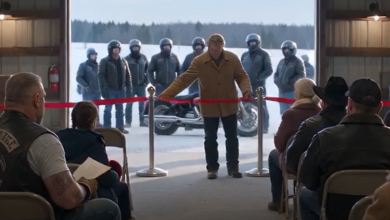
The county held a public meeting once the road was repaired and the review was complete. Hank went because Tessa asked if he’d sit beside her. Six riders from the Iron Spoke Motorcycle Club came in behind him, carrying their helmets. They filled the last row and kept them on their laps. One of them had left his reading glasses at home and leaned over to share the meeting packet with the man beside him.
A county engineer walked the room through the timeline. The warning gear was removed early. The plate truck was delayed. The foreman knew about the delay and still left the approaches unguarded. The photographs Wade had circulated were taken before the trench was opened.
When the engineer showed a still from Tessa’s camera, Hank could see the back of his own jacket, crooked at the shoulder from the fall. His cone was a pale blur in Wade’s hand.
The engineer said the county had assessed a contract penalty and suspended the contractor’s work until an independent crew could review its traffic controls. The contractor’s manager stood up to say Wade had been removed from field supervision and that the company would correct its account of the incident in writing.
Wade sat two seats from the aisle. He waited until people began folding their packets before he spoke.
“The equipment was late,” he said. “I was trying to keep a crew from standing there on overtime.”
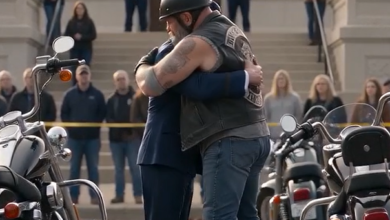
Tessa turned toward him. “After Ben died, you drove me to the hospital in that truck.”
Wade’s hands stopped moving.
“You waited in the parking lot until my sister got there,” she said. “I remembered that when you told me Hank was the problem. I figured you’d know better than the rest of us.”
“I should’ve called the county when the plates didn’t come,” he said.
“Who did you think was going to come around that turn?”
He looked down at the folded packet on his knee. Hank waited long enough to hear the ventilation fan shut off. Wade never answered her.
Outside, the driver who’d wanted the motorcycle moved caught up with Hank. He owned a small upholstery shop. He said he’d already asked Tessa if he could do something for the family.
“She said you might know what would help.”
Hank had been thinking about a thing Tessa told him at the shelter. After Ben died, people had brought dinner every night for a month. Her first car repair bill came in month two.
“How are you with canvas?” Hank asked.
“Pretty good. Why?”
“Come by the shop Saturday. Nora drew something we could use.”
Part 8
The shelter called after the hold and ownership checks were finished. Hank signed the adoption papers on a Thursday, paid the fee, and went back out to the truck for his wallet because he’d left it sitting on the dash. By the time he came back, Nora was leaning over the counter to watch the clerk fill out the tag order.
“What’s he called?” the clerk asked.
Tessa had heard Ben call him Buddy, along with every other dog he’d ever stopped to pet. Walt had called him Hey. Hank had been saying “easy” so often he was fairly sure the dog thought it was his name.
“Beacon,” Hank said.
“Like a light?” Nora asked.
“Like the one that should’ve been out there.”
The dog had gained a few pounds. His exam and X-rays showed an old healed injury, and the clinic gave Hank a plan to build him up with short walks and check how he managed as he got stronger. He still sat with his left foot turned out. At the shop, he picked the one place Hank had to step over him every time he went for a socket.
One afternoon Nora brought over a faded orange towel. She’d found it at the back of the linen closet and asked Tessa whether she could cut it to fit Beacon’s bed.
“Dad used it when he fixed things in the driveway,” she told Hank. “Mom says that’s why it always smells a little funny.”
Hank spread it across the bed, grease stain up. Beacon sniffed from one corner to the other and lay down with his chin on the stain.
The first benefit ride took shape on the shop’s folding table. Tessa wanted a fund that could help families with the expenses that showed up after somebody had been hurt or killed on a job. The riders had figured on giving all the money to her. She helped them set up a fund through a local community foundation instead.
“What about a guy who gets hurt and comes home?” Eli asked. He’d come in to fix the table leg, which folded if you leaned on it. “His wife still has to take off work.”
Tessa slid him a chair. “Write that down.”
On Saturday the upholsterer came by expecting to measure a seat. Nora handed him a pencil drawing of Beacon in profile, sitting crooked, one back foot out. She’d drawn the pale line on his leg in white crayon. You had to turn the page to the light to see it.
The club used her drawing for its new patch and a flag. The dog went inside the old iron wheel, with his head turned toward the road. They put the ride’s motto, “Watch the Road Ahead,” on the paper route sheets. Nora asked if the man making the patch could please leave Beacon’s foot the way she drew it.
He did.
Hank thought that was the end of the design meeting until Nora pulled out another sheet of paper. She’d drawn the bike from the side. Next to it was a low box with one wheel.
“He can’t ride on your lap,” she said. “So I figured out where he goes.”
Part 9
Three years after the crash, two hundred motorcycles lined up for the annual benefit ride through Bell Creek. The first time they’d done it there had been twenty-six. Hank remembered because Tessa had bought thirty rolls for breakfast and spent the afternoon handing out the last four.
Now she ran check-in under the diner awning. Nora, twelve and tall enough to reach over the sidecar, helped Hank fit Beacon’s goggles. She’d learned to put one finger under the strap while he tightened it. Beacon got in on his own, waited for his harness to be clipped to its short tether, then sat with one back foot stretched across the padded floor.
The first practice session in that sidecar had taken place with the engine off. Beacon had climbed in for a piece of chicken and climbed right back out. It took weeks of short trips before he could settle through a turn. Now, if Hank left the garage door open on a Saturday morning, he’d find Beacon sitting in it before he’d had his coffee.
“You got the flag?” Nora asked.
Hank checked the mount behind the sidecar. Nora’s drawing pulled straight in the breeze. Through the cloth he could see the pale mark the flag maker had left on the dog’s leg.
A woman in a grocery-store uniform came over while he was checking the harness. She asked if he was the fellow she should thank for a set of tires. Her husband had come home from a paving job with a broken pelvis the previous winter. She’d been driving him to appointments on a spare.
“Talk to Tessa under the awning,” Hank said.
“I did. She said come talk to you.”
Hank looked over. Tessa was busy taking somebody’s registration, though he could see her smile down at the clipboard.
“Did the tires get you through the winter?” he asked.
“All the way through.”
“Good.”
A town officer closed the intersection. The riders fastened their helmets and pulled on their gloves. On the sidewalk, a little boy leaned back against his mother’s knees when he got a good look at Hank. Hank knew what the boy could see from down there. He had arms like tree trunks, knuckles covered in ink and a beard that stuck out around his helmet strap.
Hank held still. The boy spotted Beacon behind the sidecar windshield and raised one finger in a small wave. Hank lifted his hand back.
Then Nora reached in and tucked the corner of a faded orange towel under Beacon’s chin. She’d brought it from his bed at the shop.
“Does he still need that?” Hank asked.
“He sleeps better with it,” she said.
Hank thumbed the starter. Two hundred engines came on behind him in uneven bursts. At the officer’s signal, he eased into the first block at parade speed. The flag lifted behind the sidecar. Beacon turned his goggled face toward the people on the curb, one crooked foot sticking out exactly as Nora had drawn it.
At the end of the block, Hank saw Tessa standing beside Nora with one arm around her shoulders. He gave them time to see the dog before he made the turn.
Beacon kept his chin on Ben’s towel.
Follow this page for more stories about the people and dogs we meet along the way.