Part 2: The Biker Tore a Girl’s Scholarship Letter Apart on the Awards Stage—Then Pulled the Real Scholarship His Entire Club Had Funded from His Vest
Part 2 — The Girl Whose Future Had an Activation Fee
My name is Maya Torres, and during senior year, I learned that hope can become dangerous when it arrives carrying exactly the number you need.
My number was $17,416.
That was the annual gap between my financial-aid package and the estimated cost of attending Ohio State’s nursing program after grants, federal loans, and the money my mother could contribute.
I knew the figure better than my own phone number.
My mother, Rosa, cleaned rooms at the Riverside Motor Lodge and repaired uniforms for restaurant workers from our kitchen after her shift. My father died when I was nine, leaving no savings and enough medical debt to teach us that paperwork could outlive a person.
I worked at Mae’s Riverside Diner four evenings each week.
Every tip went into a coffee tin marked COLLEGE, though the handwriting belonged to my father. By spring, the tin held $4,822 and smelled permanently of metal, onions, and diner grease.
I could have attended Beckford Community College and transferred later. There was no shame in that route, but Ohio State offered the pediatric nursing program I had wanted since my father’s final hospital stay.
One nurse named Patrice never lied to me.
She explained every machine, showed me where to warm my hands before touching Dad, and remembered that I took my coffee with more milk than coffee.
I wanted to become the calm person inside someone else’s worst room.
The National American Scholars Trust contacted our guidance office in March. Their representative said a regional foundation had nominated students with strong grades, community service, and financial need.
Nobody remembered submitting my application.
The organization explained that schools could nominate students automatically through a national academic database. That sounded plausible enough to stop further questions.
Their website showed scholarship recipients standing beside university signs. The photographs were real, although we later learned they had been copied from public graduation posts.
The testimonials were fabricated.
The tax-identification number belonged to an inactive charity in Nebraska.
What convinced us was their knowledge.
They knew I had applied to Ohio State. They knew my mother’s approximate income, my father’s death, my volunteer hours at Beckford Memorial Hospital, and the exact amount of my aid gap.
A random criminal could not know those things.
Someone had supplied them.
The award letter promised $70,000 across four academic years. The amount covered my gap almost perfectly, leaving enough for books and clinical uniforms.
A second sheet described a refundable verification deposit needed to establish the transfer account. It requested $2,850 within ten business days.
My mother hesitated.
“Scholarships give money,” she said. “They don’t borrow it.”
I called the organization’s helpline. A patient woman named Evelyn explained that the deposit protected donors from fraudulent recipients and would be returned with the first disbursement.
She knew my student identification number.
That detail silenced my mother’s doubt.
We borrowed against her 2009 Toyota Camry, the car she needed to reach work. The lender charged an interest rate neither of us fully understood.
The activation payment was scheduled for the afternoon after the awards ceremony.
Hammer learned none of this from me.
The Iron Lanterns had watched my college plans from a distance because one of their members, Cody, ate at Mae’s Diner every Thursday. Cody tipped in exact multiples of five and always left his booth cleaner than he found it.
He once saw me studying anatomy between customers.
Later, he asked where I planned to attend college. I told him Ohio State if money appeared from heaven and community college if heaven remained on budget.
That sentence reached Hammer.
For eighteen months, the Iron Lanterns had been building an education fund for students whose families earned too much for full aid and too little to cover the difference.
Hammer insisted the first award go to someone entering nursing.
His daughter Allison had once wanted the same career.
Sixteen years earlier, she graduated from East Mercer High with excellent grades and an acceptance to Kent State’s nursing program. Hammer worked overtime welding truck frames, while Allison waited tables near Route 8.
Then she received a $50,000 scholarship letter from the American Collegiate Promise Foundation.
Different name.
Same address.
Same signature.
The organization requested a $1,900 verification fee and copies of Allison’s Social Security card, driver’s license, tax return, and enrollment documents.
Hammer sold a custom chopper to raise the fee.
Within two months, the scholarship website disappeared. Loans appeared in Allison’s name, her checking account was drained, and her identity circulated through a network targeting students unlikely to afford attorneys.
The college placed her enrollment on hold because financial records showed undisclosed loans.
Allison blamed herself.
Hammer blamed whoever had signed the letter.
He rode to 417 Wexler Street with Bishop and Moose. The “suite” was a private mailbox inside a shipping store, but Hammer located the man collecting its mail.
Marcus Vale was not a doctor.
His real name was Martin Valeski, a former college recruitment contractor who had access to student data through third-party marketing vendors.
Hammer followed him into the parking lot.
Bishop told him to stop.
Hammer did not.
He dragged Valeski from his car and broke two of the man’s fingers before police arrived. The attack allowed Valeski’s attorney to portray the fraud complaint as retaliation from a violent biker.
Evidence was lost while departments argued over jurisdiction. Valeski disappeared before investigators assembled a prosecutable case.
Hammer served fourteen months.
Allison lost another year.
She visited him once in county jail and slid the fraudulent scholarship letter beneath the visitation glass.
“You tore his body because you couldn’t tear this,” she said.
Then she left.
Hammer kept a photocopy of that letter inside his vest for sixteen years.
He memorized the address.
He memorized the gold seal.
Most of all, he memorized the long descending stroke beneath Marcus Vale’s false signature.
On my awards stage, Hammer saw that stroke again.
The man who once attacked the criminal had six seconds to choose whether he had learned anything.
He chose the paper.
Part 3 — Six Pieces Falling Across the Stage
The awards ceremony began at ten on a bright Saturday morning. By 10:43, two hundred phones had recorded Hammer destroying my scholarship.
My mother and I sat in the front row.
She wore a borrowed navy dress, and I wore my father’s silver watch even though its hands had stopped at 2:17 years earlier.
Principal Hargrove announced several local awards before saving mine for the end. When he said seventy thousand dollars, my mother made a sound between laughter and a sob.
I climbed the stairs.
The auditorium lights erased the audience, leaving only a dark field beyond the stage. I could still hear my mother clapping harder than anyone else.
Principal Hargrove handed me the letter.
I opened it slowly because photographers had asked me to face forward. The gold seal caught the light, and the words FULL REGIONAL MERIT AWARD appeared across the top.
For perhaps twenty seconds, I believed the hardest years of my life had become useful.
Then Hammer stood.
His movement altered the room before he spoke. Parents watched the enormous biker enter the center aisle, while a security volunteer stepped toward him and reconsidered.
Hammer’s boots struck the floor.
Heavy. Measured. Coming closer.
Bishop said his name from the back row, not loudly but with warning inside it.
Hammer continued.
He climbed the side steps and stopped three feet from me. Up close, I saw gray threaded through his beard and a small white scar beside his right eye.
“Can I see that?”
I assumed the Iron Lanterns wanted a photograph. I handed him the letter.
He read the foundation’s name without reacting. Then his eyes reached the address, and one tattooed thumb moved across the printed line.
“Where’d this come from?”
“The scholarship organization.”
“Who nominated you?”
“My school, I think.”
Principal Hargrove moved between us.
“Mr. Dawson, please return the document.”
Hammer ignored him.
“Did they ask for money?”
My mother rose from her chair.
“It’s refundable.”
Hammer looked at her with an expression I could not interpret.
“How much?”
“Two thousand eight hundred fifty.”
Bishop left the back row.
“Brother,” he called. “Step off the stage.”
Hammer examined the signature. His breathing slowed, which I later learned was more dangerous than seeing him angry.
“Vale,” he said.
Principal Hargrove reached for the paper.
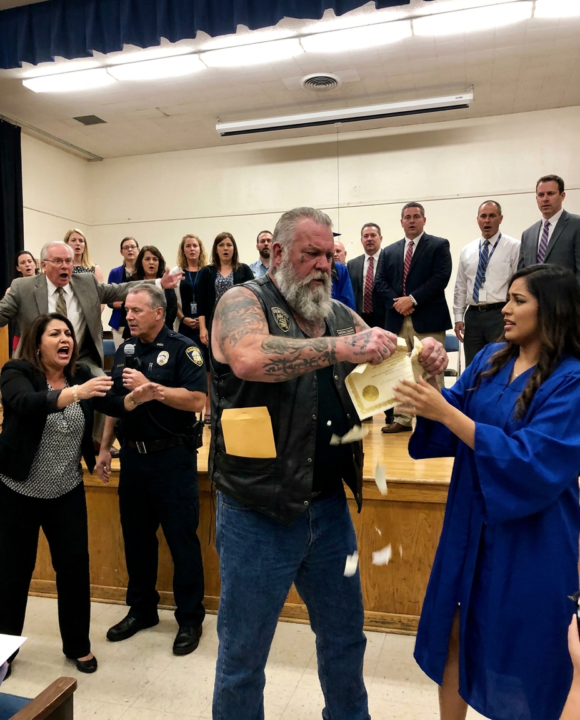
Hammer tore it in half.
My mother screamed.
He folded both halves and tore again, then separated the pieces until the letter became six irregular fragments in his hands.
One carried my name.
Another carried the amount.
A third carried the gold seal that had allowed every adult in the room to stop asking questions.
Hammer released them.
They drifted across the stage.
For one moment, the auditorium was completely silent. Then chairs scraped, parents shouted, and Principal Hargrove ordered the resource officer to call police.
I dropped to my knees.
I tried collecting the fragments as though tape could restore the money. My fingers shook so hard that each piece slipped away again.
“You had no right,” I said.
Hammer knelt opposite me.
“No.”
The answer stunned me.
He did not claim authority. He did not call himself a protector. He acknowledged that he had destroyed something belonging to me.
Then he pointed toward the verification sheet.
“But they don’t get your identity.”
My mother slapped him.
The sound traveled through the microphone.
Hammer remained still.
She struck his chest next, but her fists met heavy leather and a body that had absorbed worse things without moving.
“That was her future!”
Hammer opened his vest and removed Allison’s old letter. He placed its photocopy beside the pieces of mine.
The organization names differed, yet the address matched exactly. The signature carried the same descending line.
I stared at both documents.
Principal Hargrove accused Hammer of fabricating evidence to justify his behavior. Hammer responded by telling the officer to contact the state financial-crimes unit.
Then he said Detective Allison Dawson’s name.
Police arrived seven minutes later. Until they came, staff positioned themselves between Hammer and my family, while Bishop argued with him near the curtain.
“You promised we’d present ours after the ceremony,” Bishop said.
“Wasn’t waiting.”
“You had the evidence. You could’ve stopped the payment without doing this onstage.”
Hammer glanced toward the reporters.
“If it stays quiet, they keep the seal.”
Bishop understood before I did.
Destroying my letter publicly was not only about preventing our payment. Hammer wanted every phone to capture the address, signature, and fee before the organization could erase its website and target another student.
He had turned the ceremony into a crime scene with two hundred witnesses.
That did not make his method painless.
When officers arrived, Hammer placed his hands behind his head. Scarred knuckles closed over his shaved scalp, and the tattoos reading HOLD FAST became visible beneath the stage lights.
The first officer knew him.
“Ray, what happened?”
“Found Vale’s paper.”
“You touch anybody?”
“Paper only.”
“You sure?”
Hammer looked at my mother.
“She touched me. We’re even.”
My mother nearly slapped him again.
The officer collected every fragment using evidence gloves. The torn pieces preserved fingerprints, printing marks, and a faint tracking pattern embedded in the gold seal.
A second officer photographed the verification sheet.
While they worked, a woman entered through the rear doors wearing a navy jacket marked with the state attorney general’s office.
Her hair was dark like Hammer’s photograph, though silver appeared near her temples. She walked directly to the stage and stopped before him.
Allison Dawson.
Hammer’s daughter.
He had not seen her since his release from prison eleven years earlier.
They stood five feet apart.
Neither moved closer.
Allison looked at the torn paper, then at my mother, and finally at Hammer.
“You recognized Wexler Street?”
“Yeah.”
“The signature?”
“Yeah.”
“You hit anyone?”
“No.”
Her eyes lowered toward his hands.
“Progress.”
Hammer almost smiled.
Then Allison turned to me and explained that her task force had been investigating a network operating under eleven scholarship names. They suspected a new campaign but lacked a current victim willing to cooperate before sending money.
My letter gave them that victim.
My mother covered her face.
“We borrowed against the car.”
Allison asked whether the payment had been transmitted.
“Scheduled for four o’clock.”
“Don’t cancel it yet.”
Hammer’s head lifted.
“No.”
Allison faced him.
“We trace where it goes.”
“No.”
“It may be our best path to Valeski.”
“That’s her mother’s car.”
“The state can protect the funds.”
“You said that last time.”
The room tightened around their old argument.
Allison did not look away.
“This isn’t last time.”
Hammer’s hand moved toward the inner pocket of his vest, where a second envelope remained hidden.
The real scholarship.
He had planned to present it after my ceremony, but now police needed the fake payment to proceed without warning the scammers.
If the club revealed its award too early, reporters might publish everything and destroy the operation.
Hammer had raised enough money to save my education.
For the moment, he had to let me believe he only destroyed it.
That was the price Allison asked him to pay.
He closed his vest.
“Fine,” he said.
The word sounded like something breaking.
Part 4 — The Scholarship Hidden Inside the Leather Vest
The state arranged a controlled transfer from a protected account, replacing the money my mother had borrowed while allowing the scammers to believe their payment succeeded.
Only six people knew.
I was one of them.
Hammer was not supposed to be.
Allison excluded him from operational details because his history with Valeski created legal risks. She feared that if her father learned the collection point, he might abandon sixteen years of restraint.
Hammer accepted the restriction publicly.
Privately, he rode alone for three hours along Route 17, stopping only when Bishop blocked his Harley at an abandoned gas station north of Beckford.
The Iron Lantern president knew Hammer’s habits. Whenever rage threatened his judgment, Hammer rode until exhaustion made decisions for him.
Bishop parked across the exit.
“Move,” Hammer said.
“No.”
“I’m not going after Vale.”
“You’re riding like you are.”
Hammer shut off the engine. The sudden silence left only cooling metal, chain rattle, and trucks passing beyond the cracked pumps.
He removed the real scholarship envelope from his vest.
It contained proof of $86,000 held by an independent community foundation, enough to cover my documented financial-aid gap for four years.
No activation fee.
No personal data sent through email.
No promise dependent on publicity, grades beyond reasonable academic standing, or my willingness to pose beside motorcycles.
The club had built the fund slowly.
Cody repaired twenty-seven engines after work and donated every dollar. Moose sold his late father’s fishing boat.
Bishop contributed the settlement from an old workplace injury. Several members surrendered a month of overtime wages.
Hammer sold the blue 1978 Harley he and Allison had restored before the scam tore their family apart.
That motorcycle mattered more than the others.
Allison had painted a thin white line around its tank when she was seventeen. The line curved badly near the seat because Hammer made her laugh while the paint was wet.
He never corrected it.
For years, the motorcycle stayed beneath a cover inside his garage. Hammer started it every April, listened to the engine for one minute, then shut it down.
Selling it funded nearly one-third of my scholarship.
Bishop initially opposed the sale.
He believed Hammer was attempting to purchase forgiveness from Allison through another student. Brotherhood had carried him through prison and grief, but it had also learned to challenge the difference between generosity and punishment disguised as generosity.
Hammer insisted the scholarship was not about forgiveness.
“Then why nursing?” Bishop asked.
Hammer had no answer that convinced either of them.
The club voted anyway. Twenty-one supported the fund, nine opposed using the restored Harley, and twelve abstained.
They agreed that my award would remain anonymous until after the school ceremony. Hammer would hand me the documents only if I accepted without pressure.
Now that envelope remained against his chest while I believed college had vanished.
“Give it to her,” Bishop said at the gas station.
“Allison needs the scam quiet.”
“Then tell the kid enough.”
“Can’t.”
“You’re making her carry your secret.”
Hammer stared toward the highway.
“She’s carrying seventy grand she thinks I destroyed.”
“That’s exactly my point.”
Brotherhood reached its breaking place there. Bishop accused Hammer of trusting police more than the girl supposedly being protected, while Hammer accused Bishop of wanting gratitude before the danger ended.
Neither was entirely wrong.
Hammer finally gave Bishop the envelope.
“If I go near Vale, you hand this to Maya.”
Bishop tucked it beneath his vest.
“If you go near Vale, I’ll hand it to her while you’re back in a cage.”
Hammer restarted the Harley.
He returned to Beckford without searching for anyone.
The controlled payment traveled through four accounts before reaching a prepaid debit system connected to a storage facility outside Akron. State investigators placed surveillance around the building.
At 6:12 the following evening, a man arrived to collect packages from Box 417.
He was not Martin Valeski.
He was Beckford High guidance counselor Thomas Reed.
Mr. Reed had helped me complete financial-aid forms. He possessed my Social Security number, family income, student identification number, and college choices.
He had also led the district’s review of the scholarship organization.
The adult we trusted to protect my future had sold it.
Investigators arrested Reed inside the storage office with twelve student files, blank gold seals, and a phone used to communicate with the National American Scholars Trust.
His messages revealed that he received $600 for each student who paid a verification fee.
He had supplied records from three districts.
Allison called Hammer from the arrest site.
“Reed’s in custody.”
“Vale?”
“Not here.”
“Then it isn’t finished.”
“No.”
She paused.
“Dad, I need you to hear the next part without riding anywhere.”
Hammer gripped the phone.
Allison explained that Valeski had contacted Reed that morning. He knew police might be close, and he wanted to exchange the full student database for immunity.
The meeting would occur at the attorney general’s regional office.
Hammer was ordered to stay away.
He agreed.
Then he opened his garage and found the blue 1978 Harley parked inside.
The buyer had returned it.
A note rested on the seat.
Some things should fund a future without leaving the family. The club covered the difference.
Forty-two Iron Lantern signatures followed.
Bishop had quietly raised the sale amount again after learning what Hammer surrendered. He bought the motorcycle back without telling him.
Hammer sat beside it until midnight.
For the first time, the real scholarship inside Bishop’s vest did not feel like one man’s attempt to repay an old debt.
It belonged to the whole brotherhood.
That changed what happened next.
Part 5 — What Allison Had Been Investigating for Sixteen Years
Allison met Martin Valeski the following morning inside a secured conference room. He arrived with an attorney, a gray suit, and the same narrow smile shown in old surveillance photographs.
He was sixty-two now.
Time had softened his face without changing what his business did to families.
Valeski claimed he was merely a consultant connecting scholarship organizations with students. He blamed Thomas Reed for illegal fees and denied controlling the fake websites.
Allison placed my torn letter on the table.
The six pieces had been arranged beneath transparent evidence film. The gold seal carried microscopic toner defects matching printers found inside Valeski’s rented office.
He looked at the damage.
“Your father still tears things when he gets confused?”
Allison did not react.
She placed her own letter beside mine.
For sixteen years, she had preserved it inside an evidence sleeve. She did not keep it because she remained trapped by the scam.
She kept it because nobody had prosecuted the people behind it.
After Hammer went to prison, Allison abandoned nursing school for one semester. Then an identity-theft advocate helped restore her credit and challenged the fraudulent loans.
Allison returned to college.
She changed her major to forensic accounting.
The daughter Hammer believed he had permanently driven away spent the next decade learning how to follow money farther than his motorcycle could follow a man.
She joined the state attorney general’s office and built cases against predatory student services, diploma mills, and scholarship scams.
She did not contact Hammer.
Forgiving him privately could have created questions about her objectivity in the Valeski investigation. More honestly, she still loved him and remained furious that his violence had transformed her victimization into his prison sentence.
Both truths survived.
The Iron Lantern scholarship reopened contact between them.
Bishop approached Allison six months before my ceremony and asked her to review the fund’s legal structure. He wanted no hidden conditions, tax problems, or personal data collection.
Allison agreed anonymously.
She created the independent account, verified every donation, and insisted payments go directly to accredited schools after the recipient approved each transfer.
Hammer did not know.
The real scholarship in his vest had been protected by his daughter before it ever reached me.
That was why Allison arrived at the auditorium so quickly. The club had already invited her to attend the later presentation from the rear row.
She saw Hammer tear the fake letter before she could stop him.
Valeski believed Allison’s estrangement made her weak. He mentioned Hammer repeatedly, hoping anger would disrupt her questions.
She let him speak.
Then she played a recording obtained from Thomas Reed’s phone. Valeski’s voice described first-generation students as ideal targets because their families were “grateful before they were careful.”
My hands curled when I heard it later.
Allison’s did not.
She presented account records linking Valeski to forty-three verification payments, seventeen identity sales, and four fraudulent private loans.
His attorney requested a recess.
The meeting ended without immunity.
Valeski was arrested in the hallway.
Hammer waited across the street inside Mae’s Diner, exactly where Allison had ordered him to remain. Bishop sat opposite him with the scholarship envelope between two coffee cups.
When Allison entered, every Iron Lantern stood.
She asked them to sit.
Hammer remained standing until she crossed the room.
“You stayed away,” she said.
“Wasn’t easy.”
“It wasn’t supposed to be.”
He nodded.
For several seconds, they faced one another beneath the smell of coffee, fried onions, and rain drying on leather jackets.
Hammer reached into his pocket and produced the key to the restored blue Harley.
“I sold it.”
“I know.”
“They bought it back.”
“I know that too.”
He looked toward Bishop.
“Everybody knows things before me now.”
Allison almost smiled.
Then Hammer removed his photocopy of her scholarship letter. The folds had weakened from years inside his vest.
“I’m sorry,” he said.
Not for the scam.
Not for failing to recognize it.
For making her recovery carry the additional weight of his violence.
Allison did not tell him everything was forgiven. She took the letter, placed it beside the original in her evidence case, and closed the latch.
“Come to Maya’s presentation,” she said. “Stand in the back.”
That was their beginning.
The second awards ceremony was held one week later inside the Beckford High gymnasium. No reporters were invited until I approved them.
No organization seal appeared behind the podium.
Forty-two Iron Lanterns stood along the rear wall, their leather cuts dark against the bleachers. Hammer remained between Bishop and Allison.
Principal Hargrove apologized publicly for failing to verify the fraudulent award independently. Mr. Reed had been suspended, arrested, and charged.
Then Allison explained the real scholarship.
The Iron Lantern Education Fund would provide up to $86,000 across four years. Payments would go directly to Ohio State after I confirmed each semester’s enrollment.
I owed no activation fee.
The fund wanted no Social Security number beyond what the independent administrator legally required. The club would never receive my grades, medical details, or banking information.
There was one optional condition.
Hammer could deliver the envelope himself if I wanted him to.
I looked toward the back wall.
“Bring it up.”
His boots crossed the gym floor.
This time, people understood the sound.
Hammer stopped before me and removed the plain envelope from inside his vest. The paper was slightly bent, carrying the shape of his chest and the miles he had ridden with it.
I accepted it.
Then I handed him a small roll of clear tape.
The audience laughed quietly.
Hammer looked toward the evidence display holding the six pieces of my fake letter.
“Some things shouldn’t be repaired,” he said.
“No,” I answered. “But they should be remembered.”
We mounted the torn scholarship inside a frame with Allison’s original letter. Between them, we placed the real fund’s only rule.
No student pays to receive help.
Part 6 — The Six Pieces Behind Glass
I attended Ohio State that fall.
The first tuition transfer arrived without a ceremony, photograph, or congratulatory telephone call. I received a plain email from the community foundation confirming payment.
That ordinary message made my mother cry harder than the gold-sealed letter had.
She paid off the loan against her car after the state returned the protected funds. The Camry continued rattling through another three winters.
Hammer offered to repair it.
My mother refused to let a man who owned seven motorcycles touch “an innocent automobile.”
They became friends anyway.
Every semester, the Iron Lanterns sent one question through the foundation: Do you still want the support?
The question mattered because their help did not become ownership. I could change schools, change majors, or refuse the next payment without being accused of ingratitude.
I remained in nursing.
During my junior year, I began volunteering with Allison’s fraud-awareness program. We visited rural high schools, community colleges, churches, and libraries throughout Ohio.
We taught families to verify tax records independently, distrust urgent fees, protect student data, and contact financial-aid offices through numbers found outside award letters.
Hammer attended some events.
He never lectured.
He stood beside the exit, carried boxes, and showed parents the two addresses he had memorized. When someone asked why they should trust a convicted biker, he answered honestly.
“You shouldn’t. Check me too.”
That sentence became the safest advice in the room.
Beckford High kept the framed letters outside its counseling office. The display contained the six pieces Hammer tore, Allison’s damaged original, and a blank example showing common warning signs.
No photograph of Hammer appeared.
He requested that omission because he did not want students thinking safety depended on a frightening man recognizing a signature at the last second.
The district needed systems.
Guidance staff began independently verifying every outside award. Student records could no longer be shared with third-party programs without written consent and a documented purpose.
A compensation fund helped sixteen families targeted through Thomas Reed’s files.
Reed accepted a plea agreement and surrendered his counseling license. Valeski received a federal sentence after investigators connected his operation across five states.
The story became larger than my ceremony.
Yet once each May, Hammer still visited the empty auditorium alone.
He sat in the same rear seat where he first heard the Wexler Street address. He carried two cups of diner coffee, placing one beside him.
Sometimes Allison joined him.
Sometimes she did not.
Their relationship returned slowly, without a dramatic embrace. They met for breakfast, argued over motorcycles, and restored the blue Harley together one part at a time.
Allison repainted the thin white line around its tank.
She deliberately left the curve crooked near the seat.
When the engine finally started, Hammer listened with both hands resting on the handlebars. The V-twin rumble filled the garage and shook dust from Rebecca’s—no, Allison’s—old college boxes.
She stood beside him.
“You going to sell it again?”
“No.”
“Good.”
“Club won’t buy it twice.”
Allison laughed.
That sound traveled farther inside him than any apology.
Part 7 — The Scholarship with No Gold Seal
I graduated from Ohio State four years after Hammer tore my letter. My mother sat beside Allison in the front row, while forty-two Iron Lanterns waited outside because the university limited guest tickets.
Hammer received one.
He wore a clean white shirt beneath his leather cut and complained that the collar was trying to kill him.
When my name was called, I crossed the stage carrying my father’s stopped watch inside my pocket. The nursing pin felt lighter than the plain envelope Hammer had handed me years earlier.
Afterward, we met beside the motorcycles.
The Iron Lanterns had placed no banner across the parking lot. They simply stood near their Harleys, holding diner coffee while hot engines clicked beneath the afternoon sun.
Bishop gave me a medical bag.
Cody gave me a set of tools because he believed nurses should know how to repair everything. Moose’s widow brought the scarf he had worn during the first scholarship fundraiser.
Hammer offered nothing.
I asked why.
“You already got the expensive part.”
Then Allison handed me an envelope.
My stomach tightened before I opened it.
The paper inside contained no seal, signature, fee, or financial promise. It was a photocopy of the Iron Lantern fund’s first ledger.
Forty-two names appeared beside forty-two donations.
Hammer’s entry described the blue Harley sale, crossed out after the club returned the motorcycle. Beneath it, someone had written PAID IN MILES, NOT METAL.
I looked at him.
“You knew about this?”
“Nope.”
Everybody laughed because Hammer still remained the last man told anything involving feelings.
I began working in pediatric nursing at Beckford Memorial Hospital. My first paycheck funded a ten-dollar monthly contribution to the Iron Lantern Education Fund.
Ten dollars became twenty.
Other recipients joined.
The fund eventually stopped depending on motorcycle repairs and private sacrifice. It became a chain of former students paying forward manageable amounts without requiring anyone to sell what carried their memories.
Each spring, we award one scholarship.
The envelope is always plain.
The recipient receives seventy-two hours to review the documents with anyone they trust. No cameras attend unless the student requests them.
Hammer still sits in the last row.
Before every ceremony, he checks the organization’s address, administrator, bank, and legal filings even though Allison already examined them twice.
Then the engines begin outside.
Their low rumble crosses the school parking lot while the new recipient opens an envelope containing no urgency and no hidden price.
The six torn pieces remain behind glass.
Leave “LETTER” in the comments for more of Hammer and Allison’s journey, and follow the page for powerful biker stories about brotherhood, sacrifice, and second chances.
The real scholarship never needed a seal.
PROMPT 1 — Ảnh bài đăng hai cảnh
A vertically composed two-scene split image featuring the same biker as the central character in both scenes; top scene on a crowded American high school awards stage, Ray “Hammer” Dawson, an imposing white American biker age 56, six-foot-four and nearly 285 pounds, burly, broad-shouldered, barrel-chested, shaved head, thick black-and-gray beard, weathered sun-beaten face, deep wrinkles, scarred knuckles, prominent sleeve tattoos, neck tattoos and knuckle tattoos, wearing a plain patched black leather motorcycle vest over a faded black T-shirt, blue jeans, heavy motorcycle boots, chain wallet and silver skull ring, violently tearing a gold-sealed scholarship letter into multiple pieces directly in front of an eighteen-year-old Latina student in a graduation dress, white paper fragments suspended in the air, the girl reaching toward them in horror, her Latina mother screaming, an angry white male principal pointing toward security, shocked parents rising from auditorium seats, Hammer’s expression fierce but alarmed rather than cruel; bottom scene in a school gymnasium one week later, the same Hammer standing centrally and gently presenting the girl with a plain thick envelope from inside his leather vest, forty-two diverse adult American bikers in leather cuts standing quietly along the rear wall, a dark-haired white female state investigator in her forties watching beside him, the student and her mother visibly overwhelmed, no readable writing on any paper, clothing or signs, no text, no logo, no date, no timestamp, raw candid smartphone photography, authentic unedited Facebook snapshot, accidentally captured by an ordinary bystander, imperfect framing, awkward natural angle, consumer phone camera auto-exposure, natural deep focus, harsh everyday lighting, realistic skin and fur imperfections, mild digital noise, subtle JPEG compression, limited dynamic range, ordinary colors, unstaged real-life atmosphere, not cinematic, not polished, not professional, no HDR, no bokeh, no studio lighting, no artificial AI appearance
PROMPT 2 — Thumbnail một cảnh cao trào
The exact shocking and paradoxical climax on an American high school awards stage, Ray “Hammer” Dawson dominating the center of the frame, an intimidating white American biker age 56, six-foot-four and nearly 285 pounds, broad-shouldered, barrel-chested and burly, shaved head, thick black-and-gray beard, weathered sun-beaten skin, deep facial wrinkles, scarred knuckles, visible sleeve tattoos, neck tattoos and knuckle tattoos, wearing a plain patched black leather vest over a faded black T-shirt, blue jeans, heavy black motorcycle boots, chain wallet and silver skull ring, captured at the instant he forcefully tears an official-looking gold-sealed scholarship letter into six pieces above the podium, paper fragments frozen between his tattooed hands and the floor, an eighteen-year-old Latina honor student in a graduation dress recoiling and desperately reaching for the destroyed pages, her Latina mother screaming from the front row, an angry white male principal grabbing the microphone and pointing toward security, shocked teachers and parents rising behind them, Hammer looking dangerous yet urgently certain because he recognizes the fraudulent document, one plain unopened envelope visibly tucked inside his leather vest without readable writing, no readable text anywhere, no logo, no date, no timestamp, raw candid smartphone photography, authentic unedited Facebook snapshot, accidentally captured by an ordinary bystander, imperfect framing, awkward natural angle, consumer phone camera auto-exposure, natural deep focus, harsh everyday lighting, realistic skin and fur imperfections, mild digital noise, subtle JPEG compression, limited dynamic range, ordinary colors, unstaged real-life atmosphere, not cinematic, not polished, not professional, no HDR, no bokeh, no studio lighting, no artificial AI appearance