The Biker Threw a Little Girl’s Teddy Bear into the River—Then Police Used the Hidden Tracker Inside It to Catch the Father Hunting Her
Part 2 — Six Motels, One Teddy Bear, and a Door Nobody Could Find
My name is Jenna Cole, and by the morning Hammer threw Barnaby into the Ashford River, I had spent eleven months learning how to disappear without frightening my daughter.
We never called it hiding. Lily believed we were taking a long, inconvenient vacation, although vacations usually do not involve prepaid phones, courthouse corridors, or instructions about which windows to avoid.
Her father, Darren Cole, had never hit Lily.
That sentence kept me trapped for years because I used it whenever somebody asked whether my daughter was safe. Darren struck walls, broke dishes, controlled money, and wrapped his fingers around my throat, but he never hit Lily.
He made sure she watched.
When I threatened to leave, Darren knelt beside her and promised that Mommy’s confusion would eventually disappear. Then he bought Barnaby and told Lily the bear would always help Daddy find her.
At the time, I heard affection.
Later, I understood the warning.
The night we fled our home outside Beckford, Ohio, Lily wore pajamas beneath her winter coat. I drove barefoot because my shoes were beside the bed, where Darren had finally fallen asleep after punching a hole through our pantry door.
We reached the Willow Creek Safe House before dawn. Its address was confidential, its blinds remained closed, and every resident had a story that made ordinary sounds dangerous.
For Lily, it was three knocks.
For me, it was the scrape of a truck door.
Darren violated the protection order twice during our first month. He appeared outside Lily’s old school and later followed my sister home, but both times he left before deputies arrived.
He knew how to approach the law without touching it.
Detective Mara Nolan believed he had help from a private investigator. I believed Darren simply understood fear better than anyone investigating him ever could.
He knew I would change my hair and abandon my social media accounts. He also knew I would never take Barnaby away from Lily.
Hammer entered our lives because Willow Creek had a broken furnace.
The shelter could not publicly request repairs without exposing its location, so its director contacted the Iron Lantern Motorcycle Club. Several members were licensed tradesmen, though their jackets made nervous donors imagine something else.
Hammer owned Dawson Heating and Mechanical before arthritis forced him to sell the company. He still carried tools in one saddlebag and emergency blankets in the other.
The first time he visited, he removed his club cut before entering.
He said patches could frighten children.
Lily watched him repair the furnace from behind a doorway. When he struck his knuckle against a metal panel and muttered under his breath, she brought him a cartoon bandage.
Hammer wore it all afternoon.
That was the first contradiction I noticed—the enormous man with scarred hands who accepted a purple unicorn bandage as though receiving a military decoration.
He never asked why we lived there. He addressed every woman as “ma’am,” looked away when residents entered access codes, and declined coffee because lingering might make someone uncomfortable.
Yet Lily trusted him.
Children sometimes trust the person everyone else fears because children measure danger differently. They notice whether a large hand approaches quickly, whether a voice changes behind closed doors, and whether a smile disappears when adults leave.
Hammer’s smile never changed.
During his third visit, Lily asked about the word HOLD across his knuckles. He told her the letters reminded him not to release something important when life pulled hard.
“What did you hold?” she asked.
“A hand,” he replied.
He offered nothing more.
The Iron Lanterns treated Hammer’s silences as territory. Moose, a retired paramedic, knew when to redirect questions. Bishop, the club president, watched doors while Hammer worked.
Their youngest prospect, a former foster child named Cody, repaired donated bicycles for the shelter’s children.
They were not saints.
Hammer had served eighteen months in prison for aggravated assault after nearly killing the man who abused his younger sister. Bishop had once lost his license to alcohol.
Moose carried guilt from a highway crash where he could save only one passenger.
What joined them was not innocence.
It was the decision to become useful after causing harm.
Two weeks before the bridge incident, Darren sent my sister a photograph of Lily leaving an unfamiliar grocery store. The picture had been taken from across the street.
Detective Nolan moved us to another safe apartment.
Darren found that neighborhood within four days.
No one understood how.
Staff inspected our car. Deputies scanned my phone, checked Lily’s tablet, and examined every suitcase. The safe-house director quietly questioned employees.
Suspicion spread through Willow Creek like smoke.
One resident accused the bikers because they had recently learned our location. Another suggested I was contacting Darren secretly and putting everyone at risk.
I almost left the program from shame.
Hammer found me carrying bags toward the parking lot. He did not demand an explanation; he sat on the curb beside my car and listened while his Harley cooled behind him.
Its metal clicked softly in the evening air.
When I finished, he asked whether Darren had given Lily anything I kept bringing between locations.
I listed clothes, books, and a silver necklace the deputies had already inspected. Then Lily emerged carrying Barnaby.
Hammer looked at the bear.
I remember that now.
He did not inspect it then because Lily clutched it defensively, and he understood that taking a comfort object from a traumatized child could create a wound nobody saw.
Instead, he called Detective Nolan and asked whether her department owned a portable radio-frequency detector.
It was being repaired.
Hammer said his club had one.
Bishop objected when Hammer explained the situation at their clubhouse. The scanner belonged to an Iron Lantern member who installed commercial security systems, and using club equipment in an active investigation could pull everyone into legal scrutiny.
The club had members with records.
Police attention was rarely harmless to them.
“We fix the furnace,” Bishop said. “We escort them if Nolan asks. We don’t run our own investigation.”
Hammer accepted the order.
Then Darren sent me a photograph of Lily asleep beside Barnaby.
The picture had been taken through the narrow gap between the apartment curtains.
Hammer returned to the clubhouse, placed the photograph before Bishop, and asked whether obedience mattered more than a child’s breathing.
The brotherhood split.
Six members supported Hammer. Five warned that Darren might be baiting them into an assault charge, knowing their histories would make conviction easy.
Bishop did not answer for a long time.
Finally, he unlocked the equipment cabinet and handed Hammer the scanner.
“No cowboy garbage,” he said. “Nolan runs it.”
Hammer nodded.
“Police plan,” he agreed. “All the way.”
That small promise would matter later, because Darren was counting on Hammer behaving exactly like the violent man described in his criminal record.
He had researched every Iron Lantern.
He wanted one of them to lose control.
Part 3 — The Morning Barnaby Began to Chirp
Detective Nolan chose Mae’s Riverside Diner because it was public, crowded, and surrounded by cameras. She wanted a controlled setting where Hammer could scan our belongings without alarming Lily.
We arrived shortly after eight.
Hammer and three Iron Lanterns occupied a booth with clear sightlines to both entrances, while Nolan waited in an unmarked sedan behind the diner.
Nobody explained the plan to Lily.
She ordered pancakes shaped like a bear, placed Barnaby beside her plate, and complained that maple syrup should count as a beverage.
For nine precious minutes, we looked ordinary.
Then Barnaby fell.
Hammer picked him up, and his thumb pressed against the new seam beneath the bear’s faded shirt. Something firm shifted under the stuffing.
He set the toy on the seat instead of returning it.
“Jenna,” he said quietly, “who repaired this?”
I examined the uneven blue thread. I had never seen it before, but Lily said Daddy had fixed Barnaby’s tummy after a “doctor visit” shortly before we escaped.
Hammer’s jaw tightened.
He carried the scanner from his Harley and switched it on beneath the table. The device registered several signals from phones, wireless cameras, and the diner’s router.
When he moved it toward Barnaby, one pulse remained unnaturally regular.
Every thirty seconds, the reading spiked.
Detective Nolan entered through the kitchen and examined the screen. She called a technical investigator, who confirmed the signal pattern matched a cellular GPS tracker capable of transmitting location for months.
Darren had not needed to follow us.
Barnaby had been reporting our position.
Lily watched our faces and pulled the bear against her chest. She asked whether Barnaby was sick, and Nolan answered that something unsafe might be hidden inside him.
“Then take it out,” Lily said.
That would have been safest physically, but it would also alert Darren. Once the tracker stopped or remained stationary at the diner, he would know we had discovered it.
Nolan believed he was nearby.
The photograph sent the previous night suggested he had been watching the apartment personally.
Her team could trace the tracker’s network connection, but obtaining real-time provider information required legal steps already underway. They needed Darren to expose himself.
Hammer proposed the river.
Ashford Bridge crossed a slow channel before the water narrowed toward an abandoned boat launch. A bear dropped from the pedestrian side would drift roughly half a mile and catch among the downstream rocks.
Road access paralleled the river.
If Darren watched the tracker, he might believe we were traveling on the service road or trying to dispose of evidence. Either interpretation could draw him toward a location already surrounded by deputies.
Nolan approved the decoy only after placing officers on both banks. She also instructed Hammer not to confront Darren under any circumstances.
Our job was to walk across the bridge, allow the tracker to continue transmitting, and leave immediately after the drop.
The plan sounded clinical inside the diner.
It felt monstrous outside.
Lily refused to surrender Barnaby. She wrapped both arms around him and begged me not to remove the last thing her father had given her.
I knew the bear was dangerous.
I also knew it had absorbed every tear she could not explain.
I hesitated.
That was all Darren needed.
A gray pickup appeared near the eastern approach, paused, and continued. Nolan heard through her radio that a dark SUV with plates registered to Darren’s coworker had entered Ashford ten minutes earlier.
“We move now,” she said.
Hammer approached Lily slowly and offered his silver skull ring in exchange for the bear. She shook her head.
He offered his bandana.
She refused again.
Then Hammer saw a dark vehicle turn toward the bridge.
His expression hardened.
“I’m sorry, kid.”
He pulled Barnaby from her arms.
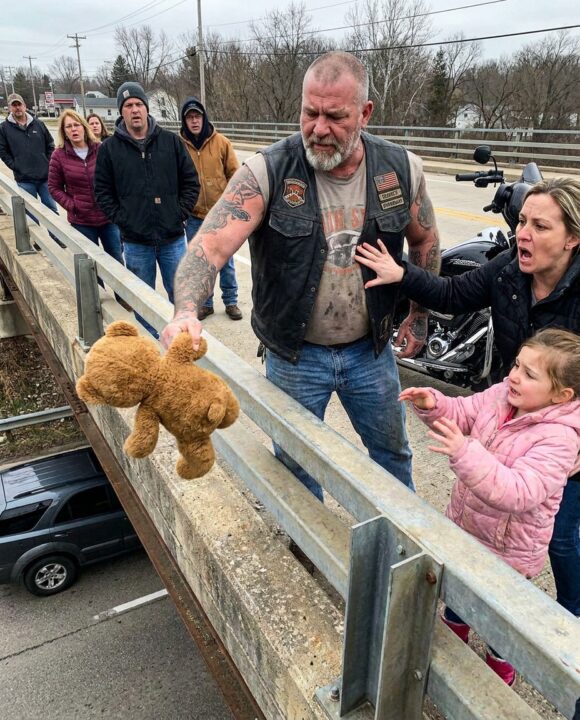
Lily screamed and grabbed his vest. I struck Hammer across the cheek so hard my palm burned, but he turned away from us and threw the bear over the railing.
For one impossible second, Barnaby floated against the sky.
Then he fell.
The crowd saw only a giant biker stealing a toy from a crying child. A jogger shoved Hammer, a fisherman cursed him, and someone called 911.
Hammer accepted every accusation without explaining the operation.
Revealing police positions could destroy the trap.
He planted his boots, lowered his hands, and let strangers believe the worst.
The bear struck the water and rolled onto its back. Lily tried climbing the railing, but I caught her around the waist.
“Daddy gave him to me!” she sobbed.
Hammer looked as though those words had entered beneath his ribs.
“He put something bad inside,” I said, although I was unsure whether I was explaining the danger to Lily or forgiving myself.
The dark SUV passed the bridge.
Hammer tracked it with his eyes.
Nolan’s voice crackled through the receiver beneath his vest. The vehicle had turned onto the service road, matching the tracker’s movement downstream.
The plan was working.
Then Darren called my emergency phone.
Only police, shelter staff, and my sister knew that number.
I answered because Nolan signaled me to do so.
Darren did not greet me.
“You let that animal touch my daughter?”
His voice was calm, which meant his anger had reached the dangerous place beyond shouting.
I stared at Hammer.
Darren could see us.
“You’re on the bridge,” he continued. “Tell the biker to look beneath his motorcycle.”
Hammer moved first.
A black plastic box had been magnetically attached behind the Harley’s oil pan. Two wires led toward a small flashing module.
It was not an explosive, though nobody knew that immediately.
Hammer dragged us behind a concrete support while Nolan ordered the bridge cleared. Moose shut off the Harley’s ignition, and Bishop pushed pedestrians toward the western entrance.
Lily covered her ears.
The module emitted a sharp electronic chirp.
A deputy with bomb-response training inspected it remotely and identified a second tracking device connected to a harmless noise maker.
Darren had tagged Hammer’s motorcycle too.
He had known about the police escort.
He had expected the bridge.
The decoy downstream was not drawing him into a trap.
It was drawing officers away from us.
A crash sounded behind the diner across the street. The gray pickup smashed through a delivery gate and stopped beside the bridge approach.
Darren stepped out holding a tire iron.
The crowd scattered.
Hammer had every reason to attack him. Darren had stalked a child, terrorized a woman, and transformed a teddy bear into a leash.
Instead, Hammer moved between us and lowered his hands.
“Police are here,” he said. “Don’t make your daughter watch.”
Darren smiled.
“She’s watched worse.”
Then he rushed forward.
Part 4 — Why Hammer Refused to Throw the First Punch
Darren swung the tire iron toward Hammer’s head, but Hammer raised his forearm and took the blow against bone. The impact sounded like wood splitting.
He staggered.
He did not strike back.
Bishop and Moose moved from opposite sides, yet Hammer shouted one word that stopped them.
“Hold!”
Darren swung again. This time Hammer caught his wrist, turned his body, and pinned him against the concrete barrier without punching or choking him.
His injured arm shook violently.
Darren spat into his beard and whispered that men like them always revealed what they were eventually.
Hammer tightened his grip for half a second.
Then he released it.
That choice almost cost him.
Darren drove an elbow into Hammer’s mouth, broke free, and ran toward Lily. I pulled her behind me, knowing my body would not stop him but unable to offer anything else.
The fisherman who had threatened Hammer stepped into Darren’s path.
So did the jogger.
Then every Iron Lantern on the bridge formed a wall without throwing a single blow.
Darren stopped.
Deputies emerged from both approaches with weapons drawn. Nolan ordered him onto the pavement, and this time he obeyed.
The false tracker beneath Hammer’s motorcycle became evidence of stalking and attempted interference with an investigation. The device inside Barnaby provided another link.
The restraining-order violation happened in front of twenty witnesses.
I thought the nightmare had ended.
It had only changed shape.
At the lower boat launch, officers recovered Barnaby from between two rocks. The bear’s stuffing had absorbed river water, and one glass eye had cracked.
Inside its belly, investigators discovered a commercially available tracker, an extended battery, and a tiny microphone.
Darren had not only known where we slept.
He had listened.
Every whispered bedtime story, every conversation with shelter workers, and every frightened plan to move had traveled through the toy Lily pressed beside her face.
I vomited beside the police cruiser.
Lily did not understand the full violation. She only asked whether Barnaby could be washed.
Detective Nolan said the bear had to remain evidence.
My daughter folded herself inward.
Hammer sat on the curb while a paramedic wrapped his forearm. Blood darkened his beard where Darren’s elbow had split his lip.
Lily approached him slowly.
“You killed Barnaby,” she said.
Hammer did not correct her.
“I threw him in the water.”
“Why didn’t you cut him open?”
“Because the bad man needed to believe Barnaby was still traveling.”
“My daddy isn’t a bad man.”
I expected Hammer to argue. Adults often answer children’s divided love by forcing them to select one clean truth.
Hammer understood that love could survive knowledge it should not survive.
“Then he’s a man who did bad things,” he said. “You don’t have to solve all of him today.”
Lily looked at the bandage around his arm.
“Did he hurt you?”
“A little.”
“Why didn’t you hit him?”
Hammer glanced at me before answering.
“Because he wanted you to see that.”
Those words opened the story behind his knuckle tattoos.
Hammer’s legal name was Ray Dawson. Twenty-one years earlier, his daughter Emily had been seven years old and living with her mother’s second husband, a man named Calvin Reese.
Hammer was not Emily’s biological father.
He was the biker her mother dated after leaving Reese the first time.
Reese used that fact like a weapon. He told police Hammer was unstable, cited his old assault conviction, and claimed the Iron Lanterns were gang members threatening his family.
Emily’s mother, Sarah, returned to Reese after months of financial pressure and apologies. Hammer lost contact with both of them.
Then a teddy bear arrived at his garage.
It belonged to Emily.
She had hidden a note inside its vest saying Reese watched Mommy through “the little talking box” sewn beneath the bear’s stomach.
Hammer tore the toy open and found an audio transmitter.
He rode directly to Reese’s home.
He intended to collect evidence and call police. Instead, Reese mocked him through the doorway, describing private conversations he had recorded between Sarah and Hammer.
Hammer lost control.
He broke Reese’s jaw and three ribs while Emily watched from the stairs.
Reese was arrested later for surveillance and assaulting Sarah, but Hammer’s violence gave the defense everything it needed. The recordings were challenged, the custody case stalled, and Hammer returned to prison for violating parole.
Sarah disappeared with Emily before he was released.
He searched for years.
Sixteen years later, a county investigator informed him that Sarah and Emily had died in a house fire in Kentucky. Reese had disabled a smoke detector and locked an exterior door, but he died in the same fire before charges could be filed.
Hammer kept one photograph of Emily inside his vest.
She held a brown teddy bear.
That was why he recognized the uneven seam beneath Barnaby’s shirt. That was why his hand trembled after throwing it.
He had failed to remain controlled when one child needed him.
He would not repeat that failure before another.
The word HOLD across his right hand meant more than holding Emily’s fingers. It meant holding his temper, holding the line, and holding himself inside the boundaries that kept evidence alive.
The tattoo on his left knuckles completed the phrase.
FAST.
HOLD FAST.
Lily traced the letters without touching his bruised skin.
“Did your little girl forgive you?” she asked.
Hammer stared toward the water.
“I never got to ask.”
For the first time that day, Lily stopped demanding Barnaby.
She removed the purple friendship bracelet from her wrist and tied it around Hammer’s uninjured hand.
“This can be from both of us,” she said.
Hammer bowed his head.
Behind us, Bishop turned away and pretended to inspect his motorcycle.
The cruelest-looking man on the bridge had not thrown away my daughter’s last piece of comfort.
He had thrown away his final chance to be misunderstood safely, trusting strangers, police, and his own brothers not to let the old version of him decide what happened next.
Part 5 — The Second Device Was Never Meant for Hammer
Darren remained jailed after the bridge arrest, but Detective Nolan warned that the case was not finished. His coworker claimed the SUV had been stolen, and the tracker accounts were registered under false names.
Darren denied installing anything.
His attorney argued that anybody could have placed the devices inside Barnaby or beneath Hammer’s motorcycle. He described Hammer as a convicted violent offender obsessed with vigilante justice.
Video from the bridge showed Hammer throwing the bear.
It also showed him restraining Darren.
Depending on where the recording began, Hammer could appear either heroic or dangerous. Social media chose both versions before the day ended.
One clip titled BIKER STEALS CHILD’S TOY reached half a million views. Another called him a kidnapper working with corrupt police.
The Iron Lantern clubhouse received threats.
Bishop ordered members to stay away from Willow Creek until the investigation settled, fearing their presence would expose the shelter and damage Darren’s prosecution.
Hammer disagreed.
“Family doesn’t disappear when cameras arrive,” he said.
“Family also doesn’t contaminate evidence,” Bishop answered.
Their argument split the club again. Some members believed Hammer’s history made him too vulnerable to manipulation, while others believed abandoning us would prove Darren’s story about intimidating bikers.
Hammer surrendered his patch temporarily.
He placed his leather cut on Bishop’s table and walked out wearing only a faded black shirt, as if removing the garment could silence twenty years of belonging.
Lily heard about the disagreement from Cody.
She blamed herself.
Children can turn adult cruelty inward with terrifying speed. Lily decided Barnaby had caused the arrest, the club conflict, and Hammer’s injuries because she had refused to leave the toy behind.
I told her none of it was her fault.
She asked why adults always said that after making children carry the consequences.
I had no good answer.
Three nights later, the safe apartment lost power.
The outage affected only our unit.
I smelled hot plastic near the kitchen, grabbed Lily, and followed the emergency protocol into the stairwell. A deputy met us outside while maintenance inspected the electrical panel.
Someone had jammed a small radio module between two breakers.
It was not designed to start a fire. It was designed to create signal interference and force security cameras offline.
The module matched the noise maker beneath Hammer’s Harley.
Darren had been in custody for three days.
He had help.
Nolan examined his calls and discovered repeated contact with a private security contractor named Victor Hale. Hale had installed alarms at Darren’s workplace and once served as a reserve deputy.
He knew surveillance equipment.
He also knew police procedure.
The second tracker had never been placed beneath Hammer’s motorcycle merely to monitor him. It had been designed to pull investigative attention toward the biker and away from whoever approached our apartment.
Darren wanted Hammer arrested.
Hale wanted the shelter’s address.
Their arrangement reached beyond my family. Hale had sold tracking devices, listening equipment, and confidential address information to at least nine men subject to protection orders.
Some women had returned to their abusers because every escape location was mysteriously discovered.
Others were accused of violating shelter confidentiality and removed from programs.
Darren and Hale had built a business from manufactured helplessness.
Barnaby was only one product.
Detective Nolan needed evidence linking Hale to the devices. The transmitter inside the bear carried no serial number, while its components could be purchased anonymously.
Then Hammer remembered the blue thread.
The stitches were uneven, but their pattern repeated every seventh loop. Emily’s old bear had been sewn the same way because Reese purchased modified toys from a hobby-electronics technician.
Hammer retrieved the photograph from inside his vest. Nolan enlarged it and found a small repair label barely visible beneath the bear’s leg.
The technician’s surname was Hale.
Victor Hale was Calvin Reese’s nephew.
The same family had used surveillance against Sarah and Emily decades earlier. After the fire, Victor acquired Reese’s remaining equipment and refined the operation.
Hammer had not encountered a familiar crime by coincidence.
Hale had recognized him too.
Placing the second device on his Harley was personal. Hale wanted the biker blamed, discredited, and possibly imprisoned before he connected Barnaby to Emily’s bear.
That knowledge nearly broke Hammer’s restraint.
He arrived at the police station after midnight, carrying the photograph in a waterproof envelope. His knuckles were white around the edges.
Nolan asked where his Harley was.
“At the clubhouse.”
“Where is your gun?”
“With Bishop.”
“Where is Victor Hale?”
Hammer looked at her for several seconds.
“If I knew, I wouldn’t be here.”
That was the answer she needed.
He had chosen procedure again.
Nolan persuaded a judge to approve searches of Hale’s warehouse and Darren’s storage unit. Officers found modified toys, magnetic trackers, false registration documents, and a database of confidential addresses.
One file contained my name.
Another contained Sarah Dawson’s.
Hale had preserved his uncle’s recordings and converted them into examples for future clients. Hammer listened to only thirty seconds before removing the headphones.
Sarah’s voice asked whether anyone could hear her.
Emily whispered from somewhere nearby.
Hammer left the room without speaking.
Outside, he sat on the pavement beside an unmarked cruiser. His shoulders moved once, but no sound came from him.
I sat beside him.
For several minutes, neither of us tried to repair what the recordings had reopened.
Then Hammer gave me the purple bracelet Lily had tied around his wrist.
“Keep this until I earn it,” he said.
“You already did.”
“No. I kept Darren from getting what he wanted. That’s not the same as giving Lily something back.”
The next morning, Victor Hale attempted to flee through West Virginia. State police arrested him after Nolan traced a hidden account used to activate Barnaby’s tracker.
The account showed thousands of location updates.
The final transmission came from the Ashford River.
Hammer’s terrible act had preserved the device long enough to record Darren following it downstream, directly linking his phone, vehicle, and accomplice to the stalking operation.
Barnaby had become more than bait.
The battered bear had become the witness Darren never expected to survive.
Part 6 — What the Iron Lanterns Placed Inside the New Bear
Barnaby remained in evidence for seven months. By the time Darren and Hale accepted plea agreements, the bear had dried into a stiff, stained shape that no careful washing could restore.
Lily still wanted him back.
Detective Nolan explained that the microphone and tracker would be removed, but she could not promise the damaged seams would survive.
Hammer asked permission to attend the evidence release.
He arrived without his club cut.
The Iron Lanterns still had not returned his patch because Bishop believed Hammer had violated the club’s order by remaining involved after the bridge.
The disagreement was never about whether Hammer had saved us. It was about whether brotherhood meant obeying the man beside you or challenging him when fear began making decisions.
Bishop entered the evidence room ten minutes later.
He carried Hammer’s vest over one arm.
“You made us choose between protecting the club and protecting a family,” Bishop said.
Hammer stood silently.
“I chose wrong.”
Bishop held out the cut.
Hammer did not take it immediately. He looked toward the other members gathered in the hallway—Moose, Cody, and six men who had risked scrutiny by cooperating with Nolan.
“No more private missions,” Hammer said. “If families need escorts, we coordinate with the shelter. If we find equipment, police handle it.”
Bishop nodded.
“And every patched member takes trauma-response training,” Hammer continued. “Looking scary isn’t a safety plan.”
Moose laughed once.
Bishop did not.
“Anything else?”
“Yeah. We build something for the kid.”
That became Barnaby Two.
Cody found a teddy bear with the same brown fur and crooked smile. Moose transferred one undamaged glass eye from the original toy, while a retired seamstress from Willow Creek repaired its left ear with blue thread.
Lily’s original Barnaby could not safely hold ordinary stuffing because mold had developed inside the fabric.
Instead, the club placed the surviving pieces in a sealed transparent box, together with the removed tracker and a copy of the court order protecting us.
The new bear received no electronics.
Hammer insisted that Nolan scan it twice.
Inside its vest, however, the Iron Lanterns added several harmless objects: a diner receipt from the morning of the bridge, a small cloth lantern, and Hammer’s silver skull ring.
I objected when I saw the ring.
It had belonged to his father and was one of the few valuable things he owned.
Hammer shrugged.
“A kid traded me a bear for it.”
“She never agreed to that trade.”
“Then she can return it when she’s eighty.”
Lily hugged Barnaby Two but did not smile immediately. She studied the repaired ear, the mismatched eye, and the vest sewn from a piece of black leather.
“He isn’t the same,” she said.
“No,” Hammer answered.
“Is that bad?”
“No.”
He said the word softly, without pretending replacements could erase losses. The new bear would not carry the scent of six motels or remember her whispered conversations.
It would begin empty.
Lily placed the old evidence box beside the new bear and decided both would keep the same name.
One Barnaby had carried her past.
The other could carry nothing she did not choose to place inside.
Darren received a prison sentence for stalking, illegal interception, violation of a protection order, and conspiracy. Hale received longer because investigators connected him to multiple victims.
Several women had their shelter eligibility restored.
Two dormant cases reopened.
Hammer never celebrated the sentences. He attended hearings, answered questions, and left before reporters could photograph him.
When a journalist asked whether throwing the bear had been heroic, he looked genuinely annoyed.
“It was evidence,” he said. “The kid was brave. Write that.”
The journalist wrote about Hammer anyway.
He hated the article.
Lily framed it.
Part 7 — Every Sunday Beside the Ashford River
We moved into a small yellow house fifteen miles from Beckford after the trial. The address was no longer secret, but Lily still checked unfamiliar vehicles from her bedroom window.
Healing did not arrive with the judge’s sentence.
It came in ordinary pieces.
It came when Lily slept through three knocks from a delivery driver. It came when I opened the curtains before breakfast and left them open through the afternoon.
It came when Barnaby Two spent an entire night on the floor because Lily had rolled away from him without waking.
Hammer visited every Sunday.
He never appeared unexpectedly. He called first, parked his Harley at the curb, and shut off the V-twin before Lily’s homework papers could vibrate across the kitchen table.
Sometimes he repaired something.
Sometimes he drank coffee and said almost nothing.
Once each month, we met Detective Nolan and several Willow Creek families beside the Ashford River. The Iron Lanterns had installed emergency call boxes along the riverside trail after receiving county approval.
They also funded scanners for three shelters.
No club logos appeared on the equipment.
Bishop said frightened families did not need to wonder whether help came with membership conditions.
At the bridge, Lily usually carried Barnaby Two beneath one arm. She would stand at the railing and watch the water pass over the rocks where the original bear had been recovered.
On the first anniversary, she brought Hammer his skull ring.
He closed her fingers around it again.
“Eighty,” he reminded her.
Lily rolled her eyes.
She was nine now and had recently decided most adults were embarrassing.
Before we left, she asked Hammer whether he still thought about Emily. He rested both scarred hands on the railing, exposing the words HOLD FAST.
“Every day.”
“Does it hurt every day?”
“Different every day.”
Lily considered that answer, then removed the little cloth lantern from Barnaby’s vest. She tied it beneath the zipper inside Hammer’s leather cut.
Now Emily’s photograph and Lily’s lantern rested side by side.
Hammer looked toward the highway until he trusted his voice again.
Then he started the Harley.
The engine’s low rumble traveled across the river, heavy but no longer frightening. Lily covered one ear, raised her free hand, and waved as he turned toward Route 17.
His red taillight disappeared beyond the trees.
The river kept nothing but the signal.
Leave “BARNABY” in the comments for more of Lily and Hammer’s journey, and follow the page for powerful biker stories about courage, brotherhood, and second chances.