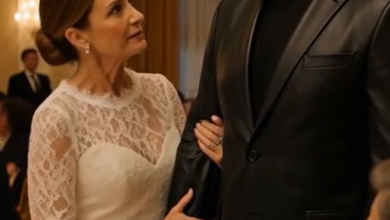
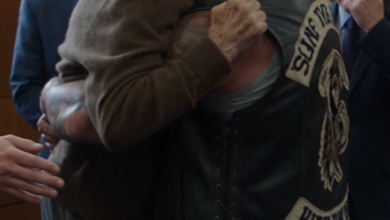
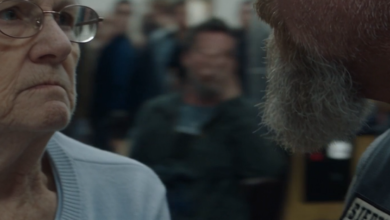
The Biker Ripped a Dead Father’s Photograph from a Little Girl at His Grave—The Address Hidden Behind It Led to Letters He Had Protected for Ten Years
Part 2 — The Father We Reduced to His Worst Year
My name is Sarah Cole, and for ten years I told Emma the truth about her father in pieces small enough for a child to carry.
Michael could make her laugh by balancing spoons across his nose. He sang badly in the car, repaired broken lamps for neighbors, and gave away coats he still needed.
Those things were true.
He also became addicted to prescription opioids after a steel beam crushed his left ankle at work. He lied about pills, emptied our savings, disappeared for days, and once drove with Emma in the car while impaired.
Those things were true too.
The final incident ended our marriage.
Michael backed his truck into a grocery cart while Emma sat behind him. No one was injured, but I found pills scattered beneath her car seat.
I took our daughter to my sister’s house and filed for emergency protection.
Michael violated the order once by appearing outside Emma’s daycare. He did not threaten anybody. He stood across the street holding a stuffed rabbit and crying.
Police removed him.
After that, he vanished.
Hammer had known Michael since they were teenagers. They joined the Iron Lanterns before either man possessed enough sense to understand the promises stitched onto a club patch.
They were brothers in every way except blood.
Hammer helped Michael find his first job, stood beside him at our wedding, and held Emma before either grandfather reached the hospital.
He also ignored the addiction too long.
When Michael slurred his speech at club meetings, Hammer called him tired. When money disappeared from the Iron Lantern emergency fund, Hammer quietly replaced it before asking questions.
Brotherhood became concealment.
By protecting Michael from consequences, Hammer helped the addiction grow.
The club eventually discovered twelve thousand dollars missing from an account used for medical expenses. Bishop, the club president, demanded Michael surrender his patch.
Hammer argued for treatment.
Other members wanted police.
Michael confessed, returned what little remained, and entered a rehabilitation program outside Akron. He left before completing the first month.
That was the last version of him I knew.
What I did not know was that Michael returned to treatment two weeks later using another name because shame made him fear the club would discover him.
He remained sober.
Doctors then found advanced liver cancer during tests for abdominal pain. The disease was not directly caused by his recent addiction, although Michael believed every illness represented punishment.
He had months.
His counselor encouraged him to contact us through attorneys. Michael refused after learning my protection order remained active.
The counselor explained that court orders could be modified.
Michael answered that legality and permission were not the same.
He had spent years entering rooms because he wanted forgiveness. For once, he intended to remain outside unless invited.
Instead, he wrote.
His first letter addressed Emma at age three. The next was meant for her fourth birthday, then fifth, sixth, and every year through eighteen.
Some envelopes contained three pages.
Others contained one sentence.
He wrote additional letters for graduation, heartbreak, failure, marriage, and the day she might become a parent.
Hammer visited him weekly.
Those rides covered ninety miles each way along Route 8. Winter wind entered Hammer’s gloves, salt whitened his boots, and hospital disinfectant replaced gasoline whenever he entered Michael’s rented room.
Michael asked him to deliver the first birthday letter immediately.
Hammer refused.
“You don’t get to become a good father on paper because she can’t answer back,” he said.
The words nearly ended their friendship.
Michael accused him of helping Sarah erase him. Hammer accused Michael of using death to escape the work of rebuilding trust.
Then Michael’s counselor proposed the conditions.
The letters would remain sealed at a neutral location. Sarah would not be contacted. Emma would receive them only if, after turning twelve, she independently wanted to know more about her father.
No one would present Michael as redeemed.
No one would pressure her to read.
Michael accepted.
The neutral location became Building C at 614 Mercy Road, a storage garage attached to a feed warehouse. The property belonged to Ruth Ellis, a retired teacher who volunteered with the rehabilitation program.
She gave Michael a ten-year prepaid lease.
He stored the letters inside a green steel toolbox, sealed against moisture and bolted to a shelf.
On the back of the photograph he had once given me, Michael wrote the address and Hammer’s name. He believed I would eventually pass the picture to Emma.
He was right.
Before dying, Michael made Hammer promise three things.
Do not contact Emma before she asks.
Do not open the letters.
Do not let the Iron Lanterns turn his final months into a clean redemption story that erased the harm before it.
Hammer kept all three.
That obedience looked exactly like abandonment from our side.
He attended the funeral but stayed near the road. He watched Emma grow through school photographs posted publicly, then refused every request to meet her.
On her birthdays, he rode past Mercy Road and checked the garage lock.
He never entered.
The lease prohibited access until the agreed date unless fire, flooding, or demolition threatened the contents. Ruth Ellis died during the eighth year, and ownership passed to a development company.
Notices were mailed to Michael’s last address.
Hammer never saw them.
By the time Emma visited the grave, Building C had been sold for demolition.
The ten-year promise had survived addiction, death, anger, and silence.
It might not survive a bulldozer.
Part 3 — The Race from Cedar Ridge to Mercy Road
We left the cemetery in four vehicles and three motorcycles.
Emma rode with me, clutching the photograph against her coat. The corner torn during the struggle remained folded backward, exposing Michael’s final instruction.
Hammer led on his black Road King.
The V-twin rumble traveled ahead of us through the wet streets of Beckford, while rain darkened the shoulders of his leather cut.
I had spent a decade resenting that sound.
Whenever motorcycles passed our house, Emma looked toward the window. She did not know whether she wanted one rider to stop or feared that somebody might.
Now we followed the loudest motorcycle in town toward letters I was not sure she should read.
Building C stood behind an abandoned feed warehouse near the county line. Temporary fencing surrounded the property, and a demolition excavator waited beside the loading dock.
A security guard blocked the gate.
Hammer showed the brass key and a copy of Michael’s storage agreement he carried inside his vest.
The guard examined the expired lease.
“Property changed hands,” he said. “Everything inside was posted for removal.”
“When?”
“Thirty days ago.”
“No notice came.”
“Not my department.”
Hammer looked toward the garage row.
Building C remained standing, but its metal door had been marked with orange paint. The structures beside it were already empty.
Emma pressed close to the fence.
“Are my letters in there?”
Hammer answered without softening it.
“If nobody moved them.”
The demolition supervisor arrived and refused access because asbestos inspection had closed the building. Hammer’s shoulders tightened.
Michael’s brother, David, began shouting about lawsuits. Several Iron Lanterns moved toward the gate, and the security guard reached for his radio.
Bishop stepped between them.
“No fences,” he told the club. “No threats.”
Hammer said nothing.
His right fist closed around the words HOLD FAST, while rainwater traveled between his knuckles.
Ten years earlier, he might have broken the lock and accepted arrest afterward. That instinct remained visible in his jaw.
Emma touched his wrist.
“If you get arrested, do I get the letters faster?”
Hammer looked down at her.
“No.”
“Then don’t make this about you.”
The words sounded like something Michael might have said after recovery.
Hammer opened his hand.
The development company’s project manager joined by telephone. Bishop explained the storage agreement, while I provided Emma’s identity and requested supervised retrieval of personal effects.
The manager insisted their legal department review everything.
Demolition would begin at six the following morning.
A decision might require two days.
Hammer called Ruth Ellis’s former attorney. The number had been disconnected.
Cody searched public property records and found the firm that administered her estate. Their receptionist located a scanned addendum describing the toolbox as personal property held in trust for Emma Cole.
That document changed the conversation.
The company agreed to permit entry with an asbestos-certified supervisor, but the supervisor lived ninety minutes away and heavy weather had closed part of Route 8.
We waited at Mae’s Riverside Diner.
Emma placed the photograph on the table between us. For the first time, we studied it carefully.
Michael sat on a Harley with one hand resting across Hammer’s shoulder. Both men were young, beardless, and convinced time would keep forgiving them.
On the reverse, beneath the address, faint impressions crossed the paper where Michael had written on another sheet placed above it.
Emma tilted the photograph toward the diner window.
Several words became visible.
Don’t make her love me.
Hammer saw them.
His face changed.
Michael had said the same thing aloud during their final conversation, but Hammer had never known the sentence was impressed onto the photograph.
Emma asked whether her father had loved her.
“Yes,” Hammer answered.
“Was he good to us?”
“No.”
“Did he get better?”
“For a while.”
“Would he have stayed better?”
Hammer looked toward the rain.
“Don’t know.”
Those answers gave Emma something our family stories had not.
Space.
Nobody forced love to erase harm. Nobody asked harm to erase love.
At 8:40 that evening, the certified supervisor reached Mercy Road. Police documented our entry, while demolition staff unlocked the fence.
Hammer’s brass key opened Building C.
The garage smelled of damp wood, rust, mouse droppings, and old motor oil. Shelves lined one wall, but most were empty.
The green toolbox was gone.
Only four bolt holes remained where Michael had secured it.
Emma made no sound.
Hammer touched the vacant shelf.
His hand trembled once.
The promise appeared to have ended in an empty garage.
Then Cody found drag marks leading toward the rear wall.
A sheet of plywood covered a narrow utility closet. Behind it stood three salvaged cabinets marked for recycling.
The green toolbox was not inside them.
The demolition crew had removed it two days earlier.
According to the disposal manifest, all metal from Building C had been transported to Beckford County Recycling.
The facility’s industrial crusher started at five each morning.
We had eight hours.
Part 4 — The Toolbox beneath Three Tons of Scrap
Beckford County Recycling closed at nine, but its night supervisor knew the Iron Lanterns. Moose had repaired his daughter’s car without charging labor the previous winter.
He agreed to meet us at the yard.
The green toolbox had entered a mixed-metal pile covering nearly half an acre. Forklifts had already moved parts of the load toward the morning processing line.
Searching at night was unsafe.
Hammer wanted floodlights and volunteers.
The supervisor refused. Unstable scrap could shift, cut, or crush anyone climbing through it.
Again, Hammer faced a locked boundary between his promise and the object behind it.
Again, Emma stopped him from turning urgency into recklessness.
“What would Dad’s box look like now?” she asked.
Hammer described it: military green paint, reinforced corners, a dent shaped like Ohio near one latch, and Michael’s initials scratched beneath the handle.
The supervisor reviewed security footage from the unloading dock. At 2:17 that afternoon, a demolition truck dumped metal from Mercy Road.
The camera showed the toolbox sliding near a rusted furnace cabinet.
Operators used the furnace’s size to estimate where that section entered the pile.
They could isolate it using machinery.
At midnight, an excavator began removing layers beneath the supervisor’s direction. The Iron Lanterns watched from behind a safety barrier, unable to use their hands.
Hammer hated waiting.
He paced between his Harley and the fence, boots grinding wet gravel. Bishop followed without speaking.
Their brotherhood had once been built around action—repair the engine, confront the threat, ride through the night.
Now it was being tested by restraint.
At 1:36, the excavator exposed the furnace cabinet.
The toolbox was not beside it.
At 2:10, workers found a crushed green lawnmower deck. Emma thought it was the box and began running before I caught her.
At 3:05, rain intensified.
The supervisor warned they might need to stop because visibility had dropped. Hammer offered the club’s portable work lights, which could be positioned safely outside the equipment path.
That compromise kept the search moving.
At 4:18, an operator saw a rectangular object wedged beneath truck axles and bent shelving.
The excavator lifted the upper debris.
There it was.
Green paint.
Reinforced corners.
Ohio-shaped dent.
The toolbox had been flattened slightly across one side, but both latches remained closed.
Hammer placed his forehead against the safety fence.
The operator carried it to a clear inspection area. Fire personnel checked for hazardous contents before allowing us near.
Emma received the brass key.
It entered the lock but would not turn because the lid had shifted. Hammer offered to pry it open.
Emma shook her head.
“Can it be repaired?”
The recycling supervisor used a hydraulic spreading tool to relieve pressure around the latch. After several adjustments, the lock turned.
Emma lifted the lid.
Inside lay a second sealed container wrapped in oilcloth. Moisture had entered the toolbox but not the inner case.
Twenty-one envelopes rested inside.
Ten birthdays had passed since Michael’s death, yet he wrote beyond them. There were letters for ages thirteen through eighteen, one for graduation, one labeled WHEN YOU ARE ANGRY WITH ME, and another labeled IF YOU DECIDE NEVER TO READ THESE.
There were envelopes for me, David, Bishop, and Hammer.
Emma did not open any.
She counted them.
Then she found a bank envelope containing repayment receipts for the twelve thousand dollars Michael stole from the Iron Lantern fund.
Every payment had been made through money orders during his final months.
The last receipt covered only part of the remaining balance.
Beside it lay a cashier’s check for the rest, never deposited because Michael died before delivering it.
Bishop studied the amount.
Hammer had secretly covered that exact balance years earlier.
Michael’s check would have repaid him.
Hammer never knew it existed.
The club had believed Michael died with an unpaid debt. Several members still refused to speak his name during memorial rides.
Now the evidence could clear that part of his history.
It could not clear everything.
Money returned did not restore trust. Sobriety at the end did not erase the years when Emma and I needed safety from him.
Michael understood that.
His envelope to the Iron Lanterns contained no request for his patch to be restored. He asked only that the repaid money support families affected by addiction.
Bishop read the letter twice.
Then he placed Michael’s old patch, which he had carried for ten years without admitting it, beside the receipts.
Hammer stared at him.
“You kept it?”
Bishop nodded.
“Couldn’t wear it. Couldn’t burn it.”
Brotherhood had preserved its own secret.
Emma selected the envelope labeled WHEN YOU ARE ANGRY WITH ME.
She asked Hammer to open it because her hands were shaking.
He refused.
“Your letter.”
“Your promise.”
“Promise was to bring you here.”
She looked at him.
“You’ve been carrying this alone for ten years.”
Hammer’s voice roughened.
“Didn’t make it mine.”
Emma opened the envelope herself.
Michael’s first sentence contained no explanation.
You are allowed to be angry after I am dead.
She read the rest silently.
When she finished, she folded the pages along their original creases and returned them to the envelope.
“Was it good?” I asked.
Emma considered the question.
“It was honest.”
That was better.
Part 5 — The Letters Michael Refused to Send
We carried the toolbox to the Iron Lantern clubhouse because Emma did not want to open the remaining letters at home.
The club placed it on a clean table near the garage windows. Nobody arranged chairs ceremonially or asked Emma to read aloud.
Hammer brought coffee for adults and hot chocolate for her.
Then he waited outside.
Emma opened the birthday letter for age twelve first. Michael had written it knowing he would never see whether she became tall, quiet, funny, angry, or anything he could predict.
He refused to offer fatherly instructions.
Instead, he described mistakes.
He explained how addiction narrowed his world until every promise became something he made to reach the next hour. He admitted stealing, lying, and driving while impaired.
He wrote that protecting herself from him had been the correct choice.
He never asked Emma to forgive me for leaving because I needed no forgiveness.
That line broke something inside my chest.
For years, part of me feared Michael’s family believed I abandoned a sick man. His letter recognized that I had protected our child when he would not.
The birthday envelopes differed.
At thirteen, he wrote about anger and privacy. At fourteen, he described the first motorcycle engine he dismantled and failed to reassemble.
At fifteen, he warned that apologies without changed behavior were only requests for another chance.
At sixteen, he enclosed no advice, only a blank page.
You may know more about being sixteen than I ever did.
Some letters were clumsy.
Some centered his guilt too much. Emma occasionally stopped reading and placed an envelope back into the box.
The choice remained hers.
My letter contained seven pages. Michael apologized without asking me to answer. He described his recovery, diagnosis, and the agreement with Hammer.
Then he admitted why the letters had remained hidden rather than placed with an attorney.
Michael distrusted himself.
He feared that during a moment of pain or fear, he might revoke the arrangement and send everything against my wishes.
Hammer was the only person stubborn enough to keep a promise even when Michael begged him to break it.
During Michael’s final week, he did beg.
He asked Hammer to deliver Emma’s third-birthday letter immediately. He wanted proof that his daughter knew he loved her before he died.
Hammer refused.
Michael called him cruel.
Hammer sat beside the bed all night anyway.
The following morning, Michael apologized and repeated the original conditions. Those were his final clear words.
Hammer’s envelope remained unopened on the clubhouse table.
Emma carried it outside.
She found him seated on the curb beside his Road King, leather vest open, hands wrapped around cooling coffee.
“Your turn,” she said.
“No.”
“He wrote your name.”
“Don’t mean I’m ready.”
“You made me ready.”
Hammer looked toward the clubhouse.
“No. Brought you to the box. Different thing.”
Emma sat beside him.
“Then I’ll wait.”
They remained there for twenty minutes.
Finally, Hammer opened the envelope.
Michael wrote only one page.
He thanked Hammer for keeping me and Emma away during the unstable years, even when that made Michael hate him. He admitted Hammer’s silence would later look like betrayal.
Then came the sentence Hammer read three times.
If Emma finds these, do not ask her to carry me back into the club. Let her decide what remains mine and what becomes hers.
The final paragraph concerned the photograph.
Michael knew Emma might attempt to leave it at his grave. If she did, Hammer was supposed to stop her long enough to reveal the address.
He had predicted the cemetery moment precisely because he understood how exhausting inherited grief could become.
The instruction did not say to preserve the photograph forever.
It said to return the choice after showing her the back.
Hammer carried the picture to Emma.
One corner remained torn from their struggle.
“You still want to leave it?” he asked.
She looked at Michael’s face.
“Not today.”
Hammer nodded.
No celebration.
No claim that the promise had healed anything.
The letters did not return a father. They changed the shape of his absence by giving Emma words she could accept, reject, postpone, or question.
The repaid money created another decision.
The Iron Lanterns voted to deposit Michael’s cashier’s check into an addiction-recovery transportation fund. Hammer added the amount he had covered ten years earlier.
Several members objected to using club resources under Michael’s name.
Emma attended the meeting.
“Then don’t use his name,” she said. “Use the money.”
The fund remained anonymous.
It paid for rides to treatment, court appointments, job interviews, and family visits. Recipients did not need to belong to the club or prove redemption.
Hammer drove the first person himself.
He never told Emma who it was.
Secrets could still protect dignity when they were not hiding harm.
Part 6 — One Envelope Every November
Emma did not read all twenty-one letters immediately.
She placed the toolbox inside our hall closet and kept the brass key on a cord beneath her shirt.
Some months, she forgot about it.
Other months, she sat on the closet floor without opening the lid.
On each birthday, she selected one envelope. She read alone first, then decided whether to share it with me.
At thirteen, she opened Michael’s letter about anger and crossed out three sentences she disliked.
Hammer told her she was allowed.
At fourteen, she read the motorcycle story and asked the Iron Lanterns to show her how carburetors worked.
Hammer began with a lawnmower engine because he claimed teenagers should damage inexpensive machinery first.
At fifteen, she opened the graduation letter early. Michael had written no congratulations because he could not know whether she would graduate.
Instead, he wrote that unfinished paths did not make unfinished people.
She returned that one to the box for later.
The photograph stayed on her desk with the torn corner visible. Emma refused offers to restore it professionally.
She said the damage belonged to its history.
Every November, Hammer rides to Cedar Ridge Cemetery before sunrise. He parks near Michael’s grave, shuts off the V-twin, and waits through eleven minutes of silence.
One minute for every year Michael was gone from Emma’s life before the letters were found.
He no longer goes alone.
Sometimes Bishop joins him. Sometimes Emma rides in a truck with me and brings no flowers.
Nobody speaks for Michael.
The toolbox eventually moved to a preservation case because moisture threatened its damaged hinges. The original green metal remains around the sealed inner container, including scratches from the recycling yard.
Emma requested that the crushed side never be straightened.
The address behind the photograph led to the letters, but the dents proved how close words can come to disappearing forever.
Building C was demolished the morning after our search.
Hammer watched from Mercy Road.
When the garage walls fell, he removed his leather glove and closed one bare hand around Michael’s brass key.
Then he gave it to Emma.
The key opened nothing now.
She kept it anyway.
Part 7 — The Photograph Facing Both Directions
Emma turned eighteen this year.
She opened Michael’s final birthday letter at Mae’s Riverside Diner, seated in the booth where Hammer had waited while workers searched the recycling yard.
The Iron Lanterns occupied nearby tables but kept their voices low.
Emma read the letter once.
Then again.
Michael had not tried to predict the woman she became. He described the woman he hoped she had permission to become—someone untouched by the obligation to repair his reputation.
His final line gave her the photograph completely.
Keep it, bury it, tear it, or forget it. None of those choices can change that you were loved, and none must erase what I did.
Emma handed the page to me.
Then she turned the photograph face down.
The Mercy Road address had faded, but the words Ask Hammer why remained visible beneath the torn mounting paper.
Hammer sat across from her.
“You asked,” he said.
“You answered eventually.”
“Slow learner.”
“You’re still learning.”
“Yeah.”
Emma removed the brass key from beneath her shirt and placed it beside his coffee. Hammer pushed it back.
“Yours.”
“It opens nothing.”
“So?”
She closed her fingers around it again.
After breakfast, we rode to Cedar Ridge Cemetery. Emma traveled with me, while Hammer and the Iron Lanterns followed at a distance.
She carried no flowers.
At Michael’s grave, she placed the photograph against the stone. For several minutes, his face looked outward toward us.
Then Emma turned it around.
The address faced the sky.
She did not bury the photograph or take it home. She slipped it into a clear weatherproof holder beneath the memorial vase, leaving both sides visible depending on where someone stood.
Michael’s face remained.
So did the road to his words.
Hammer adjusted nothing.
He returned to his Harley, pulled on his gloves, and started the engine. One by one, the other motorcycles joined until their low rumble crossed the wet cemetery grass.
Emma raised the brass key.
Hammer lifted two scarred fingers from the handlebar.
Then he rode toward Mercy Road without looking back.
Leave “PROMISE” below for another chapter, and follow the page for more biker stories about family, brotherhood, and truths protected until someone is ready to choose them.