The Biker Ripped a Cancer Student’s Wig Off in the Cafeteria—The Next Morning, He Returned Bald with Forty Riders Wearing Her Scarf
Part 2 — The Girl Who Wanted Nobody to Call Her Brave
My name is Elena Morales, and I had served as Beckford High’s nurse for fourteen years before the afternoon our cafeteria divided one violent-looking moment into competing versions of the truth.
Chloe Bennett had entered my office the previous September carrying a geometry book, a water bottle, and a folded laboratory report she had not yet shown her mother.
She had found a swollen lymph node beneath her collarbone during volleyball practice. Two weeks later, doctors diagnosed Stage III Hodgkin lymphoma.
People began calling her brave immediately.
Chloe hated it.
She said brave was a word adults used when they could not fix anything, and every compliment made her feel responsible for comforting the person offering it.
Chemotherapy took her appetite first. Then it took her energy, her eyelashes, and the dark hair reaching halfway down her back.
Her mother, Dana, saved several locks before the hospital shaved the rest, but Chloe refused to watch. She turned toward the wall and counted ceiling tiles.
The teal scarves came later.
One oncology nurse gave Chloe a box containing twelve colors, but she always selected teal because it matched the faded eyes of her late grandfather.
She tied the knot low behind her left ear and practiced until she could do it without a mirror.
The wig represented something different.
Students from Beckford High raised nearly three thousand dollars for it through a car wash, a bake sale, and a motorcycle ride organized by the Iron Lanterns.
Chloe had not requested the fundraiser. When she learned about it, she wanted the money redirected toward families who lacked insurance.
Dana convinced her to accept the wig because rejecting every kindness could become another form of hiding.
Hammer delivered the final donation personally.
He left the envelope with Principal Vance and asked that the club receive no public credit. His only condition was that Chloe choose the style herself.
That was how the auburn wig entered our story.
Its color resembled Chloe’s natural hair but carried a warmer red tone beneath sunlight. The first time she wore it, she stood in my office for nineteen minutes before opening the door.
“What if everyone knows?” she asked.
“They probably will.”
“What if they stare?”
“Some will.”
She studied herself in the mirror.
“What if I look fake?”
I told her every student in the building was pretending to be somebody, but she happened to be wearing clips.
That made her laugh.
Hammer had known more about wigs than any of us realized. His daughter Rebecca underwent leukemia treatment seventeen years earlier, back when Hammer still answered to Ray and worked as a welder near Akron.
Rebecca was fifteen, sarcastic, and stubborn enough to wear combat boots beneath her hospital gown. She lost her hair after her second treatment cycle.
Hammer offered to shave his own head.
Rebecca refused.
She said the gesture would make strangers look at them as a matching tragedy, and she did not want her father turning her illness into his performance.
Hammer listened.
His hair grew long during her treatment, and Rebecca began braiding it whenever his visits lasted through the afternoon. She would fasten the braid with a teal cloth strip torn from an old mechanic’s shirt.
Then Hammer missed three weeks.
He had been arrested after finding Rebecca’s stepfather stealing her prescribed pain medication. Hammer broke the man’s jaw in a hospital parking garage and violated probation from an earlier assault.
The court did not care that he had found stolen medicine.
It cared what his fists had done.
Rebecca’s condition worsened while Hammer sat in county jail. He was released two days before she died but arrived at the hospital after she had lost consciousness.
Her final clear conversation was with Bishop, then a young Iron Lantern road captain.
She gave him the teal strip from Hammer’s braid.
“Tell Dad not everything has to be broken before he notices it,” she said.
Bishop kept those words private for seventeen years.
He returned the cloth after Rebecca’s funeral but never repeated her final sentence, believing guilt might destroy the man who already carried too much of it.
Hammer cut his hair once, leaving the top short while preserving the long gray-black braid at the back. The braid stayed hidden beneath his collar or bandana.
Most people never saw it.
That was the hair he refused to remove.
It was not vanity. It was the final place Rebecca’s hands had worked patiently, dividing three sections and pulling them together.
The Iron Lanterns built their pediatric ride program after her death. They transported parents whose cars failed, delivered fuel cards, and escorted children returning from treatment.
Hammer rarely entered hospital rooms.
He waited beside elevators, repaired wheelchairs, and carried boxes. Children reminded him of questions he could no longer answer.
Chloe was different because she treated him normally.
Their first real conversation happened outside Mae’s Diner after the wig fundraiser. She saw the edge of his hidden braid and asked why an old man kept “a twelve-inch rat tail.”
Hammer replied that sixteen-year-olds with artificial eyebrows should avoid criticizing other people’s hair.
Chloe laughed until she coughed.
After that, they exchanged insults whenever he visited school.
She called his Harley a lawn mower with unresolved anger. He called her wig “the expensive squirrel.”
Beneath the teasing, they recognized something in each other.
Both hated being reduced to the worst event of their lives.
Hammer did not call Chloe brave. He asked whether the treatment tasted more like pennies or aluminum that week.
He never said she looked good. He asked whether she felt strong enough to walk or wanted a chair without apologizing.
When Chloe returned to school, Hammer left a small packet in my office. Inside were wig tape, gentle adhesive remover, two fire-resistant cotton scarves, and a note containing four words.
For bad hair days.
Chloe carried one teal scarf in her backpack but wore the auburn wig every day.
She believed accepting help did not mean she had to display the reason she needed it.
That was why the cafeteria moment wounded her so deeply.
Hammer had protected the skin physicians had fought to heal, but in front of three hundred students, he had stripped away the boundary she had built around her illness.
Saving someone did not automatically erase what the rescue cost.
Hammer understood that before anyone explained it.
The question was whether his brothers would understand what he planned to do next.
Part 3 — Eleven Seconds Between Smoke and Flame
The lunch celebration began at 12:17 on a Thursday.
By 12:19, the entire school had chosen sides.
Chloe’s table stood near the western windows, where October sunlight struck the gold thread Maya had woven through the wig. The decoration resembled a loose halo, deliberately crooked because Chloe disliked anything resembling a pageant crown.
Trevor brought the candle.
He had purchased trick candles from a gas station, believing Chloe would laugh when the flame returned after each attempt to extinguish it.
He placed one in a cupcake and lit it beneath the table, away from supervising teachers.
Chloe leaned forward.
The candle went out.
Then it reignited.
A ventilation fan pushed the small flame toward her left shoulder, where one metallic plastic strand had slipped from the crown.
The strand caught without producing an immediate flame. It carried a glowing orange point upward, hidden against the auburn fibers.
Hammer was carrying a box toward the side exit.
He heard students chanting Chloe’s name, turned briefly, and kept walking. Then the smell reached him.
Burning synthetic hair does not smell like human hair. It smells sharper, closer to overheated wiring and melted upholstery.
Hammer had smelled it once before.
At a childhood cancer fundraiser nine years earlier, a girl’s costume braid had touched a patio heater. Hammer used his leather jacket to smother it, but the melted fibers fused against the child’s shoulder.
She survived.
The scars remained.
He dropped the box.
“Chloe, hold still.”
Nobody heard him.
He crossed the cafeteria as the orange point reached the wig’s underlayer. The flame was still smaller than a thumbnail, but the surrounding fibers had begun curling inward.
Maya saw Hammer approaching and assumed he was joining the celebration. Chloe turned toward her friends, exposing the burning section beside her ear.
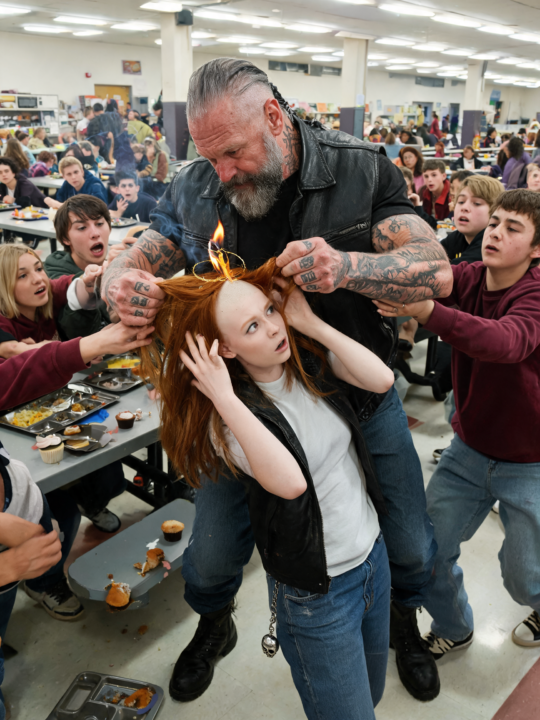
Hammer grabbed the wig at two points.
He pulled upward and backward, using enough force to break the clips before melted fiber could touch Chloe’s scalp.
The action saved perhaps three seconds.
It also looked unforgivable.
Chloe’s hands flew toward her head. Dana screamed from the faculty table, while Trevor lunged across the bench and struck Hammer’s forearm.
The wig ignited as it fell.
Hammer planted his boot over it, but the synthetic fibers squeezed outward beneath the sole. A flame crawled along the gold strand toward a fallen paper decoration.
He dropped to both knees.
His leather vest came off in one movement. He wrapped the wig inside it and pressed the bundle against the tile.
Smoke rose around his beard.
Students attacked him.
A wrestler named Lucas locked both arms around Hammer’s neck. Trevor grabbed his right wrist, and another boy drove a shoulder into his ribs.
Hammer’s body tightened.
For half a second, I saw the old reflex return.
His scarred fist closed. His shoulders rotated. The men pinning him had no idea how quickly he could have injured them.
Then Chloe shouted.
“Stop touching him!”
Hammer opened his hand.
He allowed Lucas to drag him sideways while keeping the burning bundle beneath his boot. One student punched his shoulder; another kicked his thigh.
Hammer never struck back.
“Extinguisher,” he rasped.
I pulled the nearest unit from the wall. Cafeteria manager Linda Cho cleared the safety pin and sprayed the floor after Hammer lifted his boot.
White powder covered the ruined wig.
The fire ended.
The screaming did not.
Dana reached Chloe first and wrapped a cardigan around her head. Chloe pushed it away because hiding in front of everyone now felt worse than being seen.
“Get him out!” Dana shouted.
Hammer remained kneeling. Melted fibers had fused to his vest, while a black streak crossed his right palm.
He looked at Chloe’s scalp instead of her face.
“Behind the left ear,” he said. “Check there.”
“I know my job,” I answered more sharply than necessary.
I examined Chloe beneath the emergency shower station. Her scalp showed two torn clip marks, one reddened patch, and no melted plastic.
Physically, she had escaped serious injury.
Emotionally, she stood nearly naked before an audience holding phones.
Students whispered. Several girls cried. One boy continued recording until Linda knocked the phone downward.
Chloe looked at Hammer.
“You could have warned me.”
“I tried.”
“You could have covered me.”
“There wasn’t time.”
“You could have done anything except make everybody see me like this.”
Hammer’s face changed.
He had expected anger over the destroyed wig. He had not understood that Chloe regarded exposure as a second injury.
“I’m sorry,” he said.
She pointed toward the black bundle.
“That took six months.”
Hammer glanced at the melted fibers.
“I know.”
“No, you know it cost money. You don’t know what it took.”
He removed his silver skull ring and placed it beside her. The gesture made no sense to anyone except Hammer.
It was the most valuable object he carried, but Chloe stared at it as though he had offered a spare bolt.
Principal Vance arrived with the school resource officer. After seeing only the final moments, he ordered Hammer handcuffed until police could review the videos.
Hammer extended both wrists.
The cuffs closed over HOLD FAST.
News of the arrest reached the Iron Lantern clubhouse before investigators finished interviewing witnesses. Bishop arrived furious, accompanied by Moose and Cody.
He did not challenge police.
Instead, he watched cafeteria footage captured by a ceiling camera. The angle showed Hammer crossing the room and tearing away the wig, but the flame remained hidden behind Chloe’s head.
“Looks bad,” the officer said.
“It was bad,” Bishop answered. “That doesn’t make it wrong.”
The decisive video came from an unexpected source.
Trevor had placed his phone against a napkin dispenser to record Chloe blowing out the trick candle. His camera captured the gold strand touching the flame, the orange point climbing toward her ear, and Hammer moving before anyone else reacted.
Trevor initially deleted the video.
He feared punishment for bringing the candle and believed Chloe might blame him for losing the wig. The file remained in his recently deleted folder until Maya told police she had seen him recording.
When investigators recovered it, the room fell silent.
The flame was visible for four full seconds.
By the fifth, it entered the wig.
Hammer reached Chloe on the sixth.
On the seventh, the wig left her head.
By the eleventh, it was burning beneath his boot.
Police removed the cuffs.
Dana did not apologize immediately. She watched the footage twice, then touched Chloe’s bare scalp and began shaking.
Hammer stood nearby with blood at the corner of his mouth from the students’ blows.
He did not ask anyone to thank him.
He asked whether Trevor had been arrested.
Principal Vance said the student would face suspension.
Hammer looked toward the frightened boy.
“Don’t ruin a kid for one stupid candle.”
“You nearly went to jail because of him,” Bishop said.
“I’ve gone for worse reasons.”
The remark was not funny, but Moose lowered his head to hide a smile.
The superintendent banned Hammer and the Iron Lanterns from district property pending a safety review. Public anger did not disappear after the video surfaced; it merely divided.
Some people called Hammer a hero.
Others argued that ripping away a sick girl’s wig was an assault regardless of the danger.
Chloe refused interviews.
She left school wearing the teal scarf from her backpack, tied so tightly that a pressure line formed across her forehead.
That evening, Hammer delivered a new wig to our front office. It was expensive, fire-resistant, and nearly identical to the ruined one.
Chloe sent it back unopened.
Inside the box, she placed the skull ring and a note.
You saved my life. You still don’t get it.
Hammer read the message inside his garage.
Then he removed the bandana covering Rebecca’s braid.
For seventeen years, his brothers had treated that hair as sacred.
At 4:40 the following morning, they heard electric clippers running behind the locked door.
Part 4 — The Hair Hammer Had Refused to Cut for Seventeen Years
Bishop reached the garage first.
He found Hammer seated on an overturned bucket beneath a single fluorescent tube, holding Rebecca’s teal cloth strip in one hand and a pair of clippers in the other.
Most of Hammer’s head had always appeared shaved, but a thick braid began near the crown and ran beneath his collar.
Gray threaded through black.
Rebecca had braided the same section during her final months. Hammer had trimmed around it but never cut through the strands her fingers had separated.
“You don’t owe the school a spectacle,” Bishop said.
Hammer looked at the mirror mounted above his workbench.
“I’m not doing it for the school.”
“Then why?”
“Because I bought her another mask.”
The unopened wig box sat beside his Harley. Chloe’s note rested on top.
Hammer finally understood what she meant. He had treated the ruined wig as damaged property, assuming an identical replacement would restore what his hands removed.
It would not restore her control.
Chloe did not need him to purchase another way of looking healthy. She needed the person who exposed her to share some of that exposure without pretending it was equal.
Bishop studied the braid.
“Rebecca told you not to shave.”
“She told me not to turn her into a performance.”
“That still matters.”
“It does.”
Hammer raised the clippers but stopped before touching his hair.
The difference was consent.
Rebecca had not wanted matching bald heads. Chloe had not requested forty either.
Hammer could shave himself, but marching a motorcycle club onto school grounds might transform Chloe’s private humiliation into another public event she never chose.
He called me.
It was 5:06 a.m. when my phone rang. I assumed the hospital was reporting a student emergency.
Instead, Hammer asked one question.
“If a whole lot of ugly men wore teal scarves outside the building, would that help her or make it worse?”
I told him I did not know.
“Ask Chloe,” he said.
That answer separated him from every adult who had decided what courage should look like on her behalf.
I called Dana, who woke Chloe. They argued for twelve minutes before Chloe took the phone.
Her voice sounded exhausted.
“You planning to make a parade out of me?”
“No.”
“Then why forty men?”
“Because thirty-nine need the lesson.”
“What lesson?”
Hammer glanced toward Bishop.
“That showing up doesn’t mean taking over.”
Chloe remained silent long enough for us to hear her breathing.
“Outside only,” she said. “No engines during first period.”
“Yes, ma’am.”
“No giant signs.”
“Wasn’t planning any.”
“No pink ribbons.”
Hammer looked offended.
“Kid, we have standards.”
A small laugh escaped her.
Then she added one condition.
“Everybody chooses. Nobody gets ordered to shave.”
Hammer agreed.
Bishop did not.
The Iron Lantern charter prohibited members from wearing coordinated symbols not approved by club vote. Bishop also feared the superintendent would accuse them of intimidation.
“We were banned from the property,” he reminded Hammer.
“The public road isn’t school property.”
“You bring forty Harleys outside a high school after one of us was arrested, and every camera in Ohio will call it retaliation.”
“Then we don’t start the bikes.”
“You think silence makes forty bikers invisible?”
“No. Makes them listen.”
The argument reached the clubhouse before sunrise. Twenty-three members arrived wearing yesterday’s clothes, some still carrying thermoses from night shifts.
Hammer stood before them without his vest.
He explained the fire, Chloe’s note, and her conditions. Then he placed the clippers on the table.
“No orders,” he said. “No patch pressure. You want hair, keep it. You want a scarf, take one. You want no part of this, coffee’s by the door.”
Nobody moved initially.
Moose crossed first.
He had worn a silver ponytail to his waist for twenty-two years. He sat on the bucket, handed Hammer the clippers, and said, “Leave the eyebrows, brother.”
Cody went next.
Then two riders chose scarves without shaving. Another member refused both but volunteered to drive the truck carrying breakfast.
Choice became the point.
Some shaved completely. Some trimmed only a narrow section. Several bald riders laughed that cancer solidarity finally required nothing from them.
Bishop remained beside the wall.
He carried the teal cloth strip Rebecca had once entrusted to him. Hammer noticed it and understood something had been hidden.
“Why do you have that?”
Bishop answered by repeating Rebecca’s final message for the first time.
“Tell Dad not everything has to be broken before he notices it.”
The clippers stopped.
Hammer did not speak.
Seventeen years of grief rearranged itself inside the garage. Rebecca had not condemned his hands; she had asked him to notice danger, fear, and need before force became the only language available.
In the cafeteria, he had noticed in time.
Afterward, however, he had again tried to repair pain by replacing a broken object.
Bishop handed him the cloth.
“I should’ve told you at the funeral.”
“Yeah.”
“I thought it would bury you.”
“Maybe it would’ve dug me out.”
Bishop accepted the words without defending himself. Brotherhood sometimes failed through betrayal, but sometimes it failed through love frightened of telling the truth.
Hammer placed Rebecca’s strip beside Chloe’s returned ring.
Then he cut the braid.
It landed quietly on the workbench.
No music played. Nobody cheered. The men heard only clippers, leather creaking, and the tick of cooling engines outside.
Hammer divided the braid into two sections. One went into a small cedar box with Rebecca’s photograph.
The other he gave to a nonprofit that made wigs for children, but only after confirming untreated gray hair could be accepted.
At 6:45, the Iron Lanterns tied teal cotton scarves around their heads.
Moose looked like a pirate who had lost an argument. Cody wore his backward. Bishop’s knot sat perfectly centered because he had watched an online tutorial before leaving home.
Hammer’s scarf covered the fresh line where his braid had been.
The skull ring remained absent from his hand.
At 7:20, forty motorcycles rolled toward Beckford High. They stopped two blocks away, and the riders pushed the machines the remaining distance so Chloe would hear no engines during first period.
Forty enormous men moved through the gray morning beside silent Harleys.
Students began gathering at the windows.
The superintendent called police.
Chloe walked outside before officers arrived.
She wore no wig.
Her teal scarf was tied loosely behind her left ear, and the entire Iron Lantern club wore the same color without a single sign bearing her name.
Hammer stood at the curb.
He did not approach.
Chloe crossed the distance herself.
She examined his bare scalp, the missing braid, and the old burn scar curving above his right ear.
“You look terrible,” she said.
Hammer nodded.
“Club vote was unanimous.”
“It wasn’t,” Bishop called from the line.
Chloe smiled for the first time since the cafeteria fire.
Then she removed Hammer’s skull ring from her pocket. She had not actually left it in the returned package; Dana found it beneath her pillow that morning.
Chloe pushed the ring onto his finger.
“Now you get some of it,” she said.
Hammer closed his fist carefully.
Some of it.
Not all.
That was enough.
Part 5 — The Scar Beneath Hammer’s Hair
The arrival outside Beckford High did not resolve everything. Superintendent Cole ordered the bikers to leave, while local reporters framed the gathering as either intimidation or redemption.
Chloe disliked both descriptions.
“No one is redeemed because they bought matching fabric,” she told one reporter. “And no one is threatening you by standing quietly.”
Her statement became the first public sentence she chose for herself.
Principal Vance invited Hammer and Bishop into a safety meeting after confirming Chloe had approved the gathering. The superintendent objected, but Dana insisted the school owed them a conversation.
Hammer wore no club cut inside.
He placed it across the back of a chair and sat with his tattooed hands visible on the table.
Trevor attended with his parents. His face had turned the color of notebook paper, and he had not returned to the cafeteria since the fire.
He apologized to Chloe three times.
The first apology blamed the trick candle. The second blamed the gold strand. The third finally accepted that his attempt to create a memorable video had made him ignore a rule designed to prevent exactly what happened.
Chloe listened.
“You weren’t trying to hurt me,” she said. “But you were trying to film me before asking.”
Trevor deleted every copy he controlled and requested that the school discipline him through community service rather than suspension.
Hammer supported that plan.
Trevor later spent eighty hours assisting the Iron Lanterns with their pediatric ride program. His first job involved removing flammable decorations from donated wigs and costumes.
He never complained.
The school adopted stronger rules governing open flames, synthetic hair, loose decorative fibers, and recording students during health-related events. Those changes mattered, but Chloe demanded one more.
Every emergency plan had instructions for protecting bodies.
None addressed dignity.
She worked with me to create the ten-second privacy protocol. During medical incidents involving clothing, prosthetics, wigs, or other personal equipment, the nearest staff members would use jackets, blankets, or their own bodies to form a visual barrier.
Nobody could guarantee perfect privacy in a crisis.
We could still plan to protect it.
Hammer donated several fire-resistant blankets small enough to store throughout the cafeteria. He refused to place the club emblem on them.
Chloe chose plain teal storage bags.
The old scar above Hammer’s ear became another question students wanted answered. Chloe was the only person he allowed to ask directly.
They sat outside Mae’s Diner two weeks after the fire, drinking coffee and hot chocolate while October traffic moved along Route 17.
Hammer explained that the scar came from a motorcycle crash, though not in the way gossip suggested.
Years earlier, after Rebecca died, he rode while exhausted and struck a guardrail. Gasoline leaked across the pavement, and a spark ignited his jacket.
Bishop pulled him away.
The flames burned the side of Hammer’s scalp and neck. Surgeons removed damaged tissue, leaving a pale ridge hidden beneath the hair Rebecca had braided.
Hammer kept the braid partly for her and partly because it covered evidence of the night he stopped caring whether he reached home.
Chloe touched the knot of her scarf.
“So you hid too.”
“Yeah.”
“But you let everyone think the braid was only about Rebecca.”
“Easier story.”
Chloe understood. People prefer grief with one clean origin, while actual grief gathers layers until nobody remembers where the first wound ended.
Hammer’s braid represented Rebecca’s hands, his imprisonment, the hospital room he reached too late, and the crash he survived unwillingly.
Cutting it did not release those memories.
It merely stopped using them as a curtain.
Chloe told him the wig had become her curtain too. She liked how it looked, but eventually she could not distinguish wearing it by choice from wearing it to prevent other people’s discomfort.
“I still want another one,” she said.
Hammer nodded.
“But I want to pick when.”
“Your head.”
“My head.”
“Your rules.”
That became their agreement.
The replacement wig remained in my office until Chloe requested it three months later for winter formal. She wore it with a silver dress, danced for forty minutes, then removed it because the room grew hot.
Maya carried it afterward like an expensive helmet.
No one stared when Chloe returned to the dance wearing her teal scarf.
The Iron Lanterns funded a second wig for another student but changed how they handled the gift. Instead of presenting it publicly, they provided a confidential voucher allowing the student to select a wig, scarf, hat, or another expense entirely.
Hammer called it money without instructions.
That phrase became the rule for every later fundraiser.
The greatest surprise arrived in December when Chloe’s scans showed treatment had worked. Her cancer was in remission, although follow-up appointments and fear would continue for years.
Dana wanted a celebration.
Chloe refused candles.
She invited the Iron Lanterns to the school auditorium, where students displayed forty teal scarves along the front railing. Each scarf represented a family receiving transportation support.
Hammer attended in the back row.
When Chloe spoke, she did not call him her hero.
“I was saved by a man who hurt me,” she said. “Both things are true. What mattered afterward was that he listened when I told him the rescue had a cost.”
Hammer lowered his head.
The room remained quiet.
“He didn’t ask me to forgive the moment,” Chloe continued. “He asked what I wanted the next moment to become.”
Then she looked toward Trevor.
“So did the student who brought the candle. So did the friends who filmed. So did the school that had no plan for protecting privacy.”
No villain remained convenient enough to carry the entire story.
There were mistakes, instincts, old wounds, good intentions, and eleven seconds in which one man noticed smoke before everyone else.
Chloe stepped away from the microphone wearing the auburn wig.
Halfway down the aisle, she removed it.
Underneath was the teal scarf.
Hammer’s old skull ring hung from a chain around her neck because his swollen knuckles no longer allowed him to wear it comfortably.
Inside, Rebecca’s name rested against Chloe’s heartbeat.
Part 6 — Forty Silent Motorcycles Every October
The cafeteria fire happened seven years ago, but every October, forty Iron Lanterns still gather outside Beckford High before sunrise.
Some riders have changed.
Moose died after a long heart illness. Cody became club president when Bishop retired, and Trevor earned his emergency medical technician certification after graduating.
Hammer continues to arrive first.
His hair has never grown beyond gray stubble. The burn scar remains visible above his right ear, crossing weathered skin like a pale road on an old map.
Each rider carries one teal scarf.
They do not all wear them. Choice remains part of the ritual.
Some tie scarves around their heads. Others wrap them around handlebars, tuck them inside leather cuts, or place them beside photographs of family members lost during treatment.
At 7:20, the riders turn off their engines.
The silence lasts eleven seconds.
One second for every moment between the first thread of smoke and Hammer lifting the burning wig from Chloe’s scalp.
Afterward, they start the Harleys together. The V-twin rumble rolls across the parking lot and shakes the windows, but students no longer mistake the sound for a threat.
The club delivers cotton head coverings, transportation vouchers, and fire-resistant storage bags to regional oncology programs.
Nothing carries Hammer’s name.
Chloe returns whenever her work allows. She became an occupational therapist specializing in adolescents recovering from serious illness, partly because she remembered how easily treatment saved a body while overlooking the person living inside it.
She wears her natural hair short now.
The first strands returned soft and uneven, darker than before. Hammer called them “a defective paintbrush,” so Chloe threatened to glue his old braid back onto his head.
Their insults have remained the gentlest language between them.
The original wig sits inside a sealed display box in Beckford High’s safety-training room. Most of it is blackened and fused, while the gold decorative thread remains visible along one edge.
Beside it rests Trevor’s candle.
The display contains no dramatic caption. Chloe allowed only a short explanation about synthetic fibers, ignition risks, privacy response, and consent.
Students learn what happened without being told whom to worship or condemn.
Rebecca’s teal cloth strip remains in Hammer’s cedar box. Every October morning, he places it inside his vest before riding to the school.
He never ties it around his head.
That fabric belongs to a girl who asked him not to make her illness into a performance. Honoring Chloe never required rewriting Rebecca.
Two girls.
Two choices.
One man finally learned to hold both.
After the eleven seconds of silence, Chloe usually walks toward Hammer and straightens the crooked knot in his scarf.
He complains that she pulls too tightly.
She answers that his head is hard enough to survive it.
Then the motorcycles begin moving toward Route 17, carrying families to appointments, homes, and ordinary mornings that no longer feel ordinary.
Part 7 — The Scarf Hanging Beside the Leather Vest
I retired from Beckford High last spring. On my final day, Chloe visited the nurse’s office with Hammer, Dana, Bishop, Trevor, and more teal scarves than I could count.
The room looked smaller than I remembered.
Hammer examined the cabinet hinges because fixing objects remains easier for him than enduring farewells. Chloe found the mirror where she first wore the auburn wig and stood before it quietly.
Her natural hair reached her shoulders.
She opened her bag and removed the old teal scarf. The fabric had faded, while the knot area carried the pale wear of hundreds of mornings.
She placed it around my neck.
“You were the first adult who didn’t tell me I looked normal,” she said.
I remembered telling her everyone was pretending.
I had forgotten.
Hammer had not.
He removed a small cedar box from his saddlebag and gave it to Chloe. Inside lay half of Rebecca’s braid, the section he had preserved after shaving his head.
Chloe stared at him.
“You sure?”
“No.”
“That isn’t an answer.”
“It’s the honest one.”
She closed the box without taking it.
Instead, she placed her scarf inside beside the braid and returned the box to Hammer.
“Keep them together,” she said. “Neither girl asked you to throw everything away.”
Hammer’s beard moved around the beginning of a smile.
He carried the box outside and secured it inside his Harley’s saddlebag. Then he returned to help remove the final medical supplies from my office.
That evening, we rode to Mae’s Riverside Diner. I traveled in Dana’s car, while Chloe sat behind Hammer wearing Rebecca’s cloth strip safely tucked inside her jacket.
The Iron Lanterns filled the parking lot.
Their engines settled one after another, leaving behind cooling metal, leather creaks, and the smell of gasoline mixed with diner coffee.
Chloe removed her helmet.
Her hair had flattened against her forehead, and Hammer told her it looked worse than the expensive squirrel.
She struck his shoulder.
He pretended the blow nearly killed him.
Near the entrance, a young girl receiving chemotherapy watched them from her family’s booth. She wore a purple scarf and looked uncertain about the tattooed men outside.
Hammer noticed.
He did not enter her space or offer a speech. He simply removed his own teal scarf, held it where she could see, and waited.
The girl lifted one hand.
Hammer lifted his.
Nothing more was required.
After dinner, the club departed along Route 17. Hammer rode last, his red taillight remaining visible after the other motorcycles vanished around the bend.
A teal scarf fluttered from his saddlebag.
Inside rode two locks of hair and two histories that no longer needed hiding.
Leave “HAMMER” in the comments for the next chapter, and follow the page for more powerful biker stories about courage, brotherhood, and quiet acts of protection.
The scarf stayed visible after the rider disappeared.