The Biker Locked Thirty Students Inside the Athletic Room and Blocked Their Only Door—Seconds Later, the Glass Roof Crashed Where They Had Been Standing
Part 2 — Why Hammer Counted Every Child Twice
The firefighters reached us through the gym after clearing a path around the collapsed corridor.
Hammer remained conscious, although a dislocated shoulder and deep bruising made every breath look painful. Glass had cut the back of his neck, and the twisted door frame pinned one boot.
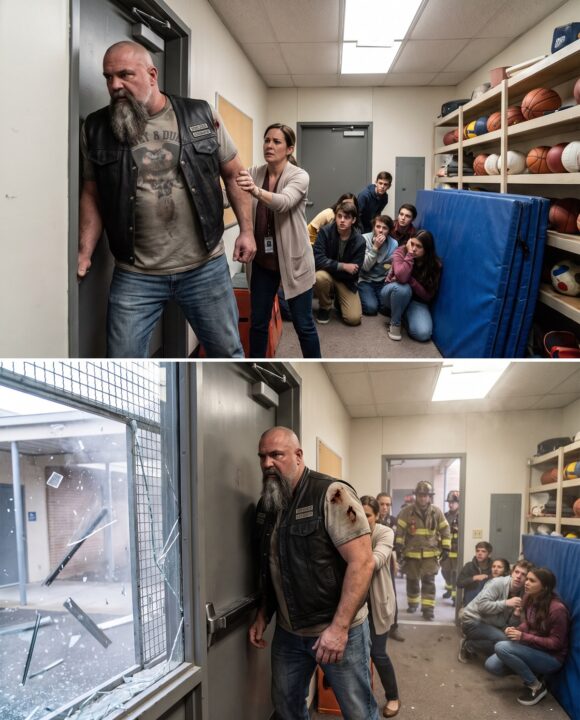
He refused treatment until responders counted the students independently.
Thirty.
He asked again.
The fire captain crouched beside him.
“Thirty children, one teacher, one stubborn biker.”
Hammer nodded.
“Good.”
Only then did he allow paramedics to cut away his shirt.
The scars beneath it did not belong to motorcycles. Long surgical lines crossed his ribs, while a pale crushed section near his right shoulder suggested an older injury far worse than today’s.
Inside the leather vest, the BEN patch remained visible.
I asked about it while paramedics stabilized his arm.
Hammer stared at the steel door.
“Later.”
The word was not a promise. It was a wall.
Outside, parents gathered behind police barriers. The first calls from students had described an armed biker locking children inside a room, so responding officers initially prepared for a hostage situation.
Then the glass roof collapsed.
Every frightened message changed meaning.
The man blocking the door had not been keeping rescuers away from children.
He had been keeping a collapsing building away from them.
News cameras arrived before the ambulances left. Principal Vale attempted to speak, but firefighters pulled him aside for questioning about evacuation routes and the chained rear exit.
His son Liam watched from a blanket beside the gym wall.
Liam was twelve, small for his age, and accustomed to being treated as an extension of his father’s position. That morning, he had seen fear dismantle the authority Principal Vale wore so comfortably.
“He knew about the roof,” Liam whispered to me.
I asked what he meant.
Two nights earlier, Liam had waited in his father’s office after basketball practice. A large envelope sat on the desk bearing the Iron Mercy Riders’ return address.
The front carried red handwriting:
IMMEDIATE CLOSURE RECOMMENDED.
Principal Vale read the report, placed it inside a drawer, and told the facilities director the district could not close the athletic wing before the state tournament.
Liam saw him lock it away.
He did not understand the importance until the ceiling fell.
“Why would my dad do that?”
I
TITLE: The Biker Locked Thirty Students Inside the Athletic Room and Blocked Their Teacher from Opening the Door—Then the Glass Roof Collapsed Exactly Where They Had Been Standing
SEO DESCRIPTION: A biker locks thirty students inside a gym room, then braces the door as a failing glass roof crashes through the hallway outside.
Part 1 — Teaser, Version 1: The Man Blocking the Only Door
The tattooed biker locked thirty middle-school students inside our athletic-equipment room, planted his enormous body against the only door, and refused to let me evacuate them while pieces of the hallway ceiling began striking the floor outside.
I was their physical-education teacher.
His name was Ray “Hammer” Dawson, though at that moment I knew him only as the frightening stranger who had taken my keys.
It happened on a Thursday morning at Beckford Middle School in southern Ohio, during a career fair held beneath the glass-roofed corridor connecting our gymnasium to the main academic building.
Rain struck the panels overhead. Wind pressed against the steel framework, and hundreds of students moved between displays hosted by firefighters, nurses, mechanics, electricians, and local business owners.
Hammer had arrived with the Iron Mercy Riders.
Their motorcycles stood in a disciplined row beside Route 33, black Harleys still dripping from the morning rain. Inside, the bikers were delivering adaptive sports equipment purchased for children with disabilities.
Hammer looked less like a donor than someone security might follow.
He stood six-foot-four and weighed nearly 285 pounds, with a shaved head, a thick black-and-gray beard, tattooed forearms, scarred knuckles, and a weathered black leather vest stretched across his shoulders.
Thirty seventh graders followed me from the gym toward the career booths.
We had crossed half the glass corridor when Hammer stopped beside an exposed support column and tilted his head.
He heard something.
I heard only students talking, rain ticking overhead, sneaker soles squeaking, and the distant V-twin rumble of a late-arriving motorcycle.
Hammer raised one hand.
“Everybody back.”
I asked what was wrong.
He did not answer immediately. His eyes moved along the steel beams supporting the glass roof, then toward a thin crack spreading through the plaster near a ventilation grille.
Another sound came from above us.
Ping.
Metal striking metal.
Then came a lower groan, long enough to feel through the floor.
Hammer turned toward the nearest room—the athletic storage area built from concrete block beside the gym—and ordered my students inside.
Several laughed.
I told him he had no authority.
Then a fist-sized piece of ceiling fell behind us.
Hammer moved.
He lifted one frightened boy away from the debris, pushed open the equipment-room door, and directed all thirty students through it while I shouted for them to remain in the corridor.
I believed evacuation meant reaching the main exit.
Hammer believed the corridor had already become the danger.
He counted every child aloud.
“Twenty-seven. Twenty-eight. Twenty-nine. Thirty.”
Then he took the master keys from my stunned hand, entered behind us, and locked the steel door.
“What are you doing?” I demanded.
“Keeping them here.”
“You can’t imprison students.”
“Not leaving.”
I reached for the lock.
Hammer stepped between me and the handle.
Two boys began filming. A girl near the volleyball carts cried that the biker had kidnapped us, while another student called 911 from beneath a stack of folded mats.
I struck Hammer’s shoulder with both hands.
He did not move.
Outside, Principal Warren’s voice came through the door, ordering him to unlock it. A security officer pulled the exterior handle while Hammer planted both boots against the floor.
“You hear the principal,” I said. “Open this door.”
Hammer pressed one scarred palm against the wall.
“Listen.”
At first, I heard nothing unusual.
Then came three sharp metallic snaps above the corridor.
Hammer’s face changed.
He turned toward the children and ordered everyone behind the stacked wrestling mats. His voice remained low, but something inside it made thirty panicked students obey.
I still reached for the lock.
Hammer caught my wrist—not painfully, but firmly enough to stop me.
“If that door opens,” he said, “they run straight under the glass.”
The corridor lights flickered.
A ceiling panel struck the exterior side of the door. Principal Warren shouted again, then his voice moved farther away as staff finally began retreating.
Hammer placed his back against the steel.
The building groaned.
Not like thunder.
Like something enormous deciding it could no longer remain above us.
The first section of glass roof collapsed outside.
Thousands of fragments struck the corridor tile with a roar so violent that several children screamed before the sound finished reaching us.
Air pressure slammed the door inward.
Hammer absorbed it.
His boots slid six inches. The handle turned against his hip, and a strip of metal pushed through the upper frame.
He leaned harder.
Another section fell.
Glass, plaster, twisted aluminum, and rain crashed into the exact place where my students had been standing less than one minute earlier.
Hammer’s knees buckled.
Blood appeared through the back of his shirt where the bent frame cut beneath his vest, but he did not leave the door.
He counted again.
“Twenty-eight. Twenty-nine. Thirty.”
Only after firefighters entered through the gym did Hammer allow himself to fall.
Inside his leather vest, beneath the club patches, paramedics found a faded photograph of a teenage boy standing under another glass roof.
On the back, someone had written:
DANIEL DAWSON—COUNTED TWENTY-NINE OUT. NEVER COUNTED HIMSELF.
The following day, investigators discovered Hammer had warned the school about the roof three weeks earlier.
Someone had buried his report.
Worse, one of the thirty children he protected was the son of the administrator who ordered the corridor kept open.
Want to know who Daniel was and why the school ignored Hammer’s warning? Drop THIRTY below—I’ll share more soon.
Part 1 — Teaser, Version 2: Thirty Children and One Locked Door
Thirty children were screaming behind a locked steel door while a 285-pound biker held the handle shut with his body, and I was the teacher trying to pull him away seconds before the hallway roof came down.
His boots kept sliding.
That is the detail I remember most.
Not the tattoos. Not the leather vest. Not even the blood spreading across the back of his gray shirt.
I remember Ray “Hammer” Dawson’s boots scraping inch by inch across the athletic-room floor while something outside struck the door hard enough to bend its upper hinge.
Thirty seventh graders crouched behind wrestling mats.
Some prayed.
Some filmed.
One called her mother and whispered that a biker had locked them inside Beckford Middle School.
I believed the same thing.
Ten minutes earlier, Hammer had been standing beneath the school’s glass atrium with four members of the Iron Mercy Riders.
They had come to deliver adaptive basketball equipment during our career fair, although their appearance made several parents uncomfortable.
Hammer was enormous—six-foot-four, nearly 285 pounds, with a shaved head, a long black-and-gray beard, scarred knuckles, and tattoos covering both forearms.
His black leather vest carried road patches darkened by rain. A chain wallet clicked against his jeans, and his heavy motorcycle boots left wet marks across the polished hallway.
I was guiding thirty students from the gymnasium toward the science wing.
Rain hammered the skylights while autumn wind moved through the old building. The atrium had leaked for months, but plastic buckets and repeated maintenance requests had become ordinary parts of school life.
Hammer stopped beneath the second support beam.
He removed one glove and touched the column.
“What?” I asked.
He looked upward.
A white line had opened near the steel connection plate. Fine plaster dust drifted through the air like flour.
“Get them out of here.”
I told him facilities had inspected the roof during summer break.
Hammer asked who signed the inspection.
His tone angered me.
Then a metallic snap echoed overhead.
He pushed the athletic-room door open and began directing students inside. I ordered them to keep moving toward the designated evacuation exit.
Hammer blocked the corridor.
“Wrong way.”
“You are not school staff.”
“No.”
“Then move.”
Another piece of plaster fell.
This one shattered beside a student named Leah Carter. Hammer covered her head with his leather vest and carried her into the room.
The remaining children followed from fear and confusion.
I entered last, intending to bring everyone back out once the debris stopped.
Hammer took my keys.
He locked the door.
I lunged toward him.
He planted his broad back against the steel and refused to move, even when Principal Warren pounded from the hallway.
“Open this door now!” the principal shouted.
Hammer looked toward the ceiling.
“Get away from the glass!”
Principal Warren ordered security to remove him.
Students began crying that we were hostages. One boy raised a hockey stick while I tried to persuade Hammer to release the lock.
He could have threatened us.
He did not.
He counted us.
“Twenty-seven. Twenty-eight. Twenty-nine. Thirty.”
Then he asked whether the equipment room had another exit. I pointed toward a narrow maintenance door opening into the gym.
Hammer unlocked that side.
He had not trapped us.
He had sealed the dangerous entrance while leaving a protected escape route available.
I did not understand yet.
Neither did the security officer pulling the outer handle.
Hammer pressed his shoulder beneath the lock and shouted for everyone outside to retreat.
The principal accused him of abducting children.
Hammer answered with three words.
“Roof is walking.”
That phrase made no sense until the ceiling began moving.
A dark line traveled across the corridor plaster. Dust streamed beneath the door, followed by the sharp crack of a glass panel breaking somewhere overhead.
Hammer told the students to lie behind the mats.
I remained beside him.
“You need to move,” I said.
“If I move, they open it.”
Security was still pulling from the other side.
Hammer wedged his body tighter.
Then the atrium collapsed.
The roar swallowed every voice.
The door drove inward, striking Hammer’s back and throwing him toward me. He caught the frame with both hands and forced it closed again as broken glass poured through the hallway.
A metal bracket sliced his shoulder.
His knees hit the floor.
Still, he counted.
“Twenty-nine. Thirty.”
Firefighters reached us through the gym five minutes later. Beyond the door, the corridor had disappeared beneath collapsed steel, insulation, water, and thousands of glass fragments.
The principal had escaped because Hammer’s final warning made a custodian drag him away.
Every student survived.
When paramedics removed Hammer’s vest, a small photograph fell from an inside pocket.
It showed a smiling teenage boy standing beside the biker beneath the glass entrance of a youth recreation center.
The photograph had been folded around an old inspection notice.
Both carried the same date.
That boy died when another roof collapsed seventeen years earlier, after Hammer heard the warning sounds and trusted a supervisor who told him everything was safe.
He had obeyed once.
He would never obey again.
But the school’s hidden maintenance records later revealed someone else had heard those same warnings before our career fair—and deliberately erased them.
Want to know whose son Hammer saved and what the hidden roof report revealed? Drop DOOR below—I’ll share more soon.
Part 2 — The Sound Hammer Had Heard Seventeen Years Earlier
My name is Claire Bennett, and I had taught physical education at Beckford Middle School for eleven years before the roof collapse.
I knew every emergency route, every student’s medical plan, and every stubborn hinge in the gymnasium.
Yet the man who saved my class understood the building better after touching one column for three seconds.
Hammer remained unconscious for six minutes after firefighters reached the equipment room. Paramedics found a deep cut across his shoulder, two cracked ribs, and severe bruising along his spine.
The steel door had distributed part of the impact.
His body absorbed the rest.
All thirty students left through the maintenance entrance into the gym. Firefighters passed them one by one toward the rear athletic field while parents gathered behind emergency vehicles.
I counted repeatedly.
Thirty.
Nobody was missing.
The glass corridor looked like a frozen river shattered by an earthquake. Roof beams had folded across display tables, while rain poured through the opening onto career-fair posters and abandoned backpacks.
Hammer’s black leather vest remained on the equipment-room floor.
I picked it up before following the students outside.
It was heavier than expected. A bent metal fragment had cut through the back panel, stopping against layers of leather before reaching his shoulder.
Inside the left pocket, I found the photograph.
The boy beside Hammer looked about seventeen. He had the same gray eyes and square jaw, but his hair curled over his forehead, and his smile carried none of Hammer’s guarded weight.
The handwritten message on the back said:
DANIEL DAWSON—COUNTED TWENTY-NINE OUT. NEVER COUNTED HIMSELF.
Beneath the photograph lay a corroded steel bolt.
Someone had polished one side until numbers became visible.
At the hospital, Bear and Marisol met me beside Hammer’s room. Both still wore wet riding gear, and neither seemed surprised by the photograph.
Daniel had been Hammer’s only son.
Seventeen years earlier, Hammer worked as an ironworker maintaining the roof of the Anderson Youth Recreation Center outside Columbus.
Daniel volunteered there after school, helping younger children with wrestling and basketball.
The building used a glass canopy supported by steel connectors similar to those inside Beckford Middle.
Weeks before the collapse, Hammer documented water intrusion near several fastening plates. His supervisor described the corrosion as cosmetic.
Hammer requested closure.
The supervisor refused because the center was hosting a regional youth tournament.
Hammer heard three metallic snaps on the morning of that tournament.
He reported them.
Again, management dismissed his concern.
“Ray trusted the men above him,” Bear said. “That was the last time.”
At 2:14 that afternoon, part of the canopy failed.
Daniel was inside with thirty children.
The teenager heard glass cracking and moved the younger students into a concrete locker room. He held the fire door while another coach led them through a rear exit.
Daniel counted twenty-nine children.
He went back for the thirtieth.
The child survived beneath a bench.
Daniel died in the corridor.
Hammer reached the recreation center after the collapse and spent nine hours helping firefighters remove debris.
He found his son’s shoe first.
Bear stopped speaking.
Marisol continued because some truths are carried best by the person whose voice can remain steady.
Hammer blamed the supervisor.
Then he blamed the company.
Eventually, he blamed himself for leaving the site after hearing the warning sounds.
His grief became anger, and anger joined the painkillers prescribed after a work injury. Within two years, he lost his job, his marriage, and almost his life.
Iron Mercy pulled him back.
They did not rescue him with speeches.
Bear removed the pills. Marisol drove him to treatment. Doc sat outside counseling sessions because Hammer refused to enter unless somebody waited.
After recovery, Hammer stopped working on commercial structures. He repaired motorcycles and volunteered with community safety projects, especially buildings used by children.
He carried Daniel’s photograph on every ride.
The corroded bolt came from the collapsed youth center.
Whenever Hammer heard someone dismiss a leak, crack, loose plate, or unexplained structural noise, he held that bolt and remembered what “probably safe” had cost him.
Three weeks before our career fair, Iron Mercy visited Beckford Middle to measure storage space for donated adaptive sports equipment.
Hammer noticed rust stains beneath the atrium framing.
He photographed a loose connection cover and reported it to Principal Warren.
The principal forwarded the photographs to District Facilities Director Martin Vale.
Vale sent an inspector.
According to the district’s public statement, the inspector found no immediate danger.
Hammer did not believe that statement.
He returned one week later with Doc, a retired municipal building inspector and Iron Mercy member. Doc examined the area from the floor without accessing restricted spaces.
He heard intermittent clicking as wind shifted across the glass panels.
The bikers submitted a written recommendation requesting an independent structural review and temporary corridor closure.
Nobody responded.
Hammer came to the career fair carrying two things: donated equipment for our students and a printed copy of the unanswered warning.
He planned to confront Principal Warren after the event.
The report was no longer inside his saddlebag.
Police found the leather case opened beside his Harley.
Someone had removed it during the emergency.
That missing report mattered because District Facilities released a different document hours after the collapse.
Their version carried Doc’s name and concluded the roof presented no urgent concern.
Doc stared at the signature.
“I didn’t write that.”
The report had been altered.
The district was preparing to blame Iron Mercy’s retired inspector for declaring the corridor safe.
Bear wanted to call reporters immediately.
Hammer woke before they decided.
His voice was barely audible through bruised ribs.
“Count the kids.”
I told him all thirty survived.
He closed his eyes.
Only then did he ask about the report.
When Bear explained the forgery, Hammer tried to sit up despite the nurse’s orders.
Marisol pressed him back.
“We’ll handle it.”
“No threats,” Hammer said.
“Nobody said threats.”
“You thought it loud.”
Even injured, he knew his club.
The younger riders wanted to surround district offices, demand records, and force officials to respond publicly.
Hammer refused.
Thirty children had just survived a terrifying confinement and structural collapse. Turning their school into the center of a biker confrontation would deepen their fear.
“Paper first,” he said. “Engines later.”
That was when police identified the student who had accidentally captured the missing report on video.
The boy’s name was Evan Vale.
He was one of my thirty students.
He was also the facilities director’s son.
Part 3 — The Boy Whose Father Buried the Warning
Evan was twelve, small for his age, and better at filming jokes than completing homework.
During the career fair, he recorded almost everything: Bear dropping a box of basketballs, Hammer struggling with a folding display table, and classmates imitating motorcycle sounds behind the bikers.
His phone continued recording when the ceiling began cracking.
The video showed Hammer handing a brown leather folder to Principal Warren beside the athletic-room entrance.
“Give this to Vale,” Hammer said. “Today.”
Principal Warren placed the folder on a table.
When the first ceiling fragment fell, people ran. A district administrator wearing a blue raincoat picked up the folder and carried it toward the office.
Evan recognized the man.
It was his father.
The video then followed Hammer forcing students into the equipment room. Evan hid behind volleyball carts while filming through a gap.
His footage captured my hands striking Hammer’s chest, Principal Warren pulling the outer handle, and thirty frightened children accusing the biker of holding us hostage.
It also recorded the sounds above the corridor.
Ping.
Ping.
Ping.
Hammer heard them and went pale.
“Behind the mats,” he ordered.
The video ended when glass struck the door and Evan dropped the phone.
Police recovered it beneath a cart.
Martin Vale initially denied taking the report. When investigators showed him the footage, he claimed he secured it to prevent loss during evacuation.
He could not explain why officers later found the empty leather folder inside his locked office.
The original document remained missing.
Vale’s son sat inside a temporary classroom while adults discussed criminal investigations around him.
Evan stopped speaking.
Children whose parents cause public harm often become unwilling stand-ins for the guilty adult. Other students whispered that his father nearly killed everyone.
Someone wrote ROOF BOY across his locker.
Hammer heard about it from Sofia Grant, one of the students who had crouched beside him at the door.
He left the hospital against medical advice.
Bear tried stopping him.
Hammer removed the monitoring leads, pulled a clean shirt over his bandaged shoulder, and walked toward the elevator.
“You can’t save every kid,” Bear said.
Hammer pressed the button.
“Watch me try.”
Iron Mercy escorted him back to Beckford Middle, but every engine shut down two blocks away.
Parents had already gathered outside the emergency fencing. Some applauded Hammer, while others believed his dramatic actions contributed to the collapse.
A short video circulating online showed only the locked door and children screaming that a biker would not release them.
The glass falling came after the clip ended.
Once again, strangers judged the beginning without seeing the next five seconds.
Hammer ignored the cameras.
He found Evan sitting on the football bleachers behind the temporary classrooms.
The boy looked at the bandage beneath Hammer’s shirt.
“My dad says you scared everybody.”
Hammer lowered himself slowly, wincing as cracked ribs pressed against his belt.
“He’s right.”
Evan glanced up.
“You admit it?”
“Kids were scared.”
“You locked us in.”
“Yes.”
“Then why are people calling you a hero?”
Hammer considered that question.
“People like short words.”
He did not ask Evan to defend him.
He did not insult Martin Vale or force the child to choose between truth and family.
Instead, Hammer removed Daniel’s photograph from his vest and showed Evan the boy who had once counted twenty-nine children from another damaged building.
“My son scared kids too,” Hammer said. “He yelled. Pushed them. Locked one door.”
“Did they hate him?”
“For a minute.”
“What happened?”
“They lived.”
Evan studied the photograph.
“Did he?”
“No.”
Hammer spoke the word without softening it.
Evan returned the picture.
“My dad knew the roof was bad.”
Hammer did not react.
“How do you know?”
“I heard him arguing with Mom.”
Evan explained that his father received an engineering estimate recommending replacement of several roof connections. The work required closing the corridor for at least six weeks.
Closing it would cancel the career fair, basketball tournament, and a major donor event.
The district faced a budget vote.
Vale feared photographs of a closed school wing would damage public confidence and threaten funding.
He ordered temporary patching.
Then he asked the inspector to revise the language from “potential progressive connection failure” to “normal age-related movement.”
Hammer listened.
Evan began crying.
“He said he was protecting our school.”
Hammer’s scarred fingers closed around the edge of the bleacher.
“Maybe he believed that.”
“Do you hate him?”
Hammer looked toward the collapsed corridor.
“No.”
“You should.”
“Hate doesn’t hold roofs.”
The answer disappointed Evan, perhaps because anger would have allowed him to hate his father through somebody stronger.
Hammer understood that temptation.
He had spent seventeen years learning what hatred could carry and what it always dropped.
Evan gave him a small locker key.
“My dad keeps copies in the old maintenance office.”
Police searched the office with a warrant.
They found inspection photographs, engineering estimates, emails from Principal Warren, and the missing original report inside a locked filing cabinet.
Doc’s authentic signature appeared beneath a recommendation for immediate closure.
Martin Vale had ordered an assistant to create the altered version after the collapse.
Principal Warren had objected to keeping the corridor open but ultimately followed Vale’s instruction.
That fact did not absolve him.
He had heard Hammer’s warning outside the equipment room and continued pulling the door, nearly exposing us when the roof failed.
Thirty students survived despite the adults responsible for them, not because of those adults.
I was included.
I had tried opening the door.
The realization hollowed me.
I returned to the equipment room after investigators released it. Dust covered the wrestling mats, and a deep dent marked the steel where the collapsing frame struck.
Hammer stood behind me.
“I should have listened,” I said.
“You listened when it mattered.”
“No. I fought you.”
“You moved the kids behind the mats.”
“After you told me.”
He leaned against the wall, protecting his injured ribs.
“Teachers are supposed to question strangers locking doors.”
I looked at him.
“Even when the stranger is right?”
“Especially then.”
Hammer would not let gratitude erase judgment. His action had been necessary, but he understood why it appeared terrifying.
That honesty mattered more than hero language.
Outside, reporters demanded a statement. Bear wanted the full student video released to clear the club’s reputation.
Several parents refused because their children appeared frightened and identifiable.
The brotherhood divided.
Some members had lost work after being labeled kidnappers. A local restaurant canceled Iron Mercy’s fundraiser, and anonymous callers threatened the clubhouse.
Bear argued the video belonged to Evan and could prove everything.
Hammer refused to use it without permission from every family.
“Our names can take a beating,” he said. “Kids don’t pay for our patch.”
A younger member removed his club vest and threw it across a chair.
“If we stay silent, Vale wins.”
Hammer looked toward Daniel’s photograph.
“No. He wins if we become men who need children exposed to save ourselves.”
The room fell quiet.
Then Evan entered with his mother.
He wanted to release one part of the video—the ceiling sounds, Hammer’s warning, and the locked door—while protecting every student’s face and voice.
His mother agreed.
Twenty-eight families consented.
Two did not.
Hammer respected the two.
The video remained private.
The club’s reputation continued collapsing almost as quickly as the roof.
Then the thirtieth student came forward.
She had not filmed Hammer.
She had filmed the ceiling.
And her recording contained a voice nobody expected to hear.
Daniel Dawson’s.
Part 4 — The Voice Hidden Beneath the Glass
The thirtieth student was Leah Carter, the girl Hammer carried after plaster fell beside her.
Leah used a small audio recorder during school because a processing disorder made written notes difficult. The device remained active throughout the career fair.
It captured nearly forty minutes.
At first, the recording contained ordinary noise: students laughing, vendors explaining careers, basketballs striking the gym floor, and rain tapping the glass roof.
Then Hammer’s voice appeared.
He was speaking with Doc near the support column before my class entered the corridor.
“Same three knocks,” Hammer said.
Doc answered, “Could be the glazing frame shifting.”
“No.”
“You sure?”
“I know that sound.”
Hammer touched the steel column.
Then he whispered a name.
“Daniel.”
Leah’s recorder captured what happened next: Hammer ordering evacuation, my refusal, the first ceiling fragment, children entering the equipment room, and Principal Warren demanding the door open.
The roof groaned.
Hammer began counting.
Twenty-seven.
Twenty-eight.
Twenty-nine.
He paused before thirty.
During that pause, a second voice appeared faintly beneath the children’s crying.
It sounded young.
“Dad, count yourself.”
Everyone who heard the recording reacted differently.
Leah believed it was another student.
Audio technicians later described it as overlapping speech shaped by echoes inside the equipment room.
Bear heard Daniel.
So did Hammer.
He listened once, removed the headphones, and walked outside without speaking.
I found him beside the broken atrium at sunset. The district had covered the opening with tarps, but wind still moved fragments against the steel.
“You heard it,” I said.
Hammer stared through the fence.
“I heard thirty kids.”
“And Daniel?”
His hand closed around the corroded bolt in his pocket.
“Dead boys don’t talk.”
The answer was practical.
His face was not.
Leah’s parents permitted investigators to use the recording. They also allowed a shortened, anonymized version to be released publicly without student voices.
The audio proved Hammer recognized structural failure before visible collapse. It captured his repeated warnings and Principal Warren’s attempts to open the door.
Public opinion shifted overnight.
The same people who called Hammer a kidnapper now posted his photograph beside words like guardian, warrior, and angel.
He rejected every label.
“Yesterday they wanted me jailed,” he told Bear. “Today they want me polished into a statue. Neither one knows me.”
Yet the recording revealed more than his actions.
Engineers compared the metallic pings to acoustic evidence from the Anderson Youth Center collapse seventeen years earlier.
The failure patterns matched.
Both buildings used connector assemblies supplied by Vale Structural Components, a company once owned by Martin Vale’s father.
The corroded bolt inside Hammer’s pocket carried the manufacturer’s stamp.
Martin Vale had grown up knowing what happened at Anderson.
His family company paid a confidential settlement after investigators found defective protective coatings on several connectors, but no criminal charges followed.
Vale later joined the Beckford district and oversaw construction upgrades.
He approved the same connector design during a renovation because replacing the entire atrium framework exceeded the budget.
Hammer had not known that.
His son died beneath hardware connected to Vale’s family.
Seventeen years later, Vale ignored warnings about another failing roof and nearly repeated the same tragedy with his own child standing underneath it.
The discovery could have destroyed Hammer’s restraint.
Bear expected him to confront Vale.
Marisol hid the Road King keys.
Hammer found the spare set, started the engine, and rode toward the county detention center where Vale awaited arraignment.
The club followed.
So did I.
Rain began before we reached the courthouse. Twenty-four Harleys lined the street, their V-twins echoing against government buildings.
Deputies prepared for trouble.
Hammer dismounted alone.
Vale appeared behind a secured transport entrance wearing handcuffs. When he saw the bikers, fear crossed his face.
Hammer stopped beyond the barrier.
“You knew Anderson,” he said.
Vale lowered his head.
“My father handled that case.”
“My son died.”
“I know.”
“And you used the same hardware.”
“The certification remained valid.”
Hammer stepped closer.
Deputies raised their hands.
Bear whispered his name.
Vale continued speaking, perhaps believing technical explanations could protect him from a father.
“We had budget limits. The probability of simultaneous failure was considered low.”
Hammer’s fists closed.
Every scar across his knuckles stood white.
Then Evan emerged from a nearby car with his mother.
Hammer saw the boy.
His hands opened.
He did not strike Vale.
He did not threaten him.
He removed Daniel’s photograph and held it against the barrier.
“This is what low probability looks like.”
Vale stared at the picture.
Hammer returned it to his vest.
“You tell the truth. All of it.”
Then he walked away.
Evan followed.
“Why didn’t you hurt him?” the boy asked.
Hammer stopped beneath the courthouse awning.
“Because you were watching.”
That answer traveled through the club.
Brotherhood had once meant standing beside Hammer during fights, addiction, funerals, and long rides through nights when he could not remain inside his own house.
Now brotherhood meant helping him leave before grief chose his actions.
Marisol returned his keys.
Bear placed one hand behind Hammer’s neck.
Nobody spoke.
The Iron Mercy Riders left the courthouse without revving their engines.
Martin Vale later accepted a plea agreement requiring full cooperation with the structural investigation. His testimony exposed falsified records, suppressed inspection reports, and unsafe connector assemblies in fourteen public buildings.
Every building closed for emergency assessment.
Three showed advanced corrosion.
One was another elementary school.
No roofs fell.
No children were injured.
Daniel’s death had echoed across seventeen years, not through the mysterious voice on Leah’s recording, but through the father who finally understood he could honor his son without becoming the anger that survived him.
Still, one question remained.
Why had Hammer counted thirty children twice while the roof collapsed?
I assumed he was verifying everyone.
The truth waited inside Daniel’s old photograph.
When conservation specialists separated its folded layers, they discovered a final note written by the boy on the morning he died.
Part 5 — The Thirtieth Name on Daniel’s List
The note was written on the back of a recreation-center attendance sheet folded beneath Daniel’s photograph.
Hammer had carried it for seventeen years without knowing another page was trapped inside.
Moisture from the original collapse had sealed the layers together. A document specialist separated them while preserving the faded pencil.
Daniel had listed thirty children scheduled for the youth tournament.
Twenty-nine names carried check marks.
The thirtieth name belonged to six-year-old Caleb Morris, the child Daniel went back to find.
Below Caleb’s name, Daniel had written:
Count the adults too. They forget they can break.
Nobody knew when he wrote it.
Bear believed Daniel added the sentence after watching Hammer work through injuries without resting. Marisol remembered the boy complaining that his father treated pain like unpaid mail.
Hammer read the note inside his garage.
He sat on a stool beneath the photograph while rain struck the metal door. His bandaged shoulder remained stiff, and bruises darkened both sides of his ribs.
Emily Ross, the paramedic overseeing his follow-up care, told him he should still be resting.
Hammer ignored her.
She took the shop keys and locked his tool cabinet.
He stared at Daniel’s sentence.
Count the adults too.
During both collapses, Hammer counted children and excluded himself.
At Anderson, he worked nine hours beneath unstable debris before accepting treatment. At Beckford, he braced the athletic-room door until his body failed.
He believed self-sacrifice proved love.
Daniel’s note challenged that belief.
The boy had not asked his father to become another casualty.
Hammer folded the paper carefully.
“I don’t know how to count me,” he said.
Bear leaned against the workbench.
“Start with thirty-one.”
Hammer looked toward him.
“Thirty kids. One stubborn old biker.”
“I’m fifty-six.”
“Ancient.”
Hammer almost laughed.
That small sound carried more healing than any ceremony the district planned.
Beckford Middle remained closed for four months while engineers inspected and rebuilt the atrium. Students attended classes inside two churches, a community college, and the Iron Mercy clubhouse.
The clubhouse became my temporary physical-education classroom.
Bikers moved motorcycles, tool cabinets, and an old pool table to create space for movement activities. They taped court lines across the concrete and installed padded wall panels.
Parents initially objected.
Then they visited.
They found no illegal bar, hidden weapons, or threatening initiation ritual. They found coffee, repair manuals, folding chairs, donated helmets, and a bulletin board covered with thank-you drawings from children.
Hammer never taught alone.
He assisted certified staff, carried equipment, and repaired anything students broke.
Evan Vale attended every class.
Other children avoided him until Hammer paired him with Leah during a cooperative obstacle course.
When one boy called Evan’s father a murderer, Hammer stopped the activity.
“His father answers for his choices,” he said. “Evan answers for his.”
That boundary protected the boy without excusing Martin Vale.
It also exposed my own quiet failure.
After the collapse, I had treated Hammer as unquestionably right and myself as entirely wrong. That version was easier than admitting safety required constant judgment rather than permanent heroes.
Hammer had locked a door.
In that moment, it saved lives.
In another context, the same action could create danger.
He insisted our new emergency plan document both truths.
“Don’t teach kids to obey leather,” he said. “Teach them to notice exits.”
Together with firefighters and structural engineers, we redesigned evacuation procedures for the rebuilt school. Athletic rooms received clear occupancy signs, emergency communication devices, and secondary exits.
Students practiced listening for instructions while also identifying protected locations and reporting environmental changes.
Leah suggested three metallic pings become part of the school’s safety education.
Engineers warned that building failures do not always announce themselves the same way, so we avoided turning Hammer’s experience into a universal rule.
Instead, the lesson became simpler.
If something changes—sound, movement, cracking, falling material—report it and move away.
Adults must listen.
The district created the Daniel Dawson Building-Safety Fund using insurance recoveries and redirected renovation money.
Hammer rejected a proposal placing his own name beside Daniel’s.
“You saved thirty children,” the superintendent said.
“My son saved thirty-one.”
The superintendent reviewed the old attendance sheet.
“Records say thirty children survived Anderson.”
Hammer touched Daniel’s note.
“He saved me later.”
The fund paid for independent inspections at aging youth facilities. Iron Mercy supplied transportation and volunteer labor where qualified professionals approved it.
Doc joined the advisory board.
Bear handled donations.
Marisol wrote rules strict enough to make everyone complain, which proved they were probably useful.
Hammer attended meetings but refused the chairman position.
He finally understood leadership did not require standing in every doorway alone.
Principal Warren resigned.
Before leaving, he requested a private meeting with Hammer and me.
He admitted hearing the metallic snaps before reaching the equipment-room door. Fear convinced him the students needed immediate evacuation, so he kept pulling despite Hammer’s warning.
“I almost opened it,” Warren said.
Hammer nodded.
“I almost let my son stay beneath a roof because a supervisor said it was fine.”
Warren looked confused.
“You forgive me?”
“No.”
The principal’s face tightened.
Hammer continued.
“Forgiveness isn’t mine. But I understand panic.”
That distinction became part of every conversation afterward.
Understanding did not erase responsibility.
Responsibility did not require hatred.
At the reopening ceremony, thirty students walked through the rebuilt corridor wearing clear safety helmets signed by their classmates.
Hammer stood near the athletic-room door.
He did not block it.
Daniel’s photograph rested inside his vest, now wrapped around the recovered attendance sheet.
When Evan approached, Hammer handed him a small steel washer salvaged from the old corridor after engineers declared it harmless.
Evan turned it over.
“What does this mean?”
“Nothing yet.”
“What am I supposed to do with it?”
“Make it mean better.”
Evan carried the washer inside.
Years later, I learned he kept it through high school and college. He studied structural engineering, specializing in public-building rehabilitation.
He never denied what his father had done.
He refused to let it determine what he would do.
Hammer kept the corroded Anderson bolt.
The polished side showed the manufacturer’s stamp.
The rusted side showed time.
He placed it beside Daniel’s note rather than carrying it inside his fist.
Some burdens remain.
They simply stop needing to be weapons.
Part 6 — The Door Hammer Opens Every October
Every October, Iron Mercy rides from Route 33 to the Anderson Youth Recreation Center memorial.
The original building no longer stands. A small community park occupies the site, with a concrete basketball court and thirty young trees planted around its edge.
Twenty-nine trees form a circle.
The thirtieth stands near the entrance.
Daniel’s name appears on a small metal plate beneath it.
Hammer arrives before sunrise.
He shuts down his Road King, removes his gloves, and walks the circle while counting every tree.
He once stopped at twenty-nine.
Now he counts thirty.
Then Bear taps his shoulder.
“Thirty-one.”
Hammer includes himself.
The ritual never becomes cheerful, but it becomes lighter.
Students from Beckford Middle sometimes join the ride. They arrive by bus rather than motorcycle, bringing handwritten notes about the lives they built after the collapse.
Leah became a sound engineer.
She still owns the recorder that captured the roof and the voice everyone interpreted differently.
Evan designs inspection systems for older schools.
Sofia Grant became a firefighter, saying she remembered how Hammer’s voice remained calm even when the building sounded frightened.
Others became teachers, nurses, mechanics, parents, or adults whose ordinary lives proved the significance of that locked door.
I continue teaching.
The athletic-equipment room remains part of my gym, although the original damaged door hangs inside the school’s safety-training center.
A deep inward dent crosses the steel at shoulder height.
Visitors often place their palms against it.
Hammer never does.
He says he remembers the shape from the inside.
After the memorial, the club rides to Beckford Middle. Engines stop beyond the student entrance, and the bikers push their motorcycles through the final block.
Hammer checks the rebuilt corridor with our facilities team, never pretending he is a licensed engineer.
He asks questions.
He listens to the answers.
If professionals say a condition is safe, he reviews the evidence rather than trusting authority blindly or rejecting it automatically.
That balance took him longer to learn than motorcycle repair.
At noon, he visits Daniel’s fund office inside the old maintenance wing. The original warning report hangs behind protective glass.
Beside it is the altered version carrying Doc’s forged signature.
Both documents remain visible because safety failures often begin not with missing knowledge, but with someone changing the language until danger sounds affordable.
Hammer’s president patch hangs beneath the display.
He wears a plain vest during school visits.
Children know him anyway.
They call him Mr. Hammer, which he claims sounds like a cartoon carpenter.
Each year, new seventh graders ask whether he truly locked thirty students inside a room.
“Yes,” he says.
“Were they scared?”
“Yes.”
“Were you scared?”
He pauses.
“Yes.”
That answer surprises them most.
The enormous biker does not pretend courage erased fear. He tells them his hands shook, his knees weakened, and part of him remained seventeen years in the past beneath another falling roof.
Then he shows them Daniel’s note.
Count the adults too.
The words are no longer hidden.
Neither is he.
Part 7 — Thirty Students Returned to the Door
On the tenth anniversary of the Beckford collapse, all thirty former students returned to the rebuilt school.
They were twenty-two and twenty-three years old by then.
Several brought spouses. Four brought children. One arrived late from a nursing shift, while another came directly from an airport wearing a wrinkled suit.
Hammer waited inside the gym.
Age had silvered the rest of his beard and stiffened the shoulder once struck by the door. He still stood six-foot-four, though his posture carried the miles more honestly.
The students entered without announcement.
Hammer began counting automatically.
“Twenty-seven. Twenty-eight. Twenty-nine.”
He stopped.
Evan Vale stepped through last.
“Thirty.”
Bear stood behind Hammer.
“Thirty-one, brother.”
The old biker lowered his head.
Claire—the teacher I had been that day—would have filled the silence with instructions or explanations. I had learned better.
Nobody needed words yet.
Leah approached first and gave Hammer a small speaker containing the original recording. She had cleaned the sound without altering the voices.
Sofia brought a firefighter’s helmet.
Evan carried the steel washer Hammer gave him at the reopening ceremony.
He had mounted it inside a clear case beside a model of a safer public-school roof connection.
“What did you make it mean?” Hammer asked.
Evan placed the case in his hands.
“A building that listens.”
Hammer traced the edge of the washer.
Then the former students led him toward the athletic room.
The damaged steel door remained on display nearby, but a new door stood in its original frame.
Thirty names had been engraved along the inside.
A thirty-first appeared at shoulder height.
RAY “HAMMER” DAWSON.
Beneath it was Daniel’s sentence.
COUNT THE ADULTS TOO.
Hammer touched his son’s words.
His eyes remained dry, but his scarred hand trembled against the metal.
Evan opened the door.
Nobody blocked it.
The thirty students crossed together, then turned and waited for Hammer on the other side.
He remained in the corridor for several seconds.
Perhaps he heard glass falling again. Perhaps he saw Daniel counting children beneath another roof, still seventeen, still believing his father deserved a place among the living.
Bear did not push him.
Marisol did not call his name.
Hammer stepped through by himself.
The door closed softly behind him.
Outside, thirty-one motorcycles waited beneath the October sky—one for every life Daniel’s final note had taught Hammer to count.
Leave “HAMMER” below if you want the full update about the thirty students and the door that still carries their names.
Follow our page for more unforgettable biker stories about misunderstood courage, wounded families, tested brotherhood, and rough men who stand firm when everything else falls.