Part 2: The Biker Dragged a Little Boy Away from His Mother’s Casket During the Funeral—Then Sat Outside the Cemetery All Night So He Would Not Face Goodbye Alone
Part 2 — The White Ribbon Inside Hammer’s Vest
My name is Rebecca Collins, and I became Caleb’s temporary guardian three days before Sarah died.
That arrangement looked sensible on paper.
I was thirty-nine, divorced, employed as an elementary-school librarian, and living fifteen minutes from Caleb’s school. Sarah and I had shared bedrooms, secrets, and childhood punishments.
Yet grief changes families into rooms filled with competing certainty.
Our mother believed Caleb should move to Florida. Uncle Patrick wanted him raised by Daniel’s parents in Tennessee, while two cousins questioned whether I could manage a traumatized child alone.
Caleb heard every conversation.
Adults believed lowering their voices protected him. Children who have already watched death approach become experts at hearing what grown people hide.
Sarah understood that.
During her final weeks, she asked each relative to stop discussing custody beside her hospital bed. Nobody stopped for long.
Hammer did.
He visited every Tuesday at 6:00 p.m., removed his leather vest outside the hospice room, washed his hands, and waited until Sarah invited him closer.
He brought nothing dramatic.
Sometimes he carried road coffee for the nurses. Sometimes he repaired the loose wheel on Caleb’s toy cart or replaced batteries in the bedside radio.
I assumed he belonged to Sarah’s volunteer network.
She never explained their history.
After the casket incident, Hammer handed police his identification and agreed to remain while the funeral home documented the broken hinge.
He did not threaten legal action.
He asked only whether Caleb had been examined.
Paramedics found bruising along the boy’s waist from Hammer’s rescue, but no serious injury. The alternative remained visible in the deep impact mark across the closed lid.
Mercer & Sons offered immediate reimbursement.
I refused to discuss money during the burial.
Hammer refused to let the funeral home remove the failed support until police photographed it.
He knew exactly what he was seeing because he had worked at Mid-Ohio Casket Works for seven years after leaving prison.
That detail alarmed my uncle.
“What were you in for?”
Hammer answered without looking away.
“Assault.”
The word confirmed every suspicion my family carried.
He explained nothing further.
Only later did I learn Hammer’s conviction came after he attacked a drunk driver who killed his younger brother. The driver survived, while Hammer spent twenty-two months learning anger could extend grief without changing its ending.
Mid-Ohio hired him through a reentry program.
He assembled lid supports, reinforced frames, and adjustable beds while attending addiction treatment for pain medication he began taking after military injuries.
Hammer understood caskets mechanically.
Sarah understood what they represented.
Their lives crossed when Hammer’s wife, Caroline, entered hospice with pancreatic cancer. Sarah served as her night nurse during the final month.
Hammer attended every appointment but often remained outside the room. He could repair an engine beneath rain, confront armed strangers, and endure withdrawal.
He could not watch Caroline disappear.
Sarah never shamed him.
One evening, she sat on the hospital corridor floor beside the enormous biker and waited until he admitted he feared Caroline would see terror on his face.
Sarah answered, “She already knows you’re afraid. What she needs is to know you stayed.”
Hammer entered the room.
Caroline died with his hand beneath hers.
Afterward, Sarah attended the funeral without wearing a uniform. She found Hammer beside the casket and gave him a white hospice ribbon carrying Caroline’s name.
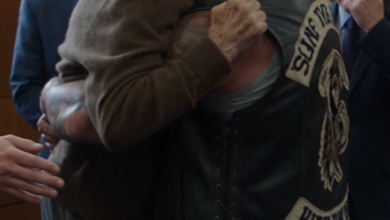
He stitched it inside his vest.
When Sarah became ill, Hammer returned the kindness quietly. Iron Mercy delivered meals, drove Caleb to baseball practice, and paid two utility bills through an anonymous community fund.
Sarah knew the money came from them.
Caleb did not.
The white ribbon inside Hammer’s vest had two names stitched on opposite sides.
Caroline.
Sarah.
After Sarah’s burial, I took Caleb home. He refused dinner, tore flowers from condolence baskets, and demanded we return to the cemetery.
I explained that the gates closed at dusk.
He said his mother hated dark rooms.
I told him Sarah was no longer frightened.
That sentence may have been philosophically comforting to adults.
To Caleb, it sounded like another person explaining that his mother no longer belonged to him.
At 11:20 p.m., I discovered his bedroom window open. His bicycle was gone, along with a flashlight, two blankets, and the plastic astronaut recovered from the chapel floor.
Police located the bicycle outside Green Hollow Cemetery.
The gate remained locked.
For fifteen minutes, we believed Caleb had climbed the fence and entered alone.
Then a patrol officer noticed the Harley beneath an oak near the outer wall.
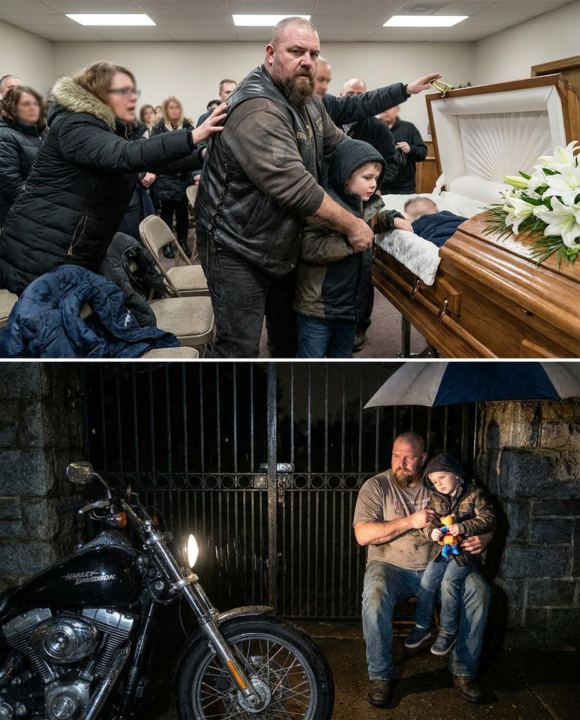
Hammer sat beside the boy.
Caleb had reached the cemetery but could not climb the iron gate. He curled against the stone entrance while deciding whether to try.
Hammer had been riding County Road 8 after insomnia drove him from home. He saw the bicycle without reflectors and stopped.
He called police before approaching Caleb.
Then he contacted me.
My phone had been inside the patrol car, so I never received the call.
By the time I arrived, Hammer’s vest covered the boy. The biker sat in a short-sleeved shirt while cold rain gathered across his tattoos.
“Come home, Caleb,” I said.
“No.”
“We can visit tomorrow.”
“Tonight is her first night.”
Hammer looked toward me.
“He can sit here until sunrise.”
“He is eight.”
“I noticed.”
“He needs sleep.”
“He needs this more.”
I became angry because part of me knew he was right.
The cemetery caretaker allowed us to remain outside the gate but prohibited entry after dark. Hammer opened his saddlebag and removed a thermos, emergency blanket, flashlight, and Sarah’s sealed letter.
My name appeared across the envelope.
Hammer said Sarah instructed him to deliver it only if Caleb tried returning to the cemetery alone.
I opened it beneath the Harley’s headlight.
Sarah’s first sentence read:
Rebecca, if he goes back for me, please don’t make him come home before he is ready.
The letter asked me to remain nearby without forcing conversation.
It asked Hammer to sit with Caleb because he understood the difference between accompanying grief and trying to remove it.
The final page contained a second envelope addressed to Caleb.
Before I could open it, headlights appeared along the road.
Twelve Iron Mercy motorcycles approached the cemetery.
Hammer stood.
“I told them not to come.”
Bear removed his helmet.
“You’re freezing, brother.”
“We don’t turn this into a ride.”
“No engines. No patches near the kid.”
The bikers parked beyond the hill, shut down silently, and carried folding chairs, dry blankets, coffee, and a small propane heater toward the wall.
My family saw their arrival differently.
Uncle Patrick claimed Hammer was using Sarah’s death to stage a biker vigil and influence Caleb before the custody hearing.
He called our attorney.
By sunrise, the night outside Green Hollow Cemetery had become evidence in a family dispute.
And Sarah’s letter had named Hammer for a role none of us expected.
Emergency co-guardian.
Part 3 — The Casket Model the Funeral Home Was Told to Remove
The guardianship clause turned grief into open conflict.
Sarah had appointed me as Caleb’s primary guardian, but she named Hammer as emergency co-guardian for decisions involving Daniel’s military benefits, trauma counseling, and continued contact with Iron Mercy Riders.
My relatives called it irrational.
Hammer called it unnecessary.
“I’m not raising somebody else’s boy,” he said after reading the document.
Sarah anticipated that response.
A note beneath his signature line said:
You are not replacing either parent. You are helping Rebecca keep him connected to both.
Daniel Cole had ridden with Iron Mercy before joining the Marines. He was never a patched member, but Hammer taught him basic motorcycle repair and helped prepare for his first deployment.
After Daniel died, Sarah withdrew from the club because every engine reminded Caleb of the funeral escort.
Hammer respected her distance.
They communicated through occasional letters and Tuesday hospice visits.
Sarah believed Caleb would eventually need someone who remembered his father before uniforms, photographs, and folded flags turned Daniel into a symbol instead of a person.
Hammer remembered Daniel burning pancakes at the clubhouse, dropping a Road King during training, and carrying peppermint candy because Aaron Bell had given him the habit.
He remembered the living man.
That was the role Sarah wanted preserved.
My uncle challenged the document.
Caleb’s paternal grandparents supported it after reading Sarah’s letter, but they wanted the boy moved to Tennessee.
While lawyers argued, investigators examined the failed casket support.
The model was a Mercer Heritage 410, manufactured eighteen months earlier through subcontracted assembly after Mid-Ohio Works closed one production line.
Six months before Sarah’s funeral, the manufacturer issued a service bulletin involving hinge pins that could migrate from improperly crimped housings.
The bulletin did not require a full public recall. It instructed funeral homes to inspect affected caskets before use and replace questionable supports.
Mercer & Sons received the bulletin.
Their maintenance log showed Sarah’s casket passed inspection.
Hammer doubted it.
The broken pin displayed no fresh tool marks around the retaining edge. Decorative fabric concealed oxidation indicating the support had remained loose for weeks.
The funeral director, Lawrence Mercer, blamed an employee.
The employee produced emails showing Mercer personally ordered staff to continue using affected caskets because replacement hardware was backordered.
“Families don’t touch the lids,” Mercer wrote. “Risk is minimal if staff handles them.”
Nobody accounted for an eight-year-old climbing toward his mother.
When reporters learned what happened, the chapel video spread online. A relative had recorded Caleb’s farewell and unintentionally captured Hammer’s intervention.
The first clip ended before the lid fell.
It showed a tattooed biker dragging a child away from his mother’s casket while mourners attacked him.
Millions viewed it.
Hammer received threats.
Mercer & Sons released a statement implying an unidentified guest disrupted safe funeral procedures, causing mechanical stress that might have damaged the hinge.
The funeral home blamed Hammer.
Iron Mercy wanted the complete video released.
The remaining footage showed the lid falling, the separated support, and Hammer shielding Caleb. It would clear him instantly.
Caleb appeared throughout.
His scream, his mother’s body, and the private moment he tried kissing her would become permanent public property.
Hammer refused.
“That boy doesn’t pay for my name.”
Bear argued the funeral home’s lie threatened everyone associated with the club.
Sponsors withdrew from Iron Mercy’s children’s programs. Hammer’s motorcycle garage received cancellations, and someone broke a clubhouse window.
Marisol suggested releasing only the mechanical portion with faces obscured.
Mercer’s attorneys claimed any edited video lacked context.
The club divided.
A younger rider named Chase secretly uploaded the complete recording.
Within an hour, public opinion reversed.
Hammer became a hero.
Caleb became content.
Strangers analyzed his crying, Sarah’s appearance, my slap, and every relative’s reaction. People created slowed-down clips of the falling lid.
One account replayed Caleb’s scream beneath dramatic music.
Hammer found Chase inside the clubhouse.
He did not strike him.
He removed the rider’s access keys and ordered a disciplinary hearing.
“You cleared my name,” Hammer said. “With the boy’s worst minute.”
Chase argued millions now understood the truth.
Hammer answered, “Understanding stolen from a child is still theft.”
Iron Mercy suspended Chase for violating the family’s privacy. Several members resigned in protest, believing the club punished someone who defended its president.
Brotherhood had become another hinge under pressure.
Caleb stopped attending school after classmates found the video. Children asked whether he touched his mother’s body and why the biker threw him.
He blamed Hammer.
“You put me online.”
Hammer accepted the anger even though he had opposed the release.
“No,” I told Caleb. “Someone else did.”
“He’s their boss.”
That accusation reached Hammer.
He offered to resign as president.
Marisol refused to accept the patch.
“Leadership means cleaning what your people broke,” she said. “Not leaving us with the mess.”
Hammer contacted platforms, attorneys, and child-privacy advocates. Iron Mercy funded legal efforts to remove unauthorized copies.
The original uploader deleted his post.
Copies remained.
The internet keeps what families would burn.
During this crisis, Lawrence Mercer offered us a settlement covering funeral costs, counseling, and Caleb’s education.
The agreement required us to release the funeral home from liability and publicly state Hammer’s sudden movement contributed to the hinge failure.
My uncle urged acceptance.
The money could protect Caleb’s future.
Hammer said the decision belonged to me.
Sarah’s sealed envelope for Caleb remained unopened because I believed he should choose when to read it.
That night, he asked for it.
Inside was a short letter and an old photograph of Daniel sitting beside Hammer’s Harley.
Sarah wrote:
If people argue about who saved you, remember they are looking at the wrong moment. The person who stays afterward is showing you who he is.
Caleb read the sentence twice.
Then he asked where Hammer was.
He was outside Green Hollow Cemetery.
Again.
The biker had returned alone each night since the burial, sitting beyond the locked gate because Caleb once said his mother feared darkness.
He never told the boy.
He never photographed it.
He simply stayed.
Part 4 — The Night Sarah Once Sat Beside Hammer
Caleb asked me to drive him to the cemetery at 1:00 a.m.
I wanted to say no.
School resumed in the morning, the weather had turned cold, and every counselor advised rebuilding predictable routines.
Then I remembered Sarah’s instruction.
Do not make him come home before he is ready.
We found Hammer beneath the same oak near the cemetery wall. His Road King stood with its headlight off, while a battery lantern illuminated Caroline’s and Sarah’s names inside his open vest.
Caleb approached without speaking.
Hammer moved his coffee aside.
The boy sat beside him.
For several minutes, neither looked at the other.
Finally, Caleb asked, “Why do you come if I’m not here?”
Hammer stared through the iron gate.
“Your mom stayed for me once.”
He told Caleb what Sarah had never shared with the family.
During Caroline’s final night, Hammer entered the hospice room after Sarah’s corridor conversation. He held his wife’s hand, but when her breathing changed, panic overwhelmed him.
He ran outside.
He climbed onto his Harley and reached the parking-lot exit before Sarah appeared in front of the motorcycle.
She did not order him back inside.
She sat on the curb.
Hammer shut down the engine.
Sarah remained beside him for forty-three minutes while he described every reason he could not watch Caroline die.
When he finished, Sarah said:
“If you leave now, she may die alone. If you return, you may feel broken. Only one of those wounds belongs to you.”
Hammer returned.
Caroline died before sunrise with him beside her.
Sarah remained outside the room afterward because she understood he might need someone waiting beyond the first goodbye.
Years later, when her own illness became terminal, she asked Hammer to offer Caleb that same presence.
Not advice.
Not replacement parents.
Presence.
Caleb pressed his forehead against his knees.
“I was mad when you pulled me.”
“I know.”
“I still am.”
“Okay.”
“You saved me.”
“Looks that way.”
“Do I have to thank you?”
“No.”
Caleb looked toward him.
Hammer’s refusal released something. Gratitude can become another demand placed on grieving children, especially when adults need meaning from a frightening event.
The boy began crying.
Hammer did not embrace him until Caleb moved closer first.
Then the enormous biker opened one arm and allowed the child to decide the distance.
I watched from the Harley.
That was when another vehicle stopped along County Road 8.
Lawrence Mercer stepped out.
The funeral director carried a cardboard records box and looked older than he had one week earlier.
He confessed that Sarah’s casket had been substituted the morning of the service.
The model she purchased arrived damaged during transport. Rather than postpone the funeral, Mercer selected an identical-looking casket from inventory.
That unit appeared on the service-bulletin list.
An employee warned him.
Mercer inspected the visible hinge area, saw no obvious defect, and approved it because relatives were already arriving.
He falsified the maintenance log afterward.
When the lid failed, fear made him blame Hammer.
Mercer brought the original substitution forms, emails, and security footage showing staff discussing the defective support.
“Why bring this now?” I asked.
He looked toward Caleb.
“My daughter saw the video.”
“That changed your conscience?”
“No. She asked whether I would have blamed the biker if that lid had killed the child.”
Mercer offered to surrender the records before investigators obtained them.
Hammer told him to call his attorney.
Mercer shook his head.
“I called the police.”
Headlights appeared behind him.
He gave the box to an officer and accepted arrest for evidence tampering and reckless endangerment.
Before entering the patrol car, Mercer approached Caleb.
Hammer stood between them.
Caleb looked around the biker.
Mercer apologized without requesting forgiveness.
Then he left.
The records strengthened our civil case, but they exposed another secret.
Sarah knew about the casket substitution.
A staff member called her hospice social worker because the replacement differed slightly from the model selected.
Sarah had left instructions approving any safe alternative if delivery problems arose.
Mercer altered that instruction after the fact, inserting the affected model number.
Beneath Sarah’s original signature was a handwritten note:
Please keep the lid closed if Caleb climbs. He will try to kiss me.
She knew her son.
She had anticipated the exact farewell.
Mercer ignored the warning.
Hammer did not merely recognize a failing hinge.
He fulfilled a mother’s last specific effort to protect her child after death.
Caleb asked to see the note.
I gave it to him.
He traced Sarah’s handwriting with one finger.
“She knew I’d climb?”
“Yes.”
“Was she mad?”
“No.”
Hammer looked through the gate.
“She wanted you safe.”
Caleb leaned against him.
The cemetery caretaker arrived before dawn and unlocked the pedestrian entrance. He allowed us to walk to Sarah’s grave under supervision.
Caleb placed the plastic astronaut beside the temporary marker.
Hammer remained several steps away.
“Come here,” Caleb said.
Hammer joined him.
The boy held out one hand to me and one to the biker.
For the first time since Sarah died, Caleb stood between two living people without believing either one intended to pull him away from her.
Sunrise moved across the cemetery.
We thought the family conflict might finally soften.
Then Daniel’s parents arrived from Tennessee carrying military records Sarah had never seen.
The documents suggested Caleb’s father had not died where the Marines told us.
Hammer knew the truth.
And Sarah had asked him to keep it secret until Caleb chose to ask.
Part 5 — What Hammer Knew About Caleb’s Father
Daniel Cole died during a convoy attack in Afghanistan, but the official notification simplified his final actions.
He was listed as killed while protecting fellow Marines.
That was true.
It was incomplete.
Daniel’s unit vehicle struck an explosive device outside a village. The blast disabled communications and injured several men.
Secondary fire began from a nearby ridge.
Daniel could have remained behind the armored vehicle until support arrived. Instead, he crossed exposed ground to reach an Afghan interpreter trapped beside a second vehicle.
The interpreter had a seven-year-old son living nearby.
Daniel pulled him into cover.
Then he returned for the boy.
A second explosion killed Daniel and injured the child. Both the interpreter and his son survived.
Because the operation involved local intelligence personnel, early reports concealed identities and precise circumstances.
Daniel’s parents received a fuller account years later through a declassified unit statement.
Sarah never did.
She knew Daniel saved others but not that he died returning for a child roughly Caleb’s age.
Hammer knew because Daniel’s former platoon sergeant joined Iron Mercy after leaving the Marines.
Sarah asked Hammer not to tell Caleb until the boy questioned whether his father chose to leave him.
She feared adults would turn Daniel’s death into a lesson requiring Caleb to feel proud whenever he felt abandoned.
Pride does not cancel abandonment inside a child.
At Sarah’s grave, Caleb finally asked.
“Did Dad want to die?”
“No,” Hammer said.
“Then why did he go back?”
“There was a kid.”
“Like me?”
“About your age.”
Caleb stared at Daniel’s military photograph.
“Did he love that kid more?”
Hammer lowered himself carefully.
“No.”
“Then why save him?”
“Because he was there.”
The answer did not romanticize death or turn Daniel into someone searching for sacrifice.
He saw a child in danger.
He moved.
That was all.
Caleb began crying again.
“My dad went back. Mom stayed for people. You pulled me away.”
Hammer nodded.
“I keep getting left by people who help somebody.”
That sentence broke every adult present.
Caleb had interpreted courage as a force that repeatedly took parents away from him.
Daniel returned for a child.
Sarah spent years caring for dying families while managing her own illness.
Hammer risked injuring himself beneath the casket lid.
To us, those actions demonstrated love.
To Caleb, love had become the thing that made people disappear.
Hammer did not argue.
He sat beside the grave until Caleb asked whether protecting people always meant leaving.
“No,” Hammer said. “Most days it means coming back.”
“Did you come back?”
“Tonight.”
Caleb looked toward the cemetery entrance.
“So did Aunt Rebecca.”
“Yes.”
“Will you both keep doing that?”
I answered first.
“Yes.”
Hammer waited.
Promises frightened him because he understood their weight.
“I’ll show up,” he said. “Then you decide what it means.”
That became the foundation of our strange family.
The custody hearing occurred six weeks later. Daniel’s parents withdrew their request to relocate Caleb after recognizing another abrupt move would deepen his losses.
They remained active grandparents and visited monthly.
My uncle continued opposing Hammer’s co-guardian role, citing his conviction and former addiction.
Hammer submitted every treatment record, probation document, employment review, and personal reference without asking the club to intimidate anyone.
Sarah’s hospice social worker testified.
So did Daniel’s former platoon sergeant.
The judge preserved Sarah’s arrangement with specific boundaries. I remained primary guardian, while Hammer received authorization to support military-benefit matters, counseling continuity, and agreed contact.
He held no independent medical or educational authority.
Hammer accepted every limitation.
My uncle called the outcome dangerous.
Caleb called it Tuesday, because Hammer still arrived every Tuesday at 6:00 p.m., just as he had during Sarah’s hospice care.
They rarely discussed death.
They repaired bicycles, ruined pancakes, and built model rockets that leaned sideways because Hammer refused to read instructions.
Iron Mercy members became familiar visitors, but Marisol enforced Sarah’s boundary: Caleb would never become the club mascot or appear in promotional photographs.
Chase, the rider who uploaded the funeral video, completed his suspension and apologized directly.
Caleb did not forgive him immediately.
Chase accepted that.
He spent months helping child-privacy advocates remove copied videos and donated earnings from his construction job toward counseling services.
Brotherhood survived, but only after understanding loyalty without accountability becomes another broken hinge.
Mercer & Sons closed.
The manufacturer expanded its service bulletin into a formal recall and required redesigned hinge supports across affected models.
Funeral homes throughout Ohio received updated inspection training.
Hammer testified about what he observed, but he refused invitations to demonstrate casket safety on television.
“No kid’s mother becomes a prop,” he said.
Our settlement funded Caleb’s education and created the Sarah Collins Family-Farewell Room at a nonprofit hospice center.
The room contained low platforms, adjustable seating, child-safe viewing options, and trained grief counselors.
No photographs of the funeral appeared there.
Only Sarah’s white ribbon hung inside a shadow box.
On its reverse side was Caroline’s name.
Two women who never met while alive had become connected through the biker each taught to stay.
Part 6 — Tuesdays Beyond the Cemetery Gate
Every Tuesday evening, Hammer parks his Road King outside my house at exactly 5:57.
He shuts down the engine before reaching the driveway because Caleb dislikes sudden noise while doing homework.
The motorcycle’s cooling metal ticks beneath the porch window. Boots cross the steps, leather creaks, and Hammer knocks twice.
He never enters without invitation.
During the first year, Caleb asked to visit Green Hollow Cemetery every Tuesday.
We brought flowers, plastic astronauts, school drawings, and once a badly burned pancake because Sarah had always eaten his cooking.
Hammer stood beyond the headstone unless Caleb called him closer.
He understood proximity should be offered, not claimed.
As the years passed, visits became less frequent. Caleb sometimes chose baseball practice, friends, or an evening at Murphy’s Diner instead.
Nobody treated those choices as forgetting.
Grief changed from a locked gate into a road Caleb could approach or leave without permission.
On the anniversary of Sarah’s burial, Iron Mercy still gathers outside the cemetery.
The club does not conduct a memorial ride. No engines enter, no photographs are staged, and no patches surround the grave.
Bikers park beyond the hill and carry lanterns toward the outer wall.
They remain until sunrise.
Some sit for Sarah.
Some sit for Caroline, Daniel, Aaron, or people whose names never appeared on a vest.
Hammer calls it the Night Watch.
Caleb calls it Tuesday with worse coffee.
At thirteen, he asked why Hammer still carried the loose casket hinge pin inside his saddlebag.
The biker removed it.
Oxidation darkened the brass, while one side remained scarred where the support slipped.
“Reminder,” Hammer said.
“Of me?”
“Of looking twice.”
Caleb placed the pin beside Sarah’s ribbon inside a small wooden box.
“You don’t have to carry the dangerous part forever.”
Hammer looked at him.
“That something your counselor said?”
“No. I made it up.”
“Pretty good.”
Caleb took the box home.
The saddlebag felt lighter afterward.
At sixteen, he returned the plastic astronaut to Sarah’s grave permanently. Weather had faded its white suit and scratched the visor.
Hammer offered to replace it.
Caleb refused.
“She knows this one.”
That night, we sat outside the cemetery wall until clouds covered the moon. Caleb spoke about college, fear, and the possibility of becoming a hospice social worker.
I asked whether the work might feel too close to Sarah.
He answered, “Maybe close isn’t always bad.”
Hammer stared through the gate.
He understood.
All his life, he had confused leaving with strength and distance with protection. Sarah taught him that remaining could be the harder form of courage.
Caleb gave that lesson somewhere to live.
Part 7 — The Last Night Caleb Needed Us to Stay
Caleb turned eighteen on a rainy Tuesday.
He received acceptance to Ohio State and planned to study social work, although he warned everyone that plans were allowed to change.
For his birthday, Hammer gave him no motorcycle.
That disappointed several club members and relieved every relative.
He gave Caleb the original white hospice ribbon carrying Sarah’s name on one side and Caroline’s on the other.
Caleb held it carefully.
“You carried this seventeen years.”
“Long enough.”
“Why me?”
“Your mom started it.”
That evening, Caleb asked us to visit Green Hollow Cemetery.
The caretaker left the pedestrian gate open until nine. We walked to Sarah’s grave carrying no flowers, lanterns, or plastic astronauts.
Caleb sat in wet grass.
Hammer and I remained nearby.
He read Sarah’s first letter again—the one asking us not to force him home before he was ready.
When he finished, he folded it along the worn creases and placed it inside his coat.
“I think I’m ready now,” he said.
“For what?” I asked.
“To leave before dark.”
The sentence sounded ordinary.
It was not.
For ten years, Caleb had associated leaving the cemetery with abandoning Sarah. Even after visits became less frequent, he waited until darkness before walking away.
That evening, sunlight remained above the trees.
He stood.
Hammer remained seated.
Caleb looked toward him.
“You coming?”
“Thought you might want a minute.”
“I’ve had ten years of minutes.”
Hammer rose slowly. Age had entered his knees, though he denied it whenever Bear mentioned the sound they made.
We walked toward the gate together.
Halfway there, Caleb stopped and turned toward Sarah’s headstone.
He did not wave.
He did not promise to return.
He simply looked until the distance felt complete.
Outside, the Road King waited beneath the oak where Hammer once sat with a frightened eight-year-old wrapped inside his leather vest.
Caleb touched the passenger helmet.
“Can we ride past Dad’s memorial?”
Hammer handed it to him.
“You tell Rebecca first.”
Caleb looked toward me.
It was a question, not a decision already made.
I checked the weather, the helmet, and the understanding in both their faces.
“Home before ten.”
Hammer nodded.
“No promises,” Caleb said, repeating an old club phrase.
I shook my head.
“Wrong family.”
The boy smiled.
“Then we’ll come back.”
That answer was enough.
Caleb climbed onto the Harley. Hammer started the engine, waiting until the boy secured both hands before rolling toward County Road 8.
I watched their taillight pass the cemetery wall.
For the first time, neither of them looked back.
Sarah was not alone.
Neither were they.
Leave “HAMMER” below if you want the next update about Caleb and the biker who kept returning every Tuesday.
Follow our page for more unforgettable biker stories about misunderstood courage, wounded children, loyal brotherhood, and strangers who remain beside grief until morning.