Our Manager Sent a Former Prisoner Into the Rain Without an Interview — Then an Old Biker Brought Him Back and Asked One Question Nobody Expected
The man we had just called a thief was halfway into the rain when a gray-bearded biker stepped in front of him, took off his gloves, and asked for his application.
I was standing beside the service counter with a work order in my hand. There were four mechanics close enough to hear what our new manager had said, and none of us had found the courage to interrupt him.
“People like you will steal anything that isn’t bolted down.”
The applicant’s name was Daniel Price. He was thirty-two, wore a blue shirt that had been ironed carefully, and had arrived twenty minutes early for an interview. He had also spent three years in prison. He had written that on the application himself.
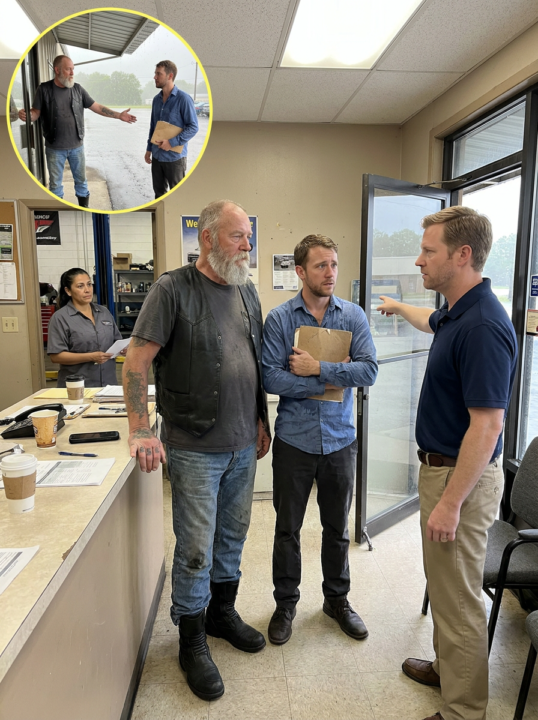
Our manager, Brent Voss, tapped the line with his pen as if Daniel had tried to hide it. Daniel explained that he had completed a vocational course. He had references, copies of his training records, and the name of an instructor willing to speak with us. Brent pushed the folder across the counter before he finished.
“This is a garage, not a rehabilitation center.”
An air wrench rattled in the far bay. Then somebody released the trigger, and the silence made the sentence sound worse.
My name is Isabel Ramirez. I had worked in that building for twelve years, through two owners and more difficult winters than I cared to count. I knew how to stop a customer from driving away with unsafe brakes. Apparently, I did not know how to stop my boss from doing this.
Daniel gathered the papers in the wrong order. One sheet slid onto the floor, and he bent to retrieve it before any of us moved. When he straightened, he asked whether he could leave the instructor’s number. Brent said no.
Daniel nodded. He did not argue, swear, or tell us that we would regret it. He tucked the folder against his chest and walked outside, where rain was blowing beneath the edge of the awning.
The biker had been sitting near the vending machine. I had noticed him when his Harley rolled into the lot: a huge older man with a long gray beard, tattooed hands, a weathered leather vest, and boots that left dark prints on the tile. I assumed he was waiting for someone in the shop. He had not touched the coffee we offered.
Now he followed Daniel through the door. Through the glass, I watched him stop several feet away and say something. Daniel shook his head. The biker listened, then removed his gloves instead of reaching for the folder. That small courtesy stayed with me.
He asked again. This time Daniel handed him the papers, holding the bottom corner where the rain had already softened the cardboard. The biker read every page.
Inside, Brent muttered that some people never knew when to leave. I looked at the application Daniel had submitted online, still open on the desk monitor. An interview had been scheduled. Somebody here had already decided his qualifications deserved a conversation.
Outside, the biker pointed toward the building. Daniel looked past him at the counter, and I recognized the expression on his face: not hope, exactly, but the fear of being humiliated twice.
The biker opened the door and held it. He did not pull Daniel by the arm. He waited until Daniel chose to come back.
Brent stood straighter when they approached. “I already told him we’re not hiring.”
The biker placed the wet folder on the counter, carefully clear of a puddle left by somebody’s coffee cup. Then he looked at me. “Did he get an interview?”
“No,” I said. It was the first useful thing I had said all morning.
Brent told the biker that staffing decisions were none of his business. The old man reached into his vest, took out his phone, and asked Daniel whether he was willing to stay five more minutes.
Before those five minutes were over, our manager would learn why the stranger knew the workshop’s oldest rule—and why nobody should have sent Daniel into that rain.
Part 2 — The Appointment We Had Already Promised
Six weeks earlier, the sign above our garage had changed, but the stubborn drawer beneath my workbench still needed lifting before it would open. That was how the sale felt to most of us. New name outside, same trouble inside, and a lot of promises waiting to become something we could use.
The Miller family had sold the business to Bridgeline Auto, a small regional group with five other locations. Mrs. Miller was retiring. Her husband had died the year before, and she was tired of doing the books at the kitchen table after working a full day at reception.
We were told our jobs would remain. Mara Chen, the operations director, met with us twice and listened while we described the broken heater, the crowded booking schedule, and the apprentice position we had been trying to fill since January. She wore steel-toed shoes into the bays. I liked that.
The owner was supposed to visit after the transition settled. We knew his last name was Keene. We had not met him, and the introduction scheduled for that week had been moved because a water main failed at another location. Nothing about a man in riding leathers beside our vending machine connected with the name on a corporate email.
Brent Voss had arrived three weeks before Daniel. He was thirty-nine, quick with scheduling software, and good at remembering customers’ names. During his first week, he negotiated a supply problem that had been wasting our time for months. I want to be fair about that. He was not incompetent at everything.
But he liked a clean explanation more than a complicated person.
An employee who was late was unreliable, even if Brent had changed the schedule the evening before. A customer who asked three questions was difficult. An applicant with a gap in employment was probably hiding something. He said these things with the confidence of someone who had mistaken suspicion for experience.
I had challenged him about the schedule. I had not challenged him enough about the rest.
We needed an apprentice who could arrive consistently, listen, document work, and ask before doing something unfamiliar. We did not need a magician who could rebuild an engine on the first morning. Half the experienced mechanics I knew had learned their trade after somebody let them sweep a floor and stand close enough to watch.
Daniel’s application had reached us through a local employment counselor. Our previous service lead had reviewed it before moving to another branch. The conviction was disclosed. The training course was listed. The appointment was already on the calendar when Brent decided to handle interviews himself.
There was no trick. Daniel had come where somebody told him to come.
Later, after I had earned enough trust to ask, he told me about that morning. He rented a room above a laundromat and ironed his shirt on a folded towel because the house did not have an ironing board. He carried the application inside a grocery bag until he reached our awning.
He had removed the bag before coming in. He thought the folder would look more professional.
The paper inside represented small expenses that mattered: printing, bus fare, a replacement identification card. He had enough money left for the ride home and something cheap to eat. He was not starving dramatically on our doorstep. He was doing the ordinary arithmetic of being poor, in which one unsuccessful appointment could consume a day’s margin.
His conviction was for breaking into a contractor’s storage building and stealing equipment. He had gone with two other men and carried tools out himself. There was no innocent misunderstanding buried in the record. When he told me the story later, he used the word stole.
He also told me the contractor had employed three people and lost work while replacing what they took. Daniel knew this because it had been explained in court. He did not believe completing his sentence had restored those lost days.
“What would you have said if Brent let you finish?” I asked him once.
“That I can’t change the first answer,” he said. “Only give him some more answers after it.”
He had completed a basic automotive program while incarcerated. His instructor’s assessment described careful measurements, good attendance, and a habit of asking for clarification. It did not call him an expert. Daniel had circled that part because he wanted to be hired for skills he actually possessed.
On the handwritten note behind his application, he had made a short list: ask about shared tools, ask about the earliest shift, explain the bus route, tell the truth. He had checked the last item before coming through our door.
That was the page the biker read in the rain.
At the time, I knew almost none of this. I knew a position was open. I knew a man had arrived for an appointment. I knew my manager had insulted him instead of interviewing him, and I was still pretending that staying quiet kept me out of the decision.
Then the biker brought him back.
Daniel stopped on the reception mat, the same place where he had wiped his shoes before being told he would steal ours. This time, a large tattooed hand held the door behind him until the edge of his folder was safely through.
It was not much of a shelter. It was the first one we had offered.
Part 3 — Five More Minutes
Brent came around the counter with his palms pressed flat against his trousers. I had seen him use that posture with angry customers. It made him look patient while he explained that a conversation was over.
The biker did not move closer. He placed Daniel’s folder on the dry end of the counter and asked whether the appointment had been canceled before Daniel arrived. Brent said the conviction made him unsuitable. The biker asked whether he had called the references.
“I don’t need to call anyone to understand a theft conviction.”
“No,” the biker said. “You need to call them to understand the applicant.”
A radio played quietly in the bays. Luis, our youngest technician, reached over and turned it off. The sudden absence of music made every smaller noise noticeable: water dripping from Daniel’s jacket, the compressor cycling, somebody setting a socket into a metal tray.
Brent said he was protecting the business. He described missing inventory at a previous shop and the cost of replacing equipment. Some of that concern was real. Mechanics buy tools over years, often with money they could have spent on better cars or a less crowded apartment.
I understood being afraid of losing them. I did not understand making Daniel answer for every theft that had ever happened near a garage.
The biker asked whether every applicant was refused without an interview if they had a record. Brent said it was common sense. Then he called it company policy.
The older man looked at him for a long moment. “Show me.”
Brent reached for the employee handbook, stopped, and said he did not need to justify his hiring decisions to a customer. The biker nodded as though that answer had clarified something. He turned to Daniel instead of continuing the argument over his head.
“Would you rather speak somewhere private?”
Daniel looked at the employees gathered near the open door between reception and the bays. He had already heard his worst decision announced to all of us. His thumb worked against a softened corner of the folder.
“I’d rather know whether there’s a job.”
“That’s fair.”
“And I don’t want anyone buying me one.”
The biker’s expression changed, almost a smile but not quite. “Also fair.”
I asked Daniel if he wanted to sit. He said he would rather stand. I offered a towel for the papers, and he accepted that. The difference between deciding for him and asking was becoming embarrassingly easy to understand.
Outside, another motorcycle turned into the lot. Its rider wore a rain jacket over his vest and carried a small cardboard box beneath one arm. The biker glanced through the window, raised a hand, and beckoned him inside.
The new arrival introduced himself as Hank. He had been riding behind the older man before stopping for fuel. They were bringing a rebuilt starter motor to one of the mechanics, which explained why neither had booked work at reception.
Hank listened to the last part of Brent’s explanation. His eyes moved toward the tool chests, then back to Daniel.
“What was the conviction?” he asked.
Daniel answered. He did not change the word burglary to trouble. Hank rubbed his jaw. A trailer full of his own equipment had been stolen years earlier, he said, and the insurance payment had covered less than he expected.
The older biker let him finish.
For a moment, I thought Daniel was about to lose this chance too. His papers were back against his chest. He shifted one foot toward the door, and I remembered how quickly he had learned that movement.
Hank asked the biker whether he was sure.
“No,” the older man said. “That’s why people get interviewed.”
There was something almost irritating about his refusal to promise an easy ending. He did not say he could recognize a good man by his eyes. He did not guarantee Daniel would never disappoint us. He kept asking for the ordinary process we had denied him.
Brent took advantage of that hesitation. He said if the stranger wanted to trust Daniel, he could take him somewhere else. The words were polished now, but the meaning had not changed.
I put my work order on the counter. “He had an appointment,” I said. “We have an opening. I can assess his training.”
Brent turned toward me. “You’re not responsible for staffing.”
“I’m responsible for whoever works beside me.”
My voice shook at the end. I hated that it did, but Daniel looked up. I had been waiting for a fearless way to say something that required a little fear.
The biker asked Daniel whether he would stay five more minutes. Daniel said yes. Then the old man took out a battered phone and called Mara Chen.
Brent’s expression tightened at the name. He asked how the biker knew our operations director, but the man was already listening to the line connect.
“Mara, I’m at the old Miller place,” he said. “Is the apprentice position still open?”
He put the call on speaker after asking her permission.
“Yes, Walt,” she answered. “Isabel’s been waiting on that hire. Did you get there ahead of Hank?”
Hank lifted his box slightly, as if the woman could see him.
The biker looked at Brent, who had gone very still. Then he asked Mara to confirm something else, and nobody in that room reached for the door.
Part 4 — The Name Behind the Garage
“Mara,” he said, “would you tell Brent who he’s speaking with?”
There was a short pause. Then her voice came clearly through the little speaker. “Walter Keene. He owns Bridgeline.”
Nobody made a dramatic sound. Brent’s mouth opened, then closed. Luis glanced toward me, and I looked back at the older man’s rain-dark boots, trying to fit them into the idea of the person who signed our paychecks.
Walt thanked Mara and said he would call her privately in a few minutes. He ended the call without making her listen to a public punishment. Then he rested the phone beside Daniel’s application.
“I came to bring Luis that starter and look at the building,” he said. “I got here early. I heard enough.”
Brent began explaining that he had been trying to protect company property. Walt let him finish. When Brent referred to Daniel as a risk, the older man lifted one hand.
“His name is Daniel.”
He asked Brent to show him the written hiring rule he had claimed existed. Brent could not. Walt said they would review the interview and his conduct with Mara, but he was no longer to handle applicants until that review was complete.
There was no shouted demand for keys, no vest thrown onto a desk, no audience invited to enjoy someone else’s fear. Brent stepped into the office to speak with Mara. The door closed, and the silence he left behind belonged to the rest of us.
Walt faced the employees near the bay entrance.
“We check references. We train. We secure the tools. None of that changes.” He looked at Daniel, then back at us. “But if nobody lets a person make things right, all we’re building is a prison without walls.”
He did not repeat it. He did not need to.
Daniel’s fingers tightened on the towel I had given him. For a second, I thought he might cry. Instead, he asked the question he had already asked once.
“Does that mean there’s a job?”
“It means there’s an interview,” Walt said. “And the opening is real.”
I brought two chairs into the quieter side office. Daniel chose to leave the door open. Walt asked him to explain his training, the work he had done, and the work he knew he was not ready to do.
Daniel did not suddenly become smooth because an important man was listening. He lost his place twice. He mixed up the dates of two courses, checked the certificate, and corrected himself. He explained the bus schedule before we asked, because the first arrival would not get him there for our usual opening time.
We had an afternoon vacancy too. Nobody had told him.
When Walt asked about the conviction, Daniel looked directly at him. He described breaking into the contractor’s building, taking the equipment, and selling his share. He did not turn being broke into permission. He said he was still making the payments required of him and could provide the relevant documents privately.
“What are you looking for here?” Walt asked.
“Work I can get better at.”
Not a family. Not a miracle. Work.
We called the instructor with Daniel’s permission. The man answered between classes and remembered him immediately. He described someone methodical, slow with unfamiliar equipment, and willing to admit when he needed help. He also said Daniel sometimes rushed after being corrected, as though speed could erase embarrassment.
That was useful information. Praise alone would not have been.
His second reference confirmed the part-time maintenance work he had been doing since his release. Then I asked whether he would be comfortable completing a short, paid skills assessment on our training bench. We agreed on the time and payment before beginning. No customer’s car became a test of anybody’s faith.
I gave him a basic inspection worksheet and several ordinary components. He identified what he knew, checked the references available to him, and set one damaged tool aside rather than pretending not to notice it.
Then I asked him a question beyond the course he had taken.
He stood very still. “I don’t know,” he said.
“What would you do?”
“Ask whoever’s supervising me before I touched it.”
Walt, watching from a stool, nodded once. I made a note on the worksheet. Daniel looked worried until I told him that answer had saved him from a much worse one.
He was not ready to work independently. He was ready to learn. That was what we had advertised for.
By late afternoon, Daniel had an offer for a paid apprentice position, with a clear schedule, an introductory review period, and the same training expectations we used for other new hires. I would supervise him. He would use the shared tools under our normal checkout system until he could begin building his own set.
He read the offer carefully. “Can I take a copy?”
“It’s yours,” Walt said.
When Daniel left, the rain had eased to a thin mist. We put his papers in a dry envelope, and he checked the bus time before stepping outside. Nobody announced that his life had been fixed. He still needed to get home, wash his shirt, and show up Monday.
Afterward, Walt walked through the bays with me. He stopped beside the old wooden bench and ran his fingers over a gouge near the vise.
“Put that there in seventy-eight,” he said.
“You worked here?”
“For Mr. Miller’s father. Before I bought my first place.”
He had been nineteen, recently out of county jail for stealing and selling equipment from another shop. The owner of this garage had given him a chance after checking his references and hearing the whole story. There had been rules, close supervision, and months before he was trusted with more.
“I wasn’t owed his tools,” Walt said. “I needed a chance to earn the right to use them.”
He pulled on his gloves. The old burn on one thumb came from a welding lesson he had been too proud to interrupt. Mr. Miller had sent him back through the safety training instead of sending him away.
I looked toward the reception counter. “Did you buy this place because of him?”
“Partly.” Walt glanced around the bays. “And because it’s a good shop.”
Then he looked at me. “Keep it one.”
Part 5 — The Mistake He Didn’t Hide
Daniel arrived on Monday carrying a lunch container and the dry envelope. He had taken an earlier bus to a stop farther away and walked the last stretch, because he did not want his first morning to begin with an explanation.
I showed him where to put his coat.
He asked whether he should lock up his lunch.
“There’s a refrigerator,” I said. “Write your name on it.”
He looked at the marker beside the door for a moment before picking it up. His hand was steady. The little label became the first place in our building where his name meant something other than a question.
The work was not glamorous. He inventoried supplies, cleaned reusable equipment, learned our documentation system, and shadowed me through inspections. Some days he seemed exhausted by the number of things he did not know.
He asked anyway.
Brent was not at the counter. After speaking with employees and reviewing the application records, Mara ended his employment later that week. I was told only what I needed to know. Daniel was not asked to attend the conversation, and nobody brought him the news like a gift.
A service lead from another branch covered reception while we hired a replacement. The calendar remained full. Customers needed their cars, suppliers missed deliveries, and the garage did not turn into a kinder place merely because one unkind employee was gone.
We had to behave differently ourselves.
Our tool procedures applied to everybody. Shared equipment was signed out. Personal chests stayed locked when their owners wanted them locked. Daniel’s pockets were not inspected, and his work was not treated as a secret test everyone else had already passed.
Hank still had reservations. He came by to help Luis with a difficult job and asked me how the new apprentice was doing. I told him the truth: careful, inexperienced, slow with the software, better at listening than at believing he was allowed to stay.
Hank nodded. He did not hand over his most expensive tools as a gesture. He worked beside Daniel for an hour, watched him return everything he used, and came back the following week. Trust began as something smaller than a declaration.
On Daniel’s twelfth day, he made a mistake that cost us money.
I had corrected him for hurrying through a checklist. He became flustered, moved a loaded cart before checking the space behind him, and scraped the painted panel of a customer’s vehicle. The sound was short and ugly. Every person in the bay heard it.
Daniel stopped moving.
I saw the same tight shoulders I had seen at the door in the rain. He looked at the mark, then at me, and opened his mouth without saying anything. A technician beside the next lift muttered that perhaps it had been there before.
“It wasn’t,” Daniel said.
He walked to the service desk and reported exactly what he had done.
The customer had to be notified. The damage had to be assessed and repaired. Daniel helped me document it, and we reviewed how rushing had contributed. He did not get a speech telling him the scratch was secretly a blessing. He got a clear account of what had gone wrong and how his work would be supervised going forward.
At the end, he asked what time he should collect his things.
“Why?”
“I’m still in the review period.”
“Yes,” I said. “And this is a review.”
He stared at me.
I told him that reporting damage immediately mattered. So did learning from it. Neither canceled the cost of the repair, but firing every apprentice who made a correctable mistake would leave us with no apprentices and plenty of employees who hid things.
Daniel offered to have the repair taken out of his wages. I told him the shop would handle the customer’s repair and that his responsibility was to follow the revised process. His paycheck was not a substitute for learning.
He nodded, then asked whether he could rewrite the checklist in the order he actually used it. I looked at his version the next morning. He had added a pause before moving equipment and left space to mark who had checked the work with him.
We used it. That was the first improvement he gave us.
There were other difficulties. In his second month, a bus broke down and he arrived late. He called as soon as he knew. We adjusted the handover, recorded the time accurately, and moved on. Nobody called the transportation problem proof of a criminal personality.
Sometimes I found him staying near the time clock after his shift, rereading a service note. I told him that required training needed to be scheduled and paid, and helped him arrange time for it. He had become used to treating exhaustion as evidence that he deserved a place.
I wanted competence instead.
Walt visited every few weeks. He asked Daniel what he was learning, but he asked Luis and me the same question. He did not introduce Daniel to customers as the former prisoner he had rescued. When a visitor tried to tell that story across the shop, Walt redirected the conversation to the car they had brought in.
Daniel noticed.
At three months, he passed his introductory review. His raise was modest, written down, and earned against the same criteria we had discussed at the beginning. He called his employment counselor from the parking lot, then returned to ask how much longer he needed supervision on a particular task.
He was starting to ask about the future in units larger than a week.
At six months, Hank sold him a used tool chest at a fair price. They wrote a simple receipt. Daniel paid in installments they agreed on beforehand, and Hank left the old stickers because Daniel said the dents did not bother him.
The first time Daniel locked it, he checked the key twice.
By winter, he was helping a newer apprentice find information in the service system. I watched him stop himself from taking over the keyboard. He moved his chair aside and let the younger man try again.
When the answer finally appeared, Daniel smiled. “There,” he said. “You found it.”
I remembered the instructor saying he rushed when embarrassed. He still did sometimes. But he had begun recognizing that feeling in another person before it turned into a mistake.
That was when I started thinking about the Saturday program.
Part 6 — The Mechanic We Chose to Teach
The youth center had asked us about a workshop months before Daniel arrived. They wanted somewhere sixteen- and seventeen-year-olds could learn basic mechanical skills in a structured setting. Some had been suspended from school. Some had been referred through youth services after getting into trouble. Others simply needed an adult who would expect them to come back.
We had space on Saturday mornings, but space was not a program.
Mara and the center’s coordinator spent months working through transportation, consent, supervision, safety training, and what we could realistically teach. The plan used donated components and disabled training equipment. Customer vehicles were not practice projects, and nobody would be left alone with a roomful of teenagers because they seemed good with kids.
We needed one lead mechanic to plan the lessons and work alongside the center’s staff.
Luis knew more advanced diagnostics than Daniel. I had more years of experience than both of them. Hank could explain a machine’s history until everybody’s coffee went cold. But none of those things automatically made someone patient when a teenager said the whole exercise was stupid.
Daniel had that patience in a particular way. He did not enjoy being insulted. He simply did not panic when someone tried to hide embarrassment inside an insult.
Before we asked him, he attended an introductory session as an assistant. The coordinator was present throughout. Daniel had completed the program’s screening and safeguarding training, and we discussed which parts of his own history he wanted to share. He was not required to turn it into a performance.
A boy named Owen arrived late and announced that he already knew how to use every tool on the bench.
Daniel looked at the carefully arranged tools. “Good. You can help me check the list.”
Owen picked up the wrong item and heard another student laugh. He dropped it harder than necessary, folded his arms, and said the session was a waste of time. I saw two adults prepare to answer at once.
Daniel waited. “Want me to go first?” he asked.
Owen shrugged. Daniel named the first item, explained its ordinary use, and handed the list back. He did not pretend to make a mistake so the boy could feel superior. He simply made beginning again look like part of the work.
Owen stayed.
Near the end, a small component rolled from his station onto the floor. He blamed the table. Daniel asked him to help find it before anyone stepped on it, and they knelt on opposite sides of the bench without turning the moment into a contest.
Afterward, the coordinator asked Owen how it had gone.
“He doesn’t act like he’s waiting for me to mess up,” the boy said.
Daniel was across the room putting equipment away. I do not know whether he heard.
The next week, Walt asked the center’s staff for their assessment. He asked me about Daniel’s technical limits and how we would support them. Then he offered Daniel the lead instructor assignment, with additional preparation time and pay, while keeping the coordinator involved and experienced mechanics available when needed.
It was almost exactly a year after the interview.
Daniel looked at the schedule, then at me. “You could teach more than I can.”
“Then ask me when you need to.”
He understood that answer.
He was the only mechanic selected to lead the program. It was not a prize for having suffered most, and it did not make the rest of us less valuable. He had demonstrated a skill the role needed, and we intended to help him develop it.
Hank volunteered to prepare the training equipment. The man who had once hesitated at the idea of sharing a shop with Daniel now wanted to know which Saturday he should bring his pickup.
“Before you volunteer every weekend,” Daniel told him, “there’s a schedule.”
Hank grinned. “Listen to management.”
Daniel laughed, then checked the supply list again.
On the evening before his first session as lead, I found him rewriting the opening lesson. He had crossed out a paragraph about his own past and replaced it with three questions: What have you worked on? What do you want to learn? What do you do when you don’t know?
He asked whether that was enough to begin.
I thought about a wet folder lying unopened on our counter, and a roomful of people who had mistaken one answer for an entire man.
“That’s a good start,” I said.
He put the lesson into a clean folder and left it on his workbench.
Part 7 — A Dry Envelope
The rain returned on the first official Saturday, steady enough to drum against the metal awning. Walt arrived on his Harley before the students, shook water from his gloves, and parked himself near the vending machine.
This time, he drank the coffee.
Daniel was laying out the equipment when the center’s van pulled in. Four teenagers came through the door together. Owen arrived last, wearing a jacket too light for the weather and carrying his enrollment papers beneath it.
One page slipped free and landed on the wet reception mat.
He stared at it.
I recognized that stillness before he moved: the quick calculation of whether a small mistake was about to become proof that you did not belong. Daniel came around the counter, picked up the page by a dry corner, and asked whether there were any others.
Owen pulled out the rest. “Sorry.”
“We’ve got towels.”
That was all Daniel said.
He did not glance toward Walt to see whether his kindness had been noticed. He took the papers into the office, copied the information they needed, and returned the originals in a dry envelope. Then he showed Owen where to put his coat.
The lesson began with the three questions Daniel had written the night before. Some answers were boasts. Some were barely audible. One girl said she wanted to understand enough not to be talked down to when her car needed work.
Daniel nodded. “Useful reason.”
He wrote the students’ goals on his planning sheet. Then he explained the safety rules and told them that not knowing was ordinary, while pretending could get somebody hurt. I stood nearby with the coordinator, available but out of the center of things.
Walt watched from the doorway.
At the first break, Daniel took him to the training bench. The old wood was covered by a protective mat, but the gouge near the vise remained visible at the edge. Walt touched it with one finger.
“Still there.”
“Doesn’t affect the bench,” Daniel said.
“No.”
They left the rest unspoken.
Later, while the students worked in pairs, I opened the supply drawer and found a folder Daniel had placed there by mistake. It was the old one, the cardboard still rippled along the bottom from that first morning.
I called him over instead of opening it.
He smiled when he saw it. “I brought that to remind myself what I wanted to ask.”
“Did you get the answers?”
“Most of them.”
There was no framed application on the wall. No photograph of Walt leading him through the rain. Daniel’s past remained part of his life, not the garage’s favorite advertisement. The folder went back into his bag, and he returned to a teenager who needed help finding the next step.
At noon, the van driver came inside to collect the group. Owen asked whether they would use the same stations next week.
“If you want,” Daniel said.
“Same one’s good.”
He said it casually, but he rested his hand on the edge of the bench before leaving. Daniel checked the schedule and confirmed the time. A place had been set aside for him, and someone expected him to return.
Walt pulled on his gloves. The Harley coughed once, then settled into its familiar rumble outside the open bay.
Daniel stood by the door with a stack of dry envelopes for the students. He gave Owen one last reminder about the next session, then stepped aside to let the others through.
He waited until the van pulled beneath the awning before waving them through. This time, the papers stayed dry.
Follow our page for more biker stories about second chances, quiet courage, and the people who hold a door open when it matters.