I Called the Police When a Biker Reached Into a Blind Man’s Coat — Then the Man on the Bench Asked Them Not to Take Him Away
I called the police when I saw a tattooed biker reaching inside a blind man’s coat at our bus stop, and twenty minutes later, the officer holding his wrists asked me a question I couldn’t answer.
“Did you actually see him take the wallet?” I had been certain until she said actually. From behind my café window, I had seen a leather vest, a frightened movement, and a large hand disappear beneath a navy jacket. I had supplied everything in between.
My name is Nora Ellis, and I run the Corner Cup in Alder Creek, Ohio. On that Thursday morning, the bus shelter outside my café held three people: a college student wearing headphones, a man with a white cane, and a younger man who kept checking the road. Then the Harley arrived.
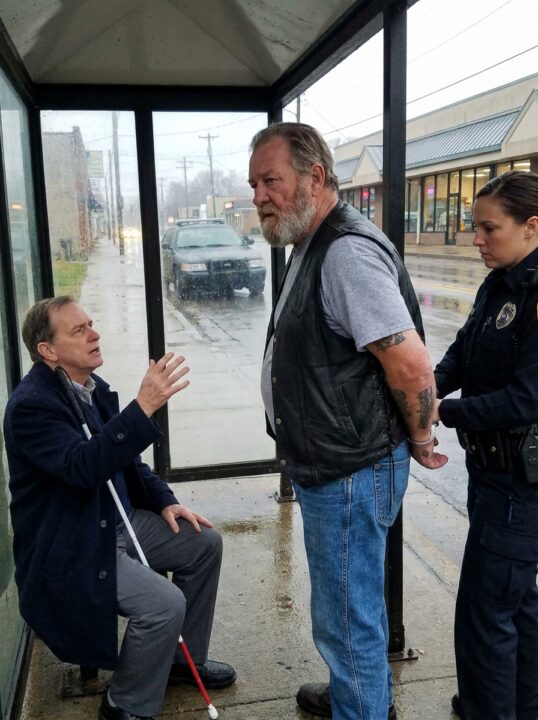
The rider parked beside the curb, cut the engine, and walked toward the shelter carrying nothing but his gloves. He was enormous, easily six feet five, with a gray beard, tattooed forearms, and boots that looked older than my business. The chain on his jeans caught the light as he stopped behind the man with the cane.
I recognized him, vaguely. He rode with a local club and sometimes bought coffee without taking off his vest. I knew his order. I did not know his name. What I remember most clearly is how little time passed between noticing him and deciding what kind of man he was.
A delivery cart rolled across my window. For several seconds, it blocked the lower half of the shelter. When it moved, the biker was bent over the seated man, his right hand near the opening of the man’s coat. The younger man pointed. “He’s taking his wallet!” I grabbed my phone before I grabbed my coat.
Outside, the biker stepped backward with both hands open. The man on the bench gripped his cane and asked what was happening, but three people answered at once. The student pulled off her headphones. Someone across the street started recording. The biker said, “I put it back.” That sounded like a confession to me.
The police car came from the next block. Officer Brooks separated the men and told the biker to keep his hands where she could see them. He obeyed. He even turned slowly when she asked, as though he understood how easily another movement could become another accusation.
The man with the cane said his name was Leonard. He wanted to check his pocket, but the officer asked him to wait while she secured the situation. Nobody asked him where he had been going. I would remember that later. The younger man who had shouted was no longer beside the shelter. I assumed he had moved away from the commotion. I did not notice when, or in which direction.
The handcuffs clicked. The biker looked past me toward the bench. “His bus,” he said. “He needs the driver to stop.” I thought he was changing the subject. Officer Brooks asked me to describe what I had witnessed, and I repeated the sentence I had already given dispatch: a biker had tried to steal a blind man’s wallet.
Then she asked the question that broke it apart. Did I actually see him take it? Behind her, Leonard ran one thumb along something inside his coat. His face changed, but not in the way I expected. He asked whether the man in handcuffs was still there.
The biker answered before anybody else could. “I’m here.” Leonard turned toward his voice. “Then don’t let them leave with him yet.” There was a small brass fastener on the pavement beneath the bench. The biker had noticed it. Leonard had noticed something else. I was standing between them with my phone still warm in my hand, realizing neither of them was talking about what I thought I had seen.
Before the cruiser door closed, Leonard asked me to describe one detail beneath the bench—and my answer would expose the missing seconds in my story.
Part 2 — The Man Whose Name I Had Forgotten
I did not learn the biker’s name until Officer Brooks asked for it. Raymond Maddox, fifty-eight, resident of the same town where I had lived most of my life. The name should have meant something to me. Three months earlier, he had repaired the sticking back door at my café and refused payment because my morning cook had already bought the hardware.
I remembered the repair. I had somehow forgotten the man. That was the first uncomfortable thing I had to admit. The second was that I had made my report sound more certain than my view allowed. I told Officer Brooks about the delivery cart, and she made a note without reassuring me. Behind her, Ray stood quietly while a second officer spoke with Leonard.
Leonard was sixty-four, a retired appliance technician who had lost most of his sight gradually. He lived alone, used the bus, and volunteered twice a week at a community workshop. That morning, he was carrying replacement knobs for an old radio somebody wanted repaired. Nobody at the shelter had known that. We had reduced his whole day to the cane across his knees.
He asked Officer Brooks to put the broken fastener in his hand. She photographed it first, then described where it had been found. Leonard turned it between his fingers and pressed it against the short leather tab on his wallet. They belonged together. “My sister made that tether,” he said. “It clips inside my coat.”
The leather had worn thin beside the snap. Leonard remembered feeling something brush his knee when he stood to check the approaching bus, but he had thought it was his bag. He could not say exactly when the wallet had fallen. He could say that Ray had spoken close to him before the shouting started.
“What did he say?” the officer asked. Leonard frowned. “Something about my pocket. I didn’t catch all of it.” A garbage truck had been lifting a container across the street. Its metal crash had swallowed the first half of the exchange. The café window had swallowed the rest for me. There were pieces everywhere, but I had already arranged mine into a complete accusation.
Ray said he had seen the wallet on the pavement. Another man was reaching down, and Ray had picked it up first. He had told Leonard where he was putting it, then slipped it into the coat pocket. His explanation was simple. The problem was that my call and the shouted accusation had described a different movement.
Officer Brooks took my corrected statement. She told Ray she was taking him to the station while they sorted out the conflicting accounts and tried to locate the other witness. I watched her guide him toward the cruiser, and for the first time I understood that asking questions after handcuffs was not the same as asking them before.
He turned toward Leonard. “Your wallet should’ve stayed in your hand,” he said. “I should’ve asked.” Leonard nodded once. “Yes. You should have.” Neither man tried to make that exchange prettier. Returning somebody’s property did not give Ray permission to decide how to handle their clothes.
Being startled did not mean Leonard had accused him. Both things could be true, and the crowd seemed disappointed by how little noise the truth made.
Ray asked me to call Eddie Torres, whose number was in his phone. The officer helped arrange it. I expected a furious club president promising to bring twenty motorcycles to the station. Instead, Eddie asked whether Ray was hurt, whether Leonard had his belongings, and whether anybody had saved the footage before it disappeared.
“What footage?” I asked. “Whatever there is. Start looking.” The Corner Cup’s camera faced the register. Our delivery entrance camera covered an alley. Neither showed the shelter, but the bakery across the street had recently installed a camera under its awning after somebody backed into the front window. I could see its small black housing from where I stood.
Eddie said he would come on foot from the repair shop. “No crowd,” he added. “He doesn’t need a parade.” I learned more about Ray over the weeks that followed, not through a speech at the curb. He had once served time for an assault outside a bar. He did not describe it as a misunderstanding. He had hurt someone, and he had spent years making sure that violence was not the first tool he reached for anymore.
Eddie had known him through that work. Their riding club included mechanics, nurses, warehouse workers, and men who had been sober longer than some of our customers had been alive. They argued, showed up late, and occasionally let one another down. Their loyalty was real precisely because it was not effortless.
Ray’s own wallet was attached to his jeans by a chain. Inside his saddlebag were leather offcuts and a small repair kit because he made replacement straps for friends. Later, that detail would look almost painfully obvious. At the time, all I had seen was the chain.
Before the cruiser pulled away, Leonard asked me to stay beside him until his bus came. I said of course, too quickly, as if one small kindness could erase a larger mistake. “Not because I can’t wait alone,” he said. “Because you saw something, and I need you to keep looking.” Then he turned his face toward the bakery across the street.
Part 3 — The Clip That Started Too Late
The bakery owner was out making a delivery, and his assistant did not have access to the camera account. That ordinary inconvenience felt unbearable. A recording might exist less than fifty feet away, while a man who had explained himself three times was already riding to the station in handcuffs.
I asked the assistant to call her boss. Then I asked her to tell him exactly what we needed preserved: the minutes before the police arrived, not only the arrest. She wrote down the time from my call history. For once that morning, I was careful about the difference between what I knew and what I hoped.
Outside, Leonard was still on the bench. The bus he had intended to catch had gone, and another would not come for a while. He called the workshop himself, explained that he was delayed, and asked somebody to start sorting the donated radios without him. I stood close enough to hear his voice remain steady.
When he hung up, I offered to call a relative. “For what?” he asked. I had no useful answer. He put the phone away and adjusted the grocery bag by his feet. I asked whether he wanted coffee instead, and this time the question gave him a choice he actually needed. He wanted it black, in a cup with a lid, and he wanted me to tell him when I handed it over.
Eddie arrived wearing a faded work shirt beneath his leather vest. He was smaller than Ray, with silver hair tied at his neck and grease darkening the creases beside his fingernails. He introduced himself to Leonard before he spoke to me. He did not touch the cane.
Then he asked me to repeat what I had seen. I did, more slowly this time. When I reached the gap behind the delivery cart, Eddie looked toward the café window. He crossed to the shelter, stood where Ray had stood, and glanced back at me. From the register, I would have seen his shoulders and almost nothing below them.
“You reported the part you missed,” he said. He did not raise his voice. I wished he had. There was nowhere to put my defensiveness when he was simply correct.
My phone started buzzing while we waited. A customer had sent me a short clip already circulating in a neighborhood group. It began with Ray stepping away from Leonard, continued through the handcuffs, and ended before the officer asked me about my view. The caption called him a predator. Nothing in the clip showed a wallet.
Underneath it, strangers identified his club from older photographs. Somebody posted the address of Eddie’s repair shop. Another person said every member should be watched around vulnerable people. A woman I knew from the school fundraiser wrote that she was glad I had been brave enough to call. I put the phone facedown.
Eddie had seen the same post. Two club members wanted to ride to the station. One had found a photograph of the man in the red cap on somebody else’s page and wanted to publish it. Another wanted to share Leonard’s face beside a statement describing Ray as his rescuer.
Eddie showed the screen to Leonard instead of deciding for him. “Absolutely not,” Leonard said. He did not want strangers studying his face, his cane, or his coat pocket. He did not want to become evidence of somebody else’s goodness, either. Eddie typed that answer into the club’s conversation and told the others to stop reposting the clip.
A member called him immediately. I could hear the anger without hearing every word. Ray would have come for any one of them, the man argued. Were they really going to sit around drinking coffee while people called him a thief? “We’re getting the whole recording,” Eddie said. “That’s coming for him.”
He stepped away to finish the call. Leonard sat quietly, thumb resting on the broken strap. I realized the easiest way to look loyal was becoming the least useful way to help.
There was another problem. When Eddie called a man who occasionally rode with the club, the man said he would rather stay out of it until they knew more. He remembered Ray’s conviction. He remembered a temper that had frightened him years before.
Eddie did not pretend that history was invented. “He did that,” he said. “We still have to find out whether he did this.” That sentence stayed with me. My mistake had not been knowing too little about Ray’s goodness. It had been treating an appearance, a shouted claim, and a blocked view as if they were an event I had actually witnessed.
Officer Brooks called me from the station. She needed the bakery owner’s name and contact number. I told her about the camera and repeated that I had not seen the wallet leave Leonard’s pocket. Saying it the second time did not feel easier. It felt more necessary.
She asked me to send a written correction describing my view. I went behind the café counter, opened a blank page, and wrote down the delivery cart, the customer asking for change, and the exact words I had heard. I left out what I had assumed.
Outside, the bakery owner’s van finally stopped at the curb. He was holding a paper bag of rolls when I reached him. I spoke so quickly he asked me to begin again. This time I did. A man had been arrested, there were conflicting accounts, and his camera might show what happened before the part everybody had already seen.
He set the rolls on the counter and opened the camera account on his tablet. Eddie waited beside the door. Leonard chose to remain at the shelter, where the next bus driver would see him, and asked us to describe whatever we found without softening it.
The recording loaded in little squares of gray. Then the street appeared, ordinary and quiet, several minutes before my call. Ray was not even in the frame yet. The man in the red cap was.
Part 4 — The Hand That Left Empty
The bakery camera had no sound. That mattered. It could show hands, directions, and the order of movements, but it could not tell us what anybody had said. The owner enlarged the view without cutting away the edges, and we watched the whole stretch once before stopping it.
Leonard sat with his bag between his shoes. He took his wallet out, removed something small, and put the wallet back into his coat. Later he told us he had been checking the compartment where he kept his bus fare. On the screen, it was simply a familiar task performed without looking down.
A delivery truck stopped beyond the shelter. Leonard stood briefly, apparently listening for his bus, and the wallet slipped past the edge of his coat. It landed under the bench. The short tether hung loose beside it. The younger man saw it fall.
He did not point it out. He moved from the shelter’s far end to the open side and looked toward Leonard, then toward the road. I felt Eddie shift beside me. Neither of us said anything while the young man placed one foot near the wallet and bent forward.
The Harley entered the frame then. Ray parked, removed his gloves, and started toward the café. He saw the wallet before he reached our door. His route changed by only a few feet, but those few feet were the beginning of the story my call had erased.
He bent down as the younger man reached beneath the bench. Ray got there first. The young man’s hand followed the wallet upward, fingers open, then stopped when Ray turned toward him. There was no punch, no shove, no chase. Ray held the wallet close to his own chest for a second and pointed toward Leonard.
The young man straightened. Ray moved around the end of the bench and leaned toward Leonard’s shoulder. His mouth moved. Leonard turned slightly, but the garbage truck was lifting its container across the road at that exact moment. We could see the bin hanging above the truck like a dark square.
Then came the movement I had seen. Ray placed the wallet inside Leonard’s right coat pocket. He did not pull it out. His hand entered holding something and left empty. He stepped back immediately, while the young man pointed at him and opened his mouth.
My delivery cart crossed the café window. There it was. Not a mysterious gap, not an impossible coincidence, just several seconds in which one person had acted and another had supplied an explanation. I had seen the end of a return and called it the beginning of a theft.
The bakery owner rewound the recording. I asked him not to crop it. We needed the wallet falling, the other man reaching, Ray picking it up, and the return. We also needed the seconds afterward, when the man in the red cap moved behind the gathering crowd and walked away while everybody watched the biker.
Eddie called Officer Brooks. He did not announce that we had proved every possible thing about every person. He said the recording clearly showed the wallet on the ground before Ray approached and showed Ray putting it into Leonard’s coat.
The officer asked the owner to preserve and send the original segment. He did that directly. We did not film his tablet and upload a shaky victory clip to compete with the first accusation.
I went back across the street. Leonard heard my footsteps stop beside the bench. “Well?” “He put it back,” I said. “I know what he told us. What did you see?”
The distinction was fair. I described the recording from the beginning: the fallen wallet, the broken tether, the younger man’s hand, Ray changing direction. Leonard listened without interrupting. When I finished, he rubbed the leather tab again. “He tried to tell me,” he said. “I heard ‘right pocket.’ Then everybody started shouting.”
I sat at the far end of the bench and asked if that was all right. He said yes. The bus shelter smelled of wet concrete and somebody’s spilled orange soda. Cars passed, a café customer waved through the window, and the street continued behaving as though nothing important had happened.
“I’m sorry,” I said. “I told them I saw him stealing.” Leonard turned toward me. “Did you?” “No.” “Then make sure they hear that part from you.”
I called Officer Brooks again, although she already had my correction. I told her we had watched the recording and that my original description had been wrong. I did not say it merely looked different from another angle. I did not blame the man in the cap for making me speak with certainty.
She said they were reviewing it. There was still waiting after the truth became clear to us. A recording had to reach the right person, accounts had to be compared, and arrangements had to be made. I had expected certainty to undo the morning as quickly as suspicion had created it. It did not.
Leonard caught the next bus after asking Eddie to call him with news. He did not need to sit at the scene until every stranger felt better. Before boarding, he gave Eddie his number and said he wanted to speak with Ray when Ray was ready. The driver lowered the step and waited. Leonard found the rail himself.
About ninety minutes after the cruiser left, Officer Brooks called Eddie. Ray was being released; the recording did not support the theft accusation against him. The other man’s conduct and identity were still being looked into. She did not promise an arrest we had not earned the right to predict.
Eddie went to collect his friend. I stayed at the café because my cook had been running the place alone and because there was work I could no longer ask somebody else to do. I opened the neighborhood post and wrote a correction under my own name.
I had called the police. I had not seen a theft. The full recording showed Ray returning a wallet that had fallen before he arrived. Then I asked the person who uploaded the clip to remove the accusation.
My hands shook more than they had when I made the call.
Part 5 — What an Apology Couldn’t Buy
Ray came back to the café in Eddie’s pickup, because his Harley was still parked beside the shelter. He stood on the sidewalk for a moment before touching the handlebars. There were pale marks around his wrists. He pulled his sleeves down without looking at the people watching through my window.
I met him outside. “I was wrong,” I said. He nodded, but he did not rescue me from the silence afterward. Eddie went to check the motorcycle. I could hear the chain on Ray’s jeans shift as he put his hands into his pockets.
“I’m correcting it everywhere I can,” I added. “Good.” That was all he owed me. I offered coffee and lunch. Ray looked toward the counter, then said he would take coffee because he had missed the cup he came for. He paid before I could turn the offer into something that resembled forgiveness. I left the money in the register.
Eddie sat beside him. They talked about a wheel bearing waiting at the shop and whether Ray’s dog had been let out. The normal conversation almost hurt to hear. A person could be frightened, humiliated, and angry, and still have a dog expecting him home.
When there was a quiet moment, I asked whether I could sit down. Ray looked at Eddie, then at the empty chair. “All right.” I told him I had recognized him only after hearing his name. I mentioned the repaired café door. He remembered the hinge screws being too short, not the favor.
That made my apology harder. He had left something useful behind, and I had retained only the outline of his vest. “Why didn’t you just hand Leonard the wallet?” I asked. Ray stared into his coffee for a moment. “Should have.”
He had seen the other man reach. He had been angry about it. Then he had noticed Leonard’s cane and the broken strap, and he had tried to fix the whole situation too quickly: pick up the wallet, tell Leonard, put it somewhere secure.
“I said, ‘Dropped your wallet. Right pocket, okay?’” he told me. “He turned. I took that for yes.” It had not been yes. Leonard had been trying to hear him over the truck. Ray knew that now. He did not use the other man’s behavior as an excuse to skip the part he could have handled better.
There was no secret hero’s speech after that. He asked for another napkin because coffee had spilled beneath the cup.
Leonard called before Ray finished it. Eddie put the phone on the table only after both men agreed. Leonard wanted to know whether Ray was home, whether he still had his motorcycle, and whether the officers had kept his gloves.
“Gloves are here,” Ray said. “Bike too.” “Good. Next time, tell me you found something and let me hold out my hand.” “Yes, sir.” “And thank you.” Ray pressed his thumb against the rim of the cup. “You’re welcome.”
They arranged to meet the following Saturday at the café. Leonard wanted to know whether Ray could replace the broken tether. He did not ask for charity. He asked what the work would cost and whether there was a fastener he could operate more easily.
Ray named the cost of the materials. Leonard said that was not the same as paying for the work. Their first argument was about a fair price, which seemed a better beginning than any speech I could have written for them.
Later, Eddie told me why the accusation had landed so heavily among some of the club members. Ray’s old conviction was not a rumor. Years earlier, Eddie had waited outside a different police station after Ray had genuinely hurt someone. Friendship had not required calling him innocent then. It required helping him take responsibility.
This time, Eddie had needed the same discipline in the opposite direction. He had to stop friends from turning anger into intimidation, stop others from treating an old wrong as proof of a new one, and keep looking while everyone wanted a simpler story.
One member apologized for refusing to help. Ray accepted the apology but said they should talk privately, not in front of the whole club. Another asked permission to post the security footage. Ray said Leonard’s answer came first.
Leonard did not want the recording shared publicly. It showed him handling his money, his daily route, and a moment of confusion he had never offered for entertainment. The club released a short correction without his photograph. The bakery kept the original available to investigators.
Officer Brooks also contacted Ray. I was not present for that conversation, and he did not give me a transcript to repeat. He told me she acknowledged that the initial account had been wrong and explained what would happen with the report. He intended to follow up rather than pretend the cuffs had never happened.
My own correction traveled more slowly than the clip. Some people removed what they had shared. Some argued about wording. A few disappeared from the conversation after declaring themselves certain the first time.
I called the café customer who had described me as brave. “I need you to share the correction,” I said. She did. So did my cook, the bakery owner, and Eddie. It was not enough to pull every copy back, but it was work we could do without turning Leonard into a public exhibit.
That afternoon, Ray collected his gloves and walked toward the Harley. I followed him as far as the door, carrying a question I knew he might not want. “Will you come back?” He looked through the window at the chair he had used.
“Coffee’s decent,” he said. Then he started the engine.
Part 6 — Three Pieces of Leather on a Napkin
On Saturday, Leonard arrived before Ray. He found the café entrance with his cane, asked me which tables were free, and chose the one away from the refrigerator hum. I described the chair and placed his coffee where he requested it. I did not steer him by the shoulder.
Ray came in carrying a little canvas pouch. There were three pieces of leather inside, two different clips, and a short strap he had cut from an old belt. He laid them on a clean napkin, then stopped before placing anything in Leonard’s hands. “Want me to explain them first?” “Yes.”
I was wiping the neighboring table much longer than it needed wiping. Ray noticed but said nothing. He described each fastener in plain language, then let Leonard test them. One spring was too stiff. Another caught against the seam of his coat. The third opened cleanly beneath Leonard’s thumb.
“That one,” Leonard said. “But make the strap a little shorter.” Ray measured the length against Leonard’s own hand rather than guessing. They settled the price after another brief disagreement. Leonard paid for the materials and Ray’s time. Ray used the money to buy both their breakfasts, which Leonard called a technicality.
They laughed. It was the first easy sound I had heard between them. There were no cameras lifted to capture it, no crowd applauding, no announcement that the town had learned a lesson. My cook burned a piece of toast and swore quietly behind the service hatch. The ordinary morning suited them.
Leonard returned the next week with a small radio under his arm. Ray had mentioned that the one in his garage had stopped working, and Leonard wanted to examine it. He asked Ray to describe where it had been stored and whether the problem had started before or after the roof leak.
“After,” Ray admitted. “That’s a useful detail to lead with.” Eddie laughed so hard he had to put his cup down. The radio came back working a week later. Leonard explained what he had replaced, and Ray listened instead of congratulating him for managing it without sight. I had heard enough clumsy praise at the bus stop to recognize the difference.
Their Saturday meetings became irregular but steady. Sometimes Ray rode in alone. Sometimes Eddie joined them. Leonard missed two weeks because the workshop was preparing a sale, and nobody treated his absence as a crisis. He had other commitments. So did Ray.
The club invited Leonard to a cookout through Eddie, who asked about transportation without assuming he needed it. Leonard accepted a ride because the workshop was across town and the buses ran less often on Sundays. At the cookout, he complained that somebody had mistaken burned meat for a cooking technique. The man at the grill handed him the seasoning.
Ray told me that story while waiting for a sandwich. He was grinning. Leonard had become a person they argued with, listened to, and expected to show up when he said he would. He had not become their project.
There were less comfortable days, too. Someone recognized Ray from the old clip at a gas station. Another person repeated the accusation in a neighborhood discussion months after the correction. Eddie kept a copy of the written clarification, but a document could not stop every stranger from choosing the version they preferred.
Ray did not enjoy being told to ignore it. “Easy advice from the other side,” he said once. I stopped giving it.
Instead, when the accusation appeared somewhere I could answer, I answered with what I had personally done and what the recording showed. I asked people not to share Leonard’s image. I stopped describing my original call as an understandable mistake before I had even finished apologizing for it.
One afternoon, the bakery owner brought over a still frame for the case file. It showed the shelter before any of us had noticed trouble: a man waiting for a bus, another near the road, an empty patch of sidewalk where a motorcycle would soon stop. Nothing in it announced who deserved our trust.
I returned the print to its envelope and put it with the other records. Outside, Leonard and Ray were arguing about whether the repaired radio sounded better than the one Eddie had bought new.
For once, nobody asked me to decide.
Part 7 — This Time, I Watched the Whole Thing
The next spring, I saw Leonard’s wallet on the counter again. He had set it down while paying for coffee, then turned toward Ray’s voice near the door. For one brief second, my body remembered the bus stop before my mind caught up: the navy coat, the brown leather, the possibility of something going wrong.
I kept my hands where they were. “Leonard, your wallet is beside the sugar bowl,” I said. “Thank you. Which side?” “Your right. About a hand’s width.” He found it, checked the new tether, and put it away.
That was the entire event. No rescue, no commotion, no person reaching into his clothes because they believed efficiency was the same thing as help. Ray watched from the doorway. He gave me a small nod, then asked Leonard whether he was ready.
They were going to the community workshop. Ray had offered to repair two benches, and Leonard wanted him to look at the handles before he bought supplies. Eddie would bring the lumber later in his pickup. The plan involved measurements, an overdue invoice, and sandwiches wrapped in foil.
I asked how long they expected to be gone. “Depends whether he listens,” Leonard said. Ray lifted both hands. “I’m learning.”
Outside, a bus hissed to a stop. Leonard paused to let the passengers clear the sidewalk. Ray stood beside him, leaving room for the cane. From the café window, the two men looked nothing like the picture that had traveled around town the year before.
Or perhaps they did. The leather vest was the same. The tattoos were the same. Leonard still wore the navy coat. What had changed was the story I was willing to invent from a few seconds of somebody else’s life. I did not take a photograph.
Later that week, Ray brought in the old radio and set it on a shelf near the kitchen. He had found another for his garage, he said, and Leonard thought this one should live somewhere it would be used. Its case was scratched, and one knob was a different color.
My cook turned it on before lunch. A baseball game crackled through the little speaker. Ray stood listening for a moment, then tapped the top with one thick finger. “He got the station back.” I knew he meant Leonard. I let the sentence stay about the radio.
There was never a ceremony for what happened at the bus stop. Ray did not receive a medal, and Leonard did not make a speech about the kindness of strangers. The man in the red cap did not return to confess in front of a convenient crowd. We gave the investigators what we had and did not invent an ending for the parts we never learned.
What remained was smaller, and it lasted. A repaired strap. A radio that worked. Two men keeping an appointment when neither owed the other a performance. Eddie’s pickup parked outside on Saturdays, with enough tools in the back for whatever somebody had promised to fix.
One cold morning, Leonard came in wearing a different coat. He had moved the tether himself and wanted Ray to check whether the clip sat flat against the lining. Ray waited until Leonard removed the coat and placed it on the chair. Then he checked.
When they left, rain had started tapping against the shelter roof. Leonard paused at the café threshold while a delivery cart rattled past. Ray stood beside him, one hand open between them. “Arm?” he asked. “Please.”
Leonard found his elbow. The cart moved on. This time, I watched the whole thing.
Follow our page for more biker stories about quiet courage, second chances, and the people whose kindness stays after the engines fade.