Part 2: Bikers Found One Dog’s Paw Moving Between Two Mountain Boulders — Then a Hydraulic Jack Exposed the Child It Had Shielded for Six Hours
Part 2 — The Sound Beneath the Harleys
Wrench and I had been riding together for twenty-seven years, but that did not mean we trusted each other easily.
Trust between men like us was not a warm thing. It was a record—who arrived when the phone rang at 2:00 a.m., who kept his hands steady when blood covered the pavement, who stayed after everyone else decided the problem had become inconvenient.
Wrench had earned his record before I earned mine.
He spent nineteen years repairing underground equipment in the copper mines near Bagdad, Arizona. During his tenth year, a roof section failed eighty feet from his crew. One man died before the rescue cage reached them. Wrench helped keep three others alive for eleven hours by building a support wall from broken timber, tool cases, and the steel frame of a ruined ventilation fan.
He never told that story himself.
Jo told me after I mocked him for carrying blocks of hardwood in his saddlebags.
“Some men carry ghosts,” she said. “Wrench carries cribbing.”
I had my own history. At thirty-two, I worked the night shift at a quarry and spent most mornings trying to kill the pain in my back with whiskey and prescription pills. My wife left after finding our six-year-old daughter cooking noodles alone because I had passed out in the garage.
I did not blame her.
I blamed everyone else for six more years.
The Copper Saints were smaller then—seven riders, a rented storage bay, and no reputation beyond being loud near breakfast. Wrench found me sleeping behind that bay one January morning with my Harley lying on its side and blood frozen along my eyebrow.
He did not offer comfort.
He poured my pills into a coffee cup, set it on the workbench, and placed a hammer beside it.
“Choose,” he said.
“Between what?”
“Those and everything.”
I broke the pills with the hammer.
Getting sober took longer than that moment, and it looked less heroic. It involved relapses, court dates, shaking hands, cheap church coffee, and Wrench sleeping on a chair outside my bathroom because I had told him I could not trust myself until morning.
The Copper Saints did not rescue me.
They stayed close enough for me to do the work.
Years later, when my daughter Lena allowed me back into her life, I sewed a narrow blue strip inside my cut—the same shade as the dress she had worn at her high school graduation. I never explained it to anyone.
Wrench knew.
That was why the blue fabric in the dog’s mouth struck me before the child’s fingers did.
For a second, I was back outside that school auditorium watching Lena cross the stage while I stood behind the crowd, uncertain whether I had earned the right to say her name.
Then Jo said, “Pulse,” and the mountain returned.
The scream from above came again.
“Eli!”
Razor scrambled uphill before I could stop him. Loose rock slid beneath his boots, rattling past us into the trees. He reached the road and shouted back that a group of hikers was coming down from the northern trail.
The first man appeared through the junipers less than a minute later.
He was Latino, perhaps forty, with a torn yellow rain shell, dried blood across one shin, and the wild, unfocused expression of someone who had not slept. Behind him came two women, a teenage boy, and a county deputy.
“My son,” the man said. “Someone said you found—”
Jo stood before he could reach the crevice.
“What’s his name?”
“Eli Navarro. Ten years old. Blue jacket. Gray backpack.”
“Does he have any medical conditions?”
The man stared at her.
“Daniel,” one of the women said. “Answer her.”
“Asthma. Mild. He has an inhaler in his pack.”
Jo turned toward me.
The gray backpack was visible beyond the dog’s hind leg.
Daniel tried to pass her. She blocked him again.
He looked at her black cut, at the tattoos wrapping her wrists, then at the eight large men surrounding the boulders. Fear and exhaustion distorted what he saw.
“What did you do to him?”
Nobody answered.
The question did not deserve anger, but Razor had less patience than the rest of us. He took one step forward.
Wrench said his name once.
Razor stopped.
Daniel tried to move around Jo, and I caught his shoulders. He struck my chest with both hands.
“Get off me!”
“Your boy is alive,” I said.
Everything in him collapsed except his knees.
I lowered him onto a flat rock.
Jo explained what we knew. Eli was beneath the dog. His pulse was present. The upper slab was unstable. Pulling either of them before the technical team arrived could shift the rock onto both bodies.
Daniel listened until she mentioned the dog.
“What dog?”
“We don’t know.”
“Eli doesn’t have a dog.”
That was the first smaller truth to fall into place.
The animal wedged beneath the boulder did not belong to the child.
Daniel had taken Eli and two friends hiking the previous afternoon. A sudden storm separated the group near an old mining trail. Daniel followed what he believed were Eli’s footprints downhill while the boy apparently moved toward higher ground.
Search teams worked through the night.
Nobody reported seeing a dog.
The county deputy crouched beside Daniel and explained that a helicopter had been grounded by fog until dawn. Ground crews found Eli’s backpack strap caught on a scrub oak half a mile uphill, then lost his tracks near the basalt field.
Daniel covered his face.
“I went the wrong way.”
“You searched,” I said.
“I left him up here.”
“You searched.”
The difference mattered, even if he could not hear it yet.
Search and Rescue radioed that their technical unit was seventeen minutes away. The storm was closer. Rain began ticking against the leather shoulders of my cut, sparse at first, then steady enough to darken the stone.
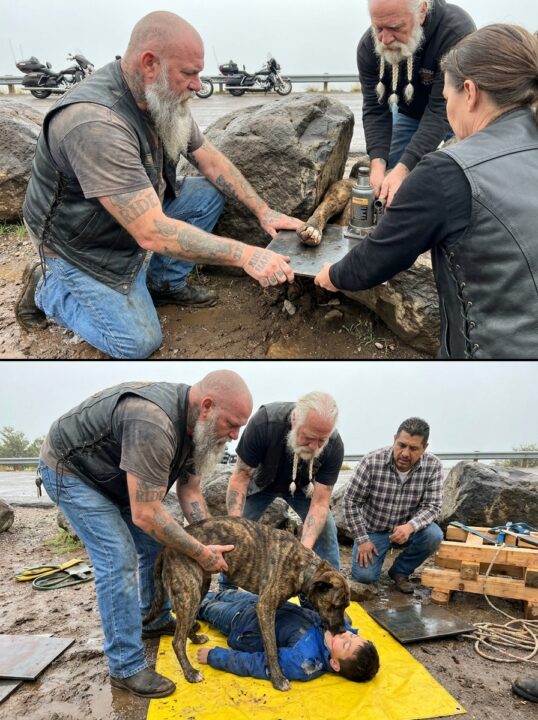
Wrench laid a tarp over the jack and rebuilt the base with wider cribbing. Water made the slope slick. Every rider had a task: divert runoff, hold rope lines, watch the upper fracture, keep Daniel back, speak to the dog.
We started calling it Buddy because silence felt wrong.
“Stay with us, Buddy,” Jo said through the opening. “Help is coming.”
The dog’s eye remained closed.
Daniel crawled toward the lower edge despite the deputy’s warning.
“Eli,” he called. “Dad’s here.”
Nothing.
Then the dog’s tail moved once against the rock.
Daniel heard it.
He lay flat in the mud and pushed his hand toward the opening. He could not reach his son, but his fingers touched the dog’s hind paw.
“Keep him there,” Daniel whispered. “Please. Just keep him there.”
The animal did not know the words.
It knew the voice.
Its jaws tightened again around Eli’s collar.
The rock settled another fraction.
Wrench’s jack took part of the load, but the wooden block beneath it split with a sound like a rifle shot.
Every man on that slope flinched.
The upper slab dropped.
The dog screamed.
Beneath it, the boy began to cough.
Part 3 — Three Inches of Mountain
Search and Rescue arrived carrying rope bags, helmets, medical packs, a powered hydraulic spreader, and the controlled urgency of people who understood that rushing and moving quickly were not the same thing.
Team leader Sarah Holt was a forty-six-year-old white woman with a red climbing helmet and a voice that never rose. She studied Wrench’s cribbing, the bottle jack, the crack above us, and the water running beneath the lower slab.
“You built this?” she asked.
Wrench nodded.
“It’s holding.”
“Mostly.”
She looked at him again.
“Stay with me.”
That was the entire conversation. No concern about our leather cuts. No argument over authority. The mountain had stripped everyone down to ability.
Sarah placed two rescuers above the slab to monitor movement. Another drove ground anchors into stable rock. They ran a safety line around Wrench, me, and the two specialists who would work near the seam.
Jo briefed the medical team. The boy’s pulse was weak but regular. No visible bleeding. Possible hypothermia, dehydration, head injury, crush injury, and airway compromise. The dog had labored breathing and blood around its mouth.
The list sounded worse each time she added a word.
Daniel stood beneath a juniper with the deputy holding one arm. He had stopped asking to come closer.
Sarah examined the opening with a flexible camera. The small screen showed what my flashlight had only partly revealed.
Eli lay on his right side in a pocket beneath the slabs. His knees were drawn toward his chest. One hiking boot was missing. Dirt covered his dark hair. A bleeding scrape ran from his temple toward his ear, but his chest moved.
The dog lay above and partly beside him.
Its shoulders occupied a narrow shelf. Its spine bowed beneath the descending rock. One rear paw braced against the lower slab while the other rested across Eli’s hip. Its jaws still gripped the jacket collar, holding the boy’s chin angled upward.
Without that grip, Eli’s face might have turned into the muddy runoff beneath him.
Without the dog’s body, the upper slab would have settled at least four more inches.
Four inches was the distance between pressure and crushing.
Sarah watched the screen, then looked at Wrench.
“How long has it been loaded?”
“Don’t know.”
One rescuer checked the exposed fur and drying blood.
“Not minutes.”
They placed the powered spreader near the upper end of the crack, but the rock surface began to crumble when pressure was applied. Moving the tool farther down would place it too close to the dog’s chest. The bottle jack remained the best lift point.
Wrench wiped rain from his eyes.
“We raise the slab one-quarter inch. Crib. Reset. Repeat.”
Sarah nodded.
“Goal?”
“Three inches. Maybe four.”
“What happens at three?”
“I can reach the dog’s shoulder.”
“And the boy?”
“Jo can reach his airway.”
Sarah turned toward her team.
“You heard him.”
The next ninety minutes passed in measurements smaller than fear.
Quarter-turn.
Crib.
Check fracture.
Check pulse.
Reset.
Again.
Each movement drew a grinding sound from the stone. The vibration traveled through my gloves and into my wrists. I held the steel plate behind the jack while Wrench worked the handle.
Razor and Big Sam cut additional cribbing from a dead juniper trunk using a folding saw. A rescuer shaved each block flat. Jo remained near the opening, speaking to Eli and the dog.
At the first inch, she reached the boy’s wrist more securely.
At an inch and a half, she slid a thermal sheet over his exposed arm.
At two inches, the dog opened its eye.
It looked directly at Wrench.
He stopped pumping.
“Hey, mountain dog,” he said. “You did enough.”
The dog’s lip lifted.
Not a full growl. A warning.
It believed we were trying to take its position.
Wrench removed one glove and pushed his bare hand into the seam. The dog snapped once, weakly, then turned its face back toward Eli.
“I know,” Wrench said. “I know what you’re doing.”
He left his hand where it was.
The rain strengthened. Water struck the tarp, ran along my sleeves, and pooled beneath my knees. Below us, thunder echoed through the valley.
At two and a half inches, the dog released Eli’s collar.
Daniel made a broken sound from the trees.
Jo pushed her arm deeper and supported the boy’s chin.
“He’s breathing.”
The dog tried to grip the jacket again but could not close its jaws. Blood coated its tongue. Its head fell against Eli’s shoulder.
“Move,” Razor said. “Come on, dog. Crawl out.”
There was room now. We could all see it.
The dog’s hindquarters lay near an open channel leading upward. If it pushed with its rear legs and turned its shoulders, it could reach us.
It did not move.
Sarah asked whether we could pull it.
Wrench said no.
“If its back is still taking load, we pull and the slab drops onto the kid.”
“The jack is holding.”
“The jack is helping. That dog is holding.”
Razor swore and turned away.
He had joined the Copper Saints eight months earlier, young enough to believe strength meant doing something with his hands. Waiting seemed like surrender to him.
“My truck jack has a longer throw,” he said. “I can run up and—”
“No time,” Wrench replied.
“You don’t know that.”
“I know this rock.”
“You always know everything.”
Wrench finally looked at him.
“No. I know what happens when a support comes out early.”
The words silenced the slope.
Jo later told Razor about the mine collapse. At that moment, none of us needed the history. We could hear it in Wrench’s voice.
Sarah ordered another quarter inch.
The jack handle moved.
The slab rose.
A rescuer drove a hardwood wedge into the new space. Another stacked a steel crib beneath the far edge. The fracture widened but did not run.
“Two and three-quarter,” Sarah said.
The dog’s chest expanded once, then stopped.
Jo reached farther.
“No breath.”
Everything accelerated.
“Give me three inches,” she said.
Wrench pumped.
The slab lifted.
A crib block jammed.
The spreader took secondary pressure. Sarah’s team locked the line. I shoved my shoulder beneath a steel brace even though my body added almost nothing.
“Three!”
Jo slid both hands around the dog’s head and pulled it toward the opening. The shoulders remained wedged.
“Ribs caught,” she said.
Wrench reached in beside her. His forearm disappeared beneath the slab. The dog’s tooth scraped his wrist, opening a thin red line.
“Easy,” he said.
He rotated the dog’s left shoulder downward.
Something inside the animal clicked.
Razor covered his mouth.
The dog slid six inches toward us.
The upper slab shifted.
“Hold!”
Nobody breathed.
The jack tilted but remained seated.
Wrench pulled again. Jo caught the dog’s front legs. Together they dragged it free, laid it on the tarp, and immediately began assisted breathing.
For one terrible second, the crevice above Eli narrowed.
Then the cribbing caught.
The dog had been carrying part of the rock.
Now wood and steel carried it.
Sarah’s team moved.
A rescuer entered feet first with a harness. Jo stabilized Eli’s neck while another medic fitted oxygen tubing through the gap. They cut the blue jacket rather than pulling against it.
Daniel knelt twenty feet away, repeating his son’s name.
The dog lay motionless beside Wrench’s boots.
Jo sealed her mouth over a canine resuscitation mask and forced air into its lungs. One breath. Two. Three.
Nothing.
Razor dropped beside her and began chest compressions with two fingers placed behind the dog’s elbow.
“Come on,” he said. “Come on, buddy.”
At the seventeenth compression, the dog coughed blood onto Jo’s sleeve.
Its chest moved.
A sound went through the bikers—not cheering, not yet, but the release of air nine men had been holding together.
Minutes later, the rescue team brought Eli out.
His body appeared smaller than I expected. Mud covered his face. One sock was missing, and a strip of blue jacket remained clenched between the dog’s teeth.
The medics placed him on a litter.
Daniel was allowed close enough to touch his hair.
“Eli, it’s Dad.”
The boy did not open his eyes.
Daniel looked toward the dog.
“Is that his dog?”
“No,” I said. “You told us he doesn’t have one.”
“Then why was it there?”
No one had an answer.
A medic checked the dog and looked at Jo.
“Possible flail chest. At least two fractures, probably more. It needs surgery.”
The county team’s evacuation helicopter could carry the child but not the dog. The nearest emergency veterinary clinic capable of chest surgery was in Prescott Valley, nearly forty miles away.
Our motorcycles were useless for transporting it.
Razor ran uphill.
Five minutes later, he returned driving the deputy’s four-wheel-drive SUV down the service track, the rear seats folded flat. The deputy had given him the keys without being asked twice.
We loaded the dog onto a rigid board beside Jo.
Before the doors closed, Daniel reached inside and touched the animal’s muddy head.
“My son doesn’t know you,” he said.
The dog’s amber eye opened halfway.
Its tail moved once.
Then the helicopter rose with Eli, and the SUV carried his unknown guardian down Mingus Mountain.
We thought the rescue was over.
We were wrong.
Part 4 — The Dog That Could Have Left
Eli reached Flagstaff Medical Center before noon. A scan showed a concussion, dehydration, mild hypothermia, a fractured wrist, and bruising across his shoulder and back.
No spinal damage.
No crushed chest.
No brain bleed.
He was unconscious for another seven hours, but the doctors expected him to wake.
The dog arrived at High Desert Emergency Veterinary Center with three fractured ribs, severe bruising around the lungs, a dislocated shoulder, cracked teeth, torn paw pads, dehydration, and internal bleeding near the spleen.
The veterinary surgeon, Dr. Priya Shah, warned us that an operation might kill it.
Without surgery, the bleeding probably would.
Wrench signed the authorization.
The receptionist asked whether he owned the dog.
“No.”
“Do you know its name?”
“No.”
“Who will be responsible for the cost?”
Wrench removed a metal cash box from his saddlebag. It contained the emergency fund for our memorial ride—money intended for fuel, motel rooms, breakdowns, and injured riders.
He placed it on the counter.
“We are.”
Razor looked at me. The fund belonged to the whole club. Wrench had no authority to spend it alone.
I was president.
He waited for me to object.
“Use all of it,” I said.
The surgery lasted two hours and forty-six minutes.
We waited in the parking lot because the lobby could not hold nine rain-soaked bikers, Daniel’s hiking party, two deputies, and the reporters who had begun following the rescue radio traffic.
Harleys stood in an uneven row beneath the clinic lights. Wet leather steamed as the afternoon heat returned. Nobody had eaten since breakfast.
Razor sat against the wall with the strip of blue jacket in his hands.
Daniel reached the clinic after Eli was stabilized. He still wore the torn yellow shell. Hospital tape covered the place where a nurse had drawn his blood after he nearly fainted.
He walked straight to Wrench.
“Did it live?”
“In surgery.”
Daniel nodded, then looked at the cash box.
“How much?”
“Don’t know.”
“I’ll pay.”
“Later.”
“I said I’ll pay.”
Wrench’s face hardened.
“And I said later.”
Daniel mistook the tone.
“So you can put your club’s name on it? Get your picture taken?”
Wrench stepped close enough that Daniel had to raise his head.
I moved between them.
It was not because Wrench would strike him. He had not thrown a punch in twenty-one years. But fear reads size before history, and Wrench frightened people without effort.
“We don’t want the picture,” I said.
“Then what do you want?”
“For the dog to come through the door breathing.”
Daniel stared at us. His anger failed, leaving only fatigue.
“I left my kid.”
“No,” I said. “The storm separated you.”
“I chose the lower trail.”
“You chose with the information you had.”
“I was wrong.”
“So were we.”
He waited.
“When we found the paw,” I said, “we thought the dog was what needed saving.”
Daniel sat on the curb.
For a while, engines cooled, leather creaked, and traffic passed on Florentine Road. A paper cup rolled through the parking lot until Razor stopped it with his boot.
Dr. Shah came outside at 4:38.
The dog had survived surgery.
The spleen injury was controlled. The dislocated shoulder had been reset. One fractured rib had punctured the outer lining near the lung, but not the lung itself. The other two fractures would heal with confinement and pain control.
Wrench asked the only question that mattered.
“Will it breathe on its own?”
“It already is.”
Razor bent forward and pressed both hands to the back of his neck.
Daniel covered his eyes.
Dr. Shah was not finished.
“The pattern of injury is unusual,” she said. “The pressure was distributed across the dog’s back and left side for a prolonged period. It wasn’t struck once. It was compressed gradually.”
“How long?” Jo asked.
“Several hours.”
The Search and Rescue team arrived with measurements from the crevice. Their camera footage showed claw marks leading from the open upper channel down toward Eli’s pocket.
The dog had not fallen in beside the boy.
It had entered from above.
Fresh paw prints began near the trail where Eli’s backpack strap was found. They followed his sliding path through loose shale, crossed a ledge, then disappeared into the opening.
Eli had fallen first.
The dog followed.
More important, the open channel behind the animal measured almost fourteen inches at its narrowest point. The dog’s chest was barely ten inches wide before swelling.
It could have left.
Even after the slab shifted, the dog had enough space to reverse and climb out during the first hours. Scratches on the rear wall showed that it had tried once.
Then it went back down.
Sarah used two water bottles and a folded jacket to demonstrate what the rescue camera revealed. Eli had landed in a pocket beside the lower boulder. The upper slab began settling after rain washed soil from beneath one end.
The dog climbed between the moving rock and the child.
Its hind legs found the lower wall. Its shoulders pressed upward. Its body became a brace.
When the pressure grew, it gripped Eli’s jacket collar and kept his head above the runoff.
It stayed that way for approximately six hours.
Daniel watched the demonstration without moving.
“The opening was wide enough?” he asked.
“Yes,” Sarah said.
“For the dog to get out?”
“Yes.”
“But if it moved…”
“The slab would have settled farther. Based on the marks, another three to five inches.”
Daniel looked at the floor.
“Onto my son.”
Sarah did not answer.
She did not need to.
The first photograph spread online that evening. It showed nine Copper Saints surrounding a bloodied tarp beside two boulders. Without context, people accused us of hurting the dog, trapping it, even staging the rescue.
A second image showed Wrench carrying the unconscious animal toward the deputy’s SUV. His beard was wet, his arms were covered in tattoos, and blood ran along his wrist from the dog’s tooth.
The clinic asked us not to respond until the county released verified details.
Razor wanted to fight every stranger on the internet.
Wrench told him to put the phone away.
“The dog doesn’t know what they said.”
That ended it.
At 9:06 that night, Eli woke.
His first words were difficult to understand because his mouth was dry. Daniel leaned close and asked him to repeat them.
“Is the dog okay?”
Daniel called us from the hospital corridor.
Wrench answered on speaker.
“He asked about the dog,” Daniel said.
“Tell him it made surgery.”
“Does it have a name?”
“No.”
There was a pause.
Eli’s weak voice came through the phone.
“Atlas.”
“Why Atlas?” Razor asked.
Another pause.
“He held the mountain.”
Wrench turned away from the speaker.
Nobody commented on the movement of his shoulders.
The name stayed.
But the next morning, Dr. Shah scanned Atlas for a microchip.
There was none.
County animal control searched missing-dog reports from Jerome, Clarkdale, Cottonwood, Prescott, and nearby tribal communities. No description matched him. He had no collar, no tag, and no surgical scar indicating a previous owner.
His paw pads were thick from long travel. His teeth showed wear from chewing bones and hard objects. Burrs from multiple elevations clung to his tail.
Atlas was not Eli’s dog.
He was not anyone’s dog.
A wildlife camera later supplied the final proof. For nearly eight months, it had captured the same brindle animal moving alone along three ridgelines. Sometimes he slept near an abandoned mine shed. Sometimes hikers left food, but he never remained close enough to be touched.
He had lived wild on Mingus Mountain.
Then a child fell.
The dog that trusted no human followed him into the rocks.
Part 5 — What Eli Remembered
Eli spent four days in the hospital.
Atlas spent nine days in intensive veterinary care.
For the first forty-eight hours, neither could see the other. Eli asked about him whenever he woke. Atlas refused food unless Wrench sat outside the kennel with his back against the wall.
The clinic staff tried chicken, beef, canned recovery food, and broth. Atlas turned his face away.
Wrench brought a dry piece of jerky from his saddlebag, checked the ingredients with Dr. Shah, then broke the approved portion into tiny pieces.
Atlas ate from his palm.
That frightened dog had bitten Wrench during the rescue. Now it would only eat when the same tattooed hand entered its kennel.
“You look alike,” Jo told him.
Wrench glanced at Atlas.
“How?”
“Gray, difficult, and offended by help.”
Atlas sneezed.
Wrench considered that agreement.
Daniel visited the clinic each morning before returning to Eli. On the third day, he brought the cut section of the blue hiking jacket. Dr. Shah had washed away the blood but left the tooth marks untouched.
Atlas smelled it and tried to stand.
His injured shoulder failed. He struck the kennel floor and cried out.
Daniel knelt.
“Easy. He’s safe.”
Atlas stared at him.
“He’s safe because of you.”
The dog lowered its head onto Daniel’s hand.
That afternoon, Eli remembered what happened.
He had become separated after stopping to retie his boot near a bend. When he looked up, fog covered the trail and the others were gone. He heard Daniel shouting below, moved toward the voice, and stepped onto loose rock.
The slope gave way.
Eli slid nearly sixty feet, struck a tree root, then dropped into the basalt seam. His backpack caught briefly and tore free. He remembered pain in his wrist, water running beneath his cheek, and the upper stone making a slow grinding sound.
Then a dog appeared above him.
Eli had seen the animal earlier near the trail. It kept its distance, watching from behind a juniper while the hiking group ate lunch. Eli had quietly left half a turkey sandwich on a flat rock.
The dog did not approach until the people moved away.
Hours later, it found him.
Eli remembered calling it “boy,” though nobody yet knew whether it was male. Atlas climbed into the opening and licked mud from his face. When the rock shifted, the dog jumped back.
It could have left then.
Instead, it turned around and came down sideways.
Eli said Atlas pressed against the upper slab and lay partly over him. Each time the stone moved, the dog grunted. When water reached Eli’s mouth, Atlas caught the jacket and pulled his head upward.
The boy remained conscious through part of the night.
He talked because the darkness frightened him.
He told the dog about school, a girl named Maya, his mother’s pancakes, the science fair volcano that never erupted, and how angry Daniel would be because he had lost one boot.
Atlas listened.
At some point, Eli understood that the dog was hurting.
“I told him to go,” he said.
Daniel sat beside the hospital bed.
“What did he do?”
“He licked my ear.”
“Then?”
“He stayed.”
Eli began shaking.
Daniel climbed carefully onto the narrow mattress and held him. The boy’s fractured wrist rested between them in a blue cast.
“I told him I wasn’t worth dying for.”
Daniel’s face folded.
“What did the dog do?”
“He put his paw on me.”
The same paw we later found scraping between the rocks.
Eli had faded in and out after that. Before losing consciousness, he heard motorcycles on the road above. The vibration traveled through the boulders.
Atlas heard them too.
The dog began scratching toward the sound.
One paw through the seam.
Again and again.
By the time we found him, the pads were torn and two nails had split. He was not merely trying to escape. The angle of the scratches pointed outward and upward, toward the road.
He had been signaling.
Every seed from that morning returned with a different meaning.
The exposed paw was not proof that the dog had failed to crawl out. It was the only part of its body it could move without releasing pressure from the slab.
The growl was not fear of rescue. Atlas was warning us not to pull away the support holding the stone.
The strip of blue fabric was not caught accidentally in his teeth. He had gripped it to keep Eli’s airway above the water.
The open path behind him was not overlooked.
Atlas knew it was there.
He chose not to use it.
When the county released the technical report, public anger changed direction. People who had accused the Copper Saints of harming the dog now called us heroes. News vans parked outside the clinic. A pet-food company offered free supplies if Wrench posed beside Atlas wearing a branded shirt.
He declined.
A motorcycle dealership offered to cover the surgery in exchange for putting its logo on our memorial ride.
I declined.
The clinic accepted private donations only after Atlas’s bill was paid, directing the extra money toward emergency care for unidentified animals.
The Copper Saints’ entire emergency fund covered less than half the cost.
Daniel sold his fishing boat.
Wrench tried to stop him.
“My son is alive,” Daniel said. “The boat can become money.”
Wrench had no answer to that.
People still wanted a simple version of the story: frightening bikers rescued heroic dog; heroic dog rescued innocent child; grateful family adopted dog; everyone rode toward a clean ending.
Real recovery did not move that neatly.
Atlas developed pneumonia after surgery. Eli began waking at night convinced the ceiling was descending. Daniel blamed himself until his marriage started bending beneath it. Razor could not hear stone crack without returning to the slope.
Wrench visited Atlas every day.
Sometimes he sat for hours without touching him.
The dog understood that kind of company.
On the ninth morning, Dr. Shah opened the kennel. Atlas limped toward Wrench, stopped at his boots, and lowered himself across the toes as if preventing them from moving.
Wrench crouched and placed one scarred hand behind the dog’s ears.
“You’re waiting for the boy,” he said.
Atlas closed his eyes.
“You and me both.”
Part 6 — The First Time Atlas Chose a Home
Eli met Atlas again twelve days after the rescue.
The clinic arranged the visit before opening so the room would remain quiet. Daniel brought Eli through the side entrance in a wheelchair, although the boy protested that his legs worked.
His face was pale. A blue cast covered his wrist. The healing scrape near his temple had become a narrow pink line.
Atlas waited on a padded mat wearing a chest harness that avoided his ribs. His left shoulder was shaved, and a row of small sutures ran through the brindle fur. Wrench sat beside him.
Nine Copper Saints stood along the rear wall.
We had ridden there at dawn. Nobody discussed why all nine needed to attend.
Eli stopped in the doorway.
“Atlas?”
The dog’s ears lifted.
For three seconds, neither moved.
Then Atlas tried to stand.
His rear legs pushed first. The injured shoulder trembled. Dr. Shah reached for him, but Wrench raised one hand.
“Let him choose.”
Atlas got upright.
He took one step.
Then another.
His nails clicked across the clinic floor. The sound was uneven, slow, but each step carried him closer to the boy.
Eli slid from the wheelchair before Daniel could stop him and knelt.
Atlas pressed his forehead against the boy’s chest.
No bark. No leap. No dramatic howl.
He simply leaned.
Eli wrapped his good arm around the dog’s neck, careful of the ribs. Atlas placed the same injured paw across the boy’s knee.
Razor walked out of the room.
Big Sam followed him.
The rest of us examined walls, ceiling tiles, shoelaces, and anything that allowed grown men to keep their faces private.
Daniel crouched beside them.
“Khe đá đủ rộng cho nó thoát,” he said quietly in Spanish first, then repeated the words in English for us. “The opening was wide enough for him to escape. But if he escaped, the rock would have closed on my son.”
His hand moved along Atlas’s back without touching the healing fractures.
“So he stayed there as a brace—with his own body—for six hours. Three broken ribs, and he still stayed.”
Eli looked at Wrench.
“Can he come home with us?”
Daniel did not answer immediately.
The family lived in a small house in Cottonwood with a fenced yard, one elderly cat, and a landlord who prohibited dogs over thirty pounds. Daniel had already spoken with the landlord.
The answer had been no.
He had then shown him the rescue report.
The answer remained no.
Daniel offered a larger deposit.
Still no.
Wrench knew nothing about this when he said, “If they won’t let him, Atlas can stay with me.”
Eli’s grip tightened around the dog.
Wrench continued before anyone mistook the offer for sentiment.
“I have six acres. Quiet shop. No stairs.”
Atlas raised his head toward him.
The dog had survived alone for months. He trusted Wrench. A home with the old mechanic would have been safe.
Daniel took an envelope from his jacket.
Inside was a signed amendment to the lease.
The landlord’s twelve-year-old daughter had seen the county report. She placed a chair outside her father’s office and refused to move until he read every page.
He approved Atlas.
The dog went home with Eli three weeks later.
Wrench built the travel crate himself, although Atlas refused to enter it until Eli crawled inside first. The boy sat cross-legged against the rear wall, and the dog limped in beside him.
Daniel’s wife, Marisol, cried when she saw the shaved shoulder and bruised ribs. She had stayed near the hospital during the search because their younger daughter was ill. Guilt had found her too, only from a different direction.
Atlas approached her slowly.
She sat on the kitchen floor.
He rested his head in her lap.
The elderly cat struck his nose once, then slept beside him that night.
Atlas adapted to doors, bowls, soft beds, and household sounds with surprising patience. The refrigerator frightened him. The vacuum cleaner offended him. He refused to walk beneath ceiling fans for almost a year.
He also refused to leave Eli alone.
When the boy showered, Atlas waited outside the bathroom. When he returned to school, Atlas sat beside the front window until the bus came back. During nightmares, the dog climbed onto the bed despite his damaged shoulder and pressed his body against Eli’s chest.
The first time a thunderstorm crossed Cottonwood, Atlas disappeared.
Daniel searched every room and found him wedged between Eli’s bed and the wall, bracing his back against the frame.
Still holding.
Still protecting.
They moved the bed away from the wall after that.
Wrench visited each Sunday. He checked Atlas’s gait, inspected the harness, and brought pieces of approved jerky in an unmarked paper bag.
Atlas always heard his Harley before the family did.
The dog would rise, limp toward the door, and wait until the V-twin stopped.
Then his tail struck the floor once.
Exactly once.
Part 7 — The Mountain Came Home With Him
Atlas recovered, but he never fully regained the use of his left shoulder.
He could walk. He could trot for short distances. He could chase a tennis ball badly and steal sandwiches with professional accuracy.
He could not climb Mingus Mountain again.
Dr. Shah warned that steep trails would place too much pressure on the healed ribs and damaged joint. Eli accepted the rule more easily than Daniel did. The boy had no desire to return to the crevice.
For the first year.
On the anniversary of the rescue, the Copper Saints rode Highway 89A at 9:17 a.m. We stopped at the same shoulder and killed our engines.
No one went below the guardrail.
Wrench placed a small wooden wedge beside the road marker. He had carved one word into it.
ATLAS.
The following year, Eli came with us.
He was twelve, taller, quieter, and still carried a narrow scar near his temple. Daniel drove him and Atlas in an SUV while the Copper Saints rode ahead.
Atlas recognized the mountain.
He began trembling before they reached Jerome.
Eli sat beside him in the cargo area, one hand resting over the three places where the ribs had healed crookedly. Daniel offered to turn around.
Eli shook his head.
At the overlook, he opened the rear hatch.
Atlas looked toward the pines.
The dog’s nose lifted. Wind moved through his gray-brindled fur. His damaged leg touched the ground, then rose again.
He wanted to follow us.
He could not.
Eli had prepared for that.
He wore a padded hiking carrier designed for older dogs. Wrench had rebuilt the frame with wider straps, a steel lower brace, and blue fabric taken from a new jacket Daniel bought for the purpose.
Atlas stepped into it willingly.
Eli crouched while Daniel and Wrench secured the straps. Then the boy stood with the dog resting against his back.
For six hours, Atlas had carried the mountain away from Eli.
That morning, Eli carried Atlas toward it.
We did not descend to the original crevice. Search and Rescue had closed the unstable section, and the upper slab was later secured to prevent another collapse.
Instead, we walked to a safe overlook above the basalt field.
Nine bikers led the path. Boots crushed pine needles. Leather creaked. Chains tapped against wallets. Behind us came Daniel, Marisol, Eli’s younger sister, Dr. Shah, Sarah Holt, and two rescuers from the original team.
Eli carried Atlas the final half mile.
At the overlook, he lowered the dog onto a blanket.
Atlas stared across the valley for a long time.
Then he placed one paw on Eli’s boot.
The ritual continued every September.
As Eli grew, the carrier changed. Wrench built three versions before arthritis made his own hands unreliable. Razor took over the welding but never matched the old man’s clean seams.
Atlas’s muzzle turned white. His stride shortened. The damaged shoulder stiffened each winter.
Eli kept carrying him.
At sixteen, he carried forty-eight pounds of dog.
At eighteen, he carried forty-four.
At twenty, after Atlas’s hearing began to fail, he pressed his face beside the dog’s ear and said the same sentence before every climb.
“My turn to hold you.”
The Copper Saints continued riding ahead of them. Some original members died. Others sold their motorcycles when their knees stopped cooperating. Nobody surrendered the September ride.
Wrench missed the ninth anniversary after a stroke.
Eli carried Atlas to his rehabilitation room the next morning.
The old mechanic could not speak clearly, but his right hand still worked. He touched the healed ribs, then the blue strap on the carrier.
Atlas lowered his body across Wrench’s feet.
Keeping him there.
Wrench smiled.
Atlas made his final climb when he was estimated to be fifteen years old.
Eli was twenty-two.
The dog could no longer stand for more than a minute, but his eyes remained clear. At the overlook, Eli lowered him onto the familiar blanket and sat beside him while our motorcycles cooled along the road.
Daniel repeated the sentence he had first spoken outside the clinic years earlier.
“The gap was wide enough for him to leave.”
Eli stroked Atlas’s white muzzle.
“But he stayed.”
The dog rested one paw across Eli’s wrist.
Wind moved through the pines. Far below, tires crossed the switchbacks. Wrench’s old Road King, now ridden by Razor, clicked softly as its engine cooled.
Nobody gave a speech.
Atlas had never needed one.
When it was time to leave, Eli opened the carrier.
The old dog looked once toward the rocks, then leaned against the young man he had saved.
Eli lifted him.
The Copper Saints started their engines one at a time, and the V-twin rumble rolled across Mingus Mountain—not loud enough to frighten him, only loud enough to let him know we were still there.
Follow our page for more biker stories about feared riders, quiet rescues, and the lives forever changed when someone chooses to stay.