Part 2: An 82-Year-Old Woman Beat a Biker’s Gas Tank With Her Cane — The Crowd Reached for Their Phones Until He Answered a Rhythm Her Dead Husband Had Left Unfinished
Part 2 — The Knock Outside the Kitchen Door
My name is Mara Collins, and the truth behind Evelyn’s cane began long before anyone reached for a phone outside my diner.
It began in 1966, when Evelyn Carter was twenty-one and working evenings at the same roadside restaurant her aunt owned before I did.
The place had another name then. The booths were red vinyl, coffee cost ten cents, and the jukebox near the kitchen skipped whenever a heavy truck passed on Route 66.
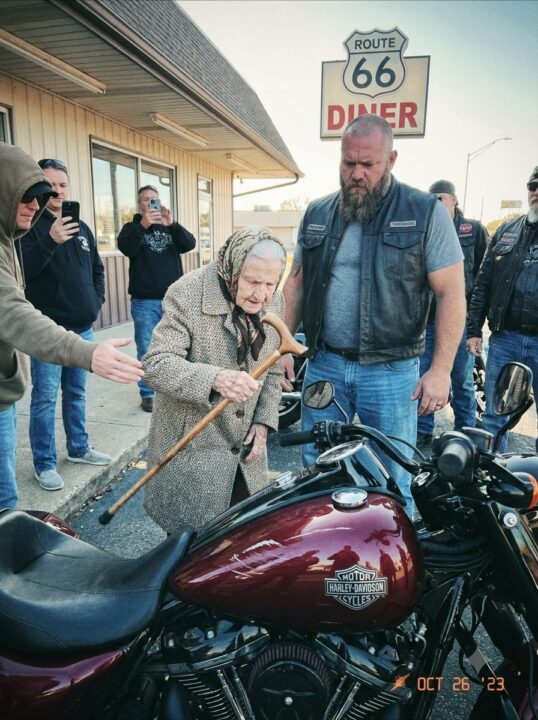
Walter Shaw came in every Thursday.
He was twenty-three, lean, loud, and permanently scented with welding smoke. He had returned from Army mechanic training with a surplus jacket, a dented motorcycle, and an unfortunate belief that every woman wanted to hear him discuss carburetors.
Evelyn did not.
“She ignored me for six weeks,” Walter once told me. “Naturally, I assumed that meant progress.”
The motorcycle was an old Panhead held together by wire, borrowed parts, and stubbornness. Its burgundy tank already carried the crescent-shaped dent beside the cap.
Walter had put it there the night he met Evelyn.
He was trying to park in front of the diner while watching her through the window. He hit the newspaper box, tipped the motorcycle, and crushed the tank against the curb.
Evelyn saw everything.
She brought him ice for his elbow and charged him for the coffee he spilled.
That dent became their first shared joke.
One night, Walter arrived after closing. Evelyn was mopping the kitchen, and the front door had already been locked. He could see her through the narrow glass panel, but the jukebox and industrial fan drowned out his voice.
Walter took off his Army class ring and tapped the fuel tank.
Three slow.
Two quick.
One slow.
Evelyn looked up.
He repeated it.
She came to the door.
“Are you breaking your own motorcycle now?” she asked.
“Depends. You busy Friday?”
“I am now.”
Walter used that rhythm for the next fifty-five years.
When he arrived home late, he killed the engine at the curb and tapped the tank with his wedding ring. Three slow, two quick, one slow. Evelyn would open the front door before he reached the porch.
The signal meant, Come outside. I made it back.
She answered by tapping the metal storm door: one slow, two quick, three slow.
That meant, Door’s open. Come home.
After age damaged Evelyn’s hearing, the ritual mattered more. She might not hear the motorcycle, but she could feel the vibration through the porch rail when Walter struck the tank in the driveway.
It survived arguments, layoffs, the birth of their son, two mortgage notices, Walter’s drinking years, and the winter Evelyn slept in the spare room for eleven weeks.
He always knocked.
She always answered.
Ray Dawson entered their lives in 1987.
He was seventeen and already looked older, with shoulders built by moving tractor tires at his uncle’s junkyard. His father was in prison. His mother had disappeared into another marriage. Ray slept behind a tire shop until Walter caught him stealing gasoline from a customer’s motorcycle.
Walter did not call the police.
He handed Ray a five-gallon can.
“Fill it,” he said.
Ray expected a beating. Instead, Walter made him sweep the shop, change oil, and eat dinner with Evelyn.
The first evening, Ray sat at their kitchen table without removing his leather jacket. He finished three plates of meatloaf while answering every question with a shrug.
Evelyn packed him food for the following morning.
He came back the next night.
By nineteen, Ray had learned to rebuild a transmission and ruin every peaceful situation offered to him. He fought, drank, disappeared for days, then returned to Walter’s garage when he needed money or stitches.
Walter kept the door open.
Evelyn did not excuse Ray. That was different.
She took his bottles. She made him apologize when he broke things. After Ray was arrested for attacking a man outside a bar, she visited the county jail and left a clean shirt without saying she forgave him.
Walter visited the following week.
“You coming home useful?” he asked.
Ray stared at the floor. “Don’t have a home.”
Walter tapped the steel visiting table.
Three slow.
Two quick.
One slow.
Ray looked up.
Walter answered himself.
One slow.
Two quick.
Three slow.
“Now you do.”
Years later, when Ray formed a small riding club with Walter, Mack Delaney, and four other mechanics, he chose the road name Hammer.
Walter became Knock.
The names sounded like a joke.
They were also a promise.
Walter knocked. Ray answered.
Their club, the Lanterns, did not advertise itself as charitable. Its members repaired cars for widows, escorted veterans’ funerals, delivered medicine during ice storms, and carried fuel to stranded riders.
Walter described their purpose in six words.
“Find the door. Let somebody in.”
Ray heard those words repeatedly during the worst years of his life.
He heard them after a second jail sentence. After his younger brother overdosed. After Ray remained sober for nine months, relapsed, then walked twelve miles to Walter’s garage because he was too ashamed to call.
Walter opened the door without speaking.
His wedding ring tapped the frame.
Three slow.
Two quick.
One slow.
Ray stepped inside.
That ring was now wrapped around Evelyn’s cane.
Walter had placed it there himself during the final winter of his life, when arthritis made her grip weak. He carved the ashwood handle, cut six small notches into the underside, and fitted his ring into the curve where her thumb rested.
She could feel the sequence even when memory blurred.
Ray had noticed the ring outside my diner.
That was why he let her keep striking the tank.
He was not waiting for her to stop.
He was waiting to learn whether she remembered how to finish.
Part 3 — The Last Ride Everyone Blamed on Ray
Walter was seventy-eight when doctors found the mass behind his heart.
By then, he moved more slowly but refused to sell the Harley he had owned since 1989, a black Electra Glide carrying the restored burgundy tank from his first motorcycle.
The original Panhead had died decades earlier. Walter saved the tank.
He moved it from bike to bike.
The metal had survived rain, road salt, two crashes, a garage fire, and one terrible attempt by Ray to repaint it with hardware-store enamel. Beneath every new layer remained the shallow crescent dent Walter made while watching Evelyn through the diner window.
Walter called it the most expensive first date in Missouri.
Cancer gave him months.
He told Evelyn they had years.
She knew he was lying but allowed it for a while. They had learned that love sometimes meant giving the other person time to reach the truth without being dragged.
Their son, Mark, reacted differently.
Mark was fifty-two, an accountant, and had spent his childhood watching the Lanterns arrive at birthdays with loud engines and leave during emergencies with grease still on their hands. He respected his father but distrusted the club.
He especially distrusted Ray.
Mark remembered the arrests, the broken promises, and the night Ray appeared at their house bleeding from one eyebrow. He did not remember Ray later sitting beside Walter through heart surgery or refinancing his garage to cover an employee’s medical bill.
To Mark, Ray remained the dangerous boy his parents should have stopped rescuing.
When Walter’s health declined, Mark demanded that he stop riding.
Walter agreed.
For eleven days.
Then he called Ray.
“I need one more.”
“No.”
Walter cleared his throat. “That sounded like a full sentence.”
“It is.”
“Didn’t raise you for vocabulary.”
“You didn’t raise me to kill you either.”
Walter wanted to travel eighteen miles, from the Shaw house to Mercer’s Diner, then return along Farm Road 105 beneath the cottonwoods. It was the route he rode on his first date with Evelyn.
He did not want speed. He did not want a parade.
He wanted the tank beneath his hands.
Ray refused three times.
Walter asked a fourth.
Evelyn knew.
She stood at the kitchen window while Ray helped Walter onto the passenger seat of a trike borrowed from Mack. Walter’s Electra Glide was too heavy for him, so Ray rode it beside them, carrying the burgundy tank.
Before leaving, Walter removed his wedding ring.
He tapped the motorcycle.
Three slow.
Two quick.
One slow.
Evelyn answered against the storm door.
One slow.
Two quick.
Three slow.
The ride lasted forty-three minutes.
Walter drank half a cup of coffee in my diner. He made me promise not to replace the cracked sugar jar. He signed the wall behind booth seven, where generations of travelers had left initials.
Then he asked Ray to push his wheelchair outside.
They sat beside the Harley.
“Tank goes to Ev,” Walter said.
Ray shook his head. “Bike goes to Mark.”
“Mark hates it.”
“He’s your son.”
“Ev’s my wife.”
Walter had already signed the title. He placed it inside an envelope with a letter and instructed Ray not to deliver either immediately.
“When?” Ray asked.
“When she knocks.”
“You’re talking nonsense.”
“You know the signal.”
Ray looked at him.
Walter’s breathing had become shallow. His hands trembled against the armrests, but his eyes remained clear.
“I might not make it home enough to knock,” he said. “So rebuild the bike. Bring the tank where she can find it.”
“Tell her yourself.”
Walter studied the diner entrance.
“She’ll try to keep me alive for her. I need her to let me go for me.”
Ray’s jaw tightened.
“No.”
Walter smiled faintly. “That still your favorite word?”
Ray drove him home.
He stopped the Electra Glide beside the driveway and waited for Walter to tap the tank. Walter lifted his hand but could not close his fingers around the ring.
Ray offered to do it.
Walter shook his head.
Evelyn was visible behind the storm door.
She waited.
Walter tried once more. His knuckles barely touched metal. No sound carried across the yard.
Then his hand fell.
Evelyn opened the door anyway.
She came outside, knelt beside the trike, and held his face.
Walter died two days later at home.
He never completed the final knock.
Mark learned about the ride after seeing photographs on Mack’s phone. Grief needed an object, and Ray was large enough to carry it.
“You stole two days from him,” Mark said at the funeral.
Ray could have explained that Walter planned the ride.
He did not.
Evelyn was sedated and exhausted. The title remained hidden beneath the Harley seat. Walter had told him to wait.
So Ray accepted Mark’s anger.
After the burial, Mark went to his parents’ garage and found the motorcycle missing. He called the sheriff and reported it stolen.
The deputy visited Ray’s shop.
Ray showed him Walter’s signed release, but not the final title. The release allowed him to take the motorcycle for repairs. It did not explain ownership.
The deputy decided the matter was civil and left.
Springfield decided Ray had stolen a dead man’s Harley.
The club urged him to return it.
Mack was blunt. “Whatever Knock planned, this is tearing his family apart.”
“He told me to rebuild it.”
“Then rebuild it and take it back.”
“Not until she knocks.”
“Evelyn may never remember.”
Ray looked at the dismantled motorcycle spread across his shop.
“Then I keep waiting.”
That decision split the Lanterns.
Three riders stopped attending meetings. One accused Ray of using Walter’s death to claim the club’s most recognizable motorcycle. Mark threatened legal action. Evelyn entered assisted living after falling in her kitchen, and her doctors warned that grief had worsened her confusion.
Ray rebuilt the Harley alone.
He replaced bearings, wiring, brake lines, corroded spokes, and cracked leather. He cleaned Walter’s fingerprints from the chrome but left the crescent dent untouched.
Every Thursday, he tapped the tank.
Three slow.
Two quick.
One slow.
Nobody answered.
Nineteen months passed.
Then Ray rode the finished motorcycle to Mercer’s Diner on the anniversary of Walter and Evelyn’s first date.
He believed he was meeting Mack for coffee.
Mack had arranged something else.
Green Meadows’ shuttle turned into the parking lot.
Evelyn stepped down.
She saw the burgundy tank.
And she raised her cane.
Part 4 — The Woman Everyone Mistook for Confused
The first three blows frightened us.
The next two angered the crowd.
The sixth silenced Ray.
Evelyn stood beside the Harley breathing through her mouth. Her cane had left a white scratch across the paint, yet her eyes remained fixed on the dent beside the fuel cap.
The nurse reached for her wrist.
Ray stopped her.
“Let her finish.”
“She could hurt herself.”
“Then hold her elbow. Not the cane.”
The nurse hesitated, then placed one hand beneath Evelyn’s arm.
She struck again.
Three slow.
Two quick.
One slow.
Mack removed his hat.
The other Lanterns followed because they finally recognized what Ray had heard from the first sequence.
Walter’s knock.
Mack had arranged the meeting but had not expected Evelyn to remember. He had visited Green Meadows several times, showing her photographs of the motorcycle and asking whether she wanted to see it.
Some days she called him Walter.
On other days, she asked why a stranger was holding pictures of her husband’s tank.
That Saturday, she said nothing during the shuttle ride.
Then the Harley appeared through the window.
She stood before the lift had reached the ground.
The crowd believed a confused old woman was damaging a stranger’s motorcycle. Mark, arriving behind the sheriff’s cruiser, believed Ray had staged the entire scene.
Neither was true.
Evelyn knew exactly what she was striking.
When Mark accused Ray of theft, she turned toward her son.
“Be quiet. I’m listening.”
Mark stopped.
Evelyn repeated the pattern, slower now. Each strike required her entire body.
Ray lowered himself beside the opposite side of the tank.
He had spent nineteen months imagining this moment. In every version, he explained Walter’s plan, returned the title, and rode away before anyone saw what it cost him.
Instead, his hands shook.
He removed the skull ring because it belonged to him, not Walter. The answer had to come from skin.
One slow.
Two quick.
Three slow.
The tank carried the sound between them.
Evelyn closed her eyes.
“Door’s open,” she said.
Ray’s beard moved against his chest when his head dropped.
The sheriff stepped back.
Mark did not.
“You told me she couldn’t remember Dad’s funeral,” he said to the nurse.
“I said memory can be uneven.”
“She thought I was her brother last week.”
Evelyn faced him. “You were wearing his ugly brown coat.”
A few people laughed before realizing she had made a joke.
Evelyn did not have to be perfectly well for this memory to be real. The rhythm lived somewhere deeper than dates, medication schedules, and room numbers. Walter had placed it into fifty-five years of ordinary evenings.
Her hand found the cane’s silver ring.
“Your father made this,” she told Mark. “Six notches underneath. Feel them.”
Mark turned the handle over.
Three widely spaced cuts.
Two close together.
One alone.
Walter had carved the signal into the wood.
Mack opened the saddlebag and brought out a small cloth bundle. Inside lay Walter’s ring mold, wood shavings from the cane, and a photograph dated three months before he died.
The photograph showed Walter at Ray’s workbench, guiding Ray’s hands as they fitted the silver band around the cane.
Mark stared at it.
“You knew?”
Ray nodded.
“Why didn’t you tell me?”
“Your dad said not to.”
“My father was dying.”
“He was still your father.”
“That doesn’t answer me.”
“It’s the only answer I have.”
Mark stepped closer. His anger had not vanished. It had simply lost its easiest shape.
“You took him riding.”
“He asked.”
“You should’ve refused.”
“I did.”
“But you still took him.”
“Yes.”
The parking lot tightened around that word.
Ray did not defend the decision. Walter had wanted the ride, but Ray had made it possible. Love did not erase consequence. Grief did not create simple verdicts.
Then Evelyn spoke.
“I told Ray to take him.”
Mark looked at her.
She touched the tank. “Your father thought I didn’t know. He hid his gloves under the bed like a child. I packed his medicine in Ray’s saddlebag.”
“Mom—”
“He was already leaving us. I gave him forty-three minutes when he still felt like himself.”
Mark’s face collapsed inward.
For nineteen months, he had blamed Ray for taking something.
Evelyn had believed Ray returned something.
She reached beneath her scarf and withdrew a small key hanging on a cord.
Walter’s spare ignition key.
“I kept mine,” she said.
Ray retrieved the envelope from beneath the seat and offered it to her.
Evelyn did not take it.
“That’s yours to read.”
Walter had written Ray’s name on the front. Below it were the instructions Ray had obeyed:
ONLY AFTER EVELYN KNOCKS ON THE TANK.
Ray broke the seal.
The missing title fell out first.
It listed Evelyn Shaw as owner.
A second folded sheet contained Walter’s handwriting.
Hammer,
If she knocks, she remembers enough.
Do not let Mark tell her what to do with the bike. Do not let the club turn it into a shrine. It belongs to Ev because it always did. I only kept the engine warm.
She may sell it. She may give it away. She may ask you to ride it past the house every Thursday until she gets tired of hearing it.
Whatever she chooses, answer her.
And stop letting my boy hate you for following my order. I was dying before the ride. I was alive during it.
Find the door.
Knock
Ray read the letter once.
Then again.
His voice failed when Mark asked what it said, so he handed the page over.
Mark reached the final line and looked toward the Harley.
Evelyn placed both palms on the tank.
“Start it,” she said.
Ray turned the key.
The V-twin caught with a heavy uneven pulse. The vibration traveled through the tank, into Evelyn’s fingers, along her arms, and through the cane braced beneath one hand.
She smiled.
Not because she believed Walter had returned.
Because for one minute, something familiar had.
Then she tapped the tank with her wedding-ring cane.
Ray answered.
The crowd put away its phones.
Part 5 — What Walter Hid Inside the Old Fuel Tank
We moved into the diner when the October rain began.
Evelyn chose booth seven, the same booth where Walter took her on their first date. Ray sat across from her but left enough room for Mark, who remained near the window holding the signed title.
The Lanterns occupied neighboring tables.
Nobody spoke above a murmur.
I brought Evelyn coffee. She took one sip and frowned.
“Used to be stronger.”
“So did we,” I said.
She accepted that.
Ray placed Walter’s letter beside the sugar jar. The cracked blue jar Walter made me promise not to replace still stood in the center of the table.
Evelyn traced the envelope but did not ask anyone to read it again.
“He always overexplained after dying,” she said.
Mark almost smiled.
Outside, rain spotted the burgundy tank. The scratch from Evelyn’s cane remained visible beneath the diner lights.
Ray told her he could repair it.
“No.”
“It’s through the clear coat.”
“Good.”
“It’ll rust.”
“Then keep it dry.”
Ray understood.
The cane marks belonged beside the crescent dent. One came from the night Walter met her. The other came from the morning she answered his final knock.
Neither needed hiding.
Mack then revealed something even Ray did not know.
During the restoration, Walter’s old tank developed a leak along the lower seam. Ray sent it to Mack’s welding shop because repairing fuel tanks required equipment his garage did not have.
When Mack opened the tank, he found a narrow brass tube secured beneath the fuel cap.
Walter had placed it there before his final ride.
Inside was a strip of paper, a small diner receipt, and an old photograph.
The receipt came from Evelyn’s first date in 1966: two coffees, one slice of apple pie, seventeen cents in tax.
On the back, Walter had written:
SHE CAME OUTSIDE.
The photograph showed twenty-one-year-old Evelyn standing beside the dented Panhead, one hand covering her mouth while Walter attempted to lift the fallen motorcycle.
Ray studied it.
Walter had never shown him that image.
The second side of the paper carried instructions for the club.
If the tank is opened, the old girl finally leaked worse than I did.
Put the dent back where Ev can touch it. Don’t polish away the bad years. And if Hammer tries to make this bike perfect, remind him that perfection is just damage with better lighting.
Mack had followed the instructions.
He repaired the seam but left the dent, scratches, and faded outline where Walter’s knees had worn the paint.
He kept the hidden items because he believed they belonged to Evelyn.
Now he placed them in her hands.
She rubbed her thumb across the diner receipt. The paper was too fragile for her to feel Walter’s writing, so Mark read it aloud.
SHE CAME OUTSIDE.
Evelyn’s chin trembled.
She did not cry immediately. She folded the receipt, unfolded it, then asked me whether apple pie still cost twenty-five cents.
“Not since I’ve been alive.”
“Walter blamed inflation for ruining romance.”
Ray turned toward the window.
Evelyn reached across the table and struck his hand lightly with her cane.
“Don’t hide now.”
He faced her.
“You carried this for nineteen months,” she said.
“Walter told me.”
“You always do everything he tells you?”
“No.”
“Only the painful things?”
Ray had no answer.
Evelyn pushed the signed title across the table.
“It’s mine?”
“Yes.”
“Then I decide.”
“Yes, ma’am.”
She looked toward Mark. “You want your father’s bike?”
Mark studied the Harley through the wet glass.
For years, he had resented the machine for pulling Walter away from birthdays, dinners, and quiet weekends. Only later did he understand that his father rode toward people more often than he rode away.
Still, Mark shook his head.
“I wouldn’t know what to do with it.”
“Neither did Walter,” Evelyn said. “That never stopped him.”
She turned to Ray.
“Keep it running.”
Ray’s eyes narrowed. “That isn’t the same as giving it to me.”
“No. You don’t get to own it.”
A faint smile appeared beneath her scarf.
“You answer it.”
Her plan was simple.
Every Thursday at four, weather permitting, Ray would bring Walter’s Harley to Green Meadows. He would park outside the residence, kill the engine, and tap the tank.
If Evelyn wished to come outside, she would answer.
If she did not, he would leave.
No pressure. No performance. No phones.
Mark would keep the title for her. The club would maintain the motorcycle. When Evelyn no longer wanted the ritual, she would decide what came next.
Ray agreed.
Then Mark asked the question everyone had avoided.
“Did Dad know the ride might kill him?”
Evelyn looked at the photograph in her hands.
“The ride didn’t kill him.”
“The doctor said exertion—”
“The doctor said he had days.”
Mark’s knuckles whitened against the table.
Evelyn’s voice softened. “Your father was frightened of becoming only a patient in our memories. For forty-three minutes, he was Knock again.”
Mark looked at Ray.
“You should’ve told me.”
Ray nodded. “I should have.”
It was the first time he admitted that.
Walter’s instructions had required secrecy, but secrecy still had a cost. Ray had protected a dying man’s choice while leaving his son alone with the wrong story.
“I thought keeping his word was enough,” Ray said.
“It wasn’t.”
“No.”
That answer did more than an apology would have done.
Mark sat beside him.
They did not shake hands.
They shared Walter’s cold coffee.
Outside, Evelyn’s cane scratch shone across the burgundy tank.
Ray never painted over it.
Part 6 — Every Thursday at Four
The ritual began five days later.
At 3:58 on Thursday afternoon, Ray parked Walter’s Harley outside Green Meadows. He wore his leather cut, faded jeans, and scarred riding boots, but left the rest of the club behind.
He shut off the engine.
Residents watched from the windows.
Ray removed his skull ring and tapped the tank with bare knuckles.
Three slow.
Two quick.
One slow.
Nothing happened.
He waited.
At 4:03, the front door opened. Evelyn emerged with her nurse, blue scarf tied beneath her chin and cane resting against one shoulder.
She reached the motorcycle and answered against the tank.
One slow.
Two quick.
Three slow.
Ray started the engine for exactly one minute.
That was all.
The following week, she did not come out.
Ray waited ten minutes, then left without entering the building.
Mark later explained that she had slept through the afternoon.
Ray returned the next Thursday.
This time Evelyn was already seated near the door.
Winter forced them into the covered ambulance bay. Snow gathered along the curb while the Harley’s exhaust clouded the air.
Some weeks Evelyn remembered every detail. She told stories about Walter dropping the bike, burning pancakes, hiding Christmas presents in the garage, and proposing with grease under his fingernails.
Other weeks, she asked Ray whether he worked there.
He never corrected her harshly.
“My name’s Hammer,” he would say.
Evelyn touched the notches beneath her cane handle.
“Then somebody must be knocking.”
The Lanterns repaired a small wooden bench for the entrance. Mark began coming on the first Thursday of each month, initially in his work clothes, later in Walter’s ugly brown coat.
Ray taught him how to start the Electra Glide.
Mark stalled it four times.
Evelyn laughed so hard the nurse brought her oxygen.
The video recorded outside my diner disappeared from social media after the student who filmed it learned the story. She returned to apologize and offered to delete the clip from her phone in front of Ray.
He nodded.
“Keep the first six seconds.”
She looked confused.
“That’s the part where everybody was wrong.”
She kept nothing.
Springfield gradually learned that Ray had not stolen Walter’s motorcycle. Fewer people learned the entire truth, which suited Ray.
He did not need a town’s forgiveness.
He needed to answer on Thursdays.
The cane marks slowly darkened as moisture reached the scratched metal. Ray coated them with clear sealant but refused to add paint.
Beside the old crescent dent, the six pale lines looked accidental.
They were not.
They were the final half of a conversation fifty-five years long.
Part 7 — The Door Walter Left Open
Evelyn continued the Thursday ritual for fourteen months.
On her eighty-third birthday, Green Meadows held a small gathering beneath the covered entrance. Mark brought apple pie. I brought the cracked sugar jar from booth seven. Mack arrived with the Lanterns but made them park across the street so one engine remained distinct.
Ray arrived at four.
He tapped the tank.
Three slow.
Two quick.
One slow.
The door opened.
Evelyn walked outside without her nurse’s hand beneath her elbow. She moved carefully, leaning on the cane Walter had made, and stopped beside the burgundy tank.
She answered.
One slow.
Two quick.
Three slow.
Then she handed Ray the cane.
“Your turn to keep it.”
He stared at her.
“I’m not dying today,” she said. “Stop making that face.”
Mark laughed.
Evelyn had decided the Harley’s future. After her death, the motorcycle would belong to the Lanterns under one condition: it could never be displayed behind glass.
It had to be used.
The club would ride it during funeral escorts for riders whose families could not afford one. At every home they visited, the lead rider would tap Walter’s pattern before leaving.
No explanation unless someone asked.
Ray placed the cane carefully across the motorcycle seat.
Evelyn touched the dent from 1966, then the scratches she had made outside my diner.
“Your paint still looks terrible,” she said.
“You did that.”
“Walter started it.”
Ray looked toward the residence door.
For decades, he had believed Walter was the man who kept opening doors for him. Only now did he understand that Evelyn had stood on the other side of each one.
She packed the food.
She visited the jail.
She remembered his name when other people remembered only his record.
Walter knocked.
Evelyn let him in.
Before Ray left, Mark approached with Walter’s old wedding ring. The silver band had loosened from the cane during winter and required repair.
Instead of reinstalling it, Evelyn asked Mark to give it to Ray.
Ray refused.
She struck his boot with the rubber tip.
“Don’t make an old woman repeat herself.”
He slid the ring onto a leather cord and tied it inside his vest beside his heart.
Then he mounted the Harley.
The engine started with its familiar uneven beat. Evelyn stood beneath the awning, one hand raised, while the Lanterns waited across the street.
Ray rolled toward the road, stopped, and looked back.
He tapped the tank once with Walter’s ring.
Evelyn tapped the doorframe with her cane.
The door was still open.
Follow the page for more biker stories about misunderstood riders, unfinished promises, and the quiet people waiting behind every leather vest.