A Young Woman in a Wheelchair Kept Crashing Into a Biker’s New Harley—Then the Club Discovered the Homemade Sidecar Ramp and What He Had Sold to Finish It
Part 2 — The Girl Who Wanted to Hear the Canyon Answer
Mari entered our lives at a diner twenty miles east of Flagstaff.
The place was called Dale’s Highway Grill, though Dale had been dead since 1987 and nobody knew who owned the faded pickup parked permanently near the kitchen door. The coffee tasted burned by seven in the morning. The green vinyl booths cracked during winter. Truckers liked it because the parking lot could hold twelve rigs and nobody complained about diesel engines idling beside breakfast.
The Iron Saints met there every second Sunday.
Mari worked the register during college breaks. Her mother, Rosa, managed the motel across the highway, and Mari was studying mechanical engineering at Northern Arizona University through a combination of online courses and trips to an accessible campus building in Flagstaff.
She had been nineteen for four days when Hammer first spoke to her.
The club had arrived after a charity ride, fourteen motorcycles rumbling into the gravel lot beneath a bruised monsoon sky. Rain darkened our leather. Boots tracked red mud across the diner floor. Customers watched us enter with the guarded expressions we had learned to ignore.
Mari did not look impressed.
She rolled between tables, passed out menus, and told Preacher his wet bandana was dripping into the sugar dispenser.
Preacher removed it.
Hammer sat near the window. Mari noticed the old patch sewn inside his leather cut, not outside where anyone could read it.
It showed a tiny sidecar beneath a line of crooked mountains.
“You ride a sidecar?” she asked.
“No.”
“Then why the patch?”
Hammer closed the vest.
“Old idea.”
Mari looked through the window at his Harley. “I’ve never been on a motorcycle.”
Most people would have answered with pity. Hammer did not.
“Why not?”
Mari’s eyebrows lifted. “Because my legs don’t work.”
“Sidecar doesn’t need your legs.”
That was all.
He returned the next week with a tape measure.
Mari thought he wanted the width of her wheelchair for a doorway or a donation ramp. Hammer measured the tires, caster clearance, footplate height, seat angle, battery housing, and the distance between her elbows when she propelled herself.
He asked permission before touching the chair.
Every time.
“What are you building?” she asked.
“Maybe nothing.”
“That’s a lot of measurements for nothing.”
Hammer folded the tape. “Nothing costs more than you’d think.”
Mari had become a wheelchair user after a distracted delivery driver ran a red light and hit her family’s sedan outside Gallup, New Mexico. Her father died at the scene. Her mother suffered a broken pelvis. Mari survived with injuries to her lower spine and permanent paralysis below the waist.
She hated when strangers called her lucky.
She also hated being described as brave for buying groceries, going to class, or moving from a chair into bed.
Hammer never called her either word.
He asked what she wanted from the ride.
“Speed,” she said.
“How much?”
“Enough that my mother complains.”
Rosa, wiping the next table, answered without looking up. “Your mother is already complaining.”
Mari smiled.
Then she became serious. “I don’t want to transfer into a regular sidecar. I want my chair locked inside. I want to roll up and secure it myself.”
Hammer nodded.
He had already expected that.
For the next six weeks, he spent his evenings in the club garage measuring frames and studying accessible-transportation standards. He visited a company that modified vans. He called sidecar manufacturers in Ohio, Texas, and Washington. Most refused to certify an improvised wheelchair system. One technician stayed on the phone for two hours and explained every reason Hammer’s first design would fail.
Hammer wrote them all down.
The project grew expensive.
A standard sidecar was not enough. The floor required reinforcement and lowering. The suspension had to account for a passenger who could not shift her body through turns. The wheelchair needed four secure points plus a mechanical docking plate. The ramp had to be strong enough to hold the powered chair yet light enough for Hammer to deploy beside the road.
Then there was the escape system.
Mari insisted she needed a way to release the chair herself if Hammer became injured.
Preacher laughed when he heard that.
“You planning to rescue him?”
Mari looked at Hammer’s shoulders. “You think I can drag that out of a ditch?”
“No.”
“Then I need to roll away before he lands on me.”
Hammer added the release lever.
That was how their friendship worked. Mari found the weakness. Hammer rebuilt the metal. Neither treated the other gently enough to make the work useless.
The Harley complicated everything.
Hammer had ordered the black Road Glide the previous winter. It was the first new motorcycle he had ever owned. He had also placed a deposit on a custom chrome package: polished wheels, forks, controls, engine covers, exhaust shields, mirrors, and trim.
He kept photographs of the pieces inside his toolbox.
He never admitted how often he looked at them.
When the sidecar estimate rose beyond four thousand dollars, I offered to start a club collection. Hammer refused.
“Girl didn’t ask for charity.”
“She asked for a ride.”
“Then build a ride.”
“You don’t have the money.”
Hammer looked at the chrome photographs.
Three days later, the boxes disappeared.
He told us he had canceled the order. That was not true. He sold the parts to a touring-bike collector in Phoenix and lost nearly eight hundred dollars on the deal because he needed payment immediately.
Preacher found out.
The argument shook the garage.
“You saved two years for that kit.”
“Saved too long.”
“For what? So some kid can ride once?”
Hammer’s expression hardened.
“You ride every Sunday and still don’t know what one ride is worth.”
Preacher stepped closer. “This club could have helped.”
“Helping after I ask ain’t helping her.”
“That makes no sense.”
“Does to me.”
The room went quiet.
Hammer collected the aluminum order the next morning. He paid cash. Then he placed the receipt beneath an old notebook he kept locked inside the bottom drawer of his workbench.
I saw the name on its cover.
June.
I had known Hammer for twelve years.
I had never heard him say it.
Part 3 — Three Impacts and One Line Nobody Crossed
The first complete test happened on a Saturday in late September.
Mari arrived at eight in the morning with Rosa and a canvas bag containing gloves, water, medication, a tire pump, and enough emergency supplies to cross a continent. Rosa examined the sidecar as though Hammer had built it from cardboard and optimism.
“It has brakes?” she asked.
“Independent disc.”
“Seat belt?”
“Four-point restraint.”
“Roll bar?”
Hammer tapped the reinforced frame.
“Helmet?”
He held one up.
Rosa pointed toward the Harley. “Life insurance?”
Hammer looked at Mari. “She always like this?”
“Today she’s relaxed.”
Rosa did not smile.
The sidecar looked unfinished. Its outer shell was matte black fiberglass, because paint had become the last expense on the list. The interior held a flat aluminum floor, rubber guides for the chair wheels, a docking latch, a padded front brace, and two crossed restraint straps.
The ramp folded along the outside.
Hammer deployed it.
The aluminum touched concrete with a hollow clack.
Mari wheeled to the base and studied the angle. “Too steep.”
“It’s eleven degrees.”
“Feels like twelve.”
Hammer checked with a digital level.
Eleven point eight.
Mari looked at him.
He adjusted the legs.
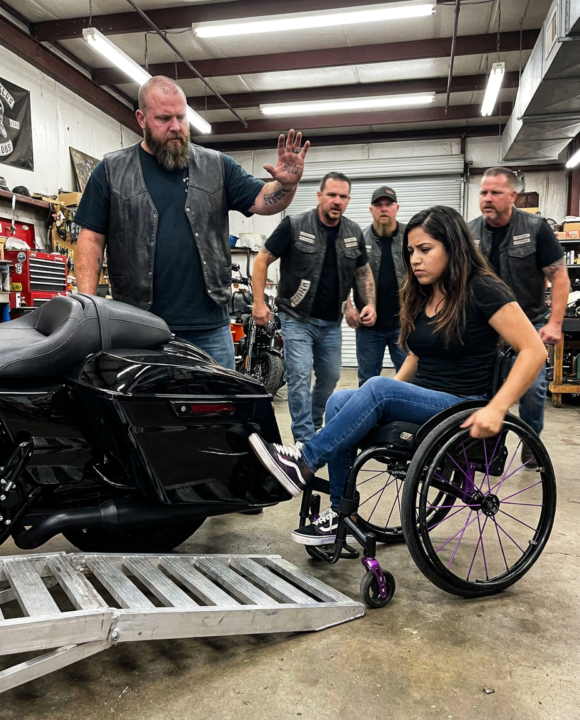
Her first attempt started smoothly. The front casters reached the sidecar floor, but the ramp flexed beneath the chair’s right wheel. Mari corrected left. The caster struck the guide rail, and the chair pivoted toward the Harley.
Bang.
Her footplate scraped the saddlebag.
Everyone inhaled.
Hammer inspected the contact point, then examined the ramp.
“Again.”
Mari backed down.
Rosa objected. “Maybe that is enough for today.”
“No,” Mari said.
The second attempt failed faster. Her right wheel climbed the narrow safety edge. She jerked her hand to correct. The wheelchair twisted, and the steel footplate struck the rear fender.
The dent was small.
The sound was not.
I saw Hammer’s jaw move beneath his beard. He had spent his life around motorcycles and knew every injury metal could suffer. Still, he never glanced at the fender first.
“You hurt?” he asked.
“No.”
“Hands?”
“Fine.”
“Chair?”
“Ugly before I got here.”
“Again.”
Mari backed twenty feet across the garage.
That was when Preacher, Boone, and a young prospect named Tyler entered through the side door. They had been collecting blankets for a shelter ride and knew nothing about the scheduled test.
Preacher saw the scratched saddlebag.
He saw Mari accelerate.
He shouted.
Mari’s head snapped toward him. Her palm slipped from the push rim. One caster clipped the ramp, and her chair veered violently left.
Bang.
The third impact rocked the Harley against its kickstand.
Move.
That was the only word in the room.
Preacher charged forward. Boone came behind him. Tyler rushed to catch the wheelchair before it tipped and grabbed both handles.
Mari shouted, “Don’t touch me.”
Tyler kept pulling.
Hammer caught his wrist.
Fast.
The enormous biker’s fingers closed around the prospect’s forearm, but he did not squeeze. His voice dropped so low the welding lights seemed to hum around it.
“She said no.”
“I was stopping her from falling.”
“She said no.”
Tyler released the chair.
Preacher pointed at the Harley. “She’s wrecking your bike.”
“Testing her ramp.”
“You’re letting her use a thirty-thousand-dollar motorcycle as a crash barrier?”
“Appears so.”
Preacher stepped around Hammer and saw the first two dents. “This isn’t a joke.”
Mari turned her chair toward him. Her face had gone pale, but her voice remained steady.
“I told him it needed another two inches.”
“Then let one of us push you.”
The moment those words left Preacher’s mouth, I knew they were wrong.
Mari looked down at her legs, then back at him. “Would you let someone push your Harley through every curve?”
“That’s not the same.”
“It is to me.”
Preacher opened his mouth.
Hammer stopped him.
“She loads herself.”
“What happens on the road when she can’t?”
“Then we fix what stopped her.”
“And if fixing it destroys the paint?”
Hammer looked at the Harley.
“Paint’s already scared.”
Nobody laughed.
He crouched beside the ramp and placed two scarred fingers beneath its right edge. The aluminum had bowed where the wheelchair crossed. He measured the wheel marks, the distance to the guide rail, and the angle of the sidecar floor.
Mari wiped her palms against her jeans. “The left rail needs to move out two inches, and the center brace needs to shift right.”
Hammer nodded.
“Could lower the hinge half an inch too,” she said.
He checked it.
She was right.
Preacher noticed the receipt beneath Hammer’s gloves. He pulled it free and read the amount. Then he found the chrome sales contract.
His expression changed.
“You sold the whole package?”
Hammer took the paper from him.
“For this?”
“For materials.”
“You didn’t cancel it.”
“No.”
“You sold it at a loss.”
“Buyer had cash.”
Preacher stared at the plain black Harley, then at the scratched paint, then at Mari’s wheelchair.
For once, our president had nothing to say.
Hammer unbolted the ramp.
He worked through lunch. He widened the surface, moved both rails, strengthened the center support, and lowered the hinge. Mari stayed beside the welding table and recalculated the load distribution while Rosa brought coffee.
At six, Hammer redeployed the ramp.
Mari lined up.
Her hands were blistered. Hammer offered gloves. She refused them because she needed to feel the rims.
The wheelchair climbed without drifting. Both casters passed between the rails. The docking pin slid beneath the chair and locked with a hard metallic click.
Mari stopped inside the sidecar.
Nobody cheered at first.
The sound of that lock was too clean, too final. Six weeks of measurements, arguments, and damaged paint had narrowed into one click.
Then Boone slapped the workbench. Tyler shouted. Rosa covered her mouth. Preacher turned away and inspected a wall that needed no inspection.
Hammer reached for the ignition.
His hand stopped above the switch.
The garage quieted again.
Mari waited.
“Start it,” she said.
Hammer could not.
His shoulders locked. His breathing changed. Sweat appeared along his temples although the evening air had cooled.
He looked not at Mari, but at the old notebook lying open near the welding machine.
On the visible page was a pencil drawing of the same ramp.
A woman had written beneath it:
Don’t spend forever making it perfect, Ray. Just take me somewhere.
Hammer lowered his hand.
“Test’s over.”
Mari’s face fell. “The latch worked.”
“Tomorrow.”
“You said today.”
“Tomorrow.”
He walked into the tool room and closed the door.
Through the thin metal wall, we heard a single blow.
Not against a person.
A fist against a workbench.
When Hammer emerged, blood marked two knuckles. He wrapped them in a shop rag and told everyone to go home.
Mari did not.
She rolled beside the locked tool-room door and remained there until the garage was empty.
Then she asked the question the rest of us had avoided.
“Who was June?”
Part 4 — The Sidecar That Waited Eleven Years
June Dawson was Hammer’s wife.
They met when Ray was thirty-three, recently sober, nearly broke, and living inside a rented room above an auto-parts store. He already had the tattoos and the motorcycle. What he lacked was any reason to stop riding when the sun came up.
June gave him one.
She was a physical therapist at a veterans’ rehabilitation clinic in Prescott. She had short red hair, a sharp laugh, and no patience for men who confused silence with depth. Their first argument happened because Ray parked across the wheelchair-accessible stripes beside her clinic.
June made him move the Harley.
Then she made him apologize to every patient whose path he had blocked.
He returned the next week with yellow paint and repainted the stripes.
They married eleven months later.
June rode behind him for fourteen years. She disliked high speeds, loved mountain roads, and tapped twice against his ribs whenever she wanted him to slow down. Ray learned every signal her gloves could make against his leather jacket.
Then her right hand began going numb.
Doctors first suspected a pinched nerve. The weakness spread. Testing brought a diagnosis neither of them could bargain with: amyotrophic lateral sclerosis.
ALS took small things before it took large ones.
June stopped fastening her helmet. Then she could no longer lift her leg across the motorcycle seat. Later, she lost enough strength in her hands that holding Ray around the waist became unsafe.
They parked the Harley.
Ray promised it was temporary.
June moved from a cane to a walker and then to a wheelchair. Ray widened doorways, built shower rails, lowered countertops, and installed a van lift. He solved every problem that involved lumber, steel, bolts, or wire.
The motorcycle remained in the garage.
One afternoon, June sketched a wheelchair sidecar on the back of a clinic form. She drew a folding ramp, a docking plate, and a ridiculous roof shaped like a cowboy hat.
“Build that,” she told him.
Ray studied the page. “Unsafe.”
“Then make it safe.”
“Need reinforced frame.”
“You own a welder.”
“Side load will pull the bike.”
“You have large friends.”
She wrote the sentence about taking her somewhere hospital windows could not see.
Ray began designing.
Then he did what frightened men often do when a promise matters too much.
He delayed.
He researched every possible failure. He telephoned manufacturers, studied suspension geometry, and redrew the frame until the lines wore through the paper. Each time June asked when they would ride, he listed another part he needed.
“We get one chance,” he told her.
June answered, “We get fewer than you think.”
Her illness accelerated.
One spring morning, Ray installed the first steel bracket on an old sidecar frame. That afternoon, June entered the hospital with pneumonia.
She never came home.
After the funeral, Ray removed the bracket and placed it in the bottom drawer of his workbench. He stored June’s notebook beneath it. For eleven years, he never opened either one in front of us.
The sidecar patch inside his vest had been June’s last anniversary gift. She had sewn it when her fingers could still hold a needle.
Preacher knew some of the story.
Not all.
The Iron Saints had offered to help build the sidecar while June was alive, but Hammer insisted on doing it himself. He told them there would be time after he solved the remaining problems.
There wasn’t.
That was why the chrome mattered.
June used to tease Ray about polishing his motorcycle while the sink leaked. She called every shiny part “another mirror for a man who won’t look at himself.”
After her death, Hammer stopped buying chrome.
Then, eleven years later, he ordered the expensive package for his new Harley.
I asked him why.
We were in the garage after Mari left. He sat on a low stool, wrapping his split knuckles while rain hammered the metal roof.
“Thought if the bike looked different, it’d be different.”
“From what?”
“The one she waited on.”
The new Harley was not a celebration.
It was an escape hatch.
Then Mari asked him for a ride.
She was nineteen, impatient, technically gifted, and unwilling to let fear hide beneath careful language. She examined Hammer’s old notebook and saw not a dead woman’s abandoned dream, but an engineering project with solvable defects.
She also discovered something none of us understood.
The original design was not incomplete.
It had been ready.
June’s final pages contained measurements verified by a rehabilitation engineer. The frame calculations were safe. The ramp angle worked. The docking system could have been purchased years earlier.
Ray had not failed because he lacked one more part.
He had failed because completing the sidecar meant admitting June was never going to sit behind him again. As long as the design remained unfinished, part of their old life remained merely postponed.
Mari found the engineer’s approval letter folded inside the notebook.
She rolled into the tool room and placed it in front of Hammer.
“You could have built it.”
He did not answer.
“You were scared.”
His face hardened. “Careful.”
Mari did not move back.
“Of hurting her?”
Hammer stared at his wrapped hand.
“Of taking her out and seeing how sick she was. Of people looking. Of dropping her. Of doing it wrong. Pick one.”
“And now?”
“Now she’s dead.”
Mari held his gaze. “That wasn’t my question.”
Hammer stood so quickly the stool tipped behind him. At full height, he towered over her. Any sensible person might have retreated.
Mari crossed her arms.
“You think a ramp fixes this?” he asked.
“No.”
“You think one ride pays a debt?”
“No.”
“Then what do you want?”
“My ride.”
Two words.
Nothing more.
Hammer looked toward the Harley. Three fresh scratches cut through the black paint. The sidecar waited beside it, ramp folded, docking plate installed.
Mari reached into her backpack and removed a chrome mirror.
It was the only piece from Hammer’s expensive package the Phoenix buyer had not wanted. Hammer had given it to Rosa to return for a refund, but Mari kept it.
She held the mirror toward him.
“You sold all your shiny stuff,” she said. “Still found a way not to look.”
Hammer stared at his own weathered face in the chrome.
Then he took the mirror from her.
At dawn, he bolted it to the Harley.
Not because the bike needed it.
Because he did.
Part 5 — The Ride That Began at Walking Speed
The next morning, forty-two motorcycles stood outside the Iron Saints’ garage.
Preacher had called every member within a hundred miles. Some rode through rain from Phoenix. Two came down from Page before sunrise. An old member named Doc trailered his bike because arthritis no longer allowed him to ride farther than twenty miles, but he refused to miss what Preacher called “club business.”
Hammer stepped outside and stopped.
“What’s this?”
Preacher adjusted his gloves. “Support vehicle.”
“Don’t need forty-two.”
“Good. We brought forty-two anyway.”
The previous argument still hung between them. Preacher had dismissed Mari’s first ride as a single event, something less important than the motorcycles we rode every week.
He did not apologize with a speech.
He brought the road.
Boone carried spare ramp hardware. Tyler had fabricated two wider guide rails and left them on the workbench without attaching his name. Doc brought a trauma kit. Four members had mapped accessible fuel stops along the planned route. Another rider carried a folding privacy shelter in case Mari needed medical care beside the highway.
Rosa arrived last.
She parked her aging sedan beside the garage and remained behind the wheel for several minutes. Through the windshield, I saw her gripping a photograph of her late husband.
When she stepped out, her eyes were dry.
“I still think this is a terrible idea,” she told Hammer.
“Probably.”
“If she gets hurt—”
“She won’t.”
“You can’t promise that.”
Hammer glanced at the road.
“No.”
That answer earned more trust than a promise would have.
Mari rolled from the passenger side wearing black jeans, protective boots strapped over her feet, a reinforced jacket, gloves, and a full-face helmet resting on her lap. Someone had attached a small purple ribbon to the helmet’s rear vent.
She stopped at the ramp.
The garage fell silent.
Hammer deployed it. Aluminum met pavement. He checked each hinge pin, lowered the stabilizing leg, and placed both hands behind his back.
He did not push.
Mari aligned her chair.
The first wheel climbed. Then the second. Her shoulders tightened as she crossed the hinge. The ramp flexed but held. Both casters entered the guides, and the chair rolled forward until the docking plate caught.
Click.
Mari tested the release lever.
Unlock.
She backed down.
Several riders groaned.
Mari ignored them.
She rolled up again.
Click.
She pulled against the docking point, rocked her chair, tested the restraints, and checked the emergency release. Only then did she nod.
“Ready.”
Hammer folded the ramp against the sidecar. He secured the upper brace and tightened the four-point restraint across Mari’s hips and shoulders. Every movement was slow enough for her to object.
She objected twice.
“Too tight on the left.”
He loosened it.
“Headrest needs to come forward.”
He adjusted it.
Then he climbed onto the Harley.
His hand hovered over the ignition switch.
I watched his right boot settle on the pavement. I watched leather pull across his shoulders. I watched the chrome mirror reflect the empty passenger seat behind him.
Mari saw it too.
“Ray.”
He looked toward the sidecar.
“I’m not June.”
“I know.”
“You don’t owe me her ride.”
“I know.”
“Then quit looking like you’re taking a ghost.”
Hammer’s jaw tightened.
Mari lowered the visor of her helmet.
“Take me.”
He turned the key.
The engine fired.
Forty-two V-twins answered, but nobody moved. Hammer let the Harley idle while vibration traveled through the sidecar frame. Mari’s hands gripped the arm supports.
“You okay?” he asked.
Her helmet nodded.
Hammer released the clutch.
The motorcycle rolled forward at walking speed.
Ten feet.
Twenty.
Thirty.
At the edge of the lot, he stopped.
Mari raised her visor. “Is this the part where you tell me we tested enough?”
“Thinking about it.”
“I will ram this sidecar into your bike from the inside.”
Hammer looked at her.
Then the corner of his beard lifted.
The Harley entered Route 66.
We formed two lines behind them. Preacher rode left. I rode right. Rosa followed in the center with Doc driving the support truck behind her.
Hammer kept the speed at thirty-five for the first mile.
Mari signaled with one hand.
Faster.
He increased to forty-five.
The sidecar suspension moved cleanly over cracked pavement. The chair remained locked. Mari’s headrest supported her through the first long curve.
Faster.
Hammer shook his head.
Mari repeated the signal.
At fifty-five, the wind pulled loose strands of dark hair from beneath her helmet. The sidecar vibrated. The purple ribbon snapped behind her.
Then she laughed.
We could not hear it over the engines.
We saw it.
Her shoulders shook. Her head tipped back. One gloved hand rose above the sidecar rim, fingers spread against the desert air.
Hammer saw her in the chrome mirror.
His body changed.
The stiffness left his shoulders. His grip loosened. He stopped riding as if the road were waiting to punish him.
We turned north toward Oak Creek Canyon.
The plan was to ride twelve miles to the overlook, rest, and return. Hammer had selected the shortest route with the gentlest curves.
Mari knew.
At the overlook, she confronted him.
“Twelve miles?”
“First ride.”
“That’s a grocery run.”
“It’s a test.”
“The ramp was a test.”
Hammer removed his helmet. “Weather’s moving in.”
The sky was clear.
Mari pointed down the road. “Where did June want to go?”
Every rider within earshot became still.
Hammer looked toward the mountains.
“Sedona.”
“How far?”
“Twenty-eight more.”
Mari tightened her gloves. “Good.”
Rosa approached, and Hammer braced for an argument.
Instead, she placed the photograph from her car inside the sidecar pocket. It showed Mari at six years old sitting on her father’s shoulders beside the red rocks of Sedona.
“He used to promise he’d take her back,” Rosa said.
Two unfinished promises occupied the sidecar now.
Hammer looked at Preacher.
The club president started his engine.
“Route’s clear, brother.”
Hammer climbed back onto the Harley.
We rode south.
Part 6 — Red Rock, Rain, and the Missing Chrome
The weather did change near Sedona.
A thin rain began against the canyon walls, darkening the road and raising the smell of wet dust, pine, hot engines, and cooling exhaust. Hammer slowed. The formation tightened behind him.
Mari kept one hand above the sidecar rim, feeling each drop.
At a scenic pullout beneath the red cliffs, Hammer stopped and deployed the ramp. Mari released her restraints herself, unlocked the docking plate, and rolled down onto damp pavement.
No one applauded.
By then, we understood she had not come to become someone else’s inspiring moment.
She had come to see the canyon.
Mari positioned herself beside the guardrail. The red stone rose through rain mist. Water ticked against her helmet. Forty-two bikers stood behind her, suddenly unsure where to put their hands.
Hammer remained near the Harley.
Mari removed the photograph from the sidecar pocket and studied it. Her father had been laughing in the picture. Rosa stood beside him, younger and sunburned. The six-year-old Mari had both arms raised as if she owned every rock in Arizona.
She handed the photograph to her mother.
Then she called Hammer.
He approached.
Mari held out June’s notebook, which she had carried inside her jacket. Hammer had not known.
She opened to the page bearing June’s request: take me somewhere the hospital windows can’t see.
“There are no hospital windows here,” Mari said.
Hammer looked at the canyon.
“No.”
“So tell her.”
He did not speak.
Mari waited.
Rain gathered in Hammer’s beard. His scarred hands opened and closed at his sides. Preacher lowered his eyes. I heard engines ticking behind us as they cooled.
Finally, Hammer touched the sidecar patch inside his vest.
“We made it, June.”
Four words.
That was all he had.
It was enough.
On the return ride, the rain grew harder. Hammer’s new Harley lost its clean shine within minutes. Mud streaked the saddlebags. Water filled the scratches left by Mari’s footplate. The single chrome mirror blurred beneath raindrops.
The bike looked used.
Hammer looked relieved.
Back at the garage, Preacher carried a cardboard box to him. Inside were the two dented saddlebag panels and rear-fender trim removed during inspection.
“We can replace them,” Preacher said. “Club will cover it.”
Hammer shook his head.
“Insurance?”
“No.”
“You’re keeping the dents?”
Hammer ran one thumb along the deepest scratch.
“First miles.”
Preacher nodded.
Nobody argued.
Weeks later, the Phoenix collector who bought Hammer’s chrome learned why he had sold it. He arrived at the garage on a gold touring bike with almost every surface polished bright enough to hurt the eyes.
He offered to sell the package back at the original price.
Hammer declined.
The collector looked at the unfinished sidecar, the scratched black Harley, and the purple ribbon tied around its mirror.
“You don’t miss it?”
Hammer considered the rows of chrome on the man’s motorcycle.
Then he looked toward Mari, who was teaching Tyler how to measure the ramp hinge properly.
“Shiny ain’t the same as finished.”
The sidecar received paint a month later.
Mari chose matte black because it did not show fingerprints. Rosa added one thin purple stripe. Preacher wanted the club emblem on the side, but Mari refused.
“I’m not advertising you.”
“You ride with us.”
“I tolerate you.”
Preacher smiled. “Same thing.”
Inside the sidecar, beneath the emergency release lever, Hammer mounted a small metal plate. It did not carry June’s name. It did not mention loss, courage, charity, or second chances.
It contained four words taken from her notebook:
Just take me somewhere.
Part 7 — The Woman Who Built the Next Ramp
Mari’s first ride did not remain her only ride.
She returned the following Sunday, then twice the month after that. Hammer taught her the hand signals used by the club. She learned to inspect the docking latch, test the restraint anchors, and recognize changes in the sidecar through vibration.
By winter, she could identify a loose mounting bolt before Hammer.
He disliked that.
She enjoyed it.
The deeper change happened inside the garage.
Mari converted her sidecar calculations into a university design project. She interviewed wheelchair users with different levels of mobility, body control, chair width, and medical support needs. She discovered quickly that a ramp suited to her could exclude someone using a larger powered chair.
Hammer helped her build the second prototype.
This one belonged to nobody yet.
They widened the floor, strengthened the hinge, and created adjustable guides. Mari designed a manual emergency release reachable with limited hand movement. Doc helped develop a head-support system. Rosa insisted on weather protection.
Preacher found the funding.
He organized a ride called Miles Without Stairs and collected enough money for three adaptive sidecars. The club that had once rushed to protect Hammer’s paint now spent Saturdays allowing wheelchair users to ram test chairs into their motorcycles.
The dents multiplied.
Nobody repaired them.
Two years after Mari’s first ride, a thirteen-year-old boy named Evan arrived with muscular dystrophy. He wanted to ride beside his older brother before his strength declined further.
His powered chair was wider than Mari’s.
The ramp failed.
One wheel caught the guide rail, turning his chair toward Hammer’s Harley. Evan panicked and stopped.
Every club member remained still.
Mari rolled beside him.
“What moved?” she asked.
“The chair went right.”
“How much wider?”
“Maybe an inch.”
Mari looked at Hammer.
He already held a wrench.
“Again,” he said.
Evan tried four more times.
On the fifth, the docking plate locked.
Click.
The sound traveled through the garage exactly as it had years earlier. Hammer stood beside the scratched Harley with June’s patch hidden inside his vest and rain beginning against the roof.
Mari inspected the latch.
“Ready,” she said.
Hammer lowered the ramp.
Evan’s brother started his motorcycle. Twenty-seven Iron Saints followed them toward Route 66.
Mari remained behind.
She had final exams the next morning and refused to lose study time merely because bikers lacked calendars. Hammer stayed too, pretending the Harley needed maintenance.
They worked beneath the yellow shop lights until evening.
Before leaving, Mari rolled beside the motorcycle and touched the deepest scratch on its saddlebag—the mark from her third collision.
“You ever wish you kept the chrome?” she asked.
Hammer wiped grease from his hands.
“No.”
“Not even once?”
He looked toward the empty sidecar.
“Chrome never asked for another mile.”
Outside, engines faded west along Route 66. Inside, Mari opened June’s old notebook beside a clean sheet of drafting paper.
Hammer placed a pencil near her hand.
She drew the next ramp.
Follow our page for more unforgettable biker stories about rough hands, tested brotherhood, and the quiet sacrifices hidden beneath every first ride.