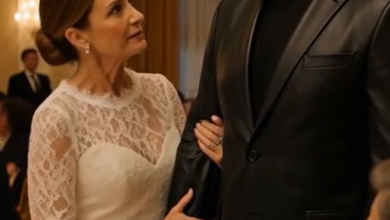
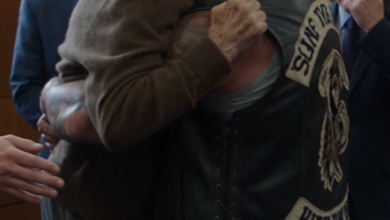
Part 2: A Tattooed Biker Pulled the Groom Out Minutes Before His Wedding Vows—But He Was the Foster Father Who Knew Why the Young Man Couldn’t Breathe
Part 2 — The Boy Who Slept Beside the Garage Door
I did not learn Ray’s history with Jonah until after the wedding.
That was partly Jonah’s fault.
He had told Emily pieces, but he never assembled them into a story. He described Ray as the mechanic who gave him his first job, the man who taught him to change brake pads, and the old biker who came whenever his truck refused to start.
He never used the words foster father.
Jonah entered Kentucky’s foster system at twelve after his mother died from an untreated infection and his biological father, Carlton Pierce, was arrested during a violent drunken episode.
The first placement lasted three months.
The second lasted eleven days.
Jonah ran from the third before the social worker finished unpacking his clothes.
He learned quickly that adults liked promises more than they liked frightened children. Families called him quiet until his silence became inconvenient. They called him independent until he stopped trusting them. Then they called him difficult.
At thirteen, he slept behind Dawson Iron Works for two nights.
Ray found him curled beneath a discarded motorcycle cover beside the garage’s rear door. It was February. Ice covered the gutters, and Jonah had wrapped shop rags around his shoes because his socks were wet.
Ray did not ask where he came from.
He opened the back door.
“Coffee’s bad,” he said. “Cocoa’s worse.”
Jonah stared at him.
“Food?”
The boy nodded.
Ray heated canned soup on a hot plate, called child services, and sat across the garage without blocking the exit. When a caseworker arrived, Jonah climbed beneath Ray’s workbench and refused to come out.
Ray waited.
After an hour, he lay flat on the concrete and looked beneath the bench.
“You stay there, you’ll smell like gear oil.”
Jonah said nothing.
“Could improve you.”
The boy almost smiled.
Ray became an emergency foster placement because there were no available beds nearby and because the caseworker, Denise Hall, knew him through a veterans’ youth program.
Licensing him permanently took months.
His past did not look promising on paper.
Ray had served time for aggravated assault at twenty-four after nearly killing a man during a bar fight. He had spent years drinking, riding from state to state, and treating every authority figure like an enemy.
The conviction was old. His sobriety was not.
Denise asked why anyone should trust him with a traumatized child.
Ray answered, “You shouldn’t. Check everything.”
So she did.
She interviewed employers, neighbors, club members, probation officers, and the elderly couple whose roof Ray repaired without payment. She inspected his home and found only one bedroom.
Ray slept on the couch for five years.
Jonah took the room.
The placement was supposed to last three weeks. Carlton refused to surrender parental rights, and reunification remained the official goal long after everyone stopped believing it was safe.
Ray never promised adoption.
He promised breakfast.
He promised rides to appointments.
He promised that the garage’s back light would remain on if Jonah ran.
The boy tested every promise.
Three months into the placement, Jonah broke Ray’s bathroom mirror during a panic attack. He packed his clothes before Ray returned from work, certain damage meant removal.
Ray entered the house, looked at the broken glass, and gave him a broom.
“Shoes first.”
Jonah waited for the shouting.
It never came.
“Am I leaving?”
Ray swept the larger shards.
“School starts at eight.”
“That isn’t what I asked.”
“Door’s there if you need air. Bed’s there when you come back.”
Jonah stayed.
At fourteen, he stole twenty dollars. At fifteen, he failed two classes. At sixteen, he disappeared after receiving a birthday card from Carlton.
Ray found him behind an abandoned gas station on U.S. Route 31W.
Jonah was shaking so badly he could not stand.
Ray sat beside him.
He taught the boy to name what he saw, heard, and felt. A therapist later gave the grounding exercise proper language, but Ray’s version remained simpler.
“Find the ground before you choose a road.”
Panic attacks followed Jonah into adulthood.
They became less frequent, not nonexistent. He learned to recognize them, speak honestly, attend therapy, and ask for space before fear became flight.
Then he met Emily.
She worked in the office of an auto-parts distributor that supplied Dawson Iron Works. Their first date lasted twenty-three minutes because Jonah became overwhelmed in a crowded restaurant and left without explanation.
Emily found him outside.
She did not demand an apology.
She sat on the curb and asked whether he wanted company.
Two years later, Jonah proposed behind the garage’s back door.
Ray watched through an oil-streaked window.
He did not interrupt.
Yet as the wedding approached, Jonah’s old fear returned. He did not doubt Emily. He doubted himself.
Carlton’s voice still lived inside him:
Men like us leave.
We ruin decent women.
Nobody keeps us once they know us.
Jonah told no one how loud that voice had become.
Not Emily.
Not his therapist.
Not even Ray.
But Ray saw the signs: the sleeplessness, the unfinished meals, the way Jonah checked every exit in the chapel.
The foster father did not sit beside the side door because he expected Jonah to run.
He sat there so the boy would know someone could follow without chasing.
Part 3 — The Voicemail in the Utility Room
Carlton Pierce had not been invited to the wedding.
Jonah mailed an invitation anyway.
He sent it to a halfway house in Tennessee where Carlton was believed to be living after another prison sentence. The envelope returned three weeks later marked undeliverable.
Jonah told Emily he was relieved.
That was not entirely true.
On the wedding morning, Carlton called.
Jonah was dressing in the chapel’s small groomsmen’s room when his phone vibrated. The number was blocked. He almost ignored it.
Then he answered.
Carlton’s voice had aged, but Jonah recognized the uneven rhythm immediately.
“Big day,” his biological father said.
Jonah stepped into the utility room and closed the door.
“How did you get this number?”
“Family keeps track.”
“You’re not my family.”
Carlton laughed.
“Then why send the invitation?”
Jonah could not answer.
Carlton had seen an online wedding announcement. He knew Emily’s name, the venue, and the ceremony time.
He also knew where to strike.
“You think a suit makes you different?”
Jonah ended the call.
A voicemail arrived seconds later.
He listened.
Carlton said marriage was a trap for men who pretended they could stay. He said Jonah would eventually frighten Emily, disappoint her, and leave a child waiting beside a window.
Then he offered one final instruction.
“Walk out now. It’s the kindest thing you’ll ever do for her.”
Jonah’s body reacted before his mind did.
His hearing narrowed. His hands went numb. The room tilted, and the collar of his white shirt felt like a cable tightening around his throat.
He removed his bow tie.
He tried the door.
Could not move.
That was where Ray found him.
Ray had noticed Jonah disappear from the groomsmen’s room. He waited sixty seconds before following, knocked twice, then entered when he heard something fall.
The groom was sitting against the wall beside a mop bucket.
His phone remained on the floor, replaying Carlton’s message.
Ray listened once.
Then he deleted it.
Jonah lunged for the phone.
“Why did you do that?”
“Already heard it.”
“I needed it.”
“No.”
“It proves he’s right.”
Ray crouched.
“Proves he owns a phone.”
Jonah tried to stand and failed.
“I’m going to hurt her.”
“You planning to?”
“No.”
“Then that’s fear talking.”
“My mother believed she could change him.”
“You ain’t Carlton.”
“What if I am?”
Ray’s voice sharpened.
“Then prove it by choosing. He never did.”
That was when I entered.
I heard only the end. I saw my sister’s groom on the floor and a tattooed biker telling him he might leave.
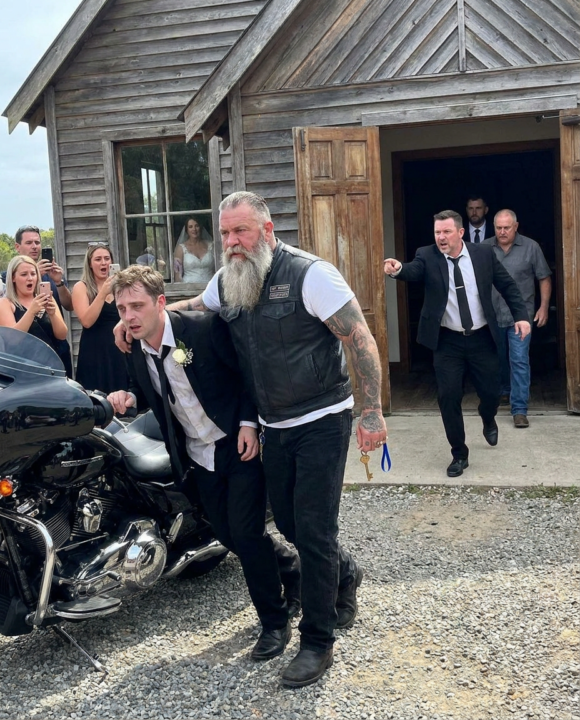
When Ray led Jonah outside, I believed he was removing him from the wedding.
So did Robert.
The confrontation in the parking lot escalated quickly.
Robert demanded Jonah return inside. The groomsmen surrounded Ray. Our wedding coordinator called venue security, and my uncle began filming while loudly announcing that the biker had manipulated the groom.
Six Iron Lanterns were parked near the reception barn. They saw Ray surrounded and moved toward him.
Tiny Ruiz reached the lot first.
“What’s the trouble?”
Robert pointed at Ray. “Your friend is helping this man abandon my daughter.”
Tiny looked at Jonah.
The groom sat hunched on the stone wall, elbows against his knees, breathing too fast.
Tiny understood.
He turned toward the club.
“Back up.”
One younger rider objected. “They’re crowding Hammer.”
“Back up.”
The Lanterns obeyed.
Ray did not need a wall of bikers.
Jonah needed fewer eyes.
Tiny asked guests to return inside. Most refused. Phones remained raised. Robert continued demanding explanations.
Ray finally turned on him.
“Sir, your daughter deserves a man who says yes because he means it.”
“She deserves not to be humiliated.”
“Agreed.”
“Then bring him inside.”
“No.”
Robert’s face darkened.
Ray added, “Not until he can choose her without running from himself.”
The words angered me.
“They are the same choice today.”
“No, ma’am.”
“Yes, they are.”
Ray pointed toward the chapel.
“If he walks through that door only because a hundred people will judge him for leaving, that ain’t a vow. That’s a hostage note.”
Nobody answered.
Jonah looked at the motorcycle key lying on the gravel.
Then at the blue-ribboned chapel key in Ray’s hand.
“One leaves,” Ray reminded him. “One returns.”
Jonah’s breathing slowed enough for him to speak.
“I don’t deserve her.”
Ray sat beside him.
“Probably not.”
Robert made an angry sound.
Ray ignored him.
“She don’t deserve you either.”
Jonah looked confused.
“Love ain’t wages,” Ray said. “Nobody earns another person by being clean enough.”
“What if I become him?”
“Then you get help before you hurt people.”
“What if I fail?”
“You repair.”
“What if she leaves?”
“You let her choose.”
Jonah’s eyes filled, but no tears fell.
“What if I leave?”
Ray looked down at the word tattooed across his fingers.
STAY.
“Then I find you,” he said. “Same as always.”
Jonah picked up the motorcycle key.
Robert closed his eyes.
I felt something collapse inside me.
The groom stood.
He walked toward Ray’s Road King.
Then he opened the motorcycle’s right saddlebag, placed the key inside, and shut it.
He returned to the stone wall.
Ray held up the chapel key.
Jonah did not take it.
“Not yet,” he said.
Ray nodded.
For the first time that morning, the groom had made a decision that did not belong to panic.
The ceremony would wait.
Then Emily stepped into the parking lot.
Part 4 — The Key Emily Gave the Biker
Emily did not look at the guests.
She did not look at our father.
She looked at Ray.
“Did he hear from Carlton?”
Ray’s eyebrows lifted.
“You knew he might?”
“He checked the mailbox every day after sending the invitation.”
Jonah raised his head.
“You knew?”
Emily nodded.
“Why didn’t you say anything?”
“Because you told me you were relieved. I wanted to believe you.”
“That was stupid.”
“No.” She took one step closer. “It was human.”
Ray moved between them.
I thought he was blocking the bride from her groom.
He was protecting Jonah’s choice.
“Emily,” he said, “you agreed not to come close until he asked.”
Our father exploded.
“You arranged this?”
Emily turned toward him.
“Yesterday.”
The blue-ribboned chapel key belonged to the kitchen entrance behind the altar. Emily had given it to Ray during the rehearsal dinner.
She had noticed Jonah counting doors.
She had watched him stand at the rear of the chapel after everyone left and test the emergency exit twice. When she asked what was wrong, he said he wanted to know the building’s layout.
Emily knew better.
She found Ray beside his Harley.
“If he panics tomorrow, don’t let anyone force him down the aisle.”
Ray studied her.
“Including you?”
“Especially me.”
“What do you want me to do?”
“Help him decide.”
“Which way?”
“His way.”
She gave him the two keys: the motorcycle key for leaving and the chapel’s back-door key for returning.
Around the chapel key, she tied blue ribbon from her bouquet and folded a note through the ring.
Ray now handed that note to Jonah.
The groom unfolded it.
Emily’s handwriting read:
COME BACK ONLY IF YOU CHOOSE ME. IF YOU NEED TO LEAVE, LET RAY TAKE YOU SOMEWHERE SAFE. I WOULD RATHER LOSE A WEDDING THAN LOSE YOUR TRUST.
Jonah read it twice.
His knees weakened.
Ray caught his elbow.
The crowd’s misunderstanding finally broke.
The biker had not prepared an escape against the bride’s wishes.
The bride had entrusted him with both exits.
Jonah looked at Emily.
“Why would you marry someone you had to plan an escape route for?”
Emily’s answer came gently.
“I wasn’t planning an escape route for you.”
She touched the blue ribbon.
“I was leaving you a way back.”
Jonah closed his eyes.
He asked everyone except Emily and Ray to go inside.
Our father resisted. I took his arm.
For once, I understood what the biker had been asking of us.
Fewer eyes.
Less noise.
Room for truth.
We returned to the sanctuary. Guests whispered while the organist repeated the same quiet piece. The wedding coordinator wanted to announce a delay, but Emily had left her phone with me.
A message appeared.
Thirty minutes. Keep the front doors closed.
Outside, Jonah told Emily about Carlton’s call.
He admitted he had been hiding the return of his panic attacks. He described waking at night convinced he would become violent, unreliable, or cruel simply because those qualities existed in the man whose blood he carried.
Emily listened.
She did not promise that love would cure him.
She did not say he could never hurt her.
She told him marriage required honesty before certainty.
“I don’t need you fearless,” she said. “I need you to tell me when fear is driving.”
Jonah looked at Ray.
“You taught her that?”
“No.”
Emily almost smiled. “I’m capable of original thoughts.”
Ray stepped away, but Jonah stopped him.
“Did you ever think you’d become your father?”
Ray’s face changed.
His own father had disappeared before he turned ten. For years, Ray believed abandonment lived in blood too. Prison, alcohol, and violence seemed to confirm it.
Then a frightened boy slept behind his garage.
“Every day,” Ray said.
“What stopped you?”
“Nothing.”
Jonah waited.
Ray tapped one scarred finger against his chest.
“I choose against him every day.”
That was the difference.
Not purity.
Not certainty.
Repetition.
Jonah asked Emily whether she still wanted to marry him after hearing everything.
She said yes.
Then she asked him the same question.
He looked toward the front doors, where a hundred guests waited. His breathing tightened again.
“I can’t walk in there.”
Ray raised the chapel key.
“Good thing doors come in pairs.”
They went around the building.
The kitchen entrance opened behind the altar. Caterers stepped aside as the biker entered first, followed by the groom and the bride.
From inside the sanctuary, nobody saw them return.
We heard only the back latch turn.
Then Ray appeared beside the officiant.
He was still wearing his leather cut.
His boots left faint gravel marks across the polished floor.
Jonah entered behind him.
Emily followed.
The entire chapel turned.
Ray did not escort the groom away from his wedding.
He walked his son back to it.
Part 5 — The Vow That Began With the Truth
The ceremony did not resume immediately.
Jonah stood before the guests with his bow tie in one hand and the chapel key in the other. His shirt remained untucked at one side. His face was blotched from panic, and his wedding photographs would never look perfectly arranged.
Emily stood beside him.
Ray remained several steps behind.
Jonah asked the officiant for the microphone.
“I owe everyone an explanation,” he said.
Ray shook his head.
“No.”
The microphone picked it up.
A nervous laugh moved through the chapel.
Jonah looked back at him.
“Don’t I?”
“You owe her truth. Crowd bought seats to witness it, not own it.”
The officiant gently lowered the microphone.
Jonah turned toward Emily instead.
He spoke only to her.
“I almost left because I thought leaving before I hurt you would make me better than my father.”
Emily held his hand.
“It wouldn’t.”
“No.”
“What changed?”
Jonah glanced at the two keys.
“I realized he always called running kindness because it sounded better than fear.”
The chapel remained quiet.
Jonah told Emily that he could not promise never to panic again. He could not promise every old instinct would disappear after vows. What he could promise was to tell her when the exits began looking easier than the conversation.
Emily answered with her own promise.
“If you need a door, I’ll help you find one. But I won’t decide whether you walk through it.”
Those became their actual vows.
Not the polished sentences printed in the ceremony booklet.
The officiant closed the booklet.
Ray stood behind Jonah with both hands folded across his leather vest. He looked more uncomfortable than he had while surrounded by angry groomsmen.
When the officiant asked who presented Jonah in marriage, everyone hesitated. That question had not been included in rehearsal.
Jonah turned.
He held out the chapel key.
Ray stared at it.
“Come here, Dad.”
The word crossed the sanctuary softly.
It still reached every pew.
Ray did not move.
Jonah had lived with him five years, worked beside him eleven, and called him for every breakdown, job loss, rent problem, and night when old fear returned.
He had never called him Dad in public.
Ray’s chain wallet clicked as he finally stepped forward.
Jonah placed the blue-ribboned key inside his scarred hand.
“Who brings this man to this marriage?” the officiant asked.
Ray looked at Emily.
Then at Jonah.
“He does.”
The officiant smiled. “Would you like to add anything?”
“No.”
Tiny Ruiz cleared his throat from the last pew.
Ray frowned.
Then he added three words.
“I walked beside.”
That was enough.
Jonah and Emily exchanged rings at 3:47 p.m., thirty-eight minutes later than planned. Guests applauded, but the loudest sound came from the Iron Lanterns striking one fist against their leather vests.
At the reception, our father approached Ray near the barn doors.
Robert was not a man who apologized easily.
“I thought you were taking him away.”
Ray drank from a bottle of water.
“I was.”
Robert stared.
“If that’s what he chose.”
“You would’ve let him abandon Emily?”
“Would’ve taken him somewhere safe. Then brought him back to face what he did.”
“That isn’t comforting.”
“Wasn’t meant to be.”
Robert looked toward the dance floor, where Jonah and Emily moved slowly beneath strings of lights.
“You protected him from us.”
Ray shook his head.
“Protected his decision from noise.”
Our father extended his hand.
Ray looked at it before accepting.
Robert’s hand nearly disappeared inside his.
I apologized next.
Ray shrugged.
“You were guarding your sister.”
“I called you a kidnapper.”
“Been called worse.”
“You could’ve explained.”
He looked toward the guests who had raised phones rather than lowered their voices.
“Explanations don’t help a man breathe.”
The videos from the parking lot were deleted at Emily’s request. Most guests complied. One cousin had already uploaded a ten-second clip showing Ray gripping Jonah’s arm and leading him out.
By evening, strangers online were calling the biker a wedding crasher.
Jonah wanted to respond.
Ray refused.
“People got half a picture,” he said.
“Then let me give them the other half.”
“Your panic ain’t public property.”
That ended it.
The wedding remained imperfect and private.
Near the end of the reception, Jonah handed Ray a manila envelope.
Ray opened it.
Inside was a completed petition for adult adoption.
Kentucky law allowed one adult to adopt another with consent. Jonah had prepared the paperwork months earlier but hesitated to present it.
The wedding changed that.
On the first page, beneath the section asking why the adoption served the relationship, Jonah had written:
HE WAS MY FATHER BEFORE THE LAW LEARNED HIS NAME.
Ray read the line.
Then he returned the papers.
Jonah’s face fell.
“You don’t want it?”
“Need one correction.”
“What?”
Ray tapped the word was.
“Am.”
Part 6 — The Light Over the Back Door
The adoption hearing took place four months later.
Ray wore a dark suit borrowed from Tiny, but he kept his motorcycle boots. Jonah wore the same blue tie from his wedding.
Emily carried the chapel key.
The judge reviewed their history and asked Ray whether he understood that adult adoption created a permanent legal parent-child relationship.
Ray glanced at Jonah.
“Permanent’s the part we’re here for.”
The judge approved the petition.
Jonah Pierce became Jonah Dawson-Pierce.
Ray did not cry in the courtroom. He signed the documents, shook the judge’s hand, and complained that the courthouse parking meter had stolen two dollars.
Outside, Jonah handed him a folded card.
It contained a new key.
“What’s this?”
“Our house.”
Ray frowned. “You live forty miles away.”
“Keys work over distance.”
Emily had installed a blue ribbon through it.
The same color as the chapel key.
Ray added it to the ring inside his leather vest.
From then on, the back door became part of the family’s language.
When Jonah and Emily argued, they did not threaten to leave forever. One of them would say, “I need the back door,” meaning space without disappearance.
They used it rarely.
They honored it every time.
Ray kept the rear light at Dawson Iron Works burning after sunset, just as he had when Jonah was thirteen. The old garage door had been replaced, but Ray refused to remove the dented brass lock.
Above it hung a wedding photograph.
The picture did not show vows, rings, or the first kiss.
It showed Ray opening the kitchen entrance while Jonah and Emily stood behind him. The biker’s leather vest filled half the frame. Gravel covered his boots, the groom’s shirt was untucked, and the bride held her dress above the mud.
Nobody looked polished.
Everyone had returned.
When customers asked about the photograph, Ray gave the same answer.
“Wrong door. Right wedding.”
Part 7 — The Man Waiting Outside
Three years later, Jonah experienced another severe panic attack.
It happened at two in the morning after Emily told him she was pregnant.
Joy reached him first.
Fear followed.
He left the bedroom, walked downstairs, and stood beside the back door with one hand on the lock. Carlton’s old voice returned with every possibility: failed father, frightened child, slammed doors, inherited damage.
Jonah did not leave.
He called Ray.
The biker arrived twenty-six minutes later on his Road King, the V-twin rumble rolling through the sleeping neighborhood before cutting into silence.
Ray did not knock.
He sat on the back steps.
Jonah opened the door and joined him.
They remained there until sunrise.
No speech.
No rescue performance.
Just cold coffee, leather creaking in the early wind, and two men choosing against fathers who had taught them disappearance.
When Jonah’s daughter was born, he named her Clara Ray Dawson-Pierce.
Ray objected to the middle name.
Emily ignored him.
At the hospital, Jonah placed the baby in Ray’s massive arms. The newborn disappeared against the black leather vest, one tiny hand closing around the tattooed finger marked STAY.
Ray looked terrified.
Jonah smiled.
“Need air?”
“Shut up.”
“The back door’s down the hall.”
Ray adjusted the blanket.
“Ain’t leaving.”
Years have passed since the wedding, but I still remember the moment he led Jonah from the chapel. At the time, I saw an intimidating stranger pulling a groom away from my sister.
I did not see the father who knew panic could disguise itself as certainty.
I did not see the man carrying both keys.
The old chapel still stands beside U.S. Route 31W. Couples enter through the front beneath polished flowers and rehearsed music.
Behind the altar is a smaller kitchen door with scratched paint and an ordinary brass lock.
Jonah and Emily visit every anniversary.
They bring coffee for Ray, stand beside that back entrance, and take one photograph.
In every picture, Ray holds the door.
Follow our page for more powerful biker stories about misunderstood fathers, quiet rescues, and the fierce men who help lost people find their way home.