A Six-Year-Old Girl Made 28 Bikers Kneel in Her Schoolyard — Then Her Deaf Father Saw What Their Scarred Hands Were Trying to Say
Part 2 — The Child Who Counted Thursday Headlights
I taught first grade at Cedar Ridge Elementary for twelve years, but Maisie Cole was the first student who corrected my hands before telling me her last name.
On the first morning of school, I introduced myself and attempted to sign WELCOME. I had learned the gesture from an online video the previous night because the enrollment file said Maisie’s father was deaf.
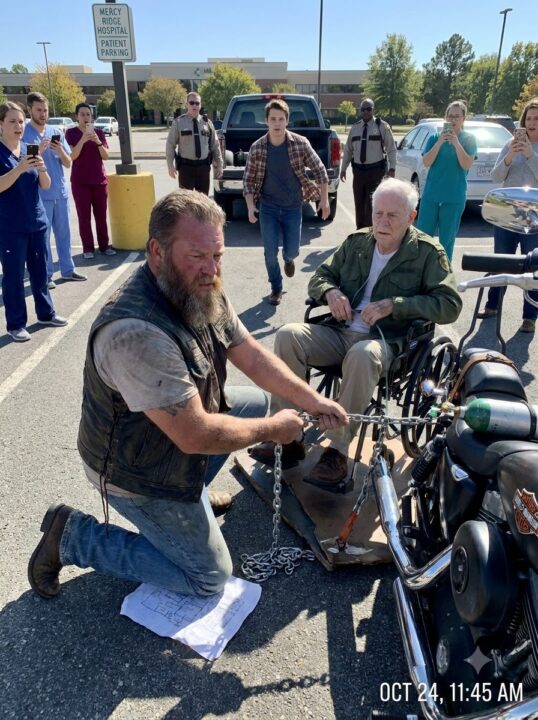
Maisie watched me, tilted her head, and adjusted the angle of my palms.
“Now it means welcome,” she said. “Before, it was just flapping.”
That was Maisie.
She was polite when politeness did not interfere with accuracy.
Jonah arrived twenty minutes later, leaning on a black cane. He was thirty-eight, lean, broad through the shoulders, with short dark hair and pale burn scars reaching from behind his right ear to the collar of his work shirt.
His hearing aids helped with some lower sounds, but speech reached him as broken shapes. He preferred people to face him, speak normally, and avoid shouting.
“Loud doesn’t make lips clearer,” he told our receptionist.
The receptionist stopped shouting.
Jonah worked from his garage repairing lawn equipment, generators, and small engines. Before the accident, he had been the lead fabricator at Dawson Custom Cycles, Hammer’s motorcycle shop near Route 13.
He never mentioned that job.
Maisie did.
“My daddy made motorcycles stop shaking wrong,” she told the class during career week.
“Does he still?” a boy asked.
“No. Motorcycles forgot him.”
I wrote that sentence down because children sometimes say the truth before understanding its weight.
Thursday afternoons became a pattern. At exactly seven, Maisie would glance toward the road whenever an engine passed. If the sound was deep enough to rattle our classroom windows, she counted it on her fingers.
One.
Two.
Three.
She never explained.
In November, she drew a picture of twenty-eight motorcycles parked outside a red garage. In the center stood a man labeled DAD, although the figure wore a black vest and had no hearing aids.
I asked who the other riders were.
“My dad’s brothers.”
“Do they visit?”
She shook her head.
“Why not?”
“Daddy says grown-up reasons.”
That usually means grief, shame, money, or pride. Sometimes all four.
The first purple card appeared in April. Maisie brought it to the reading table with a club photograph she had found beneath Jonah’s workbench.
The picture showed thirty men outside Dawson Custom Cycles. Hammer stood in the center, younger but unmistakable. Beside him was Jonah, smiling beneath a patch that read SILENT JACK.
The name had once been a joke.
Jonah was the quietest rider in the club long before the explosion made silence permanent.
Two men in the photograph had since died. Twenty-eight remained.
Maisie had counted.
On the back were their road names and several addresses. She wanted to invite them to the Father’s Day breakfast.
I told her invitations had to go through parents.
“Daddy will say no.”
“He may have a reason.”
“He watches for them every Thursday.”
That stopped me.
Maisie explained how Jonah sat beside the garage window during club night. He pretended to organize invoices, but he always positioned his chair where he could see Route 13.
Sometimes motorcycles passed.
They never turned in.
She believed the bikers had forgotten where he lived. Six-year-olds prefer practical explanations because practical problems can be solved with crayons, envelopes, and stamps.
I should have called Jonah.
Instead, I asked our family liaison, Denise Harper, whether she knew the Iron Lanterns. Denise’s brother had served with two members in Iraq. She offered to forward one supervised invitation to their club president.
Maisie refused to write an invitation.
She wrote an accusation.
YOU FORGOT MY DAD.
Below it, in smaller letters:
COME FRIDAY. I WILL TEACH YOU WHAT TO SAY.
Denise copied the card and mailed it to Hammer.
We expected a phone call.
None came.
What we did not know was that Hammer carried the card to the Iron Lanterns’ Thursday meeting and placed it in the center of their table.
Twenty-seven men stared at five purple words.
Preacher, the club president, finally said, “She ain’t wrong.”
Hammer folded the card once.
“We go.”
A younger rider named Colt asked whether Jonah wanted them there.
Hammer looked at the child’s uneven handwriting.
“No.”
“Then we shouldn’t.”
For three years, that logic had protected them from Jonah’s anger and protected Hammer from his guilt.
It had also left a six-year-old counting headlights.
The club voted.
Fifteen supported going. Eight believed arriving without Jonah’s permission would reopen the wound. Four abstained. Hammer listened, took off his president emeritus patch, and placed it on the table.
“Not asking for a club ride,” he said. “Asking who remembers him.”
All twenty-seven men stood.
Brotherhood had passed the easy test years earlier when they waited outside Jonah’s hospital room. Now it faced the harder one.
They had to walk back into the life of a man who might not forgive them.
Part 3 — The Morning the School Reached for Lockdown
The bikers planned to arrive quietly.
That was their first mistake.
Twenty-eight Harley-Davidsons cannot enter an elementary-school parking lot quietly, even when every rider keeps the throttle low. The sound reached the playground before the motorcycles turned into the bus lane.
Their second mistake was arriving in full leather cuts.
Hammer had suggested plain clothes, but Preacher refused.
“If we apologize,” he said, “we don’t dress like somebody else.”
The third mistake was the gray-covered motorcycle loaded onto a trailer behind Hammer’s pickup. From the school office, it resembled an unidentified machine surrounded by men wearing skull patches.
By 8:42 a.m., three parents had called 911.
Our assistant principal, Mark Ellison, ordered a soft lockdown. Classroom doors closed. Exterior access points were secured. Children remained inside, away from the windows.
Maisie was already outside.
Denise had escorted her to meet what she believed would be five club representatives. When twenty-eight motorcycles arrived, Denise froze long enough for Maisie to run toward Hammer.
I followed.
Hammer looked down at her yellow cardigan.
“You sent the card?”
“Yes.”
“Mean little thing.”
“You came.”
“Fair point.”
Maisie unfolded a sheet of paper covered with hand diagrams. She had drawn three stages: thumb out, middle fingers folded, little finger up.
“I have twenty minutes,” she announced.
A biker called Mutt glanced at the school clock. “For what?”
“Practice.”
The men laughed.
Maisie did not.
“Daddy reads hands fast,” she warned them. “If you’re wrong, he’ll know.”
That ended the laughter.
She placed Hammer in front because he was largest. When he tried the sign, scar tissue locked his right little finger against his palm.
“What happened?” she asked.
“Shop fire.”
“The one with Daddy?”
Hammer nodded.
Maisie inspected the hand without fear. The blast had severed two tendons and driven metal into his wrist. Surgery restored his grip, but not full extension.
“You can use the other hand,” she said.
“Left shakes.”
“Why?”
Hammer glanced at Preacher.
“Nerves.”
The tremor had started after the explosion and worsened whenever Hammer smelled burned gasoline. He hid it by keeping his left hand on a handlebar, inside a pocket, or wrapped around coffee.
Maisie considered both hands.
Then she pressed Hammer’s damaged right fist against the center of his chest.
“Do this after everyone signs.”
“What’s it mean?”
“It means you mean it.”
No textbook had taught her that.
The bikers knelt so she could reach their hands. That was the moment Mark came running with his radio, followed by our campus security officer.
“Stand up,” Mark ordered.
No one moved.
The image was wrong from every angle: twenty-eight rough men surrounding a little girl, school doors locked behind them, a concealed motorcycle on a trailer, and Hammer kneeling close enough for Maisie to hold his scarred wrist.
Mark repeated the order.
Hammer rose slowly.
“You need to leave school property.”
“After she finishes.”
“She is a minor.”
“She invited us.”
“She cannot authorize twenty-eight adults to enter a school campus.”
Preacher stepped forward. “He’s right, Hammer.”
The club shifted uneasily.
Some men had criminal records from younger years. Two were veterans uncomfortable around uniformed security. One rider, Boone, had spent eighteen months in prison after an assault outside a bar. None wanted a confrontation beside children.
Mutt turned toward his motorcycle.
Maisie saw him.
“You promised.”
He stopped.
That child’s voice held more authority than Mark’s radio.
Hammer removed his sunglasses and faced the administrator. “We’ll move across the street. No argument. But the girl comes only if a teacher brings her.”
It was a reasonable compromise.
Before we could act on it, police vehicles turned into the lot.
Three officers stepped out.
Hands stayed near their belts.
The bikers spread their fingers away from their bodies. Hammer ordered everyone to remain still. His voice was quiet, but twenty-seven men obeyed.
Then Jonah appeared at the side entrance.
He saw the police first.
Then the motorcycles.
Then Maisie.
Fear crossed his face before anger replaced it.
Jonah pushed himself out of the wheelchair, caught the railing, and stood with his cane. The counselor tried to help. He waved her away.
He walked toward us.
Every step hurt.
Hammer took one step forward.
Jonah raised his palm.
Stop.
Hammer stopped.
Jonah signed sharply.
WHY ARE POLICE HERE? WHAT DID YOU DO?
Hammer looked at Maisie.
The child signed back.
I INVITED THEM.
Jonah’s eyes moved from his daughter to the kneeling bikers.
WHY?
BECAUSE THEY FORGOT YOU.
The schoolyard went still.
Jonah’s expression tightened. He turned toward Hammer and signed too fast for the biker to follow.
Maisie translated aloud.
“He says you don’t get to come after three years and make this about you.”
Hammer absorbed the words.
“Tell him he’s right.”
Maisie signed.
Jonah answered.
“He says take your motorcycles and go.”
Several bikers looked down.
Mutt started walking away again. Boone removed his sunglasses and wiped them though they were clean. Preacher stared at the faded pavement between his boots.
Hammer did not move.
He reached inside his leather cut.
The campus officer tensed.
Hammer slowly removed Jonah’s old SILENT JACK patch.
It was cracked at the edges and darkened by rain. Twenty-eight signatures had been stitched across the back in white thread.
Jonah stared.
Hammer placed the patch on the pavement between them.
“We didn’t forget,” he said carefully so Jonah could read his lips. “We failed.”
Jonah looked at the patch but did not pick it up.
Then Hammer signed the only sentence he had practiced well enough to risk.
YOUR DAUGHTER IS BRAVER THAN US.
Jonah’s cane slipped.
I caught his elbow.
For one second, he leaned against me. His body trembled, although his face remained hard.
Maisie stepped closer.
“Can they show you now?”
Jonah shook his head.
“No.”
The child’s mouth opened, but Hammer interrupted.
“Leave him be.”
He ordered the Iron Lanterns back to their motorcycles.
The men rose.
The surprise appeared over.
Then Jonah noticed the gray-covered motorcycle.
A familiar front wheel protruded beneath the canvas.
He crossed the yard before anyone could stop him and pulled the cover away.
Underneath stood the black-and-cream Harley he believed had been destroyed in the explosion.
Its fuel tank carried a new emblem.
Two hands forming an imperfect sign for love.
Part 4 — What Happened Inside Dawson Custom Cycles
The motorcycle should not have survived.
Three years earlier, Jonah had been working late inside Dawson Custom Cycles when he smelled gasoline beneath a touring bike. Hammer had already closed the front office and gone into the paint room.
Jonah traced the leak to a damaged line. Before he could disconnect the shop battery, a compressor relay sparked.
Gasoline vapor ignited.
The first blast threw Jonah against a tool cabinet. The second shattered the shop windows and dropped part of the ceiling near the paint room.
Hammer was trapped beneath a steel shelf.
Jonah could still hear then.
He heard Hammer shouting his name.
Smoke filled the shop. Flames climbed the insulation above the doorway. Jonah crawled beneath the shelf, lifted enough weight to pull Hammer free, and dragged him toward the rear exit.
A burning beam fell behind them.
The pressure wave ruptured both of Jonah’s eardrums and fractured the bones around his right ear. He remembered the sound as a metal door slamming inside his head.
Then silence.
Hammer woke outside with Jonah lying across his legs. Jonah’s neck was burned. His hip was broken. Blood ran from both ears.
Hammer’s first clear memory was Jonah touching his throat and asking why he could not hear his own voice.
At Mercy Ridge Hospital, doctors performed two surgeries. They saved a small amount of hearing in Jonah’s left ear, but the damage was permanent.
The Iron Lanterns filled the waiting room.
They brought coffee, food, phone chargers, and a helmet for Maisie to decorate while she waited. Her mother, Rachel, had died from a brain aneurysm eighteen months before the fire, leaving Jonah as the only parent of a three-year-old girl.
Hammer blamed himself.
The leaking motorcycle belonged to his shop. The faulty compressor relay had been scheduled for replacement. Hammer had postponed the repair because business was slow.
He told no one that detail except Preacher.
On Jonah’s second day after surgery, Hammer carried Jonah’s leather cut into the hospital room. Smoke had scorched one shoulder. Blood marked the collar.
Jonah was asleep.
A nurse asked Hammer to remove it because the smell of burned leather triggered Jonah’s panic whenever he woke.
Hammer took it away.
When Jonah later asked where it was, Preacher wrote, SAFE WITH US.
Jonah read only the first word.
SAFE.
Not his.
The misunderstanding grew from there.
Hammer tried to visit, but every hospital corridor smelled like antiseptic layered over smoke. His left hand shook. He vomited in a stairwell and left before reaching Jonah’s room.
The next week, he returned.
Jonah was learning signs with a rehabilitation specialist. Hammer stood outside the glass wall and watched him struggle to shape words with hands still bandaged from burns.
Shame stopped Hammer from entering.
Preacher visited instead. He brought insurance paperwork and documents transferring partial ownership of the shop to Jonah.
Jonah refused them.
He believed the money was pity.
Hammer believed the refusal meant hatred.
Both men chose silence because each considered it less painful than the wrong words.
The club attempted group visits, but Jonah found twenty men speaking at once impossible to lip-read. Their beards covered their mouths. They forgot to face him. One shouted as if volume could cross damaged nerves.
Jonah left the room.
After that, the Iron Lanterns reduced their visits to avoid exhausting him.
He interpreted the empty chairs as retreat.
When Jonah returned home, Hammer parked outside twice. Both times he saw Maisie sleeping against her father’s chest and could not force himself to knock.
He left groceries on the porch.
Jonah assumed they came from a church.
Mutt repaired the broken garage door at night.
Jonah thanked his neighbor.
Preacher paid the overdue property tax through an anonymous veterans’ fund, though Jonah had never served. The lie nearly exposed them, so Preacher changed the paperwork to an emergency tradesmen’s grant.
They helped from the shadows because it was easier than being forgiven.
Then Jonah sold his motorcycle.
Hammer bought it through an intermediary before the listing had been active for an hour.
The fire had damaged the electrical system and warped the frame, but the engine, wheels, fuel tank, and much of the front end remained salvageable. Hammer brought the pieces into the rebuilt shop after closing.
Every Thursday, while the club met in the front room, he worked alone behind a steel door.
He never said what he was building.
The men eventually understood.
One brought an original mirror. Another found a matching saddle. Boone machined a bracket for a vibration-based navigation unit. Preacher installed extra visual indicators and small lights connected to sensors that warned of vehicles approaching from behind.
They were not building a motorcycle for a deaf man because they believed deafness made riding impossible.
They were rebuilding the specific motorcycle Jonah believed the fire had taken.
Hammer refused to finish the fuel tank.
The old emblem had burned away, and every replacement design felt dishonest.
Then Maisie’s purple card arrived.
On the reverse side, she had drawn twenty-eight hands attempting the “I love you” sign.
Hammer carried the card into the paint room.
He finally knew what belonged on the tank.
The motorcycle beneath the gray cover was not perfect. One section of the original frame remained too twisted to reuse. The right saddlebag carried a permanent scorch mark. Hammer had preserved it.
Jonah walked around the Harley without touching it.
He noticed the warning lights.
The reinforced mirrors.
The vibration unit near the handlebar.
Then he found his hospital bracelet tied beside the clutch.
His name remained readable beneath smoke stains.
He turned toward Hammer.
“You kept this?” Jonah asked.
Hammer faced him directly.
“Kept everything.”
Jonah pointed at the motorcycle. “Why didn’t you bring it to me?”
Hammer lifted his trembling left hand.
“Coward.”
That was the first truth neither man could misread.
Part 5 — The Words Twenty-Eight Men Had Never Learned
Jonah did not forgive Hammer in the schoolyard.
Real forgiveness rarely arrives on cue, especially when twenty-eight motorcycles, three police cars, and an entire elementary school are watching.
He touched the fuel tank.
Then he stepped away.
Maisie looked devastated.
She had believed one correct hand sign could repair three years. Children assume adults remain broken only because no one has shown them the right instruction.
Jonah knelt carefully beside her.
He signed slowly.
YOU DID NOTHING WRONG.
“Then why aren’t you happy?”
I watched his face change.
Jonah could explain damaged nerves, fire, guilt, and pride to an adult. Explaining them to his daughter required smaller words.
“Sometimes,” he said, “people miss each other and stay angry because coming back feels harder than staying gone.”
Maisie pointed toward the bikers.
“They came back.”
Jonah looked at Hammer.
“Yes.”
“Then you have to do your part.”
Preacher covered his mouth to hide a smile.
Jonah saw him.
For the first time that morning, his anger loosened.
He asked Maisie what she had taught the men. She positioned him beside the uncovered Harley, then ordered the Iron Lanterns to return to their places.
The police remained, but their hands had moved away from their belts. Mark canceled the soft lockdown. Classroom doors opened, and children spilled onto the fenced edge of the playground.
Twenty-eight bikers formed a line.
Maisie stood before them.
“Ready?”
Twenty-seven men raised their right hands.
Hammer pressed his damaged fist against his chest.
Together, they signed:
I LOVE YOU.
Then they added a second sequence Maisie had kept secret.
DAD.
COME HOME.
Jonah’s face went still.
He looked at Maisie.
She nodded toward the line.
Mutt turned his palms upward.
Preacher signed BROTHER.
Boone signed SORRY.
Colt signed WE WAITED.
Some gestures were awkward. Several were wrong. One man accidentally signed something close to “beautiful chicken,” which Maisie corrected later.
Jonah understood them anyway.
The final biker was Hammer.
He could not form the standard sign. His right little finger remained locked, and his left hand shook too severely to hold the position.
He pressed his fist over Jonah’s patch inside his vest.
Then he signed with his limited right hand:
MY FAULT.
Jonah answered immediately.
NO.
Hammer repeated it.
MY SHOP. MY FAULT.
Jonah stepped closer.
He took Hammer’s scarred wrist and lowered it.
Then Jonah signed the words he had refused to express for three years.
I WAS ANGRY YOU LEFT.
Hammer’s jaw tightened.
I THOUGHT YOU HATED ME.
I THOUGHT YOU PITIED ME.
Hammer looked down.
Jonah tapped his chin, forcing him to look again.
YOU SHOULD HAVE ASKED.
Hammer nodded.
YOU TOO, he signed.
Jonah almost smiled.
Almost.
Then a child behind the fence shouted, “Is he getting his motorcycle back?”
Jonah could not hear the question, but Maisie translated.
He looked at the restored Harley.
“I can’t ride that today.”
Hammer nodded. “Wasn’t asking.”
“Why bring it?”
“So you’d know it still had a place.”
Jonah studied him.
“And if I never ride again?”
Hammer answered without signs because his lips were clear.
“Still yours.”
That mattered more than the motorcycle.
The club had not rebuilt it to drag Jonah back into the man he had been before the fire. They had rebuilt it so he could choose what happened next.
Choice was something the explosion had taken from him.
Maisie handed Jonah his old SILENT JACK patch. The signatures on the back belonged to every remaining Iron Lantern.
Beneath them, in purple thread, were five smaller words:
WE NEVER FORGOT YOUR ROAD HOME.
Jonah ran his thumb over the stitching.
“Who sewed this?”
Hammer pointed at Preacher.
Preacher shook his head and pointed toward the school office.
Denise stepped forward.
Maisie had dictated the words. Denise had sewn them the night before.
Jonah closed his hand around the patch.
Then he noticed two empty spaces among the signatures.
The deceased riders from the old photograph were not forgotten. Their road names had been stitched near the bottom: Cricket and Old Sam.
All thirty names remained together.
Jonah turned to Maisie and touched two fingers against her throat. She understood and said the words aloud so he could feel the vibration.
“I love you, Daddy.”
He closed his eyes.
For three years, Jonah had lived inside a world that reached him through movement: lips, fingers, floorboards, engines felt through concrete, and his daughter’s small voice beneath his fingertips.
Now twenty-eight pairs of scarred hands spoke into that world.
Jonah raised his own hand.
I LOVE YOU TOO.
The bikers remained still.
He added another sign.
BROTHERS.
Preacher turned away. Boone removed his sunglasses. Mutt pretended to inspect his boot.
Hammer simply nodded.
That was enough.
Part 6 — The First Ride Was Only Across the Parking Lot
Jonah did not ride home with the Iron Lanterns that Friday.
He made them wait six weeks.
First, he asked to see every modification. He inspected Hammer’s welds, rejected two mirror brackets, rewired one warning light, and moved the vibration unit because Hammer had mounted it where Jonah said “only an idiot with gorilla hands” would place it.
Hammer accepted the criticism.
Some friendships apologize through work.
Jonah began visiting Dawson Custom Cycles on Thursday afternoons. He entered through the rear door at first, avoiding the club meeting in front.
Maisie came with him.
She taught basic signs beside the parts counter. Twenty-eight bikers learned HELLO, STOP, HELP, RIDE, FAMILY, and COFFEE. Mutt remained hopeless at COFFEE and repeatedly signed something resembling PERFUME.
Maisie charged him one cookie per correction.
Within a month, the Iron Lanterns had installed bright shop lighting so Jonah could read lips. Men stopped speaking over one another. Bearded members learned to angle their faces toward him.
Preacher placed a whiteboard beside the meeting table.
No one treated the changes like charity.
They treated them like shop rules.
Hammer’s guilt took longer.
He and Jonah worked beside each other without discussing the postponed compressor repair. Then one Thursday, Jonah placed the old faulty relay on the workbench.
Hammer stared at it.
“I knew it was bad,” he said.
Jonah already knew. The insurance report had shown the maintenance delay.
“Why didn’t you tell me?”
“Couldn’t make what you lost smaller.”
“No.”
“Couldn’t look at Maisie.”
Jonah turned the relay between his fingers.
“You think disappearing helped her?”
Hammer shook his head.
Jonah placed the burned component in a metal bin.
“Then stop trying to suffer correctly.”
Hammer laughed once, rough and brief.
The first test ride happened in an empty church parking lot off Route 13. Jonah wore a full-face helmet with a visual alert system. Hammer rode ten yards behind him. Preacher waited near the exit.
Maisie stood beside me holding a cardboard sign.
ONE LAP, DADDY.
Jonah completed one.
Then two.
On the third, he stopped beside Maisie and lifted his visor.
She changed the sign.
ONE MORE.
The rebuilt Harley moved forward again.
No one cheered. The bikers understood that too much celebration could turn Jonah’s choice into a performance for them.
They simply raised their hands.
Twenty-eight imperfect signs followed him around the lot.
Part 7 — What the School Hears Every June
A year later, Cedar Ridge Elementary invited the Iron Lanterns back for Father’s Day.
This time, the office knew they were coming.
The motorcycles parked beyond the playground fence. Engines shut down together. Children waited near the basketball court with paper diagrams taped to their wrists.
Maisie was seven now.
She stood on a wooden step so she could see the bikers’ hands. Hammer knelt anyway.
His injured fingers had not improved, but his sign had become recognizable. He raised the damaged hand as far as it would go, then pressed it against his chest.
Jonah stood beside him wearing his SILENT JACK patch on a new leather cut.
He still used a cane. He still missed spoken words. Some days the ringing inside his head forced him into the garage alone.
None of that disappeared.
But Thursday headlights now turned into his driveway.
The club’s newest rider was a deaf Army veteran named Luis Moreno. Jonah had taught him to use the motorcycle’s visual warning system. Luis taught the Iron Lanterns several signs Maisie considered too rude for school.
At 9:14, the principal asked everyone to face the first-grade windows.
Children filled the glass.
Maisie raised one finger.
Twenty-nine bikers knelt.
Jonah remained standing until she pointed at him.
“You too, Daddy.”
He obeyed.
Thirty scarred hands rose in the Missouri sunlight. Some fingers were stiff. Some shook. One was missing a tip. Hammer’s could not make the full shape.
The message survived every imperfection.
I love you.
Beyond the fence, the restored Harley waited beside Jonah’s cane. Its scorched saddlebag caught the light, and the hand-painted emblem on its tank remained slightly uneven.
Jonah preferred it that way.
When the lesson ended, Maisie ran to him. He placed two fingers against her throat while she spoke.
“Did they get it right?”
Jonah looked across the kneeling line.
He signed his answer.
FINALLY.
A few minutes later, the Harleys rolled toward Route 13. Jonah rode between Hammer and Preacher while Maisie waved from the curb.
She could not follow every motorcycle with her eyes.
But she did not need to count them anymore.
They all turned back now.
Follow the page for more biker stories where rough hands, loud engines, and misunderstood men reveal the quiet courage hiding underneath.