A Schoolgirl Threw Her Backpack Into a Biker’s Face After He Followed Her Bus for Weeks—Then a Dead Driver’s Final Voicemail Revealed Why Hammer Never Passed Her Street
Part 2 — The Driver Who Never Left a Child at an Empty Stop
Clarence Whitaker drove school buses for thirty-one years.
Everyone called him Cal.
He was a sixty-eight-year-old Black American man with silver hair, long arms, and a voice deep enough to settle an entire bus without shouting. Before becoming a driver, he had served as an Army mechanic and spent eighteen years repairing city vehicles.
He knew engines.
He also knew children.
Cal memorized which students lived with grandparents, which parents worked late, which houses had dogs that escaped, and which younger children required someone visible at the door before he allowed them to step off the bus.
He did not consider that extra work.
“Route isn’t finished when the door opens,” he said. “It’s finished when the child gets where somebody expects them.”
I began riding Route Fourteen after my father died.
My mother’s hospital schedule changed every month. Some afternoons she met me at the stop. Other days she slept between shifts while I carried a key and walked home alone.
Cal watched until I reached the blue porch.
Every time.
When a construction project closed our usual stop, transportation moved us six blocks farther away. The temporary route required students to walk beneath an old railroad underpass where two streetlights had been broken for months.
Cal objected.
The transportation office documented his concern but had no closer turning point for the bus. The road beside my house was too narrow for a full-size vehicle to reverse safely.
Cal began waiting at the stop longer.
He could not follow me without delaying forty other students, so he watched through his mirrors until I turned beyond the underpass. Then he called my mother and asked her to adjust her shifts.
She tried.
Hospitals do not reorganize emergencies around school-bus schedules.
During the final weeks of Cal’s life, he noticed a gray sedan near the underpass on three afternoons. The driver did not approach me. The car left whenever the bus remained longer than usual.
Cal reported the plate.
It belonged to a vehicle with expired registration, but police could not confirm who was driving. There was no evidence of a crime.
Still, Cal worried.
He knew the difference between proof and instinct. He also knew neither should be confused with panic.
Then his heart condition worsened.
Doctors scheduled surgery. Cal told the transportation office he expected to return in three weeks. He cleaned his bus, updated the substitute-driver file, and wrote notes about every child requiring special attention.
My note read:
Maya Collins—blue porch. Mother at St. Francis Hospital. Temporary stop creates long walk. Confirm authorization before any escort.
Cal intended to arrange that escort through proper channels.
He chose Hammer.
The two men had known each other for twenty-two years, though I did not learn how until after the backpack incident.
Hammer had been thirty-four, newly released from county jail after a series of alcohol-related offenses, when Cal found him beside Highway 51.
Hammer had been riding after drinking.
He entered a curve too fast, struck loose gravel, and went over the shoulder. The Harley stopped against a drainage culvert. Hammer landed forty feet away with a severe leg injury and a damaged helmet.
Cal was driving an empty school bus back to the depot.
He saw the motorcycle’s headlight below the road.
He stopped.
For forty-seven minutes, Cal remained beside Hammer. He used his belt and a clean shop towel to control bleeding, kept Hammer awake, and guided emergency services to the hidden crash site.
Hammer repeatedly tried to apologize.
Cal refused to accept it.
“You don’t owe me dying words,” he said. “Stay awake.”
At the hospital, doctors told Hammer he might have lost the leg—or his life—if Cal had passed the drainage ditch.
Cal visited two days later.
Hammer said, “I owe you.”
Cal shook his head. “You owe whoever needs you next.”
Hammer became sober during recovery.
He did not transform into a simple man. He remained angry, stubborn, and capable of making poor decisions. But he stopped drinking, returned to motorcycle repair, and built the Iron Saints around service rather than the chaos of his younger years.
Each year on the crash anniversary, he brought Cal a cup of black coffee at the bus depot.
Cal drank it too slowly.
Hammer waited anyway.
Before surgery, Cal called him.
He explained my route, the underpass, the streetlights, the gray sedan, and my mother’s schedule. He asked Hammer to escort me only after obtaining consent from my family and the transportation office.
“Public road,” Cal said. “Stay two hundred feet back. Never approach her alone. Make sure Denise knows.”
Hammer agreed.
Cal added one final sentence.
“Don’t make the girl feel watched.”
Hammer failed there.
Not because he ignored the instruction.
Because the people responsible for explaining his presence never completed the chain.
Cal entered surgery the following morning.
He never woke up.
Part 3 — Nineteen Afternoons in the Rear Window
Hammer did not begin following me immediately.
First, he called the school transportation office. The supervisor was unavailable. He left his name, number, license plate, insurance information, and Cal’s voicemail with an administrative assistant.
The assistant created a note in Cal’s route file.
It was not forwarded to the replacement driver.
Hammer then called my mother.
She did not answer because she was assisting during an emergency procedure. He left a voicemail explaining that Cal had asked him to help with my walk home and requesting permission.
The message cut off after forty-three seconds because Hammer’s phone lost service inside his garage.
My mother heard only:
“Ms. Collins, this is Ray Dawson. Cal Whitaker gave me your number regarding Maya’s afternoon route. I’ll be near Willow Street after the bus—”
Nothing followed.
She assumed Ray worked for transportation.
She returned the call. Hammer was riding and did not answer. She left a message saying, “If this is the safety escort Cal mentioned, yes, that is fine. Please coordinate with the school.”
Hammer heard consent.
My mother believed she had authorized a school employee.
Neither told me.
On the first afternoon, Hammer parked outside a grocery store near the bus stop. He waited until I exited Route Fourteen, then followed at approximately walking speed on the opposite side of the street.
I noticed immediately.
He noticed me noticing.
He increased the distance.
That looked worse.
Near the underpass, the gray sedan was parked beside a closed tire shop. When Hammer’s Harley appeared, the car pulled away.
I never saw it.
Hammer did.
He photographed the plate and sent it to Cal’s daughter, who forwarded it to the police contact handling her father’s earlier report. The plate matched.
Officers increased patrols, but they still had no evidence of a crime.
The second day, the sedan did not appear.
Hammer followed anyway.
By the fifth afternoon, I had learned the sound of his engine. A Harley does not disappear into traffic. The exhaust reached me in slow, uneven pulses, each one confirming the man was still there.
I began carrying my keys between my fingers.
I kept my mother’s number ready on my phone. I stopped wearing headphones. I crossed streets unnecessarily and entered stores to see whether he would wait.
Hammer always waited outside.
He never came closer.
That restraint should have mattered. Fear turned it into strategy.
On the seventh day, two older boys were arguing near the underpass. One kicked a trash can into the walkway. When they saw Hammer, they moved away.
I believed they were afraid of him.
I did not understand they were the reason Cal had disliked the temporary stop long before he noticed the sedan.
On the ninth day, rain flooded the curb. Hammer stopped his motorcycle across one lane, allowing me to pass without stepping into traffic. He did not look at me.
I thought he was hiding his face.
On the eleventh day, my shoelace came loose. I bent beside a bus bench. Hammer stopped one hundred feet away and turned his motorcycle sideways so approaching cars could see me more clearly.
I thought he was waiting for me to stand.
On the fourteenth day, I reported him to my school counselor.
She took me seriously.
That was important.
She did not tell me I was imagining danger because Hammer had never approached. She documented his plate, notified the campus officer, and contacted transportation.
Transportation found a partial note in Cal’s route file:
Ray Dawson escort pending family confirmation.
The words pending and family confirmation should have stopped everything.
Instead, the office called my mother at work and left another voicemail. She did not hear it until the night after the confrontation.
The system had information.
Nobody possessed all of it.
On the eighteenth afternoon, the gray sedan returned.
It drove behind me slowly after I left the underpass. Hammer moved his Harley between the car and the sidewalk without blocking traffic. The sedan accelerated and turned away.
A store camera recorded the encounter.
Again, I never saw the car.
I saw Hammer.
By the nineteenth day, fear had become anger because anger felt less helpless.
The rain started before school dismissed. I watched the Harley in the rear window all the way to Willow Street.
Hammer reached the stop before us using a parallel road. He parked across from the shelter, removed his gloves, and waited.
Jerome King kept the bus door open.
Five students remained nearby.
I approached Hammer.
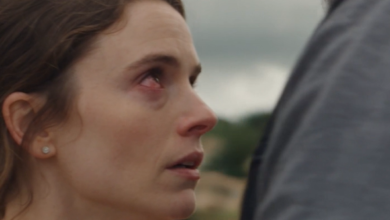
My heart struck my ribs so hard I could hear it.
“Why are you following me?”
Hammer shut off his engine.
“Cal asked me.”
Traffic covered his words.
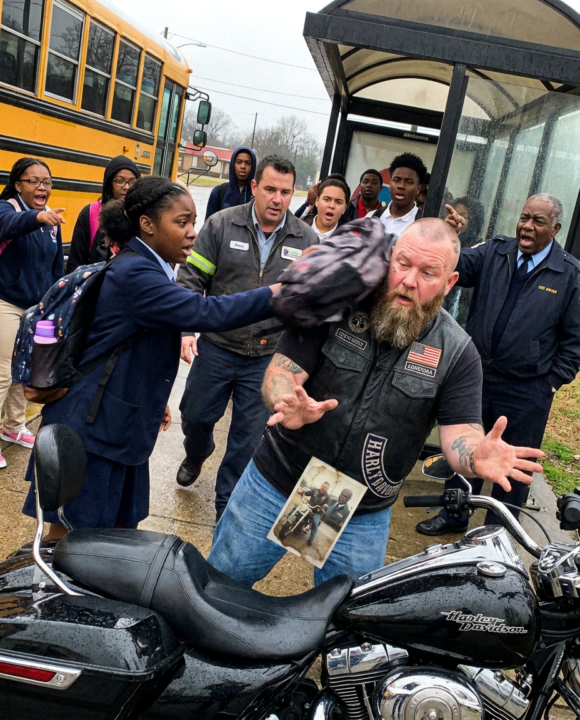
He reached inside his vest for the photograph and the printed transportation note.
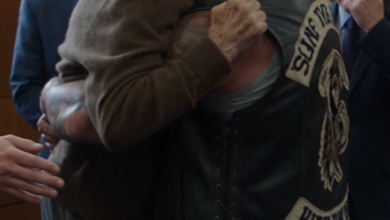
I saw only his hand disappearing beneath black leather.
I swung the backpack.
Impact.
Hammer’s head snapped sideways. His sunglasses hit the sidewalk. The Harley rocked beneath him.
A father named Victor Harris ran from his truck and shoved Hammer against the motorcycle.
“Stay away from her!”
Hammer did not strike back.
He opened both hands.
“Call her mother.”
Victor pushed him again.
Jerome left the bus and stepped between them.
Students raised phones. The convenience-store clerk called police. I stood with both fists tight, waiting for Hammer’s anger.
It never came.
Blood appeared at the corner of his mouth where the water bottle had driven his lip against his teeth.
A small brass token slipped from his vest.
It landed beside Cal’s photograph.
The token carried the number 47.
Hammer had worn it for twenty-two years.
One minute for every minute Cal refused to leave him beside the wreck.
Part 4 — The Voice Cal Left Behind
Police arrived quickly.
Hammer sat on the curb with his hands visible. He did not attempt to leave, although several club members were already calling after seeing videos from the bus stop.
An officer asked whether he wanted to press charges.
Hammer looked at me.
“No.”
I had struck him hard enough to bruise his cheek and split his lip. Everyone had witnessed it.
“You were assaulted,” the officer said.
Hammer wiped the blood with his thumb.
“She was scared.”
“That does not make it legal.”
“No.”
“Do you want medical attention?”
“No.”
The officer turned to me. My mother had not arrived yet. Jerome and the school counselor stood nearby as temporary responsible adults.
I told the truth.
Hammer had followed me for nineteen days. He had changed routes when I changed routes. He had waited until I entered my house. He had never spoken to me before that afternoon.
The facts sounded terrible.
They were also accurate.
Hammer handed the officer his phone.
“Voicemail.”
Cal’s final request played through the speaker.
His breathing sounded strained.
“Ray, I need one thing. Maya Collins, Route Fourteen. Temporary stop at Willow. Six blocks to the blue porch. Denise is working afternoons. The underpass lights are out, and that gray sedan showed twice. Transportation’s got my report.”
Cal paused to breathe.
“Get permission. Stay back. Public route only. Don’t approach her alone. Make sure she gets through the blue door.”
Another pause.
“You told me I could ask once. This is it.”
Hammer’s voice followed on the recording.
“I’ll handle it.”
Cal answered, “Handle it right.”
The message ended.
The officer looked at Hammer. “Did you get permission?”
“Thought I did.”
He played my mother’s return voicemail.
Her words were clear enough to sound like consent and vague enough to reveal the misunderstanding.
If this is the safety escort Cal mentioned, yes, that is fine. Please coordinate with the school.
The school had not completed coordination.
Hammer should have stopped until it did.
He knew that now.
“I got ahead of paper,” he said.
Jerome crossed his arms. “You followed a fifteen-year-old who did not know who you were.”
“Yeah.”
“You understand why she thought the worst?”
Hammer touched his bruised cheek.
“Got the summary.”
He did not defend the decision merely because his intentions were good.
That mattered almost as much as the voicemail.
Then police reviewed the store camera footage from the previous afternoon. It showed the gray sedan moving slowly behind me. Hammer’s Harley entered the lane at a legal distance and remained between the car and the sidewalk until the sedan turned.
The officer ran the plate.
The vehicle had been sold informally and never re-registered. Investigators later located the driver, who claimed he used the alley near the underpass to reach a repair property. Police found no basis to accuse him of targeting me.
That uncertainty remained.
Hammer had not saved me from a proven crime.
He had made sure uncertainty never had to be tested while I walked alone.
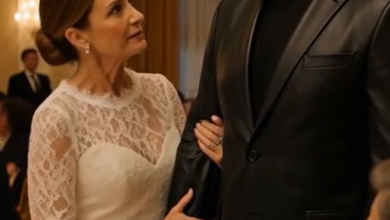
My mother arrived in hospital scrubs.
She saw Hammer’s injured face, the police cars, and me holding Cal’s photograph. The truth reached her in pieces.
She apologized to me first.
“I should have told you about the message.”
“You didn’t know who he was.”
“No. But I should have checked.”
Then she faced Hammer.
“You should never have started until the school introduced you.”
Hammer nodded.
“Correct.”
Most adults defend themselves when a teenager proves them wrong.
Hammer accepted the boundary.
That was when Preacher and eight Iron Saints entered the parking lot.
The engines were loud enough to turn every head. Victor stepped in front of me again, expecting the club to confront us.
Preacher shut off his Harley.
He looked at Hammer’s lip.
“Who hit you?”
Hammer answered before anyone could point.
“Communication.”
Preacher stared at him.
Then he looked at me.
“You the student?”
“Yes.”
“Were you scared?”
“Yes.”
Preacher turned back to Hammer.
“Then you did it wrong, brother.”
Brotherhood was tested.
It chose the truth.
The Iron Saints did not surround me. They did not argue with police. They parked across the street and waited until my mother took me home.
Hammer stayed at the stop.
Not to follow.
To give his statement and finish what accountability required.
Part 5 — What Happened Forty-Seven Minutes Beside Highway 51
I asked Hammer to tell me how Cal saved him.
We met three days later inside the school counselor’s office. My mother attended. Jerome attended. A transportation supervisor attended. The door remained open.
Hammer arrived without his vest.
He wore a clean black shirt and carried Cal’s photograph in a paper envelope.
He did not sit until I did.
“Were you drunk?” I asked.
“Yes.”
The answer came without delay.
“How drunk?”
“Enough to think I wasn’t.”
“Did you hit another car?”
“No.”
“Could you have?”
“Yes.”
Hammer told me about Highway 51.
He had left a bar shortly after midnight and ignored two friends who offered him a ride. Loose gravel took the front tire on a curve. The Harley slid beneath a guardrail and disappeared down an embankment.
The crash broke Hammer’s leg, dislocated his shoulder, and cracked his helmet. He could hear vehicles passing above but could not climb toward the road.
Then an empty school bus stopped.
Cal found him.
For forty-seven minutes, the bus driver held pressure against Hammer’s leg, kept his airway clear, and refused to let him close his eyes. Rain soaked both men. Gasoline ran from the damaged Harley into the ditch.
Hammer apologized repeatedly.
Cal told him to save his breath.
At one point, Hammer said, “If I live, I owe you anything.”
Cal answered, “Live first. Promise later.”
After recovery, Hammer attended treatment and quit drinking. The crash did not magically remove every problem. He relapsed once, then returned to treatment before riding again.
Cal stayed involved.
He drove Hammer to meetings in the same pickup he used for fishing. He checked the breath of a thirty-four-year-old man as if Hammer were another student boarding Route Fourteen.
When Hammer reached one year sober, Cal gave him the brass token marked 47.
“Not an anniversary,” Cal said. “A reminder. Somebody stayed.”
Hammer carried it inside his vest.
Twenty-two years later, Cal finally requested repayment.
“Why me?” I asked.
Hammer looked at the floor.
“Cal worried.”
“That isn’t what I mean. Why did he care about me?”
Cal cared about every student, but my family had given him another reason.
My father, Andre Collins, drove a city ambulance before he died from cancer when I was nine. Years earlier, Andre had been one of the paramedics who treated Hammer beside Highway 51.
He was the man who climbed down the embankment first.
Cal held Hammer alive.
My father carried him up.
Neither man told me.
Cal knew Andre’s daughter rode Route Fourteen. After my father died, he watched our blue porch more carefully. His final request connected three men across twenty-two years: one who stayed in the ditch, one who carried the stretcher, and one who survived long enough to follow the bus.
My mother began crying before I did.
Hammer removed another photograph from the envelope. It showed my father in a paramedic uniform beside Cal’s bus. A younger Hammer stood between them on crutches.
On the back, my father had written:
Next time, ride sober.
Hammer obeyed.
He had carried that photograph through twenty-two crash anniversaries.
“What was the gray car?” I asked.
“Don’t know.”
“So maybe I wasn’t in danger.”
“Maybe.”
“You still would’ve followed?”
“Cal asked.”
I looked at the bruise I had left on his cheek.
“You should have introduced yourself.”
“Yes.”
“You should have waited for the school.”
“Yes.”
“You should not wear dark glasses while following teenagers.”
Hammer considered that longer.
“Also yes.”
The counselor almost laughed.
I did.
Only once.
The transportation office changed its procedures after our meeting. No private volunteer could accompany a student without written guardian consent, student notification, identity verification, defined routes, visible identification, and confirmation from both the school and driver.
The Iron Saints proposed a program called Cal’s Last Stop.
Hammer refused to let it begin until a child-safety organization reviewed everything. He also refused to participate alone.
The final program used pairs of screened volunteers walking or riding along designated public routes. Students met them first. Parents received photographs, vehicle information, and direct phone numbers. Nobody appeared without warning.
Intentions no longer counted as authorization.
That lesson carried Hammer’s bruise inside it.
Part 6 — The Blue Porch Rule
Cal’s Last Stop began with six students.
The Iron Saints provided money, reflective jackets, background checks, and radios. Other volunteers came from churches, neighborhood associations, and retired transit workers.
Hammer rarely escorted anyone.
He handled motorcycle maintenance and route maps. When he did ride, another approved volunteer accompanied him, and every student knew his name before seeing his Harley.
He wore clear glasses.
I considered that progress.
The broken lights beneath the underpass were repaired after my mother, Jerome, and six other parents attended a city meeting. A new camera covered the crossing. The temporary stop moved two blocks closer once construction ended.
My walk became ordinary again.
Hammer still appeared on Fridays, but now he waited beside the bus shelter wearing a reflective volunteer vest over his leather cut. I knew when he was coming.
That changed everything.
The Harley no longer sounded like a threat behind me. It sounded like an engine holding a steady distance.
On the final afternoon of my mother’s hospital rotation, Hammer followed me to the blue porch. Another volunteer rode behind him.
I unlocked the door and turned.
“You can stop now.”
Hammer shut off the Harley.
“Route closed.”
“You kept count?”
“Thirty-seven authorized days.”
“And nineteen unauthorized.”
He nodded. “Those too.”
I approached him voluntarily for the first time.
The faded bruise had disappeared.
I handed him my old backpack. The water bottle remained inside.
Hammer raised one eyebrow.
“I’m not hitting you.”
“Helpful clarification.”
Inside the bag was a framed copy of Cal’s route card and a new brass token marked 48.
Hammer examined it.
“Why forty-eight?”
“Cal stayed forty-seven minutes. You stayed one more time.”
He shook his head.
“Math’s sentimental.”
“Take it.”
Hammer placed the token beside Cal’s original.
The next year, I volunteered with the program. Not as someone needing protection, but as an older student walking middle-school children from temporary stops.
Hammer explained one rule before my first route.
“Never make somebody feel watched.”
I looked at him.
“You know that one from experience?”
“Expensive lesson.”
Part 7 — The Driver at the Last Stop
I graduated three years later.
My mother sat in the front row. Jerome King attended in his formal transportation jacket. Cal’s daughter brought her father’s old bus cap.
Hammer stood near the rear exit with Preacher and four Iron Saints.
They wore clean leather cuts and expressions suggesting they would rather face a hailstorm than a high-school ceremony.
Afterward, I found Hammer beside his Harley.
He handed me a small wrapped box.
Inside was Cal’s brass token marked 47.
I tried to return it.
“That’s yours.”
Hammer shook his head. “Was.”
“Why give it to me?”
“Route changes.”
He had carried the token for twenty-five years. It represented the minutes Cal kept him alive, the promise that followed, and every afternoon Hammer stayed behind my bus.
I closed my fingers around it.
“What do you carry now?”
Hammer opened his vest.
Beside my father’s photograph was the token marked 48.
Sentimental math.
He had kept it.
Years later, I became a transportation safety coordinator for Shelby County schools. On my first morning, I inspected a bus route beneath an underpass where the lights worked, the camera worked, and the stop sat within sight of three occupied homes.
A black Harley waited beside the curb.
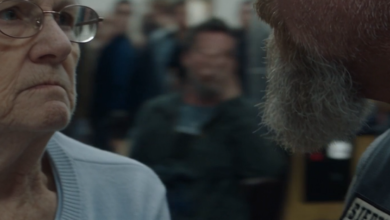
Hammer was older. His beard had gone mostly gray. His shoulders remained broad beneath the same plain leather vest.
“You following me again?” I asked.
“Supervisor requested inspection.”
“I’m the supervisor.”
“Then paperwork’s solid.”
A yellow bus approached.
Hammer started his engine but did not move until the final student boarded. Then he followed at an approved distance, visible in the driver’s mirror.
At the blue porch, my mother stood outside holding two cups of coffee.
One for me.
One for the man who had finally learned to introduce himself.
Hammer parked at the curb. The engine went quiet. For a moment, I could almost hear Cal’s deep voice telling us a route was not complete merely because a door had opened.
The child had to reach the place where somebody expected them.
Hammer looked at the porch.
“Route finished.”
This time, I knew why he stayed.
Follow our page for more unforgettable biker stories about frightening misunderstandings, final promises, and rough-looking riders who quietly make sure someone gets home.