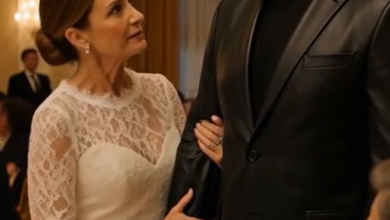
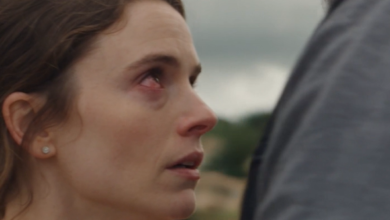
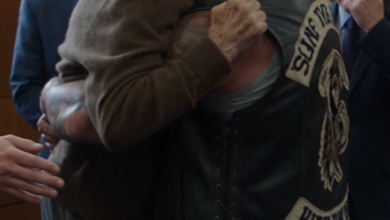
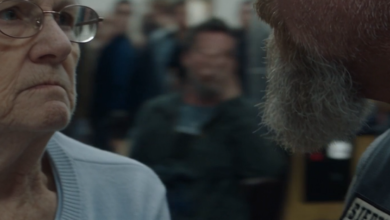
Part 2: A Nun Slapped a Biker and Tore the Box from His Hands—Then She Learned Whose Ashes He Had Carried Home
Part 2 — Five Years of Silence
My name is Daniel Mercer, though the club has called me Preacher since the year I joined the Iron Covenant Riders and made the mistake of quoting Scripture during a bar fight. I was riding behind Ray that Sunday, and if you watched one of the shaky videos from outside St. Brigid’s, you probably saw me—the gray-bearded biker reaching toward two angry parishioners while Sister Margaret held the box against her chest.
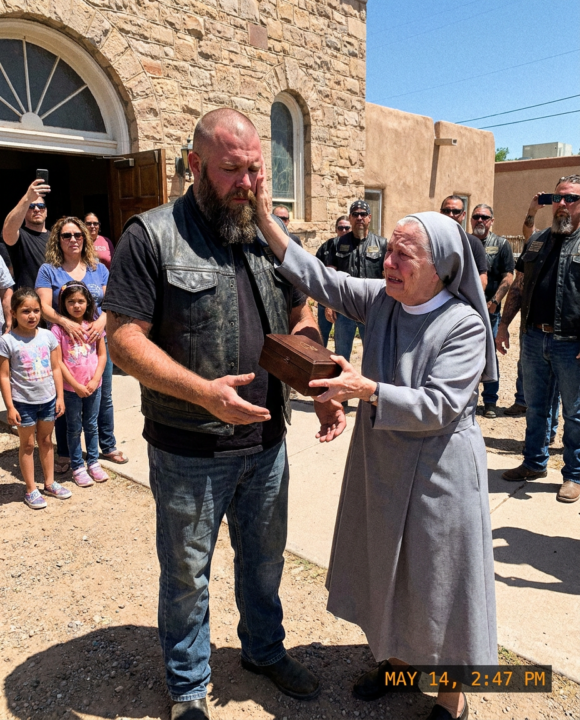
The video made Ray look guilty. Twelve seconds showed the slap, the box, and his silence; twelve seconds never showed what came before.
I first heard about Thomas Vale five years earlier, during a club run from Albuquerque to Gallup. A storm had washed mud across Interstate 40, forcing us beneath an abandoned service-station awning near Grants. While the rest of us complained about wet gloves and lukewarm coffee, Ray stood staring across the road at a man pushing a grocery cart through the rain.
The man was thin, silver-haired, and wrapped in a military field jacket despite the summer heat. He walked with his head tilted as though listening to a voice no one else could hear.
Ray crossed four lanes without telling us why.
The homeless man saw him coming and reached inside his jacket. I expected a knife, but he produced half of a broken St. Christopher medal.
“You finally got fat,” the man told Ray.
Ray laughed once, then embraced him.
That was Thomas.
Seven years before that meeting, when Ray’s marriage had ended and his construction business collapsed, Ray had disappeared into whiskey, pills, and the kind of rage that ruins every room before it ruins the man carrying it. He lost his house, served eleven months for assault, and spent one winter moving between shelters and underpasses because pride felt easier than asking his daughter to forgive him.
Thomas found him beneath the San Mateo bridge during a freezing rain.
Ray had been soaked, shaking, and barely conscious. Thomas gave him the green military coat off his own back, pushed cardboard beneath him, and counted each breath until dawn. When Ray stopped answering, Thomas walked nearly two miles to bring an outreach nurse.
Ray woke in a hospital with pneumonia. Thomas was gone.
Ray rebuilt his life slowly. He became sober, started repairing motorcycles, rejoined his daughter, and helped form the Iron Covenant’s emergency outreach rides. He searched for the stranger who had saved him, but “Tom” and a weathered face were not enough to find one unhoused man drifting across the Southwest.
Then he saw him in that rain.
Thomas agreed to eat with us at a diner, provided we sat near the exit. He refused money but accepted dry socks, coffee, and eggs. While he ate, I saw a newspaper clipping folded inside his jacket. It showed Sister Margaret beside St. Brigid’s food pantry, holding a photograph of her missing brother.
Ray saw it too.
“That’s you,” he said.
Thomas folded the clipping immediately. “That was me.”
“Your sister’s looking for you.”
“She’s looking for someone who doesn’t exist.”
Ray offered his phone. Thomas stood so quickly his chair fell.
“If you call her, I’m gone.”
The whole diner turned toward us. Ray set the phone down.
Thomas explained in fragments. He had been an Army medic, then a civilian paramedic. A roadside crash involving a family had awakened memories he had buried since deployment. He stopped sleeping, began drinking, and eventually stole medication from an ambulance. When the investigation started, he ran before his sister could see him arrested.
The charges had long since expired or been resolved without prison, but shame does not obey court calendars.
Thomas drifted from shelters to camps, always telling himself he would return after getting sober, after finding work, after replacing his teeth, after becoming someone Maggie could introduce without explaining.
Each promised return created another year of absence. Each year made the door feel heavier.
Ray told him Sister Margaret would rather have a broken brother than an empty room.
Thomas looked directly at him. “Would your daughter have said that when you were using?”
Ray did not answer.
That silence became the foundation of his mistake.
He agreed not to reveal Thomas’s location on one condition: Thomas would accept help. Ray found him a room in a transitional residence, drove him to a veterans’ clinic, and stored his few belongings at the motorcycle shop. Every month he asked permission to call Sister Margaret. Every month Thomas refused.
The club argued about it constantly. Mack believed family had a right to know. I believed Thomas, as a competent adult, had a right to decide. Ray stood between those truths until both cut him.
Twice we drafted messages to Sister Margaret. Twice Ray deleted them after Thomas vanished for days, convinced he had been betrayed.
The third year, Thomas agreed to let Ray collect Sister Margaret’s public letters and church notices. He read them alone at the shop after closing. He never answered, but he kept each envelope inside a dented tobacco tin.
Five years passed that way—not as clean rescue, not as deliberate cruelty, but as a chain of imperfect decisions made by men afraid that one wrong pull would break the only thread connecting them.
Then Thomas began coughing blood into a shop towel.
At the hospital, doctors found advanced lung cancer. Treatment could give him time but not the life he had imagined needing before he went home.
Ray placed his phone beside Thomas’s bed.
“This promise ends now,” he said.
Thomas stared at Sister Margaret’s number for nearly an hour.
Then he whispered, “Not yet. Help me write first.”
That night, he began the letter that would eventually cross the church courtyard in Ray’s vest. But before he finished it, Thomas disappeared from the hospital, taking his coat, his tobacco tin, and the last chance we thought we had to bring brother and sister together alive.
Part 3 — The Day Thomas Reached the Church
We searched for Thomas for six days.
The Iron Covenant was not a large club, but riders know places formal searches overlook: truck stops where cash buys silence, abandoned lots behind repair garages, washes beneath railroad bridges, cheap motels willing to ignore identification, and desert camps invisible from the road. We divided New Mexico into routes and carried Thomas’s photograph without publishing his illness or violating more of his privacy than necessary.
Ray barely slept. He rode until his hands cramped, returned to the shop for coffee, then rode again.
On the third night, I found him sitting on the concrete beneath the San Mateo overpass where Thomas had once saved him. Rainwater dripped through a crack and landed beside his boot.
“You should’ve called Sister Margaret five years ago,” I told him.
“I know.”
“I told you not to.”
“I know that too.”
“Then which one of us is guilty?”
Ray stared into the darkness. “The one carrying the promise.”
It was the longest answer he gave all week.
We finally located Thomas at a bus station in Santa Fe. A clerk remembered the green military jacket and said he had purchased a ticket to Albuquerque but left before boarding. Security footage showed him dropping an envelope into a mailbox and walking toward a church shuttle.
By the time we reached St. Brigid’s, he was gone.
Sister Margaret later found proof he had been there. The church’s security camera showed Thomas standing across the street during evening service, thinner than the photograph on her missing-person flyers and leaning against a utility pole for support.
For forty-two minutes he watched the entrance.
He crossed when the congregation began leaving, climbed three of the six stone steps, and saw Sister Margaret through the open doors. She was laughing with a family from the food pantry, holding a little boy’s hand while his mother adjusted a paper bag of groceries.
Thomas raised his hand.
Sister Margaret never saw him.
Then the little boy called her “Sister Maggie,” and Thomas lowered his arm. He sat on the third step until everyone had gone, touched the broken medal beneath his shirt, and walked away.
We learned why from the unfinished letter found weeks later.
Thomas remembered promising their mother that he would protect Maggie. Yet every image he had of returning ended with her becoming his nurse, advocate, banker, driver, and shield against consequences he believed were his alone. Seeing her care for that family convinced him she had built a life in which he was no longer the center of every emergency.
He mistook her strength for freedom from him.
The irony was unbearable. Sister Margaret had entered religious life partly because years of searching for Thomas taught her how many families lose people while those people are still alive. The pantry, shelter referrals, and evening meals were not replacements for her brother. They were evidence of the space his disappearance had opened inside her.
Thomas left St. Brigid’s and collapsed behind a closed laundromat two miles away. A woman found him the next morning and called an ambulance. He gave hospital staff a false surname but placed Ray’s shop card in the emergency-contact field.
Ray and I arrived before noon.
Thomas looked smaller than the pillow behind him. Oxygen tubing ran beneath his nose, and bruises marked his arms where nurses had searched for veins. His first words were not an apology.
“Did she see me?”
Ray said no.
Relief passed across Thomas’s face, followed instantly by grief.
Ray pulled a chair beside the bed. “You don’t get to keep doing this.”
“I almost made it.”
“You made it to the steps.”
“That’s closer than I’ve been in twelve years.”
“Close doesn’t count when someone is waiting.”
Thomas turned toward the window. “You going to call her?”
“Yes.”
“If you do, I’ll tell them to remove you.”
Ray’s scarred hands closed into fists, but his voice remained level. “Then remove me.”
That was where their promise finally broke.
Ray walked into the hallway and called St. Brigid’s. A volunteer answered and said Sister Margaret had left for a three-day retreat in Colorado where phones were prohibited except for emergencies handled by the diocese. Ray explained there was an emergency. The volunteer promised to contact the retreat center.
An hour later, a wildfire forced the evacuation of the mountain road leading to it. Communications failed across the area.
Thomas’s condition worsened that evening.
The doctor told us he might have several weeks, but his oxygen levels and damaged heart made every prediction uncertain. He could begin aggressive treatment, enter hospice, or remain in the hospital while they stabilized him.
Thomas chose hospice.
Ray chose a facility six blocks from St. Brigid’s.
For the first time, Thomas did not object.
We moved him into a room with a western window. Ray placed the tobacco tin on the bedside table, along with the half-medal, the blue rosary, and a photograph of Thomas and Maggie as children beside a red bicycle.
Sister Margaret still had not received the message.
Ray called every number the diocese provided. Roads remained closed. A staff member at the retreat center finally confirmed that Sister Margaret was safe, but before they could bring her to the phone, the emergency generator failed.
It sounds impossible when told afterward. In the moment it was merely a sequence of ordinary obstacles—bad timing, smoke, dead towers, a failing body, and an old man who had spent twelve years believing there would always be another morning.
Near midnight, Thomas woke and asked Ray to help finish the letter.
His hands shook too badly to write, so Ray held the pen while Thomas dictated. I sat near the window and listened as a dying brother tried to fit twelve missing years into pages too small to contain them.
He confessed the theft, the drinking, the shelters, and the church steps. He told Maggie he had followed news of her ministry, carried every photograph he found, and said her name before sleeping even when he no longer believed in prayer.
Then he said something Ray made him repeat.
“Tell her I was never lost from her. I was hiding from myself.”
At two in the morning, Sister Margaret’s return call finally reached Ray’s phone.
Thomas heard it ring.
Ray looked at the screen, then at him.
Thomas closed his eyes and shook his head.
The promise had ended, but the choice now belonged to a man with perhaps hours left. Ray could answer and force the reunion Thomas feared, or let the call pass and preserve the fragile peace in the room.
He answered.
“Sister Margaret?”
Static swallowed the reply.
The call disconnected.
Ray dialed again. Nothing.
Thomas smiled faintly. “Maybe God knows I’m a coward.”
Ray leaned close enough that their foreheads nearly touched.
“No,” he said. “God knows you’re tired.”
Thomas asked Ray to open the curtains. Dawn had not arrived, but Albuquerque’s lights glowed beneath the low clouds. Somewhere beyond them stood St. Brigid’s, the room Maggie had prepared, and a bed that would remain empty one final night.
Thomas handed Ray the half-medal.
“Bring me home Sunday,” he said. “She’ll be at the eleven o’clock Mass.”
Ray asked if he meant the ashes.
Thomas nodded.
Then he added, “Don’t say it on the phone. She’ll be alone when she hears it.”
Ray knew that was another mistake. So did I.
But when you sit beside a dying man, his final request can sound less like a preference and more like a law.
Part 4 — The Last Twelve Hours
Thomas did not die immediately after making his request. He remained with us for twelve more hours, and those hours were the confession Ray had come to deliver outside St. Brigid’s.
At dawn, three Iron Covenant riders arrived with breakfast no one ate. Mack brought Thomas a clean blue shirt. Luis brought an electric razor, but Thomas decided to keep his beard after seeing his reflection.
“Maggie always said it made me look like a failed bank robber,” he murmured. “Let her recognize the criminal.”
It was the first time we heard Ray laugh that week.
The hospice nurse, Elena, helped Thomas into a reclining chair by the window. She spoke to him normally, without the softened voice people often use around the dying. When she noticed the row of motorcycles outside, she asked whether he rode.
“Never trusted machines with only two wheels,” Thomas said.
Ray lifted an eyebrow. “You lived under a bridge.”
“Bridge had pillars.”
That small argument gave the room air.
The club members took turns sitting with him. Thomas asked each man how he had met Ray, then corrected every exaggerated version. He knew more of our stories than we knew of his because Ray had talked about us during their years together, filling long drives to medical appointments with tales of breakdowns, funerals, divorces, relapses, marriages, and roadside rescues.
I realized Thomas had not lived entirely outside family. He had stood at its edge, accepting warmth without allowing anyone to call it home.
Around nine, Sister Margaret reached Ray again.
This time the signal held.
Ray stepped into the hallway, but Thomas called him back and asked him to put the phone on speaker. Sister Margaret’s voice came through breathless and frightened. She had heard only that Ray knew where Thomas was and that something was wrong.
“Is he with you?” she asked.
Thomas stared at the phone.
Ray waited.
Thomas opened his mouth, but no sound emerged.
Sister Margaret repeated her question.
Finally, Thomas whispered, “Hey, Magpie.”
There was silence, followed by a sob so sudden it seemed to strike everyone in the room.
Only Sister Margaret had called him Tommy. Only Thomas had called her Magpie.
She spoke his name again and again as if twelve years could be crossed through repetition. He apologized. She told him to stop. He tried to explain, and she told him explanations could wait until she arrived.
Her retreat group was being escorted down the mountain, but smoke and road closures made the drive uncertain. She estimated six hours.
Thomas told her he would wait.
For almost three hours, hope rearranged the hospice room. Sister Margaret described the bed behind the rectory, the marmalade, the clean sweatshirt, and the parish nurse prepared to help. Thomas joked that he hated orange marmalade. Maggie accused him of lying, because he once ate an entire jar with a spoon.
Then his breathing changed.
Elena increased the oxygen and asked Sister Margaret to keep talking. Maggie recited memories: Thomas teaching her to ride a bicycle, hiding beneath a kitchen table during a thunderstorm, splitting the St. Christopher medal before his first deployment, and carrying her six blocks after she broke an ankle at thirteen.
Thomas held the phone against his chest.
He made Ray promise again to bring him home.
At noon, the evacuation convoy stopped behind an overturned truck. Sister Margaret was still three hours away.
Thomas’s blood pressure fell. His fingertips turned blue. Elena explained what was happening, and Maggie began praying through the phone while Ray sat beside the bed.
Thomas reached for his rosary, but his hands could not close around it. Ray wrapped the beads through his fingers and held them there.
“Count,” Thomas whispered.
Ray thought he meant prayers.
Thomas shook his head. “Breaths. Like the bridge.”
Years earlier, Thomas had saved Ray by counting his breaths through a freezing night. Now Ray returned the act.
“One,” he said as Thomas inhaled.
The club joined softly.
“Two.”
Thomas exhaled.
“Three.”
Sister Margaret prayed at the other end of the call while traffic idled on a mountain road. Her brother listened to her voice, surrounded by men in leather whom she had never met.
At breath thirty-seven, Thomas opened his eyes.
“Tell Maggie the door wasn’t heavy,” he said. “I was.”
Sister Margaret heard him.
“No, Tommy,” she answered. “You were my brother. That was all you ever had to be.”
Thomas began to cry. He had spent twelve years preparing for judgment and had no defense against mercy arriving without conditions.
Ray kept counting.
At breath fifty-one, Thomas’s grip loosened around the rosary. At fifty-two, he looked toward the western window. At fifty-three, he stopped.
Ray waited before saying fifty-four.
Elena placed her hand on his shoulder.
Sister Margaret’s voice continued through the phone, asking what had happened even though some part of her already knew. Ray picked up the device but could not speak. I took it from him and told her Thomas had died with her voice in the room.
She screamed once. Then the line became quiet.
“I’m coming,” she said.
The convoy moved twenty minutes later, but a mudslide closed the highway and forced everyone back to the retreat center. Sister Margaret could not reach Albuquerque until the following evening.
By then, Thomas’s body had been transferred to the crematory named in his hospice documents. He had chosen cremation because he owned no burial plot and believed it would create less trouble.
Ray paid the expenses from money Thomas had secretly saved in a coffee tin while working occasional repair jobs at the shop. The rest came from the club, though no rider admitted how much he contributed.
The walnut box was not an urn when Ray purchased it. It was a machinist’s chest from a thrift store, scarred at the corners and sturdy enough to protect the tobacco tin, rosary, medal, letters, and metal container holding Thomas’s ashes.
Ray scratched T.V. into the urn himself because Thomas had once said polished memorials were for people with cleaner histories.
Sister Margaret called Saturday night. Her voice sounded empty from exhaustion.
“Where is he?”
“At my shop.”
“Can I come?”
Ray looked at the box on his workbench. Thomas had asked to be brought home Sunday after Mass, before the church steps emptied. It was a strange final request, but we later understood that he wanted his return witnessed. He did not want Maggie to hide his story as though homelessness and addiction had made him a family secret.
“Let me bring him,” Ray said.
“Is he alive, Ray?”
That was the moment Ray should have answered plainly.
He tried. I watched him grip the phone, heard him draw breath, and saw the certainty in his face collapse beneath the memory of Thomas saying she would be alone when she learned.
“I’ll explain tomorrow,” he said.
Sister Margaret mistook evasion for cautious hope.
She prepared the room.
Ray understood his mistake when we pulled into the church lot and saw clean sheets fluttering through an open rectory window.
By then, it was too late to protect her from anything.
Part 5 — The Slap Before the Embrace
After Sister Margaret opened Thomas’s letter on the church steps, she did not read it immediately. She ordered everyone inside.
The parishioners who had filmed the confrontation followed us into the fellowship hall, suddenly ashamed of their phones but unwilling to leave. Father Paul locked the outer doors. The Iron Covenant riders stood along one wall, rain-spotted leather and dusty boots looking out of place beneath children’s drawings and signs advertising the church food drive.
Sister Margaret placed the walnut box on a folding table.
Ray remained standing.
“Sit,” she told him.
He sat.
The red mark from her palm had darkened against his cheek. She brought a damp cloth from the kitchen and held it out. Ray shook his head, so she placed it beside him.
“I’m not apologizing yet,” she said.
“I didn’t come for one.”
“I know.”
She opened Thomas’s letter.
His handwriting weakened across six pages. In places, Ray had steadied the pen; in others, Thomas had dictated while Ray wrote. Sister Margaret recognized the distinction immediately and made Ray identify each sentence that belonged directly to her brother.
Thomas told her about reaching the church steps. He admitted seeing her inside and leaving. He confessed that he had known of her search for years. Then he defended Ray before she had a chance to accuse him.
Ray did not keep me from you, he wrote. He kept me alive long enough to become the man who finally tried to return. When he pushed, I vanished. When he waited, I came back. If you need someone to blame, blame the dead man who spent twelve years confusing shame with responsibility.
Sister Margaret stopped reading.
“You should still have called,” she told Ray.
“Yes.”
“Even if he hated you.”
“Yes.”
“Even if he disappeared again.”
“Yes.”
“Then why didn’t you?”
Ray looked toward the club. “Because I knew what it was like to believe family was better without you. When he said it, I heard my own voice. I thought respecting him would eventually make him trust me. Maybe part of me was protecting the version of myself he saved under that bridge.”
It was not a heroic answer. That was why Sister Margaret believed it.
Ray had not hidden Thomas for money or control. He had done something more human and therefore harder to forgive: he had allowed gratitude, guilt, and recognition to interfere with judgment.
Sister Margaret resumed reading.
Thomas described the final call, the breath count, and the words Maggie had spoken before he died. He thanked Ray for ensuring her voice was the last familiar sound in the room. He asked that half his ashes be buried beside their mother and half scattered near the overpass—not because the bridge had been home, but because two broken men had once refused to let each other die there.
Then came the second name.
Elena Ruiz.
Thomas asked Sister Margaret to find Elena, the hospice nurse, and give her a smaller sealed envelope. Inside was an apology to the family involved in the ambulance crash that had triggered his collapse years earlier.
The accident had not been Thomas’s fault. A drunk driver had crossed the center line. Thomas had treated a nine-year-old girl at the scene, but she died before reaching the hospital. Her name was Elena Ruiz.
For years, Thomas believed the nurse at his hospice was that child’s mother because they shared the name. He never asked, too afraid of the answer. In reality, Nurse Elena was the girl’s cousin. She had recognized Thomas’s name from family stories but had chosen not to tell him until he was ready.
Thomas never became ready.
The letter asked Maggie and Ray to deliver his apology anyway.
That request turned his return into something larger than a funeral. Thomas had not asked to be remembered as innocent. He had asked them to carry the guilt he could no longer carry and place it before people who might reject it.
Sister Margaret folded the pages carefully.
“I hit you because I thought you brought me proof that I had failed him,” she told Ray.
Ray said nothing.
“Then I hit you because you knew him when I didn’t.”
He nodded.
“The third time was because you were here, and he wasn’t.”
“I know.”
She crossed the room and stood before him. The crowd seemed to hold a single breath.
Sister Margaret lifted her hand.
Several parishioners flinched, expecting another slap.
Instead, she touched the red mark on Ray’s cheek.
“I am sorry,” she said.
Ray lowered his head. “So am I.”
She embraced him then, not with the desperate force caught on the phones outside but slowly, as someone making a deliberate choice. Ray’s arms remained at his sides until she told him Thomas had trusted him and that, despite everything, this mattered.
Only then did he hold her.
The two men who had approached Ray in the courtyard apologized. The mother who had warned everyone about the box deleted her video, but it was too late; someone else had already uploaded a copy. By evening, millions of people had watched a nun slap a biker without hearing Thomas’s name.
Sister Margaret refused requests from television stations. She would not allow her brother to become a shocking caption.
Instead, she asked the parish to prepare a memorial meal and told Ray the entire Iron Covenant was invited. She placed Thomas’s ashes in the room behind the rectory for one night, on the bed she had made for him.
The orange marmalade remained unopened on the table.
Ray sat outside the door until dawn.
When I asked why he did not sleep, he ran his thumb across the broken St. Christopher medal and said, “He made it home. Someone should stand watch.”
The next morning, Sister Margaret emerged carrying Thomas’s half of the medal. She joined it to her own, though the broken edges no longer aligned perfectly.
Then she handed Ray a motorcycle helmet.
“You’re taking me to the bridge,” she said.
Ray studied her habit and sensible shoes.
“Not dressed like that.”
For the first time since the box arrived, Sister Margaret smiled.
“Thomas said you argued with everyone, Hammer. Don’t disappoint him now.”
Part 6 — The Road Between Two Homes
Sister Margaret did not ride behind Ray that morning. Father Paul threatened to call the bishop, Ray refused to move the Harley until she wore proper clothing, and the entire argument ended with Maggie borrowing jeans, boots, a riding jacket, and a full-face helmet from Luis’s wife.
We rode eight motorcycles toward the San Mateo overpass, with Sister Margaret seated behind Ray and the walnut box secured inside a padded case on my touring bike. Traffic noise rolled beneath the concrete, carrying the same hard echo Thomas and Ray had heard during their freezing night years before.
A city outreach team met us there. Sister Margaret had invited them because she refused to let Thomas’s memorial displace the unhoused people living nearby. We brought breakfast, clean socks, water, wound-care kits, and bus vouchers. Ray spoke privately with each person before anyone took photographs.
At the edge of the wash, Maggie opened the urn.
She scattered only a handful of ashes, allowing the wind to carry them beneath the bridge rather than across the people gathered there. Ray placed Thomas’s old field jacket beside an outreach worker who promised to give it to someone needing it that night.
Then Maggie read one sentence from her brother’s letter.
“I was never lost from her; I was hiding from myself.”
A man sitting beside a shopping cart began to cry. He asked if the church helped people contact families without forcing reunions. Sister Margaret said they would now.
That promise became the Thomas Vale Homeward Desk inside St. Brigid’s pantry—not a missing-person operation and not a program that treated every estranged family as safe. It offered phones, mailboxes, document replacement, counseling referrals, and trained mediators who helped people decide whether and how to make contact.
Ray insisted on one rule: no one’s location would be disclosed without consent unless immediate danger or law required it.
Sister Margaret insisted on another: “Not yet” could be respected, but it could not become an excuse to stop asking.
The Iron Covenant volunteered every Tuesday. Men feared in gas stations spent evenings repairing wheelchairs, charging phones, driving veterans to clinics, and delivering sealed letters without demanding to know what they contained.
Ray and Maggie still argued about Thomas. She believed he might have returned years earlier if Ray had called. Ray believed an unwanted disclosure might have driven him farther away. Neither could prove what the unwritten version of their lives would have been.
Their disagreement remained.
So did their friendship.
Two months later, Nurse Elena accompanied them to meet her aunt, the mother of the girl Thomas had tried to save. Ray carried Thomas’s apology, but the woman refused to read it.
“He didn’t kill my daughter,” she said. “The drunk driver did.”
Maggie asked if she could leave the letter anyway.
The woman accepted it, held it unopened against her chest, and asked whether Thomas had suffered.
Ray answered, “For longer than he should have.”
She looked at his leather cut, his scarred hands, and the half-medal hanging beside Maggie’s silver cross.
“Then I hope he finally put it down,” she said.
Outside, Sister Margaret took Ray’s face between both hands, precisely where she had slapped him.
This time, the people nearby understood the gesture.
Part 7 — What the Box Carried Home
We buried the remaining ashes beside Thomas and Maggie’s mother on a cool October morning. The headstone did not describe Thomas as homeless, veteran, addict, medic, missing man, or cautionary lesson. It carried his name, his dates, and a simple line Sister Margaret chose from his final letter:
HE CAME HOME HEAVY, BUT HE CAME HOME.
Ray stood at the back during the service. He wore the same leather cut and faded shirt he had worn on the day of the slap, though Maggie had cleaned the dust from his collar herself. When the prayers ended, she asked him to come forward and place the blue rosary beneath the small cedar marker.
He hesitated.
“That belongs to family,” he said.
Sister Margaret looked toward the riders.
“I know.”
Ray knelt and placed it beside the urn.
The walnut box returned to St. Brigid’s. Maggie keeps it in the Homeward Desk, not as decoration but as a place for letters people are not yet ready to send. Some remain there for days. Others remain for months. Volunteers never open them.
Once a year, on the anniversary of Thomas’s death, the Iron Covenant rides from the church to the overpass. Sister Margaret usually goes in the outreach van now, though she still claims Ray’s cornering scared her less than Father Paul’s driving.
Ray no longer calls the night beneath that bridge the moment Thomas saved his life. He says Thomas merely kept him alive long enough to decide whether he wanted saving.
That distinction matters to him.
The video of the slap still appears online occasionally, usually with a false caption claiming a biker threatened a church or a nun discovered contraband in a mysterious box. Ray never corrects strangers. Sister Margaret sometimes does, but only when the correction can direct people toward outreach services.
When someone asks whether she regrets striking him, she answers honestly.
“Yes.”
Then she adds, “But Ray understood that grief sometimes reaches the hand before it reaches the heart. He stood still long enough for mine to catch up.”
The last time I visited St. Brigid’s, I found Ray repairing a loose wheel on a homeless veteran’s cart while Sister Margaret sorted mail beside the walnut box. They were arguing about whether Thomas would have preferred coffee or orange marmalade at the anniversary meal.
Ray said coffee.
Maggie said marmalade.
Neither would yield.
Above them, the two broken halves of the St. Christopher medal hung together on a plain cord. The edges did not match, and a narrow gap remained between them, visible whenever the light crossed the room.
Sister Margaret never had the pieces repaired.
Some things, she told me, should show where they were broken—not to glorify the damage, but to prove that imperfect edges can still be carried together.
Outside, Ray’s Harley waited beneath the cottonwood trees. The walnut box sat open on the desk, holding three new letters addressed to people who did not yet know someone was trying to find the road back to them.
No one knew whether those letters would be sent.
But for the first time, waiting did not mean doing nothing.
Follow our page for more biker stories about misunderstood riders, unfinished promises, and the quiet roads that finally carry lost people home.