Part 2: A Nine-Year-Old Girl Slapped a 285-Pound Biker at Her Father’s Funeral — Then a Roadside Recording Revealed the Promise He Could Never Keep Alive
Part 2 — The Man Who Never Passed a Broken Machine
Ray Dawson earned the name Hammer before he learned how to repair anything.
At twenty-one, he used his fists faster than most people used judgment. He fought in bars around Gallup, New Mexico, collected unpaid gambling debts for men he later pretended not to know, and rode motorcycles assembled from parts whose ownership nobody discussed.
By fifty-six, he ran Dawson Fleet and Diesel outside Flagstaff.
The shop serviced delivery trucks, church vans, farm equipment, ambulances, and motorcycles that arrived in cardboard boxes after their owners had given up. Hammer charged people who could afford him and quietly erased labor from invoices belonging to widows, veterans, and families stranded far from home.
His appearance erased most evidence of kindness.
He stood six-foot-four, weighed nearly 285 pounds, shaved his head, and wore a thick black-and-gray beard. A faded rattlesnake covered his right forearm. Black letters across his scarred knuckles spelled HOLD FAST.
Children noticed the silver skull ring.
Parents noticed everything else.
The Iron Mercy Riders had grown around his repair shop. Boone Collins, a former Army mechanic, served as road captain. Deacon Price had worked as a flight medic. Lobo Ramirez operated a recovery truck. Cole Mercer, the youngest prospect, swept floors, changed oil, and believed earning a patch required doing dangerous things.
Hammer kept correcting him.
“Danger finds fools,” he once said. “Work finds brothers.”
Mark Ellison met Hammer eighteen months before the accident when his pickup overheated outside Winslow. Mark had pulled onto the shoulder with Ellie, three grocery bags, and a birthday cake melting across the passenger floor.
Hammer stopped.
Mark locked the doors.
Ellie lowered her window before her father could stop her and asked whether the enormous stranger was a pirate.
Hammer examined his beard.
“Union won’t let me say.”
She laughed.
Mark did not.
He remained suspicious while Hammer replaced a split heater hose using a spare from his saddlebag. When Mark asked what he owed, Hammer pointed to the collapsing cake.
“Get that home.”
Mark returned the next week with a new cake.
That became their arrangement. Mark brought food he insisted Ellie had chosen. Hammer pretended the shop needed it. Ellie sat on an overturned bucket and asked questions about every tool.
Mark was a county bridge inspector. He spent long days examining concrete seams, drainage walls, retaining bolts, and guardrails on remote Arizona roads.
His wife, Sarah, had died of ovarian cancer four years earlier.
After that, Mark built his life around schedules. Breakfast at 6:30. School at 7:45. Dinner at 6:00. Laundry on Wednesday. Telescope on Friday nights if the sky stayed clear.
Grief had made him precise.
Ellie depended on it.
Hammer never discussed his own past with them. Mark knew he had served time, but not why. Ellie knew only that he wore a broken watch that never displayed the correct hour.
She asked about it once.
“Doesn’t work,” Hammer said.
“Then why wear it?”
“Still tells me something.”
“What?”
Hammer looked toward the highway outside his shop.
“When not to leave.”
Mark heard that answer.
He did not press.
The weekend before the crash, Mark brought his pickup to Dawson Fleet and Diesel because he heard a clicking noise near the rear axle. Hammer found a loose exhaust bracket, repaired it, and inspected the truck from bumper to bumper.
The brakes were sound. Steering components were tight. Tires had good tread. Nothing mechanical would explain what happened three days later.
Before Mark left, Ellie placed a small wooden house on his key ring. She had painted its roof red, its walls yellow, and three uneven blue windows across the front.
“That’s us,” she said.
Mark counted the windows. “We only have two bedrooms.”
“The third is for when Mommy visits.”
Mark’s expression changed.
Hammer looked down at the workbench.
Ellie had been six when Sarah died. Nobody had corrected every way she imagined her mother returning.
Mark put the key ring in his pocket.
“Then I better not lose the house.”
On the afternoon of October 17, Mark inspected a retaining wall along Route 89A. Storm clouds had formed over the red cliffs, and the weather service warned that temperatures would fall after sunset.
He called me at 3:51.
“I’ll be late picking up Ellie.”
“How late?”
“Forty minutes. Maybe an hour.”
“I can get her.”
There was a pause before he answered.
“Tell her I’m coming.”
Mark understood what missed promises did to his daughter. During Sarah’s final year, hospital emergencies had repeatedly changed every plan. Ellie had learned to stand near windows and wait for headlights.
“She won’t mind,” I said.
“I will.”
Those were my brother’s last clear words to me.
At 4:23, Hammer and four riders left his shop for Cottonwood. A stranded family had called about a wheelchair-accessible van with a failed alternator. The nearest commercial service wanted eight hundred dollars just to tow it.
Hammer loaded tools onto his touring motorcycle. Boone asked why they could not take the recovery truck.
“Traffic.”
The motorcycles moved south in staggered formation, their V-twin engines echoing between the cliffs. Rain darkened the pavement in scattered patches.
Cole rode behind Hammer.
Near Mile Marker 385, Hammer saw a silver minivan stopped partly in the southbound lane. Its hazard lights were weak. A woman stood near the driver’s door waving both arms.
A baby remained strapped inside.
Hammer slowed.
Before he could reach her, Mark’s pickup appeared around the blind curve.
The truck was traveling within the speed limit. Its brake lights came on immediately. The rear moved sideways on loose gravel washed across the road.
Mark had three choices.
Strike the minivan.
Cross into the motorcycles.
Or take the guardrail.
He chose the guardrail.
The pickup passed within inches of the woman, shattered three wooden posts, struck a steel barrier, and disappeared into the ravine.
Hammer braked hard enough to lay black rubber across the road. His rear wheel lifted, touched down, and slid sideways. Cole’s motorcycle clipped Hammer’s saddlebag and fell.
The two remaining riders stopped traffic.
Hammer reached the broken rail before the dust settled.
He looked down.
Mark’s pickup had landed against two pine trees eighty feet below. The roof was crushed. One headlight remained on, illuminating rain and branches.
Hammer recognized the truck.
Then he saw the red wooden house hanging from the ignition.
He did not wait for ropes.
He climbed over the guardrail.
Part 3 — Six Hours Beneath Route 89A
Loose shale moved beneath Hammer’s boots as he descended.
Boone shouted for him to wait. Deacon was calling emergency services. Lobo searched for an anchor point while Cole, bleeding from one elbow, redirected cars away from the blind curve.
Hammer kept going.
He reached the truck in less than four minutes.
The driver’s side had folded against a tree. The passenger window was shattered but too narrow for his shoulders. Hammer removed his leather vest, wrapped it around his right forearm, and punched the remaining glass from the frame.
“Mark.”
No answer.
He pushed his head and one arm inside.
“Mark, it’s Ray. Look at me.”
Mark’s eyes opened.
Blood ran from a cut above his temple. The steering column held his legs. One section of the roof pressed against his right shoulder. Every breath produced a wet clicking sound.
Hammer had heard that sound before.
He did not tell Mark.
“Ellie,” Mark whispered.
“She’s safe.”
“You know?”
“Grace has her.”
Hammer could not know that yet, but he knew somebody would collect a nine-year-old before allowing her to stand alone outside school.
Mark tried to reach his pocket. His broken arm would not move.
“Key.”
Hammer found the key ring near the damaged ignition. He placed the wooden house in Mark’s left hand. Mark closed three fingers around it.
“The woman?”
“She’s alive.”
“Baby?”
“Alive.”
Mark exhaled.
That answer seemed more important to him than his own condition.
Above them, sirens approached. Boone lowered a rope, but Hammer could not fasten a harness around Mark without shifting the steering column.
Deacon climbed down carrying a trauma bag. He assessed Mark through the window, placed oxygen near his face, and attempted to control the bleeding.
The pulse was weak.
“We need a hydraulic team,” Deacon said.
“How long?”
“Forty minutes if the road stays open.”
It did not.
At 5:06, a section of rain-soaked rock broke above the north lane. Stones struck the highway, damaged a fire engine, and blocked the rescue truck carrying hydraulic equipment.
The ravine shifted.
Rescue Captain Helen Morris ordered everyone except essential medical personnel out until geologists evaluated the slope. Deacon was directed back up because his harness line crossed an unstable shelf.
Hammer refused.
“You are not protected down there,” Morris shouted.
“He isn’t either.”
“If that truck moves, we lose both of you.”
“Then secure it.”
“We can’t do that with you underneath.”
Hammer looked at Mark.
Mark’s eyes had closed again.
“I’m not underneath.”
“You are inside the collapse zone.”
Hammer pulled his vest through the window and laid it across Mark’s chest. Cold rain passed through the damaged roof.
“I’m staying.”
Captain Morris asked the sheriff to order him out. The sheriff did. Hammer ignored him. Deputies threatened arrest.
He remained beside Mark.
Above the ravine, the Iron Mercy Riders faced their own choice. If they challenged police, the road would become more dangerous. If they left, Hammer would stand alone against an entire rescue command.
Boone removed his vest and placed it on his motorcycle.
Then he asked every rider to do the same.
“We follow orders up here,” he told them. “He keeps his promise down there.”
Cole protested. He wanted to descend.
Boone gripped the young man’s shoulder.
“You add one more body, Hammer has to worry about you.”
That stopped him.
The club moved motorists back, cleared debris under police supervision, carried equipment, and provided their heavy recovery straps to the rescue team. Nobody argued again.
Below them, Hammer talked.
He told Mark about Ellie’s pirate joke. He described the ruined cake from their first meeting. He said the shop still had three purple fingerprints on a white toolbox because Ellie had touched it after painting a solar-system model.
Mark smiled without opening his eyes.
“Never cleaned it?”
“No.”
“Soft.”
“Rust prevention.”
Mark coughed. Blood reached the corner of his mouth.
Hammer wiped it away with his shirt.
The truck shifted.
Metal groaned against the trees. A pine root snapped beneath the rear axle. Hammer braced his boots against the passenger door and pushed one shoulder into the dashboard.
For several seconds, 285 pounds of muscle, leatherless skin, and stubbornness became part of the damaged truck’s support.
Then the recovery line tightened from above.
The vehicle stopped moving.
Mark watched him.
“You scared?”
“Busy.”
“Liar.”
Hammer almost smiled.
At 6:02, Mark’s phone began vibrating beneath the seat. The screen was cracked. An accidental voice-recording app had activated when the emergency shortcut was pressed during the crash.
The phone recorded everything.
Neither man knew.
Mark’s breathing worsened. Deacon shouted instructions from above, but there was little Hammer could perform inside the narrow cab. He kept the oxygen line clear. He checked Mark’s pulse. He held pressure where he could.
At 6:19, Mark asked the time.
Hammer looked at his broken watch by instinct.
“Don’t know.”
“You wear a watch.”
“It quit.”
“When?”
“Long time ago.”
“Why keep it?”
Hammer did not answer.
Mark opened his eyes.
“Someone?”
Hammer looked toward the rain falling through the branches.
“My brother.”
Mark waited.
“Motorcycle went down,” Hammer said. “We were young. Bikes were stolen. I ran before the police came.”
“You came back.”
“Nineteen minutes later.”
“Was he alive?”
Hammer’s jaw tightened.
“No.”
Mark’s fingers moved weakly around the little wooden house.
“You’ve been coming back ever since.”
“Save your air.”
“I’m right.”
“Still wasting air.”
Mark rested again.
At 6:48, the technical team reached the upper slope, but another section of rock had to be stabilized before they could descend with extraction equipment.
Darkness arrived quickly in the ravine.
Temperatures fell.
Hammer placed both hands around Mark’s left hand, warming it as best he could. The red wooden roof pressed between their palms.
“Ellie waits near the window,” Mark said.
“I know.”
“She’ll think I chose work.”
“She won’t.”
“Tell her.”
“You tell her.”
Mark shook his head.
A long silence passed between them.
“Get me home,” Mark whispered.
“You’re going home.”
“To Ellie.”
“To Ellie.”
“Promise?”
Hammer looked at the watch stopped at 2:18.
Thirty-one years earlier, his younger brother Cal had been bleeding beside a wrecked motorcycle on a New Mexico service road. Hammer had promised to find help. Instead, he spent nineteen minutes hiding stolen parts and rehearsing a lie.
Cal died alone.
Hammer had never made another promise beside a wreck.
Until Mark asked.
“I promise.”
At 7:09, Mark’s pulse weakened.
At 7:11, he squeezed Hammer’s hand once.
At 7:12, he stopped breathing.
Hammer began compressions. The angle was wrong, the space too narrow, and the steering column prevented proper positioning.
He continued.
Deacon called down the rhythm. Hammer counted aloud. His scarred hands slipped. He repositioned them and started again.
After twenty-three minutes, Deacon stopped counting.
“Ray.”
Hammer pressed again.
“Ray, listen to me.”
Another compression.
“He’s gone.”
Hammer’s arms stopped.
The wind moved through the crushed windshield. Rain tapped against metal. Far above, motorcycle engines had been turned off, leaving the ravine almost silent.
Hammer remained with one hand on Mark’s chest.
Then he picked up the red house, closed Mark’s fingers around it, and said, “I’m still here.”
The rescue captain ordered him up again.
Hammer looked toward the darkness above.
“I promised his daughter.”
“You cannot bring him back.”
“That wasn’t the whole promise.”
He pulled his vest higher over Mark’s chest.
“I said I’d bring him home.”
Part 4 — The Nineteen Minutes Hammer Could Never Recover
The technical recovery lasted six more hours.
Crews drilled anchors into stable rock and ran two independent safety lines to the pickup. Every movement had to be measured. The trees holding the truck had split, and the crushed vehicle threatened to roll farther into the ravine.
Hammer could have climbed out during three different pauses.
He refused.
Mark was no longer conscious. He no longer felt the cold. He could not know whether the enormous biker remained beside him.
Hammer knew.
That was enough.
At 8:34, Boone lowered a dry blanket. Hammer used it to cover Mark’s head and shoulders. At 9:17, Deacon sent down water and a thermal jacket for Hammer.
Hammer put the jacket beneath Mark’s body to protect it from broken glass.
He drank nothing.
At 10:02, Sheriff Nolan Grant climbed close enough to speak without shouting.
“You’re compromising the recovery.”
“No.”
“You’re exhausted.”
“Yep.”
“You may become a second patient.”
“Then don’t treat me.”
The sheriff looked into the damaged cab.
“Why are you doing this?”
Hammer lifted his broken watch.
Grant did not understand.
Boone did.
Only three members of Iron Mercy knew the full story of Cal Dawson. Boone had been there on the night of the crash, riding a third stolen motorcycle several miles ahead.
Cal was nineteen.
Hammer was twenty-five, not twenty-one as he later told Mark in the ravine. He changed the number because admitting he had been old enough to know better remained difficult.
The motorcycles had been taken from a dealership storage yard. Hammer planned the theft. Cal followed because he followed his brother everywhere.
At 2:18 a.m., Cal entered a corner too fast. The front wheel struck loose sand, and the motorcycle slid beneath a parked utility trailer.
Hammer reached him within seconds.
Cal was alive.
He had a deep wound near his hip and could not move his legs. Hammer took off his belt, pressed it against the bleeding, and promised to bring help.
Then he heard sirens.
Instead of running toward them, Hammer ran in the opposite direction. He hid two stolen ignition modules, removed a temporary license plate from his motorcycle, and threw a tool bag into a drainage pipe.
Nineteen minutes passed.
When Hammer returned, Cal had stopped breathing.
A cracked watch lay beneath the wreck, its hands frozen at the moment of impact.
Police determined that faster medical attention might have saved him.
Hammer was convicted of motorcycle theft, obstruction, and leaving the scene of an injury accident. He served four years and seven months.
Their mother never visited.
At Cal’s funeral, she slapped Hammer beside the casket.
“You promised to bring help,” she said.
He had not defended himself.
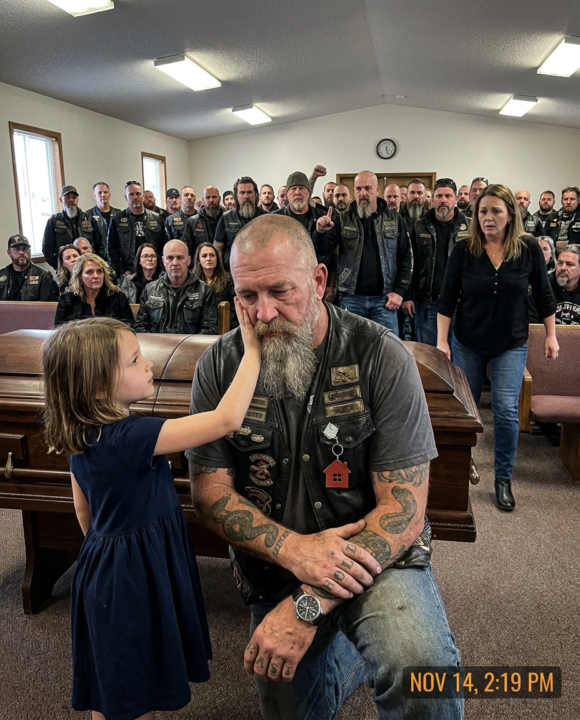
Thirty-one years later, when Ellie crossed the chapel and struck the same cheek, Hammer would hear his mother’s hand before he felt the child’s.
That was why he knelt.
It was also why none of the Iron Mercy Riders moved after he raised one finger. The older members knew some blows belonged to the person receiving them.
At 11:46 p.m., rescuers stabilized Mark’s pickup. They removed the passenger door but could not immediately lift the steering column without shifting the cab.
Hammer helped guide the hydraulic ram.
Captain Morris allowed it because he understood the crushed structure better than anyone else below. Years of repairing wrecked trucks had taught him where metal would bend and where it would tear.
At 12:28, the dashboard lifted.
Mark’s legs were released.
Hammer wrapped the dry blanket around him and fastened the recovery harness under the rescuers’ instructions. When they prepared to raise the body, Morris told Hammer to climb first.
“No.”
“The line is ready.”
“He goes first.”
“Ray, the slope is holding.”
“He goes first.”
Mark was lifted through the dark ravine at 1:43 a.m.
Hammer kept one hand beneath his shoulder until the recovery line took the full weight. Only then did he release him.
The little red house remained in Hammer’s palm.
He had removed it because the damaged key could tear the recovery bag. He planned to return it at the top.
Instead, deputies placed Hammer in handcuffs.
The woman from the minivan had been taken to the hospital in shock. Early witnesses described motorcycles near Mark’s truck. Hammer’s skid mark began thirty yards before the broken guardrail.
Sheriff Grant had no choice but to treat him as a possible cause of the crash.
The Iron Mercy Riders reacted badly.
Cole stepped toward the deputies. Lobo started an engine. Deacon demanded that Hammer receive medical treatment before questioning.
Hammer stood barefoot in the mud because one boot had been lost below.
“Shut it down,” he told them.
Nobody moved.
“Now.”
Engines stopped.
Hammer held out both wrists.
The deputies secured him, placed him in a patrol vehicle, and took his vest as evidence because blood from Mark covered the inner lining.
The broken watch stayed on his arm.
The red wooden house remained inside the vest pocket.
For nine hours, Hammer answered questions.
He described every motorcycle position, every brake application, every word Mark spoke, and every action performed in the truck. He refused a lawyer until Boone arrived and called him an idiot.
“You look guilty,” Boone said.
“Been guilty before.”
“Not of this.”
“Truth stays put.”
The recovered truck offered the first confirmation. Its event recorder showed Mark braking before Hammer’s motorcycle entered the critical zone. Steering data proved the pickup turned sharply away from the stopped minivan.
Then the woman woke in the hospital.
Her name was Rachel Kim. She had been driving home to Phoenix with her eleven-month-old son when the minivan lost electrical power on the blind curve. She tried to roll onto the shoulder, but the steering locked.
Mark’s pickup appeared.
Rachel remembered his face through the windshield.
She remembered him seeing the baby.
She remembered the truck changing direction.
“He chose the rail,” she told investigators. “He could have hit us. He chose the rail.”
The second confirmation came from Mark’s phone.
Technicians recovered fifty-eight minutes of audio. Wind and damaged electronics obscured several sections, but the voices remained clear.
The recording proved Hammer did not cause the crash.
It also captured the promise.
Investigators returned a copy to our family on the morning of Mark’s funeral. I intended to listen alone after Ellie fell asleep.
Ellie found it first.
She heard Hammer say her name. She heard her father ask to come home. She heard Hammer promise.
Then she saw the biker enter the chapel without Mark walking beside him.
To a nine-year-old, death did not erase a promise.
It proved someone had broken it.
Part 5 — What Ellie Heard After the Slap
Hammer remained on one knee while Ellie stared at the red wooden house in her palm.
Nobody spoke.
Mark’s coworkers had stopped advancing. The funeral director lowered his phone. Thirty Iron Mercy Riders stood along the chapel wall with their hands visible.
Ellie looked at the dried blood.
“Was he holding this?”
“Until the end,” Hammer said.
“Was he scared?”
Hammer considered the question.
“Sometimes.”
“Did he call for me?”
“He talked about you.”
“What did he say?”
Hammer did not repeat Mark’s fear about missed promises or the window where Ellie waited. Some last words belong to children only after they are old enough to carry them.
“He said you know more stars than he does.”
Ellie wiped her face.
“He always mixes up Vega and Sirius.”
“Sounds serious.”
“It’s a star.”
“I know.”
“You didn’t.”
“No.”
The smallest breath of laughter escaped her before guilt swallowed it.
Then she looked toward the casket.
“Why didn’t you save him?”
There was no safe answer.
Hammer could have blamed the rocks, the delayed rescue equipment, the injuries, the cold, or the limits of what any human hands can repair.
Instead, he said, “I couldn’t.”
Ellie waited for more.
None came.
She looked at his cracked watch.
“Did that belong to your brother?”
Hammer’s eyes moved toward me.
I had not told her.
“The recording,” Ellie explained. “Daddy asked.”
Hammer nodded.
“Did you leave him?”
The chapel tightened around that question.
“For nineteen minutes.”
“Did he die?”
“Yes.”
“Was he alone?”
“Yes.”
Ellie’s small fingers closed around the wooden house.
“Daddy wasn’t.”
“No.”
“Not even after?”
“Not even after.”
She stepped closer.
Hammer remained still.
Ellie touched the red mark her hand had left across his cheek. Then she wrapped both arms around his neck.
The sound that left Hammer was not a sob. It was one broken breath forced through a man who had spent thirty-one years refusing to make it.
His hands hovered behind Ellie’s back.
He did not know whether he was allowed to hold her.
She solved that problem by pulling harder.
Hammer placed one hand between her shoulders.
The entire Iron Mercy line looked away.
After the service, Sheriff Grant brought the full recovered recording. He asked whether I wanted to hear the final section before deciding what Ellie should know.
We listened in the funeral home office.
Mark’s breathing filled the speaker. Rain struck the truck. Hammer’s voice remained low and steady.
Then another sound emerged at 6:37.
A baby crying.
Rachel Kim had left the hospital against medical advice and returned to the road after sunset. She stood above the ravine holding her son, refusing to leave until she knew whether Mark survived.
The baby’s cries traveled down through the trees.
Mark heard them.
“Kid?” he asked.
“Baby from the van,” Hammer said.
“Safe?”
“Safe.”
Mark laughed once, though the movement hurt him.
“Worth the truck.”
The recording went quiet except for rain.
Several minutes later, Mark asked Hammer to bring him home.
It was not a request to survive.
By then Mark understood what was happening.
He asked Hammer not to let Ellie’s final memory become a closed casket arriving without anyone who knew his last thoughts. He wanted the wooden house returned. He wanted Ellie told that he had not chosen work over her.
Most of all, he did not want his daughter believing he had died alone.
“Tell her I was looking at the house,” Mark whispered. “Tell her I knew the way.”
Hammer promised.
The recording ended shortly after Mark’s heart stopped. Hammer’s voice continued for several minutes after the pulse disappeared.
He talked about Ellie.
He described the shop, the purple fingerprints, the birthday cake, and the pirate joke. Perhaps he spoke for Mark. Perhaps he spoke for Cal. Perhaps silence had become the one thing he could no longer tolerate beside a broken machine.
At the funeral reception, Rachel arrived with her baby.
The room recognized her from the news reports. She approached Ellie slowly and knelt beside her chair.
“Your father saved my son.”
Ellie looked at the sleeping child.
“Did he know?”
“Yes.”
“Did he see you get away?”
Rachel began crying.
“The man with him told him.”
Ellie turned toward Hammer.
He stood near the exit, clearly preparing to leave before anyone thanked him publicly.
“Ray.”
Almost nobody called him that.
He stopped.
Ellie walked over and handed him Mark’s truck key.
Hammer looked at the wooden house.
“That’s yours.”
“The house is mine,” she said. “The key is yours.”
“Don’t have his truck.”
“It doesn’t work anymore.”
“Then why give it to me?”
Ellie pointed toward his watch.
“Still tells you something.”
Hammer lowered his head.
The child had used his own answer against him.
He removed the key from the wooden house, placed the house in Ellie’s palm, and hooked the damaged truck key behind his broken watchband.
After that day, he wore both.
One object marked the nineteen minutes he had abandoned his brother.
The other marked the six hours he had stayed.
Part 6 — The Motorcycle Mark Had Hidden for Nine Years
We believed the funeral ended the story.
It did not.
Two weeks later, Hammer called me from his shop. Mark’s county office had delivered a sealed storage key found among his personal effects.
The key opened a unit near Flagstaff containing an old black touring motorcycle.
It had belonged to Mark.
I had never seen it.
Before Sarah became ill, Mark rode with a small veterans’ charity group, though he was not a veteran himself. He transported supplies, repaired fences, and helped escort funeral processions for families who had no military honor guard.
When Ellie was born, Mark stopped riding.
After Sarah died, he moved the motorcycle into storage because Ellie begged him never to risk leaving her too.
The machine had not started in nine years.
A folded note sat beneath the seat.
“If anything happens before Ellie is grown, don’t sell this for parts. Let Hammer decide whether it can come home.”
Mark had written it six months after meeting him.
Hammer read the note twice.
Then he pushed the motorcycle into the inspection bay.
Iron Mercy spent four months restoring it. They replaced every unsafe component but preserved the scratches on the fuel tank and a tiny yellow handprint Sarah had left while helping Mark repaint the bike.
Ellie visited on Saturdays.
She polished chrome, sorted bolts, and drew stars on cardboard while Hammer worked. He never started the engine without warning her first.
When the motorcycle finally ran, its V-twin rumble filled the shop.
Ellie covered her ears.
Then she smiled.
The club did not give a nine-year-old a motorcycle. They placed it in a family trust, insured it, and stored it at Dawson Fleet and Diesel until she became old enough to decide what it meant.
Once each month, Hammer rolled it outside.
Ellie sat behind him while the motorcycle remained on its stand. She held the handlebars, listened to the idle, and asked where her father had ridden.
Hammer answered only with places he knew.
Over time, the motorcycle stopped being evidence of another way Mark might have died.
It became proof that he had once lived beyond schedules, school pickups, hospital rooms, and grief.
Rachel and her son visited every October.
The boy grew quickly. On the first anniversary of the crash, he placed a toy truck beside Mark’s photograph at the shop.
Hammer added no plaque.
He disliked explanations mounted on walls.
The broken watch, damaged key, red wooden house, and black motorcycle said enough.
Part 7 — The Ride That Finally Brought Him Home
Seven years after the funeral, Ellie turned sixteen.
At 6:30 that morning, Hammer parked Mark’s restored motorcycle outside our house. More gray filled his beard, and arthritis had begun stiffening two fingers on his right hand.
He carried a second helmet.
Ellie had completed a motorcycle safety course, but she was not ready to ride Mark’s machine alone. Hammer understood before she admitted it.
“Passenger seat works,” he said.
Thirty Iron Mercy Riders waited at the end of the street.
Ellie climbed behind him.
The red wooden house hung beneath her jacket. Mark’s damaged truck key remained fastened beside Hammer’s broken watch.
They rode north toward Route 89A.
I followed in my car with Rachel and her seven-year-old son. At Mile Marker 385, the motorcycles slowed and entered a turnout near the repaired guardrail.
Hammer killed his engine.
Thirty more engines fell silent.
Ellie walked to the edge carrying a small metal box. Inside were several of Mark’s ashes, the original funeral program, and a photograph of him holding her beside the old motorcycle.
She did not scatter the ashes into the ravine.
Instead, she buried the box beneath a pine tree on safe ground above it. Hammer helped cover the soil with both hands.
“Did you bring him home?” she asked.
Hammer looked toward the road, then at the motorcycle Mark had left behind.
“Took a while.”
Ellie leaned against his shoulder.
“You kept the promise.”
“No,” he said. “We did.”
On the ride back, Ellie sat straighter. At the entrance to Flagstaff, Hammer pulled into Dawson Fleet and Diesel and stopped beside the open bay.
He removed Mark’s key from his watchband.
For seven years, it had struck the cracked crystal whenever he moved his wrist. Now he placed it in Ellie’s hand.
“You sure?” she asked.
Hammer looked at Mark’s motorcycle.
“Time.”
Ellie closed her fingers around the key.
Thirty engines started outside.
Hammer raised one scarred hand, and the riders turned toward the highway while Ellie remained beside the motorcycle her father had trusted him to bring home.
This time, nobody was left behind.
Drop HAMMER below and follow the page for more full stories about bikers whose quiet promises outlive the road.