A Neck-Tattooed Biker Opened a Silver Locket Whenever He Missed His Daughter — Then a Stranger Broke It and Uncovered the Voice He Had Never Heard
Part 2 — The Man in Booth Seven
Graves first entered the Copper Cup on a Thursday afternoon in August, when the temperature outside Kingman had climbed past 108 degrees and heat shimmered above Route 66.
I heard his motorcycle before I saw him. The engine had a slow, uneven rumble, deep enough to vibrate the spoons in their plastic tray. It rolled to a stop beside the west window, and several customers turned as the rider swung one heavy boot onto the pavement.
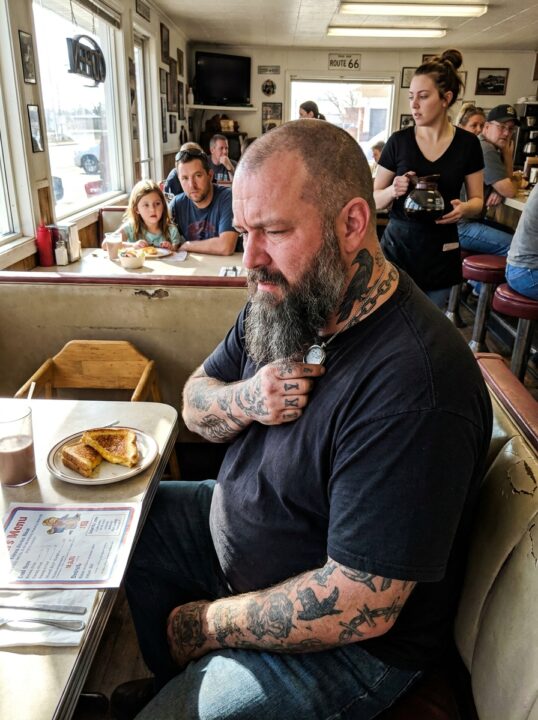
He removed his helmet.
The tattoos reached nearly to his jaw.
One side of his neck showed a black raven with its wings folded. The other carried a line of numbers so faded that I could not read them. Across his throat was a broken chain, each link darkened with age.
Graves came through the door carrying the smell of gasoline, hot leather, and desert wind. He chose booth seven without asking and sat with his back against the wall.
“Coffee?” I asked.
“Black.”
“Food?”
He studied the laminated menu, then turned it over to the children’s section.
“Two grilled cheese. Cut corner to corner. No crust on one.”
I looked toward the empty seat opposite him.
“Someone joining you?”
“No.”
He did not sound unfriendly. He sounded finished.
I brought the coffee and entered the order. When the sandwiches arrived, Graves moved the plate with no crust to the empty side of the booth. He set a chocolate milk beside it, removed a yellow crayon from the cup near the register, and laid it across the children’s menu.
At 4:17, he touched the locket beneath his shirt.
That was the first time I heard the giggle.
I assumed the device was connected to a phone. Voice-message lockets had existed for years, though I had never seen one hanging from the neck of a man who looked capable of pulling an engine from a truck with his bare hands.
The laughter ended.
Graves returned the locket beneath his shirt and drank his coffee.
He left the second sandwich untouched until a young woman entered carrying a sleeping toddler. She counted the money in her purse, ordered water, and asked whether one pancake could be split between them.
Graves stood, carried the untouched plate to her table, and left before she could refuse.
Under the children’s menu, I found a twenty-dollar bill.
That became his Thursday routine.
He never explained why he came at the same time. I learned his name from Deke Rollins, another Iron Mesa Rider who stopped for breakfast one morning.
“Graves isn’t his road name because he puts people in them,” Deke told me. “It’s because he tends the ones everyone else forgets.”
According to Deke, Wade Mercer repaired motorcycles in a cinder-block garage near the old railroad yard. He spent Tuesday mornings maintaining wheelchairs at the veterans’ center and Saturday nights towing stranded riders without charging them.
He had also been arrested four times before he turned thirty.
The last conviction sent him to state prison for twenty-two months.
Deke did not tell me the offense, only that Graves came out quieter than he went in. He stopped drinking, joined the Iron Mesa Riders, and spent the next three decades answering for decisions that could not be erased by good behavior.
I understood why townspeople feared him. His silence left room for them to fill in their own version of his history.
But his hands told another story.
The knuckles were scarred, yes, and the letters HOLD FAST were tattooed across them. Yet his nails were trimmed carefully. He carried small adhesive bandages in his vest. When an elderly woman dropped her cane, he lifted it without touching her arm, waiting until she gave permission.
Children still made him uneasy.
Whenever one approached, Graves’s shoulders stiffened. He spoke in a lower voice and kept both hands visible.
One Thursday, an eight-year-old boy named Mason stopped beside booth seven and stared at the raven tattoo.
“Is that bird dead?” Mason asked.
“No.”
“Why doesn’t it fly?”
“It’s resting.”
“For how long?”
Graves looked toward me as if I had trained the child for interrogation.
“Long enough,” he said.
Mason pointed at the locket. “What’s in there?”
Graves covered it with one hand.
“A sound.”
“What kind?”
“The kind you don’t waste.”
That answer stayed with me.
By November, I had begun setting booth seven before he arrived. Two plates. Two chocolate milks. One black coffee. A yellow crayon.
I told myself I was respecting a regular customer’s habits. The truth was that I had started waiting for those four seconds of laughter.
The giggle was never identical in my memory. Some weeks it sounded bright. Other weeks it carried a tiny catch at the end, as if the child had laughed until she ran out of breath.
Graves listened differently each time too.
On good Thursdays, his eyes stayed open. On difficult ones, he pressed the locket between both hands and leaned forward until his beard almost touched the table.
Once, after a funeral procession passed the diner, he opened it three times.
He ate nothing that day.
I did not ask.
Then, near Christmas, I found an envelope beneath the children’s menu instead of the usual twenty-dollar bill. It contained four hundred dollars and a note written in block letters:
FOR BREAKFASTS. KIDS ONLY. DON’T PUT MY NAME ON IT.
I caught him in the parking lot.
“I can’t take this.”
“You already did.”
“Where did it come from?”
“Work.”
“Why children?”
He fastened his helmet. “They don’t choose what adults break.”
Before I could ask more, the Road King came alive beneath him. The engine shook the silver locket against the tattoos on his chest.
As Graves turned toward Route 66, the wind caught the edge of his vest.
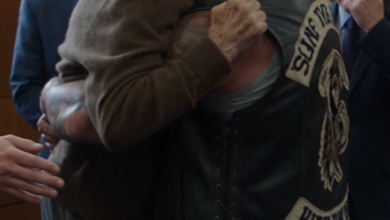
For one second, I saw something sewn inside the black leather.
It was a piece of yellow fabric covered with tiny purple stars.
A child’s handwriting ran along one edge.
Only two words were visible.
DADDY’S ARMOR.
Part 3 — The Day the Diner Turned Against Him
The accusation happened the following June, eleven months after Graves first sat in booth seven.
The Copper Cup was crowded with families escaping the afternoon heat. A youth baseball team occupied three tables near the windows, two truckers were arguing about road construction, and five-year-old Lacey Halpern spun on a counter stool while her father tried to read a work message.
Graves arrived at 4:13.
He looked worse than usual.
Dust covered his boots, and a fresh tear ran along the shoulder of his leather cut. His beard had not been trimmed. When I poured his coffee, I noticed dried blood across two knuckles.
“You hit somebody?” I asked.
“Starter housing.”
“Did it hit back?”
“Won.”
I brought his usual order. Graves placed the no-crust sandwich across from him, added the yellow crayon, and waited.
At 4:17, Lacey laughed at the paper straw wrapper she had launched toward the ceiling.
Graves flinched.
The sound must have found a part of him that had no armor. He lowered his coffee, removed the silver locket, and pressed the black button.
A child giggled from inside.
Lacey heard it. So did her father.
Brent Halpern was thirty-six, broad enough to believe he could handle most confrontations and frightened enough about his daughter to create one before checking the facts.
“Did you record her?” he asked.
Graves looked up. “No.”
“I just watched you press that thing after she laughed.”
“It isn’t her.”
Brent stood. “Then play it again.”
Graves closed the locket.
“No.”
That one word sharpened everything.
A woman near the window lifted her phone. One of the baseball fathers moved closer. The truckers stopped talking.
Brent crossed the aisle.
“Let me see it.”
“Sit down.”
“You don’t get to record children and tell me to sit down.”
Graves’s fingers tightened around the silver case. “I didn’t record your kid.”
“Prove it.”
“No.”
Brent reached toward the chain.
Graves caught his wrist.
The movement was quick enough that half the diner stood. I came from behind the counter and told them both to stop, but another customer had already called the sheriff.
Graves released Brent immediately.
“Don’t touch the locket,” he said.
Brent pulled back, striking the edge of the table. His elbow caught Graves’s hand.
The chain snapped.
The silver oval hit the floor and sprang open. A fractured giggle escaped from the speaker, then warped into a thin electronic cry.
Graves moved so fast that Brent stumbled backward.
But the biker did not attack him.
He dropped to his knees.
“Don’t move,” Graves said.
His voice cracked.
A customer had stepped within inches of the tiny circuit board. Graves crawled beneath the table, ignoring the coffee soaking into his jeans. His scarred hands swept carefully across the tile.
I found the case. Deke, who had entered seconds after the locket fell, located the battery. The speaker rested beneath the counter.
The memory chip was missing.
Graves stood and looked around the diner. His throat worked beneath the broken-chain tattoo, but no sound came out.
Brent still did not understand.
“You could have a hundred recordings on that thing,” he said.
Graves turned toward him.
Deke moved between them.
For twenty years, Deke had served as the man who recognized when Graves was one breath away from becoming the person he had worked to bury. He placed both palms against his brother’s chest.
“Wade.”
Nobody called him that.
“Back door,” Deke said.
Graves did not move.
“Now, brother.”
His fists opened. Closed. Opened again.
Then Lacey crawled beneath her stool.
She emerged holding the memory chip on the tip of one finger.
“Is this the little girl?” she asked.
Graves stared at it.
His knees bent as if the floor had shifted. He lowered himself until he was level with Lacey but remained several feet away.
“That holds her voice,” he said.
“Who is she?”
“My daughter.”
“Where is she?”
Graves looked at the empty plate in booth seven.
“Not here.”
Lacey’s father finally lowered his hands.
The sheriff’s deputy entered at that moment. He saw a tattooed biker kneeling near a child, several customers filming, broken electronics on the floor, and Deke standing between Graves and an angry parent.
The scene looked exactly like the story everyone had already decided to tell.
“Step away from the girl,” the deputy ordered.
Graves obeyed.
The deputy asked whether anyone had been threatened. Three customers spoke at once. Brent said Graves had grabbed him. Another man insisted the locket contained a recording of Lacey.
I held up the broken silver case.
“It was recorded years ago.”
“How do you know?”
I did not.
That was the problem.
Graves could have explained. Instead, he stood beside booth seven with his arms hanging at his sides, watching the memory chip in Lacey’s palm as though every word spoken around him came from underwater.
Deke finally turned to the deputy.
“His daughter died thirteen years ago.”
The room changed.
Phones lowered one by one.
Brent looked at Graves, then at his own child.
“I didn’t know.”
“You didn’t ask,” Deke said.
Graves gave him a warning glance. Deke stepped back.
The deputy examined the locket, took statements, and determined that no recording had been made inside the diner. Brent declined to press charges for the wrist grab. Graves declined to accuse Brent of damaging the locket.
That should have ended it.
Instead, the video appeared online before sunset. The first clip showed only Graves catching Brent’s wrist. Its caption described a “violent biker confronted for recording children.”
A second video showed Graves on his knees speaking to Lacey, but the broken locket could not be seen.
By evening, strangers had identified his repair shop. Someone painted CREEP across the garage door.
Graves did not respond publicly.
He loaded the locket pieces into an old tobacco tin, returned the yellow crayon to its cup, and placed enough cash on the table to cover every meal in the diner.
As he walked out, Brent called after him.
“Mr. Mercer, I’m sorry.”
Graves stopped with one hand on the door.
“You got a little girl?”
“Yes.”
“Then take her home.”
He stepped into the heat and left the second grilled-cheese sandwich untouched.
That night, Deke found Graves sitting on the floor of his dark garage beneath the words someone had painted across the door.
He was holding the empty chain against his chest.
For the first time in thirteen years, 4:17 had arrived without Callie laughing.
Part 4 — The Voice Inside the Metal
I learned Callie’s name the next morning.
Deke brought the tobacco tin to the Copper Cup before sunrise. He placed it on the counter beside my coffee pot but kept one broad hand over the lid.
“Know anyone who repairs old digital recorders?”
“My son works with electronics.”
“How good?”
“Good enough to charge me for fixing my own toaster.”
“This isn’t a toaster.”
I called Owen.
My son was nineteen and spent his mornings repairing hearing aids at a clinic in Kingman. He also bought broken radios, handheld game systems, and old cameras from estate sales, then covered our dining-room table with enough parts to make the house look robbed.
Owen examined the locket under the counter light. The silver case had been bent, the speaker wire torn, and one battery contact flattened. The memory chip appeared intact.
“I can repair the housing,” he said. “But getting the recording back depends on the board.”
“How long?”
“Maybe a day. Maybe never.”
Deke closed the tin.
“He needs better than maybe.”
“That’s what electronics gives you.”
Deke looked at me. “Graves won’t hand it to a stranger.”
“Then why did you bring it here?”
“Because he won’t hand it to anyone.”
Graves had refused every repair offer. He believed the chip would be wiped, copied, or damaged further. The giggle was the only recording he possessed, and surrendering it meant trusting someone with what remained of his daughter.
Deke asked me to visit the garage.
The graffiti had been covered with gray primer when I arrived. Graves sat inside beside his dismantled Road King, polishing the same bolt for so long that the metal had begun to shine brighter than the rest of the engine.
The yellow fabric with purple stars was spread across a workbench.
It had once been a child’s pillowcase.
“Daddy’s Armor” was written across it in blue marker.
Graves noticed me looking.
“Callie made it into a vest lining,” he said. “Mostly tape and crooked stitches.”
“How old was she?”
“Six.”
I placed Owen’s business card beside the bolt.
“He might be able to repair the locket.”
“No.”
“Deke said—”
“Deke talks too much.”
“You trusted the device to survive thirteen years around gasoline, rain, and your chest. You can trust someone long enough to connect one wire.”
His eyes lifted.
“You got children?”
“One son.”
“Alive?”
The question cut more sharply than he intended. Graves looked away before I answered.
“Yes.”
“Then you don’t know.”
“No,” I said. “But I know what silence did to you yesterday.”
He stood so quickly that the stool rolled backward. At full height, with the raven tattoo dark against his throat, he filled the narrow space between the workbenches.
“You heard four seconds in a diner. Don’t tell me what you know.”
I should have left.
Instead, I picked up the pillowcase lining.
The stitches were wild. Purple thread crossed yellow fabric in uneven loops. Small words had been written beside the seams:
POCKET FOR GUM.
POCKET FOR ROCKS.
SECRET POCKET. NO GROWN-UPS.
“Did she make this before she got sick?” I asked.
Graves’s shoulders lowered a fraction.
“After.”
Callie was seven when doctors found a tumor near her spine. By then, Graves had already spent years rebuilding their relationship after prison.
He had missed her second and third birthdays while serving twenty-two months for felony assault. He rarely explained the conviction, but Deke later told me Graves had nearly killed a man during a bar fight. The other man survived. Graves went to prison. Callie learned to walk while her father watched through photographs.
When he returned home, she hid behind her mother.
Graves spent six months earning the right to hold her.
He stopped drinking. Sold his firearms. Took night work repairing motorcycles so he could collect Callie from preschool every afternoon. The broken-chain tattoo across his throat marked the day he decided his daughter would not inherit the life he had built from anger.
Callie forgave him before he forgave himself.
At six, she declared his leather vest “too scratchy and too black.” She made the yellow lining from her pillowcase and demanded that he wear it beneath his club cut.
He did.
When cancer entered their house, the vest went with them to every treatment.
The locket came from a county fair during Callie’s final remission. A vendor sold cheap metal charms that could store a ten-second voice message. Callie wanted one shaped like a star, but Graves chose the silver oval because it looked stronger.
“What did she record?” I asked.
He touched the empty chain.
“I tried to make her say her name. She laughed at my face.”
“That’s the sound?”
“The first four seconds.”
“Why only four?”
“Machine always stopped there.”
“Did you ever ask someone to check it?”
“It worked. You don’t open a working engine looking for trouble.”
At the fair, Callie had worn a purple sun hat and eaten half a cinnamon funnel cake before feeding the rest to a goat. Graves recorded her laughter after powdered sugar landed in his beard.
Three months later, the cancer returned.
She died at 4:17 on a Thursday afternoon.
That explained the hour.
Graves had been holding her hand, but Callie’s mother had been in the hospital hallway arguing with an insurance representative. Their marriage ended within a year. She moved east and took nearly everything that belonged to their daughter because remaining in Arizona had become impossible.
Graves kept the vest lining, three photographs, one yellow crayon, and the locket.
“I don’t have her baby shoes,” he said. “Don’t have her drawings except what’s written on that cloth. I don’t have videos because our computer died before we understood backups.”
His thumb rubbed the place where the chain had rested.
“But I had her laugh.”
I slid Owen’s card closer.
“You still might.”
Graves remained silent for a long time.
Then he opened the secret pocket sewn into the yellow fabric and removed a folded photograph. Callie sat on the shoulders of a younger Wade Mercer, both of them covered in powdered sugar.
On the back, she had written one sentence:
DADDY LOOKS SCARY BUT HE IS TICKLISH.
Graves placed the photograph in the tobacco tin beside the broken locket.
“If your boy copies it, I want to know.”
“He will make a backup if you permit it.”
“No cloud. No phone.”
“Two physical copies. One for you and one sealed somewhere safe.”
Graves nodded once.
That was how the most feared biker on Route 66 trusted a nineteen-year-old hearing-aid technician with the last sound his daughter had left behind.
None of us understood that Owen was about to find more than four seconds.
Part 5 — The Recording Graves Had Never Heard
Owen worked at our dining-room table beneath a magnifying lamp.
Graves refused to leave.
He sat in a wooden chair wearing his leather cut despite the heat, elbows on his knees, while Owen cleaned the memory chip and connected it to a reader. Deke stood near the door. I made coffee nobody drank.
For the first hour, the computer detected nothing.
Graves did not move.
Owen replaced an adapter, checked the voltage, and tried again. A folder appeared containing two damaged audio files.
“Two?” I asked.
Graves leaned forward. “There’s only one.”
Owen raised a hand. “Let me recover them before we decide what they are.”
The first file was 4.3 seconds long.
He clicked it.
Static cracked through the speakers, followed by Callie’s giggle.
Graves closed his eyes.
The sound filled my small dining room differently than it had filled the diner. Without coffee cups, conversation, or accusation around it, the laugh seemed younger. A quick inhalation came first, then three bright bursts and a breathless squeak.
Graves pressed his fist against his mouth.
“Play it again.”
Owen did.
After the fourth playback, Graves opened his eyes.
“Put it back in the locket.”
“I can. But there’s another file.”
“It’s garbage. Machine made noise sometimes.”
“The file is eleven seconds.”
Graves stared at the screen.
“Play it,” Deke said.
“No.”
It was the first time Deke openly challenged him.
“Brother, that girl recorded eleven seconds. You don’t get to bury them because you’re scared.”
Graves stood.
Deke did not step back.
The two men had ridden together for twenty-seven years. Deke had collected Graves from prison, driven Callie to treatment when Graves’s motorcycle broke down, and stood beside him when the child’s casket entered the ground.
“You think I’m scared of a recording?” Graves asked.
“I think you’ve built your whole life around four seconds because four seconds can’t say something you don’t want to hear.”
Graves’s scarred fingers curled.
Owen quietly moved the computer farther from them.
The room held its breath.
Then Graves returned to the chair.
“Play it once.”
Owen opened the second file.
At first, we heard county-fair noise: music, people talking, a carnival worker calling for tickets. Then came Graves’s younger voice.
“Say something, Peanut.”
Callie laughed—the same laugh carried inside the locket for thirteen years.
But this time, it continued.
“Daddy,” she said, still breathless, “you’re supposed to laugh too.”
A lower laugh followed.
Graves’s laugh.
It sounded unguarded, almost boyish. Nothing like the dry grunt he used when Deke told a joke. Callie laughed harder because he was laughing, and the two sounds tangled together.
Then her voice returned.
“Now you can’t forget both of us.”
The file ended.
Nobody moved.
Graves looked toward Owen as though the boy had manufactured the words.
“Again.”
Owen replayed it.
“Again.”
On the third playback, Graves lowered his head. His beard touched his chest, and his shoulders began to move.
Deke turned toward the window.
I watched the man everyone in Kingman considered dangerous place both hands over his face because his daughter had preserved something he never knew he had lost.
Not only her laughter.
His own.
For thirteen years, the locket’s damaged playback contact had stopped after the first audio segment. Graves had opened it thousands of times without knowing Callie’s complete message waited behind the sound he recognized.
She had not recorded the locket only so he could remember her.
She had recorded it because she knew he would forget himself.
Owen recovered both files and saved them to two small memory cards. One went into the repaired locket. The other was sealed inside a waterproof metal capsule.
Graves asked Deke to keep the capsule.
Deke shook his head.
“You need to decide where safe is.”
“You’re safe.”
Three words.
That was all.
Deke accepted it.
Owen straightened the locket case as well as he could, but the impact had left a crease across its face. He offered to polish it away.
Graves stopped him.
“Leave the mark.”
He replaced the chain with a thicker silver one. When the locket settled against his throat, the new metal crossed the broken-chain tattoo.
Owen had changed the button sequence. One press played Callie’s giggle. Two presses played the complete message.
Graves listened to the short recording first.
Then he pressed twice.
“Daddy, you’re supposed to laugh too.”
This time, when the younger Graves laughed through the tiny speaker, the older man gave a rough sound in response. It was too broken to be called laughter, but it was trying.
The next morning, Graves returned to the Copper Cup.
Conversation stopped when he entered.
The online accusation had already been corrected, but corrections travel more slowly than fear. Several customers had seen the first video and not the follow-up. A mother gathered her children closer. One trucker watched Graves’s hands.
Brent Halpern stood beside booth seven with Lacey.
He had been waiting for nearly an hour.
“I owe you an apology,” Brent said.
Graves looked at the repaired locket.
“You owe your girl breakfast.”
“I was protecting her.”
“I know.”
“I should’ve asked.”
“Yes.”
Brent swallowed. “I broke the last recording of your daughter.”
“No. You broke the case.”
Graves pressed the button.
Callie giggled.
Lacey smiled immediately.
Then Graves pressed twice.
Callie’s voice filled the diner.
“Daddy, you’re supposed to laugh too.”
When the recording ended, five-year-old Lacey stepped closer and held out a purple shoelace with tiny yellow stars painted along it.
“It’s so it won’t fall again,” she said.
Graves looked at Brent before accepting it.
Her father nodded.
Graves tied the shoelace around the locket chain, creating a small safety loop that attached to his vest.
The colors matched Callie’s handmade lining.
“Thank you,” Graves told her.
Lacey pointed toward the empty side of booth seven.
“Is that your daughter’s sandwich?”
“It was.”
“Can I sit there?”
Graves’s entire body became still.
For years, nobody had occupied that seat. Customers had asked. Deke had tried once and received a look strong enough to move him elsewhere.
Lacey waited.
Graves pulled the chair out with one boot.
“For today,” he said.
She climbed into the booth.
I brought two grilled-cheese sandwiches, two chocolate milks, one black coffee, and a yellow crayon.
At 4:17, Graves opened the locket.
Callie laughed.
Lacey laughed back.
And after thirteen years, Wade Mercer did too.
Part 6 — The Money Beneath the Children’s Menu
The repaired locket explained the empty chair, but not the money Graves left beneath the children’s menu.
I learned that story several weeks later when an envelope arrived from the Arizona Department of Corrections. It contained a handwritten thank-you note from a twelve-year-old boy named Julian and a photograph of him eating pancakes at the Copper Cup with his grandmother.
The note was addressed to MR. GRAVES.
I showed it to Wade when he came for his Thursday meal.
He read it twice, folded it along the original creases, and placed it inside his vest.
“How does a child in Phoenix know your name?”
“He doesn’t.”
“The note says Mr. Graves.”
“Deke talks too much.”
Deke had revealed the existence of Callie’s Table, a fund Graves had maintained anonymously for nearly ten years.
It began with a breakfast he remembered from prison.
Callie was two years old when her mother brought her to visit him for the first time. The prison was three hours from Kingman. Before entering, they stopped at a roadside diner, where Callie ate half a pancake and drew circles on a paper menu.
Graves saw the yellow crayon tucked inside her coat pocket during the visit.
He asked what she had drawn.
“My daddy coming home,” she said through the scratched glass.
Graves did not come home for another sixteen months.
After his release, he kept that crayon. Years later, Callie used it at the county fair shortly before recording the locket. The same yellow crayon now rested in booth seven, worn short from children who never knew where it came from.
Graves understood what children carried into prison visiting rooms: confusion, shame, long drives, empty stomachs, and questions adults avoided. Once his motorcycle business became profitable, he began leaving money at diners along the routes to Arizona prisons.
The owners received simple instructions. If a family traveling to visit an incarcerated parent could not afford breakfast, the fund paid. No photographs. No public gratitude. No promises that the parent deserved forgiveness.
The children had not committed the crime.
“The money under my menu goes there?” I asked.
“Some.”
“How many diners?”
“Eight.”
“How many families?”
“Don’t count.”
Deke counted.
Over ten years, Graves had covered at least 1,700 breakfasts.
Callie’s Table was named not because Callie had died, but because she had once been the child on the other side of prison glass. Graves said the fund was not charity. It was an installment on a debt no court had ordered him to pay.
After his locket story became known, donations arrived at Mercer Cycle Works. Graves returned the ones bearing conditions or requests for publicity. He accepted small envelopes without names.
Brent Halpern contributed every month.
So did the sheriff’s deputy who had ordered Graves away from Lacey.
Owen began repairing donated handheld games for children facing long drives to correctional facilities. Deke organized riders to deliver restaurant vouchers, although Graves prohibited club patches inside visiting areas.
“Kids have enough people looking at them,” he said.
The Iron Mesa Riders accepted the rule, but not without a fight. Several wanted to turn Callie’s Table into an official club charity. They argued that public attention would raise more money and serve more families.
Graves refused.
During one meeting, Cal Rourke accused him of letting pride restrict the program.
“You hide everything until it breaks,” Cal said. “The locket. The fund. Yourself.”
Graves left before the meeting ended.
For three weeks, Callie’s Table received no new deposits from the club. Riders chose sides. Some believed Graves had earned the right to control anything bearing his daughter’s name. Others believed the work had grown beyond one man’s grief.
The disagreement nearly split the Iron Mesa Riders.
It ended when a woman named Rosa Hernandez entered the Copper Cup with her fourteen-year-old son.
Years earlier, Callie’s Table had purchased their breakfast before Rosa took the boy to visit his father in prison. The child was now an honor student. His father remained incarcerated.
Rosa asked to speak at the club meeting.
“Mr. Mercer never told my son his father was innocent,” she said. “He never told him to forgive. He bought him eggs, gave him a yellow crayon, and let him arrive at the prison without being hungry.”
Then she placed twenty dollars on the table.
“My son has a job now. This buys breakfast for the next child.”
Graves looked at Cal.
“Public enough?”
Cal shook his head. “Human enough.”
They rebuilt the program together.
The name stayed Callie’s Table. Graves agreed to allow a small website listing participating diners, but no photograph of him or Callie appeared. The page contained only a drawing of an empty booth with two sandwiches and a yellow crayon.
Every Thursday at 4:17, Graves continued ordering two meals.
The second plate no longer remained empty for long.
Sometimes Lacey occupied the seat. Sometimes Julian’s grandmother did. Sometimes a child traveling with exhausted parents received the sandwich without knowing why a neck-tattooed biker had ordered it.
Graves never explained unless they asked.
When children wanted to hear the locket, he required them to ask first. If they pressed the button themselves, he kept one hand beneath the silver case so it could not fall.
Most laughed when Callie laughed.
A few became quiet.
One boy asked whether hearing her made Graves miss her less.
“No,” he said.
“Then why listen?”
Graves looked down at the battered crease across the silver.
“Because missing her isn’t the worst thing.”
“What is?”
“Forgetting what I miss.”
Part 7 — When the Locket Opened Again
One year after the locket broke, the Copper Cup held a small gathering for Callie’s twentieth birthday.
Graves had objected to the word party. Lacey solved the dispute by declaring it “a sandwich meeting with cake,” which apparently fell within biker regulations.
The Iron Mesa Riders filled the back half of the diner. Deke brought the waterproof capsule containing Callie’s backup recording. Owen checked the repaired locket. Brent and Lacey arrived carrying yellow flowers tied with a purple shoelace.
Graves took booth seven.
He wore Callie’s handmade lining beneath his leather cut. The fabric had become thin enough that Mara’s old stitches—crooked purple loops crossing faded yellow cotton—needed reinforcement.
Lacey had repaired them.
At 4:17, Graves removed the locket.
The diner became quiet, but it was not the old wary silence. Children leaned forward. Bikers lowered coffee cups. People who had never met Callie waited to receive the smallest thing she had left behind.
Graves pressed once.
Her giggle filled the room.
He pressed twice.
“Daddy, you’re supposed to laugh too.”
The younger Wade laughed through the speaker. This time the older Wade did not fight the sound that answered from his chest.
It came out rough and low.
But it was laughter.
Afterward, Graves took the Road King to the Kingman cemetery. Deke and I followed in my car, while the other riders remained behind to cover every meal served at the Copper Cup that evening.
Callie’s grave stood beneath a mesquite tree at the edge of the property. The marker was simple:
CALLIE ROSE MERCER
SHE MADE THE HARD MAN LAUGH
Graves lowered himself beside it and placed one yellow flower against the stone.
For years, he had visited alone. That evening, he allowed Deke and me to remain several steps behind.
“I don’t have much of hers,” he said, looking at the marker. “Three pictures. That crooked vest lining. A crayon too small to use.”
He lifted the locket from beneath his shirt.
“But I have her laugh right here on my neck. When I miss her voice too much, I open it—and she still laughs with me.”
He pressed the button.
The giggle moved through the dry Arizona air.
A breeze lifted the ends of his beard. Far beyond the cemetery fence, a truck rolled along Route 66. The fading engine noise blended with Callie’s laughter until neither sound seemed entirely separate from the other.
Before we left, Graves opened the locket once more.
This time, he pressed twice.
“Daddy, you’re supposed to laugh too.”
Graves placed two fingers against the stone, then stood.
On the ride back, Deke led. Graves followed, and I watched the silver locket flicker against his throat whenever the setting sun entered the space between his vest and beard.
The metal was no longer smooth. One side was creased from the diner floor. A purple-and-yellow safety cord remained looped through the chain. The speaker sometimes crackled before Callie’s voice began.
Graves refused every offer to replace it.
New things had no history.
That night, a family entered the Copper Cup ten minutes before closing. A tired grandmother carried a sleeping child, while an older boy counted coins near the door.
They ordered water.
I placed two grilled-cheese sandwiches and two chocolate milks on their table.
“Someone already paid,” I said.
The boy looked toward booth seven, but Graves had left.
Only the yellow crayon remained beneath the children’s menu.
Outside, a Harley engine came alive. Its heavy rumble faded east along Route 66, carrying a frightening-looking biker into the desert with his daughter’s laughter resting over his heart.
Somewhere beyond the diner lights, the locket opened again.
And Callie was still laughing.
Follow our page for more biker stories about intimidating men, quiet acts of love, and the small memories they carry through their hardest miles.