Part 2: A Mother Dog Refused to Leave the Rescue Shelter Without Her Mud-Soaked Basket, and the Tattooed Biker Blocked the Door — When We Lifted the Blanket, a Tiny Orphan Was Sleeping Against Her Heart
Part 2 — The Dog Beside the Flooded Culvert
Bear found June at 4:57 that morning, thirty-eight miles north of Flagstaff where Route 89 crosses a dry wash that becomes a river whenever summer rain falls hard enough on the red earth.
The Red Mesa Riders had been returning from an overnight animal transport to Page. Six men rode staggered behind Bear, their V-twins punching through rain so heavy the headlights seemed trapped inside it.
Switch Calder saw the white van first.
It had left the highway, broken through a low fence, and rolled onto its side near the drainage channel. One rear door hung open. Plastic carriers, torn feed sacks, and sections of bent wire cage lay across the mud.
Bear raised one fist.
Six engines dropped into silence.
They expected injured people. Instead, they heard dogs barking from inside the van and a smaller sound coming from somewhere beyond the headlights.
Bear told Switch to call emergency services. Gauge and Morrow climbed onto the van, broke the remaining rear latch, and began passing animal carriers through the open door.
There were four puppies, two adult cats, a sedated Chihuahua, and three empty cages.
No driver.
The rain erased footprints almost as quickly as they formed. A trail led toward the highway, then disappeared beneath runoff pouring from the shoulder.
Bear walked toward the drainage channel.
He heard something beneath a juniper bush—a low warning followed by a thin, irregular cry. When his flashlight crossed the bank, two amber eyes reflected from the darkness.
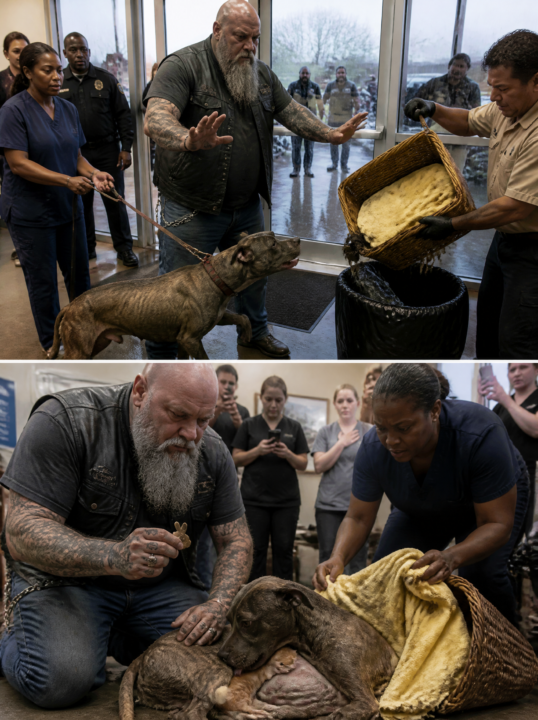
June stood in water reaching halfway up her legs. Her body covered an old wicker basket wedged between a rock and a broken branch.
Bear moved closer.
She showed him every tooth.
He stopped.
Twenty-seven years earlier, inside the Florence state prison complex, Bear had learned the difference between a dog threatening to attack and a dog explaining what she could not afford to lose.
The prison program paired selected inmates with shelter dogs considered too frightened or reactive for adoption. Bear had been assigned a brown hound mix named Rabbit, who bit through two leashes during their first week and slept with her face against the kennel wall.
Bear was serving twenty-six months for receiving stolen motorcycles and lying to investigators.
The motorcycles had been stolen by his younger brother, Dennis Rourke.
Bear took the charge because Denny had a pregnant girlfriend, a five-year-old stepson, and a talent for promising that one final rescue would change him. Bear believed prison would destroy his brother.
Instead, the lie preserved him.
Rabbit did not care about the reasons.
She responded to patience, distance, food placed without demands, and hands that stopped moving whenever she became afraid. Bear trained her to tolerate a collar, enter vehicles, ignore loud doors, and trust strangers one careful inch at a time.
When Rabbit graduated as a mobility-assistance dog for an injured schoolteacher, Bear made a brass tag shaped like a rabbit from workshop scrap. He scratched his initials into the back and attached it to the wicker bed she used during training.
The teacher kept the tag until Rabbit died twelve years later. Then she returned the bed to Bear, who had become president of the Red Mesa Riders and converted one section of their garage into an emergency animal-transport room.
The basket stayed there.
Until it disappeared.
Bear had noticed it missing six months before the flood. Denny sometimes helped repair the club’s transport trailer, and Bear assumed his brother had borrowed the basket for one of the stray dogs he claimed to be fostering.
Bear asked once.
Denny said he knew nothing about it.
Bear accepted the answer because accepting it was easier than opening every old door between them.
Now the basket sat beneath a terrified mother dog beside an overturned van.
Bear recognized the green rope first. The Red Mesa Riders sealed the ends of their rescue rope with orange heat shrink so it could not be confused with motorcycle tie-downs. A piece of that orange material remained near the knot.
He recognized the weld on the van next.
The rear hinge had cracked the previous winter. Denny repaired it at the club garage, leaving a crescent-shaped bead where the torch angle had slipped.
Bear told himself that hundreds of white vans carried imperfect welds.
Then he saw two ghosted rectangles on the doors where magnetic signs had been removed.
Red Mesa Animal Transport.
Someone had used the club’s reputation to move animals.
Bear said nothing to the other riders.
That failure would cost him later.
At the culvert, he removed his leather cut and placed it on the mud. June’s eyes followed the vest. Bear pushed it forward with one boot, giving her a dry surface without entering the circle she defended.
“Not taking it,” he said. “Taking both.”
June did not understand the words. She understood that he had stopped advancing.
Bear waited through rain, approaching sirens, and the impatient shouts of a deputy who wanted him away from the flood channel. After twenty minutes, June stepped onto the leather.
Bear lifted the basket first.
It was heavier than wet blankets should have been, but water sloshed through the broken wicker, and June lunged whenever he tilted it. He assumed rocks or debris had collected beneath the fabric.
He secured it to his Harley.
June refused the animal-control truck. She planted her paws, pulled backward, and stared at the basket already strapped to Bear’s motorcycle.
Bear opened the sidecar used for emergency animal transports.
She climbed in.
He fixed a safety harness around her chest, covered her with his cut, and rode south at forty miles an hour while the storm struck his bare arms like thrown gravel.
June never took her eyes off the basket.
Behind them, Switch’s helmet camera recorded the overturned van, the empty cages, and one brief image nobody examined until the following day: Denny Rourke standing beyond the guardrail in a torn gray shirt, watching his brother ride away with the evidence.
Part 3 — The Kitten Whose Heartbeat Began to Fade
The orange kitten stopped breathing properly six minutes after we opened the blanket.
One moment its paws were kneading June’s belly. The next, its body went loose inside my hands.
Dr. Asha Patel carried it toward the treatment wing while I followed with June. Bear lifted the basket and came behind us, ignoring the security guard who still believed he might become violent.
The kitten weighed eleven ounces.
Its temperature was below the lowest reliable reading on our intake thermometer. Fleas moved through the damp fur around its neck. Its gums were pale from blood loss, one hind leg was swollen, and mud had dried inside both nostrils.
Dr. Patel placed it beneath warm oxygen.
June tried to climb onto the examination table.
When I held her leash, she turned and seized the nylon between her teeth. She did not bite my hand. She bit through the thing keeping her from the kitten.
Bear stepped between us.
I expected him to grab her collar.
Instead, he lowered the wicker basket beside the oxygen unit and sat on the floor with his back against the cabinets. June entered the basket, curled around its broken edge, and pressed her nose to the clear incubator wall.
The kitten’s chest lifted.
Stopped.
Lifted again.
Bear rested one scarred hand on the tile. June placed her paw across two of his fingers.
That was how they waited.
We called the kitten Cricket because the first sound it made resembled the insect trapped behind our break-room refrigerator. It was too weak to nurse safely, so Dr. Patel gave warmed fluids beneath the skin and glucose along the gums.
A donor cat named Amos provided blood for a transfusion.
June watched every needle.
Bear watched June.
I cleaned the cut on his arm while he remained seated beside the basket. He had needed seven stitches since morning, but he refused to leave the treatment room.
“Did you know the kitten was there?” I asked.
“No.”
“You knew something was inside.”
“Knew she did.”
“That isn’t the same thing.”
“It was enough.”
His telephone vibrated repeatedly. Each time, the name DENNY appeared across the screen.
Bear turned it facedown.
At 7:18 p.m., Cricket’s heartbeat became irregular. Dr. Patel asked us to remove June because the dog’s attempts to reach the incubator interfered with treatment.
We led her into the recovery room.
June threw her body against the door.
Once.
Twice.
On the third impact, Bear stepped into her path. He took the force against his thighs, dropped to one knee, and held the wicker basket between them.
“No,” he said.
June trembled. Milk dripped onto the blanket.
Bear folded his leather cut inside the basket, covering the place where Cricket had slept. June climbed in, buried her nose against the vest, and went still.
The biker smelled of gasoline, wet leather, road coffee, and antiseptic. None of it should have calmed a frightened mother dog.
Yet his vest carried the kitten’s scent.
For the next hour, Bear remained on the floor while June lay half across his legs. The letters tattooed on his knuckles spelled HOLD FAST. At first, I had taken them for another biker warning.
That night, they looked like instructions he had written to himself.
Cricket’s heart steadied shortly before eight.
We were not given time to celebrate.
A man entered the lobby wearing a dry denim jacket despite the storm. He was shorter than Bear and thinner through the shoulders, but the resemblance lived in the gray eyes, flattened nose, and habit of looking at every exit before addressing anyone.
Dennis Rourke placed a waterproof folder on my desk.
Inside were veterinary invoices, a microchip registration, and a breeding certificate identifying June as Belladonna of Northern Star Kennels.
Denny called her Bella.
June did not respond.
He claimed the van had been stolen from his property that morning. He claimed unknown thieves loaded several animals and crashed while escaping. He claimed he had spent hours searching before learning that Bear had brought his dog to us.
The documents looked legitimate.
The microchip matched.
Denny wanted June released immediately.
He also wanted the basket.
When I told him about Cricket, his face changed for less than a second. His surprise was not that a kitten existed.
It was that the kitten remained alive.
Bear saw it.
So did I.
Denny smiled and said the kitten must belong to one of the rescued cats. He offered to take both animals home, where June could continue caring for it.
Dr. Patel refused. Cricket was an active medical patient and could not leave.
Denny turned toward Bear.
“Tell them.”
Bear did not move.
“Tell them Bella is mine.”
Bear’s voice came rough. “Paper says she is.”
“Then we’re done.”
“No.”
The Red Mesa Riders began arriving outside. The low rumble of their motorcycles moved through the shelter walls until metal bowls rattled inside the kennel runs.
Denny looked pleased.
He believed the club had come for him.
For most of their lives, Bear had arrived whenever his brother called. He paid debts, repaired vehicles, found jobs, spoke to angry wives, and explained Denny’s absences to children who were old enough to recognize another lie.
In return, Denny called that protection brotherhood.
The distinction had never been tested in front of twenty frightened animals.
Deputy Lena Ortiz arrived and examined the documents. She explained that the shelter could hold June temporarily because of the crash and visible injuries, but ownership law still treated animals largely as property.
Unless we could prove neglect, theft, or criminal transport, Denny might reclaim her after the emergency hold.
Bear’s riders filled the lobby.
Gauge locked the front door. Morrow lowered the blinds. Switch stood close enough to Denny that the smaller man stopped smiling.
I told them all to leave.
Nobody moved.
Bear rose from beside June. He was still wearing a bloodstained T-shirt, without his leather cut, and somehow looked more dangerous because he no longer carried the thing identifying him as a club president.
Denny stepped backward.
Bear could have frightened the truth out of him.
Everyone in the room knew it.
Instead, Bear held out his motorcycle key.
“Switch.”
The rider took it.
“Why?” Denny asked.
“So I don’t follow you.”
Bear turned to Deputy Ortiz.
“Search our garage.”
The room went silent.
“Search the transport trailer, accounts, parts lockers, everything,” he continued. “Van’s been in our shop. Basket came from us. If my club touched this, you need the records.”
Gauge stared at him. “Bear, that trailer carries medical donations without individual receipts.”
“I know.”
“Our charity license is under review.”
“I know.”
“A full search could close the program.”
Bear looked toward June, who remained curled around the empty place where Cricket had been.
“Then open every door.”
That was the first time Denny appeared truly afraid.
Cricket survived the night.
By dawn, June was allowed to lie beside the incubator again. She pressed her body against the clear wall, and the kitten dragged itself toward her warmth.
We believed that was the crisis.
We believed keeping Cricket alive and preventing Denny from taking June would be enough.
Then Switch reviewed his helmet footage from the flood.
The camera showed June leaving the basket.
She ran toward the overturned van through water deep enough to lift her hind legs. Thirty seconds later, she returned carrying the orange kitten gently in her mouth.
She had not merely guarded an orphan she happened to find.
She had gone back for it.
And the footage showed Denny watching her do it.
Part 4 — What the Helmet Camera Saw in the Rain
We played the video four times.
The first three, everyone watched June.
On the fourth, we watched Denny.
He stood beyond the guardrail with mud on his jeans and blood on one sleeve. He was not injured badly enough to prevent movement. He had reached the highway, found stable ground, and chosen to remain hidden while his animals struggled inside the overturned van.
June appeared at the edge of the frame.
She was already limping.
She crossed the flooded ditch, entered through the damaged rear door, and disappeared. When she emerged, Cricket hung from her mouth.
The kitten’s mother lay inside a broken carrier. Dr. Patel later determined that the adult cat had died during the rollover. Cricket was the only kitten listed in that carrier, though a smear of fresh ink suggested someone had altered the transport sheet.
June carried Cricket toward the basket.
Denny watched.
He did not help her.
When Bear approached, Denny moved farther behind the guardrail and called someone from a second phone that investigators had not yet recovered.
Switch paused the recording.
“Say the word,” he told Bear.
It was not an invitation to speak.
It was an offer.
The Red Mesa Riders could find Denny before police built a case. They knew the back roads, storage properties, abandoned service stations, and mechanics willing to hide a van. Several club members had lived long enough outside the law to understand its blind corners.
Bear understood too.
He looked at each rider.
“No one touches him.”
Morrow kicked a plastic chair hard enough to crack one leg. Gauge accused Bear of letting Denny use the club for months. Switch demanded to know why Bear had not identified the van at the flood scene.
Bear answered without defending himself.
“I knew the weld.”
The words landed badly.
“You knew?” Gauge asked.
“Knew he fixed it. Saw our rope. Saw the missing signs.”
“And said nothing?”
“Yep.”
Denny laughed from beside Deputy Ortiz.
That sound nearly broke the room.
Switch crossed the lobby before anyone could stop him. Bear caught his vest with one hand and drove him against the wall, not to hurt him but to prevent him from reaching Denny.
The two bikers stood chest to chest.
“You covered your brother,” Switch said.
“I hesitated.”
“Same thing to that dog.”
Bear released him.
“I know.”
Deputy Ortiz separated everyone and placed Denny outside while another unit arrived. She still lacked grounds to arrest him. The video showed cowardice, not necessarily ownership fraud or intentional cruelty.
The search of the Red Mesa garage began at noon.
Investigators found copied vaccination certificates, blank microchip forms, unregistered cash payments, and animal carriers with identification numbers filed away. They found three magnetic Red Mesa Animal Transport signs behind Denny’s workbench.
They also found a ledger.
Gauge had kept it because he distrusted electronic accounting. Every animal the club moved was listed with a date, origin, destination, driver, vehicle, and fuel receipt.
Denny’s van appeared seventeen times.
Only six trips were authorized.
On the other eleven dates, he used the club’s signs to collect animals from backyard breeders, overcrowded rural properties, and people advertising “free puppies” online. He told sellers the animals were going to rescue partners.
Many were not.
Some were sold through a kennel registered under his girlfriend’s name. Others went to unlicensed brokers who moved puppies across state lines.
June had delivered five puppies twenty-three days before the crash.
Denny sold all five the morning of the storm.
He had separated them from June before they were old enough to leave her safely. Then he loaded June into the van with animals acquired elsewhere because another breeder in Nevada wanted an adult female who had already produced a healthy litter.
June’s search for puppies at our shelter was not confusion.
She was looking for babies taken hours before she escaped.
Cricket had been the only newborn left near her.
That explained the milk.
It did not explain the choice.
Dr. Patel said maternal hormones could cause a dog to accept young from another species, especially after losing her own litter. She warned us not to turn June into a sentimental symbol. The dog had not performed a miracle for an audience. She had responded to a cry with the body, instincts, and milk she possessed.
Bear understood that better than reporters did.
By afternoon, the flood footage had reached local news. Calls came from national pages asking to film June nursing Cricket. One producer wanted Bear to recreate carrying the basket through our lobby.
He refused.
“They were drowning,” he said. “Not auditioning.”
The producer offered money to the shelter.
Bear still refused, though he had no authority to decide for us.
I refused too.
That surprised him.
Denny’s attorney then produced another problem. The breeding certificate and microchip remained in Denny’s name. Unless charges were filed quickly, he could petition the court for June’s return.
Our evidence proved illegal use of the club’s identity and possible fraud. It did not yet prove Denny personally owned or operated the breeding kennel.
His girlfriend had signed most documents.
Denny smiled whenever Deputy Ortiz explained the distinction.
Then Bear asked for the brass rabbit tag.
I brought it from the evidence bag.
The tag seemed insignificant beside ledgers and stolen transport signs. Bear turned it over, revealing a number stamped along the lower edge.
FSP-1174.
It was the inventory number from the prison dog-training program.
Bear explained the basket’s history, Rabbit’s training, and its eventual donation to the Red Mesa Riders. The club’s insurance records listed the basket as part of an emergency kit stolen six months earlier.
Denny had submitted the theft claim himself.
He reported that the entire kit had disappeared during a break-in, then accepted reimbursement on behalf of the club. No break-in had occurred.
The basket inside his van proved insurance fraud.
More importantly, the original emergency kit had contained a battery-powered temperature recorder used while transporting newborn animals. Investigators searched the van again.
They found the recorder lodged beneath a rear seat.
Its memory contained six months of location data.
The device had traveled to kennels, rural sales sites, parking-lot exchanges, and the storage building where Denny kept animals before transport. It recorded the van’s location throughout the morning of the crash.
It also recorded an eighteen-minute stop at Northern Star Kennels, where June’s puppies disappeared.
Deputies obtained a warrant.
The storage building held thirteen dogs, seven cats, falsified health certificates, sedatives, and a notebook containing the names of buyers who had purchased June’s litter.
All five puppies were alive.
Two were already across state lines, but investigators located them.
When Deputy Ortiz told us, June was feeding Cricket from a bottle Dr. Patel held against her belly. The kitten’s paws pressed into the dog’s skin while milk moved through the tube.
Bear listened to the news without smiling.
“Bring them back?” he asked.
“Not immediately,” Ortiz said. “They’re evidence, and some are with families who may not know how they were obtained.”
Bear nodded once.
Denny was arrested at 6:41 p.m.
He asked Bear to pay his bond.
Bear stood outside the shelter while rainwater dripped from the awning between them.
“You did time for me once,” Denny said. “You know what that place does.”
Bear’s scarred hands closed.
Then opened.
“I know what I did for you.”
“We’re blood.”
Bear looked through the clinic window at June lying beside a kitten that did not share one drop of hers.
“No,” he said. “Blood isn’t the word you need.”
The deputy closed the cruiser door.
Only after the vehicle left did Bear’s hands begin to shake.
Part 5 — The Home Check Nobody Expected Bear to Pass
Cricket remained in intensive care for nine days.
June stayed beside her.
Because the kitten could not nurse continuously, our staff fed her through a small tube every two hours. June cleaned her afterward, nudged her beneath the blanket, and growled at the incubator alarm whenever it sounded.
She did not growl at us again.
The old basket remained between the treatment table and June’s bed. We disinfected what could be cleaned, reinforced the broken wicker with medical tape, and replaced the contaminated lower pad while preserving the yellow blanket after it passed sanitation.
Bear visited before opening and after closing.
He never brought cameras.
He brought supplies: kitten formula, puppy pads, clean towels, two heating discs, and a spreadsheet prepared by Gauge showing every Red Mesa transport for the previous three years.
The club had lost permission to move shelter animals while investigators completed the audit.
Six members blamed Bear.
Three blamed Gauge for keeping incomplete donation receipts. Two left the club entirely because they believed cooperating with police violated brotherhood.
Bear did not remove their names from the wall.
“They rode with us,” he said. “Leaving doesn’t erase miles.”
The remaining riders sold a half-restored Harley to pay for temporary commercial transport so rural shelters would not lose services during the suspension. Bear offered his motorcycle first.
The club refused.
His black touring Harley had pulled eighteen animal trailers and carried June from the flood. Selling it would have punished the work rather than corrected the failure.
Instead, they sold a custom chopper Denny had helped build.
Nobody argued.
During Cricket’s fifth night, I found Bear asleep in a chair outside the recovery room. June’s leash was looped loosely around his wrist. The leather cut covered his chest, and a photograph had slipped from its inside pocket.
It showed a younger Bear standing beside Rabbit and the schoolteacher who received her. He still had dark hair, a shorter beard, and the uncertain posture of a man recently released from prison.
Rabbit sat between them in the same wicker basket.
On the back, the teacher had written: You taught her that doors can open without someone leaving her behind.
Bear woke while I was reading it.
I apologized.
He folded the photograph and returned it to the hidden pocket.
“Why didn’t you take Rabbit after prison?” I asked.
“She had a job.”
“Did you want her?”
“Yep.”
“You gave her away anyway.”
“Wasn’t giving. Was fitting.”
That became important two days later when Claire, June’s original foster volunteer, withdrew.
She had agreed to one adult dog. Her landlord would not permit a cat, and separating June from Cricket was no longer medically necessary but remained emotionally risky.
Other foster homes offered to take Cricket.
June refused every trial separation.
If the kitten left the room, June paced until her paws bled. If Cricket cried from behind a door, the dog pressed her nose against the bottom gap and stopped eating.
Dr. Patel believed the behavior could ease gradually. She also believed forced separation during recovery might undo the trust June had begun forming with people.
We needed a home for both.
Bear submitted an application.
I nearly rejected it before reading the second page.
His felony conviction appeared near the top. So did his ownership of two motorcycles, his residence above a repair garage, and his admission that he sometimes worked twelve-hour nights.
On paper, he looked wrong for a recovering mother dog and a medically fragile kitten.
Then we conducted the home check.
The apartment above the Red Mesa garage had a private entrance, washable floors, secured windows, locked cabinets, and a spare bedroom already cleared for foster animals. Bear had built a low ramp beside the stairs and enclosed part of the freight elevator so June would never need to climb.
A veterinary clinic stood four blocks away.
Gauge lived in the adjoining unit. Switch worked daytime hours below. Three club members had completed animal first-aid training. A whiteboard listed feeding times, medication intervals, emergency numbers, and who would sleep in the spare room during Cricket’s first week.
Bear had even removed the hanging motorcycle chains because he worried a kitten might climb them.
“Who designed all this?” I asked.
He pointed toward the men arguing over a baby gate.
“Brothers.”
The word meant something different now.
Bear’s application still required a personal reference. He listed a retired schoolteacher named Helen Alvarez.
Rabbit’s handler.
Helen arrived using a cane, carrying the original records from the prison dog program. She told me Bear had visited Rabbit every year until the dog died at sixteen. He repaired ramps, paid for medication anonymously, and sat on the porch during Rabbit’s final night without asking to be recognized as her first trainer.
“He thinks love means knowing when something belongs somewhere else,” Helen said. “Sometimes he forgets it can also mean letting something stay.”
Bear heard her.
He walked outside.
The home check passed.
We scheduled June and Cricket’s foster-to-adopt release for the following Monday. Bear arrived with his touring Harley and an enclosed animal trailer rather than the sidecar.
The repaired basket had been secured inside with four straps. A padded crate surrounded it, leaving June room to lie beside Cricket without the kitten moving freely during transport.
June entered the trailer.
Then she came back out.
For one frightening moment, I thought she had rejected Bear’s home. She walked past me, returned to the treatment wing, and stopped beneath the empty incubator where Cricket had spent her first night.
Bear waited.
June sniffed the floor, turned, and walked back to the lobby.
She was not refusing to leave.
She was checking that she had forgotten nobody.
I placed Cricket inside the basket.
June climbed in beside her.
Bear closed the trailer gate but left the outer door open while he checked each latch twice. Three riders signed the transport card. Gauge photographed the seals, not the animals.
Before leaving, Bear handed me the brass rabbit tag.
“It belongs with the basket,” I said.
“No.”
He pointed toward our emergency supply cabinet.
“Next one.”
We attached the tag to a clean rescue basket prepared for whatever frightened animal came through our doors after dark.
The old basket went home with June.
That evening, Bear sent one photograph.
June lay inside the spare bedroom with Cricket sleeping beneath her chin. The room was plain. The light was bad. Bear’s enormous boot appeared accidentally at the edge of the frame.
There was no caption.
None was needed.
Part 6 — The Saturday Basket Run
Cricket grew into the kind of cat who treated rules as temporary suggestions.
At six weeks, she climbed Bear’s jeans. At three months, she slept inside his motorcycle helmet. By six months, she had learned to hook one paw into his beard whenever he tried to stand before she finished resting on his chest.
June tolerated everything.
She cleaned Cricket’s ears long after the kitten could clean them herself. She carried toys back to the old basket and waited beside the garage door whenever Cricket disappeared upstairs.
Bear completed the adoption after ninety days.
The Red Mesa Riders passed their audit with penalties. They lost two sponsors, paid restitution for misused insurance funds, and accepted a two-person authorization rule for every vehicle, animal pickup, and cash expense.
Their transport privileges returned in winter.
The first Saturday afterward, Bear placed the reinforced wicker basket inside the club trailer. June rode beside it in a secured compartment, while Cricket traveled in a fastened carrier where she could see the dog.
They delivered formula, blankets, heating pads, and small digital scales to five rural shelters.
The club called it the Basket Run.
Bear hated the name because reporters liked it.
The name stayed.
Once each month, riders gathered outside Red Rock County Animal Rescue before sunrise. Their engines rolled across the empty parking lot, then stopped together so frightened animals inside would not endure unnecessary noise.
Bear always entered last.
He checked the brass rabbit tag hanging from our clean emergency basket, left supplies beside the intake desk, and visited whichever animal had arrived during the night.
He never asked whether June’s puppies remembered her.
All five were recovered and placed through licensed rescues after Denny’s case ended. Two adopters sent photographs. Bear kept them in a sealed envelope but never showed June.
“She has Cricket,” he said.
It sounded simple.
It was not.
Dennis Rourke pleaded guilty to fraud, animal cruelty, unlawful transport, and falsifying veterinary documents. He received prison time and a permanent prohibition against breeding or commercially transporting animals.
He wrote Bear three letters.
Bear opened the third.
Nobody knew what it said. He folded it once, placed it inside the pocket with Rabbit’s photograph, and returned to work.
One stormy Saturday, a new volunteer tried to discard a cracked plastic pet bed brought in with a frightened shepherd.
June stood beside the disposal cart and stared at Bear.
He checked the bed carefully.
Nothing lived beneath the towel.
Only then did June walk away.
Bear kept the bed anyway until the shepherd entered foster care.
Some habits begin as fear.
Others become a promise.
Part 7 — When Another Small Cry Came Through the Door
Two years after the flood, June’s muzzle had begun turning white.
Cricket was no longer small. She had become a broad orange cat with one folded ear and an unreasonable belief that every leather jacket belonged to her.
The old wicker basket remained beside Bear’s workbench.
Its handle leaned to one side. Medical tape covered the crack, and the yellow blanket had faded almost cream after repeated washing. Cricket slept there during the day. June slept beside it at night.
Bear never repaired the wicker completely.
“Still holds,” he said.
On the anniversary of the storm, I arrived at the shelter before dawn and heard a motorcycle beneath the awning.
Bear stood outside with rain moving through his gray beard. June waited in the covered sidecar, secured by a chest harness, while Cricket watched from a locked carrier fitted behind the seat.
Bear carried the old basket.
A teenage volunteer opened the door and told him we already had clean beds.
Bear looked at me.
I laughed.
“The basket comes too.”
He set it beneath the intake desk while the Red Mesa Riders unloaded supplies. Their patches were wet. Their boots tracked mud across the same tile where June had once fought to protect what we nearly threw away.
At 6:12, animal control arrived with a tiny black kitten found beside a highway rest area.
The kitten was cold and calling for a mother who had not been located.
June heard it.
She rose slowly from the sidecar, walked into the lobby, and stopped beneath the carrier. She had no milk now. Her joints were stiff, and she could no longer climb stairs without Bear walking beside her.
Still, she lay down.
The volunteer placed the carrier near her after Dr. Patel completed the examination. June pressed her body against its plastic wall, giving the kitten warmth without touching it.
Cricket jumped into the old basket and watched.
Bear lowered himself to the floor. His knees cracked loudly enough to make the volunteer smile. June rested her head across one of his boots.
No one reached for the basket.
No one asked whether the animals belonged together.
Outside, twenty motorcycles started one after another. The V-twins shook rain from the awning and sent a low vibration through the shelter windows.
Bear stayed until the kitten stopped crying.
Then he lifted the basket, secured Cricket’s carrier, checked June’s harness twice, and walked toward his Harley.
At the door, he looked back at the clean emergency basket beneath our intake desk. The brass rabbit tag moved slightly against its handle.
A small sound.
Almost a bell.
Bear nodded once and stepped into the rain.
June rode beside him.
Cricket rode behind.
The old basket went home too.
Drop BEAR in the comments and follow the page for more biker stories about rough hands protecting the small and forgotten.