A Homeless Boy Stole a Biker’s Harley Key and Threw It Down a Storm Drain — Then the Crowd Saw What Someone Had Done to the Brakes
Part 2 — The Name That Silenced Twelve Engines
My name is Mara Bennett, and I had worked at Ruthie’s Roadhouse for seventeen years before the morning Eli Cole threw Ray Dawson’s key into our storm drain.
I had witnessed fistfights, marriage proposals, three roadside births, one tornado, and a loose pig that ate half our breakfast buffet. Nothing had ever silenced that parking lot like the name Samuel Cole.
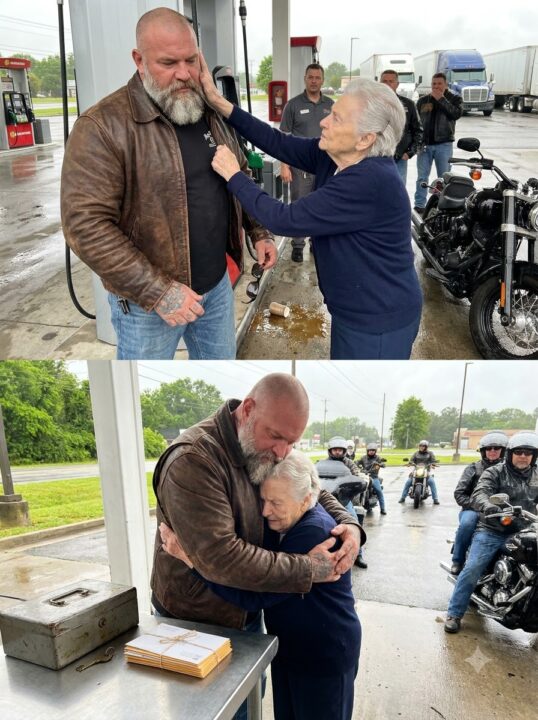
Ray remained crouched beside the damaged Harley. Eli stood three feet away, rubbing the red marks Deke’s fingers had left on his arms. The other bikers stared at the brass motorcycle charm as if it were a dog tag recovered from a battlefield.
Deke spoke first.
“Sparrow didn’t have a kid.”
“He had me,” Eli said.
The old biker flinched.
Ray rose and turned toward him. “Ease up.”
“I’m asking.”
“No. You’re accusing.”
Deke’s jaw tightened, but he stepped back.
Ray carried the boy inside, not because Eli could not walk, but because the grocery bag around his foot had torn open. The child protested until Ray placed him in a booth and told him to stop being stubborn.
“That rich coming from you,” Preacher said.
Ray ignored him.
I brought towels, warm water, and the first-aid kit. Eli’s exposed foot was gray from cold, with two infected cuts along the heel. When I reached for it, he jerked away so sharply his knee struck the table.
Ray noticed.
He did not touch the boy again without asking.
“Can Mara clean that?” he said.
Eli looked toward the windows, measuring the distance to every exit. “Police coming?”
“The sheriff is.”
“Then no.”
“You stopped me from riding a dead brake down Black Hollow Hill.”
“Doesn’t make the key mine.”
Ray pulled two twenty-dollar bills from his wallet and placed them on the table. “That covers a locksmith.”
“I don’t want your money.”
“Ain’t for you.”
Eli looked confused.
Ray pointed toward me. “Pays the diner for whatever you’re about to eat.”
Eli glanced at the second half of his sausage biscuit.
Then he ordered toast.
Only toast.
Ray ordered eggs, bacon, potatoes, pancakes, and milk. He pushed the plates across the table without commenting when Eli ate fast enough to cough. The boy then wrapped two strips of bacon in a napkin and tucked them into his sweatshirt.
“For somebody smaller?” I asked.
He nodded.
“Who?”
“Girl named Wren. She sleeps by the bus station.”
Ray’s expression changed, but he asked no more.
Sheriff Lena Ortiz arrived fifteen minutes later. She was five-foot-seven, wore no patience on her face, and had known the Iron Hounds long enough to begin with Ray instead of the child.
“Explain the brake.”
Ray showed her the line.
Lena photographed the cut, collected a smear of green paint from the underside of the fender, and asked who had been near the motorcycles. Eli described Silas Voss, the tow truck, the blade, and the direction he had driven.
At the name Voss, Lena stopped writing.
“You lived with him?”
“For six months.”
“County placement?”
Eli nodded.
“Why did you leave?”
The boy’s eyes went toward the windows again.
Ray slid out of the booth and stood between Eli and the twelve men watching him. “Everybody outside.”
Deke objected. “Hammer—”
“Outside.”
Leather creaked. Boots moved. Eleven intimidating men obeyed without another word.
Once the room cleared, Eli told Lena about the stolen motorcycle parts, the burned backpack, and the other children Silas had used to enter garages through windows too narrow for adults. He mentioned Cody, a fourteen-year-old who had been removed after Ray visited the tow yard.
He did not mention what Silas had done to him.
Not directly.
He said only, “I knew what his angry steps sounded like.”
Lena understood.
So did I.
The sheriff called the county child-protection office, then dispatched deputies to Silas’s tow yard. She also asked for paramedics to examine Eli’s foot.
“No ambulance,” he said.
“It doesn’t mean trouble,” Lena replied.
“It always means I go somewhere.”
Ray sat across from him again. “Sometimes somewhere is warmer.”
“Until they send you back.”
No biker had an answer for that.
While we waited, Ray examined the brass charm more closely. He turned it over, thumb rubbing the bent wheel.
Samuel “Sparrow” Cole had made twelve charms like it from scrap brass fifteen years earlier. Every original Iron Hound received one on the day the club delivered its first load of school supplies to tornado survivors in Picher, Oklahoma.
Ray still carried his inside his vest.
He removed it.
The two tiny motorcycles were nearly identical, except Eli’s had a small notch carved across the rear fender.
“S means Samuel?” Eli asked.
“S means Sparrow.”
“That was Dad’s road name.”
“We know.”
Eli stared around the diner. “You rode with him?”
Ray looked toward Deke through the glass.
“Until we failed him.”
Eight years earlier, Sparrow had been the Iron Hounds’ treasurer. Fourteen thousand dollars disappeared from a winter-relief account three days before the club was supposed to purchase heaters for thirty-two families.
The bank records showed Sparrow’s access code.
His garage closed overnight. His rented house was empty. His phone went dead near the Kansas line. When police found his pickup abandoned beside the Spring River, there was blood inside—but no body.
Some members believed he had died.
Others believed he had staged the scene and fled with the money.
Deke believed the second.
Ray never chose aloud.
That silence became its own accusation.
The Iron Hounds removed Sparrow’s name from the clubhouse wall. They held no memorial ride. They buried an empty coffin privately so Sparrow’s mother would have somewhere to place flowers, then refused to wear club colors at the service.
Eli listened without blinking.
Finally, he reached for the charm.
“My dad didn’t steal.”
Ray placed it in his palm.
“I know that now.”
“How?”
“Because three months ago, somebody mailed me the missing ledger.”
“Who?”
“Your father.”
Eli’s hand closed.
“My dad died six years ago.”
Ray’s eyes hardened.
“Then somebody has spent six years pretending to be a dead man.”
Part 3 — Seven Miles of Black Hollow Hill
The missing Harley key remained beneath three feet of rainwater, leaves, cigarette filters, and road grit.
Ruthie’s maintenance man removed the grate while one of the Iron Hounds held a flashlight. They found the key lodged against a crushed soda can forty minutes later.
Ray did not put it back into the ignition.
First, he pushed the motorcycle into an empty service bay behind the diner. Sparrow had taught him that when one failure looked intentional, a man checked everything.
They found the second cut beneath the rear fender.
Then a loosened axle nut.
Then a narrow puncture in the fuel hose positioned above the rear exhaust pipe.
The brake failure might have sent Ray off Black Hollow Hill. The leaking fuel could have ignited before he reached it.
Silas had not intended to frighten him.
He intended to erase him.
Deke paced outside the bay while Lena photographed the damage. “We go to the tow yard.”
“No,” Ray said.
“He tried to murder our road captain.”
“He also has kids in his system.”
“We wait, he runs.”
“We charge in, he destroys evidence or hurts whoever’s inside.”
Deke pointed toward Eli. “That boy knows the property.”
Ray stepped between them. “That boy isn’t a map.”
“I didn’t say use him.”
“You looked at him when you said it.”
Deke’s face darkened.
Eight years earlier, Deke had been the loudest voice demanding that Sparrow lose his patch. He had called him a thief in front of the entire club. He had voted to remove his name from the wall.
Now Sparrow’s son had saved Ray’s life.
Deke did not know where to put that weight.
The paramedics cleaned Eli’s foot and recommended antibiotics, dry clothes, and imaging for a possible fracture. He refused transport until Lena promised he would not be returned to Silas.
Even then, he asked about Wren.
Ray heard the name and turned. “The girl at the bus station?”
“She’s nine.”
“Family?”
“She says her aunt’s coming.”
“How long’s she said that?”
“Six days.”
Within ten minutes, four Iron Hounds rode toward the abandoned bus depot with Lena’s approval and instructions not to frighten anyone. They left their engines two blocks away and approached on foot carrying food, blankets, and a female deputy.
Wren was hiding inside a maintenance cabinet.
She held a broken screwdriver in one hand and Eli’s missing shoe in the other.
The girl refused to leave until Eli arrived. So Lena drove him there, with Ray following in her mirror on Preacher’s motorcycle.
Wren emerged when she heard Eli’s voice. She was tiny, with tangled brown hair, an adult raincoat reaching her ankles, and a purple bruise along one wrist.
She threw herself at him.
Eli almost fell.
Ray caught both children.
Wren saw the large tattooed stranger and screamed. Ray immediately lowered himself to one knee, removed his leather vest, and placed it on the pavement between them.
“No patch,” he said. “Just Ray.”
The child stopped screaming.
Inside her coat pocket, deputies found a folded photograph of Silas’s tow yard. Three stolen motorcycles stood beneath the rear awning. One belonged to an Iron Hound named Marcus Bell, who had disappeared six months earlier after telling the club he planned to investigate a parts-theft operation.
Now Ray understood why Silas had selected his Harley.
Ray was not the first rider he had targeted.
Back at Ruthie’s, the club learned that deputies had found the tow yard empty. The office computer was gone. The foster rooms were stripped. Silas’s white truck had last been seen traveling east on Route 66.
Deke demanded that the Iron Hounds search.
Ray refused.
“You expect us to sit here?”
“I expect us not to become twelve suspects in a homicide investigation.”
“He cut your fuel line.”
“And a thirteen-year-old saw it. We protect the witness.”
“Cops protect witnesses.”
Ray looked at Deke. “They protected him into Silas’s house.”
That ended the argument.
Almost.
Deke removed his cut and threw it across a chair. “You think I don’t know what I did to Sparrow?”
“I think you’re trying to fix it with anger.”
“He stole from us.”
“No. We said he did.”
“His code moved the money.”
“And my motorcycle was about to kill me. Things can be arranged.”
Deke’s fist closed, but not at Ray.
At himself.
The brotherhood split before noon. Five riders wanted to hunt Silas. Four wanted to remain with the children. Preacher wanted to secure the club’s records because the mailed ledger suggested somebody inside the Iron Hounds had helped frame Sparrow.
Ray made the decision.
“No one rides alone. Nobody approaches Voss. Two stay with Wren. Two escort Eli to the clinic. Three inspect every club bike. The rest go with Preacher.”
“And you?” Deke asked.
“I’m walking.”
Ray left his damaged Harley in the bay and walked seven miles to Black Hollow Hill.
I followed in my old Ford because somebody needed to ensure he did not collapse from stubbornness.
Rain had stopped, but runoff still moved along the ditch. At the steepest curve, Ray stood behind the guardrail and looked into the ravine.
A broken wooden cross leaned beneath a sycamore tree.
Marcus Bell’s name had been carved into it.
The police believed Marcus had missed the curve and crashed. His motorcycle had burned so severely that investigators could not determine why he failed to brake.
Ray climbed down the muddy slope.
Near the base of the tree, he found a small piece of hardened green paint caught inside the damaged guardrail—the same shade Lena had collected from his front fender.
A tow truck had been there.
Ray called the sheriff.
Then he called the club.
“Check Marcus’s accident report,” he said. “Somebody moved his bike after he went down.”
Preacher went silent.
“There’s more,” Ray continued. “Sparrow’s ledger listed payments to Voss Recovery.”
“How many?”
“Fourteen thousand dollars.”
The supposedly stolen charity money had not gone into Sparrow’s pocket.
It had gone to Silas.
And the only club member who had authorized those payments besides Sparrow was Deke Malloy.
Part 4 — The Brother Who Signed Without Looking
Deke did not deny the signatures.
He sat alone in Ruthie’s back booth, his leather cut folded beside him, while Preacher spread photocopies of the old bank transfers across the table. Every authorization carried Deke’s name.
“I signed stacks of checks back then,” he said.
“For what?” Ray asked.
“Winter-relief deliveries. Storage. Hauling.”
“Did you verify any of them?”
“No.”
“Did Sparrow ask you to?”
Deke stared at his hands.
“Yes.”
There it was.
Eight years earlier, Silas Voss had offered the Iron Hounds free warehouse space for heaters, coats, and donated furniture. His invoices looked legitimate. Sparrow noticed that serial numbers repeated and delivery addresses led to vacant lots.
He brought the records to Deke.
At the time, Deke’s wife was dying from ovarian cancer. He was sleeping in hospital chairs, missing club meetings, and swallowing rage because rage was easier than fear.
Sparrow asked him to inspect the warehouse.
Deke signed the payments instead.
“I told him to handle it,” Deke said.
“What happened next?” Ray asked.
“He said Voss was using our trucks to move stolen motorcycles.”
“And you believed him?”
“I told him to bring proof.”
“He tried.”
Sparrow secretly copied Silas’s records. Before he could give them to the sheriff, the charity money vanished through transfers made with his access code. Silas planted the evidence, then warned Sparrow that Eli’s mother, Rebecca, would be arrested as an accomplice if he fought back.
Rebecca was pregnant with Eli.
Sparrow ran to keep Silas’s attention away from her.
The blood in his abandoned pickup came from a blow to the head delivered at the tow yard. He escaped, crossed into Kansas, and spent two years collecting evidence under another name.
Then he returned for Rebecca and their son.
They disappeared from Missouri together.
Sparrow never stole fourteen thousand dollars.
He spent the rest of his life trying to prove who did.
The mailed ledger arrived at Ray’s house three months before the diner incident. It contained transfers, photographs of stolen frames, dates, license plates, and one handwritten line:
IF ANYTHING HAPPENS TO ME, FIND ELI BEFORE VOSS DOES.
The return address belonged to an abandoned motel in Wichita.
Ray searched hospitals, schools, shelters, and public records. Rebecca Cole had died eleven months earlier after a highway collision in Oklahoma. Eli entered foster care two weeks later.
The county placed him with Silas Voss.
That was not chance.
Silas had used his nonprofit youth program to watch for the boy’s name. He wanted to know whether Sparrow had left evidence with him.
Eli knew none of this.
His father had died from kidney failure six years earlier in a rented room near Topeka. Before dying, Sparrow gave Rebecca the brass motorcycle charm, a locked metal case, and instructions never to open it unless someone came looking for Eli.
Rebecca hid the case.
After her death, Silas searched every belonging transferred with the child. He found no box, so he assumed Eli knew where it was.
That explained the broken phone.
The burned backpack.
The angry footsteps.
Ray told Eli the truth at the clinic while a nurse wrapped his foot. He did not soften Deke’s role or excuse the club’s silence.
Eli listened with his jaw clenched.
“You all called him a thief?”
“Yes.”
“You took his name down?”
“Yes.”
“You buried a box without him?”
Ray nodded.
Eli looked toward Deke, who stood in the doorway without his vest.
“You believe my dad now because I saved you?”
“No,” Ray said. “I believe him because we finally looked at what he tried to show us.”
“That took eight years.”
“Yes.”
The boy turned his face away.
Deke entered and placed his brass motorcycle charm on the bed.
“I don’t deserve to carry Sparrow’s anymore,” he said.
“It isn’t his,” Eli replied.
“He made it.”
“He made twelve.”
Deke accepted the correction.
“I signed the payments. Then I called him a liar when he asked me to read them. Your father lost his brothers because I was too tired and too proud to admit I hadn’t done my job.”
Eli stared at the old biker.
Deke’s voice roughened. “I’m sorry.”
The boy did not forgive him.
That mattered.
Some wounds become cheap when stories repair them in a single conversation. Eli had slept under loading ramps. He had watched adults trust paperwork over bruises. He had been grabbed for saving a stranger while the man who hurt him drove away.
He had earned more than a tidy ending.
“You’re still the one who held me,” he said.
Deke nodded. “I know.”
“Too hard.”
“I know.”
“You saw a thief before I did anything.”
Deke looked down. “I know.”
Eli picked up the brass charm and placed it back in Deke’s palm.
“Then do better before you ask me again.”
Deke closed his fingers around it.
“Yes, son.”
“I’m not your son.”
“No.”
The nurse entered with the X-ray result. Eli had a hairline fracture in his left foot and needed a boot for four weeks.
Ray offered to carry him.
Eli refused.
Deke silently brought crutches.
Eli accepted those.
Outside, Preacher received a call from Sheriff Ortiz. Deputies had located Silas’s white tow truck near an abandoned quarry, but the driver had escaped on foot.
Inside the truck they found a cut section of brake hose, a green-handled folding knife, Marcus Bell’s damaged club patch, and a county placement file bearing Eli’s name.
They also found a photograph.
It showed Silas standing beside another Iron Hound.
The date was eight years old.
The second man was wearing the club treasurer’s patch that had belonged to Sparrow.
Yet Sparrow was not the man in the picture.
Someone else had worn his cut while making the transfers.
Ray looked at the face.
Then he walked outside and locked Ruthie’s door.
The man in the photograph was already inside the diner.
Part 5 — The Empty Chair at the End of the Counter
His name was Walter “Ledger” Price.
He had ridden with the Iron Hounds for twenty-three years, kept quiet during every argument, organized every funeral collection, and spent that Tuesday morning sitting at the end of Ruthie’s counter with coffee cooling between his hands.
Ledger was sixty-one, lean, silver-haired, and easy to overlook beside men like Ray and Deke. He wore thin reading glasses and spoke softly enough that people leaned closer.
He was also the only rider who had not gone outside when Eli threw the key.
When Ray locked the door, Ledger did not move.
Preacher placed the photograph on the counter.
“Tell me it isn’t you.”
Ledger examined it.
“It’s me.”
Deke surged forward, but Ray blocked him with one arm.
“Sit down.”
“He framed Sparrow.”
“Sit.”
Deke’s boots remained planted.
Eli stood near the kitchen entrance on his crutches. Wren was behind him with a deputy, wrapped in Ray’s oversized vest like a blanket.
Ledger noticed both children.
Something old and tired passed across his face.
Eight years earlier, Ledger’s twenty-four-year-old son, Aaron, owed Silas nearly thirty thousand dollars for pills and stolen motorcycle parts. Silas threatened to kill him. Ledger altered Sparrow’s banking access, approved false payments, and helped move the relief money into Voss Recovery.
He told himself he was saving his child.
Then Silas demanded more.
Ledger provided club schedules, storage locations, motorcycle registrations, and the routes members used when riding alone. Marcus Bell discovered the arrangement six months earlier.
Silas cut Marcus’s brakes.
Ledger helped move the wreck.
Ray gripped the counter until his scarred knuckles whitened. “You knew.”
“I knew after.”
“You kept riding with us.”
“I was afraid.”
“Marcus burned in that ravine.”
Ledger removed his glasses.
“I know.”
The biker did not beg for mercy. He placed his phone, wallet, and clubhouse keys on the counter. Then he slid a memory card toward Lena.
It contained copies of every transaction, message, photograph, and recording he had collected since Marcus died.
“Why keep it?” she asked.
“Because Sparrow was braver than me.”
Ledger had been the one who mailed Ray the missing records. Sparrow gave him a copy years earlier, believing that even a compromised man might someday become useful.
The package’s note was not written by Sparrow.
Ledger wrote it.
He had also been searching for Eli, hoping to reach the boy before Silas did. When he learned Eli had been placed in Silas’s home, he froze again. He feared reporting the placement would expose his own crimes before he could secure enough evidence.
His delay cost Eli months.
Lena arrested him at the counter.
Before leaving, Ledger turned toward Ray. “Silas knew your route because I gave it to him last year.”
“Why?”
“He asked which roads the club used for coat deliveries. I didn’t know what he planned then.”
“You never know,” Ray said. “That’s how you live with it.”
Ledger lowered his head.
Deke stepped forward. Everyone expected a blow.
Instead, he removed Ledger’s club cut.
The leather slid from the older man’s shoulders without resistance.
Deke folded it once and placed it on the counter.
“No patch protects you from the truth,” he said.
Ledger nodded.
As Lena guided him outside, Eli asked one question.
“Did my dad know you did it?”
Ledger stopped.
“He suspected me.”
“Why didn’t he tell the club?”
“Because my son was missing. Sparrow thought Silas would kill him if I was exposed.”
Even after being framed, hunted, and stripped of his name, Sparrow had protected the son of the man who betrayed him.
Deke turned away.
That truth struck harder than any fist could have.
Silas remained missing until dusk. Deputies searched the quarry, the tow yard, and three properties connected to his business. The Iron Hounds remained at Ruthie’s under Ray’s order.
Waiting nearly broke them.
They had motorcycles, anger, and the knowledge that a man who had killed one brother was somewhere nearby. Yet riding out would place Eli and Wren at greater risk and could interfere with the investigation.
Brotherhood had always sounded like movement to those men.
That day, it meant staying still.
At 7:18 p.m., Eli asked to retrieve something from the bus station.
Lena refused until he explained.
His mother’s locked metal case was hidden behind a loose brick beneath the loading ramp. Eli had moved it there before entering Silas’s foster home because Rebecca’s last lucid instruction had been simple:
Never let the man with the green knife find this.
Deputies recovered the case. The lock opened with a tiny key hidden inside the bent wheel of Sparrow’s brass charm.
Within lay the original charity ledgers, copies of Silas’s stolen-parts records, and a small digital recorder wrapped in one of Sparrow’s old work shirts.
The final recording was addressed to Eli.
Ray played it privately in the diner office.
Sparrow’s voice was weak, interrupted by long breaths, but still carried a mechanic’s patience.
“Eli, if you’re hearing this, then I ran out of road before I could make things right. Don’t inherit my hiding. It kept you alive once, but fear becomes a house if you stay inside it too long.”
Eli’s hands shook.
Sparrow told him about the Iron Hounds. He named Ray, Deke, Preacher, and Marcus. He described Ray as “the biggest man in Missouri who apologizes to furniture after bumping into it.”
Eli looked toward the office window.
Ray was standing outside, repairing the diner’s crooked screen door.
Then Sparrow said the part that broke him.
“If Hammer finds you, save him some trouble and let him help. He made me promise the same thing once. Neither of us was good at it.”
Ray lowered his face.
Eli did not cry loudly. He folded forward over the metal case, pressing both hands against his mouth so Wren would not hear him from the next room.
Ray remained on the other side of the desk.
He waited.
When Eli finally reached across the gap, Ray gave him his hand.
Not a speech.
A hand.
At 8:03 p.m., deputies found Silas hiding inside an unused maintenance tunnel beneath Black Hollow Hill. He carried cash, false identification, and a second green-handled knife.
He surrendered after hearing motorcycle engines above him.
The Iron Hounds had not disobeyed Ray.
They had parked beside the highway at Sheriff Ortiz’s request, using their headlights to illuminate the tunnel exits.
Twelve engines.
No chase.
No violence.
Nowhere left to hide.
Part 6 — The Name Returned to the Wall
Silas Voss was charged with attempted murder, child abuse, trafficking in stolen property, evidence tampering, and crimes connected to Marcus Bell’s death. Ledger Price accepted a plea agreement and testified against him.
The trials lasted longer than the story people told online.
Real consequences usually do.
Eli and Wren entered separate emergency placements at first. Ray disliked that, but he learned quickly that wanting to protect a child did not automatically make him qualified to decide the child’s future.
So he completed background checks.
Then classes.
Then home inspections.
He replaced the broken railing outside his small Springfield house, locked every firearm at the club property, converted his spare room into two bedrooms, and learned that teenagers could detect false patience faster than a fuel leak.
Deke attended every class with him.
“You planning to foster?” Ray asked.
“No.”
“Then why are you here?”
“Doing better before I ask again.”
Four months later, Eli moved into Ray’s home under a kinship-style foster arrangement approved through Sparrow’s documented relationship with the biker. Wren moved in with a licensed family three streets away and ate dinner with them every Friday.
The first night, Eli slept on the floor beside the bedroom door.
Ray found him there at 2:00 a.m.
He did not order the boy into bed. He brought a second pillow, placed it near the wall, and slept on the hallway floor outside the room.
By morning, Eli had moved onto the mattress.
Ray never mentioned it.
The Iron Hounds restored Sparrow’s name to the clubhouse wall. They mounted no halo above it and wrote no false version of history. Beneath his photograph, they placed a plain brass plate:
SAMUEL “SPARROW” COLE
BROTHER. MECHANIC. BELIEVED TOO LATE.
Deke objected to the final words.
Not because they were untrue.
Because they were.
At the club’s next public ride, he stood before Sparrow’s empty motorcycle space and admitted what he had done. He did not blame grief, exhaustion, or Ledger.
“I saw the evidence I expected,” he said. “Then I stopped looking.”
Eli listened from the back wall.
When Deke finished, he approached and held out the brass charm.
“Still want another chance?” Eli asked.
Deke nodded.
“Start by teaching me to ride.”
Ray nearly choked on his coffee.
“Not yet,” he said.
Deke looked at the walking boot still on Eli’s foot. “Bicycle first.”
They rebuilt one from abandoned frames behind the clubhouse.
The bicycle was ugly, heavy, and painted three different shades of black. Eli loved it.
Every Tuesday morning, he rode it to Ruthie’s Roadhouse. He parked beside the storm drain, ordered two sausage biscuits, and carried one to Wren.
Ray followed on the repaired Harley.
For the first month, before starting the engine, he waited while Eli inspected every brake line.
Neither of them considered that excessive.
Part 7 — The Key Ray Never Replaced
One year after the attempted killing, Ruthie’s installed a small wire basket beneath the storm-drain grate.
Tourists assumed it caught trash.
It was there for keys.
Ray still carried the original Harley key, its edges stained dark from the morning it spent beneath the rainwater. He could have replaced it for less than fifty dollars, but he refused.
“Best safety device I ever owned,” he said.
Eli turned fourteen, then fifteen. He grew four inches, wore two matching shoes, and began working Saturdays at the Iron Hounds’ garage. He had Sparrow’s ability to identify mechanical trouble by sound and Ray’s growing habit of feeding stray animals without letting anyone notice.
He also kept the grocery bag that had once covered his foot.
It hung above his workbench.
Not as a symbol.
It held greasy shop rags.
On the second anniversary, the club returned to Black Hollow Hill for Marcus Bell’s memorial ride. Ray stopped at the top and shut off his engine. Twelve more V-twins fell silent behind him.
Eli climbed from Preacher’s sidecar and walked toward the guardrail.
He carried two brass motorcycle charms.
One belonged to Sparrow.
The other belonged to Marcus.
He fixed them beneath the wooden cross, where they struck softly together in the wind.
Deke stood several yards away.
“Think he’d forgive us?” he asked.
Eli kept looking into the ravine.
“Dad?”
Deke nodded.
“I don’t know.”
The biker accepted that.
Eli turned. “But he expected you to do better.”
Deke looked toward Ray, then the waiting club.
“Harder job.”
“Yeah.”
They returned to Ruthie’s at 6:42 the next morning. Mara served sausage biscuits. Wren complained that Ray’s beard made him look older than the diner. Preacher claimed the coffee could dissolve engine parts.
Outside, a young traveler approached Ray’s Harley and stared beneath its front wheel.
Deke rose instantly.
Eli touched his arm.
“Look first.”
The traveler pointed to a dark spot on the pavement. It was only rainwater dripping from the fender.
Deke sat down.
He had learned.
Ray finished his coffee, walked outside, and placed the scarred key into the ignition. Before turning it, he looked at Eli.
“Brake?”
“Checked.”
“Fuel line?”
“Checked.”
“Axle?”
“Checked.”
Ray started the Harley.
The engine’s low rumble moved through the diner windows. Eli stood beneath the old neon sign with Sparrow’s brass charm hanging from his belt and watched the man he had once saved prepare to leave.
Ray pulled on one glove, then stopped.
“You coming?”
Eli looked toward the empty passenger seat.
“Where?”
“Breakfast in Tulsa.”
“We just ate.”
“Second breakfast.”
Eli climbed on.
Ray handed him a helmet. Deke and Preacher started their motorcycles behind them, followed by nine riders whose leather vests carried Sparrow’s restored name.
Before the club entered Route 66, Ray paused beside the storm drain.
The key remained in the ignition.
Eli’s hand rested near it.
Ray looked back. “You planning to throw it again?”
“If you stop listening.”
The biker nodded once.
“Fair.”
The motorcycles rolled east beneath an ordinary Missouri sky. Their engines faded beyond the diner, but for several seconds, two tiny brass charms could still be heard tapping against Eli’s belt.
The boy had found his road.
Follow the page for more biker stories about misunderstood riders, quiet courage, and the strangers who save lives before anyone understands them.