Part 2: A Grieving Mother Smashed My Harley’s Headlight and Wrapped Herself Around the Front Wheel—Then Her Dead Son’s Warning Revealed Why Nobody Could Let Me Ride Away
Part 2 — The Road King We Rebuilt from a Dead Man’s Wreck
Aaron Bell joined Iron Mercy when he was twenty-four, three years before I became club president.
He was lean, restless, and incapable of entering a room quietly, even without a motorcycle beneath him. He laughed through his nose and carried peppermint candy inside every vest pocket.
His mother raised him after his father died from a heart attack at forty-one.
Evelyn worked nights cleaning offices while her husband, Thomas, repaired school buses during the day. Aaron grew up beneath lifted chassis, passing tools and learning how mechanical failures announce themselves.
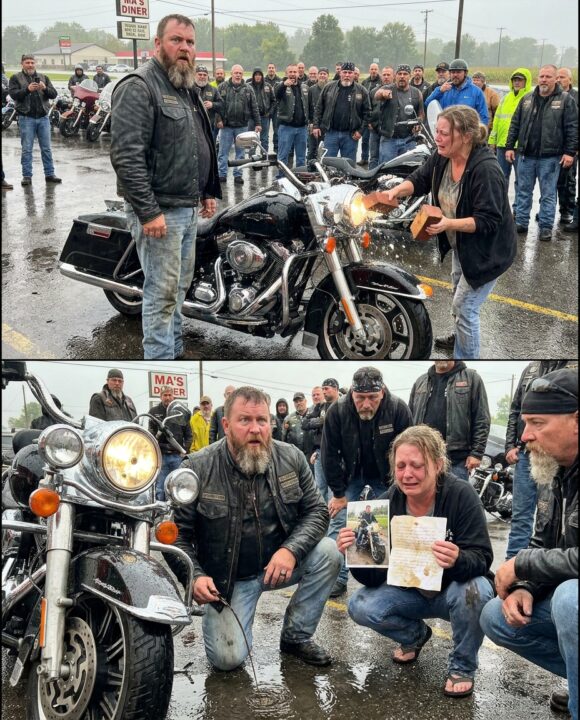
He understood brakes.
That fact damaged the official story immediately.
Aaron bought the black Road King from a police auction and rebuilt most of it beside Thomas. After his father’s death, working on the motorcycle became the language he used to remain connected.
The dent beneath the tank emblem came from a wrench Thomas dropped during their final repair.
Aaron refused to remove it.
“Dad’s signature,” he called it.
By the time his daughter Lily was born, Aaron had become cautious in ways the club teased him about. He replaced worn tires early, stopped riding through severe weather, and carried more first-aid equipment than Doc.
He never drank before riding.
He never raced.
Yet the crash report described “excessive speed inconsistent with road conditions.”
We accepted it because the alternative demanded questions nobody wanted to ask.
Aaron died during a charity supply run on Route 33. He rode alone because a storm delayed the club’s departure, and the rural family awaiting medicine could not wait another day.
A school bus entered the curve from the opposite direction.
Witnesses saw Aaron’s Road King cross the center line, then turn sharply toward the shoulder. The motorcycle struck a drainage barrier instead of the bus.
Aaron died at the scene.
No children were injured.
At his funeral, we told ourselves he sacrificed control to protect the bus. The official investigation treated that interpretation as club mythology.
Evelyn rejected both versions.
She believed Aaron’s front brake failed and he deliberately chose the barrier.
She brought his grease-stained note to the sheriff. An investigator said it proved Aaron suspected a maintenance issue, not that the issue caused the crash.
The wrecked front assembly had already been transferred to an insurance storage yard.
When Evelyn tried recovering it, she learned Iron Mercy had purchased the motorcycle.
Wrench arranged everything.
He said rebuilding the Road King would honor Aaron and someday provide something valuable for Lily.
Evelyn called the clubhouse repeatedly.
Wrench controlled the voicemail system because he served as secretary and shop manager. He marked every message heard, saved none for meetings, and told us Evelyn wanted the motorcycle destroyed.
That was partly true.
What he omitted was why.
She believed the bike carried an unresolved failure.
When I confronted Wrench in the diner parking lot, he removed his leather vest before answering. Club members do that when they know their next words may cost the patch.
“I inspected Aaron’s brakes,” he said.
“We know.”
“I found abrasion near the upper line guide.”
Bear stepped forward.
“You declared it safe.”
Wrench swallowed.
“I replaced the clamp.”
“Did you replace the hose?”
“No.”
“Why?”
Wrench looked toward the restored Road King.
The braided front line was an expensive aftermarket assembly supplied through Mercer Performance, a small shop owned by Wrench’s older brother.
A full replacement required admitting the batch might be defective. Dozens of club members had purchased the same hoses.
Wrench feared a recall would destroy his brother’s business.
He adjusted the guide, cleaned the line, tested pressure, and told Aaron the softness likely came from air introduced during earlier service.
Aaron trusted him.
That trust lasted nine days.
After the crash, Wrench searched the wreck at the storage yard. The front hose had torn during impact, making it impossible to determine whether abrasion caused the initial pressure loss.
He said nothing.
Five years later, when Iron Mercy rebuilt the motorcycle, Wrench installed another line from the remaining inventory.
The replacement carried the same internal lot code.
He claimed he had tested it thoroughly.
Evelyn’s brick revealed it leaking before I rode seven miles.
Bear lunged.
I caught him across the chest.
“Not here.”
“He killed Aaron.”
“No.”
Wrench’s face twisted.
“He’s right. I did.”
I turned toward him.
“You lied. The road still made the choice.”
Evelyn rose from the pavement.
“No, Mr. Dawson. My son made the choice.”
She held Aaron’s photograph against her chest.
“He aimed for the barrier because there were children on that bus. The failed brake did not choose where he died.”
Her words denied Wrench the easy punishment of calling himself a murderer.
He had concealed danger.
Aaron still owned the courage of his final act.
That distinction mattered.
Marisol collected Wrench’s club keys, shop access card, and secretary patch. Iron Mercy suspended him pending a formal vote.
Several younger members wanted immediate expulsion.
Others argued Wrench had served the club for twenty-three years, rescued stranded riders, covered medical bills, and remained beside grieving families.
Brotherhood became difficult precisely because both versions were true.
Wrench had done years of good.
He had also made one decision that placed business loyalty above a brother’s safety, then protected that decision with five years of silence.
I asked Evelyn what she wanted.
“Open every record,” she said. “Find every line.”
That evening, Iron Mercy contacted each rider who might be using components from the suspect batch. We grounded seventeen motorcycles before midnight.
Three hoses showed visible abrasion.
One had begun seeping fluid.
The club’s emergency inspection prevented more rides, but it also exposed a larger problem.
The supplier records from Mercer Performance did not match the lot codes stamped on the hoses.
Wrench’s brother had not manufactured them.
He had purchased counterfeit assemblies and printed his own certification labels.
When police went to question him, the shop was empty.
So were its records.
Only one person knew where he had gone.
Wrench.
Part 3 — The Brother Who Chose Blood over the Patch
Wrench’s older brother was Nolan Mercer, a former racer with a polished smile and a talent for making counterfeit certainty sound like professional advice.
He opened Mercer Performance after leaving prison for insurance fraud. Wrench invested his retirement savings and persuaded Iron Mercy members to become the shop’s first customers.
Nolan promised every component came from certified American manufacturers.
The invoices said so.
The packaging said so.
The metal stamps said so.
None of it was true.
Investigators later determined Nolan purchased unverified brake assemblies through a chain of overseas brokers, repackaged them, and altered lot markings inside his Ohio warehouse.
Some hoses met expected standards.
Others contained fittings with weak seals or braiding vulnerable to hidden friction damage.
Wrench discovered the fraud two months before Aaron’s crash.
Nolan begged him for time.
He claimed a public recall would bankrupt the shop, destroy both brothers’ savings, and leave six employees without work.
Wrench agreed to quietly inspect club motorcycles while Nolan replaced questionable inventory.
That secret arrangement depended upon every inspection being perfect.
Aaron’s was not.
After Aaron reported a soft lever, Wrench found abrasion but saw no active leak. He replaced the guide, re-bled the system, and advised Aaron to return if the problem continued.
Aaron left believing the motorcycle was safe.
The following week, he died.
Wrench planned to confess after the funeral.
Then Nolan showed him photographs suggesting crash impact caused the hose damage. He argued there was no proof of preexisting failure and warned that confessing would expose Iron Mercy to lawsuits because the club endorsed his shop.
Wrench chose silence.
He told himself he was protecting employees, his family, and the club’s charitable work.
Every year afterward, that explanation required another lie.
He intercepted Evelyn’s messages.
He discouraged independent inspection of the wreck.
He personally supervised the restoration and installed a replacement hose he believed came from a newer, safer batch.
The crooked headlight proved he was wrong again.
Bear wanted Wrench’s patch burned before sunset.
Marisol insisted the full club hear his statement. Doc demanded every maintenance log become evidence before anyone touched it.
I agreed with Doc.
Anger can destroy the very records truth needs.
Wrench sat alone inside the clubhouse while forty riders occupied the meeting hall. His vest lay folded on the table.
Evelyn attended.
That was unusual. Club disciplinary meetings remained private, but the person carrying the consequences deserved to hear our decision.
Wrench admitted everything.
Nobody interrupted.
When he finished, Bear asked one question.
“If Evelyn hadn’t broken the light, would you have let Hammer ride?”
Wrench stared at his hands.
“I didn’t know it was leaking.”
“That wasn’t the question.”
Wrench’s voice dropped.
“Yes.”
The room changed.
He would have let me lead forty motorcycles down Miller’s Grade while another suspect hose remained on the Road King.
He trusted his pressure test more than the history he concealed.
He trusted hope because truth threatened his brother.
Iron Mercy voted.
Thirty-four members supported permanent expulsion. Four requested suspension. One abstained.
I did not cast the first vote.
A president speaks last when the patch belongs to everyone.
I voted for expulsion.
Wrench removed the club emblem from his vest. His fingers shook so badly that Marisol handed him a seam knife.
He cut slowly.
When the final thread separated, Bear turned away.
Years of brotherhood do not disappear because a verdict is correct. They remain inside the room, stripped of permission to continue as before.
Wrench placed the patch on the table.
Then he gave police Nolan’s location.
His brother had fled toward West Virginia carrying digital records and remaining inventory inside a cargo trailer.
Investigators asked Wrench to call him.
Nolan answered.
Wrench kept him speaking while highway patrol traced the signal. During the conversation, Nolan admitted changing lot numbers and ordering Wrench to suppress Aaron’s complaint.
The patrol located his truck outside Point Pleasant.
Nolan ran.
He abandoned the trailer near a steep access road and escaped into wooded hills before officers closed the area.
The truck remained unsecured.
Inside were forty-eight boxes of counterfeit brake lines, customer records from five states, and a laptop containing evidence of previous failures.
One record carried Aaron Bell’s name.
Beside it, Nolan had typed:
CUSTOMER REPORTED PRESSURE LOSS—DO NOT CONTACT UNTIL INVENTORY CLEARS.
Aaron’s warning had reached the company.
They had deliberately ignored it.
We believed the recovered files would settle everything.
Then Doc reviewed the restored Road King and found a second hidden defect unrelated to the leaking hose.
The front brake master cylinder contained a mismatched internal component. Under sustained heat, pressure could fade even if the line remained intact.
That component had been installed before Aaron purchased the motorcycle.
The bike carried two separate braking hazards.
Either could have contributed to the crash.
Evelyn listened from the garage doorway.
“Can you prove which one killed him?”
Doc lowered his magnifying light.
“No.”
Her shoulders fell.
For five years she had believed finding one mechanical answer would close the question. Instead, truth multiplied the uncertainty.
Hammered metal does not remember the exact second it failed.
Damaged bodies do not return to explain.
Aaron’s note established concern. Wrench’s confession established deception. Nolan’s files established fraud.
None could recreate the final pressure inside Aaron’s hand.
Evelyn walked toward the motorcycle and placed both palms against the tank.
I expected her to ask us to destroy it.
Instead, she said, “Make it stop somebody else.”
That became our plan.
The Road King would never ride again.
We would preserve it as evidence until every investigation ended, then use its damaged systems inside a traveling safety exhibit.
Before we could begin, a call arrived from highway patrol.
Nolan had reached an abandoned riverside warehouse.
He was armed.
Wrench knew the building.
More importantly, he knew Nolan’s adult daughter and six-year-old grandson were hiding inside with him.
The expelled biker looked toward the patch on our table.
“I have to go.”
Bear blocked the door.
“You don’t ride with us.”
Wrench nodded.
“I know.”
He walked toward the parking lot alone.
I picked up my helmet.
Brotherhood had ended in one form.
Human responsibility had not.
Part 4 — The Son Aaron Saved Without Knowing His Name
We did not ride to the warehouse as an outlaw rescue crew.
Highway patrol controlled the scene, negotiators handled contact, and Iron Mercy stayed beyond the barricade because Wrench believed Nolan might speak to him.
Evelyn came with us.
She remained inside Marisol’s truck, Aaron’s photograph held between both hands while rain moved across the windshield.
Nolan had taken his daughter Rachel and grandson Eli from their home after police issued the warrant. Rachel told dispatchers she came willingly because her father threatened to harm himself.
Inside the warehouse, she discovered boxes of counterfeit components and understood why officers were searching for him.
She tried leaving.
Nolan locked the doors.
Wrench called his brother from beside the police command vehicle.
Nolan answered after six attempts.
“You brought the club?” Nolan asked.
“No.”
I stood ten feet away.
So did Bear.
Wrench continued.
“I brought the truth.”
Nolan laughed.
Wrench told him the customer records had been recovered. The business was finished, the fraud was exposed, and keeping Rachel and Eli inside would only add charges.
Nolan blamed Aaron.
He said Aaron rode too fast, ignored weather, and became useful to everyone only after dying.
Evelyn heard through the speaker.
She stepped from the truck.
I tried stopping her.
She walked to Wrench and took the phone.
“My son turned away from a school bus,” she said.
Nolan became quiet.
“There’s no proof.”
“There were thirty-two children aboard. The driver saw him look through the windshield before he chose the barrier.”
That detail was new.
Evelyn had located the retired bus driver months earlier. He described Aaron’s face during the final seconds: eyes open, jaw tight, both hands fighting the controls.
Aaron crossed the center line when the braking system failed.
Then he saw the bus.
He leaned the motorcycle away despite knowing the drainage wall left no safe path.
The driver remembered Aaron looking directly at him.
The bus carried children returning from a field trip.
One boy sat in the front seat.
His name was Eli Mercer.
Nolan’s grandson.
Aaron died preventing a collision that might have killed the child of the man whose counterfeit components helped create the emergency.
Wrench lowered the phone.
Nobody spoke.
Evelyn had known for three months.
“Why didn’t you tell us?” I asked.
“Because Aaron didn’t choose which children deserved saving.”
She did not want Eli’s identity used to punish Nolan or elevate her son into a weapon against another family.
But inside that warehouse, the truth belonged to the child’s safety.
Wrench raised the phone again.
“Aaron saved Eli once,” he told Nolan. “Open the door before you make his mother do it twice.”
The side entrance opened eleven minutes later.
Rachel emerged carrying Eli beneath a yellow raincoat. Officers led them behind armored vehicles.
Nolan remained inside.
He surrendered before dusk.
Nobody fired.
Nobody was hurt.
Wrench watched police place his brother in a cruiser. His face showed no triumph, only exhaustion.
Evelyn stood beside him.
“You chose him over Aaron,” she said.
“Yes.”
“Today you chose his child over hiding.”
“Yes.”
“That doesn’t erase anything.”
“No.”
“But it matters.”
Wrench began crying.
Not loudly.
His face simply folded while rain struck the place where his club patch had once rested.
Evelyn did not embrace him.
She placed Aaron’s photograph in his hand.
“Look at the baby.”
The photograph showed Aaron sitting on the Road King with Lily against his chest.
“He was somebody’s father,” Evelyn said. “Remember that before you ask me to forgive you.”
Wrench held the picture carefully.
“I won’t ask.”
That answer allowed the first step toward something forgiveness might someday resemble.
Nolan’s trial exposed a regional counterfeit-parts network. Authorities and legitimate manufacturers issued notices covering thousands of components sold through independent shops and online marketplaces.
Iron Mercy contacted riders across five states.
The club set up inspection days with qualified mechanics. They did not charge labor, sell replacement parts, or use the events to advertise membership.
Eleven additional hoses showed damage requiring replacement.
Two belonged to fathers who regularly carried children as passengers.
Evelyn attended every event.
She carried Thomas’s old inspection mirror and wore safety glasses too large for her narrow face. She never touched systems without the owner’s permission.
When riders complained about waiting, she showed them Aaron’s note.
Most stopped complaining.
The restored Road King remained on a lift inside our garage. Its shattered headlight stayed exactly as Evelyn’s brick left it.
The crooked remaining reflector pointed toward the leaking brake line.
We could have repaired the lamp.
We chose not to.
That broken beam had illuminated what a perfect headlight concealed.
Yet one question still bothered me.
Aaron’s note said, “Don’t let it take another father.”
He wrote it before the crash, but he never gave it to Evelyn. She found it inside a canvas pouch after his death.
The pouch had not come from his home.
It came from Wrench’s shop.
Wrench admitted Aaron left the note there during his final inspection.
On its reverse side was a second message addressed to me.
I had never seen it.
Aaron wrote:
“Hammer, if Wrench says it’s fine, ask him why he won’t put his own son on it.”
Aaron suspected the truth.
He had been trying to warn me before the road took away his chance.
Part 5 — The Father Waiting at the Bottom of Miller’s Grade
Aaron’s message changed the question I had avoided since Evelyn broke the headlight.
Why was I so willing to ride a memorial motorcycle rebuilt from a fatal crash?
I had told myself it honored him.
The honest answer was harder.
I wanted to prove the machine was innocent because machines were easier to forgive than people.
If the Road King completed Aaron’s route safely, perhaps his death could remain a tragic combination of rain, speed, and one impossible curve.
Then Iron Mercy would not have to examine Wrench, Mercer Performance, or the trust holding our brotherhood together.
I had accepted the same comfort Evelyn refused.
The club planned to start the memorial ride at Murphy’s Diner and end at Pine Creek Park, where Aaron’s daughter Lily waited beside her mother.
Lily was five when Aaron died.
She was ten now.
She knew the Road King from photographs and believed seeing it restored would feel like meeting something her father had touched.
Nobody had explained the unresolved brake concerns because adults often hide uncertainty while claiming to protect children.
Evelyn insisted we tell her.
We met Lily at the park without the motorcycle.
She sat beneath a pavilion wearing Aaron’s old denim jacket, its sleeves rolled several times around her wrists.
I showed her the shattered headlight photograph.
Evelyn showed her the note.
Lily read slowly.
“Did Dad know the bike was dangerous?”
“He suspected something was wrong,” Evelyn said.
“Did he ride anyway?”
That question pierced every adult present.
Wrench answered.
“I told him it was safe.”
Lily looked at the empty space where his club patch had been.
“Were you wrong?”
“Yes.”
“Did you lie?”
“Afterward.”
“Why?”
Wrench glanced toward Evelyn.
“Because I was scared of losing my brother.”
Lily considered this with the directness children use when adults finally stop protecting themselves.
“You lost all your brothers instead.”
Wrench nodded.
“Yes.”
Lily handed the note back to her grandmother.
“What happens to Dad’s bike?”
Evelyn explained the safety exhibit.
The Road King would travel to riding events, trade schools, and community garages. Its cutaway braking system would show how abrasion, hidden fittings, counterfeit parts, and ignored warnings could align.
The exhibit would not claim certainty about which defect caused Aaron’s crash.
It would tell the truth we possessed.
Lily asked whether the motorcycle would ever run again.
“No,” I said.
She walked toward me.
“You were going to ride it.”
“Yes.”
“Do you have kids?”
“One daughter. Two grandsons.”
“Then Grandma saved their dad.”
The sentence settled across the pavilion.
Evelyn looked away.
She had described her act as preventing another loss, not saving me. She still considered breaking the headlight a desperate crime she expected to repay.
Iron Mercy had already replaced the diner’s damaged landscaping and compensated the Road King’s restoration fund for the lamp.
Nobody wanted money from Evelyn.
The broken headlight belonged to the exhibit now.
Lily climbed onto the pavilion bench and pressed both hands against my cheeks.
“My dad wrote that note for you.”
“I know.”
“Are you listening?”
“Yes.”
She studied my face long enough to decide whether adults were trustworthy.
Then she nodded.
The Fallen Brothers Ride continued that afternoon, but nobody rode the Road King.
I led on my old black Harley, newly inspected by Doc and an independent shop. Every biker left twice the usual distance between motorcycles.
We stopped before Miller’s Grade.
Evelyn waited beside the shoulder holding Aaron’s photograph.
The club descended one at a time.
No engines revved.
No rider rushed the curves.
At Pine Creek Park, Lily counted every motorcycle entering the lot.
Forty started.
Forty arrived.
Wrench followed in Marisol’s truck because his expulsion prohibited him from riding with the formation.
He helped unload water, folded tables, and remained away from the group photograph.
Nobody told him to leave.
Nobody invited him closer.
Consequences and compassion occupied the same field without canceling each other.
After the ride, Evelyn approached me with Aaron’s canvas pouch.
Inside were the original note, copies of maintenance records, and Thomas’s small inspection mirror.
She gave me the mirror.
“Why me?”
“Because you looked at the motorcycle every day and still didn’t see the line.”
The words hurt.
They were supposed to.
I placed the mirror inside my vest beside Aaron’s photograph.
From then on, Iron Mercy changed its maintenance rules.
No club officer could inspect a motorcycle alone when another member’s safety depended upon the result. Parts tied to a member-owned business required independent verification.
Every reported braking concern received written documentation.
No memorial object carried more importance than a living rider.
The rules sounded obvious after tragedy exposed their absence.
Most necessary rules do.
Wrench cooperated with prosecutors and testified against Nolan. He pleaded guilty to evidence suppression and reckless endangerment related to the concealed defects.
The judge sentenced him to community supervision, restitution, and hundreds of hours assisting an accredited road-safety nonprofit without performing unsupervised mechanical work.
He accepted the sentence.
Before reporting for his first service day, Wrench visited Aaron’s grave.
Evelyn found him cleaning mud from the marker.
She did not forgive him.
She handed him a second cloth.
They worked on opposite sides.
Some repairs begin without anyone naming them.
Part 6 — The Headlight We Never Repaired
The Road King now stands inside a transparent trailer beside the original shattered headlight, leaking hose, cutaway master cylinder, and Aaron’s grease-stained warning.
We call the exhibit The Crooked Light.
Evelyn chose the name.
She accompanies it across Ohio, West Virginia, Kentucky, and Pennsylvania. At every stop, she tells riders she did not discover the leak through expertise alone.
She acted because grief had taught her to distrust reassurance that arrived without evidence.
The brick remains mounted beneath the display.
Visitors often ask whether she regrets breaking the headlight.
“Yes,” she says. “And no.”
She regrets the danger of swinging it near other people. She regrets frightening Lily and humiliating the club before knowing who might listen.
She does not regret stopping the ride.
Honest stories hold both answers.
I travel with her whenever possible. My job is moving the trailer, setting barriers, and keeping overconfident men from treating an exhibit like permission to diagnose their own brake systems.
Qualified mechanics handle technical questions.
Evelyn handles the human ones.
“What if the shop says everything is fine?” riders ask.
“Ask what they checked.”
“What if my friend did the work?”
“Friendship is not a pressure test.”
“What if I cannot afford replacement parts?”
“Then you cannot afford pretending.”
Her answers are blunt.
People remember them.
Aaron’s daughter Lily places a new photograph inside the trailer every birthday. At eleven, she added a picture of herself learning bicycle maintenance.
At thirteen, she contributed her first safety-course certificate.
At fifteen, she stood beside the Road King and announced she wanted to become a mechanical engineer.
Evelyn did not discourage her.
She taught Lily that machines were neither murderers nor saints. People designed, maintained, inspected, ignored, repaired, and sometimes misunderstood them.
The Road King did not decide to take Aaron.
A chain of human choices created danger.
Aaron’s final choice saved a school bus.
Wrench completes his service quietly. He has never requested restoration of his patch, and Iron Mercy has never offered it.
He attends public safety events as Calvin Mercer.
No nickname.
No vest.
Sometimes Bear brings him coffee without conversation. Sometimes Marisol reviews his paperwork and returns it covered in corrections.
Brotherhood did not return to its previous shape.
Perhaps it should not.
At Murphy’s Diner, the landscaping border contains one missing brick. Laura refused to replace it.
A small metal plate marks the empty space, but it carries no dramatic slogan.
Only a date.
Every year on that date, forty bikers gather before sunrise. Evelyn stands beside the empty place while Doc inspects each motorcycle.
The process takes hours.
Nobody complains.
When my turn comes, Evelyn crouches near the front wheel with Thomas’s inspection mirror.
I hold the work light.
She checks what the beam cannot reach.
Then she looks up.
“Not yet, Hammer.”
I wait until she says otherwise.
Part 7 — The Motorcycle That Never Took Another Father
Ten years after Aaron died, Lily graduated from high school.
She asked to hold the ceremony’s family celebration at Pine Creek Park, where her father’s final memorial route was supposed to end.
Iron Mercy arrived early.
Wrench came later in a pickup, carrying folding chairs and remaining beyond the motorcycle line until Evelyn waved him closer.
The Crooked Light exhibit stood beneath the pavilion.
Aaron’s Road King remained silent inside the trailer, its shattered headlight throwing no beam and its front wheel secured above the old leaking hose.
Lily wore her father’s denim jacket over her graduation dress.
She had been accepted into an engineering program with a scholarship partially funded by the ride Aaron never reached.
During the celebration, she opened the exhibit and removed a framed copy of his note.
“Grandma carried this for five years because nobody listened,” she said.
Evelyn shook her head.
“You listened.”
“After you used a brick.”
The crowd laughed softly.
Lily turned toward me.
“Grandma said Dad wrote the last line for another father. We always thought that meant Hammer.”
“It did,” Evelyn said.
“Maybe. But I think it meant every father who sees this bike.”
She placed the note back.
Forty-three riders attended that afternoon. Some had children playing near the pavilion. Others carried photographs of grown sons, daughters, nieces, nephews, or families they had chosen.
Before starting the annual ride, every rider touched the empty brick space at Murphy’s Diner.
Not for luck.
For attention.
Doc completed the inspections. Evelyn checked the records, and Lily reviewed the exhibit trailer before closing its door.
Wrench approached me with a small box.
Inside was a restored headlight assembly built from safe, documented components.
“I thought Lily might want it for the display,” he said.
I looked toward Evelyn.
She shook her head.
“The broken one stays.”
Wrench closed the box.
“Fair.”
He carried it back to his truck without argument.
That acceptance showed more change than any apology.
At Pine Creek Park, Lily climbed onto the passenger seat of my old Harley. She wore proper riding gear and a helmet Aaron had purchased before her first birthday.
Evelyn examined every strap.
Then she placed both hands around the front wheel.
For one heartbeat, the parking lot remembered the morning she had clung to another motorcycle while forty men misunderstood her.
This time, she was not stopping us.
She checked the tire, looked beneath the brake line, and stepped away.
“Bring her back,” she told me.
“I will.”
“No promises.”
I understood.
“Then I’ll ride like she has people waiting.”
Evelyn nodded.
The V-twin started beneath us.
Lily wrapped her arms around my waist while forty-two engines joined behind the Road King that would never run again.
We descended Miller’s Grade slowly.
At the bottom, Evelyn waited beside Aaron’s photograph.
Every motorcycle arrived.
Every father came home.
Leave “AARON” below if you want the full update about Evelyn, Lily, and the broken headlight that still travels across America.
Follow our page for more unforgettable biker stories about misunderstood grief, tested brotherhood, hidden danger, and warnings powerful enough to bring another father home.