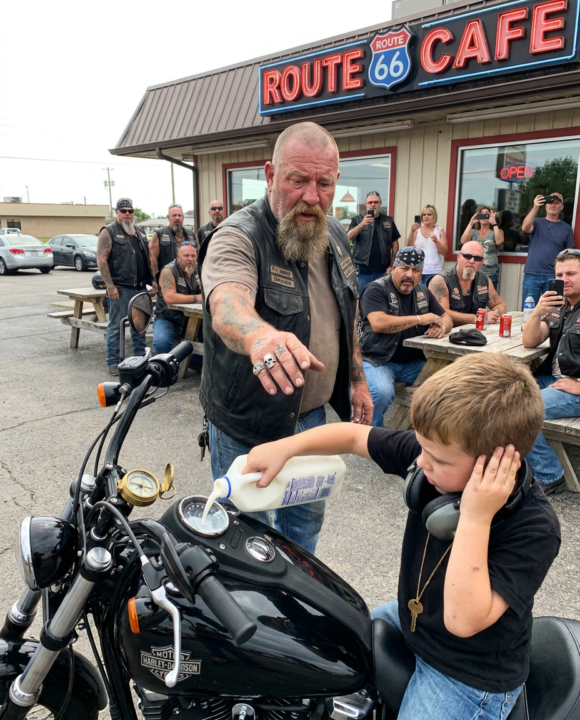
Part 2: A Boy Poured Milk Into a Biker’s Harley Tank While Twenty Riders Waited for an Explosion — The Man Pushed His Motorcycle Away and Returned With Trucks to Move the Child Somewhere Quiet
Part 2 — Luis and the Brother Who Stayed Behind
Luis Torres joined the Cinder Ridge Riders at twenty-nine.
He was not large, loud, or naturally intimidating. He stood five-foot-nine, worked as an apartment-maintenance technician, and spoke with the careful patience of a man accustomed to repairing things tenants had already attempted to fix with tape.
His road name was Sparrow.
Ray hated it.
Luis liked it because his daughter—born before Mateo and lost after three days in neonatal care—had been named Paloma, the Spanish word for dove.
He carried birds with him after that.
A silver wing on his keychain.
A sparrow stitched inside his cut.
A small brass compass engraved with feathers.
Rachel met Luis at a laundromat. He repaired the broken coin mechanism without permission, then stayed until the owner arrived so nobody thought he had stolen from it.
They married two years later.
Mateo arrived after a difficult pregnancy.
Luis changed.
He still rode, but shorter distances. He stopped drinking entirely. He refused club runs that kept him away overnight and returned home before Mateo’s bedtime whenever possible.
Ray teased him.
Luis answered, “Boy doesn’t care about mileage.”
That sentence stayed with Ray.
Ray and Luis became close because they possessed opposite instincts. Ray pushed. Luis waited. Ray solved problems by applying force. Luis first asked why the thing had broken.
When Ray’s temper returned, Luis stood near him.
Not between Ray and another man.
Near him.
That was often enough.
Ray had his own complicated history. Prison. Alcohol. An estranged daughter. Years when the club was the only family still answering his calls.
Luis never romanticized it.
“You survived your worst decisions,” he once told Ray. “That doesn’t make them sacred.”
Ray respected him for saying it.
The Torres family lived in a two-bedroom apartment beside Route 66. Their balcony overlooked the intersection, and motorcycle engines echoed between the buildings.
Mateo loved watching them.
When the club visited, he identified Ray’s Harley by the low uneven idle. Luis taught him that machines made different voices.
“This one sounds angry,” Mateo said.
Ray looked offended.
“Runs perfect.”
“Still angry.”
Luis laughed.
The apartment was never meant to be permanent. The landlord raised rent, traffic increased, and Rachel worried about Mateo crossing the shared parking entrance.
Luis found a small duplex on Juniper Street.
It sat behind a church, three blocks from an elementary school and far enough from Route 66 that engines became distant rather than immediate.
The deposit was five hundred dollars.
Luis saved cash inside a metal box because the family’s checking account was often overdrawn. He completed the lease application but had not yet submitted it.
Then Rachel’s car needed repairs.
She assumed the money had been spent.
Luis did not tell her he had borrowed from a club emergency fund to preserve the deposit.
He planned to surprise her.
On the last evening of his life, Luis met Ray outside the clubhouse. He handed him the metal box and the brass compass from his Harley.
“If I lose my nerve, give me this back tomorrow,” Luis said.
“What nerve?”
“Telling Rachel we’re moving.”
Ray shook the box.
“Why you giving me the money?”
“Because if I take it home, something will break.”
He handed the small key to Mateo before leaving.
“Guard this.”
Mateo wore it around his neck.
Luis rode home.
A pickup ran a red light at the intersection below the apartment.
Rachel heard the crash from the kitchen.
Mateo heard his father’s engine accelerate, tires scream, then stop.
Ray reached the scene six minutes later.
Luis remained conscious briefly. He asked about Rachel and Mateo. Then he said something Ray would replay for years.
“Get them off this road.”
Ray promised.
Luis died before the ambulance reached the hospital.
At the funeral, Rachel asked the Cinder Ridge Riders not to return.
The engines caused Mateo to scream until he became physically sick. She blamed motorcycles, the club, and every man who had called riding brotherhood while she selected a coffin.
Ray obeyed her request.
Too completely.
He kept the box.
He told himself Rachel had refused the club, the money, and every reminder of Luis. He planned to mail it. Then he worried cash would disappear. He planned to deliver it alone. Then he imagined her face at the door.
Days became months.
The duplex went to another family.
Ray carried the undelivered promise inside his saddlebag for four years.
Part 3 — The Sound That Filled the Diner
Rachel and Mateo remained beside Route 66 because leaving required money they never accumulated at the same time.
Rent consumed most of Rachel’s diner wages. Medical bills from Luis’s accident followed her through collection agencies. Her car failed twice. Each quieter apartment required a deposit, application fee, and moving costs.
Mateo’s fear became part of their schedule.
They avoided motorcycle rallies.
Rachel checked road events before grocery shopping.
At school, Mateo used noise-reducing headphones during fire drills and assemblies. His counselor helped him identify the difference between a memory and a current threat.
Progress came slowly.
A single Harley at a distance became manageable.
Twenty at once did not.
The Cinder Ridge Riders arrived at Canyon Star Diner after a winter charity run. No one knew Rachel worked there. Ray had avoided the diner because it was near the crash intersection, but the club president selected it after another restaurant closed.
Ray parked beside the fuel pump.
His tank was low. He opened the cap, then heard Preacher call from the entrance because a younger prospect had nearly backed into a parked truck.
Ray stepped away.
Mateo emerged carrying milk.
His decision followed a child’s logic built from an adult’s sentence.
Years earlier, Luis had caught him holding a juice box near the motorcycle.
“Anything but gas kills the engine,” Luis said.
Mateo remembered.
If milk killed the engine, the Harley could not carry another father away.
He poured.
Crow saw him first.
The club brother’s reaction came from instinct. He grabbed the boy before understanding what he had done.
Mateo screamed harder.
Ray ordered Crow back.
Milk in a motorcycle fuel tank can cause serious damage if circulated through the system. Ray knew not to start the engine. He closed the fuel valve, removed the key, and considered how to transport the bike.
Crow offered a pickup.
Mateo flinched when its diesel engine started nearby.
Ray stopped the driver.
Then he pushed.
The motorcycle weighed more than eight hundred pounds. The road to Dawson Iron & Cycle rose steadily for more than a mile. Cold wind moved down Route 66, and traffic passed close enough to pull at Ray’s leather cut.
He walked on the shoulder.
Mateo watched until the bike disappeared.
People at the diner praised Ray.
Rachel did not.
She knew kindness in a parking lot did not return four missing years.
Ray came back in Crow’s truck after the Harley had been delivered with the engine off. He parked across the road so Mateo would not hear it.
Then he carried the metal box inside.
Rachel recognized Luis’s initials scratched near the latch.
Her face changed.
“Where did you get that?”
“Luis.”
“When?”
Ray did not answer quickly enough.
Rachel looked at the key around Mateo’s neck.
“How long?”
“Four years.”
She slapped the box away.
It struck the floor.
The lid remained locked.
“You had something from my husband for four years?”
“Yeah.”
“He asked you to give it to us?”
“Yeah.”
“And you stayed away?”
“You told us to.”
“I told you not to bring twenty motorcycles outside my child’s window!”
Ray absorbed the words.
“You knew we were trapped there.”
“Didn’t know.”
“You never asked.”
That was true.
Ray had turned Rachel’s boundary into an excuse for avoiding a promise that frightened him. He believed staying away was respect. It was also easier than facing the widow of the man he could not save.
Mateo knelt beside the box.
He removed the brass key from his neck.
The lock opened.
Inside lay Luis’s savings, the old lease application, copies of identification documents, a photograph of the Juniper Street duplex, and an envelope addressed to Rachel.
The letter did not say goodbye.
Luis wrote it while expecting to return.
Rach, I found a place where Mateo can hear birds before traffic. Don’t say no until you see the kitchen.
Rachel covered her mouth.
Beneath the letter was another paper.
Luis had listed Ray as the person who would help move them.
Ray read his own name.
The parking lot incident no longer looked like the end of a misunderstanding.
It looked like a promise arriving four years late.
Part 4 — The House Behind the Church
The original Juniper Street duplex was occupied.
Rachel could not simply move into the home Luis had chosen.
Ray discovered that within an hour.
He also discovered a similar unit would become available two streets away at the end of the month. It sat behind a small church, faced a courtyard instead of traffic, and had an extra closet Mateo could use for art supplies.
The rent was slightly higher than Rachel’s apartment.
The landlord required a deposit.
Luis’s five hundred dollars no longer covered it.
Ray offered the rest.
Rachel refused.
“No.”
“Was his plan.”
“The money in the box was his plan. Your money is guilt.”
Ray had no answer.
Preacher did.
He proposed a loan through the club’s family-support fund, written properly and repaid in small monthly amounts Rachel could afford. No charity photograph. No ceremonial check. No ownership over her decisions.
Rachel considered it.
Then she asked whether the lease would remain in her name.
“Yes,” Preacher said.
“Whether I let the club visit or not?”
“Yes.”
“Whether Mateo ever likes motorcycles again?”
“Yes.”
That mattered.
The Cinder Ridge Riders did not make help conditional on forgiveness.
Rachel signed.
The repair bill for Ray’s Harley came to nearly eighteen hundred dollars. The fuel system had to be drained, flushed, cleaned, and inspected. Several components were replaced as a precaution.
Crow believed Rachel should pay something.
Other Riders agreed.
Ray refused.
“The kid’s nine.”
“Mother’s responsible,” Crow said.
“Mother’s moving.”
“Brother, that bike—”
“Metal.”
Crow stopped.
Ray tapped the fuel tank.
“Boy isn’t.”
The argument divided the club.
Some believed refusing repayment treated Rachel like a charity case. Others believed demanding money from a widow living paycheck to paycheck would punish the wrong person.
Switch Greene, a Rider who used a wheelchair after a crash, asked the question none of them had considered.
“Did anybody ask her?”
They had not.
Rachel proposed paying the direct cost over time.
Ray accepted ten dollars.
“Per month?” she asked.
“Total.”
“That is not repayment.”
“No.”
“Then what is it?”
Ray looked toward Mateo, who stood outside the shop at a safe distance.
“Receipt.”
Rachel paid ten dollars.
Ray wrote:
FUEL SYSTEM — SETTLED
She kept the receipt.
Mateo came to the shop once after closing, when no engines were running. Ray showed him the drained fuel in a transparent sample jar. Milk had separated into cloudy layers beneath the gasoline.
“You mad?” Mateo asked.
“Was.”
“When?”
“First second.”
“What happened?”
“Saw you.”
Mateo studied him.
“Dad said milk kills engines.”
“Mostly makes expensive problems.”
“Sorry.”
Ray nodded.
“Don’t do it again.”
“I won’t.”
Ray did not force him to touch the motorcycle or listen to it start. He did not turn the moment into exposure therapy, forgiveness theater, or a lesson beyond the one Mateo had already learned.
He asked permission before rolling the silent Harley closer.
Mateo said no.
Ray left it where it was.
On moving day, the club faced another problem.
Rachel did not want twenty motorcycles arriving outside the apartment. The sound would overwhelm Mateo and alarm neighbors.
Preacher ordered every Rider to bring trucks, vans, or utility trailers instead.
Several members owned only motorcycles.
They parked three blocks away and pushed handcarts the remaining distance.
Ray pushed his Harley too.
The engine remained off.
People on Route 66 watched twenty-seven bikers walking beside a silent motorcycle while mattresses, boxes, kitchen chairs, and Mateo’s drawings traveled in pickups around them.
Nobody knew why.
This time, no one filmed.
Part 5 — The Move Without Engines
The Riders arrived at 7:00 Saturday morning.
Rachel had packed most of the apartment herself. She labeled boxes by room and placed Luis’s remaining belongings in a separate stack nobody could move without asking.
Ray asked.
That surprised her.
The club loaded furniture first. Crow disassembled Mateo’s bed. Preacher wrapped dishes. Two prospects carried books down three flights of stairs and learned why nobody should fill large boxes entirely with hardcovers.
Mateo supervised his room.
He wore headphones but kept them around his neck.
No motorcycle engines started.
Ray’s Harley stood beside the curb with milk stains still visible beneath one seam of the tank. He had cleaned the paint but left a small white mark near the filler cap.
Crow asked why.
“Reminder.”
“Of the repair?”
“Of the first second.”
The second when anger arrived.
The second when Ray chose what followed it.
By noon, the old apartment was empty.
Rachel stood in the living room where Luis’s chair had once faced the window. The intersection remained visible below.
A motorcycle passed on Route 66.
Mateo froze.
Ray did not touch him.
Rachel said, “We’re leaving this room.”
Mateo looked toward the door.
Then he carried the final box himself.
The new duplex sounded different.
Wind moved through cottonwood branches. A lawn sprinkler clicked across the courtyard. Children played basketball behind the church.
Traffic existed.
It did not fill every wall.
The Riders placed furniture according to Rachel’s instructions. They did not hang club memorabilia, leave photographs, or mark the home as something they had provided.
Ray installed shelves in Mateo’s room.
One shelf held model houses.
None of them had roads.
Ray examined the drawings.
“You hate roads?”
Mateo shrugged.
“They take people.”
“They bring some back.”
“Not Dad.”
“No.”
Ray did not offer a comforting lie.
He mounted the shelf.
Later, Mateo found the brass compass from Luis’s Harley on his desk. Ray had removed it from his own handlebars.
The boy carried it outside.
“This was Dad’s.”
“Yeah.”
“Why did you have it?”
“He gave it to me with the box.”
“You kept both.”
“Too long.”
Mateo looked at the compass.
“Which way is home?”
Ray pointed toward the red needle.
“Compass finds north.”
“That isn’t home.”
“No.”
Mateo waited.
Ray tapped the center of the brass case.
“Home’s the place you’re trying to get back to.”
The answer satisfied neither of them completely.
That made it honest.
Mateo placed the compass on his shelf between two paper houses.
At sunset, the club prepared to leave. Rachel expected the motorcycles to start three blocks away and roll past the duplex.
Instead, each Rider pushed his bike toward the main road before starting.
Ray remained last.
Mateo stood in the doorway.
“You can start it here,” he said.
Rachel looked at him.
Ray did not reach for the key.
“You sure?”
Mateo listened to the quiet courtyard.
“No.”
Ray nodded.
“Then not today.”
He pushed.
That decision mattered more than starting would have.
Weeks later, Mateo chose to hear the Harley from half a block away with his counselor and mother present. Ray followed their plan. He started the engine once, kept the throttle steady, and shut it down when Mateo raised one hand.
No revving.
No surprise.
No audience.
Progress belonged to Mateo.
Not the biker.
Part 6 — Ten Dollars Above the Workbench
Rachel repaid the club loan over two years.
Every payment received a receipt.
No one forgave the balance without asking. No one used her story at fundraisers. Preacher understood that dignity required more than generosity.
Ray framed the ten-dollar fuel-system receipt above his workbench.
Crow mocked him.
“You framed being underpaid.”
Ray looked at the small white milk stain on the Harley’s tank.
“Best repair I made.”
Mateo visited the shop on quiet Sunday mornings. At first, every motorcycle remained cold. Later, he allowed Ray to turn one engine by hand with the ignition off so he could understand compression without sound.
Then he learned basic maintenance.
Not because he wanted to ride.
Because knowing how a machine stopped made it less mysterious.
Rachel watched carefully.
Ray never called the work treatment. He followed the counselor’s boundaries and let Mateo decide when to leave.
At eleven, Mateo could stand near a quiet idling motorcycle for thirty seconds.
At twelve, he attended part of a charity event wearing headphones.
At thirteen, he still disliked unexpected revving.
Nobody called that failure.
The metal box remained in Rachel’s closet. Luis’s letter stayed inside. The brass key hung above Mateo’s desk, no longer around his neck.
He did not need to guard it.
The promise had finally been opened.
Part 7 — The Engine at the End of the Street
Five years have passed since the milk entered Ray’s Harley.
Mateo is fourteen now. He draws houses with sidewalks, trees, bus stops, and sometimes roads.
He does not ride motorcycles.
Ray has never asked him to.
Rachel manages Canyon Star Diner and lives in the same duplex. The kitchen Luis wanted belongs to her now, even though it is not the kitchen in his photograph.
Every February, the Cinder Ridge Riders help another family move through a small program named Sparrow’s Road.
The families choose whether motorcycles are present.
Sometimes they request the full line of Harleys.
Sometimes the Riders arrive in silent trucks.
Both count.
Ray’s black Harley still carries the white mark beside the filler cap. The brass compass is gone, leaving two empty screw holes near the handlebars.
He refuses to cover them.
One Sunday, Mateo visits Dawson Iron & Cycle alone.
Ray is adjusting a clutch cable.
“Start it,” Mateo says.
Ray looks up.
“Why?”
“I want to hear if it’s still angry.”
Ray wipes his hands.
“You sure?”
“No.”
“Good answer.”
They roll the Harley outside.
Mateo stands near the open garage with his headphones around his neck, not over his ears. Ray waits until the boy gives a small nod.
The V-twin starts.
Low.
Uneven.
Familiar.
Mateo’s shoulders rise. His hands close. For a moment, Route 66, the apartment window, and the crash return to his face.
Ray reaches toward the key.
Mateo shakes his head.
“Five seconds.”
Ray counts without speaking.
At five, he shuts it down.
Silence returns.
Mateo exhales.
“Still angry,” he says.
Ray rests one scarred hand on the tank.
“Yeah.”
“But it stayed.”
Ray looks at him.
“So did you.”
They do not say more.
Mateo walks home carrying no key, no compass, and no fear anyone expects him to conquer before he is ready.
Ray pushes the Harley inside.
The engine remains quiet behind him.
Follow our page for more biker stories about misunderstood riders, second chances, and the moments when a powerful man chooses silence over anger.