Part 2: A Boy Hammered 365 Dents Into a Biker’s Antique Harley Tank—But When He Offered to Repair It, the Biker Revealed Whose Life It Had Already Failed to Save
Part 2 — The Boy Across Route 66
My name is Mara Quinn. I was forty-two that winter, a welding instructor at Coconino Community College and the only person besides Ray who had a key to Dawson Iron Works.
I had met Ray eleven years earlier when one of my students cracked a motorcycle frame and tried to hide it beneath fresh paint. Ray discovered the damage, repaired it without charging him, then made the kid spend six Saturdays sweeping the garage and learning why a beautiful weld could still fail.
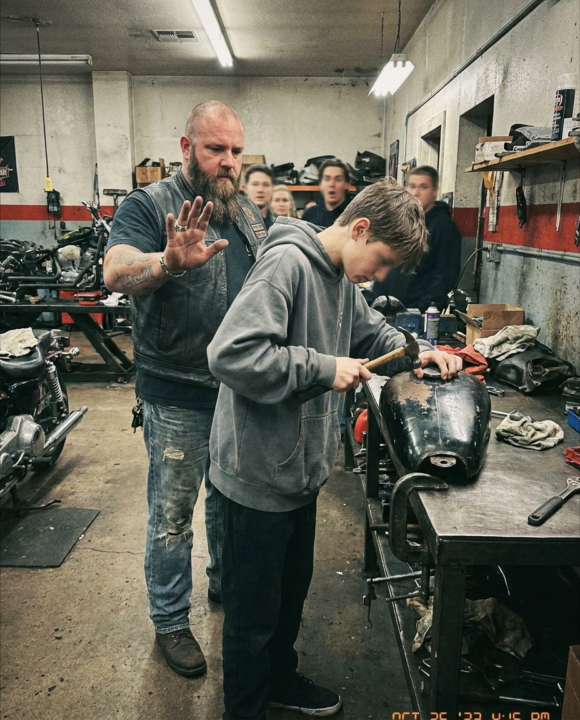
That was Ray.
Help first. Lecture never. Work afterward.
Most people in Flagstaff knew him as the giant biker who opened Dawson Iron Works before sunrise and closed whenever the last stranded rider could safely get home. His club brothers called him Hammer, partly because of his hands and partly because he spoke like one: a few heavy words, then silence.
Eli first appeared in late November.
He sat in the corner booth of the Pine Bell Diner while his mother worked behind the counter. Ray and I ate breakfast there every Thursday after opening the garage. Claire kept an eye on her son between coffee refills, but she tried not to make it obvious.
Eli wore a charcoal hoodie with the sleeves pulled over his hands. A school packet lay unopened beside him. He had headphones on without music playing and stared through the window at trucks passing along Route 66.
Ray noticed him because Ray noticed quiet things.
“What’s with the kid?” he asked me.
“Ask his mother.”
He did not. Ray hated questions that cornered people.
Instead, he left half his toast on the plate, paid the check, and crossed the highway to open the garage. Ten minutes later, Claire arrived with Eli.
Her voice was low.
“My sitter canceled. School says he can’t come back yet. I only need somewhere he can sit until my shift ends.”
Ray looked at Eli. Then at the moving belts, cutting tools, fuel cans, and welding equipment inside the shop.
“This ain’t daycare.”
Claire’s face tightened. “I know. I shouldn’t have asked.”
Ray pointed toward the small office behind the parts counter.
“He sits there. Door stays open. Ear protection on. Doesn’t cross the yellow line.”
Claire blinked. “You mean he can stay?”
“I mean those are the rules.”
Eli spent four hours in that office without saying a word.
The next day he returned.
Over the following week, I learned fragments of what Claire was carrying. Eli had been struggling for months. He had stopped sleeping properly, stopped attending soccer practice, and stopped answering friends. His school counselor had helped Claire connect him with Dr. Lena Cho, a licensed therapist in town, and together they had built a safety plan around him: trusted adults, regular check-ins, professional care, and ways to move intense feelings away from his own body.
Claire did not give Ray the private details.
She only told him, “We’re trying to keep him here.”
Ray understood.
He set boundaries before he offered kindness. Eli could enter only while Ray, Claire, or I was present. The hammer stayed locked away except during their planned ritual. The Panhead tank was empty, professionally cleaned, disconnected from every fuel source, and braced on a padded steel cradle Ray welded specifically for it.
Nothing about the arrangement was impulsive.
The idea came during Eli’s twelfth visit.
Ray had been shaping a damaged fender with a rubber mallet, producing slow, controlled knocks. Eli stood outside the yellow line and watched.
“Does hitting it make it better?” he asked.
Ray did not turn around. “Sometimes.”
“Sometimes it makes it worse.”
“Also true.”
Eli stepped closer but remained behind the line. “How do you know which one?”
Ray lowered the mallet.
“You decide what the hit is for before you swing.”
That sentence brought Dr. Cho into the garage two days later.
She was small, composed, and unimpressed by leather vests. She inspected the shop, spoke privately with Claire and Eli, then asked Ray why he was willing to use the antique tank.
Ray glanced toward the high shelf where it rested beneath the military blanket.
“Because it matters.”
Dr. Cho waited.
Ray added, “If it’s worthless, the choice means nothing.”
The ritual was folded into a broader plan. It was not treatment by itself and never replaced therapy, family care, or crisis support. It became a visible marker: after each full day Eli followed his safety plan and accepted help instead of turning against himself, he could return the following morning and make one controlled dent.
Not a reward.
A record.
The first morning, Eli barely touched the steel.
Ray marked the date beneath it.
The second morning, the boy struck harder. On the third, he froze with the hammer raised and said he had not earned the dent because the previous night had been bad.
Ray asked one question.
“Are you standing here?”
Eli nodded.
“Did you tell your mom?”
Another nod.
“Did you use the plan?”
“Yes.”
Ray pushed the tank closer.
“Then mark the day.”
Outside, February wind carried exhaust and red dust through the open bay. Inside, an old biker and a frightened boy began counting something none of us dared name aloud.
Day after day.
Dent after dent.
And each time Ray unlocked the mounting box, the small brass key trembled between his fingers.
Part 3 — The Night the Count Almost Ended
By day ninety-three, the Panhead tank no longer looked like a collector’s piece.
Small depressions covered its right side, some barely visible and others deep enough to catch a thumb. Ray recorded every date in a grease-stained ledger. Eli wrote one word beside each entry: something he had done to remain connected to the world.
Called Mom.
Sat with Mara.
Told Dr. Cho.
Walked outside.
Waited ten minutes.
Some words appeared repeatedly. Ray never demanded originality. Survival did not need to be interesting.
It only needed to continue.
The club brothers slowly stopped complaining about the tank. Cole, the prospect who had first called it ruined, began bringing breakfast burritos on Saturday mornings. Tiny Ruiz fitted a rubber grip to the hammer so Eli’s fingers would not slip. Tank Ellis—whose road name suddenly seemed like a bad joke—built a lockable wall cabinet for the ledger.
Brotherhood had entered the arrangement carefully.
Then it was tested.
The trouble came on a freezing Tuesday in March. Snowmelt ran black along Route 66, and a hard northern wind rattled the garage doors. Claire was supposed to bring Eli at seven-thirty.
They did not arrive.
At eight, Ray called. No answer.
At eight-ten, he called again.
At eight-fifteen, he removed his leather vest from its hook and pulled it on without fastening it. His movements were too controlled, which was how I knew he was afraid.
“Could be traffic,” I said.
Ray checked the empty highway.
“There ain’t traffic.”
Dr. Cho called at eight-twenty. She would not share private clinical details, but her tone told us enough: Claire had contacted her during the night. They were following Eli’s safety plan and seeking appropriate help, but the morning ritual would not happen on schedule.
Ray stared at the tank.
“What does he need?”
“Consistency,” Dr. Cho said. “And no shame when he returns.”
Ray’s jaw tightened. “He’s returning.”
It was not a question.
“He has support with him,” she replied. “Your job is to make sure this place still feels open afterward.”
The call ended.
Ray stood motionless beneath the fluorescent lights. Snow slapped the metal roof. Somewhere in the back bay, a compressor clicked off, leaving the entire building too quiet.
Then Ray swept the day’s jobs off his calendar.
Cole objected. We had three customers waiting, including a couple stranded on their way to Albuquerque.
“Tiny can handle the Road Glide,” Ray said. “Mara takes the carb job. Tank runs parts.”
“What are you doing?” Cole asked.
Ray pulled the Panhead tank from its cradle.
“Keeping the door open.”
He placed it on the workbench facing the entrance.
For eleven hours, the garage remained lit.
Club members came and went. Customers whispered. Ray refused to explain why the antique tank sat in the center of the shop with the small hammer beside it.
At noon, he poured coffee and forgot to drink it.
At three, he polished the hammer grip.
At six, Claire texted me three words: He is safe.
I showed Ray.
His shoulders dropped, but he did not sit down.
At eight-forty, headlights appeared through the snow. Claire’s sedan crossed the highway slowly and stopped outside the open bay. Eli remained in the passenger seat.
Ray did not walk toward him.
That mattered.
He stayed beside the tank and allowed the boy to decide whether to cross the distance.
Five minutes passed.
Then the passenger door opened.
Eli stepped out wearing the same gray hoodie. His face looked hollow with exhaustion, and he stopped at the garage threshold when he saw the club gathered inside.
Nobody spoke.
Cole lowered his eyes. Tiny removed his bandana. Tank moved away from the workbench so there would be a clear path.
Eli took one step.
Then another.
When he reached the tank, he stared at the empty space where that morning’s dent should have been.
“I broke the count,” he whispered.
Ray’s voice came out rough. “No.”
“I didn’t make it here.”
“You made it somewhere safer.”
“That isn’t the same.”
Ray opened the drawer, removed the hammer, and placed it on the bench.
“You came back.”
Eli’s chin began to shake. “I almost didn’t.”
Leather creaked as Ray bent down. He did not touch the boy. He simply lowered his enormous body until they were eye to eye.
“But you did.”
“I’m sorry.”
“That word doesn’t belong here.”
Eli looked around at the silent bikers. “Everyone knows.”
Ray turned toward the room.
The expression on his face could have cleared a bar.
“Everybody knows one thing,” he said. “You walked through the door.”
No one disagreed.
Eli picked up the hammer, but his wrist faltered. The metal head knocked weakly against the tank and left almost no mark.
He tried again.
Missed.
Again.
Tink. Tink. Tink.
His breathing broke into short, painful gasps. Claire took a step forward, but Dr. Cho, who had followed in her own car, gently touched her arm. Ray remained still.
“Look at me,” he said.
Eli did.
“Feet on the floor.”
The boy planted both boots.
“Name the sound.”
“Wind.”
“Another.”
“The lights.”
“Another.”
Eli swallowed. “Your chain.”
Ray nodded. His wallet chain gave a soft rattle as he shifted his weight.
“Now decide what the hit is for.”
Eli closed his eyes.
When he opened them, he swung.
The hammer slammed into the antique tank.
The deepest new dent in ninety-four days folded beneath the blow.
Claire cried out. Cole flinched. I felt the sound in my ribs.
Ray looked at the crushed metal, then at Eli.
“What was that one for?”
The boy’s answer was almost inaudible.
“Coming back.”
Ray drew the date beneath the dent.
We believed that was the crisis. We believed the night had taken them to the edge and the mark on the tank had brought Eli safely into the next morning.
We were wrong.
Because while Ray replaced the tank in its cradle, the old black paint fractured around the newest hollow. A thin crescent peeled away.
Underneath it was not bare metal.
It was blue paint.
Eli touched the exposed color.
“Was this tank somebody else’s?”
Ray closed his hand around the brass key.
For the first time since I had known him, Hammer Dawson looked like a man with nowhere left to hide.
Part 4 — The Name Beneath the Paint
Ray did not answer Eli that night.
He wrapped the tank in its military blanket, locked it inside the mounting box, and sent everyone home. Claire thanked him at the door, but he merely nodded.
Then he slept in the garage.
I found him the next morning in a folding chair, boots planted on the concrete, leather vest pulled around him like a second blanket. The ledger lay open across his lap.
“You owe the kid an answer,” I said.
Ray looked toward the locked box.
“I owe him more than that.”
He removed the brass key from his neck.
The mounting box had been bolted to the floor years earlier. I had assumed it contained parts too valuable for the display shelves. When Ray turned the key, however, I saw a stack of photographs, an old Arizona road map, two registration papers, and a child’s blue plastic model motorcycle with one wheel missing.
Ray lifted the photographs.
The boy in them was sixteen or seventeen, narrow-faced and bright-eyed, with Ray’s heavy eyebrows but none of his size. In one picture, he stood beside an unfinished Panhead frame. In another, he held the tank before it had been painted black.
It was deep blue.
“Daniel,” Ray said.
I knew the name. Everyone close to Ray did. But we knew it only as the son who was gone.
Ray rarely gave details.
Daniel had been fifteen when they found the Panhead in a collapsed barn outside Tulsa. The bike came home in milk crates. Ray and his son spent three years rebuilding it during weekends and school holidays.
Daniel chose the blue paint.
He installed the tank himself.
“He said black bikes looked like they were trying too hard,” Ray told me.
“That sounds like your kid.”
A shadow of a smile passed beneath his beard.
“He was mouthy.”
Daniel also struggled in ways Ray had not understood at the time. He concealed his pain behind jokes, late-night rides, and long hours in the garage. Ray saw bad grades and broken curfews. He responded with rules.
He did not see a boy losing his grip.
“I thought keeping him busy would fix it,” Ray said. “Thought hard work fixed everything.”
It did not.
Daniel died at nineteen.
Ray did not describe how. He never needed to. The absence was enough.
Afterward, Ray stripped the unfinished Panhead and sold nearly every piece. He could not bear to hear the engine they had rebuilt together. He kept only the blue tank.
For three years, it remained beneath a tarp.
Then one night, after too much whiskey and too little sleep, Ray placed it on the garage floor. He wanted to destroy it. He blamed the motorcycle, the house, the town, himself, and every conversation he had failed to have.
He swung his fist.
The first blow left a deep depression near the front seam.
The second broke two bones in his hand.
Ray stopped.
Not because he cared about the tank.
Because beneath the blue paint, close to the mounting bracket, Daniel had scratched a message into the steel during their restoration.
STILL HERE, OLD MAN.
Daniel had meant he was still in the garage after Ray called for dinner. A teenage joke. Three ordinary words.
After his death, they became unbearable.
Ray painted the tank black but left the dent. He mounted it on a wall and carried the brass key to its box around his neck.
“That first hollow is mine,” Ray said. “Made the night I didn’t know what to do with my hands.”
The door behind us opened.
Eli stood there.
Claire and Dr. Cho were a few steps behind him. None of us had heard their car over the wind.
Ray did not hide the photographs.
Eli saw the blue tank, the smiling teenager, and the broken plastic motorcycle. His gaze moved toward Ray’s left hand, where the knuckles had healed slightly crooked.
“You had a son?”
“Have,” Ray corrected. “He’s dead. Still my son.”
Eli looked at the floor. “Did he do what I—”
“No.”
Ray’s answer landed hard.
He stepped forward, then stopped outside arm’s reach.
“You are not him.”
Eli pulled his sleeves over his fingers. “But you think I might end like him.”
“I think endings aren’t owed to anybody.”
“You gave me his tank because you couldn’t save him.”
Ray’s beard shifted as his jaw clenched. “Partly.”
“What’s the other part?”
Ray looked at me, then Claire, then Dr. Cho. Finally, he returned his eyes to Eli.
“Because you gave me somewhere to put the next day.”
Silence filled the garage.
That was the part none of us had seen.
Ray had stopped drinking years earlier, but grief still controlled the shape of his life. He kept people at a careful distance. He repaired their machines, paid their motel bills, and rode beside their funeral processions, yet never let anyone touch the locked place inside him.
Eli’s ritual had changed that.
Every morning the boy struck the tank, Ray had to unlock the box. He had to see Daniel’s photographs. He had to remember his son without reaching for blame.
The boy was not the only person counting.
Eli wiped his face against one sleeve. “So I’m helping you?”
Ray looked uncomfortable with the word.
“You show up.”
“That isn’t an answer.”
“It’s the only one I got.”
Dr. Cho spoke gently. “Sometimes showing up is an answer.”
Eli approached the tank. Blue paint showed beneath the cracked black surface. He traced the edge but avoided the words Daniel had scratched near the bracket.
“Do you want me to stop denting it?”
Ray shook his head.
“Does it hurt?”
“Yes.”
The boy looked up, surprised by his honesty.
“Then why keep doing it?”
Ray picked up the small hammer. For a moment, it disappeared inside his massive palm.
Then he placed it on the bench between them.
“Because hurt ain’t the same as harm.”
Eli considered that.
He positioned the tank on the sandbag, chose a new patch of black steel, and lifted the hammer.
Ray stood beside him.
The blow left dent number ninety-five.
Under its edge, another sliver of blue appeared.
Part 5 — Three Hundred Sixty-Five
Spring warmed the red stone hills around Flagstaff, and the count continued.
Day one hundred.
Day one hundred forty-two.
Day two hundred.
The Panhead tank transformed beneath Eli’s hands. Its surface developed hundreds of shallow depressions, each distinct but connected, like rain frozen on a black pond.
The club stopped calling them dents.
They called them days.
Tiny built a wooden frame that allowed Eli to rotate the tank without lifting it. Cole photographed the underside after each month so no date would be lost if the tape peeled. Tank Ellis cut three hundred sixty-five small brass tags, then decided the idea looked too much like a memorial and melted them back down.
“Kid ain’t a gravestone,” he said.
Ray nodded. “Good catch.”
Brotherhood had learned to follow Eli’s lead rather than turn his struggle into their performance. There were no convoy fundraisers, no matching patches, and no public speeches. The men offered rides to appointments when Claire’s sedan failed, stocked the office with the sour candy Eli liked, and kept their phones in their pockets.
Quiet help.
That was the rule.
Eli returned to school part-time. He joined a small art class. He still had difficult days, and nobody pretended the hammer erased them. Some mornings he arrived angry. Some mornings he sat in the office for an hour before deciding he was ready.
Once, on day two hundred twelve, he refused to make the dent.
“I don’t want this to be the only thing I am,” he said.
Ray locked the hammer away.
“Then don’t.”
“You’re not mad?”
“A record works for you. You don’t work for it.”
Eli skipped the ritual that morning but returned after school. He had drawn the tank in charcoal, every depression rendered as a patch of light or shadow.
Ray studied the picture.
“You made it look expensive.”
Eli almost smiled. “It was expensive before.”
“Not like this.”
By autumn, Eli had grown two inches. His hoodie fit better because he no longer folded himself inside it. He spoke directly to customers and learned to organize sockets by size. Ray trusted him with safe, age-appropriate jobs—cleaning chrome, sorting washers, and labeling parts bins.
On day three hundred, Claire brought a cake.
Ray would not allow candles near the shop rags, so Tiny held a flashlight behind it while everyone sang badly. Eli covered his ears and laughed at the same time.
I watched Ray across the room.
He was holding Daniel’s blue plastic motorcycle.
The missing front wheel had been replaced.
Day three hundred sixty-four arrived beneath the first snow of a new winter. Eli stood before the tank for several minutes, turning the hammer in his hands.
“What happens tomorrow?” he asked.
Ray shrugged.
“We open at six.”
“You know what I mean.”
Ray did.
For almost a year, the ritual had given both of them a shape for the next morning. Ending it felt dangerous, as if the count itself held the walls upright.
Dr. Cho had prepared them for that. A milestone was not a finish line. Eli would continue receiving support, using his safety plan, and speaking when his thoughts became too heavy. The tank was a witness, not a cure.
Still, day three hundred sixty-five mattered.
Word spread quietly through the club. By sunrise, thirty-two motorcycles lined the frontage road outside Dawson Iron Works. No engines revved. No one wore a commemorative patch. They simply came.
Claire stood near the office door.
Dr. Cho stood beside her.
I placed the ledger on the workbench, opened to the final empty line, and handed Ray a black marker.
Eli arrived at seven-fourteen.
He froze when he saw the bikers.
“I thought we said no big thing.”
“This is small,” Tiny said. “You should see us do big.”
A few men laughed, easing the tension.
Ray brought out the Panhead tank.
Only a few patches of smooth black steel remained. Blue showed through dozens of cracked edges, and Daniel’s scratched message was now visible near the mounting bracket.
STILL HERE, OLD MAN.
Eli read it once.
Then he chose the last clear space.
Ray placed the hammer on the bench. “Your call.”
The boy picked it up.
His hands did not shake.
He looked at Claire, who pressed a fist against her mouth. He looked at Dr. Cho. At me. At the silent line of tattooed men who had learned that witnessing someone’s struggle did not make them owners of it.
Finally, he looked at Ray.
“What should this one be for?”
Ray’s voice was low.
“Tomorrow.”
Eli swung.
The sound rang through the garage, out across Route 66, and into the cold morning.
One clean strike.
Dent three hundred sixty-five.
Nobody cheered immediately. The moment was too heavy for noise. Ray marked the date in the ledger and handed the marker to Eli.
Beside the final entry, the boy wrote:
I stayed.
Only then did the room breathe.
Cole clapped once. Tiny pulled him into a one-armed hug. Engines outside began firing one at a time, their V-twin rumble rolling across the frontage road like distant thunder.
Eli stood before Ray and held out the hammer.
“I can fix the tank now.”
Ray did not take it.
“I learned metalwork from Mara. We can strip it, pull the dents, repaint it blue. I know I can’t make it original, but I can make it close.”
Ray ran one scarred hand over the battered steel.
“No.”
Eli’s face fell. “You don’t trust me?”
“Trust ain’t the issue.”
“Then why not fix it?”
Ray lifted the tank from its cradle. It was no longer smooth, no longer valuable in any collector’s sense, and no longer shaped like the piece Daniel had installed decades earlier.
It had become something else.
A year made visible.
Ray carried it toward the workbench where his spray equipment waited. But instead of dent pullers, filler, primer, and blue paint, he had prepared only a can of clear protective coating.
“I’m sealing it,” he said.
“With all the damage?”
Ray looked at Eli.
“Especially the damage.”
Part 6 — The Tank Above the Door
Ray spent three days preparing the tank.
He cleaned every hollow by hand with cotton cloths and mild solvent, careful not to erase the dates beneath the rim. He removed loose flakes of black paint but preserved every exposed patch of Daniel’s blue.
Eli helped.
Neither spoke much.
They sealed the tank beneath multiple layers of clear satin coating. The finish did not conceal the damage. It preserved fingerprints, hammer marks, fractured paint, and the scratched words near the bracket.
When sunlight struck the surface, the dents held shadows.
Three hundred sixty-five small shadows.
Ray could have displayed it in the club room. Instead, he mounted it above the front entrance to Dawson Iron Works, where every person entering or leaving had to pass beneath it.
No plaque explained what it meant.
Eli refused one.
“If people ask, we decide whether to tell them,” he said.
Ray agreed.
A week later, a collector from Phoenix visited the shop. He had heard Ray still owned an original Panhead tank and arrived with photographs, valuation guides, and an offer large enough to replace the garage roof.
He stared at the mounted tank.
“What happened to it?”
Ray tightened a bolt on a Road King and said nothing.
The collector stepped closer. “Those dents ruined an important piece of history.”
Ray placed the wrench down.
Eli was in the office doing homework. Ray glanced toward him before answering.
“You’re looking at the history.”
The collector raised his offer.
Ray told him the tank was not for sale.
“Everything’s for sale.”
“No.”
“You could buy another original.”
Ray wiped his hands on a shop rag.
“Not this one.”
The man left shaking his head.
That evening, Eli asked how much money Ray had refused. When I told him, the boy stared at the floor.
“You should’ve sold it.”
Ray locked the bay door.
“Why?”
“It’s just a tank.”
Ray’s chain rattled as he crossed the garage. He stopped beneath the battered steel.
“No,” he said. “It used to be.”
He took the brass key from around his neck and placed it in Eli’s palm.
The boy immediately tried to return it.
“I can’t keep this.”
“Ain’t asking you to.”
“What’s it for now?”
Ray pointed to the mounting box. Inside were Daniel’s photographs, the ledger, the charcoal drawing, and the blue plastic motorcycle with its repaired wheel.
“One day,” he said, “you may need to remember the count belonged to you. Not the tank. Not me.”
Eli closed his fingers around the key.
“What if I have another bad night?”
“You use your plan.”
“And if I think the year meant nothing?”
Ray looked up at the dents.
“Unlock the box.”
Eli wore the key for seven days, then returned it. Ray placed it on a second cord beside his own and hung both inside the office.
The gesture was small.
But the box no longer belonged to grief alone.
Part 7 — Still Here
Two years later, Eli no longer visited every morning.
He had school, counseling appointments, an after-class job at an art supply store, and a life that reached beyond Dawson Iron Works. Some weeks we saw him twice. Some months only once.
Ray never complained.
The garage remained open.
The Panhead tank still hung above the entrance. Dust collected inside the deeper dents, and sunlight faded the remaining black paint until Daniel’s blue showed more clearly beneath it.
Customers continued asking what had happened.
Ray usually answered, “It got used.”
On the third anniversary of dent number one, Eli arrived carrying a narrow wooden case. He had built it in his high-school workshop from walnut and old motorcycle crate boards.
Inside was the ball-peen hammer.
He had polished the steel head but left the rubber grip Tiny installed untouched. A small brass plate sat beneath it. The plate held no dates and no explanation.
It carried only two words:
FOR TOMORROW.
Ray read them, closed the case, and placed it inside the mounting box.
Then he handed Eli a helmet.
“Where are we going?”
“Breakfast.”
“On the Panhead?”
Ray snorted. “Panhead still ain’t finished.”
The old frame remained at the back of the garage. Over the previous year, Ray and Eli had begun rebuilding it with parts collected from swap meets and club members’ shelves.
They would never reinstall Daniel’s original tank.
Eli had fabricated a new one.
He painted it deep blue.
Before applying the final clear coat, he scratched three words near the mounting bracket where only someone removing the tank would ever see them.
STILL HERE, RAY.
Ray pretended not to notice.
That morning, they rode the Road King instead. Eli climbed onto the passenger seat, adjusted his helmet, and wrapped both hands around the grab rail.
Ray fired the engine.
The V-twin caught with a low, uneven rumble that shook dust from the garage rafters. Above them, three hundred sixty-five dents trembled in the morning light.
Claire stood across Route 66 outside the Pine Bell Diner. She lifted one hand.
Eli waved back.
Ray eased the motorcycle toward the highway, but before turning west, he looked once at the tank above the door.
At Daniel’s blue paint.
At Eli’s hammer marks.
At the steel that had carried two kinds of grief and survived both.
Then he rolled forward.
No ceremony. No speech.
Just a biker, a boy, and another morning.
Follow our page for more unforgettable biker stories about intimidating men, quiet kindness, and the lives they protect without asking for recognition.