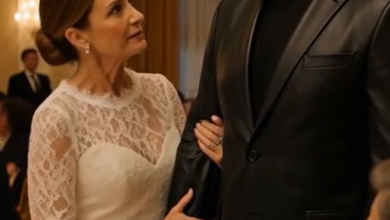
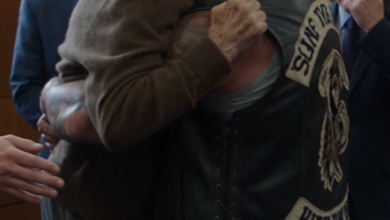
Part 2: A Biker Tore the Wedding Dress Off a Bride in Front of the Altar—Then the Burning Train Revealed Why He Had Only Seconds to Act
Part 2 — The Biker Missing from the Guest List
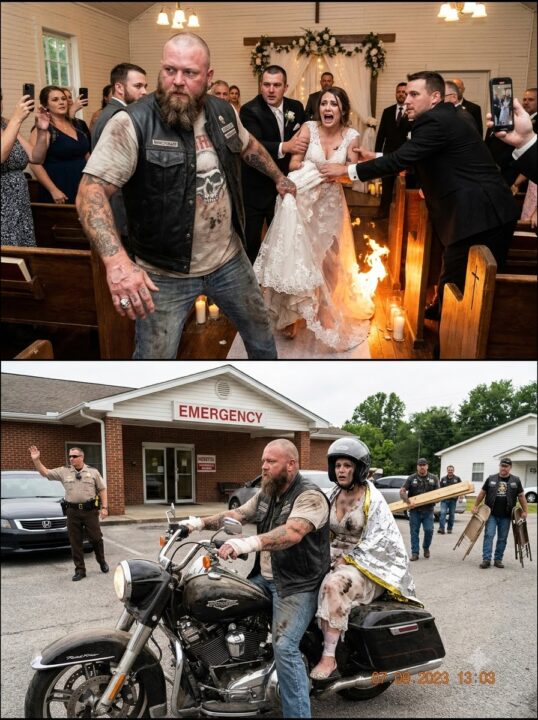
I spent the first hour at Ashford Memorial moving between Clara’s treatment room and the hallway where Hammer sat beneath a vending machine’s hard fluorescent light.
His hands rested palms-up on his knees. Blisters covered his fingers, while a shallow cut above his eyebrow marked where I had driven him into the pew.
I apologized.
Hammer studied the bandages.
“You saw a man grabbing your wife.”
“I should have seen the fire.”
“You saw what was in front of you.”
That answer denied me the easier punishment of being hated.
Clara’s injury required cleaning, topical treatment, and observation for smoke exposure, but doctors expected a full recovery. She would walk carefully for several days and carry a scar no larger than two fingers.
Hammer’s hands were worse.
He had pressed several layers of burning lace beneath his vest, causing partial-thickness burns across his palms. The doctor instructed him not to ride until his grip recovered.
Hammer looked toward the parking lot.
“My bike’s not staying here.”
Clara heard him from the doorway.
“Neither are you.”
Those were the first words she had spoken directly to him in six years.
Their distance began after her father, Daniel Bennett, died from pancreatic cancer at fifty-three. Daniel had ridden with the Iron Vow for nearly twenty years and treated Hammer like a brother.
Clara grew up around motorcycles.
Her childhood photographs showed her sitting on Daniel’s Harley, wearing pink hearing protection and a leather vest her mother sewed from an old jacket. Hammer appeared in the background of birthdays, cookouts, and school fundraisers.
Then Clara’s mother, Elaine, died in a highway collision when Clara was seventeen.
Daniel unraveled.
He drank, missed work, and spent nights riding because the house felt unbearable without his wife. Hammer tried stopping him, sometimes by hiding his keys and once by physically blocking the garage.
Daniel resented him.
Clara heard the arguments.
From her bedroom, she heard Hammer say Daniel had become dangerous. She heard her father answer that no club brother had the right to decide when another man rode.
Months later, Daniel entered recovery and remained sober, but the friendship never fully returned to its earlier shape. Hammer continued checking on him from a distance.
When Daniel received his cancer diagnosis, he told almost nobody.
Hammer drove him to treatments.
Clara, then attending college in Knoxville, believed her father traveled alone because he did not want to disrupt her final year. Daniel allowed that misunderstanding.
He feared she would abandon school to care for him.
Hammer helped preserve the lie.
That choice became the foundation of Clara’s anger after Daniel died. She arrived home during his final week and found Hammer asleep in a chair beside the hospital bed.
Clara demanded to know why nobody had called earlier.
Hammer accepted the blame.
Daniel was too weak to explain that the decision had been his.
After the funeral, Clara asked Hammer to leave the family alone. She associated his leather vest, motorcycle, and silence with every truth concealed from her.
Hammer obeyed.
He stopped attending birthdays, graduations, and holiday gatherings, even when Clara’s grandmother quietly invited him. When Clara announced her engagement, Hammer sent no message.
However, Daniel had left him a responsibility.
Two weeks before his death, Daniel called Hammer to Dawson Motorcycle Repair and brought a green military tool chest. The lock was old, the hinges rusted, and a brass key hung from twine around the handle.
Daniel made Hammer promise not to open it until Clara’s wedding day.
“What if she never gets married?” Hammer asked.
“Then she opens it when she’s ready to know I worried too much.”
Daniel also left twelve sealed envelopes marked for different moments: engagement, wedding morning, first major argument, first home, first child if there was one, and one labeled “When she thinks I chose the road over her.”
Hammer kept the chest in his garage office.
He never told Clara.
When he learned our wedding date from Clara’s grandmother, he decided to deliver the chest after the reception and leave before anyone asked him to remain.
That was why he came uninvited.
The brass key he dropped while running toward Clara opened the chest.
We carried it into a private hospital consultation room. Clara sat in a wheelchair with an emergency blanket covering the remnants of her gown, while Hammer stood near the door as though prepared to leave.
Her grandmother unlocked the chest.
Inside rested Daniel’s letters, a small digital recorder, several photographs, a metal cashbox, and a black notebook filled with names, telephone numbers, and contingency plans.
Daniel had anticipated almost everything that could disrupt a wedding.
He listed a backup officiant, a retired seamstress, a florist who owed him a favor, two available community halls, an electrician, three caterers, and every Iron Vow member who had promised to help.
Across the notebook’s first page, he had written:
“A wedding is one day. Marriage is all the repairs afterward. Still, give my girl a good day.”
The cashbox contained $8,740.
Daniel had saved it in small amounts during his final year. He called it Clara’s “bad-weather fund,” though Hammer had never known the amount.
Clara touched the money but did not count it.
She selected the wedding-day envelope instead.
Inside, Daniel congratulated us, apologized for missing the ceremony, and asked Clara not to confuse his silence with absence.
Then he mentioned Hammer.
“If Ray brings this box,” Daniel wrote, “it means he kept one more promise I made harder than it needed to be.”
Clara looked toward the doorway.
Hammer had already left.
Through the hospital window, we saw him walking toward his Harley with both hands bandaged, trying to push the eight-hundred-pound machine without gripping the handlebars.
Forty Iron Vow riders waited outside.
Bear took one handlebar.
Luis took the other.
Hammer told them he could manage.
Nobody listened.
That was how the second wedding began—not with flowers or music, but with two bikers pushing their injured brother’s motorcycle into the night while the rest carried Daniel’s unfinished plan behind them.
Part 3 — The Dress, the Chapel, and the Video Everyone Shared
By the following morning, three different recordings of the incident had spread online. Each began with Hammer grabbing Clara and ended before viewers clearly saw the burning train.
The captions described him as a jealous biker, an estranged relative, or a violent intruder. One post claimed he attacked Clara because she refused to let the Iron Vow attend.
None was true.
The cleanest footage came from our wedding videographer, but police temporarily retained the camera while investigating the chapel fire. Until they released it, the frightening version traveled faster.
Hammer’s repair shop received threats.
Strangers called the Iron Vow clubhouse and promised to make him pay. A local radio host demanded his arrest before speaking with Clara, the fire department, or anyone who had seen the flames.
My cousin Aaron felt responsible.
He was the first guest who grabbed Hammer after I struck him. Aaron’s forearm had pressed across Hammer’s throat while the biker tried pointing toward Clara’s burning dress.
“I could have stopped him from saving her,” Aaron said.
Hammer refused to discuss it.
He had already given the sheriff a statement and declined to file assault complaints against any guest. When Bear suggested identifying the people who attacked him, Hammer closed the conversation.
“They protected what they saw,” he said.
Bear disagreed.
The Iron Vow had spent decades absorbing blame whenever violence appeared near a motorcycle vest. Several members believed Hammer’s refusal to defend himself allowed the old stereotypes to continue.
Their frustration deepened when the owner of St. Luke’s Chapel announced that the building would remain closed for at least three weeks. Fire damaged two pews, part of the aisle flooring, and electrical wiring beneath the candle display.
The owner’s insurer questioned whether the ceremony violated occupancy and flame-safety requirements.
Our second wedding had nowhere to happen.
The original florist had another event. The caterer could not return, and half the guests had traveled from other states.
Clara’s mother’s gown appeared beyond saving.
Its lower skirt was burned, torn, and soaked with extinguisher residue. Only the bodice, sleeves, and several sections of old lace remained intact.
Clara told me we should abandon the ceremony.
“We can sign papers at the courthouse.”
She tried sounding practical, but her hands tightened around Daniel’s wedding letter whenever she mentioned it.
The day had represented more than marriage. It was supposed to be the final place where memories of both parents could stand beside her without controlling her.
Now the gown was destroyed.
Her father’s closest friend was injured.
Thousands of strangers were watching the worst twelve seconds without knowing what happened next.
Hammer entered her hospital room at noon wearing clean bandages and no leather vest. Bear carried the vest because Hammer could not manage it over his hands.
“Saturday,” Hammer said.
Clara stared at him. “Yesterday was Saturday.”
“Next one.”
She asked what would happen then.
Hammer placed Daniel’s black notebook on the bed.
“Your wedding.”
Clara said no.
She refused to let an injured man and a motorcycle club spend money rebuilding a celebration that already nearly burned her. Hammer waited until she finished.
“Wasn’t asking.”
That was pure Hammer.
The Iron Vow located the first backup venue in Daniel’s notebook, an American Legion hall off Route 31. Its banquet room was available the following Saturday, but the kitchen plumbing had failed and half the ceiling tiles showed water damage.
The club accepted.
Bear divided forty riders into work teams. Luis coordinated food, Doc handled tables and chairs, while a retired electrician named Mack inspected every outlet.
No open flames would enter the building.
Meanwhile, the seamstress listed in Daniel’s notebook arrived at the hospital carrying three garment bags. Her name was Beatrice Shaw, and she had altered Clara’s mother’s dress before the original wedding thirty-one years earlier.
Beatrice spread the surviving fabric across a table.
“The skirt is gone,” she said. “The dress isn’t.”
Clara asked whether she could reproduce it.
Beatrice shook her head.
“You don’t need the same dress twice.”
She planned to preserve the bodice, remove all heat-damaged material, and attach a simpler skirt from an unworn gown donated by her shop. Several pieces of Clara’s mother’s lace could be stitched inside where only the bride would see them.
The burn would not be hidden completely.
Beatrice proposed leaving one darkened edge beneath a transparent protective layer along the hem.
Clara looked uncertain.
Hammer spoke from the doorway.
“Scars prove where the fire stopped.”
Clara accepted the design.
That afternoon, hospital staff discharged her with instructions to rest, care for the burn, and return if symptoms worsened. She expected me to drive her home.
Hammer’s Harley waited beneath the entrance canopy.
His hands were too injured to ride, so Bear sat at the controls. Hammer had cleaned the passenger backrest and attached Daniel’s old brass key beside the saddlebag latch.
Clara touched it.
She realized the Road King was not merely the motorcycle that carried her from the fire. Daniel had helped Hammer select and rebuild it after Hammer’s older bike was destroyed in an accident.
Her father’s fingerprints remained beneath part of the engine casing.
Clara chose the car.
Yet before leaving, she placed one hand against the Harley’s fuel tank and whispered something I did not hear.
At the American Legion hall, the brotherhood faced another crisis. A city inspector learned that several Iron Vow riders planned to repair the building and threatened to halt work unless licensed professionals handled electrical, plumbing, and structural issues.
Some members wanted to continue secretly overnight.
Hammer stopped them.
“We don’t rebuild one dangerous room by making another.”
Licensed contractors from Ashford volunteered after watching the complete hospital statement from Clara. Riders handled cleaning, painting, furniture, and decorations instead.
It slowed the work.
It also kept everyone safe.
By Wednesday, the videographer’s full recording was released.
The footage showed the flame spreading through Clara’s train for seven seconds before Hammer moved. It showed him tearing the burning layer away, allowing guests to restrain him, and pointing toward the fire.
The final frame captured his bare hands covering the flames.
Public opinion reversed overnight.
Interview requests arrived from national programs. Donations appeared at the garage, and strangers offered to pay for the wedding.
Hammer rejected every interview.
He placed all unsolicited money into Daniel’s locked cashbox.
“This was her father’s job,” he said. “We’re just the hands.”
Then an investigator called.
The fire had not started solely because the train drifted toward a candle. The candle arrangement had been moved after the safety inspection, placing the flames several feet closer to the aisle.
Someone attending the wedding had repositioned them.
The person responsible was Clara’s grandmother.
Part 4 — What Clara’s Grandmother Moved Before the Vows
Clara’s grandmother, Helen Bennett, was seventy-eight and fiercely independent. She had arrived at St. Luke’s three hours before the ceremony to supervise flowers, photographs, and every detail she believed Daniel would have handled.
The candle display looked uneven.
Helen moved two stands closer to the aisle because she wanted their light visible behind Clara in photographs. The wedding planner objected briefly, then became distracted by a late delivery.
Helen never considered the train.
When the investigator explained the likely ignition point, she collapsed into a folding chair at the Legion hall. Her hands shook so violently that coffee spilled across Daniel’s notebook.
“I burned her,” she said.
Clara knelt carefully beside her.
Helen repeated the words.
Hammer approached, carrying a box between his bandaged palms. He did not tell Helen the fire was nobody’s fault, because that would have dismissed a choice with real consequences.
He also refused to let one mistake become her entire identity.
“You moved candles,” he said. “I’ve done worse with gasoline.”
Helen looked at him.
Hammer had not spoken publicly about his past, but Daniel knew it. Twenty-six years earlier, Hammer operated an illegal repair garage where fuel containers, damaged wiring, and oily rags shared the same cramped space.
A fire destroyed the building.
Nobody died, but a young employee suffered burns, and Hammer spent eleven months in county jail for code violations and reckless endangerment.
Daniel visited every week.
After Hammer’s release, Daniel helped him build a legal shop with proper ventilation, storage, alarms, exits, and extinguishers. He taught Hammer that regretting a dangerous choice mattered less than changing the conditions allowing it.
That history explained why Hammer had inspected St. Luke’s candle arrangement from the rear pew.
It also explained the slim emergency blanket and extinguisher he carried in his Harley saddlebag. He had lived too long with the knowledge that small carelessness can wait quietly until somebody else pays for it.
Helen asked whether Clara would ever forgive her.
Hammer nodded toward the damaged gown.
“Ask after you help fix it.”
Beatrice gave Helen the work of cleaning intact lace by hand. The task was slow, delicate, and impossible to complete while drowning in self-accusation.
Helen worked beside Clara for two evenings.
They spoke more honestly than they had in years.
Helen admitted blaming Hammer after Daniel’s death because anger felt easier than accepting her son had hidden his illness. Clara confessed she had also treated Hammer as the face of choices Daniel made himself.
The biker became a container for their grief because he never defended himself.
Hammer knew.
That was partly why he stayed away.
On Thursday night, Clara opened Daniel’s envelope labeled “When she thinks I chose the road over her.”
Daniel explained that motorcycles never pulled him away from family. Fear did.
After Elaine died, the road gave him somewhere to avoid returning home. Later, illness gave him another reason to hide, because he did not want Clara’s final college year replaced with hospital corridors.
He admitted those decisions were selfish despite being disguised as protection.
Then Daniel wrote about Hammer.
“Ray argued with me harder than anyone. If he obeyed my silence, it was because I made him choose between betraying me and frightening you before I was ready.”
Clara stopped reading.
Hammer stood across the room repairing a table leg with his wrists because his bandaged fingers could not grip properly.
She crossed the hall.
“Why didn’t you tell me after he died?”
“Would’ve sounded like blaming him.”
“So you let me blame you?”
Hammer shrugged.
“I was available.”
Clara embraced him.
His burned hands remained lifted awkwardly at his sides, unable to return the hug. After several seconds, he lowered his bandaged wrists against her shoulders.
Nobody photographed that moment.
It belonged to them.
The locked section of Daniel’s cashbox contained another surprise. Beneath the wedding savings lay the title and keys to his 2003 Harley-Davidson Heritage Softail.
Clara believed the motorcycle had been sold to cover medical bills.
Hammer had purchased it from the estate.
Daniel’s handwritten agreement stated that Hammer would restore and maintain it until Clara decided whether she wanted the bike, its value, or neither.
For six years, it remained beneath a cover at Dawson Motorcycle Repair.
Hammer showed it to us Friday morning.
The motorcycle was deep blue, the color Elaine once called Daniel’s “second bad decision.” A small mark on the passenger footboard came from Clara dropping a wrench there when she was nine.
The engine started on the second turn.
Its familiar rumble filled the garage.
Clara covered her mouth.
Hammer explained that the brass key he carried into St. Luke’s belonged to Daniel’s Harley, not the tool chest. He planned to offer Clara the choice after the reception.
The chest used a duplicate key.
Daniel wanted both opened on the same day.
Clara did not know how to ride, and she did not want to sell the motorcycle. She asked Hammer to keep it until she learned.
He nodded.
Then she made one more request.
She wanted Daniel’s Harley beside the altar at the second wedding.
Hammer resisted because motorcycles carried fuel, and the Legion hall had strict indoor safety rules. Clara laughed through her tears.
“You finally learned to say no.”
They placed the Harley outside the entrance instead.
No exceptions.
No shortcuts.
No second dangerous room.
That evening, the Iron Vow completed the hall. Folding tables replaced polished banquet furniture, donated wildflowers filled glass jars, and strings of battery-powered lights covered the water-stained ceiling.
Nothing matched.
Everything held.
At midnight, Hammer opened Daniel’s final wedding instruction. It was addressed specifically to him.
“Do not stand in the back,” Daniel had written. “If Clara allows it, walk her where I can’t.”
Hammer folded the note and placed it inside his vest.
He did not ask Clara.
She had already read her copy.
Part 5 — The Wedding Built by Burned Hands
Saturday arrived with steady rain across Route 31. Under ordinary circumstances, bad weather might have seemed like another threat to our repaired ceremony.
After fire, rain felt kind.
The American Legion hall smelled of coffee, fresh paint, pine cleaner, and the barbecue Luis had started before sunrise. Forty Harley-Davidson motorcycles lined the parking lot, their chrome dulled beneath gray skies.
Hammer arrived in Bear’s truck.
His hands remained bandaged, and the doctor still prohibited riding. Daniel’s blue Heritage stood beneath the entrance awning, protected from the rain.
Clara dressed in the meeting room.
Beatrice’s reconstructed gown looked different from the one that burned. The surviving bodice remained, but the new skirt was lighter, shorter, and free from a long train.
Pieces of Elaine’s original lace had been stitched inside the hem.
The darkened edge remained visible beneath a transparent layer near Clara’s left ankle. It did not dominate the dress, yet nobody could mistake it for ordinary decoration.
Helen fastened the final button.
She apologized again.
Clara handed her a battery-powered candle and said, “You’re in charge of this one.”
Helen laughed for the first time all week.
The wedding guests arrived with the discomfort of people returning to a story after behaving badly inside its opening chapter. Aaron approached Hammer first and apologized for pressing his forearm against the biker’s throat.
Hammer studied him.
“You move fast.”
“I moved wrong.”
“Next time, look behind you.”
They shook wrists because Hammer’s palms remained injured.
I apologized again too.
Hammer told me I had reached my lifetime limit.
Before the ceremony, Bear returned Hammer’s leather vest. Parts of its lower panel remained stiff and dark where it had smothered Clara’s burning train.
The club offered to replace it.
Hammer refused.
Beatrice had sewn a small piece of salvaged ivory lace beneath the damaged leather, leaving only one narrow edge visible from inside.
Beside it rested Daniel’s patch.
Burned cloth and wedding lace now occupied the same vest.
The ceremony began without candles.
Luis played the recorded processional through an old speaker, but the sound cut out after twelve seconds. Forty bikers tried humming the melody and discovered none knew it well enough.
Clara heard them from the hallway.
She started laughing.
The double doors opened.
Hammer waited beside her.
His size filled most of the entrance, while the black leather, tattoos, gray beard, burned hands, and stern expression contrasted sharply with Clara’s rebuilt ivory gown.
He asked whether she was certain.
Clara linked her arm through his.
“Don’t stand in the back.”
Hammer’s jaw tightened.
They walked.
His heavy boots struck the floor slowly because Clara’s burn still made her favor one leg. Nobody hurried them.
As they passed Daniel’s empty chair, Hammer stopped. Clara placed her father’s brass motorcycle key on the seat.
Then they continued.
Hammer delivered her to the altar but did not release her immediately. He looked at me with the same hard expression he had worn before tearing away the burning train.
“See all of her,” he said.
I understood.
Not only the bride in front of me. Not only the danger behind her. The full person, including everything she carried where I might not think to look.
“I will.”
Hammer stepped away.
Our vows were shorter the second time. We had spent the week learning that promises sounded different after one person had already carried another through smoke.
When the minister pronounced us married, no one threw rice or lit sparklers. The Iron Vow riders struck their motorcycle gloves against the tables, creating a rough applause like rain on a metal roof.
The reception followed immediately.
Luis served food on mismatched plates. The florist combined surviving arrangements with wildflowers gathered from club members’ yards, while Beatrice repaired a tear in the tablecloth during dinner.
Daniel’s audio recording played after the speeches.
His voice sounded thinner than Clara remembered, but his humor remained.
He congratulated us, warned me that Clara hated being told to calm down, and advised her never to let marriage become two people hiding difficulties to protect each other.
Then he addressed Hammer.
“Ray, if you’re hearing this from the back of the room, move closer.”
Every guest turned.
Hammer stood beside the exit.
Clara pointed toward our table.
He obeyed.
Daniel continued.
“You were never supposed to replace me. Just remind her somebody from my side of the aisle still showed up.”
Hammer lowered his head.
Clara moved a chair beside hers.
The empty place originally reserved for Daniel remained untouched. Hammer sat on the other side, close enough to belong without occupying her father’s absence.
After dinner, Bear wheeled Daniel’s Harley beneath the awning while Clara changed into jeans and a riding jacket. Hammer could not teach her that night because of his injuries.
He showed her the controls with bandaged wrists.
The engine remained off.
Safety came first now, even during memory.
Clara placed both hands on the handlebars and felt the machine’s weight. Hammer stood behind her, close enough to catch it but careful not to hold it upright for her.
She asked what would happen if she dropped it.
“We pick it up.”
That answer belonged equally to motorcycles, weddings, and families.
Later, I discovered that Daniel’s $8,740 remained untouched. Hammer and the Iron Vow had covered the second ceremony through donated labor, borrowed equipment, and favors collected across decades.
Clara wanted to reimburse them.
Hammer refused.
She used the money to establish an emergency repair fund at the Legion hall, paying licensed workers to fix the kitchen plumbing, replace damaged ceiling tiles, and update the fire-alarm system.
Daniel’s bad-weather money protected future weddings.
The hall placed no plaque bearing his name.
Clara requested only one visible object: a framed section of scorched lace displayed beside the fire extinguisher inspection log.
Beneath it were five words:
LOOK BEHIND WHAT YOU LOVE.
Hammer disliked the sentence because it sounded too polished.
He still checked the frame whenever he entered.
Part 6 — Every Anniversary Began at the Hospital
Clara’s scar faded during the following year, though one pale line remained above her ankle. Hammer’s palms healed more slowly, forcing him to let other mechanics handle heavy work for several months.
He hated needing help.
Clara visited the garage every Tuesday and practiced riding Daniel’s Heritage in the empty rear lot. She began with the engine off, learning balance, controls, braking, and the machine’s weight.
Hammer never rushed her.
He had once measured courage by how quickly a person moved toward danger. Age taught him that stopping before danger can require more discipline than charging into it.
By spring, Clara completed a certified motorcycle safety course. Only afterward did Hammer allow her onto Route 31 with the Iron Vow.
Their first ride lasted eleven miles.
Hammer led on his Road King, while Bear followed Clara from behind. I rode in a truck because motorcycles and I had reached a polite understanding.
They stopped at Ashford Memorial Hospital.
Clara parked near the emergency entrance where Hammer brought her after the chapel fire. She removed her helmet and touched the white painted line marking the drop-off zone.
Hammer stood beside her.
“You regret the dress?” he asked.
“I regret the candles.”
“That wasn’t the question.”
Clara looked toward Daniel’s motorcycle.
“No.”
The burned gown no longer represented a ruined day. It represented the point where something inherited became something remade.
Each anniversary began with the same route. Clara and I visited the hospital, delivered a donation to its burn-care assistance fund, then rode or drove to St. Luke’s Chapel.
The chapel reopened after extensive repairs.
Its new rules prohibited open-flame displays near aisles, fabric, and exits. Battery-powered candles replaced the original arrangement.
Helen attended every anniversary inspection.
She carried a flashlight and annoyed the staff by checking evacuation maps.
The Iron Vow also changed.
Bear introduced basic emergency-response refreshers through the county fire department. Riders learned what to carry, when not to move an injured person, and how to communicate with dispatchers.
Hammer insisted that saving Clara did not qualify him to teach medical care.
He taught observation instead.
Listen for the wrong sound.
Smell what does not belong.
Look behind the person everyone else is watching.
The full wedding video continued appearing online, often paired with the shortened clip. Hammer refused media interviews, but Clara eventually agreed to speak at a venue-safety conference.
She did not portray him as superhuman.
“He acted because he noticed,” she said. “Then trained professionals handled what came next.”
That distinction mattered to Hammer.
Hero stories often remove the ordinary preparation that makes action possible. Hammer carried an emergency blanket because his garage once burned. He watched candles because carelessness had already injured somebody in his past.
His worst mistake had trained his eyes.
It did not excuse the mistake.
It changed what he did afterward.
On our fifth anniversary, Beatrice gave Clara a small cloth bag made from the final unused section of Elaine’s wedding lace. Inside rested the brass key to Daniel’s Harley.
Clara handed Hammer a second key.
He had maintained the motorcycle long enough.
They now shared responsibility for it.
The original metal tool chest remained in our home. We opened Daniel’s envelopes gradually, never rushing to reach moments our lives had not yet entered.
The envelope marked “First major argument” was opened eighteen months after the wedding.
Daniel’s advice was terrible.
Clara laughed for ten minutes.
Hammer heard about it and said Daniel always gave bad relationship advice because his solution to conflict involved buying motorcycle parts.
Some memories were allowed to become funny.
The blackened piece of Hammer’s leather vest remained unrepaired. Beneath it, Beatrice’s ivory lace slowly darkened from road dust and motor oil.
Hammer never cleaned it completely.
He said some white things should be permitted to show where they had traveled.
Part 7 — The Bride Who Finally Took the Front
Ten years after the chapel fire, St. Luke’s invited Clara and me to attend another wedding. The bride was the daughter of one of the firefighters who inspected the original scene.
Battery-powered candles lined the aisle.
The spacing was exact.
Hammer attended too, wearing the same leather vest and sitting where Daniel’s letter had instructed him—near the family, not beside the exit.
He was sixty-six.
His beard had turned mostly gray, and his hands no longer closed completely on cold mornings. He had reduced his shop hours but still inspected every motorcycle leaving Dawson Repair.
Clara arrived on Daniel’s Heritage.
She rode alone.
The deep-blue Harley’s engine settled outside the chapel, carrying the same uneven rhythm she remembered from childhood. Hammer listened from the doorway.
He did not correct her parking angle.
That showed restraint.
Before entering, Clara removed a narrow strip of ivory lace from her saddlebag. It came from the reconstructed gown and carried the darkened edge Beatrice preserved.
She fastened it inside Hammer’s vest beside the original piece.
One strip belonged to the fire.
The other belonged to the wedding that survived it.
Hammer touched both.
“You cutting that dress apart again?”
“Only the parts I choose.”
He nodded.
Inside the chapel, the new bride’s train passed safely between the artificial candles. Hammer watched it anyway.
Some habits remain because they are useful.
After the ceremony, we rode to the Legion hall where our second wedding took place. The kitchen now served community meals, the ceiling no longer leaked, and the fire-alarm panel carried current inspection tags.
Daniel’s scorched lace remained framed beside the extinguisher log.
Hammer checked the date.
Then he examined the exit.
Clara rang Daniel’s motorcycle key against the frame to get his attention.
“Everything safe?”
Hammer scanned the room one final time.
“Safe enough to dance.”
He did not dance.
He stood beside the wall while Clara and I moved beneath battery-powered lights, but this time he was not hiding near the door. Club brothers surrounded him, children climbed onto empty chairs, and Helen watched from a photograph beside Daniel and Elaine.
Later, Hammer walked into the parking lot alone.
His Road King waited beside Daniel’s Heritage. One motorcycle had carried Clara away from a burning wedding; the other had carried her father through half her childhood.
Clara started Daniel’s bike.
Hammer started his.
The engines spoke across the dark lot, one slightly deeper than the other. I followed in our car while the Iron Vow formed behind them along Route 31.
At the hospital intersection, Hammer slowed.
Clara did not.
She took the front.
The riders followed the bride whose dress he once tore apart, their headlights stretching behind her through the Tennessee night.
Hammer remained second.
Exactly where Daniel had asked him to stand.
Follow our page and leave “HAMMER” below for more unforgettable biker stories about misunderstood courage, second chances, and promises that survive the fire.