A Biker Tore the Bouquet From My Hands and Roared Away From the Church — We Chased Him to the Hospital Where My Dying Father Was Waiting
Part 2 — The Name Written Beside the Church Door
I took the next elevator with Daniel, Owen, and half a dozen relatives who were still angry enough to mistake speed for certainty. Nobody spoke until the doors opened on the fourth floor and we heard boots striking linoleum somewhere beyond the nurses’ station.
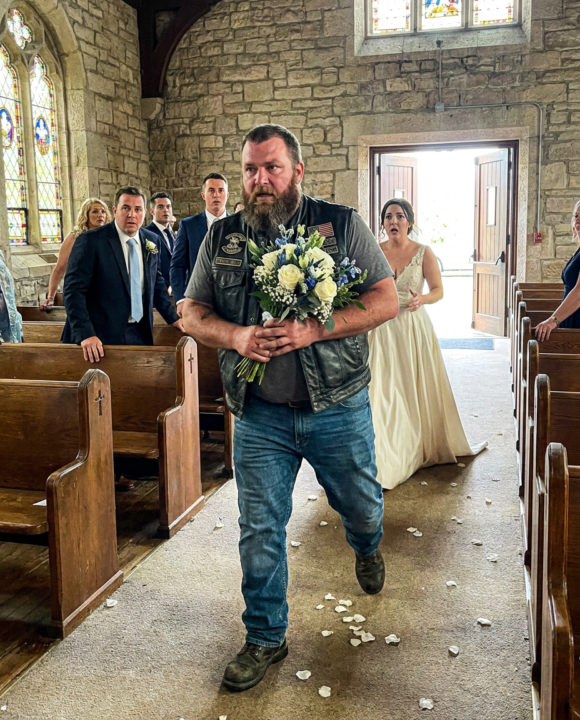
Hammer had already reached Room 412.
A nurse tried to stop us. My father had deteriorated rapidly, she said. His oxygen level had dropped. The doctor was inside. Only two family members could enter.
“I’m his daughter.”
She looked at my wedding dress, then at the petals scattered along the corridor.
Her expression softened.
“Go.”
Daniel stayed behind without being asked. Owen followed me until the nurse put a palm against his chest. For once, my brother did not argue. He stared through the narrow glass panel and whispered, “What the hell is that man doing?”
I entered alone.
Dad looked smaller than he had the night before. The oxygen mask covered most of his face, and every breath lifted his shoulders as though someone were pulling invisible wires beneath his gown. Machines crowded the bed. A photograph of my mother stood beside a plastic cup of melting ice.
Hammer was on his knees.
The huge biker had placed my bouquet across Dad’s blanket. His silver rings were gone. So were his gloves. He held the stems gently between both scarred hands while Dad touched the cedar with two fingers.
Neither man noticed me at first.
“You made it,” Dad whispered.
Hammer bent closer. “Told you I would, Cap.”
“I knew you would.”
Cap.
My father had retired from the Knox County Fire Department eleven years earlier. Men who had served under him still used the title, but I had met nearly all of them at backyard cookouts, retirement dinners, and funerals.
I had never met Raymond Dawson.
Dad’s gaze shifted toward me. Even behind the mask, I saw relief.
“There’s my girl.”
I crossed the room so quickly that my train snagged beneath a rolling stool. Hammer caught me before I fell, then released my arm as if he believed his touch might stain the dress.
“What is happening?” I asked.
Dad looked at Hammer.
“Show her.”
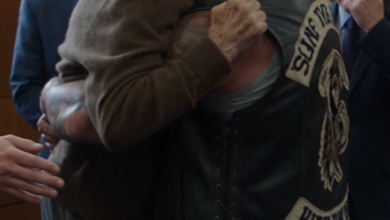
The biker reached beneath his vest and removed a small leather pouch, hand-sewn from soft brown hide. A faded blue thread ran through its edge. The dark mark on his vest was not fresh blood. It was an old stain embedded in cracked leather.
Hammer placed the pouch in Dad’s palm.
Dad tried to open it, but his fingers would not obey him. Hammer did it for him.
Inside lay my mother’s wedding ring.
I had searched for that ring after she died. Dad told me he had put it somewhere safe, then changed the subject each time I asked. I assumed he had lost it and was too ashamed to admit it.
The gold band looked tiny against Hammer’s hand.
“You said Mom was buried with it.”
Dad’s eyes narrowed with the faint smile he used whenever he had been caught protecting a surprise.
“I said she wasn’t wearing it.”
Even then, he could still do that.
Hammer took a thin strip of blue leather from the pouch. His hands moved with unexpected precision, threading it beneath the ribbon around the bouquet. He tied Mother’s ring between the rosemary and cedar, hidden deep enough that nobody would see it unless they knew where to look.
Dad watched every motion.
“That leather,” I said. “What is it?”
Hammer stopped.
Dad answered. “Piece of his first vest.”
The biker’s jaw tightened, but Dad continued. He had never been good at respecting another man’s preference for silence.
Twenty-two years earlier, Hammer had driven an old pickup off Route 129 after drinking through the night. The truck rolled twice. His younger brother, Luke, was in the passenger seat. My father’s rescue crew arrived before the ambulance.
Luke died before they could free him.
Hammer survived.
The stain across Hammer’s vest had come later, during a motorcycle collision nine years after the truck wreck. He had stopped to help a teenage rider trapped beneath a guardrail. The boy lived because Hammer held pressure on a severed artery until the helicopter landed.
My father had been the first responder supervising that rescue.
Their connection did not begin there, however. It began in the county jail, three weeks after Luke’s funeral, when Dad visited the man whose drunken choice had killed his own brother.
“Why?” I asked.
Dad’s mask hissed.
“Because everybody else visited Luke’s grave.”
Hammer looked at the floor.
Dad had kept returning. Once a month. Then every other week. He brought no sermons, no speeches, and no easy forgiveness. He brought coffee, old motorcycle magazines, and applications for treatment programs.
After Hammer’s release, Dad found him a maintenance job at the fire academy. When Hammer relapsed, Dad drove him back to rehab. When Hammer earned his first five-year sobriety coin, Dad was the only person in the folding-chair circle who knew how close he had come to dying.
“Your father didn’t save me once,” Hammer said. “He kept doing it.”
Outside the room, Owen argued with security. He wanted the bouquet returned. He still believed Hammer had manipulated a sick man.
Dad heard him.
“Ray,” he whispered.
Hammer leaned down.
“Tell the others. The road plan.”
The biker shook his head. “We don’t need to do that now.”
“That wasn’t a suggestion.”
For a moment, I saw my father as his firefighters must have seen him—weak lungs, hospital gown, command still intact.
Hammer nodded.
Then Dad’s monitor sounded twice, and the nurse stepped closer.
The room changed.
Dad looked toward the clock. It was 2:39.
My wedding should have started one minute later.
Instead, my father touched the bouquet, found Mother’s hidden ring, and pushed the flowers toward me.
“Take your mom,” he said. “Go marry that man.”
I could not lift them.
Hammer did.
He placed the bouquet into my hands, but he kept one palm beneath the stems until he was certain I had them. His scarred knuckles trembled against the white ribbon.
That was when I understood why he had taken the flowers without permission.
He had not been afraid of Owen, the police, or eighty furious guests.
He had been afraid of arriving one minute too late.
Part 3 — The Promise Made Under a Hissing Mask
I told Dad the wedding could wait.
He answered by trying to remove his oxygen mask.
The nurse caught his wrist. Hammer caught the other one. Dad glared at both men until Hammer said, “Cap, quit fighting the equipment. You’re scaring the bride.”
Dad settled back, but only because the effort had exhausted him.
Daniel entered after the doctor agreed to one more visitor. He approached the bed in his charcoal suit, his tie crooked from the drive, and lowered himself until Dad could see him clearly.
“I’m sorry,” Daniel said. “We should’ve come here first.”
Dad shook his head.
Daniel had asked for my hand eighteen months earlier, not because he believed I belonged to my father, but because he knew Dad would enjoy making him wait for an answer. Dad had stared at him across the kitchen table, sipped coffee for a full minute, then said, “Claire makes her own decisions. I’m only here to tell you how expensive the consequences will be.”
Now he reached for Daniel’s hand.
“Church,” he breathed.
“We can bring a chaplain here.”
“No.”
The word came hard.
Dad pointed toward my dress, then toward the bouquet. He had planned something at Cedar Grove Chapel, and dying had not made him willing to surrender it.
Hammer stood at the end of the bed. “We’ll get them back, Cap.”
Dad looked at him.
“All of it?”
“All of it.”
That answer seemed to calm him.
The nurse asked us to step outside while respiratory therapy adjusted his mask. In the corridor, Owen waited with blood across one knuckle from striking Hammer. Two police officers stood beside him.
Aunt Linda had reported the bouquet stolen. She had also described Hammer as armed, although nobody had seen a weapon.
One officer looked at the biker. “Raymond Dawson?”
Hammer nodded.
“Did you take the flowers from this woman?”
“Yes.”
“Without permission?”
“Yes.”
Owen folded his arms as though the confession settled everything.
Then the hospital security officer handed the police a sheet from the visitor desk. My father had added Raymond Dawson’s name at 5:12 that morning, followed by a note: Authorized to carry out personal wedding request. Time-sensitive.
The officer asked whether I wanted to press charges.
“No.”
Owen stared at me. “Claire, he grabbed you.”
“He brought Dad the bouquet.”
“He could have explained.”
Hammer wiped blood from his lip with the back of his hand. “Tried.”
“You said five words.”
“Had about five seconds.”
Owen stepped forward again. Daniel moved between them.
I expected Hammer to defend himself. Instead, he reached into his pocket and handed Owen a clean white handkerchief for his bruised knuckles.
That made my brother angrier.
“You think this makes you decent?”
“No,” Hammer replied. “It makes you bleeding on a hospital floor.”
The officer nearly smiled.
A doctor emerged from Room 412 before Owen could answer. Dad’s oxygen level had risen slightly, but only because they had increased support. The improvement would not last. We should decide who needed to say goodbye.
False hope can be crueler than bad news. For five minutes, I believed we had time because a number on a monitor changed from 78 to 86.
Then it fell again.
Dad asked for Hammer first.
That hurt. I am not proud of it, but it did. I had been his daughter for thirty-four years. A stranger had entered our church, stolen my flowers, and now stood beside my father while the rest of us waited outside.
Through the glass, I watched Hammer remove his leather cut and place it over a chair. Without it, he looked less like the man guests had feared and more like an aging mechanic in a faded gray T-shirt. His shoulders sagged.
Dad said something.
Hammer shook his head.
Dad repeated it.
The biker turned away, both hands gripping the windowsill. His back rose once, then held still. When he faced the bed again, his eyes were red but dry.
He took out his phone and began recording.
Dad spoke for forty-three seconds.
When Hammer returned to the corridor, he did not tell us what had been said. He gave the phone to me with the screen locked and a pair of cheap wired earbuds wrapped around it.
“After you reach the church,” he said.
“Why not now?”
“Because he said so.”
I was tired of men delivering my father’s commands as if I had stopped being capable of choosing. I pressed the power button.
Hammer closed his hand over the phone.
His grip was firm, but not painful.
“If you play it here, you won’t leave.”
“Maybe I don’t want to.”
“He knows that.”
A crash came from Dad’s room.
The nurse ran in. So did the doctor.
Everything became quick. A cart. Commands. The soft alarm turning sharp. Daniel pulled me against him while Owen stared through the glass with his bruised hand covering his mouth.
Hammer did not move.
He stood beside Room 412 with his leather cut folded over one arm, watching the men and women work on the person who had once refused to let him disappear inside a jail cell.
After several minutes, the doctor came out.
Dad had a pulse, but his blood pressure was collapsing. He might have an hour. He might have ten minutes.
I went back in.
My father could no longer speak, yet his eyes were clear. I placed the bouquet beside his shoulder. He looked toward the cedar, then at me.
“I have Mom,” I whispered.
His eyelids closed once.
Daniel promised to take care of me. Dad opened his eyes and gave him a look sharp enough to reject the wording.
Daniel corrected himself.
“We’ll take care of each other.”
Dad closed his eyes again.
Hammer stood at the door, unwilling to enter until I called his name. He came to the opposite side of the bed. Dad lifted two fingers from the sheet.
The biker placed his scarred hand beneath them.
At 3:06 p.m., my father took one last shallow breath.
The monitor flattened.
Nobody spoke.
Hammer bent his head until Dad’s fingertips rested against the word FAST tattooed across his knuckles.
Then he whispered, “I kept it, Cap.”
For several seconds, I thought he meant the bouquet.
I was wrong.
Part 4 — What My Father Had Ordered for the Road
Hammer left Room 412 before the nurse disconnected the machines.
He walked into the stairwell, and the heavy door closed behind him. Owen started after him, but I caught my brother’s sleeve.
“Let him go.”
“He started all this.”
“No. Dad did.”
That was difficult for Owen to accept. My brother needed grief to have a target, and Hammer was large enough to hold all of it.
I carried the bouquet into an empty family room. One rose had been crushed during the chase. Several delphinium petals were missing. Mother’s ring remained secured beneath the blue leather strip.
Daniel sat beside me.
“Do you want to go home?”
I almost said yes.
Then Hammer’s phone vibrated in my lap. A message appeared across the locked screen from someone listed only as Preacher.
Twenty-three bikes ready. We heard about Cap. Do we stand down?
Another message followed.
Flowers are loaded. Pastor has the route. Your call, brother.
The road plan.
I found Hammer in the stairwell between the third and fourth floors. He sat on a concrete step with both forearms resting on his knees. The leather cut lay beside him.
He was holding an old sobriety coin.
“Your club is waiting,” I said.
“Not my club.”
“Then who are they?”
“Men who ride together.”
“That sounds like a club.”
“Clubs have meetings. We mostly have coffee and bad knees.”
Despite everything, I laughed once.
Hammer closed his fist around the coin.
Dad had contacted the River County Riders three months earlier, he explained. If his health prevented him from attending the wedding, he wanted them to create a quiet escort from St. Luke’s to Cedar Grove Chapel.
Not a parade. No revving engines. No spectacle.
Dad had mapped the route himself.
Each rider would carry one white rose tied to the left handlebar. The flowers represented the firefighters from his station who had died before retirement, the patients he could not save, and my mother. At the church, the bikers would line the last fifty yards of the driveway with their engines off.
Dad called it “the road I can still walk.”
I stared at Hammer.
“He planned all that?”
“He planned too much. Made spreadsheets.”
“That sounds like him.”
“Color-coded.”
“That definitely sounds like him.”
Hammer told me he had argued against the idea. The sight of two dozen bikers might alarm guests. The motorcycles would attract attention on a day that belonged to Daniel and me.
Dad had replied, “Then teach those old machines some manners.”
The plan carried one additional instruction. If Dad died before the ceremony, nobody was to tell the riders until after I chose whether to proceed. He wanted my decision to be mine, free from a crowd’s expectations.
Hammer had already broken part of that order. News traveled quickly among men who had spent years answering one another’s late-night calls.
“Why did he trust you with it?”
Hammer looked at the coin.
The crash that killed his brother had happened twenty-two years earlier after a night of drinking. Hammer was twenty-nine and certain remorse alone would destroy him. At sentencing, Luke’s widow asked the judge for the maximum penalty. Hammer agreed with her.
Dad did not ask for mercy.
He asked for work.
He told the judge that punishment without a road back was merely a locked room. Hammer served eighteen months, completed treatment, and spent five years speaking at high schools about impaired driving. He repaired engines at the fire academy. He cleaned equipment after shifts nobody wanted.
On the seventh anniversary of Luke’s death, he bought a used Harley.
Dad gave him two rules.
Never ride after drinking.
Never use the motorcycle to run away from a hard conversation.
Hammer had kept both.
Six years later, a teenage motorcyclist crashed on Foothills Parkway. Hammer stopped, crawled beneath a damaged guardrail, and held an artery closed with his bare hand. That was the blood on his vest. He refused to replace the leather because Dad told him scars should sometimes stay visible.
“What did you mean when you told him you kept it?” I asked.
“My promise.”
“Which one?”
“All of them.”
The stairwell door opened. Owen stood there.
He had heard enough to lose some of his certainty but not enough to lose his anger.
“You still could’ve asked her.”
Hammer rose slowly. “I did.”
“You could’ve waited.”
“No.”
“You could’ve told us Dad was dying.”
“He told me not to.”
Owen’s jaw tightened. “So you obeyed him and stole from my sister?”
“Yes.”
“That makes no sense.”
“Promises rarely do from the outside.”
Owen stepped closer, but this time his hands remained down.
Hammer reached into the inner pocket of his cut and produced another envelope. Dad had sealed it with ordinary hospital tape. Owen’s name was written on the front.
Inside was a single index card.
My brother read it twice.
Then he sat on the same step Hammer had vacated.
Dad had written: Owen, if Ray has a split lip, I assume you hit him. Apologize before your mother finds out.
Mother had been gone seven years.
Owen’s face broke before either of ours did.
Hammer sat beside him, leaving a full step between their shoulders. He did not touch him. He simply waited while my brother pressed the card against his eyes.
After a while, Owen lowered it.
“I’m sorry.”
Hammer nodded. “Your right hand drops before you swing.”
“That all I get?”
“Want a lesson or forgiveness?”
Owen almost laughed.
I opened Hammer’s phone and called Preacher.
“This is Claire Bennett.”
Twenty-three men went silent on the other end.
I looked at my crushed bouquet, my mother’s hidden ring, and the two scarred men sitting beside each other beneath the hospital’s fluorescent light.
“Don’t stand down,” I said. “Bring my father’s road.”
Part 5 — The Silent Line Beyond Cedar Grove
We left St. Luke’s at 4:02.
The wedding had been delayed indefinitely. Some guests had gone home. Others remained at the church, uncertain whether they were waiting for a ceremony or a family returning to collect its belongings.
Hammer rode in front of Daniel’s pickup.
He wore the leather cut again, but the dark stain no longer looked threatening. It looked like a record—a moment when he had chosen to stop rather than pass someone broken beside the road.
Owen rode with us. He had wrapped Hammer’s handkerchief around his bruised knuckles.
Three miles from Cedar Grove, we saw the first motorcycle.
An older man with a white beard waited beside a gas station, his engine idling and a rose tied to his handlebar. He fell in behind our vehicle.
Then came another.
And another.
At the entrance to Old Mill Road, six riders joined us. At the bridge over Little River, seven more waited in a gravel turnout. None wore matching outlaw insignia. Their leather carried military pins, charity-ride patches, names of dead friends, and repairs made with thread that did not match.
The procession never blocked traffic.
Nobody revved an engine.
They simply came.
When we turned toward Cedar Grove Chapel, the remaining riders stood beside their parked motorcycles along the final stretch of road. Each held a white rose. As our pickup passed, they lowered the flowers toward the pavement.
Dad’s road.
The church guests had gathered outside. People who had chased Hammer earlier now watched him roll between the silent lines. Some lowered their phones. Aunt Linda began crying before anyone told her Dad was gone.
Hammer parked beside the steps.
For the second time that afternoon, he carried my bouquet toward the church. This time he held it in both hands and walked slowly.
The photographer raised her camera, then hesitated.
I nodded.
The shutter clicked once.
Inside, the sanctuary smelled of wax, old wood, and the flowers meant for a ceremony that had missed its hour. The organist remained at the bench. Pastor Mills stood beside Daniel’s mother. Dad’s empty chair waited in the front row.
On its seat lay his fire captain’s hat.
That had not been there earlier.
Walter, the custodian, explained that Hammer had delivered it before dawn. Dad had given him the chapel key and asked him to place the hat only if he could not attend.
Another seed.
Another instruction waiting for the right hour.
I went to the small dressing room behind the sanctuary. Mara repaired my veil while Aunt Linda wiped mascara from beneath my eyes. Nobody asked whether I was certain.
I was not.
Certainty belongs to people whose day follows the plan.
I had only a choice.
Daniel waited in the vestibule. “We can stop.”
“I know.”
“We can do this next month. Next year. Whenever.”
“I know.”
“What do you want?”
Through the window, I saw Hammer standing alone beside his Harley. The other riders remained near the road, giving the family space. His beard moved slightly in the warm Tennessee wind.
I remembered Dad pushing the bouquet toward me.
Take your mom. Go marry that man.
“I want to hear the recording.”
Hammer gave me the earbuds.
Dad’s voice came through beneath the hiss of oxygen.
“Claire, if Ray got those flowers here and back, forgive him for how he did it. He has the subtlety of a house fire.”
A broken laugh escaped me.
Dad paused for breath.
“I wanted your mother’s ring in the bouquet because she should be somewhere in that room besides our memories. I wanted my hat in the front row because a chair shouldn’t look empty when a man has spent his whole life trying to show up.”
Another breath.
“Raymond knows the rest.”
Hammer looked away when the message said his name.
“If I can’t walk you, ask him to take you from the door to the first pew. No farther. That first stretch is the part a person needs help with. After that, you and Daniel walk together.”
Dad’s breathing grew rough.
“Do not marry because a dying man ordered it. Marry because you still choose him after the day broke apart.”
The message ended with six quiet words.
“I love you. Now go be late.”
I removed the earbuds.
Hammer stood near the door, hat in his hands though he had no hair to cover.
“Will you do it?” I asked.
His eyes moved toward Dad’s chair.
“I don’t belong in that spot.”
“That isn’t what he asked.”
“No.”
“He chose you.”
Hammer’s scarred fingers tightened around the edge of his helmet.
“He chose me when he shouldn’t have.”
“Maybe that’s why.”
The biker swallowed once.
Then he nodded.
At 5:11 p.m., the organ began again.
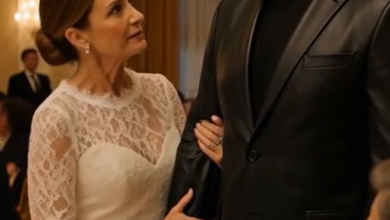
The sanctuary doors opened. Guests rose, but this time nobody reached for a phone. Hammer stood beside me in his leather cut, chain wallet, faded T-shirt, heavy boots, and the dried blood of a stranger he had saved.
I placed my hand on his arm.
He took one step.
Then another.
Leather creaked beneath my fingers. His boots struck the stone aisle with the same hard sound that had frightened everyone two hours earlier, but the church no longer heard an intruder.
At the first pew, he stopped.
Dad’s fire captain’s hat rested on the chair beside us.
Hammer touched two fingers to its brim.
Then he placed my hand in Daniel’s.
No speech.
No performance.
He returned to the rear of the church and stood by the door, exactly where Dad’s place card had told him to remain.
Part 6 — The Rose Hidden Beneath the Ribbon
Pastor Mills shortened the ceremony, but he did not make it smaller.
Daniel and I spoke the vows we had written weeks earlier. My voice failed twice. His failed once. When he slid the ring onto my finger, I felt Mother’s band tucked inside the bouquet against my palm.
Outside, twenty-three Harleys waited in silence.
After we kissed, the church remained still for one long breath. Then Owen began to clap. The others joined him, and the sound rolled through the sanctuary until it reached Hammer at the rear door.
He lowered his head.
At the reception, nobody asked him to leave.
Aunt Linda brought him a plate and apologized for telling the police he was armed. Hammer looked down at the fork, knife, and spoon beside his cake.
“Technically,” he said, “I’ve got options.”
She laughed so hard she had to sit down.
Owen handed back the white handkerchief, washed and folded. Hammer refused it.
“Keep it until you learn to swing.”
The riders did not stay long. They placed their white roses beneath Dad’s captain’s hat, one by one, then walked outside without announcing themselves.
Hammer left last.
Before starting his motorcycle, he removed a small object from his saddlebag and gave it to me. It was the leather pouch that had held Mother’s ring.
Inside was a photograph of Dad and Hammer sitting on the tailgate of an old pickup outside a rehabilitation center. Hammer looked twenty years younger and painfully thin. Dad held two cups of coffee.
On the back, Dad had written a date and one sentence:
First day Ray chose to stay.
I asked Hammer why Dad had never told us about him.
“He didn’t collect people for credit.”
“Why didn’t you come around?”
Hammer looked toward Owen, who was helping Daniel carry chairs.
“Families don’t always need the men their fathers dragged out of fires.”
“You were invited today.”
“Near the door.”
“In case you had to leave fast.”
He smiled faintly.
“That too.”
The Harley started with a low, familiar rumble. Hammer did not roar away this time. He eased down the gravel drive past the roses tied to empty handlebars.
At the road, he stopped.
Every rider shut off his engine.
In the sudden quiet, Hammer lifted one gloved hand toward Dad’s hat in the church window. Then twenty-three motorcycles started together and carried the sound toward the Tennessee hills.
The next morning, Daniel and I returned to St. Luke’s.
Room 412 had already been cleaned. The machines were gone. A square of pale sunlight rested across the empty bed.
I placed one white rose on the windowsill.
Beneath its stem, I left a strip of blue leather.
Part 7 — Every August, One Engine Arrives Early
A year later, Hammer appeared at Cedar Grove Chapel at 2:31 in the afternoon.
The time was not accidental.
Daniel and I were waiting beside the church steps with a small anniversary bouquet. Hammer arrived alone, parked in the same crooked space, and removed his helmet.
He had brought a white rose.
We rode in Daniel’s pickup to Dad’s grave. Hammer followed on the Harley, never close enough to crowd us and never far enough to disappear.
At the cemetery, he placed the rose beneath Dad’s name. I placed cedar beside it. Owen brought the handkerchief, still folded, and claimed he had not thrown a punch in twelve months.
Hammer inspected his stance anyway.
The ritual continued.
Every August, we met at 2:31. Sometimes six riders came. Sometimes twenty. One year, Hammer arrived in a truck because his knee had been replaced, then spent the afternoon complaining that four wheels made him feel “overdressed.”
Mother’s ring now hangs from a blue leather cord inside a glass frame beside our wedding photograph. Dad’s captain’s hat sits beneath it. In the photograph, Hammer is visible near the church door, slightly out of focus, holding his helmet against his chest.
Visitors sometimes ask about the enormous biker who looks as if he wandered into the wrong wedding.
I tell them he stole my bouquet.
Then I tell them why.
Five years after the ceremony, Daniel and I named our son Thomas Raymond. Hammer refused to hold him for the first twenty minutes, claiming his hands were built for wrenches, not babies.
Thomas solved that argument by gripping the FAST tattoo across Hammer’s knuckles and falling asleep.
The biker did not move for an hour.
On our seventh anniversary, Hammer finally replaced the leather cut bearing the old bloodstain. He did not throw it away. He cut a clean piece from the inside and made a small pouch for Thomas.
Blue thread around the edge.
Exactly like mine.
Hammer is older now. His beard has gone almost white, and he needs both hands to straighten his knee after a long ride. Yet each August, his Harley reaches Cedar Grove before us.
He parks near the door.
He carries one rose.
And he always leaves fast.
Follow the page for more true-hearted biker stories. Drop HAMMER below for his next quiet ride.