Part 2: A Biker Threw Every Military Medal He Owned Into a Donation Barrel—Then the Veterans Learned He Was Auctioning His Valor to Buy a New Leg for the Soldier Who Pulled Him From a Burning Vehicle
Part 2 — The Soldier Who Kept Counting to Ten
Ethan Cole joined Hammer’s unit at nineteen.
He was from a small town near Amarillo, Texas, where his father repaired farm equipment and his mother worked nights inside a nursing home. Ethan grew up taking engines apart, avoiding school dances, and telling anyone who asked that he would enlist the day he became eligible.
He did.
The Army sent him to Afghanistan as a vehicle mechanic attached to a logistics platoon. He was lean, quiet, and young enough that older soldiers called him Kid even after he had earned their trust beneath incoming fire.
Hammer was his platoon sergeant.
At forty-two, Ray Dawson already looked carved from road-worn timber. His beard was shorter then, mostly black. He had the same tattooed arms, scarred knuckles, and habit of speaking only when silence had become less useful.
He also had a reputation.
Hammer checked every vehicle himself before a convoy. He inspected tires after mechanics finished. He counted water cans, medical bags, radio batteries, and every soldier climbing aboard.
“People first,” he said. “Then gear. Gear can complain later.”
Ethan imitated him.
The first time Hammer noticed, Ethan was walking beside a convoy vehicle and counting quietly.
“One, two, three…”
“What are you doing?” Hammer asked.
“Checking wheel lugs.”
“There are ten.”
“I know.”
“Then why count twice?”
Ethan looked embarrassed.
Hammer examined the wheel.
“Count three times.”
That became their rhythm.
Ethan brought technical patience. Hammer brought distrust of anything held together by bolts, fuel, or promises. They argued about damaged parts and agreed about people.
During Ethan’s second deployment month, he repaired a generator outside a medical tent after two more experienced mechanics declared it finished. He discovered a loose connection that would have failed under load.
Hammer watched him redo the work.
“Good catch.”
Ethan shrugged. “Counted twice.”
Hammer pointed at him.
“Three.”
The platoon laughed.
Months later, laughter became scarce.
The convoy mission began before dawn outside Kandahar. Four armored vehicles carried equipment and replacement parts toward a remote outpost. Hammer rode inside the second vehicle. Ethan sat across from him beside two other soldiers.
The road narrowed between a wall and a drainage channel.
An explosion struck beneath the front quarter.
The vehicle lifted.
Then it came down on its side.
Metal screamed across the road. Loose equipment became projectiles. The cabin filled with dust, smoke, and the bitter smell of burning wiring.
Hammer struck the interior frame. His restraint jammed. One boot became pinned beneath a twisted seat mount.
Fire began near the engine compartment.
The rear hatch would not open fully.
The soldiers moved.
One crawled through the turret opening. Another forced space around the bent hatch. Ethan reached the ground, then heard Hammer coughing inside.
Someone shouted that secondary ammunition was heating.
Ethan went back.
He crawled beneath smoke, released Hammer’s restraint, and tried lifting the seat frame. It would not move.
Hammer ordered him out.
Ethan ignored him.
He used a broken section of equipment bracket as a lever. The mount shifted enough for Hammer to free his boot, but burning fuel spread beneath the vehicle.
They had seconds.
Ethan dragged Hammer toward the opening.
A second blast struck nearby.
Metal entered Ethan’s lower right leg. He fell, then stood again using the vehicle wall.
Hammer tried to crawl.
Ethan put both arms beneath his shoulders and pulled.
Ten inches.
Stop.
Ten inches.
Stop.
Ethan counted aloud because the smoke made distance impossible.
“One. Two. Three.”
Hammer told him to leave.
“Four. Five.”
Fire crossed the cabin.
“Six. Seven.”
Ethan reached the opening.
“Eight.”
Soldiers outside caught Hammer’s vest.
“Nine.”
They pulled him free.
“Ten.”
The vehicle’s ammunition ignited seconds later.
Hammer woke inside a field hospital with burns, fractured ribs, and damage to one knee. Ethan occupied another bed, his leg stabilized beneath layers of dressings and external hardware.
Hammer asked who pulled him out.
The medic pointed.
Ethan was unconscious.
The official after-action process began while both men were evacuated through different medical systems. Statements were incomplete. Witnesses rotated home. Command praised Hammer for directing evacuation and maintaining accountability during the explosion.
Hammer received a Bronze Star with valor.
Ethan received an Army Commendation Medal.
Hammer protested.
He submitted a correction stating he had been trapped, disoriented, and physically removed by Specialist Ethan Cole. The recommendation was reviewed, delayed, and returned for missing witness statements.
Years passed.
Ethan never complained.
Hammer did.
Neither could make the paperwork move faster than memory.
Part 3 — Six Years Trying to Save the Leg
Doctors initially saved Ethan’s leg.
That sentence became the beginning of a long fight rather than its ending.
The blast had damaged bone, muscle, nerves, and blood supply. Ethan underwent thirteen surgeries during the first two years. He learned to walk with braces, then lost progress after infections. Hardware broke. Scar tissue tightened. Pain remained even when he sat still.
Hammer visited whenever he could.
At first, he wore his uniform.
Later, he arrived in jeans and a leather vest because the Army had medically retired him after his own injuries. He rode from Arizona to Texas in heat that softened road tar beneath his boots.
Ethan hated those visits.
Not Hammer.
The way Hammer looked at his leg.
“You counting surgeries?” Ethan asked once.
“Thirteen.”
“Stop.”
“No.”
“I pulled you out. I didn’t adopt you.”
“Bad luck.”
Ethan threw a hospital pillow at him.
Hammer caught it.
That was the beginning of their friendship after the Army.
Ethan eventually returned home and worked inside his father’s equipment shop. He could not stand for full shifts, but he diagnosed machines faster than anyone else. Farmers learned to bring him problems other mechanics had abandoned.
He married a woman named Kayla.
They had a daughter.
The damaged leg remained.
By year five, infection reached the bone again. Doctors offered another reconstruction with uncertain results or an above-knee amputation followed by rehabilitation.
Ethan resisted.
Hammer did not advise him.
That restraint mattered.
Everyone else said what they would choose. Hammer sat beside the hospital window and waited until Ethan asked.
“Would you do it?”
Hammer looked at his own scarred knee.
“Ain’t my leg.”
“That’s why I’m asking.”
Hammer considered.
“Which choice gets you closer to the life you want?”
Ethan stared toward his sleeping daughter.
“Amputation.”
“Then you answered.”
The surgery took place in spring.
Recovery was difficult but cleaner than the years before it. Ethan received a basic prosthetic system and learned to walk again. He could cross level floors, manage short distances, and work seated at the shop.
But the socket caused skin damage during longer use. The knee mechanism did not suit uneven ground, ladders, or the heavy-equipment environment where Ethan hoped to resume full-time work.
His prosthetist recommended a high-activity microprocessor knee, custom socket, specialized foot, extended training, and several adjustments.
A funding gap remained after available coverage.
Thirty-eight thousand four hundred dollars.
Ethan refused public fundraising.
“I’m not a project.”
Hammer agreed.
“Projects got schedules.”
“I mean it.”
“I know.”
“No benefit ride. No jars with my picture. No sad speeches.”
Hammer looked toward the unfinished adaptive trike in his garage. He and Ethan had begun building it before the amputation. Ethan had designed a left-side shifter, stabilizing reverse system, and custom foot support.
The trike waited beneath a tarp.
Hammer started making calls.
He contacted veterans’ organizations, prosthetic foundations, grant programs, manufacturers, and private donors. Some promised review. Others had waiting lists. One offered partial equipment support if the remaining amount could be guaranteed.
Hammer considered selling his Harley.
Preacher discovered the advertisement before it went public.
“You sell that bike, club replaces it,” Preacher said.
“Then money moves in a circle.”
“Let us help.”
“Ethan said no benefit ride.”
“He didn’t say no club.”
“He knows what a club is.”
Preacher looked at the shadow box above Hammer’s workbench.
“You thinking about those?”
“No.”
The answer came too quickly.
Hammer had received an email from military-history collector Dr. Samuel Weller. Weller curated documented service groups for a nonprofit museum and sometimes purchased medal collections when proceeds supported veterans’ care.
The metal held little commercial value.
The history did.
Hammer’s shadow box included deployment photographs, official citations, vehicle records, letters, and the burned fabric recovered from the wreck. Weller estimated the complete documented group might attract bids between fifteen and twenty thousand dollars.
A donor offered to match the final auction amount.
That could close most of the gap.
Hammer told no one except the auction director.
Then he removed the shadow box from his garage wall.
Behind it, the paint had remained darker for twenty-one years.
A clean rectangle surrounded by dust.
That empty shape followed him to the fundraiser.
Part 4 — The Day the Veterans Stood Against Him
The Desert Star fundraiser began normally.
Coffee. Handshakes. Raffle tickets. Veterans pretending not to study one another’s mobility aids, scars, tremors, or empty chairs.
Ethan did not plan to attend.
His mother, Ruth, asked him to help transport donated tools. She knew about the auction but not Hammer’s contribution. Hammer had asked her to keep Ethan away from the main hall until bidding began.
That plan lasted fourteen minutes.
Ethan entered as Hammer lifted the shadow box.
Frank Delaney saw it first.
Frank’s anger did not come from ignorance. It came from history.
His closest friend had died in Vietnam before receiving a Navy Commendation Medal. The family fought years to obtain it. When the medal finally arrived, Frank helped the man’s mother mount it above her fireplace.
To Frank, medals did not belong solely to the recipient.
They belonged partly to everyone missing from the photograph.
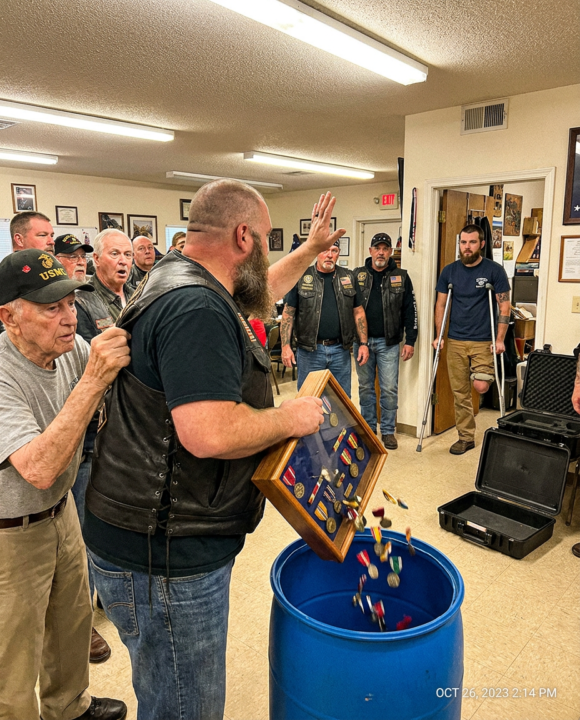
So when Hammer removed his Bronze Star and dropped it into the blue barrel, Frank heard contempt.
The metal hit bottom.
Every conversation stopped.
Hammer dropped the Purple Heart next.
Frank crossed the room.
“Pick them up.”
Hammer continued removing ribbons.
The auction director tried to intervene. Hammer shook his head.
He had expected resistance.
He had not expected how quickly veterans would divide.
Some defended his right to donate personal property. Others accused him of turning service into spectacle. A retired Army officer said valor decorations should never become fundraising merchandise.
Then a younger veteran asked the question beneath everything.
“If those medals mean nothing, what did our people die for?”
Hammer stopped.
The remaining ribbons lay in his palm.
“They don’t mean nothing.”
“Looks like it.”
Hammer turned his hand over.
The ribbons fell.
Frank grabbed his vest.
Preacher moved.
Boone stood.
Nine Iron Saints shifted toward Hammer at once, leather creaking, boots striking tile. Other veterans formed a line in front of Frank.
The fundraiser came within seconds of becoming a fight between men who had all once sworn to stand together.
Hammer raised one hand.
“Sit down.”
His club remained standing.
“Brother,” Preacher warned.
“Sit.”
The Iron Saints obeyed.
That was the test.
Not whether they would defend Hammer.
Whether they would let him absorb judgment without turning disagreement into violence.
Frank asked what Hammer’s dead brothers would say.
Hammer answered that one of them had told him to do it.
He meant Sergeant Luis Ortega, who had died two years after the convoy attack from an unrelated illness. Luis witnessed Ethan pull Hammer from the vehicle and spent years supporting the award correction.
Before his death, he wrote Hammer a letter:
If paper won’t give the kid what he earned, make your paper useful.
The letter was hidden behind the Bronze Star.
Then Ethan entered.
He saw the empty frame.
He saw the medals inside the barrel.
He understood.
“No.”
Hammer looked at him.
“No what?”
“You don’t sell those for me.”
“Already donated.”
“Take them back.”
“Can’t.”
“You can.”
Hammer pushed the barrel toward the auction table.
“Won’t.”
Ethan moved faster on his crutches than anyone expected. He reached the barrel and began retrieving medals.
Hammer stopped him by placing one hand over the opening.
Ethan looked up.
“I dragged you out because that was my job.”
“Wasn’t.”
“Then because you were my sergeant.”
“Wasn’t that either.”
“Why do you think you owe me?”
Hammer’s jaw tightened.
“Because you counted to ten.”
The room quieted again.
Hammer told the story.
Not the citation version.
The truth.
He described smoke, the pinned boot, Ethan’s injured leg, and the ten short pulls toward the opening. He admitted he ordered Ethan to leave him. He admitted fear.
He removed the burned cloth from behind the medal.
Two names appeared on it.
Hammer’s and Ethan’s.
“These came from that road,” Hammer said, pointing toward the barrel. “So does his missing leg.”
Ethan’s voice broke.
“I don’t want them.”
“Good. Buying a leg, not a gift.”
“You think this fixes us?”
“No.”
“You think a prosthetic makes what happened worth it?”
“No.”
“Then why?”
Hammer looked at the empty trouser leg.
“Because you got somewhere to go.”
The auction director opened bidding.
Frank released Hammer’s vest.
Then he removed his own Marine Corps ring and placed it beside the medals.
“Add this,” he said.
Hammer shook his head.
Frank answered, “My property.”
One by one, the room changed.
Not everyone donated medals. Many would never have considered it. They gave what they could accept losing: unit coins, signed books, tools, artwork, service photographs, flight jackets, fishing equipment, and cash.
The blue barrel filled.
No one called Hammer a disgrace again.
Part 5 — The Citation That Named the Wrong Man
Dr. Samuel Weller bought Hammer’s documented medal group for $18,700.
A private foundation matched the bid.
The veterans center auction raised another $11,200 from the items added after Frank’s ring. The Iron Saints covered travel, lodging, and therapy expenses. A prosthetic manufacturer reduced the component price after reviewing Ethan’s work requirements.
The funding gap closed.
Ethan remained angry.
He signed the prosthetic paperwork only after Hammer agreed to one condition: the medals would not disappear into a private collection.
Weller accepted.
The medal group would become part of a traveling museum exhibit about battlefield rescue, award documentation, and the medical lives soldiers carried after coming home.
Hammer’s name would remain.
So would Ethan’s.
During cataloging, Weller examined the two versions of the convoy incident.
Hammer’s official Bronze Star citation credited him with maintaining control during the attack, directing evacuation, and assisting wounded soldiers.
Those statements were not entirely false.
Before becoming trapped, Hammer had ordered the rear vehicle to reverse and directed two soldiers toward cover. His actions protected the convoy.
But the citation never mentioned that Ethan returned for him.
Ethan’s after-action statement did.
So did Luis Ortega’s witness letter.
So did another soldier’s later testimony.
Weller contacted the Army’s awards review office with permission from both men. The process did not promise correction. It could take years.
Hammer said, “Paper moves how paper moves.”
Ethan answered, “You complained about it for fifteen years.”
“Got tired.”
“No, you didn’t.”
Ethan was right.
Hammer had kept copies of every submission inside the shadow box. He never told Ethan because he did not want recognition to become another treatment Ethan was expected to wait for.
The prosthetic fitting began in Phoenix.
Hammer attended the first appointment and annoyed everyone.
He asked about socket pressure, battery life, water resistance, maintenance intervals, failure modes, and what happened if Ethan fell beside heavy equipment.
The prosthetist finally turned toward him.
“Are you always like this?”
Ethan answered first.
“Yes.”
Hammer inspected the alignment marks.
“Counted twice?”
The prosthetist looked confused.
Ethan smiled.
“Do three.”
The first socket hurt.
The second loosened after an hour.
The third fit better but required adjustment near the scar line. Ethan grew frustrated. Hammer said nothing motivational. He carried tools, water, spare socks, and the empty case.
At the end of one session, Ethan threw the prosthetic onto a padded bench.
“I pulled you ten feet through fire. I can’t walk ten feet across this room.”
Hammer sat beside him.
“Different ten.”
“That supposed to help?”
“No.”
“What does?”
“Tomorrow.”
Ethan returned the next morning.
He stood.
One step.
Then another.
The microprocessor knee responded to his movement. The custom socket held. He crossed the room, turned, and returned without crutches.
Hammer counted silently.
Ethan stopped after ten steps.
“Say it.”
Hammer looked away.
“Ten.”
The prosthetist recorded the moment. Ethan’s mother covered her mouth. Hammer inspected a loose strap that was not loose.
Two months later, Ethan returned to his father’s repair shop for a full shift.
Three months later, he climbed the two steps into the office without using the rail.
Four months later, he uncovered the adaptive trike.
Hammer handed him the keys.
Ethan did not take them.
“You sold your medals.”
“Auctioned.”
“For this leg.”
“Part of it.”
“I still don’t like it.”
Hammer placed the keys on the seat.
“Leg don’t care.”
Ethan climbed onto the trike.
The left-side controls worked. The prosthetic foot settled into its support. The engine started with a deep uneven rumble.
Hammer stood beside him.
“Count wheel lugs?”
“Three times.”
“Fuel?”
“Full.”
“Brakes?”
“Ray.”
“What?”
“Move.”
Hammer stepped aside.
Ethan rode forward.
Part 6 — The Empty Rectangle Above the Workbench
Hammer never replaced the medals above his workbench.
The empty rectangle remained.
Dust darkened the surrounding wall while the protected paint stayed pale. Visitors sometimes asked what had hung there.
Hammer answered, “Weight.”
That was all.
A year after the auction, the traveling exhibit reached Tucson. The veterans center displayed Hammer’s medals inside a glass case beside photographs of the burned vehicle, Ethan’s dog tags, Luis Ortega’s letter, and the corrected rescue narrative.
The display did not call one man the hero.
It showed sequence.
Explosion.
Entrapment.
Return.
Ten pulls.
Evacuation.
Injury.
Years of surgery.
Amputation.
Another beginning.
Frank Delaney volunteered beside the exhibit. He told visitors he had grabbed Hammer’s vest. He did not soften his mistake.
“I saw a man discarding honor,” Frank said. “I didn’t understand he was making it useful.”
Hammer avoided the opening ceremony.
Ethan found him in the parking lot sitting on his Harley.
“You coming inside?”
“No.”
“Your medals.”
“Not mine now.”
“Your story.”
Hammer looked at Ethan’s prosthetic leg.
“Working?”
“Yes.”
“Then exhibit works.”
Ethan handed him a small aluminum washer from the first prosthetic test socket. The component had been replaced during fitting.
“What am I supposed to do with this?”
“Frame it.”
“No.”
“Wear it.”
Hammer examined the washer.
Ethan had engraved a tiny number into its edge.
10
Hammer attached it inside his leather vest.
Not outside.
Near his heart, where only people standing close could see.
Each year, the Iron Saints held another prosthetic-access fundraiser. Hammer did not donate more medals because he had none. He repaired motorcycles, sold custom parts, and allowed people to bid on one full day of his labor.
That item always brought the highest offer.
Frank bought it the first year.
He made Hammer repair a lawn mower.
Hammer complained for eight hours.
Frank considered that part of the prize.
Part 7 — The Medal That Arrived Without a Uniform
The award review took three years.
A government envelope arrived at Ethan’s repair shop on a Tuesday morning. He left it unopened beside the cash register until closing.
Then he called Hammer.
“Paper moved.”
Hammer rode from Tucson to Amarillo without asking what the decision said.
He arrived after midnight. Ethan waited inside the shop wearing work pants, a grease-stained shirt, and the prosthetic leg purchased partly by the medal auction.
The envelope remained sealed.
“You open it,” Ethan said.
“No.”
“It has your submissions.”
“Your name.”
Ethan tore the envelope.
The Army had approved an upgraded valor award recognizing his actions during the vehicle fire. The letter cited his return to the burning vehicle, the rescue of his platoon sergeant, and the injuries sustained while evacuating him.
A presentation ceremony was offered.
Ethan declined the large event.
He accepted a small gathering at the Desert Star Veterans Center because his mother asked and Frank threatened to arrive at the repair shop with a marching band.
The ceremony lasted twelve minutes.
Hammer stood in the back beside the exit.
When Ethan received the medal, he looked across the room at him.
Hammer nodded once.
Afterward, Ethan removed the medal from its presentation box and carried it outside. Hammer waited beside two motorcycles—the black Harley and Ethan’s adaptive trike.
Ethan held out the medal.
Hammer stepped back.
“Don’t.”
“I’m not giving it away.”
“Then why hold it at me?”
Ethan hooked the presentation box inside the trike’s storage compartment.
“Taking it for a ride.”
They followed Route 66 west beneath a cold evening sky. Ethan led. Hammer rode behind him, the opposite formation from Afghanistan, where Hammer had always taken the first position.
At a quiet overlook, Ethan stopped.
He removed the medal and placed it on the trike seat between them.
“You threw yours away for my leg,” he said.
“Auctioned.”
“You always correct that.”
“Words matter.”
Ethan looked toward the road.
“I kept you alive.”
“Yeah.”
“You helped me stand.”
Hammer shook his head.
“Different ten.”
Ethan smiled.
They returned the medal to its box.
Engines started. Two taillights moved west, one following the other until distance made it impossible to tell which rider carried the medal and which carried the debt.
Hammer’s garage wall stayed empty.
His promise did not.
Follow our page for more unforgettable biker stories about misunderstood sacrifices, tested brotherhood, and veterans who turn yesterday’s honor into someone else’s next step.