Part 2: A Biker Threw a Little Boy’s Bicycle Into a Dumpster Before a Downhill Race — The Mother Called Him a Monster Until the Frame Broke Open
Part 2 — The Man Everyone Blamed
My name is Claire Ellis, and until that Saturday in Chattanooga, I believed dangerous people usually announced themselves through anger. Hank Mercer taught me that sometimes the angriest-looking man in a parking lot is the only person studying what everyone else has overlooked.
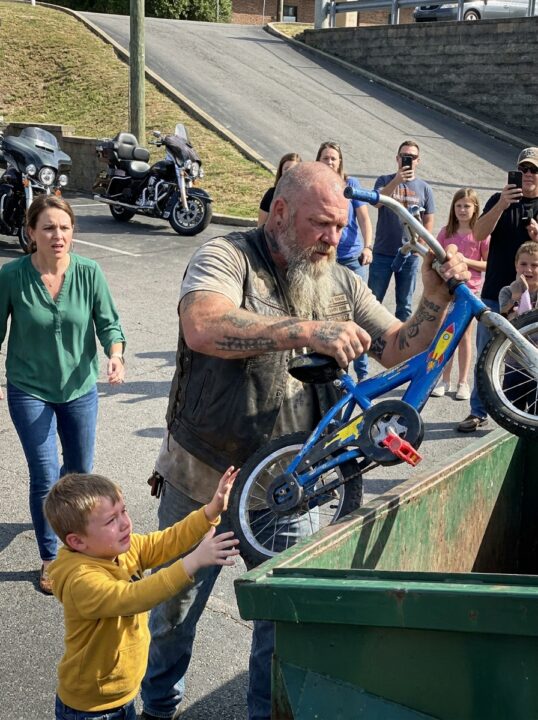
Officer Ruiz stopped the garbage truck and ordered the driver to lower the dumpster. Two firefighters helped retrieve the bicycle without disturbing it further. The blue frame had separated just behind the head tube, leaving the handlebars and front wheel attached to one jagged section while the seat, crank, and rear wheel remained connected to the other.
Hank did not say, “I told you so.”
He stood beside Noah with his hands open and visible, waiting until my son chose to come closer. When Noah finally looked inside, Hank positioned his broad body between the child and the sharp metal.
“That’s not where you threw it,” I said.
“No.”
The break had occurred four inches below the place where the frame struck the dumpster floor. Around the separation was a dark crescent of rust, powdered filler, and silver spray paint. Half of the metal had been cracked for months. Only a thin strip had still been holding the front of the bicycle together.
The rocket sticker I had added covered the outer edge.
My stomach tightened as I pictured Noah entering the first bend of Juniper Hill, squeezing the brakes while his weight shifted over the handlebars. If that last strip had failed, the front wheel would have continued in one direction while the rest of my child went in another.
Officer Ruiz photographed everything.
“How did you see it?” she asked Hank.
“The fork was walking backward under load.”
I did not understand.
He pointed without touching. “The gap between the tire and the frame was wrong. Front brake made the crack open. Brown dust appeared under the sticker.”
“Why didn’t you simply tell us?”
“I tried.”
I remembered him saying, Stop the boy.
I had assumed the order came from arrogance. Noah had assumed the biker wanted to keep him out of the event. The music, engines, parents, and announcer had swallowed whatever Hank said next.
“He was already pushing off,” Hank continued. “I had one hand on the bar and about three seconds.”
“You could have laid it down.”
“He picked it back up.”
Noah lowered his head. He had done exactly that. Hank had tipped the bicycle onto its side, but Noah, embarrassed in front of the other children, had yanked it upright and put one foot on the pedal.
So Hank made the bicycle impossible to ride.
It was a brutal decision. It was also the correct one.
Officer Ruiz did not arrest him, though she warned that destroying someone else’s property could not become his standard safety procedure. Hank accepted the warning with a short nod.
Then he turned toward the blue trailer.
The bicycle drive had been organized by the Iron Lantern Riders, a registered community club whose members included mechanics, veterans, a retired teacher, two nurses, an elevator technician, and one tattoo artist. They looked intimidating because most were large, weathered people wearing leather. That morning, however, their trailer contained helmets, repair stands, juice boxes, and bicycles intended for children.
Hank had founded the drive twelve years earlier.
Every donated bicycle was supposed to pass a forty-three-point inspection at Mercer Motor & Cycle, his repair shop on Rossville Boulevard. Bearings were checked, cables replaced, wheels trued, and frames cleaned down to bare metal wherever rust or impact damage appeared.
But the forty-seven blue-tag bicycles had arrived late.
Wade Pritchard, the club’s road captain, had found them through a regional surplus dealer three days before the event. The frames looked nearly new, and the dealer claimed they came from an overstocked youth camp that had closed.
Hank had been in Knoxville visiting his younger brother.
Wade and four riders worked through two nights to make the bicycles ready. They replaced tires, grips, chains, and seats, but because the frames appeared freshly painted, nobody stripped them.
“We did the checks,” Wade insisted. “I personally rode six.”
“You weigh two hundred sixty pounds,” Mercy said. “You didn’t ride the children’s frames.”
“I load-tested them.”
“Not the head tubes.”
Wade looked toward the waiting families. His face carried the trapped expression of a man who had tried to do something generous and now feared that admitting one mistake would erase every good intention behind it.
“It could be one damaged bike,” he said.
Hank opened the trailer.
“Then we prove it.”
He selected a small red bicycle from the same shipment and carried it to the repair stand. Beneath a glossy decal near the front was another faint brown line.
The crowd quieted.
Hank pressed the brake, braced one boot against the rear wheel, and applied controlled pressure to the handlebars. A hairline opening appeared beneath the paint.
Two bicycles.
Mercy found a third.
By noon, seven frames showed concealed cracks, four near the head tube and three beneath the bottom bracket. Someone had filled the damage, sanded it, and sprayed the frames before selling them as usable donations.
The children’s ride was canceled.
Parents who had waited for hours became furious. Some accused the club of giving away junk. Others demanded that Hank let their children take the bicycles that appeared undamaged.
Hank refused.
“We promised safe bikes,” he said. “Today we don’t have them.”
A father pointed at a green bicycle his daughter had already named Clover. “You can’t prove that one is cracked.”
“No.”
“Then give it to us.”
“No.”
The man stepped closer. The club shifted behind Hank, boots scraping pavement. For a second, I feared the parking lot would become what everyone had expected when the motorcycles arrived.
Hank raised one scarred hand.
Every rider stopped.
“No child leaves on a blue-tag frame,” he said. “If that costs us the drive, it costs us the drive.”
Wade removed his road-captain patch and placed it on the trailer floor.
“I bought them,” he said. “This is mine.”
Hank looked at the patch but did not pick it up.
“It becomes yours if you walk away.”
That was the first test.
Wade stayed.
Part 3 — Forty-Seven Broken Promises
By early afternoon, the diner parking lot had emptied except for the bikers, police, several parents, and children who were still hoping the cancellation might be reversed. Noah sat on the curb staring at the two halves of his bicycle.
Hank brought him a paper cup of lemonade.
Noah did not take it.
“You killed my bike,” he said.
Hank sat on the pavement, lowering his massive body until they were nearly eye level. His leather vest creaked, and the broken reflector tapped against the zipper beneath it.
“Yeah.”
“It was my best thing.”
“I know.”
“You don’t know anything about me.”
Hank accepted that too. He placed the lemonade beside Noah and stood.
I expected him to offer a replacement immediately. Instead, he asked whether he could inspect Noah’s helmet. He found a deep compression mark beneath the outer shell, likely from being dropped or crushed in our apartment closet.
He cut the chin straps with his pocketknife so nobody could use it again.
Noah stared at him in disbelief. “You wreck everything.”
“Unsafe things.”
“That was my helmet.”
“It was pretending.”
That sentence stayed with me.
Hank did not soften facts for children, but he did not frighten them with details either. A frame that concealed a crack was pretending. A damaged helmet with an unbroken shell was pretending. Good paint, bright decals, and clean grips could not make either one safe.
The Iron Lanterns moved the suspect bicycles into three rows. Mercy logged serial numbers. A rider named Tessa photographed every weld. Wade called the surplus dealer, but the number had been disconnected before he finished his second sentence.
That was the fourth warning.
The company address led to an empty warehouse in Dalton, Georgia. The invoice listed no individual seller. Payment had been collected through a temporary account that closed the morning after the transfer.
“This wasn’t surplus,” Tessa said. “Someone laundered scrap.”
Hank looked at the fresh paint on Noah’s broken frame. “Condemned frames.”
The word changed the investigation. Officer Ruiz contacted the Tennessee Highway Patrol’s consumer-fraud unit while Mercy searched archived safety notices. Within an hour, he found photographs from a recycling contractor in northern Georgia.
The same colors.
The same frame shapes.
The same filed serial-number areas.
A summer camp had not closed. A large retailer had paid the contractor to destroy 312 youth bicycles returned after crashes, shipping damage, and a voluntary frame recall. Instead, at least some had been cosmetically repaired and resold.
Noah’s bicycle was evidence now.
He watched Officer Ruiz place yellow tape around it.
First Hank had taken it. Then the police did.
My son stepped behind the diner and kicked the brick wall until pain made him stop. Hank heard the blows but did not follow. He remained near the corner, close enough to protect Noah and far enough to let him be angry.
After several minutes, Noah came back.
“Will the police give it to me later?”
“No,” Hank said.
I prepared for another explosion.
Noah only nodded. “Can I keep the bell?”
Hank’s eyes moved toward the small brass bell attached to the severed handlebars. It had not been damaged.
“If evidence releases it.”
That was not the comforting answer I would have offered. It was honest, and Noah seemed to recognize the difference.
The larger crisis came when local news vans arrived. A twenty-second phone video of Hank throwing the bicycle had already been posted online with the caption BIKER DESTROYS CHILD’S BIKE AT CHARITY EVENT. It ended before the frame was recovered.
Thousands of people saw the accusation first.
Reporters surrounded the club. Hank refused to speak while the investigation remained open, which made him appear guilty. Wade wanted to show the broken frame on camera and blame the supplier.
Hank stopped him.
“We put our tag on those bikes.”
“We were deceived.”
“Parents trusted our tag, not that invoice.”
“If we say nothing, they’ll bury us.”
“Then let them bury the right people.”
Wade’s fists tightened. “You’d sacrifice the entire club over one mistake?”
Hank looked at the forty-six bicycles.
“Seven we know about.”
The riders divided. Some agreed with Hank that every frame had to be quarantined. Others believed the apparently sound bicycles could be professionally tested and distributed later. Two members worried the fraud investigation would expose their club to lawsuits they could never afford.
A veteran rider named Cal removed his vest.
“I didn’t join to be called a child killer online.”
Mercy answered before Hank could. “Then help make sure you never earn it.”
Cal dropped the vest onto a folding chair and walked to his motorcycle.
Nobody stopped him.
His Harley started with a hard metallic bark. He rode out alone while the remaining engines stayed cold.
That was the second test.
At four o’clock, the club’s insurance carrier advised Hank to make no promises, admit no liability, and allow attorneys to handle replacement claims. Hank listened on speakerphone, thanked the representative, and ended the call.
Then he took a grease pencil and wrote a number on the diner window.
47
“We replace every one,” he said.
Wade laughed once, but there was no humor in it. “With what money?”
Hank looked across at the motorcycle he had ridden for seventeen years: a black Harley-Davidson Road King with worn leather saddlebags and an engine he had rebuilt twice.
“Start with mine.”
“No,” Mercy said.
“It’s paid off.”
“It’s your only ride.”
“It’s metal.”
The phrase meant something inside the club. Everyone became quiet.
Hank planned to sell his motorcycle to buy the first group of replacement bicycles. Mercy offered his touring bike. Tessa offered the savings she had set aside for a tattoo studio. Wade offered his pickup and the enclosed trailer.
The brotherhood was not repaired yet, but nobody else left.
I should have taken Noah home.
Instead, I opened my banking app. The balance was too small to help much, yet I transferred the money I had saved for next month’s electric bill into the replacement fund.
Hank saw the receipt.
“Take it back.”
“You saved my son.”
“That doesn’t make your lights free.”
He made Wade return the money.
Then a battered accessible van entered the parking lot. A thin man in a wheelchair sat behind the passenger window, watching the rows of condemned bicycles.
Hank’s face changed when he saw him.
The man was in his early fifties, with one arm held close to his chest and a faded blue bicycle reflector tied to the wheelchair frame.
Noah noticed the matching object beneath Hank’s vest.
“Who is that?” he asked.
Hank did not answer.
The van door opened.
The man smiled crookedly at him.
“Still throwing bikes, big brother?”
Part 4 — The Reflector Hank Carried
The man’s name was Daniel Mercer, though everyone called him Danny. A traumatic brain injury had slowed his speech and limited movement on the right side of his body, but his humor arrived faster than anyone expected.
Hank walked toward the van without the hard certainty he had shown all day. His hands, steady around engines, broken frames, and angry strangers, trembled once before he gripped Danny’s wheelchair handles.
“You weren’t supposed to come until tomorrow.”
“Mercy called.”
Hank looked at the older rider.
Mercy shrugged. “You were about to sell your Road King without asking the board.”
“It’s my motorcycle.”
“It’s the club’s ugliest landmark.”
Danny laughed. The sound came out uneven but warm.
Noah studied the matching reflectors. “Were they from the same bike?”
Danny glanced at Hank.
The large biker looked toward me as if asking whether Noah should hear the answer. I left the choice to my son.
Noah sat on the curb.
Hank remained standing for another moment, then lowered himself beside him.
In 1986, Hank was seventeen and Danny was ten. Their father worked nights at a foundry and had forbidden the boys from riding down Quarry Road because trucks spilled gravel across the lower turn.
Danny owned a blue BMX bicycle bought at a yard sale. One afternoon, a crack appeared near the head tube after he struck a curb. Their father told Hank to put the bike behind the shed until it could be inspected.
Hank believed he could repair it.
He had been learning to weld at a vocational school. He ground away the paint, filled the crack, sprayed the area blue, and told Danny the frame was stronger than before.
It was not.
The heat from Hank’s crude repair weakened the surrounding steel. The weld held, but the metal beside it tore open when Danny hit the brakes halfway down Quarry Road.
The bicycle separated.
Danny went over the handlebars and struck a concrete drainage wall. He spent nineteen days in a coma, seven months in hospitals, and years learning how to speak after his mind knew the word but his mouth could not shape it.
Hank carried the blue reflector recovered from the road.
“I broke his bike,” he told Noah.
Danny shook his head. “The wall broke my head. Hank broke the bike first.”
The distinction sounded like a joke. Hank did not smile.
Their father blamed Hank. Their mother tried not to. Hank blamed himself more efficiently than either of them could. He dropped out of school, drank hard, fought often, and eventually spent eleven months in county jail after breaking a man’s jaw outside a bar.
He came out heavier, quieter, and unwilling to touch another bicycle.
Danny changed that.
At twenty-one, Danny asked Hank to adapt a three-wheeled handcycle for him. Hank refused because he feared making another mistake. Danny returned every Saturday for two months until his older brother finally opened the toolbox.
This time, Hank studied.
He completed welding certification, learned frame geometry, apprenticed under a motorcycle fabricator, and submitted every adaptive modification to a second inspector. The first machine he built for Danny was ugly, overweight, and safe.
Danny rode it six blocks.
Hank followed on foot.
“That was his first motorcycle club,” Danny told Noah. “One bicycle. One scared mechanic.”
Years later, Hank bought the Road King. He did not join the Iron Lanterns because he wanted a new family or an excuse to appear dangerous. He joined because Mercy’s members volunteered at a rehabilitation center where Danny lived, repairing wheelchairs and building ramps.
The children’s bicycle drive had been Danny’s idea.
“You know bad bikes,” Danny had told Hank. “Use it.”
That explained the forty-three-point checklist, the blue reflector, and the way Hank watched children’s front wheels instead of their faces when they approached the starting line.
It also explained why he had thrown Noah’s bicycle.
He had already watched one child push off after trusting a repaired blue frame. He would not gamble on a polite explanation while another boy’s foot rested on a pedal above a hill.
The crowd near the diner listened silently. Several parents who had condemned Hank online lowered their phones.
But the deepest twist was still inside the trailer.
Danny asked to see the quarantined bicycles. Hank rolled him along the first row while he examined decals and freshly painted joints. At the seventeenth bicycle, Danny tapped one finger against the wheelchair armrest.
“Back.”
Hank reversed.
Danny pointed to a tiny pair of stamped dots beneath the bottom bracket.
Every blue-tag frame carried the same mark.
Mercy searched the retailer’s recall photographs again. The dots did not belong to the manufacturer. They had been added by the contractor responsible for destroying unsafe inventory.
“These were marked after condemnation,” Officer Ruiz said. “Whoever refinished them knew exactly what they were.”
Wade sat down on the trailer ramp.
He had not merely purchased a bad batch from a careless reseller. Someone had built a business around hiding structural damage and selling condemned children’s bicycles to charities unlikely to afford laboratory inspections.
Officer Ruiz contacted investigators in Georgia. The empty warehouse was traced to a man named Curtis Vale, a former employee of the recycling contractor. Records showed shipments to church groups, youth centers, and community drives across four states.
Forty-seven bicycles were in Chattanooga.
At least 180 others might already be under children.
The story was no longer about one destroyed birthday present.
Hank took Wade’s road-captain patch from the trailer floor and placed it in his hand.
“You made a bad call,” he said.
Wade looked down. “I could have killed someone.”
“You stop hiding, you help find every frame, and you make it right.”
“You’re not throwing me out?”
“That would make my week easier.”
Wade’s eyes lifted.
Hank pointed toward the serial-number log. “I’m not looking for easy.”
Wade put the patch in his pocket rather than back on his vest.
He had not earned it yet.
The club spent the rest of the afternoon calling every organization listed in Vale’s shipping records. They used no threats. They made no visits to the suspected seller. They gave investigators every invoice, message, photograph, and account number.
By evening, three youth centers had located twenty-two suspect bicycles.
One had been involved in a crash two days earlier.
A twelve-year-old girl in Alabama had suffered a broken wrist when her frame separated in a driveway. Her parents had blamed her for riding recklessly.
Hank called them himself.
He did not tell them what to feel. He gave them Officer Ruiz’s case number and the name of an independent frame inspector.
Before hanging up, the girl’s father said, “We yelled at her.”
Hank looked at Danny’s reflector.
“Then start there,” he answered.
That night, the state issued an emergency safety alert.
The video of Hank throwing Noah’s bicycle was broadcast again, but this time it continued for eleven more seconds. Viewers saw him block the hill, saw the frame retrieved in two pieces, and saw forty-six bicycles locked inside the trailer.
The same act that made him look cruel became the image that warned parents across four states.
Hank still refused interviews.
He had work to do.
Part 5 — What the Club Built Overnight
At 7:10 that evening, most reasonable people would have gone home. The Iron Lanterns moved all forty-seven condemned bicycles to Mercer Motor & Cycle, where investigators tagged them in a locked storage area.
Then Hank cleared the main garage floor.
“We have forty-seven children expecting bicycles,” he said.
Mercy checked the clock. “The rescheduled ride is in two weeks.”
“Too long.”
“Hank.”
“Kids already learned our promise can break.”
Danny rolled between them. “Then build a better one.”
What happened over the next thirty-six hours spread through Chattanooga without a press release. Tessa called three bicycle shops. Mercy contacted a sporting-goods manager whose wheelchair ramp the club had repaired. Wade drove to warehouses in Nashville and Atlanta with copies of the police report.
Parents brought usable bicycles their children had outgrown. A church opened its recreation hall for cleaning and assembly. A retired frame builder inspected every donated machine independently, refusing payment.
At midnight, the Iron Lantern garage smelled of degreaser, rubber, coffee, motor oil, and pizza. Harley-Davidsons stood outside in the rain because children’s bicycles occupied every repair bay.
The contrast drew people from the sidewalk.
Huge tattooed men knelt beside twelve-inch wheels. A former Marine adjusted training wheels with a torque wrench. Tessa replaced pink brake cables while Danny checked identification cards from his wheelchair. Mercy washed grease from a white handlebar basket shaped like a flower.
Hank worked on Noah’s replacement alone.
It was not new. He rejected the idea that a shiny bicycle would erase what Noah had lost. Instead, he found a solid 1990s steel mountain-bike frame small enough for a nine-year-old, stripped it to bare metal, and invited Noah to inspect every joint before any paint touched it.
Noah arrived the next morning still suspicious.
Hank handed him a magnifying glass.
“What are we looking for?”
“Anything pretending.”
They checked the head tube, bottom bracket, dropouts, fork, and seat cluster. Hank showed him the difference between a harmless paint scratch and a structural line that collected rust. He explained why a bicycle should be inspected after a hard impact and why a damaged helmet must be replaced even when the shell looks normal.
Noah asked whether Hank had inspected Danny’s old bike.
“Not enough.”
“Do you still feel bad?”
“Yes.”
“Every day?”
Hank considered the question. “Not every minute anymore.”
Danny heard him from across the shop.
That answer appeared to surprise both brothers.
Noah chose deep blue paint, but he asked Hank to leave one narrow strip of bare steel near the front.
“So I can see it,” he said.
Hank nodded. “Nothing hiding.”
The rocket sticker was replaced with a hand-painted yellow line around the head tube. It was not decoration. Hank called it an inspection ring: any crack passing through the line would become visible immediately.
He installed a brass bell from a donor bicycle because Noah’s original remained in police evidence. When he tested it, the clear note crossed the noisy garage.
Noah smiled for the first time since the dumpster.
Wade returned from Atlanta with twenty-two new youth frames purchased at wholesale. The dealer had offered a discount after hearing the story, but the total still exceeded the club’s funds.
Hank quietly placed the Road King’s title on his workbench.
Danny rolled over it.
“No.”
“We’re short.”
“You sold my first van to buy that motorcycle.”
“Exactly.”
“Bad investment. I’m still here.”
Hank tried to take the title back. Danny held it beneath his left hand.
Then Cal, the rider who had left the diner, entered the garage.
His vest was folded under his arm.
Hank did not welcome him or ask why he had returned. Cal placed a cashier’s check beside the motorcycle title. He had sold a fishing boat inherited from his father.
“It sat in my driveway six years,” Cal said. “At least the kids will move.”
The check covered the remaining frames.
Cal picked up a wrench and joined the assembly line without putting his vest on. Like Wade, he understood that returning was not the same as being restored.
The club finished forty-seven bicycles by Sunday afternoon.
Every frame had been independently inspected. Each bicycle carried a small metal tag with the date, inspector’s initials, and the shop number parents could call for free follow-up checks. Helmets were fitted individually rather than handed out by size alone.
Hank refused to place the Iron Lantern logo on anything.
“No advertisements on a kid’s safety,” he said.
The rescheduled ride happened the following Saturday, but not on Juniper Hill. Officer Ruiz helped the city close a flat section of Riverfront Parkway. The route included braking stations, inspection demonstrations, and a small practice ramp no higher than a curb.
Noah received the first bicycle.
Hank rolled it toward him but stopped several feet away.
“You decide.”
Noah walked around the blue frame. He inspected the yellow line, squeezed both brakes, checked the helmet date, and rang the bell.
Then he looked at the dumpster across the diner parking lot.
“Would you throw this one away?”
“If it lies to me.”
Noah considered that.
“Okay.”
Before mounting, he removed a small object from his pocket. Officer Ruiz had released the brass bell from his original bicycle after investigators documented it. Noah had cleaned the dust but left one scratch from the fall.
He handed the replacement bell back to Hank.
“For the next kid.”
Hank closed his scarred fingers around it.
No speech followed.
He attached it to the inspection stand.
The first rider pushed off. Then another. Forty-seven children moved down the closed street under ordinary Tennessee sunlight while parents walked beside them.
No engines roared.
The Harley-Davidsons remained parked.
The loudest sound was a row of bicycle bells.
Part 6 — The Frames They Found
Curtis Vale was arrested six weeks later after investigators traced another shipment of condemned bicycles to a storage unit outside Huntsville. Inside were seventy-three partially refinished frames, cans of filler, altered invoices, replacement decals, and a grinder used to remove recall markings.
The evidence from Noah’s bicycle connected the operation across state lines.
Eventually, 164 suspect bicycles were recovered. Some had never been ridden. Others were found beneath porches, inside church storerooms, or chained outside schools.
Fourteen had visible structural failures.
No child was killed.
The girl in Alabama recovered from her broken wrist. Hank and Wade drove down to inspect her replacement bicycle, but they arrived in an ordinary pickup without club colors or motorcycles. Her father apologized for blaming her. Hank stayed outside during that conversation because he understood it did not belong to him.
Wade never asked for his road-captain patch back.
Six months later, Hank returned it during a club meeting after Wade created a supplier-verification system requiring two members to confirm every frame’s origin. Wade sewed the patch onto the inside of his vest.
“Why inside?” Mercy asked.
“So I remember it’s work, not rank.”
Cal returned too. He never explained leaving, and Hank never demanded an explanation. Cal began managing helmet disposal, cutting every strap so damaged equipment could not be retrieved from the trash and sold.
Danny became the final inspector for the children’s drive.
His movements were slow, so nobody rushed through his station. He asked each child to squeeze the brakes, turn the bars, ring the bell, and point toward the inspection line.
“If you see something,” he told them, “you stop.”
Every Saturday morning, Hank placed Danny’s blue reflector and Noah’s donated bell beside the repair stand. One came from a mistake that could not be undone. The other came from a child who had survived the mistake Hank refused to repeat.
Noah visited often.
He learned to clean chains, patch tubes, and identify loose spokes by sound. Hank would spin a wheel, tap each spoke with a small wrench, and make Noah listen for the flat note.
“Machines talk,” Hank said.
“You just have to stop talking first,” Noah answered.
Hank almost smiled.
A year after the Juniper Hill incident, the diner replaced its green dumpster. The owner asked whether Hank wanted the dented side panel where Noah’s bicycle had struck.
He did.
Hank mounted it on the garage wall behind the inspection stand. He cleaned away the dirt but left the impact mark untouched.
There was no plaque.
Only a shallow blue streak across gray steel.
Part 7 — The Hill
Noah returned to Juniper Hill eighteen months later.
He was eleven, taller, and riding the blue bicycle Hank had built. The city had added barriers, warning signs, and a permanent inspection station near the upper parking lot. Children could ride the route only during supervised events.
I still hated the hill.
Noah knew that, so he did not ask me to pretend otherwise.
Hank and Danny waited near the first turn. Hank sat on his black Road King because the club had saved it from being sold. Danny’s wheelchair carried the old blue reflector on one side and a new brass bell on the other.
Before the ride, Noah checked his yellow inspection line.
Hank checked it again.
“You trust your work?” Noah asked.
“Trust gets inspected.”
Noah smiled and fastened his helmet.
I stood beside the starting line with the same fear I had carried the first time. The difference was that fear no longer had to disguise itself as certainty. I knew what had been checked, who had checked it, and what signs would stop the ride.
Noah placed one foot on the pedal.
Hank looked down the hill.
For a moment, the enormous biker was seventeen again, watching his little brother disappear toward Quarry Road on a blue bicycle repaired with confidence instead of knowledge.
Danny reached up and touched Hank’s arm.
“Different hill,” he said.
Hank nodded.
“Different bike.”
Another nod.
“Different ending.”
Hank raised one scarred hand.
Noah pushed off.
The bicycle gathered speed through the first curve. Its frame held. The wheels remained straight. At the braking marker, Noah slowed exactly as Hank had taught him, then continued toward the lower lot.
I heard his bell before I saw him cross the finish.
Danny rang the bell on his wheelchair.
Parents applauded, but Hank stayed quiet. His shoulders lowered only when Noah turned around at the bottom and raised one hand.
That evening, the Iron Lanterns rode away from Bellweather Diner in pairs. Their V-twins rolled across the parking lot, deep and uneven, then softened as the motorcycles joined traffic beside the river.
Hank left last.
Before starting his Road King, he walked to the dumpster and rested his hand on the new steel wall. Noah stood beside him.
“Would you do it again?” my son asked.
“Throw your bike away?”
“Yeah.”
Hank looked at the hill, then at the unbroken yellow line around Noah’s frame.
“Faster.”
Noah laughed.
The engine caught. Hank pulled onto the road, and the broken blue reflector tapped softly against his chest until the taillight disappeared around the bend.
The bicycle stayed whole.
Follow our page for more biker stories about rough-looking riders whose quiet choices protect people before anyone understands why.