A Biker Fired Up an Old Harley Inside a Memphis Hospital Lobby — Security Never Knew a Deaf Road Captain Was Feeling His Brothers’ Engines One Last Time
Part 2 — Thirty-One Nights Outside the Rehab Door
I shut the Harley down at 10:49.
That fact matters because people later claimed I had allowed it to run for ten minutes, while others swore the bikers had revved until ceiling panels fell. Neither happened. The engine ran for ninety-four seconds the first time, long enough to frighten half the lobby and wake something inside a dying man that medicine had been unable to reach.
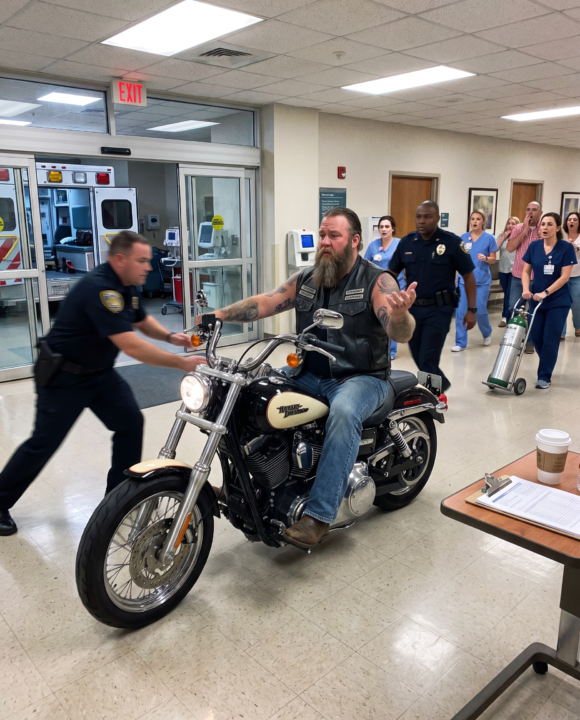
When the silence returned, it felt thinner than before.
Mack remained on the bike with both hands resting on the bars. He did not resist when I asked for the key. He removed it, placed it in my palm, and said, “Hold that. Not the bike.”
The difference confused me then.
The patient downstairs was Elias Mercer, seventy-three, a retired city bus mechanic and former road captain of the Iron Lantern Motorcycle Club. He had metastatic pancreatic cancer, pneumonia, and a heart too weak for further treatment. His daughter, Rachel Mercer, had arranged hospice care at home, but a sudden breathing crisis brought him back to St. Matthew’s three nights earlier.
By Thursday, Dr. Patel believed he had hours.
Rachel was the woman carrying the photograph. She was fifty, exhausted, and angry enough to face nine bikers without flinching. She told Mack he had promised not to start the motorcycle unless facilities approved it.
“They stopped answering,” Mack said.
“That didn’t mean yes.”
“It didn’t mean he had time.”
Rachel looked ready to slap him. Instead, she put the photograph against his chest and whispered, “You always make him choose between the rules and you.”
Mack accepted that blow without defending himself.
I took him into a consultation room while Andre kept the others beside the motorcycle. Mack sat in a chair built for people half his size, leather creaking each time he breathed. On the table before us lay his wallet, folding knife, key ring, brass ride bell, and a faded patch he had removed from inside his vest.
The patch read ROAD CAPTAIN — ELIAS “CAP” MERCER — 1986–2012.
“You stole this?” I asked.
“Borrowed it twelve years ago.”
“Does he know?”
“He knows I’m slow returning things.”
That was Mack’s humor. Dry. Almost invisible.
He told me he first met Elias in 1997 at a gas station off Highway 51. Mack was twenty-nine, recently discharged from the Army after a back injury, swallowing painkillers with whiskey and riding as if every curve owed him an apology. Elias was already road captain, the man who checked fuel stops, watched weather, set formation, and decided when pride had become too dangerous to follow.
One night outside Millington, Mack crossed the center line after drinking. Elias saw his rear tire drift, pulled alongside him, and forced him toward a gravel shoulder using nothing but hand signals and the position of his motorcycle.
Mack swung at him when they stopped.
Elias took the punch.
Then he stripped the prospect patch from Mack’s vest and said, “You don’t ride with us until you want everybody else to live.”
Mack hated him for it.
Three months later, Mack overdosed in a motel near the interstate. He had not called his parents, his former unit, or the club. He called Elias because the road captain’s number was the only one he remembered.
Elias broke the bathroom door with a tire iron, kept Mack awake until paramedics arrived, and drove him to a rehabilitation center the following week. Mack tried to leave on the first night.
Elias was outside.
He tried again on the fourth. Elias was still there, sleeping in a lawn chair beside his Harley with a thermos of road coffee balanced on the seat.
For thirty-one nights, Elias remained in the parking lot.
“He didn’t come inside?” I asked.
“Said that part was my road.”
“Why stay outside?”
Mack rubbed the old patch between his fingers. “So I’d know there was a road back.”
That was the first time I understood why eight bikers had followed Mack into a hospital knowing they might be arrested. Elias had spent decades becoming the man waiting outside the locked door.
Now they were waiting outside his.
Rachel entered after Dr. Patel called. Her father had settled again, but the brief response was real. When the vibrations stopped, his eyes closed. His hand stayed against the floor.
She placed the old photograph on the table and showed me its details. Elias rode the black-and-cream Harley now parked in our lobby. Mack followed behind on a battered Sportster. Both men were younger, yet the distance between them already looked like trust.
Elias had sold the Harley in 2012 to cover expenses during his wife’s ovarian cancer treatment. He never complained. He simply stopped leading rides and claimed his knees had become unreliable.
Mack knew the truth.
For fourteen years, he had searched registration records, swap meets, club contacts, and online listings, trying to find the motorcycle after it changed owners across three states. Six months before Elias entered hospice, Mack located its frame in a repair shop outside Little Rock.
The engine was intact.
“That’s his bike?” I asked.
Rachel nodded. “He doesn’t know Mack found it.”
The restoration had been intended as a surprise for spring. Elias was supposed to sit on it once more in his driveway. He had lost his hearing, but Mack believed the old man would recognize the engine through his boots and hands.
Cancer moved faster than the rebuild.
By the time the Harley was finished, Elias could no longer leave bed.
Mack tapped the blue tape patch he had carried in his pocket. A maintenance worker named Phil had measured the building plans and found the slab above G-12. The exhaust extractor came from the hospital garage. A hospice nurse had agreed to place Elias’s mattress low enough for him to touch the floor.
It was unauthorized.
It was also planned with astonishing care.
My radio interrupted us. Administration wanted police called. Fire safety wanted the motorcycle removed. Dr. Patel wanted another thirty seconds of vibration because Elias was trying to communicate.
Then Rachel said the words that turned a violation into a test no policy manual had prepared me for.
“My father is asking for the whole pack.”
Outside, in the rain, twenty-six Harleys were waiting.
Part 3 — The Order to Clear the Lobby
Hospital administrators do not like impossible choices, especially when impossible choices have engines, tattoos, and family members filming from three angles.
Within five minutes, Chief Operating Officer Harold Benson arrived in shirtsleeves, followed by the nursing director, a fire-safety technician, two Memphis police officers, and a maintenance supervisor who looked furious enough to fire Phil before learning why he had borrowed the exhaust extractor.
Benson’s decision was immediate.
“Remove the motorcycle.”
Mack stood.
“No.”
One word. No threat.
Still, every officer in the room shifted position.
Benson explained the risks: fuel vapor, exhaust leakage, fire-code violations, noise affecting patients, obstruction of evacuation routes, potential interference with medical equipment, and the precedent created if a motorcycle club were allowed to turn the lobby into a garage.
Every point was valid.
Mack listened without interruption, then placed Elias’s road-captain patch on the reception desk.
“Thirty seconds,” he said.
Benson shook his head.
“Twenty.”
“No.”
“Ten.”
“This is a hospital, Mr. Boone.”
“He knows.”
The answer stopped Benson because Mack was not arguing that rules did not matter. He was saying Elias had spent his last conscious years understanding exactly where he was. A hospital. A bed. A body failing one system at a time.
The motorcycle was not meant to trick him into imagining the highway.
It was meant to let him say goodbye to it.
Dr. Patel came upstairs wearing blue scrubs and fatigue across his face. He explained that vibration sometimes reached patients after hearing and speech were gone. Elias’s response could be reflexive, but the tapping pattern suggested intention. The doctor would not call the engine medically necessary.
He also would not call it meaningless.
Benson asked whether Elias could be moved to the lobby.
“No,” Dr. Patel said. “He may die during transfer.”
“Can we bring a vibration device downstairs?”
“We tried one.”
Rachel held up a small speaker the club had placed beneath Elias’s mattress earlier. Recordings of Harley engines produced only a thin electronic buzzing. Elias did not respond. A hospital bed shaker generated uniform vibration, nothing like the irregular pulse of the old V-twin he had tuned by hand for twenty-five years.
Mack said, “He doesn’t need loud. He needs true.”
Benson ordered the officers to clear the lobby.
The bikers did not move.
There were nine inside now and twenty-six outside, their motorcycles lined beneath the ambulance canopy with engines silent. Rain ticked on chrome. Water ran from black leather onto the pavement. Nobody shouted. That restraint made the moment heavier.
Elias had taught them never to confuse formation with intimidation. So they stood apart, hands visible, leaving the doors and corridors open.
Mack walked to the Harley.
One police officer blocked him. “Don’t.”
Mack stopped.
Rachel came between them and said the request was hers.
Benson reminded her that grief did not authorize danger.
“No,” she replied. “But it ought to buy thirty seconds of listening.”
The irony struck everyone except Benson: Elias could not hear, yet Rachel was begging the hospital to listen.
Downstairs, the nurse radioed that his pulse was weakening.
Then everything accelerated.
Dr. Patel ran toward the stairs. Rachel followed. Mack took one step after her, but Benson told the officers to detain him if he approached the motorcycle.
Mack’s hands curled.
His jaw tightened.
For the first time, anger broke through his discipline.
He could have pushed past the officer. At nearly 280 pounds, with three decades of hard labor in his shoulders, he might have reached the key before anyone stopped him. The bikers behind him were ready to move if he did.
Instead, Mack looked at them and raised two fingers.
Hold.
Every man stayed planted.
That was Elias’s training.
I went downstairs with Dr. Patel. Room G-12 was quiet except for oxygen, a monitor, and rainwater tapping the narrow window. Elias lay low on a floor mattress beside his hospital bed, exactly as Mack had described. His face was narrow beneath a gray beard. A clear tube rested under his nose.
His right hand lay flat on the tile.
Rachel knelt and placed the old photograph beside it.
“Dad,” she said, close to his ear out of habit. “They found your bike.”
Nothing.
She told him Mack was upstairs.
One finger moved.
She told him the brothers were outside.
Two taps.
Pause.
Three taps.
Close the gaps. Keep the pack together.
Rachel looked at me. “That’s not a reflex.”
Then Elias formed another signal. His first two fingers dragged forward. His hand turned slightly. His thumb lifted and fell.
Rachel did not recognize it.
Neither did I.
Dr. Patel watched the monitor and said we had little time.
I photographed the hand position and ran upstairs. Mack was still standing where Elias’s order had held him. I showed him the image.
His face emptied.
“What does it mean?” I asked.
Mack looked toward the lobby doors.
“Road captain is leaving formation.”
Nobody spoke.
A road captain used that signal when pulling away from the group so the next rider could take control. Elias was not asking for a sentimental noise. He was formally releasing the men he had led.
Mack reached toward the key in my hand.
Behind me, Benson said, “If you give him that, you’re done here.”
He meant my job.
I had a mortgage, two daughters in college, and a pension close enough to count in months. I knew every reason not to move.
Then the radio from G-12 carried Rachel’s voice.
“He’s waiting.”
I put the key in Mack’s palm.
Benson ordered police to stop us.
Mack mounted the Harley. Andre rolled open both ambulance doors. Phil fastened the extractor hose. The fire technician cut power to the nearest automatic door motor and stood beside an extinguisher.
People chose sides without speaking.
Mack inserted the key.
The starter turned once.
Twice.
Nothing.
The old engine would not fire.
Downstairs, Elias’s pulse began to fall.
Part 4 — The Motorcycle Mack Was Never Supposed to Find
Mack tried the starter again.
The Harley coughed, shook, then died.
For fourteen years he had hunted that motorcycle across Arkansas, Missouri, Oklahoma, and Tennessee. He had found the original frame behind a repair shop, the fuel tank hanging in a barn, one saddlebag sold through a swap meet, and the cream front fender in the garage of a retired mechanic who had no idea where it came from.
Yet when Elias needed it, the machine refused to wake.
Mack climbed off.
“Battery?” I asked.
“Fresh.”
“Fuel?”
“Enough.”
The club mechanic, Leonard “Switch” Hayes, knelt beside the engine. He was seventy, thin as cable, with oil worked permanently into the cracks of his hands. He checked the petcock, ignition leads, choke, and fuel line while everyone watched the wall clock consume seconds.
“Flooded,” Switch said.
Mack pressed both palms to the tank.
That was when Rachel returned from downstairs and saw the motorcycle clearly for the first time. Until then, panic had hidden the details. Now she noticed a shallow dent near the left knee position.
Her father had made that dent in 2001.
He was leading a charity ride outside Jackson when a pickup crossed the line. Elias laid the Harley against a guardrail rather than collide with two riders behind him. The fuel tank struck steel. He refused to repair the dent because it reminded him that a road captain’s motorcycle was never the most important one in formation.
Rachel touched it.
“You kept the scar.”
Mack nodded.
“That was the only part I told them not to fix.”
Then she found a tiny set of initials beneath the seat: L.M.
Linda Mercer. Her mother.
Elias had scratched them there on their twentieth wedding anniversary. When Linda developed cancer, he sold the motorcycle without telling the club why. He said he was tired of leading. He let younger men believe age had frightened him because pride cost less than allowing his wife to think treatment had emptied their savings.
Mack learned the truth after Linda died.
He began searching the next morning.
That was the first hidden story inside the Harley. The second sat inside Mack’s vest.
He removed his leather cut and turned it inside out. Elias’s road-captain patch was sewn over a long white hospital band bearing Mack’s name and the date of his overdose.
Thirty-one nights after Elias waited outside rehab, Mack walked into the parking lot sober and asked for his prospect patch back.
Elias refused.
Mack thought he had failed.
Instead, Elias handed him a plain piece of black cloth and told him to sew it over his heart. “You earn the next name by getting somebody else home.”
Mack spent the following years doing exactly that. He transported stranded riders, sat through detox with three club members, delivered groceries to a widow who despised motorcycles, and once rode behind a terrified eighteen-year-old for eighty miles without passing him.
The club voted Mack road captain in 2013.
He declined.
He had kept Elias’s retired patch hidden inside his vest because, in Mack’s words, “The road already had a captain.”
Benson heard all of this and remained unmoved. Grief could explain a violation, he said, but it could not make gasoline safe.
Then the fire technician surprised us.
He had measured the carbon-monoxide readings. With both doors open and the industrial extractor attached directly to the exhaust, the level had not risen above the outdoor baseline during the first engine run. The fuel tank held less than one quart. The evacuation lane remained clear.
He could not declare the act risk-free.
He could define a controlled window.
Thirty seconds.
Benson stared at him as if betrayed by arithmetic.
Dr. Patel came over the radio. Elias’s heart rate was fading, but he was conscious enough to keep his palm on the floor.
Switch removed one glove and touched the engine casing.
“Cap used to have a trick,” he said. “Cold rain, stubborn start—he’d tap the carburetor twice.”
He looked at Mack.
“Then three.”
The same pattern Elias had tapped downstairs.
It had not meant only close the gaps.
It was also an instruction.
Mack struck the carburetor twice with the handle of a screwdriver, paused, then tapped three more times. Switch adjusted the choke and nodded.
Mack mounted.
The engine fired immediately.
A deep pulse rolled across the lobby tile.
Downstairs, Rachel placed her hand over her father’s. The nurse held the radio open, allowing us to hear her describe each movement. Elias’s fingers tightened. His eyes opened.
Mack did not rev wildly. He kept the Harley at a low, steady idle, letting its uneven heartbeat travel through the frame and concrete. The lobby fell silent around it.
Five seconds.
Ten.
Fifteen.
Elias tapped the floor.
Two. Three.
Mack answered with a small roll of the throttle.
Then the dying road captain made the signal again.
Leaving formation.
Mack lifted his left hand from the grip and gave the response every rider behind a departing road captain knew.
Take your lane. We have the pack.
Outside, twenty-six motorcycles started together.
The sound entered through the open doors—not as one violent blast, but as layers of low thunder joining the pulse beneath Mack’s hands. Inside G-12, Elias could hear none of it.
He felt everything.
Rachel later told me her father’s face changed. The pain did not vanish. His breathing did not strengthen. Yet the tension left his jaw, and his fingers began tapping positions on the floor as though counting riders in a formation he knew by memory.
One. Two. Three.
He reached twenty-six.
Then he tapped once more.
Mack understood before anyone explained.
Elias had counted himself.
The road captain was still in formation.
But the deepest twist had not happened yet. Mack believed he had restored the Harley to repay the man who saved his life.
Rachel knew her father had once used that same motorcycle to save Mack for a second time—and Mack had never been told.
Part 5 — The Name Hidden in the Saddlebag
The thirty-second window ended.
Mack shut down the Harley without being ordered. Outside, the other engines stopped one by one, leaving rain, oxygen, and the small electrical noises of the hospital to fill the silence.
No one applauded.
That would have cheapened it.
Mack placed the motorcycle on its stand and went downstairs with Rachel, Dr. Patel, and me. His boots sounded heavy on each step. At the door to G-12, however, he stopped.
“I don’t know if I should go in.”
Rachel looked at the enormous man who had broken hospital rules, faced arrest, and risked losing the motorcycle he had spent years rebuilding.
Now he feared a quiet room.
She took his wrist and pulled him inside.
Elias’s eyes were open but unfocused. His hand remained against the tile. Mack lowered himself beside the mattress, knees cracking, beard brushing his vest. He placed the brass ride bell between their palms.
“Bike runs rough,” he said.
Elias’s mouth moved.
No sound came.
Mack leaned closer, but Elias had no voice left. He tapped one finger against Mack’s wrist, paused, then tapped again.
Slow down.
It was the first signal Elias had taught him.
Mack nodded. “Still working on that.”
Rachel opened a canvas bag from her father’s closet. Inside were documents Elias had asked her to bring when hospice began: his discharge papers, Linda’s wedding ring, an old club roster, and a sealed envelope with Mack’s road name written across it.
GRIZZLY.
Mack did not open it.
Rachel did.
The letter was short because Elias, like most of the riders I met that night, did not trust speeches. He wrote that Mack had misunderstood the night of his overdose. Elias had not been the person who discovered the motel.
Linda had.
Three hours before Mack made the call he barely remembered, Linda saw him staggering beside the highway. He refused help and rode away. She followed in her car, watched him enter the motel, then drove home to get Elias.
By the time they returned, Mack had locked himself in the bathroom.
Elias broke the door.
Linda called the ambulance.
What neither of them told Mack was that his motorcycle had been found with a damaged brake line. The line had not been cut. It had split from neglect. Had Mack left the motel and ridden again, he likely would have reached the downhill curve near the river with no rear brake.
Elias used his own Harley to tow Mack’s motorcycle away before police impounded it. He sold two custom parts from the Harley to pay the motel damages and the first rehab deposit when Mack’s insurance refused coverage.
Years later, those missing parts helped Mack find the bike.
The distinctive cream saddlebag had been traded to an Oklahoma rider. A hand-tooled leather strap had gone to Missouri. Mack believed Elias had customized or lost them.
In truth, Elias had dismantled pieces of the motorcycle he loved to give Mack one more chance at surviving.
Mack read that sentence three times.
His shoulders folded inward.
“You should’ve told me,” he whispered.
Elias moved one finger against his wrist.
Mack interpreted it aloud.
“No debt.”
The entire restoration had been built around repayment. Mack had carried guilt like fuel, believing he owed Elias for every sober morning, every club mile, and every life he had managed to help afterward.
Elias’s final message released him from the debt.
But there was still something in the Harley.
Rachel said her father had asked about the left saddlebag whenever he was lucid. Mack insisted it was empty except for tools. Switch brought it downstairs anyway.
Inside, beneath a wrench roll and an old rain cover, was a narrow metal box Mack had never seen. The lock opened with Linda’s wedding-ring key.
It contained thirty-one small paper receipts.
Coffee. Sandwiches. Gasoline. Aspirin.
They were dated across the month Elias waited outside rehab. On the back of each receipt, Linda had written one line about Mack’s progress, supplied by a counselor who called her each evening.
Night 4: He packed his bag, but stayed.
Night 11: He ate a full meal.
Night 19: He asked about repairing motorcycles again.
Night 31: He walked outside on his own.
The final receipt carried a longer note.
He thinks Elias saved him. Don’t correct him yet. A man sometimes needs one hero until he learns a whole family was waiting.
Mack pressed the receipt against his forehead.
He did not cry loudly. No dramatic sob broke the room. His breath merely stopped for several seconds, and when it returned, it sounded scraped raw.
Elias touched the receipt.
Then he pointed toward the old roster.
Rachel unfolded it across the floor. Beside every rider’s name was a mark indicating who had helped during Mack’s rehabilitation: one paid for medication, another repaired his Sportster, one visited his parents, two covered rent, three took turns bringing food to Elias in the parking lot.
The brotherhood Mack believed he had spent thirty years repaying had never kept an account.
That was Elias’s last lesson as road captain.
A pack closes gaps without asking which rider created them.
Mack removed the old road-captain patch from his vest and placed it beneath Elias’s hand. The old man pushed it back.
Then he pointed at Mack’s chest.
For the first time, Mack understood.
Elias was not asking him to preserve the patch.
He was passing it on.
Part 6 — The Quiet Formation at Madison Avenue
Elias Mercer died at 11:26 that night.
His daughter held one hand. Mack held the other. The brass ride bell rested between their palms, and the old Harley waited silently above them with rainwater drying on its cream fender.
The hospital did not press charges.
Benson documented every violation, suspended Phil for one shift, formally reprimanded me, and ordered a review of security procedures. Three weeks later, he approved a written protocol allowing carefully controlled farewell visits involving significant personal objects—though the new policy avoided the word “motorcycle.”
Mack paid for the scratched tile near the blue tape.
He also returned with six club members to repair a loading-dock railing nobody had asked them to fix.
That was how the Iron Lanterns handled gratitude. Poorly spoken. Carefully built.
Elias’s funeral procession did not begin at a church. It began beneath the ambulance canopy at St. Matthew’s, where thirty-five motorcycles formed two quiet lines along Madison Avenue.
Mack rode the restored Harley.
Before mounting, he opened his vest. Elias’s old road-captain patch had been sewn on the inside again, directly over Mack’s rehab band. On the outside, where everyone could see, was a new patch with no title.
It carried one word.
HOME.
Rachel rode behind him.
At the first intersection, Mack raised his left hand and gave the signal Elias had made from the hospital floor: road captain leaving formation.
The riders answered.
Take your lane. We have the pack.
Then Mack remained at the front.
Every Thursday night afterward, he returned to St. Matthew’s. He did not bring the Harley indoors. He parked beneath the far edge of the garage, walked to G-12, and sat with hospice families who had no one else waiting.
Sometimes he repaired a wheelchair brake. Sometimes he bought coffee. Mostly he remained quiet.
On the anniversary of Elias’s death, the hospital allowed Rachel, Mack, and the club to place a small brass plate beneath the lobby information desk. It contained no motorcycle emblem and no sentimental paragraph.
Only five words:
CLOSE THE GAPS. KEEP TOGETHER.
Visitors rarely noticed it.
The staff did.
Whenever a frightened family arrived alone, someone would bring another chair.
Part 7 — The Road Captain’s Final Count
A year after that night, I met Mack beneath the same ambulance canopy where I had first considered arresting him.
He had grown more gray. The Harley still carried the dent Elias refused to repair, Linda’s initials beneath the seat, and the brass bell that had rested between their hands. Mack told me he had been offered the formal road-captain title three more times.
He finally accepted.
“Thought you said the road already had one,” I reminded him.
“It does.”
He tapped his chest.
Then he handed me the key I had confiscated that night. He had mounted it inside a small wooden frame with my name carved beneath it. I told him I did not deserve a memorial for breaking protocol.
“Wasn’t for breaking it,” he said. “Was for waiting ten seconds before you did.”
That was generous. I had waited because a nurse shouted, because a dying man tapped the floor, and because something in Mack’s face made certainty difficult. Courage would be too clean a word.
Before leaving, Mack entered the lobby and stood over the tile once marked with blue tape. He placed one boot flat against it.
No engine ran.
No hand waited below.
Still, he tapped the sole twice, paused, then tapped three times.
From the reception desk, a nurse answered by knocking against the wood in the same pattern. A janitor heard her and tapped his mop handle. Andre struck two fingers against his radio. Across the lobby, five strangers looked up without understanding why the hospital had briefly developed a heartbeat.
Mack smiled.
Barely.
Outside, thirty-five riders waited in the Memphis sunlight. Mack mounted Elias’s Harley, checked the line behind him, and lifted his left hand.
One by one, the engines came alive.
The old dent caught the light. The brass bell moved beneath the frame. Mack pulled onto Madison Avenue without looking back, carrying a road captain’s patch over the scar of the man he had once been.
The pack closed every gap.
Follow our page for more unforgettable biker stories about loyalty, sacrifice, and the quiet promises carried beneath worn leather cuts.