Part 2: A Biker Chained His Harley to an Elementary School Door While Police Ordered Him Away—Then They Saw the Broken Lock and the Stranger Trying to Reach the Children Inside
Part 2 — The Biker Who Delivered Books Before the Bell
Hammer began visiting Lincoln Edison Elementary long before the day of the chain.
His daughter Amy Dawson taught second grade there for fourteen years. She did not resemble him until she became angry. Then her eyebrows lowered in the same way, and even veteran teachers found reasons to straighten their desks.
Amy was small, quick, and impossible to intimidate.
Hammer looked like a man who might frighten children.
Amy knew better.
The first time she invited him to Career Day, he refused.
“What am I supposed to tell them?” he asked.
“The truth.”
“Which part?”
“The part where you repair motorcycles, help people, and pretend you don’t like children.”
Hammer attended in a clean black T-shirt because Amy would not allow the leather vest inside her classroom. He carried a motorcycle carburetor, three dull wrenches, and enough nervousness to make his hands shake.
The children loved him.
They asked whether tattoos hurt, how motorcycles stayed upright, why his beard had two colors, and whether a Harley could outrun a dinosaur. Hammer answered every question as seriously as he would answer a mechanic.
“A motorcycle would beat most land dinosaurs,” he told them. “Flying ones create complications.”
After that, Amy invited him back each year.
He taught children how helmets absorbed force using eggs and foam. He repaired loose wheelchair brakes, built shelves for classroom books, and fixed a wooden puppet stage after the district declared it beyond repair.
He never stayed for recognition.
If the principal thanked him during an assembly, Hammer left through the nearest side door.
Door Seven.
Amy teased him about it.
“You know the front entrance works.”
“Too many people.”
“You are people.”
“Debatable.”
The Iron Saints gradually became involved. They collected winter coats, purchased backpacks, and held a reading fundraiser in which sponsors donated one dollar for every mile the club rode.
The first ride bought 312 books.
Amy wrote each rider a thank-you note in purple marker, supposedly because second graders paid more attention to purple. Hammer kept his note inside his vest.
Four years before the incident, Amy was diagnosed with leukemia.
She continued teaching between treatments until her immune system made the classroom unsafe. From home, she recorded reading lessons and mailed handwritten birthday cards to every student.
Hammer drove the cards to school.
He did not tell anyone when Amy became too weak to write them herself. He sat beside her bed while she dictated, then copied the messages in block letters that looked nothing like hers.
Children noticed.
They did not complain.
Amy died in March at thirty-nine.
Lincoln Edison planted a maple tree beside the playground. The school board proposed naming the library after her. Hammer declined on her behalf because she had once said buildings should not carry a teacher’s name until every child inside could read.
Instead, the family asked people to donate books.
More than two thousand arrived.
Hammer kept delivering them.
Every first Thursday, his Harley stopped beside the front office with boxes strapped across the passenger seat. The V-twin rumble became familiar enough that kindergarteners pressed against classroom windows and waved.
He always waved back with two fingers.
On the morning of the lockdown, Hammer brought forty-eight new books selected from a list Amy had started before she died. Among them were stories about animals, weather, firefighters, grandparents, and children adjusting to separated families.
One book had been requested by Ava Cole, a six-year-old first grader.
Ava lived with her mother under a court protection order involving an adult relative. The school maintained strict pickup restrictions and had trained staff never to release her without direct verification.
Hammer knew none of that.
He arrived at 9:52 and parked near the east wing because the main lot was crowded with delivery vehicles. He carried the first box to the office, signed the visitor sheet, and returned for the second.
That was when he heard metal clicking near Door Seven.
The stranger in the red jacket pulled the handle once.
The door opened slightly.
He looked around.
Then he tried again.
Hammer placed the book box on the wet pavement.
“Front office is around the corner,” he said.
The stranger claimed he was there for his daughter.
“Then front office.”
“She’s expecting me.”
“Front.”
The stranger looked at Hammer’s size and stepped back.
For a moment, Hammer thought the situation had ended.
Then the man walked toward the rear of the building while staring through classroom windows.
Hammer tested Door Seven.
The latch did not engage.
He tried closing it with greater force. The bolt scraped the metal frame but did not catch. A strip of tape covered the reader panel, and a maintenance notice had been placed on the interior side where nobody outside could see it.
Hammer looked through the window.
A class was moving down the hallway.
He called the front office. Emily answered. He explained the broken door and the stranger.
The connection ended when the school alarm activated.
Hammer had no school key.
He had no authority.
He had one motorcycle, one tow chain, and Amy’s voice lodged somewhere behind his ribs.
Years earlier, after a safety drill, she had asked why he always carried so much chain.
“Bike recovery,” he said.
Amy looked at Door Seven.
“Good. If one of our locks ever quits, you can lend us the Harley.”
She had been joking.
Hammer remembered anyway.
Part 3 — The Chain Pulled Tight
Hammer moved quickly.
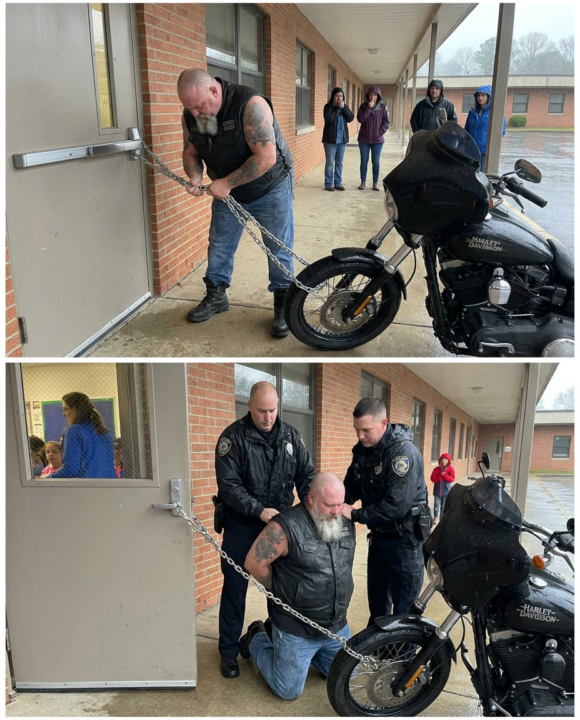
He positioned the Harley beside Door Seven without blocking the sidewalk leading to the school’s other exits. He shut off the engine, lowered the kickstand, and opened his right saddlebag.
The chain inside was six feet long.
It was not designed for school security. Hammer used it to recover motorcycles from ditches, stabilize damaged trailers, and lock equipment during overnight trips.
He threaded it through the exterior pull handle.
Then he wrapped the other end around the Harley’s rear crash bar and secured it with a hardened padlock.
The first test failed.
The chain had too much slack. The door opened four inches.
Hammer repositioned the motorcycle closer to the wall and locked the chain shorter. This time, the door moved less than half an inch before the steel became taut.
He looked through the glass.
Children were leaving the nearby classrooms under teacher supervision. The interior hallway remained clear. Staff used another corridor toward the gym, which connected to the secured bus loop on the opposite side.
Door Seven was no longer part of their evacuation route.
It was only a weak point.
Hammer stood beside it.
A parent named Rachel Vaughn saw him from the pickup lane and took a photograph. She had not witnessed the stranger or the broken latch. She saw a frightening biker attaching a chain to a school door while an alarm sounded.
She called 911.
Emily called at nearly the same time, reporting an unauthorized person in a red jacket and explaining that a visitor was attempting to secure the defective entrance.
The two reports reached different dispatchers.
The first reached officers sooner.
Biker barricading east school door.
That phrase shaped the police response.
Hammer saw the first patrol car enter the lane. He stepped away from the door and raised his hands before the officers exited.
Daniel Reed ordered him to move away from the Harley.
Hammer began to comply.
Then he saw a red sleeve disappear around the cafeteria corner.
The stranger had circled the building.
“Man’s behind you,” Hammer called.
Daniel did not turn.
Officers are trained to control the person directly in front of them before chasing an unseen report. Hammer understood that in theory.
In practice, twenty-six children were moving beyond a door that did not lock.
“On your knees!”
Hammer lowered his left knee.
The door handle moved.
Once.
Twice.
Someone pulled from the outside edge beyond the officer’s line of sight.
The chain tightened with a metallic crack.
The Harley shifted backward until its kickstand dug into wet asphalt. Hammer reached for the handle, intending to keep the motorcycle from tipping and loosening the chain.
Daniel rushed him.
His shoulder struck Hammer between the ribs. Tasha Greene seized Hammer’s right wrist and forced it behind his back.
Hammer fell against the motorcycle.
The Harley leaned.
The chain loosened.
Door Seven opened two inches.
Hammer planted one boot beneath the frame and pushed the motorcycle upright using his hip.
“Keep it tight,” he said.
Daniel pulled his left arm backward.
“Stop resisting.”
“Door.”
“Hands behind you.”
“Door opens.”
The stranger pulled again.
The door moved.
Hammer twisted toward the Harley.
Tasha reached for her radio. “Movement at east door. Possible second suspect.”
A teacher saw the gap from inside. She pushed a rolling supply cabinet against the door and continued directing students away.
Hammer felt the cabinet strike from the other side.
“Kids are there.”
Daniel handcuffed one wrist.
“I know.”
“No, you don’t.”
The words came out harsher than Hammer intended.
Daniel forced him lower.
The chain scraped across the door handle. The padlock struck the Harley’s frame. Hammer’s beard touched the wet pavement while he kept one shoulder pressed against the motorcycle.
Then came the sound of children.
Not screaming.
Counting.
Their teacher had them count steps as they moved toward the gym so nobody would run. Twenty-six small voices passed behind the window.
Hammer listened.
The stranger pulled again.
The Harley held.
At the loading dock, Officer Marcus Lee intercepted the man in the red jacket. The stranger claimed he had permission to collect his niece. Staff immediately confirmed he did not. An active court order prohibited contact, and he had been warned away from the family’s home the previous week.
Officers detained him without injury.
That information reached Daniel’s radio while he was securing Hammer’s second wrist.
“Unauthorized individual detained. East-side report confirmed. Check door integrity.”
Daniel looked at the chain.
Then he looked at the latch through the narrow gap.
The bolt hung loose.
He released Hammer’s second wrist before locking the cuff.
Hammer pulled free, not toward the officer, but toward the motorcycle. He used both hands to keep it upright until the last children cleared the hall.
Emily’s voice came through the school intercom.
“East wing clear.”
Hammer exhaled.
His arms began shaking.
The strength had not left earlier because he was fearless. It had waited until the children were gone.
Daniel removed the remaining cuff.
“I’m sorry,” he said.
Hammer checked the door.
“Later.”
“You were trying to tell us.”
“Fix the perimeter.”
Daniel nodded and returned to work.
The school completed the evacuation through the bus loop. Teachers counted every child twice. Parents received controlled updates and waited at a reunification center inside the nearby Methodist church.
The Iron Saints arrived as police vehicles surrounded the building.
Preacher led nine motorcycles into the church parking lot, then stopped when officers raised their hands.
He removed his helmet.
“Our brother called.”
Daniel expected anger.
Instead, Preacher asked, “Where do you need bodies?”
The principal assigned them to carry tables, bottled water, and boxes of emergency snacks. Club members removed their leather vests before entering the church because they did not want anxious children focusing on patches.
For the next three hours, they moved supplies.
Nobody approached the detained stranger.
Nobody interfered with police.
Brotherhood was tested.
It chose discipline.
Part 4 — The Teacher in the Photograph
After the building was cleared, Daniel returned to Door Seven.
Hammer remained beside the Harley.
The chain had pulled hard enough to bend the motorcycle’s rear crash bar. Black paint was scraped from the frame. The kickstand had carved a groove into the asphalt.
Hammer ignored all of it.
He watched a maintenance technician remove the damaged latch.
Daniel stood beside him.
“Amy Dawson was your daughter?”
Hammer’s eyes moved toward the open vest.
“You knew her?”
“She taught me second grade.”
Daniel remembered Amy as the first teacher who noticed he could understand stories when they were read aloud but struggled when the words sat still on paper. Until then, adults had called him careless.
Amy called it dyslexia.
She arranged testing, changed the way he received assignments, and taught him to use a ruler beneath each line so the words stopped moving together.
Daniel’s life changed.
He had written Hammer the purple note after Career Day because Amy asked every child to thank the visitor who affected them most.
Daniel wrote: Mr. Hammer, thank you for always coming back.
He did not remember the note until he saw it inside Hammer’s vest.
“You kept that?”
Hammer touched the paper’s worn edge.
“Amy did.”
“She gave it to you?”
“After she got sick.”
The note was one of twenty-nine she had saved in a classroom box. During her final month, she distributed them to the people named inside. Hammer received Daniel’s note along with a photograph of Amy’s second-grade class.
Behind the photograph, Amy had written something of her own.
Hammer allowed Daniel to read it.
Dad, you always think helping means arriving with the right tools. Most days it means staying after the tools fail. Keep showing up for my kids.
Daniel read the sentence twice.
The chain was not a memorial object. Amy had never touched it. She had only joked years earlier that Hammer could use his Harley if a school lock failed.
Yet when Door Seven stopped holding, Hammer heard the joke as instruction.
That was one truth.
There was another.
Hammer understood broken locks because he had once installed them.
Before operating his motorcycle repair shop, he spent nine years working commercial building maintenance. He had repaired doors at hospitals, warehouses, shelters, and schools.
When he tested Door Seven, he recognized immediately that the latch bolt was not engaging. He also knew he lacked the replacement component and legal authorization to dismantle school hardware during an active emergency.
So he chose an external restraint that staff could avoid during evacuation.
He never blocked the designated evacuation path.
He held one vulnerable door closed.
The district’s investigation later found the lock had failed before students arrived. A work order was submitted at 7:12 that morning, but the entrance remained in service because staff believed the mechanical latch still functioned after the electronic reader was disabled.
It did not.
A single internal component had fractured.
The stranger discovered the weakness by chance.
Hammer discovered it seconds later.
The district superintendent initially wanted to focus public discussion on the unauthorized chain. The principal refused.
“The chain did not create our emergency,” she said. “The broken lock did.”
Parents demanded answers. Reporters gathered outside the church. Online photographs still showed what appeared to be a biker chaining children inside a school.
Daniel asked Hammer to explain himself publicly.
Hammer declined.
“Families need facts,” Daniel said.
“Give them facts.”
“They’ll listen to you.”
“No, they’ll look at me.”
“That photograph makes you look responsible.”
Hammer examined the bent crash bar.
“Door stayed shut.”
“That isn’t enough.”
“Kids got out.”
“You don’t care what people call you?”
Hammer looked through Door Seven toward Amy’s old classroom.
“Care about sequence.”
“What sequence?”
“Kids first.”
Daniel wrote the police report himself. He stated that Hammer identified the unauthorized person, reported the threat, secured a failed exterior door without blocking active evacuation routes, complied with police commands as far as the door’s movement permitted, and used no force against officers.
He also recorded his own mistake.
I misinterpreted Mr. Dawson’s movement toward the motorcycle as noncompliance. Video later showed he was preventing the restraint from loosening while students cleared the hall.
His supervisor told him that sentence could create trouble.
Daniel left it.
Hammer read the report.
“Good cop,” he said.
Daniel expected praise to feel better.
It didn’t.
“A good cop would have listened sooner.”
Hammer folded the report.
“Good ones write down when they don’t.”
Part 5 — What the Children Saw Through the Glass
No student at Lincoln Edison saw the entire event.
That mattered.
The younger children heard the alarm and followed their teachers. A few glimpsed Hammer through Door Seven’s window. They saw a large tattooed man kneeling beside a motorcycle while officers stood around him.
Rumors filled the missing pieces.
By the next morning, one child believed Hammer had arrested the police. Another claimed the Harley was powerful enough to hold the whole school together. A third insisted Amy Dawson’s ghost had placed the chain.
The adults were less imaginative and more cruel.
Some accused Hammer of staging the incident. Others said motorcycle clubs had no business near schools. A parent demanded every Iron Saint be removed from the volunteer list.
Then security footage became available.
It showed the man in the red jacket testing Door Seven.
It showed Hammer directing him toward the main entrance.
It showed the stranger circling the building, Hammer testing the failed latch, and the chain being attached only after the school initiated its emergency response.
The footage also showed the handle moving while officers restrained Hammer.
Public anger changed direction.
Hammer disliked that too.
“Same folks need somebody to hate,” he said. “Just picked a new somebody.”
He refused interviews.
The school closed for two days while every exterior lock was inspected. Seven additional components were replaced. Door Seven received new hardware, an alarm sensor, and a bright indicator visible to staff when the latch failed to seat.
Hammer checked the work.
The maintenance director bristled. “District-certified contractor completed that.”
Hammer pulled once on the handle.
The door stayed closed.
“Good.”
He walked away.
Ava Cole, the first-grade student connected to the detained man, returned the following Monday. Her mother accompanied her and remained in the office until Ava entered class.
Hammer waited outside.
He had asked the principal whether his presence might upset the child. The principal asked Ava’s mother. She said Ava knew only that someone had tried to enter without permission and a visitor had helped keep the door shut.
Ava saw Hammer near the maple tree planted for Amy.
She stopped.
“You’re the motorcycle man.”
Hammer looked at the principal.
The principal nodded.
“Sometimes,” he answered.
“Did you lock the bad door?”
“Chain did.”
“You put it there.”
“Harley helped.”
Ava studied him. “Did the motorcycle get hurt?”
“Little.”
“Was it scared?”
Hammer considered the question.
“Probably.”
“Did it leave?”
“No.”
Ava reached into her backpack and removed a folded sheet of purple construction paper. She handed it to him.
The picture showed a black motorcycle tied to a red school door. A huge figure stood beside it. Inside the school were twenty yellow circles with smiling faces.
Across the top, in uneven letters, she had written:
HE HELD THE DOOR.
Hammer stared at the drawing.
His scarred fingers tightened along its edges, then relaxed before the paper bent.
“Thank you,” he said.
Ava ran to class.
Hammer remained beneath the maple tree after the bell.
Preacher arrived ten minutes later and found him still holding the picture.
“You planning to frame it?”
“No.”
“You framed the last one.”
Hammer looked toward Amy’s photograph inside his vest.
“Maybe.”
The Iron Saints paid to repair the Harley themselves. Hammer objected when they replaced the bent crash bar.
Preacher kept the damaged one.
He mounted it on the garage wall beside the six-foot chain. Underneath, he attached a small brass plate.
Hammer removed the plate because it contained his name.
Preacher replaced it with one containing two words:
DOOR SEVEN
Hammer allowed that.
Daniel began attending the club’s annual school-supply ride. He did not become a biker, despite Preacher’s repeated claim that his patrol posture suggested “touring-bike potential.”
He came in uniform.
The first year felt awkward.
The second felt less so.
Each time he entered the garage, he looked at the chain and remembered the handle moving after he had cuffed the man holding it closed.
He used that memory during training.
Not as a story about distrusting dispatch.
As a reminder that a correct command can still rest upon an incomplete view.
Part 6 — The First Thursday Books
Hammer continued delivering books every first Thursday.
The motorcycle carried a new crash bar, but one deep scratch remained along the frame where the chain had tightened. The repair shop offered to cover it.
Hammer refused.
“Part of paint now.”
Lincoln Edison revised its visitor procedures and emergency plans. Staff trained with police, firefighters, maintenance crews, and parent volunteers. The Iron Saints helped only when invited, carrying supplies and setting up reunification areas without interfering with security decisions.
Hammer had one job.
Books.
He arrived before the bell, unloaded the boxes, and left through Door Seven after checking the latch once.
Then twice.
The principal noticed but never teased him.
Ava grew older. In third grade, she wrote a story about a dragon that used its tail to hold a castle gate shut. In fifth grade, she joined the safety patrol and became the child most likely to remind adults their visitor badges were facing backward.
She never learned the details of the court order.
She did learn that help could look frightening from across a parking lot.
Amy’s maple tree grew tall enough to shade the east-wing windows. Each March, Hammer placed one new book beneath it inside a waterproof bag.
The first was Amy’s favorite story.
The second addressed grief.
The third was about a girl who became a teacher.
Children found them and carried them to the library. Nobody knew where they came from, although the librarian stopped pretending after year four.
The chain remained on the Iron Saints’ wall until the club moved garages. During the move, a prospect placed it in a box marked scrap metal.
Hammer found it.
He removed the chain, cleaned each link, and returned it to his saddlebag.
Preacher objected.
“That belongs on the wall.”
“Chain belongs where it works.”
“You already carry a new one.”
“Now carry two.”
One stayed with the Harley.
The other went into Lincoln Edison’s emergency equipment cabinet, properly approved and documented among safer commercial restraints, tools, and door wedges.
The old chain was never needed again.
That was fine.
A tool does not become meaningless because the danger fails to return.
Part 7 — The Officer Who Finally Heard the Whole Sentence
Seven years after Door Seven, Daniel Reed became Beckford’s police chief.
At his promotion ceremony, the city council invited teachers, officers, and community leaders. Hammer stood at the back near the exit, wearing his plain leather vest and trying to remain unnoticed despite occupying the space of two ordinary men.
Daniel saw him.
He asked Hammer to come forward.
Hammer shook his head.
Daniel waited.
The room turned.
Hammer muttered something beneath his beard and walked toward the podium with the defeated posture of a man approaching unnecessary praise.
Daniel held up the purple note from second grade.
Mr. Hammer, thank you for always coming back.
Amy had preserved it. Hammer had carried it. After the Door Seven investigation, Hammer made Daniel a copy while keeping the original inside his vest.
Daniel addressed the room.
“When I met this man again as an adult, I gave an order before I understood what he was holding together. He obeyed until obeying would have opened a broken door.”
Hammer looked toward the exit.
Daniel did not call him a hero.
He knew better.
He said, “Ray Dawson taught me that sometimes the person who appears to be blocking your path is the only thing keeping danger from crossing it.”
Hammer leaned toward the microphone.
“Long speech.”
The room laughed.
Daniel stepped aside. “Your turn.”
“No.”
“One sentence.”
Hammer looked at the officers, teachers, parents, and former Lincoln Edison students filling the room. Ava Cole sat in the second row, now thirteen, wearing a school robotics sweatshirt.
Hammer touched Amy’s photograph beneath his vest.
“Check the door,” he said.
Then he left the podium.
Outside, his Harley waited beside the municipal building. The original chain lay inside the saddlebag. Ava followed and asked whether he still checked every school entrance twice.
“Only the ones with kids.”
“That’s every school.”
Hammer started the engine.
“Then yes.”
The V-twin rumble crossed the parking lot. Daniel watched from the steps as Hammer turned toward Route 40, two fingers lifting from the handlebar before the motorcycle disappeared beyond the traffic light.
The chain never closed another door.
The promise kept opening them.
Follow our page for more unforgettable biker stories about public misunderstandings, tested brotherhood, and rough-looking strangers who quietly stand between children and danger.