A Biker Bought an Entire Rack of Prom Dresses for One Girl in a Wheelchair—Then the Shop Owner Learned Why He Wouldn’t Choose One for Her
I told the dress-shop owner I would buy every gown on the rack if she would alter all of them for a girl who used a wheelchair, and she stared at my leather vest as though I’d mistaken her store for a place where money could buy a child’s happiness.
The rack held twelve dresses. I counted twice while she watched: satin, tulle, sequins, colors I had no useful names for. One had sleeves made of beads so fine I was afraid my rough fingers would catch them. Outside the front window, my Harley sat between a florist’s van and a car with a cracked rear bumper.
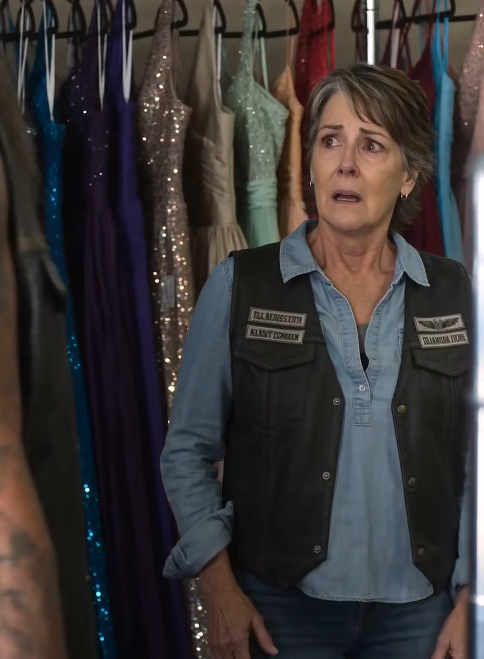
“My seamstress can work on a dress after someone chooses it,” the owner said. “She can’t completely remake twelve gowns in one afternoon.”
“I’m not asking her to finish twelve.”
“You said you wanted all of them altered.”
“I want them ready for my daughter to try while she’s sitting. Then she chooses what she likes, and we finish that one.”
The owner glanced at the dresses again. Her name was Marianne Vale. She had run the little shop outside Knoxville for twenty-three years, long enough to know when a customer was about to make her day difficult.
I was doing a fine job of it.
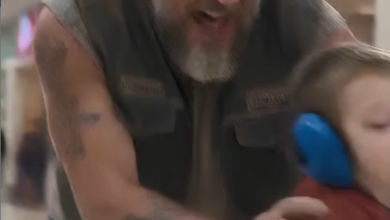
I was fifty-seven, six-foot-three, with a gray beard, tattooed arms, and boots that made too much noise on her polished floor. Marianne had already asked me once to leave my wet helmet by the door. I’d done it and stepped carefully around a stand of pale pink gowns. Still, every time I moved near the fabric, her shoulders rose.
“Does your daughter know you’re here?” she asked.
“She knows I’m arranging an appointment.”
“Does she know about the rack?”
“No. I’ll tell her before we come.”
Marianne folded her arms. “And if she doesn’t want to try any of them?”
“Then she won’t.”
That answer seemed to surprise her more than my offer to pay.
My daughter, Lucy, was seventeen. Her school prom was in three weeks. Two nights earlier, she had shut her laptop after looking at dresses online and told me she wasn’t sure she wanted to go. She liked the music. She wanted to meet her friends there. What she didn’t want was to spend an afternoon in a fitting room while somebody tugged a dress straight on a standing mannequin and assured her it would look the same once she sat down.
I had no idea whether Marianne’s shop would be different. That was why I had come alone first.
I asked about the changing room. Marianne showed me one with a narrow door and a bench that took up much of the space. I measured the doorway with the tape I kept in my vest pocket. She watched me measure it, then looked at the width I’d written on the back of a fuel receipt.
“She can’t turn around in there, can she?” Marianne said.
“Not with the bench.”
She pulled the bench out herself. We moved a display away from the other wall, and I measured again. The room changed when someone made space. It was a start.
We spent nearly an hour talking through what a first fitting could involve. Marianne called her seamstress, who explained that she could temporarily pin and baste adjustments for each gown so Lucy could see how it sat. They would need more time to finish whichever dress Lucy selected. I said I would cover the dresses and the work; Marianne said she needed to check the figures before promising anything.
Then I asked the question I had been holding back.
“Could we have the shop to ourselves for the afternoon?”
Marianne looked through the window at the traffic on Kingston Pike. “We have appointments.”
“I can pay for the time. If you have to say no, say no.”
She thought for a while. “Next Tuesday. We can reschedule those two appointments if the customers agree.”
I thanked her. She put one hand on the rack, fingers resting against a green dress Lucy might hate.
“Why twelve?” she asked. “Most girls pick three or four.”
I looked at the dresses, too. “She should get to put some back.”
Marianne’s face softened for a moment, though I could tell she still didn’t understand why that mattered so much to me. I signed the order she drew up, paid for the rack, and went home to ask Lucy whether she wanted the appointment at all.
When I told her, she asked if I had chosen the dresses. I said no.
“Good,” she said. Then she asked, “Dad, does the owner know I’m coming in my chair?”
“She does.”
Lucy looked relieved. A second later, she looked worried again.
Part 2
Lucy had been my daughter for six years by then, though I had known her for eight. She was nine when I first met her on a rainy stretch of highway outside town. I was riding home from a parts run and came upon a wreck that had just happened. I pulled over, called for help, and did what the dispatcher and then the emergency crew asked me to do.
I do not tell that night as a story about my motorcycle. I remember the rain, the bright lights of the vehicles that stopped, and a little girl asking repeatedly where her parents were. Her name was Lucy. I stayed nearby until the people trained to help took over.
Her parents, Daniel and Erin, died from their injuries. Lucy survived with a spinal injury that changed how she moved through the world. Those are facts of her life, but they are not the whole of it. She has their photographs in her room. She laughs like her mother, according to an aunt who knew them both. She loves terrible puns, understands more about old movies than I ever will, and can tell when I’ve burned the toast from the other end of the house.
After the wreck, I called the hospital to ask whether I could leave a card for her family. I learned how little a stranger was entitled to know, which was as it should be. Months later, her aunt contacted me because Lucy had asked about the man in the leather vest who had stayed by the road. I met them at a supervised family event. Later there were more visits, arranged with the people responsible for her care.
Her aunt loved her but could not take on full-time care. Lucy spent time with a foster family before I began the long process of being assessed as a possible parent. There were interviews, training, home visits, changes to my house, and stretches when nobody could promise Lucy or me where she would live. I was a single mechanic in his late forties. Wanting to help was not enough.
When Lucy first stayed at my house, she corrected me about nearly everything. I had placed cups in cabinets she couldn’t reach. I had cleared plenty of space in the garage but left a narrow turn beside the kitchen table. I had assumed she would want the bedroom closest to mine; she chose the one with a view of the maple tree.
She was right about all of it. I moved the cups, changed the table, and made the room hers.
I had spent my adult life on a Harley, going where I pleased. Living with Lucy taught me to stop at a doorway and look at it from where she sat. It also taught me that once the doorway worked, she did not need me hovering on the other side of it.
Our club helped when I asked. Boone built shelving at a height Lucy chose. Marlene, whose work was in construction, checked the changes to the house. They learned to ask Lucy whether she wanted a hand. Sometimes she did. Most of the time she wanted them to move their tools out of her way.
By high school, she had a close group of friends, an opinion about every song on my garage radio, and a schedule that usually told me when I could use my own truck. She had a blue manual wheelchair with scuffed spoke guards. She wanted to go to prom with her friends, stay late enough to complain about the music afterward, and have me pick her up when she called.
The dress became a problem because she wanted one badly enough to care how it looked. The first shop we tried had an accessible entrance but a fitting room she could not turn into. At another, a clerk held a gown against Lucy while she was seated and kept saying the skirt would “fall properly” when she stood.
Lucy said, “I won’t be standing.”
The clerk apologized. Lucy thanked her and asked to leave. In the truck, she looked out the window for a long time before telling me she did not want to spend prom pulling fabric away from her wheels. I asked whether she wanted to try another shop. She said she would think about it.
That was the evening before I went to see Marianne.
Part 3
Marianne called the next morning. The two customers with Tuesday appointments had agreed to other times, and her seamstress, Rosa, could come in early. The twelve dresses would be purchased as I’d requested. Rosa would make temporary fitting adjustments where possible, but Marianne wanted Lucy to know that some gowns might still be uncomfortable or difficult to alter.
“I’ll tell her,” I said.
“And Ray? She can stop whenever she wants.”
“I’ll tell her that, too.”
Lucy heard the plan over breakfast. I explained that I had bought the dresses so there would be enough time and room to try them without pressure to protect the stock. The choice to go was hers. If she went, she could reject every dress, and we could look elsewhere.
“You bought twelve?” she asked.
“Yes.”
“That’s a lot of dresses.”
“It is.”
“What happens to the ones I don’t pick?”
“Marianne and I will work it out. You don’t have to keep them.”
Lucy studied me over her cereal. “I want you to promise you won’t get sad if I hate them.”
“I promise.”
She took another spoonful. “I’ll go.”
On Tuesday afternoon, I drove our accessible van. My Harley stayed at home because Lucy was coming with me, not attending a motorcycle event. She chose jeans and a soft yellow sweater for the appointment and spent much of the drive telling me she was not nervous.
At the shop, Marianne greeted Lucy by name and showed her the clear path to the fitting room. She asked before touching the chair. Rosa introduced herself from the cutting table, where she had arranged clips, pins, and lengths of soft fabric. They spoke to Lucy about the dresses. I stayed near the entrance with my helmet, useful chiefly for carrying bags.
The first gown was silver, with a narrow waist that looked fine on a hanger and bunched when Lucy sat. Rosa tried a few temporary adjustments, then asked Lucy what she felt.
“Like I swallowed a curtain,” Lucy said.
Marianne laughed. I held back mine until Lucy caught my eye and grinned.
The second dress had a beautiful neckline and a front hem that pooled over Lucy’s footplate. The third had a stiff seam at the back that Lucy noticed immediately. Rosa marked it, but Lucy shook her head. “It’s going to bother me all night.”
“Then it’s out,” Rosa said.
There was no argument for keeping a pretty dress that hurt.
They worked slowly. Marianne brought water. Rosa adjusted one dress at a time, pinning fabric for Lucy to see its shape while seated and loosening anything that pressed against her. Lucy checked how each dress looked when she rolled, reached, and turned. She rejected purple because she disliked the shade. She rejected pale pink because she loved the color but not the sleeves.
By the sixth gown, she was tired. Marianne offered a break, and Lucy took it. She rolled near the front window and watched a delivery driver struggle to park. I joined her with two paper cups of water.
“Too much?” I asked.
“A little.” She drank. “Don’t tell them to stop.”
“I won’t. You can.”
“I know.”
She went back when she was ready. At dress eight, Marianne grew quiet. It was a dark green gown with a soft skirt, and for a few seconds Lucy seemed to like it. Then she reached behind herself and felt where the fabric gathered. Rosa could alter that seam, but Lucy said she didn’t want to spend the evening wondering whether it had shifted.
Marianne nodded and moved it to the finished pile. Her eyes filled. She turned away before Lucy noticed and straightened a hanger that did not need straightening.
I saw her hand tremble.
I thought she might be upset because we had asked for too much work. Then I heard Lucy say, “Can I try the next one?” and Marianne answered, “Of course, honey.”
Part 4
Dress ten was blue. Not the blue of Lucy’s chair, though close enough that I noticed. It had a simple front and a skirt made of lighter fabric that moved when she rolled. Rosa adjusted the waist and temporarily changed the way the back lay against the chair. Lucy asked for a mirror from another angle. Marianne brought one over.
I watched my daughter examine herself with the same concentration she used when choosing a new haircut. She tilted her head. She turned the chair a little. She reached forward, then looked down to see whether the skirt stayed clear of the wheels.
“How does it feel?” Rosa asked.
“Better.”
Marianne smiled. “Do you like it?”
Lucy considered the question. “I might.”
Two more gowns waited on the rack. I could see Marianne hoping Lucy would say yes to the blue one. I hoped so, too. It was late, and all of us were tired.
“I want to try the last two,” Lucy said.
Rosa set down her pins. “Then we’ll try them.”
The eleventh dress had too much glitter for Lucy. The twelfth was black, with sleeves that looked elegant until she tried to move her arms freely. Off it went. After a short rest, she asked to put the blue gown back on.
I had thought we were nearly done. Lucy had another question.
“Can I see the green one again?”
Rosa lifted it from the finished pile. Marianne found the mirror’s best position. Lucy compared the two, one after the other, while I sat with my hands around an empty paper cup. At last she chose the blue. She liked the green, but she wanted a dress she could forget about once the music started.
Rosa wrote down the alterations to finish. Marianne went into the back room for a fresh order form and stayed there longer than she needed to. When she returned, her eyes were red.
Lucy noticed. “Are you okay?”
Marianne nodded, but tears came anyway. She apologized and sat down on the low stool by the cutting table. “I’m happy you found one,” she said. “I’m sorry. Give me a minute.”
Lucy rolled closer, leaving Marianne room to speak or not speak.
“I had a customer here years ago,” Marianne said. “She used a wheelchair. I showed her two dresses I thought would be easiest to alter, and when she asked about the others, I told her they wouldn’t work. I didn’t ask her what she wanted to try.”
Lucy listened. So did I.
“I meant to help her,” Marianne continued. “I still remember her face when she left. Today I nearly did the same thing with the green dress. I wanted so badly for one to work that I almost talked you into it.”
“You didn’t,” Lucy said.
“Because you told me you weren’t sure.”
“I’m allowed to be unsure.”
“Yes,” Marianne said, laughing through tears. “You are.”
Lucy reached for the blue skirt. “I was unsure about this one, too.”
Marianne wiped her face with a tissue. She had cried more than Lucy, who had not cried at all. Lucy had been busy choosing.
While Rosa put the gown away for finishing, Marianne came to the counter where I stood. “You could have taken her to a specialist shop,” she said.
“We may still need one for something else. She liked your dresses.”
“You paid for all twelve so she could say no to eleven.”
“I wanted her to have the afternoon.”
Marianne glanced toward Lucy, who was asking Rosa whether the finished hem would move the same way. “You told me on the phone that she was your adopted daughter,” Marianne said quietly. “That you’d known her since she was nine.”
I nodded. I had told Marianne enough to explain that Lucy had family photographs she might want to carry, and that prom held more for her than I could describe. I had not told her the details of the road or of the years between meeting Lucy and becoming her father. Those belonged to Lucy.
“She told me she wants pictures of both her parents with her on prom night,” Marianne said. “She asked if the dress had a pocket for them.”
That was when I had to set the paper cup down.
Part 5
The blue gown did not have a pocket. Rosa said she could add a small one on the inside, in a place Lucy could reach without disturbing the skirt. She showed Lucy where it would be and asked whether she wanted the pocket wide enough for her phone as well. Lucy said no; her phone had its own bag. The pocket was for two photographs.
Daniel and Erin remained part of our house in ordinary ways. Their faces were on the mantel. Lucy told stories about them when she felt like it, and sometimes corrected me when I repeated one badly. The first time she called me Dad, she also asked whether that would make me think she loved them less.
I told her she never had to make room for me by moving them out.
I had meant it. Still, I had not thought to ask whether she wanted to bring their pictures to prom. Lucy had made that decision herself.
At the counter, Marianne prepared the final order. She accepted payment for the gowns because I had insisted on buying the rack before any work began. We discussed what to do with the eleven Lucy hadn’t chosen. Some temporary adjustments could be removed; a few gowns could be donated afterward if the receiving organization wanted them. Marianne and Rosa would decide the practical details with me once the fitting was finished.
When Marianne reached the alterations, she drew a line through the labor charge.
“No,” I said. “Rosa worked all afternoon.”
“Rosa is being paid,” Marianne said. “I’m covering it.”
“You don’t have to.”
“I know.”
Rosa, who had joined us at the counter, made sure the difference was clear. Her hours and materials would be paid by the shop. Marianne was choosing not to charge me for that work. Neither of them wanted Lucy to hear us bargaining as though her fitting had become a favor she owed them for.
Marianne put the pen down. “This is what I get to do with this trade,” she said. “Let me do it.”
I stopped arguing. I thanked her and asked when Lucy should return for the finished fitting.
Back at the van, Lucy waited until I had folded the fitting-room bag and put it away. “Marianne cried because of the dresses?” she asked.
“Partly.”
“She seemed embarrassed.”
“She was thinking about another customer she wished she’d listened to.”
Lucy looked out the window. “I liked her.”
“I did, too.”
“Rosa didn’t mind when I hated the purple one.”
“Nobody should mind that.”
“You bought the purple one.”
“I bought your chance to hate it.”
She laughed, then grew quiet. At a red light she asked whether I remembered what her mother’s prom dress looked like. I did not. We had photographs of Erin at a wedding and on family trips, but I had never seen one from her prom.
“We can ask your aunt,” I said.
“Maybe later.” Lucy rested her hand on the bag holding her yellow sweater. “I’m glad I picked blue.”
I took her back a week later. Rosa had finished the alterations and added the pocket. Lucy checked it first. She put two small photographs inside, one at a time, then rolled the length of the shop to see whether the skirt caught anywhere. It didn’t.
Marianne watched from the counter. Her eyes filled again, but she held her smile steady. Lucy caught sight of her and rolled back.
“You made it comfortable,” she said. “I forgot to think about the seam.”
For a seamstress, that was high praise. Rosa nodded as though she had received a proper inspection report.
Part 6
Prom night arrived with rain threatening. Boone came over to adjust a windshield wiper on the van and left before Lucy came out in her gown. He knew she had not invited the club to see it. Marlene brought hair clips earlier in the afternoon, stayed long enough to help if Lucy wanted, and went home after Lucy chose to do her hair herself.
I waited in the kitchen wearing a clean shirt. My leather vest hung by the door. I had put it on out of habit, then taken it off because Lucy had asked for photographs outside, and I thought the weather might already be turning.
When she came down the hall, she stopped beside the mantel. The blue gown moved easily as she turned her chair. She checked the small inside pocket. Then she took out the two photographs, looked at them, and put them back.
“Ready?” she asked me.
“I think so.”
“You look terrified.”
“I can change shirts.”
“It’s not the shirt.”
She was right. For weeks I had been thinking about dresses, fittings, the van, and the entrance to the school gym. Now that everything was arranged, I had to let her go enjoy it. I found the camera while she checked her phone for messages from her friends.
We took pictures on the porch before the rain started. She wanted one by herself, one with me, and one holding the framed photograph of Daniel and Erin from the mantel. Then she put the frame safely back inside. The smaller photographs stayed in her pocket.
At the school, Lucy told me where to stop. I got out and set up her chair beside the van. She transferred as she usually did, with me helping only where she asked. Across the parking lot, two friends waved from beneath the awning and came toward us.
One of them said, “You found the blue dress.”
“I did,” Lucy answered. “It has a secret pocket.”
“What’s in it?”
“Secret.”
They laughed and headed for the entrance together. Lucy turned once to check that I had her evening bag. I handed it over. She told me what time to return, adding that she would text if plans changed.
I went home. Boone called to ask whether I wanted to come by the garage, and I said no. I made coffee, put away the extra camera battery, and sat on the porch while the rain finally came. The house had been loud with preparation all afternoon. Now I could hear water running from the gutter and, farther off, a motorcycle crossing the next road.
Lucy texted just before eleven. We’re ready. Don’t park under the big tree. It drips.
I parked somewhere else. She came out with her friends, tired and talking over one another about the music. Her hair clips had shifted. The blue skirt still moved clear of her wheels.
On the drive home, she took off one earring and asked whether Marianne’s shop opened on Saturdays. She wanted to show her a photograph. I said we could call and ask.
Then she leaned back, still wearing the other earring, and fell asleep before we reached our street.
Part 7
The following Saturday, Lucy chose a picture from prom night and put it in an envelope. She wrote a note to Rosa and Marianne, then asked if I would drive her to the shop. Marianne was helping another customer when we arrived, so Lucy waited her turn.
She gave the envelope to Rosa first. The photograph showed Lucy with her friends outside the gym, laughing at something beyond the camera. The blue gown was visible from the waist down; the pocket wasn’t. Rosa looked at the picture for a long time before handing it to Marianne.
“You look like you had fun,” Marianne said.
“I did. I forgot about the dress most of the night.”
Marianne smiled. “Rosa will love hearing that.”
“I already do,” Rosa said.
Lucy thanked them both. Then she wandered toward a rack of summer dresses and began looking through it, passing over colors she disliked without explanation. Marianne let her browse. I stood near the door with my helmet, watching Lucy hold a green dress against her shoulder and decide against it.
On the ride home, she told me a friend had asked where she found her prom gown. Lucy had given her Marianne’s shop name. She hadn’t told the story of the rack.
“You can,” I said. “If you ever want to.”
“I know.”
At home, she placed the prom photograph beside the ones of Daniel and Erin. It stayed there through graduation announcements, college applications, and the ordinary arguments we had about whose turn it was to replace the milk.
The eleven other gowns went where we had arranged for them to go, after Marianne and Rosa removed the temporary fitting stitches. The blue one hung in Lucy’s closet for a while. One afternoon I heard her move the hanger aside to reach a jacket, and I smiled at the sound of it: a dress she had chosen, among the rest of her clothes.
Follow our page for more biker stories about family, second chances, and the quiet moments that stay with us long after the engines stop.