A Biker Bought Used Princess Shoes for a Girl in a Children’s Home—Then Her Question Revealed Why She Had Refused Every New Pair
The little girl ignored the glittering princess shoes in my hands, turned them over to inspect the faded size printed inside, and asked, “You remembered?”—as though the number mattered more than the gift.
I thought she disliked them.
One silver buckle had been repaired with matching thread. The pale-blue fabric was clean but slightly creased where another child’s toes had once bent it. A few plastic gems were missing from the heel.
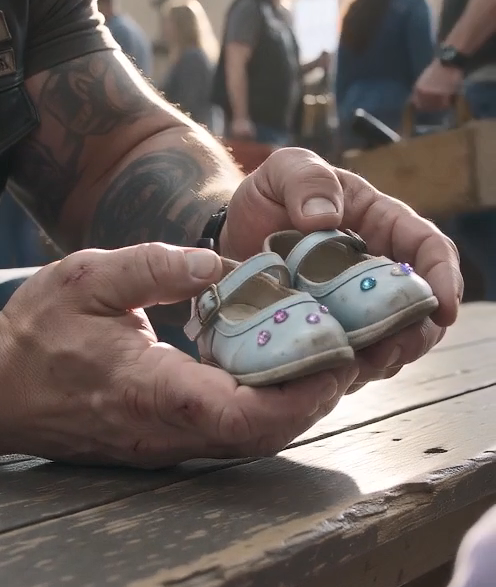
They had cost four dollars at a church flea market.
I had spent another six replacing the insoles.
My name is Ray Dawson. I was fifty-six that fall, six-foot-four and close to two hundred eighty-five pounds, with a shaved head, a black-and-gray beard, and tattooed forearms that made unfamiliar children watch me before deciding whether I was safe.
The men behind me looked much the same.
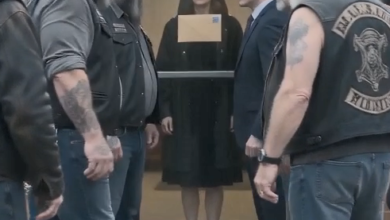
Six bikers in leather vests stood inside the family room of a small residential children’s home outside Knoxville, holding board games, winter coats and bags of school supplies.
But the smallest gift in the room was mine.
Her name was Lila.
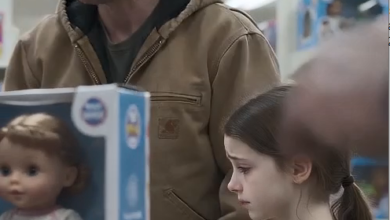
She was eight, with dark curls gathered into two uneven puffs and a purple sweatshirt that covered half her hands. She sat cross-legged near a box of donated costumes while the other children explored our delivery.
I held out the shoes.
“They’re used,” I said.
Boone cleared his throat behind me.
Children are usually not sold on gifts by leading with their defects.
But I didn’t want Lila opening the bag and discovering that I had pretended four-dollar shoes were new.
“I washed them. Replaced the inside part. Leah at the repair shop fixed the buckle.”
Lila touched one plastic gem.
“Some are gone.”
“I counted five missing.”
“Six.”
She turned the other shoe toward me.
She was right.
“Six,” I admitted.
Lila checked the inside again.
“Size one.”
“That’s what you said.”
She looked up.
Her expression did not brighten the way adults expect when they hand a child something wrapped. Instead, her mouth tightened, and her eyes filled so quickly I thought I had embarrassed her.
I started taking the shoes back.
“You don’t have to wear them.”
Her arms closed around the box.
“No.”
I released it.
Across the room, a staff member named Denise lowered a stack of notebooks she had been carrying. She knew something I didn’t.
“Lila,” she said gently, “what happened?”
The girl pressed her thumb against the faded size marking.
“He remembered the one.”
Nobody spoke.
Three months earlier, our club had delivered new shoes to the home. Lila received a pair of pink costume slippers two sizes too large because someone had written “children’s princess shoes” on a donation list without asking which child would wear them.
She thanked us.
She wore them once.
She had stuffed tissues into the toes so they would stay on.
I had found those tissues beneath a chair.
That afternoon, I had crouched beside her and asked why she didn’t choose another pair.
“They’re always big,” she said.
“Your regular shoes?”
“Everything.”
Then she told me her size.
One.
Not one and a half.
Not two because she would grow.
Size one.
I wrote it on the back of a fuel receipt and kept it inside my wallet.
Now Lila held the shoes against her chest.
“You really remembered?”
“I wrote it down.”
She considered that answer.
Perhaps memory aided by paper counted less. Perhaps it counted more because I had known my mind might fail and built a bridge across the failure.
She took off her sneakers and tried on the princess shoes.
The repaired buckles closed.
Her heel stayed where it belonged.
She stood carefully, looking down as though the floor had changed beneath her.
“They fit.”
Denise turned away and wiped her cheek.
One of my club brothers suddenly became interested in opening a box he had already opened.
Lila took four small steps across the rug.
Then she returned and stopped directly in front of me.
“I don’t need them to be new,” she whispered. “I just wanted somebody to remember before I got bigger.”
I thought the shoes were the promise.
Then she asked the question that showed me how little I understood.
“When they don’t fit anymore,” she said, “will you still know which size I am?”
Part 2
I first met Lila during the club’s winter donation visit.
The home was not an orphanage. It was a licensed residential program where children stayed for different reasons and different lengths of time while caseworkers, families and other professionals handled plans we had no right to simplify.
Some children returned to parents.
Some went to relatives or foster families.
Some remained longer than anyone wanted.
We were visitors.
That distinction mattered.
The club became involved after Marlene, our treasurer, learned the home needed coats, toiletries and school supplies. She contacted its volunteer coordinator, requested an approved list and reminded us twice that generosity did not suspend rules.
“No surprise visits,” she said.
“No photographs unless the organization and the child’s legal decision-makers approve. Don’t promise rides. Don’t promise bedrooms. Don’t ask why a child is here.”
Travis raised a hand.
“Can we ask what games they like?”
“Yes.”
“What snacks?”
“Ask the staff about allergies.”
“Motorcycles?”
“Outside, engines off.”
Boone leaned toward me.
“She enjoys controlling us.”
“She enjoys preventing lawsuits.”
“Same sparkle in her eyes.”
We followed the instructions.
Mostly.
Our first delivery included twelve pairs of children’s shoes donated by a local store. They were new, colorful and selected using a general range of sizes the home had provided.
I thought we had done everything correctly.
Then I saw Lila sitting near the wall in pink princess slippers.
They were beautiful from a distance. Sparkling fabric, plastic jewels and ribbons curling across the toes.
Up close, her heel slipped out every time she stepped.
She smiled when adults looked.
When they turned away, she walked like the floor belonged to somebody else.
I was carrying empty boxes toward the hall when one slipper came off. Lila caught herself against a chair.
“You okay?”
“Yes.”
She shoved her foot back inside.
“What size are those?”
She looked at me suspiciously.
“Two.”
“What size are you?”
“One.”
I found tissues packed into the toes.
Before touching anything, I asked if she wanted help. She nodded, and I moved the chair so she could sit.
“Why didn’t you tell somebody?”
“I did.”
Her answer was quiet.
“Who?”
“The lady who brought them said I’d grow.”
The donor probably meant well. Children outgrow things quickly. Buying larger can seem practical.
But Lila had not asked for shoes to inhabit later.
She wanted shoes she could walk in that afternoon.
Denise joined us and offered to find different footwear from the clothing room. Lila put her sneakers back on instead.
They were worn but fit properly.
She placed the princess slippers in the donation box.
“You don’t want to keep them?” I asked.
“They’ll fit somebody.”
There was no self-pity in her voice.
That made me feel worse.
I asked what size she wore again.
“One.”
Then I made the mistake of saying, “I’ll find you some.”
Lila’s face closed.
Denise looked at me.
I heard Marlene’s warning too late.
No promises.
Children in unstable circumstances can collect promises the way other children collect stickers. Adults say they will return, call, bring something or remember a birthday.
Some intend to.
Intention does not appear at the door.
I corrected myself.
“I shouldn’t have said that before checking. May I ask Denise whether I’m allowed to look?”
Lila glanced at her.
Denise nodded.
“That would be the right first step.”
So we asked.
The home did not accept arbitrary used everyday footwear because of hygiene and condition requirements. Costume shoes could be considered if cleaned, inspected and used with staff approval.
Lila wanted princess shoes for a reading celebration where children could dress as a character. She had chosen a princess who traveled through a forest without waiting for rescue.
“Does she fight a dragon?” I asked.
“She negotiates.”
“That sounds more dangerous.”
Lila almost smiled.
Denise wrote down the costume details and repeated that there was no obligation. If I found nothing suitable, staff would help Lila choose another option.
I left with the fuel receipt in my wallet.
For the next three weeks, I checked discount stores, thrift shops and online listings. New costume shoes in the correct size either cost too much for what they were or arrived too late.
Then Boone dragged me to a church flea market because he wanted an old tool cabinet.
I saw pale-blue shoes beneath a folding table.
Used.
Missing gems.
Size one.
The number found me before the glitter did.
A woman named Rose sold them. Her granddaughter had worn them for one school play, then outgrown them.
“They’ve been cleaned,” she said.
“I’ll clean them again.”
“You buying for a granddaughter?”
“A girl who needs this size.”
Rose watched me inspect the soles.
“They’re not perfect.”
“I’m not looking for perfect.”
The shoes had safe soles, intact stitching and one loose buckle. I showed photographs to Denise before purchasing them. She confirmed they could be accepted after cleaning and repair.
Then I bought them.
Four dollars.
Boone bought the tool cabinet for sixty and spent the ride home explaining how his purchase had saved money.
His cabinet leaned left.
My shoes fit.
Part 3
The day I brought them, Lila did not behave like a child receiving a costume.
She behaved like someone receiving evidence.
She walked from one end of the rug to the other, stopped, turned and walked back. She bent her knees. She rose onto her toes.
Then she sat down and checked the size again.
One.
Still one.
I asked whether they pinched.
“No.”
“Rub anywhere?”
“No.”
“Want to wear them for a little while before deciding?”
She nodded.
Denise had already told me that children sometimes said a gift fit because they were afraid it would disappear if they complained. Lila wore the shoes for ten supervised minutes, then removed them so Denise could check her feet.
No red marks.
No slipping.
They fit.
A four-dollar mistake would have hurt more than a forty-dollar gift would have helped.
The club’s other donations went into the home’s established system. Children selected items with staff rather than being photographed beside piles of boxes.
Still, several of my brothers had witnessed Lila’s reaction.
Travis found me near the coffee table.
“We should do this for all of them.”
“Do what?”
“Get their exact sizes. Exact wish lists. One volunteer for each kid.”
It sounded right for about three seconds.
Then Marlene joined us.
“And what happens when a volunteer disappears?”
Travis frowned.
“We’re not going to disappear.”
“You can speak for everybody’s next five years?”
He looked toward Lila.
“No.”
“Then don’t build something around promises individuals may not be able to keep.”
She wasn’t trying to stop the help.
She was forcing us to consider its shape.
A child should not be assigned a stranger who became emotionally important before anyone knew whether that person could maintain appropriate, approved contact.
The home already had procedures for mentors and long-term volunteers. Background checks. Training. Scheduled visits. Boundaries around gifts and communication.
If we wanted to do more, there was a path.
Good intentions still needed a door and a key.
I asked for information.
The application packet was twenty-three pages.
Boone said I had survived military equipment manuals and carburetor diagrams, so I could probably manage questions about emergency contacts.
I completed the forms.
The background checks took time. Training took longer. We learned about trauma, confidentiality, attachment, behavior and why a child testing whether an adult would return was not manipulation.
It was information gathering.
Children trusted patterns because patterns were measurable.
Words were cheap.
Thursday at four was either occupied by a person or it wasn’t.
I did not become Lila’s private rescuer.
The program placed me in a supervised mentoring role that involved several children and staff-approved activities. Other trained volunteers joined. Marlene became one, though she claimed somebody needed to supervise the bikers.
On my first scheduled Thursday, Lila wore the princess shoes.
She sat at a table doing homework in them.
I looked at the clock.
Four exactly.
“You came.”
“That was the schedule.”
“I know.”
She returned to her worksheet.
For twenty minutes, she did not speak to me again.
Denise had warned me this might happen. Lila had received the information she needed: I had arrived. Conversation was optional.
I helped another child assemble a model bridge.
At four fifty-five, I told the group I would leave at five as scheduled.
Lila looked up.
“Are you coming next Thursday?”
“I’m scheduled for the first and third Thursday this month. Next Thursday is the second.”
She frowned.
“So no?”
“Not next Thursday. The Thursday after that.”
She examined my face.
“Why?”
“Because that’s what the home approved and what I committed to.”
“Could you come anyway?”
“No.”
It felt cruel.
It was also honest.
“I’ll be here on the date I told you.”
She looked down.
“We’ll see.”
Two weeks later, I arrived at three fifty-seven.
Lila was not in the family room.
She came in at four thirteen carrying a book.
“You’re late,” I teased.
She did not smile.
“I wanted to see if you’d wait.”
I checked with Denise before answering.
“I’ll wait during the time I said I’d be here.”
Lila placed the book on the table.
Then she looked at my boots.
“What size are you?”
“Thirteen.”
She seemed impressed and slightly offended.
“That’s too big.”
“For you, yes.”
She opened her book.
“What size will you be next year?”
“Probably thirteen.”
“So feet stop?”
“Mostly.”
She considered the injustice of this.
Then she asked, “Do grown-ups remember their own size?”
“Usually.”
“Do they remember kids’ sizes?”
I knew we were no longer discussing shoes.
“Sometimes. Smart ones write it down.”
She nodded.
“Show me.”
I took the faded fuel receipt from my wallet.
On the back, beneath a gas total, I had written:
Lila—1.
Her fingers touched the edge.
“You kept it.”
“Yes.”
“Why?”
“So I wouldn’t get it wrong.”
She turned the receipt over, read the fuel amount, then handed it back.
Remembering did not have to be effortless to be real.
Part 4
The princess reading celebration happened in December.
Lila wore a green dress from the costume room and the pale-blue shoes. The outfit did not match the book cover exactly, which bothered one adult and none of the children.
Her princess entered the forest carrying a map.
Lila carried a paper map rolled under one arm.
I attended because the event fell within an approved volunteer activity. Marlene sat beside me. Boone came late and tried to enter quietly despite being a large man in motorcycle boots.
Every child heard him.
Lila read three lines from the book.
Her voice became softer on the third, but she finished.
When the applause came, she looked first toward Denise.
Then toward me.
I held up one finger.
Size one.
Her smile flashed and disappeared.
Afterward, the children had cookies. A staff member took photographs for the home’s internal records and approved family sharing. The volunteers did not post anything.
Travis asked whether we could photograph the shoes alone for the club newsletter.
Denise checked with Lila.
She said no.
That was the end of the question.
On the drive home, Boone complained that a picture of shoes without a child seemed harmless.
Marlene looked at him from the passenger seat.
“If she says no to a photograph of her belongings, what exactly do we teach by deciding it’s harmless?”
Boone gripped the steering wheel.
“Point taken.”
The club had spent years telling people that respect mattered.
Now we were learning that respect became visible when the answer inconvenienced us.
My own reasons for remembering Lila’s size were not entirely noble.
That realization arrived during training and stayed.
I had a daughter named Carrie.
She was thirty-one then, living in Ohio, married and raising a boy who believed every motorcycle belonged to me.
Carrie’s childhood had been divided between my house and her mother’s after our marriage ended. I worked long hours. I paid support. I attended major events whenever I could.
For years, I used those facts as proof that I had been present.
Carrie remembered the missed details.
The wrong school pickup time.
The birthday cake flavor she disliked.
The winter I bought boots two sizes too large because I said she would grow into them.
Her mother exchanged them.
I forgot the incident.
Carrie didn’t.
When Lila said adults always bought shoes for the future, I saw my daughter sitting beside our kitchen door with her feet swimming inside brown boots.
I called Carrie after the training session.
“Do you remember those boots?”
She was quiet.
“Yes.”
“I do now.”
“That’s an interesting sentence.”
“I’m sorry.”
She let the silence remain.
Then she said, “Dad, the boots weren’t the whole thing.”
“I know.”
I did not know.
Not fully.
So I listened.
The boots represented a pattern. I knew which oil my motorcycle used and which socket fit a part I had changed once in 1998, but I treated details about her as things her mother would keep.
I loved Carrie.
I outsourced knowing her.
Love had survived, but attention had been unevenly assigned.
“I’m trying to do better,” I said.
“With the girl?”
“With you.”
Another silence.
“Then ask me something current.”
I looked around my kitchen, realizing most of the facts I carried about my daughter belonged to someone under eighteen.
“What kind of coffee do you drink?”
Carrie laughed.
It wasn’t forgiveness.
It was an answer.
“Oat-milk latte. One extra shot. No vanilla.”
I wrote it down.
She heard the pen.
“Are you making a list?”
“Yes.”
“That’s ridiculous.”
“Still writing.”
She laughed again.
The next time she visited, I bought the right coffee.
She noticed.
We did not have a movie reconciliation. We built something less dramatic and more trustworthy from correct details repeated over time.
A grandson’s teacher’s name.
Carrie’s work schedule.
No vanilla.
Lila did not know about those calls.
She was not responsible for repairing my relationship with my daughter.
Her shoes had exposed an old failure.
What I did with that belonged to me.
At the children’s home, Lila kept testing the calendar.
She asked whether I could attend events outside my approved schedule.
Sometimes the answer was yes after staff arranged it.
Sometimes no.
When I said no, she became quiet.
I did not buy something to compensate.
I returned on the next date.
One Thursday, she asked whether I would remember her if she moved.
“I’d remember you.”
“Would you visit?”
“I don’t know what the rules or your plan would allow.”
She stared at me.
Adults often try to soften uncertainty for children by offering certainty they do not possess.
I refused to do that.
“But if approved contact is possible and you want it,” I said, “I’ll work with the adults to make a plan.”
“That’s not yes.”
“No.”
“It’s not no.”
“No.”
She thought for a long time.
Then she said, “It’s a maybe with paperwork.”
“That’s most of adulthood.”
She rolled her eyes.
For the first time, uncertainty had an honest name.
Part 5
Lila’s aunt appeared in January.
Her name was Tessa. She was thirty-eight, worked at a dental office and lived two counties away with a teenage son. She had been part of Lila’s earlier life, then lost contact during a period when family relationships, addresses and telephone numbers changed.
The professionals handling Lila’s case determined what information could be shared and what steps were appropriate.
Our club was not involved in those decisions.
I learned only what Lila and staff were permitted to tell me.
“Aunt Tessa remembers I hate peas,” Lila announced one Thursday.
“That’s useful information.”
“She says I used to eat them.”
“Dangerous accusation.”
“And she knows my middle name.”
I knew it, too.
I didn’t say so.
This moment belonged to Tessa.
Reconnection brought hope and fear together. Lila wanted visits and resisted preparing for them. She asked what would happen if Tessa disliked her now.
Denise and other professionals supported her through questions larger than volunteer conversation.
My job was smaller.
Show up when scheduled.
Help with homework.
Remember that her shoes had begun pinching near the toes.
The pale-blue pair lasted longer than expected. Leah repaired the second buckle. One missing gem became eight because Lila picked at them while reading.
Eventually, she removed the shoes halfway through a visit.
“Too small?”
“No.”
She flexed her toes.
“Maybe.”
Denise checked.
Too small.
Lila looked at me.
“What size?”
We measured with staff present and confirmed it using proper footwear fitting.
Two.
The number from the first donated pair.
The future had arrived.
She seemed unsettled.
“Do you want another pair of princess shoes?” I asked.
“No.”
The answer came too fast.
“Okay.”
She stared at the old pair.
“Are you giving them away?”
“They’re yours. You decide with Denise.”
“If they fit somebody else?”
“That’s possible.”
Her jaw tightened.
I understood.
Those shoes had begun as evidence that someone remembered her. Passing them on might feel like passing on the memory.
“You don’t have to decide today.”
She looked at Denise.
“Can I keep them when I move?”
“If they’re part of your belongings, yes.”
Lila nodded.
The shoes stopped being footwear before she outgrew them.
Tessa completed visits, home assessments, training and the many steps required before Lila could move. There were delays.
One appointment was rescheduled.
Lila interpreted it as abandonment.
She refused to speak to Tessa during the next visit.
Tessa stayed for the approved time anyway. She sat at the table doing a puzzle with another child until Lila joined for the final ten minutes.
Afterward, Tessa cried in the parking lot.
I knew because I was leaving at the same time.
She wiped her face quickly when she saw me.
“You’re Ray.”
“Yes.”
“She talks about your shoes.”
“They’re my feet, mostly.”
Tessa laughed despite herself.
Then she grew serious.
“I’m afraid I’ll do something wrong.”
“You will.”
She looked startled.
“I do things wrong every week.”
“That isn’t comforting.”
“No.”
I placed my helmet on the motorcycle seat.
“Ask the people who know what they’re doing. Apologize when it’s yours. Keep the next date.”
Tessa looked toward the building.
“She thinks one rescheduled visit means I’m leaving.”
“Then one explanation won’t fix it.”
She nodded.
I wanted to reassure her that love would be enough.
My training, my daughter and Lila had taught me otherwise.
Love needed calendars, accurate shoe sizes, transportation, signatures, meals and adults willing to repeat themselves after the first explanation failed.
Love needed logistics.
The move happened in early spring.
Lila packed the princess shoes in a small box herself. She added the paper map from the reading celebration and a photograph Denise had printed with permission.
The faded fuel receipt remained in my wallet.
We had discussed contact.
The professionals approved occasional scheduled communication as part of her support plan, with Tessa’s involvement and Lila’s agreement. There would be no private messages or surprise visits.
Our first planned visit was at a public library near Tessa’s home.
Three weeks after the move.
I arrived early.
Tessa and Lila arrived nine minutes late because of road construction.
Lila walked in wearing red sneakers.
She stopped when she saw me.
“You came.”
“That was the schedule.”
She rolled her eyes as if the answer had become boring.
That was progress.
She sat across from me.
“What size do you think these are?”
I looked at the sneakers.
“Two.”
“Two and a half.”
I opened my wallet, removed the fuel receipt and crossed out the one.
Beneath it, I wrote:
Two and a half.
Lila watched.
Then she corrected me.
“Write the date.”
I did.
Part 6
The club changed its donation program that year.
We stopped buying large quantities based only on broad assumptions. The home still accepted general supplies it specifically requested, but individualized items came through its approved system.
Staff gathered information appropriately.
Sizes.
Colors.
Interests.
Things children did not want.
That last column mattered.
Marlene created coded lists that protected identities. Volunteers selected items without receiving private case information. When practical, caregivers or staff handled the actual gifting.
The club did not need to occupy every happy photograph.
Travis called the program Remembered Sizes.
Denise suggested a broader name because children were more than measurements.
We settled on The Right Fit.
It included shoes, coats, sports equipment, school supplies and other requested items. Donations were screened through partner organizations. Used items were accepted only when appropriate, safe and specifically permitted.
It was less spontaneous than dropping boxes in a lobby.
It worked better.
At the first event, a volunteer complained that shopping from lists removed the surprise.
Marlene replied, “The surprise is that it fits.”
That sentence stayed.
Lila did well with Tessa, though “did well” did not mean every day became easy.
She tested household rules.
She kept food in her room until she trusted breakfast would appear again.
She asked whether she had to return gifts if she became “too difficult.”
Tessa worked with the people supporting them.
I received updates only through approved channels and only when appropriate.
During our library visits, we talked mostly about books and motorcycles.
Lila thought motorcycles needed brighter colors. I told her black was a color. She said it was what happened when colors gave up.
At ten, she stopped liking princess stories.
She preferred mysteries.
At eleven, she became interested in astronomy and informed me that nearly everything I knew about planets was either incomplete or wrong.
At twelve, she grew faster than my notes.
Her shoe size changed twice in one year.
Each time, she told me.
Each time, I wrote it down.
Carrie learned about Lila gradually, within the boundaries I was allowed to share. She never met her until an approved public volunteer event years later.
Before that, Carrie helped me understand something I had nearly missed.
“You know she may stop wanting you to track it,” she said.
“The size?”
“Everything.”
I looked at the receipt, now reinforced with clear tape.
“What do I do then?”
“You remember that she gets to change what remembering means.”
That was current information from my daughter.
I wrote it down elsewhere.
At our next visit, I asked Lila whether she still wanted the shoe-size ritual.
She looked offended.
“Yes.”
“All right.”
“But don’t ask in front of people.”
“Understood.”
A year later, she changed her mind.
“I’m not telling you every size anymore.”
“All right.”
“Are you mad?”
“No.”
“You wrote them down for years.”
“You asked me to.”
She examined me.
“And now?”
“Now you asked me to stop.”
She seemed dissatisfied by how little conflict the boundary created.
Then she smiled.
Being remembered had become safe enough that she could choose privacy.
The old princess shoes remained in a memory box at Tessa’s house.
Lila showed them to me once during an approved family gathering. The pale-blue fabric had faded. Leah’s repaired buckle still held.
“Do you want them back?” Lila asked.
“No.”
“You bought them.”
“They became yours when you accepted them.”
She returned them to the box.
Beside them was the paper map, the reading-celebration photograph and a folded note in Tessa’s handwriting listing the dates of their early visits.
Tessa had begun keeping her own record.
Not as proof for officials.
For Lila.
Dates she came.
Dates changed for unavoidable reasons.
Dates rescheduled and kept.
A calendar of return.
At the bottom, Lila had written:
She came back.
The shoes were no longer the most important object in the box.
That pleased me.
Part 7
Five years after the flea market, the same church held another sale.
Boone wanted to look for tool cabinets.
His first one still leaned left.
“It has character,” he said.
“It has gravity.”
We walked past tables of dishes, old books and clothes folded into imperfect stacks. Near the rear wall stood a small rack of children’s costumes.
I saw pale-blue glitter.
For a second, I thought of Lila’s shoes.
The pair on the table was new, larger and covered with enough plastic gems to interfere with satellite signals.
Boone lifted one.
“Know anybody?”
“I don’t buy shoes without a request.”
He put it back.
We had learned.
Outside, The Right Fit program had a booth beside the community hall. Volunteers were collecting approved items and funds for partner organizations. No children’s faces appeared on the banner.
Marlene kept the receipts.
Travis carried boxes.
Carrie had driven down with my grandson, who was now old enough to inform me that motorcycles were less efficient than electric vehicles.
Lila arrived with Tessa shortly before noon.
She was thirteen, nearly as tall as her aunt and wearing black sneakers she had selected herself. Her curls were pulled into a single high puff.
Contact had become less frequent as her life filled.
School.
Friends.
Activities.
That was good.
I reminded myself of that whenever I missed the child who had once waited beside a family-room clock for my boots to appear.
She approached the booth carrying a shoebox.
“What’s that?” I asked.
“Not a donation.”
She handed it to me.
Inside was a copy of the old fuel receipt.
Not the original. Mine remained in my wallet, nearly unreadable beneath layers of tape.
This copy had been enlarged and placed in a simple frame. Under the faded words Lila—1, she had added:
He remembered because he wrote it down.
Beneath that:
Then he kept coming.
I looked at her.
She suddenly seemed nervous.
“I made it in art class.”
“It’s crooked.”
“I know.”
“I like it.”
“You’re crying.”
“It’s dust.”
“There’s no dust.”
Carrie stood several feet away, giving us privacy while remaining close enough to enjoy my defeat.
I wiped my face.
Lila looked toward the donation booth.
“Do you still tell people about the princess shoes?”
“Only when I’m allowed.”
“You can tell it today.”
“Why?”
She shrugged.
“Because people think used stuff means nobody cared. Sometimes it means somebody looked harder.”
I nodded.
“What do you want them to know?”
She thought carefully.
“That I didn’t need a biker to make me a princess.”
“Agreed.”
“And you didn’t rescue me.”
“Agreed.”
“You remembered my size.”
“Yes.”
“And you came back.”
“Yes.”
She looked satisfied.
Those were the parts she chose.
So when a donor later asked about the framed receipt, I told the story that way.
A child needed costume shoes in size one.
A volunteer checked the rules, searched until he found the correct size, cleaned the shoes and kept his next scheduled visit.
The donor waited for a grander ending.
“That’s it?”
Lila answered from beside me.
“That’s a lot.”
The woman looked at her.
Then she nodded.
“Yes,” she said. “It is.”
Near closing time, Tessa asked if we wanted coffee. Carrie joined us, and Lila spent most of the conversation explaining a school project to my grandson while he challenged her facts with the confidence of a ten-year-old possessing internet access.
Nobody discussed placements.
Nobody asked Lila to express gratitude.
She complained about homework, borrowed my pen and forgot to return it.
At the parking lot, she noticed me looking at her shoes.
“You trying to guess?”
“No.”
“What size do you think?”
“You told me to stop tracking.”
“I’m asking now.”
I considered the black sneakers.
“Seven.”
“Seven and a half.”
I nodded.
She waited.
I took out my wallet.
The old receipt was still there.
I did not write on it.
Instead, I handed her the pen she had forgotten and held out my palm.
She wrote 7½ across my skin.
Temporary.
Hers to share.
Mine to remember until it washed away.
Then she hugged me, climbed into Tessa’s car and closed the door herself.
The car pulled away.
I looked at the fading number on my hand.
This time, she had chosen where it belonged.
Follow our page for more biker stories about quiet promises, chosen family, and the small details that tell someone they matter.