The Police Found a Biker Outside a Young Mother’s Hotel Room—Then Asked Why He Wouldn’t Leave
The officer told me to get away from the young mother’s hotel room or he’d remove me himself. I stayed seated, hands open on my knees, because the woman inside had asked me to watch the hallway—and someone had just come through the stairwell door.
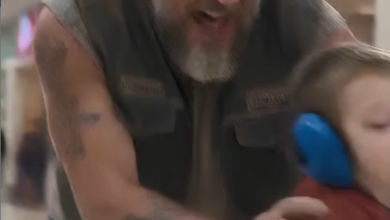
I was fifty-eight that night, broad enough to take up most of the faded armchair outside room 214. My gray beard reached my chest. Rain had darkened the shoulders of my leather vest, and my boots had left two muddy prints on the carpet before I thought to wipe them. To anybody coming off the elevator, I looked like a man waiting for trouble.
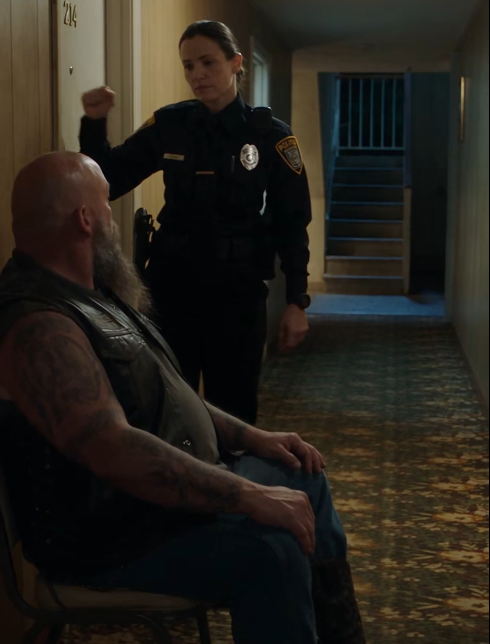
The officer saw the chair. Then he saw the door I faced.
“Sir,” he said, “step away from that room.”
My name is Ray Dawson. Most people at my garage called me Hammer, though I hadn’t earned the nickname for anything I was proud of. I’d learned long ago what my size did to a room. When a uniformed officer told me to move, I usually moved first and explained afterward.
But the woman behind that door had a seven-year-old son, one suitcase, and a reason she’d asked me not to leave her alone yet.
“I’m not trying to get in,” I said. “Could you ask her if she wants me here?”
“We received a complaint about a man sitting outside a guest’s room and watching everyone who passed. Stand up.”
Across the hall, somebody eased a door shut. At the far end of the corridor, the stairwell latch clicked again.
I kept my hands where the officer could see them.
“I’ll stand,” I said, “but please check on her first.”
His partner came around the corner, a woman with a rain-speckled jacket and her hair pulled tight beneath her cap. She looked from me to the closed door. I could almost hear the conclusion forming: large stranger, young mother, late hour, nowhere for her to go without passing him.
It was a reasonable thing to worry about. That made it harder to explain quickly.
Earlier that evening, the boy had fallen asleep on top of the bedspread with his shoes still on. His mother, Lena, had tried twice to ask whether I could stay outside for another hour. Both times she stopped halfway through, as if the request embarrassed her. Finally she said, “I don’t need you to do anything. I just need to know if someone comes.”
So I’d sat where I could see the stairwell and the elevator. I had not asked for a room key. I had not asked what name she’d used at check-in. When the vending machine rattled behind me, I nearly jumped out of the chair.
Now the officer held his hand toward me. “Sir. Up.”
I stood slowly. My knees complained. He moved between me and room 214, and his partner went to knock.
Before she could, a small sound came from inside: three taps on the door, close together, followed by a pause.
The boy. He and Lena had worked out that signal while I waited downstairs for my coffee. I had heard them practice it. He was meant to use it if he woke and couldn’t find her.
The officer’s partner glanced at me. I said, “There’s a child in there.”
She knocked and identified herself. Lena answered through the door, but I couldn’t make out the words. Then the chain shifted, and the door opened a few inches.
I saw only part of her face. She looked first at the officers, then past them toward the stairwell. Her eyes moved to the empty chair.
“He didn’t bother us,” she said. “I asked him to stay.”
The first officer turned his head toward me. Before either of us could answer, footsteps sounded behind the stairwell door, and Lena’s fingers tightened around the edge of hers.
“He told me,” she whispered, “he’d find us tonight.”
The stairwell handle began to turn.
Part 2
The person coming through the stairwell was a housekeeper carrying clean towels. She stopped at the sight of two officers and a biker in the hallway, then apologized though she had done nothing wrong. Lena shut her door while the officers spoke with her. I walked with the housekeeper to the elevator because she looked as though she would rather take the stairs down.
It would have made a neater story if the man Lena feared had appeared right then. He didn’t. For the next hour, the danger was a possibility sitting in all our heads, while the hotel ice machine thumped and somebody watched a game show two rooms away.
I had met Lena less than six hours earlier at a gas station off Interstate 40, west of Knoxville. I’d stopped there after a long ride, planning to buy coffee and call my sister. Lena’s little boy stood beside an air pump, holding a stuffed dog by one ear. She was trying to put air in a tire while reading instructions on her phone, though the tire wasn’t flat.
She kept looking toward the road.
I asked if she needed help, keeping several feet between us. She said she didn’t. Then her son, Miles, said, “Mom, it’s that tire again.” She gave him a look and thanked me anyway.
There was nothing wrong with the tire. The car had been making a noise she didn’t recognize, and she’d stopped because she couldn’t make herself keep driving. I told her I worked on cars and could listen if she wanted. She took a moment before saying yes. The noise turned out to be a loose plastic panel beneath the front bumper. I secured it enough for a short drive and told her to have a shop inspect it.
She offered me nine dollars from the cup holder. I said the coffee she’d already bought me was plenty.
That should have been the end of it.
While I washed my hands at the station sink, Miles asked his mother whether his dad knew which highway they’d taken. She told him to let her worry about the driving. Her voice was calm, but she gripped the paper coffee cup hard enough to bend its rim.
I knew that kind of calm. When I was nine, my mother used it at grocery counters and in school offices while she worked out where we could spend the night. My father could be charming in public. At home, we learned to listen for his truck before we opened the back door.
I didn’t tell Lena any of that. I asked whether she had someone she trusted to call.
“My cousin’s expecting us tomorrow,” she said. “I just need to get through tonight.”
I gave her the number of a local family-support service I knew from a charity ride, and I called it on my own phone to make sure someone answered. Lena took the call herself. The person on the line talked her through options I couldn’t give her. I stepped away and helped Miles untangle the stuffed dog’s ear from his coat zipper.
When she finished, Lena said she would book a hotel for the night and make more calls from there. She asked whether I knew a place with a staffed front desk and somewhere to park near the entrance. I did.
I rode behind her car, far enough back that she could choose to turn elsewhere. At the hotel I waited in the lobby while she checked in. She asked me to stay until she and Miles got settled. I helped carry one suitcase upstairs, left it inside the doorway, and turned to go.
Lena looked down the corridor. “Could you sit out here for a bit?”
I said yes before I knew how long a bit might be.
I called Boone, a friend from the club, and told him where I was. “If I miss breakfast,” I said, “don’t come looking for me with twelve motorcycles.”
“What do you need?” he asked.
“Maybe somebody to take my morning appointments.”
“I can do that.”
Boone didn’t ask for Lena’s story. He knew enough to leave it hers.
Part 3
After the officers spoke with Lena, they asked me to wait downstairs while they checked the hotel entrances and talked to the desk clerk. I wanted to argue. Lena’s door was upstairs, and I had told her I would be near it.
The woman officer, whose name was Alvarez, stopped me before I got far.
“She knows where you’re going,” Alvarez said. “She asked us to help.”
That settled it. Lena had asked them, and I went downstairs.
In the lobby, a young clerk named Priya tried to explain the complaint. Another guest had seen me outside room 214 twice. The first time, I was bringing Lena bottled water. The second, I’d returned from moving my motorcycle under the awning. I’d stood there looking down both ends of the hall before sitting again.
“I’m glad they called,” I told Priya. “I’d have wondered, too.”
She looked relieved and still shaken. From her desk, she could see the sliding front doors, the elevator, and my wet helmet on the floor beside me. It was almost midnight. Every new arrival made her look up.
Alvarez came down a few minutes later. She had spoken with Lena privately and asked whether Lena had reported what was happening. Lena had made one call earlier in the week, Alvarez said, but she had more to tell them now. Another officer was coming to take her statement.
I had a dozen questions. I asked none of them.
“Is Miles awake?” I said.
“He is. His mother’s with him.”
I nodded and sat back. The lobby chair had a wooden frame that pressed into my shoulders. Rain ticked against the front windows. Priya set a cup of water on the desk within my reach and went to answer the phone.
Through the receiver, I heard only her side. “Yes, this is the front desk… No, I can’t give out guest information.” She glanced at Alvarez, who came over and quietly took note of the call.
That was when the waiting changed shape.
The caller did not get a room number. He didn’t get confirmation that Lena was there. Priya ended the call, and Alvarez stepped aside to speak into her radio. I stayed seated because getting up would help nobody.
My phone buzzed. Boone.
I covered your eight o’clock.
I typed a thank-you and stared at the screen. I wanted to tell him to come sit with me, but there was already one too many people in this story who had decided he belonged outside a woman’s door. Adding another biker to the lobby might make it harder for Lena to feel she could choose for herself.
A few minutes later, Lena came down with Miles and one of the officers. She had her suitcase; he held the stuffed dog. He leaned against her leg while she spoke to Alvarez.
She told me they had arranged somewhere else for the night. She wanted to leave, but she didn’t want me riding behind them. “He knows your bike now,” she said.
I thought of the gas station forecourt. She was right. My Harley had been parked beside her car under bright lights.
“All right,” I said.
For the first time since we met, she looked straight at me without checking the road behind my shoulder.
“I’m sorry they thought you were following us.”
“They were checking on you. Let them.”
Miles held up the dog. Its ear was free of the zipper, but the seam had split. “You said you knew how to fix things.”
“Some things,” I said. “That one needs a needle.”
“I have one at my cousin’s.”
“Then your cousin’s the person to ask.”
He seemed to accept that. Lena rested a hand on his shoulder. Alvarez went to check where their ride should pull in, and Priya brought a small umbrella from behind the desk.
For a moment I thought the hardest part of the night was over. Then Lena’s phone lit up on the desk. She read what appeared there and put it down as if it had become hot.
“He’s outside,” she said.
Part 4
We could see a dark pickup across the wet parking lot. It was parked beyond the lights, near the road. I could not make out who was driving, and I had no reason to pretend I could.
Alvarez told Lena and Miles to remain inside with the other officer. She went toward the entrance, speaking into her radio. Priya locked the lobby door after she stepped out.
I stood because Miles was watching me. Then I realized he was watching to see what I would do next.
My first thought was ugly and familiar: go out there, make the man understand he could not walk into this lobby. I had spent enough of my younger years settling fear with my hands. It had never made a frightened house feel safe for long.
So I stayed beside the chairs.
Miles sat with his dog in his lap. Lena stood near him, her phone still on the desk. I asked Priya whether she had a sewing kit. She found a small one kept for loose uniform buttons, and I held it out to Lena. She looked at it, then at me.
“Would you mind?” she asked.
I sat on the carpet a few feet from Miles and repaired the dog’s ear while the officers worked outside. My fingers were too big for the tiny needle. The stitches came out uneven. Miles watched every one.
Through the windows, I saw Alvarez approach the pickup while another officer stood farther back. The driver’s door opened. A man got out. I recognized him from a photograph Lena had shown Alvarez upstairs, but I kept my mouth shut and my eyes on the thread.
He spoke with Alvarez. His arms moved as he talked. Once he pointed toward the hotel. She moved so she remained between him and the entrance. I couldn’t hear a word through the glass.
Lena’s breathing had gone shallow. I set the dog beside Miles and said, “Want to move where you can’t see the lot?”
She nodded. Priya led them into the breakfast room, away from the windows. I stayed in the lobby, where an officer could see me if they needed anything.
The man outside did not come in. After a while, he got back in the pickup, and an officer remained nearby until it left the lot. Alvarez returned wet and tired. She did not tell me everything he had said. She owed that account to Lena, not to me.
“The ride we arranged is using a different pickup point,” Alvarez said. “Ms. Porter and her son can wait inside until it arrives.”
I asked whether Lena needed anything from me.
“She’ll let us know.”
There was a time that answer would have stung. I would have heard it as a dismissal. That night it sounded like the right order of things: Lena deciding what happened to Lena.
I took my helmet from the floor. As I passed the breakfast room, I saw her through the open door. Miles was asleep against her side, his repaired dog beneath his chin. She raised one hand to show she’d seen me. I raised mine and kept walking.
Outside, my motorcycle seat was soaked. I dried it with the end of a towel Boone kept in my saddlebag. The pickup was gone, though I checked twice before starting the engine.
I made it three blocks before I pulled into a closed pharmacy lot. My hands were trembling too hard to ride well. I shut the engine off and called my sister, Emily.
“Ray?” she said. “It’s late.”
“I know.”
I told her I’d met a woman and her little boy. I told her about the hotel chair and the officers and a dark pickup. When I ran out of words, she waited.
Then she said, “You sound like Mom after we got to Aunt June’s.”
Emily had been six the night our mother drove us out of the house. I remembered her asleep in the back seat with her shoes on. Emily remembered our mother holding the steering wheel after we arrived, unable to make herself turn off the car.
“I was thinking about that night,” I said.
“I figured.”
We stayed on the phone while the pharmacy sign hummed above me. I didn’t tell Emily I’d saved anyone. I wasn’t sure what would happen to Lena tomorrow. For that one night, the officers had kept the man outside, and Lena and Miles had been able to leave without passing him.
Part 5
Boone opened the garage the next morning. By the time I arrived, he had taken two appointments and misplaced the same socket wrench three times. He looked at my face, handed me coffee, and asked whether the family was safe.
“They got somewhere for the night,” I said. “That’s all I know.”
“Enough for this morning.”
He was right. It was also hard to live with.
For several days I heard nothing. I did not call the hotel for Lena’s forwarding information. I did not ask Alvarez for an update. I worked on a delivery van, paid my electric bill, and found the socket Boone had left under a rag. Ordinary things kept needing to be done.
On Thursday, the family-support service called. Lena had given them permission to pass along a message. She and Miles were with her cousin, and she wanted to thank me for staying at the hotel. She did not leave an address. I was glad the person on the phone didn’t offer one.
A week later, Lena called me herself.
She had taken time off work to make appointments. She had spoken with an advocate about what she wanted to do next, and she had arranged for Miles to talk with someone who worked with children. Her voice still tired easily, but it steadied when she spoke about him.
“He thinks you can repair any stuffed animal,” she said.
“That’s going to disappoint him.”
“He knows the ear’s crooked. He likes showing people.”
I leaned against my workbench and pictured Miles inspecting my stitches under better light.
Lena paused. “I thought you might wonder why I asked you to sit outside.”
“You don’t have to explain.”
“I know. I want to.”
She told me that, at home, her husband had sometimes waited outside a closed door until she came out to speak with him. If she asked him to leave her alone, he would sit nearby where she could see his boots beneath the door. At the hotel she had tried locking the room, putting Miles to bed, and telling herself they were far enough away. Then she heard someone in the corridor and could not stop listening for the next footstep.
“I asked you because you stayed downstairs when I asked,” she said. “And you went to the car for my bag without asking which room was mine.”
I looked at the workbench. A bolt lay in a shallow tray beside my coffee. I picked it up and turned it between my fingers.
“You could have asked the front desk,” I said.
“I did. Priya checked the hallway when she could. She had the whole hotel to look after.”
She was quiet for a moment.
“I knew you would leave if I told you to.”
That was the part I carried longest. She trusted me to go, which made it possible for her to ask me to stay.
I told her I was glad she had called. She said Miles had a question. I heard her ask if he wanted the phone, followed by a scuffle and a small voice close to the receiver.
“Do bikers know how to sew clothes?”
“Only if they learn.”
“Can you teach me the dog ear?”
“If your mom says it’s okay.”
“She does.” He moved the phone away. “Mom, you do, right?”
Lena laughed for the first time I’d heard. We arranged to meet at a library the following Saturday. She chose the place and the time.
Part 6
At the library, Miles brought the dog and three scraps of fabric. Lena brought an old sewing kit that had belonged to her grandmother. We sat at a table near the children’s shelves while he learned to thread a needle. His first stitches were larger than mine and much straighter.
Lena read a magazine nearby. Every so often she looked up. I took care not to make our Saturday into an arrangement she had to keep. Before we left, I asked whether they wanted to meet again. Sometimes she said yes. Once she said no because they had other plans. We met the week after.
Boone heard about the sewing and offered to show Miles how to change a bicycle tire. Lena said he could, provided Miles wore clothes she didn’t mind getting dirty. Boone cleaned a corner of the garage, put out a small chair, and spent forty minutes explaining a valve cap to a boy who mainly wanted to work the pump.
Nobody called the club in. Nobody lined motorcycles outside the library. A child getting through a difficult year was not an event we needed to stage.
There were hard afternoons. Miles stopped enjoying one visit after a truck that looked like his father’s drove past the garage. Lena came to pick him up, and I walked them to her car. She thanked Boone; Miles kept both hands around his dog. I did not ask when they would be back.
My sister Emily visited later that month. She had brought a photograph she found while sorting a box at her house: our mother and the two of us outside Aunt June’s kitchen. Emily was holding a piece of toast. I was standing close to the car, looking as though I expected us to get back in.
“I thought you might want it,” she said.
I set it beside my tools. “Do you remember who took it?”
“Aunt June. Mom had finally agreed to breakfast.”
I studied our mother’s face. She looked worn out. One hand rested on Emily’s shoulder; the other held a mug she hadn’t lifted to drink.
For years I had remembered that night as a drive: the hurried bag, the road, the sound of tires in rain. Emily remembered the kitchen afterward. She remembered Aunt June warming towels in the dryer because our coats were wet. She remembered our mother sitting down to eat only after she saw both of us begin.
I called Aunt June that evening. She was eighty-four and still impatient with long introductions.
“You’re thinking about the night your mom came here,” she said after I asked about the photograph.
“Yes.”
“You kids slept in my room. She stayed up half the night.”
“Was she waiting for him?”
“She was listening for you.”
After the call, I took the photograph home and propped it on the shelf above my work boots. I had spent much of my life trying to be the person who could stop someone at the door. The photograph reminded me that our mother had also needed a chair, a towel, and time before she could sleep.
Lena still made the decisions for herself and Miles. When she asked for a ride to an appointment because her car was in the shop, I drove. When she said she could manage, I believed her. Once she asked me to wait while she went inside an office; I stayed in the car and finished a crossword badly. She came out with a folder under her arm and asked if I wanted coffee.
I did. We drank it sitting on a bench beside the parking lot. We spoke about Miles’s latest attempt to sew a cape for his dog, and she told me no more about the appointment than she wanted to.
Part 7
By spring, Miles had outgrown the jacket he wore at the gas station. He still carried the stuffed dog on long drives, though most days it stayed on his bed. One Saturday he brought it to the garage for another repair: this time a paw had come loose.
“You’re getting better than me,” I told him.
“I know,” he said, and took the needle out of my hand.
Lena sat by the open garage door with coffee. Outside, traffic moved along the service road. Boone was working on a motorcycle nearby, its engine occasionally drowning out our talk. When it went quiet, I could hear Miles pulling thread through the dog’s worn fabric.
He finished and held up the paw. The stitching showed. It would probably hold.
Lena looked at the dog, then at me. “He’s been asking about the hotel.”
“What does he want to know?”
“Why you stayed outside.”
I had no answer ready for a seven-year-old. Miles spoke before I found one.
“Mom says she asked you to.”
“That’s right.”
“But the police thought you weren’t supposed to be there.”
“They checked with your mom.”
He considered that. “Good.”
Then he put the dog on the table and asked Boone whether the motorcycle would start again. Boone turned the key, and the engine settled into a rough, familiar idle.
Later, after they left, I shut the garage and went home. The photograph of my mother was still above my boots. I looked at it while taking off my vest. Aunt June’s kitchen window was behind us in the picture, bright enough to show someone had been awake inside.
That night at the hotel, an officer had told me to leave a hallway. I understood why. If a stranger had been sitting outside Emily’s door, I would have wanted someone to ask questions, too. What mattered was that the officers asked Lena, listened to her answer, and stayed when the man she feared appeared.
I still thought about the armchair outside room 214. It was ugly, its stuffing pushed flat by years of tired guests. Lena had chosen it because she could see it through the peephole. I had sat there until help arrived, and then I’d moved so she could leave on her own terms.
On my next visit, Miles showed me the dog’s paw. The seam was holding. He asked if we could work on a bicycle tire after lunch, and Lena said they had time.
Boone rolled a wheel toward the workbench. Miles set the dog in a clean spot where it could watch. I pulled up a chair for Lena; she sat, took a sip of coffee, and watched her son begin.
Follow our page for more biker stories about the people who stay, the doors that open, and the lives quietly carried forward.