A Ten-Year-Old Carried an Oversized Helmet Into a Biker Diner—Then Told a Grieving Father His Son Had Left It Behind
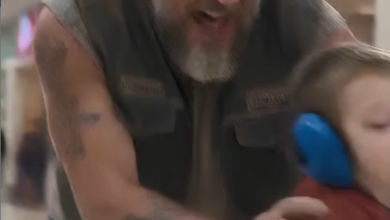
A ten-year-old boy carried a motorcycle helmet nearly as wide as his chest into our diner, set it in front of me, and said, “Mom said this belonged to your son.” I knew the dent above the visor before I could make myself look at the boy.
The Saturday breakfast crowd went quiet in pieces. First Boone stopped talking. Then the waitress paused with a coffeepot over somebody’s cup. A few riders at the counter turned on their stools.
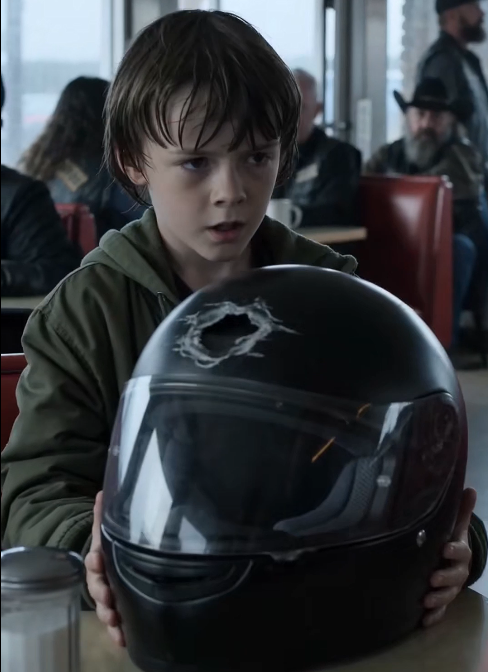
The boy stood between two tables, holding his arms away from his sides after carrying the weight of the helmet. He wore a green jacket with one cuff folded back and had rain in his hair. Behind him, a woman about thirty-five came through the diner door and stopped close enough that he could reach her if he wanted.
My name is Ray Dawson. I was fifty-nine, six-foot-four, with a long gray beard and hands that had spent forty years inside engines. People who didn’t know me usually looked at my leather vest before they looked at my face. The boy had walked straight past twelve men dressed much like me and chosen the right one.
I had not seen that helmet in four years.
There were others like it, of course: black touring helmets with a narrow silver stripe. This one had a shallow dent above the left side of the visor, made when my son Jonah dropped it onto my garage floor at seventeen. He had been furious with himself until I showed him the mark I’d put in my own helmet the week I bought it.
The dent was still there. So was the crooked blue star stuck to the back, its edges lifting from years of being handled.
“Where did you get this?” I asked.
The boy glanced over his shoulder. His mother came beside him but let him answer.
“It was at our workshop.”
I looked at her, waiting for the rest. She held a canvas tote against her coat and looked as though she had rehearsed what she might say on the drive over. Then she saw my face and lost her place.
“I’m April Mercer,” she said. “Jonah spent time with us.”
Four years earlier, after Jonah died, people had told me things like that. He’d helped at a food pantry. He’d fixed a neighbor’s porch step. He’d stayed late when someone needed a ride. I listened, thanked them, and went back to opening the garage every morning. If I let every story in, I was afraid I would never get through a day’s work again.
But a stranger had brought his helmet.
Boone pulled out the empty chair beside me. The boy did not sit. He kept looking at the helmet, then at my hands, as if he wanted to make sure I understood he hadn’t damaged it.
“I carried it carefully,” he said.
“I can see that.”
“He used to put it on the top shelf so I couldn’t reach it.”
The woman’s expression changed. “Ben.”
“It’s true, Mom.”
“I know it is.”
I touched the blue star with one finger. Its paper had been covered in clear tape. A child had cut it by hand; one point was shorter than the others. Jonah would never have put a star like that on his helmet for himself.
“Did you make this?” I asked Ben.
He nodded. “When I was little.”
He was ten now. I tried to work out how old he had been when Jonah died, and the effort made the diner feel strangely loud again: dishes clinking behind the counter, rain ticking against the windows, a Harley outside trying twice before its engine caught.
April said they had found the helmet while clearing a storage room. She had wanted to call first, but Ben had asked to bring it himself. She’d checked with Boone that I would be at breakfast. Boone met my eyes briefly; he had known someone was coming, though not what they carried.
I wanted to ask April why Jonah had left the helmet there. I wanted to know why she had kept it and why Ben knew him well enough to speak about the top shelf. Instead, I looked at the boy.
“Did he ride with you?”
“No. He said I was too young.”
That sounded like my son.
Ben finally took the chair Boone offered. His shoes didn’t quite reach the floor. April remained standing until I asked her to sit, too. Nobody at our table touched breakfast.
From her tote, April took a photograph and laid it facedown beside the helmet. She left her hand over it.
“There’s something I’d like you to see,” she said. “Jonah kept asking you to come by. I don’t think you ever knew what he wanted to show you.”
I remembered every invitation I had postponed. I looked at the photograph beneath her hand, but I couldn’t reach for it yet.
Part 2
Jonah was twenty-seven when he died. People often said he had my eyes, though that wasn’t what I saw when I looked at him. I saw his mother’s habit of listening all the way to the end of a sentence, and the careful way he set a tool down before telling someone they’d made a mistake.
His mother, Beth, had died when Jonah was nineteen. For a while after that, he and I kept our household running through lists on the refrigerator. He studied, worked part-time, and helped at the garage whenever I was short-handed. I made dinner badly. We were kind to each other in the practical ways we knew.
By his mid-twenties, I expected he would come into the business with me. He knew the work. Customers asked for him by name, and Boone used to joke that Jonah could hear a loose bracket from across the parking lot. I had never asked whether he wanted the garage to become his life.
When he told me he’d taken a job coordinating a small community repair workshop, I said, “You’ll come back when they run out of money.”
He looked at me over the kitchen table. “Maybe. I want to try it.”
I could have asked what the workshop did, who worked there, or why it mattered to him. Instead, I told him what my accountant thought about nonprofit budgets. He finished his coffee and went to work. That was the shape of many of our disagreements: nothing loud enough to apologize for, but plenty left sitting between us.
We still saw each other. He came to my place to borrow a ladder, and I went to his apartment when his truck needed a battery. Once he invited me to an open house at the workshop. I had a customer’s transmission in pieces and said I’d come next time.
There was a next time. I was busy then, too.
At the diner, April turned over the photograph. It showed Jonah kneeling beside a small bicycle with its chain hanging loose. Ben, perhaps six in the picture, stood nearby holding a flashlight in both hands. Neither was looking at the camera. Jonah was pointing toward the rear wheel, and Ben looked determined to see what he saw.
I put my thumb along the white border. “That’s him.”
“Yes,” April said.
“How long did he work with your boy?”
“Almost a year and a half.”
Ben corrected her. “Twenty months.”
April smiled. “Twenty months.”
The waitress brought fresh coffee and a glass of milk. She placed them down gently, then asked whether we wanted anything else. Ben wanted toast. April started to say they had eaten, but he looked hungry, so I ordered enough for all of us.
I could have left the table with the helmet and photograph. They had returned something that belonged to my family, and I had every right to take it home. Boone would have walked out with me and kept anyone from following.
I stayed because Ben had carried it in himself.
He told me Jonah did not allow children to use the power tools. He made them sort washers and nuts into jars, hold flashlights, and learn how to tell when a tire needed air. Ben thought sorting was boring. Jonah had told him that getting bored and paying attention at the same time was a useful skill.
“He said that?” I asked.
“Something like that,” April said.
Jonah said something like that at my garage when he was younger. I had forgotten until Ben spoke.
April explained that her family had started going to the workshop after Ben’s bicycle was damaged. At first they went for the bike. Later Ben went for the Saturday sessions, where volunteers taught children to maintain their own bicycles and helped adults with basic repairs they could do safely at home. April worked shifts at a grocery store nearby; the workshop gave them a place to go together on her afternoons off.
“Jonah ran the sessions?” I asked.
“He helped organize them. We had other volunteers, too.”
There was a restraint in the way she spoke about him. She knew I might want to hear that my son had been extraordinary. She was telling me what she had seen instead.
Ben ate his toast. Halfway through the second slice, he looked up.
“He asked me to make the star,” he said. “He said he’d know his helmet from everyone else’s.”
Part 3
After breakfast, I asked April if I could see the workshop. She said they were going there anyway to finish clearing out a storage room. The program was moving to a smaller space across town, and they had to leave the old building by the end of the month.
Boone offered to ride along. I asked him to come but to keep breakfast private.
“I know,” he said.
“I’m saying it anyway.”
He nodded. Our club had held fundraisers for years, and sometimes a man got so pleased with his own generosity that he forgot other people had to live with the attention. April had brought Ben to meet me. She had not brought him to meet everyone who followed our page.
The workshop stood behind a bus stop on an older stretch of Kingston Pike. I had passed it hundreds of times on my Harley. From the road, all I remembered was a low brick building and a mural painted on one wall. Jonah had pointed it out once while I drove him to pick up his truck. I’d been watching traffic and told him I would visit another day.
Inside, the room smelled of rubber, coffee, and the dust that settles on shelves no one has time to clean. Bicycle frames hung from hooks. A volunteer named Rosa was sorting supplies into plastic bins. She greeted April and Ben, then looked at me with open curiosity.
“This is Jonah’s dad,” April said.
Rosa set down the roll of tape in her hand. “Ray. I’m glad you came.”
That was all. She didn’t lead me to a wall of photographs or begin listing reasons to be proud. She showed April a box that still needed checking and asked Ben whether he wanted to help count reflectors.
I stood near the workbench while people got on with their morning.
Jonah would have liked that. He hated being introduced as the best mechanic in a room, even when he probably was. He would have liked Rosa more for asking him to carry a box.
April showed me the high shelf where the helmet had stayed. Jonah rode his motorcycle to the workshop, then put the helmet up there while he worked. In the months before he died, he began driving his truck more often. He’d left the helmet behind after one Saturday session, intending to collect it the next week.
He never did. A sudden illness took him within days. I had been there at the hospital; April had learned the news from another volunteer.
I stood beneath the shelf and pictured him reaching up to put it away. I knew how he held the helmet, one hand beneath the chin guard, the other clearing a space among the boxes. I had watched him do it in my garage since he was old enough to ride.
For four years, I had wondered where the helmet went. I had searched his apartment, then stopped searching when everything I found belonged to a life he couldn’t come back to finish. April had kept it at the workshop because it was one of the places he belonged. She’d planned to bring it to me sooner, but the first year passed in a blur of changes. After that, she worried a stranger arriving with his things would hurt more than help.
“I could have called,” she said.
“You didn’t know me.”
“I knew he talked about you.”
I turned toward her. “What did he say?”
She glanced at Ben, who was kneeling with Rosa beside a bin. “He said you could fix anything with moving parts. He wished you’d come here and show the kids.”
I looked at a workbench crowded with hand tools. My son had asked me to visit more than once. I had treated each invitation as something I could accept whenever the garage slowed down.
Boone came in from the truck carrying two empty boxes. He saw my expression and put them near Rosa without asking me to help. I was grateful to him for that.
April picked up a small bicycle wheel from the workbench. “Ben’s first day, this was the sort of thing Jonah taught him to inspect. The kid wanted somebody to hand him a new bike. Jonah told him they could see whether the old one was worth fixing first.”
Ben heard his name and came over. “It was.”
“You still have it?” I asked.
“I grew out of it. We gave it to my cousin.”
He said that easily. Jonah’s work had gone on being used after he was gone. I looked around the room again, at the jars of washers and the pencil marks on the edge of the table where somebody had measured a frame.
I thought April had brought me to see my son’s old workplace. I hadn’t yet understood why Ben had insisted on bringing the helmet himself.
Part 4
When Rosa took Ben to help carry a box to the front room, April asked me to sit. She pulled out the chair Jonah used to occupy during Saturday planning meetings. I knew it was his because one leg had a block of wood screwed beneath it, a repair so plain he would have been satisfied to leave it showing.
“Ben remembers him well,” she said. “Some days better than I expected.”
“He was six when Jonah died.”
“Yes.”
She took a breath. “I want to be careful about how I tell you this. Jonah meant a lot to us. I’m not saying he changed our entire lives in twenty months.”
I waited.
“When we came here, Ben’s father and I had just separated. We were working out how to share time with Ben, and he was angry with both of us. He didn’t want a new bike after his was damaged. He wanted the old one because his dad had taught him to ride it.”
April rubbed at a mark on the tabletop. She told me Ben’s father was still part of his life. Both parents had wanted to help, but Ben had stopped talking much to either of them about the changes at home. At the workshop, Jonah gave him small jobs. He let Ben be angry about a stuck bolt without telling him to calm down about everything else.
One afternoon, after Ben’s dad collected him early, Jonah told April that children often heard grown-ups speak as if a family were a machine. If it changed shape, people started talking about what had broken. He said Ben didn’t need anyone there to repair his family. He needed a place where he could still be himself.
I sat very still. That was the sort of distinction Jonah made, and the sort I usually missed.
“Ben came back because he liked Jonah,” April said. “Not because Jonah replaced anybody.”
She was right to tell me. I might have made the boy into proof of everything good about my son, then expected him to keep proving it. Ben was a child with two parents, school, friends, and his own reasons for coming to the workshop. He had not carried the helmet into the diner to become part of my grief.
“Why did he want to bring it?” I asked.
April reached into her tote and took out a folded sheet of paper.
It was a photograph of an older drawing, copied before the original went into a scrapbook. I unfolded it. Two motorcycles stood side by side beneath an enormous blue star. One rider had a gray beard. The other had brown hair. Between them stood a smaller figure holding a bicycle.
There was no name written beside the bearded rider. I didn’t need one.
“Ben made it near the end of that summer,” April said. “Jonah asked who the other biker was. Ben said, ‘Your dad, when he finally visits.’”
I stared at the drawing.
Jonah had taped the original beside the door for several weeks. April showed me a photograph on her phone: workshop volunteers preparing chairs, Ben’s drawing visible behind them. There was no secret letter tucked in the helmet and no message from Jonah composed with the knowledge that he would die. There was just a place he thought I might come.
“He wasn’t angry you didn’t make it,” April said.
“He should have been.”
“I can’t tell you what he felt about every missed Saturday.”
She did not soften it for me. I appreciated that, though I had to look away.
When Ben returned, he saw the drawing in my hand. “Mom showed you.”
“She did.”
He pulled out the chair across from me. “I used to ask if you were coming.”
“I know that now.”
“Jonah said you had a lot of work.”
“I did.”
Ben waited. Children can make a silence difficult without meaning to. I had enough reasons for missing those Saturdays. None of them changed the empty chair Jonah kept expecting me to fill.
“I wish I’d come,” I said.
Ben nodded as if that answer made sense. Then he looked toward the front room, where Rosa was stacking boxes for the move.
“That’s why I brought the helmet,” he said. “If I gave it to Mom, she would’ve mailed it. I wanted you to see where we kept it.”
Part 5
I stayed through the afternoon and helped move shelves. It was work I understood, which was a relief after talking. Boone drove back to the garage for a dolly, and Rosa put me in charge of removing the wall hooks. Ben followed with a jar for the screws.
I kept finding traces of Jonah without anyone pointing them out. A pencil line marking the height of a shelf. A chair repaired with one leg a different color from the others. A stubborn nut placed in a dish instead of a jar because Jonah always meant to find out why it wouldn’t fit.
At one point I picked up a chipped green mug. April said he used to drink coffee from it, then went back to packing. I wrapped it in newspaper and put it with the dishes going to the new place.
The workshop’s move was not a crisis waiting for me to solve. April showed me the smaller building’s floor plan and the budget they had already worked out. They needed volunteers for the heavy jobs, and a few tools would have to be shared until they could afford more. They had people helping.
I asked whether my garage could loan them a workbench.
“Possibly,” she said. “Rosa’s planning the layout.”
I liked that she sent me to Rosa rather than letting my offer become an instruction. Rosa measured the workbench with Boone the following Monday and decided it would fit if we shortened one end. We did the work after closing, with Ben’s father, Daniel, joining us to help carry it.
Daniel shook my hand and thanked me for coming. He already knew Jonah had been part of Ben’s Saturdays. We talked about the weight of the bench and the narrow doorway at the new site. There was no awkward claim for either of us to make over Ben; the boy was outside with April, trying to decide which color to paint a small wooden tool rack.
Boone caught me looking toward them.
“You all right?” he asked.
“I think so.”
He nodded. “We can stop when they’re ready for us to stop.”
Boone and Jonah had got along, though they disagreed over how to organize tools. Later, when I asked Boone why he hadn’t told me more about the workshop after Jonah died, he said he had tried once. I remembered the day. We’d been closing the garage, and I’d told him I didn’t want a tour of my son’s other life.
“I should’ve asked again,” he said.
“I could’ve asked once.”
We left it there. There were four years between those sentences, and neither of us could use the other to erase them.
The helmet came home with me after the move. I set it on a shelf beside mine. Its dent faced outward; Ben’s blue star faced the garage door. I did not clean off the lifting edge of tape. I didn’t put it on or offer it to a rider. It was an old helmet that had been dropped and stored for years. It belonged on the shelf.
Sometimes a customer saw it and asked whose it was. At first I said, “My son’s.” Later I found I could say a little more: “He used to ride over to the repair workshop on Kingston Pike.” Most people only wanted their truck back, and that was fine. I didn’t need them to stand there and listen.
April invited me to the new workshop’s first Saturday session. I checked the garage calendar before answering. Then I asked Rosa whether she actually needed another volunteer.
“Can you teach someone to check a chain?” she asked.
“Yes.”
“Then come at nine. We’ll tell you when to stop.”
I arrived early. Ben opened the door and pointed me toward a bucket of parts. He was busy helping another child sort them by size. For a while, he barely spoke to me.
I found I liked that. He had brought the helmet because he wanted to bring me to this place. Now that I was here, he had other things to do.
Part 6
I began going to the workshop one Saturday a month. Once, a repair at the garage kept me away, and I called Rosa so she could arrange another volunteer. The following month I returned. Ben greeted me, asked where I had been, and went back to the bicycle he was working on.
I got to know him in pieces. He disliked being corrected in front of other children. He liked drawing maps of routes he might someday ride on his bicycle. He called Boone “the guy who loses sockets” after hearing that story exactly once. He never asked me to talk about Jonah unless he had something particular in mind.
One rainy Saturday, he found a photograph from the old workshop while April sorted a box. Jonah was standing behind Ben, who held up a bicycle wheel with both arms. Ben took the photograph to his mother first. Later he brought it to my bench.
“I forgot he was there when we took this,” he said.
“He looks happy.”
“He used to laugh when I got grease on my face.”
I looked at Jonah’s hand in the picture, held close to Ben’s shoulder without touching him. My son was ready to catch the wheel if Ben dropped it. He was also letting Ben hold it.
April asked if I wanted a copy. I said yes. The original went back into her box because it was hers.
By then, the workshop had settled into the smaller building. Children came, grew, and went on to other interests. Adults borrowed a pump or got help making a safe, simple repair. Nobody hung Jonah’s photograph over the door. April and Rosa had a picture of the first group of volunteers in the office, among pictures of later groups.
It took me a while to understand why that felt right. I had feared Jonah would be forgotten if the room changed without him. Instead, people were using the place as he had hoped they would.
On the anniversary of his death, I rode my Harley to the workshop after closing. April knew the date, but I had not told her I would be there. Through the window I saw the empty benches and a few bicycles waiting on hooks. I stayed outside. Then I rode home and sat in my garage beside the two helmets until the engine cooled.
The next year, I went inside. Rosa was still there finishing paperwork. She made coffee, and we talked about a volunteer who was teaching the younger children how to mend punctures. I left before she locked up.
Those evenings became something I could do without asking anyone else to take part. I still visited Jonah’s grave. I still missed the calls I used to get from him on weekday afternoons. I could also go to the place he had tried to show me and recognize the sound of work carrying on.
Part 7
The following spring, Ben turned eleven. He came to the garage with April and Daniel because they wanted help choosing a bicycle that fit him. He had saved some money; his parents would cover the rest. Boone found two used bikes we could inspect together and let Ben decide which one felt right.
He chose the less expensive one. The frame had scratches, but it fit, and he liked the sound the bell made. Daniel loaded it into their car while April went back inside for Ben’s jacket.
Ben stood beside the helmet shelf. “That star’s getting loose.”
“It is.”
“I could make another.”
“You could. I’d like to keep that one.”
He considered it, then took a step back to see the helmet beside mine. “Okay.”
April came out carrying the jacket. Ben put it on and ran to the car, impatient to ride. Daniel closed the trunk, and the three of them waved as they pulled away. Boone went inside to answer the shop phone.
I remained by the open garage door. Jonah’s helmet sat where I had put it, with the dent above the visor and Ben’s uneven star on the back. Beyond it, I could see the road my son used to take toward the workshop.
I couldn’t get back the Saturdays I missed. I had finally gone there, though, and I knew what Jonah had wanted me to see: Ben at a bench, holding a wheel with both hands, learning he could do more than he thought.
I turned off the garage lights and left the door open a little longer. Outside, Ben’s new bicycle bell gave one faint ring as their car turned at the corner.
Follow our page for more biker stories about the people we miss, the promises we can still keep, and the doors we finally walk through.