A 6’6″ Biker Let His Little Girl Braid Bright Beads Into His Beard Before Every Ride—Then Risked His Road-Captain Patch Rather Than Remove Them
Part 2 — Twelve Beads Before Sunrise
I joined the Black River Brotherhood long before Wade Mercer became a father, although the word “father” would eventually turn out to be more complicated than any of us understood.
We first met him in 2007 at a twenty-four-hour truck stop off Interstate 40. I was thirty-two then, newly patched, too loud in my opinions, and still convinced a leather cut made a man larger than the promises he kept outside it. Wade was twenty-nine, already six-foot-six, and working nights for a diesel recovery company that handled wrecked semis between Knoxville and Cookeville.
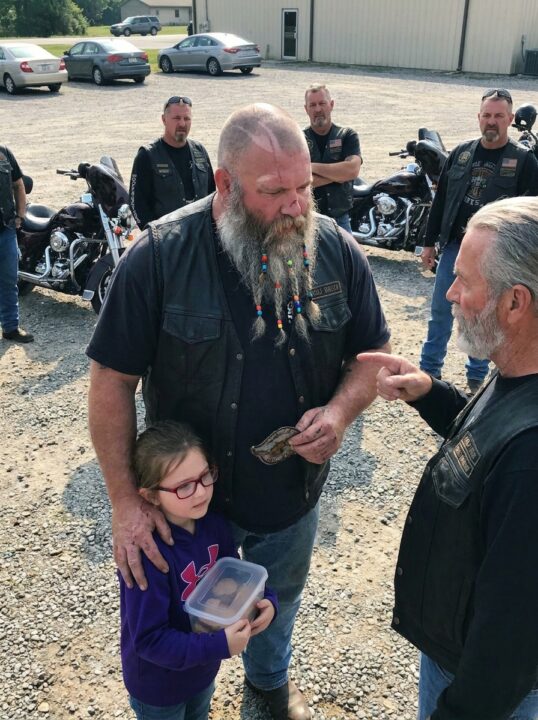
A grain truck had overturned near the exit, leaving corn scattered across both lanes. Three of our riders were stranded behind it with a damaged trailer and no way to move a wrecked Harley before rain arrived.
Wade came in a battered recovery rig that smelled of coffee, hydraulic fluid, and wet canvas. He spoke perhaps fifteen words during the entire job. He lifted what required lifting, secured what required securing, and crawled beneath the trailer while lightning flashed over the highway.
When Boone tried to pay him, Wade shook his head.
“Buy the kid breakfast.”
He pointed toward our youngest prospect, who had not eaten since the previous afternoon because he had spent his last forty dollars on fuel.
That was Wade.
He noticed what a man attempted to hide.
His younger brother, Tommy, was different. Tommy was five-foot-eleven, narrow through the shoulders, quick with jokes, and incapable of entering any room quietly. If Wade was a locked garage, Tommy was a screen door in July. He slapped shoulders, borrowed tools, forgot to return them, and convinced strangers they had known him for years.
They joined our chapter eleven months apart.
Wade earned the name Grizzly after lifting a fallen dresser off an elderly woman during a house fire. Tommy became Sparrow because he talked through every club meeting and somehow ate half the food without gaining weight.
They fought like brothers. They rode like one machine.
Tommy married a waitress named Erin Bell in 2011. Their daughter, Lucy, was born two years later with a tuft of brown hair that refused to lie flat and a grip strong enough to hold Tommy’s little finger through an entire club meeting.
Wade was the first man outside the hospital room.
The nurse asked whether he was the grandfather.
Tommy laughed until his stitches hurt.
From the time Lucy could walk, she followed both brothers through the garage. Wade taught her not to touch exhaust pipes. Tommy taught her to shout “Clear!” before anyone started an engine, even when every motorcycle had been cold for hours.
The purple stool came from a yard sale. Wade shortened two legs so Lucy could use it at his workbench, then cut one too short and refused to admit the mistake. Tommy painted it purple because Lucy had selected that color by smearing a handprint across his shirt in the hardware store.
The beard braiding started as a rainy-day game.
Lucy was four when she watched a cartoon princess braid ribbons into a horse’s mane. Tommy’s reddish-brown beard was long enough to become the obvious substitute. He sat on the purple stool while she pulled, tangled, restarted, and finally attached three oversized plastic beads.
One pink.
One yellow.
One silver.
Tommy rode to the clubhouse with them still hanging beneath his chin.
We destroyed him.
Boone called him Princess Sparrow. Denny, still a hangaround then, offered him a matching handbag. I asked whether he planned to lead our next ride or open a salon beside the interstate.
Tommy laughed with us.
At least I believed he did.
He wore the beads for most of that afternoon, allowing them to click against his helmet strap. Before our evening run, Preacher told him to remove them because a visiting chapter president was coming and the club photographs would circulate online.
Tommy glanced toward Wade.
Wade said nothing.
The beads came out.
That detail would wait six years before returning to all of us.
At the time, Wade had other problems. His fiancée had left because he worked too many nights and spoke too little about what he carried home from highway recoveries. He had pulled bodies from crushed vehicles. He had watched children sit beneath emergency blankets while firefighters cut their parents from wreckage. Rather than explain what the work did to him, he rebuilt engines until sunrise.
Tommy worried.
He gave Wade a key to their house and began sending Lucy to the garage whenever Wade disappeared too deeply into himself.
She brought crayons, crackers, and impossible questions.
Why were bolts different sizes? Could motorcycles get tired? If a beard became long enough, could a bird live in it?
Wade answered each one.
His beard grew because Lucy asked him not to cut it. She said Uncle Wade’s face looked “less mad” when the beard covered his mouth. He never told her that a longer beard usually made strangers fear him more.
Then, on an October afternoon, Erin packed two suitcases and left.
She had been fighting an addiction to prescription pills that began after a back injury. Tommy had hidden the problem from the club, borrowing money and missing rides while he drove Erin to appointments. When she relapsed, she took cash from Lucy’s birthday jar and disappeared with a man she had met through a treatment program.
Tommy unraveled.
Wade moved into the spare bedroom without asking permission. He cooked badly, washed Lucy’s school clothes with shop towels, and slept near the front door because Tommy kept leaving after midnight to search for Erin.
The brotherhood knew almost none of it.
Tommy kept making jokes. Wade kept covering his absences. We saw missed formations, unpaid club dues, and a man who always needed another favor. Resentment grew around facts we did not possess.
That was the first failure.
We judged the shape of the smoke without looking for the fire.
Six weeks after Erin left, Tommy was scheduled to lead a benefit ride for the widow of a county firefighter. He arrived late with Lucy in the passenger seat of Wade’s truck. Her hair was unbrushed. Tommy’s eyes were swollen from lack of sleep.
Lucy had braided his beard that morning.
Not three braids this time.
Twelve.
Each carried a different bead because she had begun assigning colors to the people she loved. Pink was herself. Black was Wade. Red was Tommy. Blue was the house. Green was school. Silver meant home.
Tommy wore them into the clubhouse.
The laughter started again.
Preacher stopped it, but he also repeated the order he had given months earlier.
“Take them out before formation.”
Tommy obeyed.
Wade watched him place all twelve beads inside the pink tackle box. Lucy stood near the doorway. She did not cry or argue. She only asked whether he would put them back before coming home.
Tommy kissed her forehead.
“Before supper, birdie.”
He left the box on Wade’s workbench.
The benefit convoy reached Highway 129 shortly after noon.
Tommy never reached supper.
Part 3 — The Ride That Came Home Without Him
Highway 129 bends through the Tennessee foothills in a way that punishes impatience. Trees crowd the shoulders, rock faces rise beside the pavement, and shadows remain in certain curves long after the rest of the road has dried.
The forecast promised clear weather.
The forecast was wrong.
Rain struck twenty-seven miles into the ride, light at first and then hard enough to polish the asphalt black. Preacher reduced speed. Wade moved nearer to Tommy, who was riding third behind the road captain.
I was six bikes back.
We entered a descending curve near a low stone overlook. A pickup traveling the opposite direction crossed the centerline while its driver looked down at a phone. Preacher moved right. Tommy moved farther right.
There was nowhere else to go.
His Harley struck wet gravel at the shoulder, slid sideways, and disappeared beyond the guardrail.
The convoy stopped in pieces.
Boots hit pavement. Engines died. Someone shouted for an ambulance while Wade climbed over the rail without waiting for the rest of us.
Tommy had landed among small trees thirty feet below the road. His motorcycle lay farther down the slope with the rear wheel turning slowly in the rain. Wade reached him first, braced his neck, and called his name.
Tommy opened his eyes once.
We learned later that his internal injuries were beyond anything Wade could have repaired with pressure, training, or will. Still, Wade held him while rainwater ran through both their beards.
Tommy’s last clear words were not about the pickup.
They were about Lucy.
“Tell her I kept them.”
Wade believed he meant the beads.
He promised.
Tommy died before the rescue team carried him up the slope.
The pink tackle box remained unopened on Wade’s workbench until after the funeral. Lucy sat beside it every afternoon, waiting for someone to explain why her father’s motorcycle had returned in a trailer while he had not.
Erin came back for the burial.
She stayed sober for three days, disappeared again, and sent one message saying she could not raise a child while trying to save herself. Wade became Lucy’s temporary guardian before he had time to understand the phrase.
He moved into Tommy’s house because Lucy refused to sleep anywhere else. He learned to pack lunches, sign school folders, untangle hair, and recognize the difference between the silence of a tired child and the silence of one waiting for another person to vanish.
Lucy stopped speaking eleven days after the funeral.
She could speak physically. Doctors found nothing wrong with her voice. A child therapist explained that grief, fear, and abandonment could make language feel unsafe. Lucy communicated through drawings, nods, and colored cards.
The first card she gave Wade showed a tall black figure beside a smaller pink figure.
Twelve dots hung beneath the tall figure’s face.
Wade understood.
He sat on the purple stool.
Lucy opened the tackle box.
Her hands shook so hard she dropped the comb twice. Wade waited, knees almost level with his shoulders, while she separated his iron-gray beard into small sections.
The first attempt took ninety minutes.
She attached the same twelve beads she had used for Tommy. Wade recognized the scratched pink heart, the green cube, the yellow sun, and the silver bead with a thin cut across one side from where Tommy had tried forcing it over a knot.
When Lucy finished, she pressed both palms against his cheeks.
Then she pointed toward the garage door.
Wade shook his head because he had no ride planned.
Lucy pointed again.
He understood the second time.
She needed him to leave.
More than that, she needed him to return.
Wade put on his cut and rode once around the block. He kept the Harley below thirty miles an hour. Lucy waited on the front steps with her arms locked across her chest.
When his V-twin became audible at the end of the street, she stood.
He parked, shut down the engine, and remained seated while she counted every braid.
All twelve.
The ritual began there.
Before each ride, Lucy braided his beard. When he came home, she counted the beads. Sometimes she removed them before bed. Sometimes she fell asleep against his chest with the plastic shapes pressed between her cheek and the leather cut.
Wade never explained it to us.
For months, he stopped attending club rides. We assumed he had blamed the brotherhood for Tommy’s death. Some men blamed him in return, saying he had abandoned his patch when the club needed him.
The truth was smaller and harder.
Lucy panicked whenever he started the Harley.
The first time he tried joining a formation ride, she locked herself inside the bathroom and did not emerge for four hours. The second time, she vomited beside the garage before he cleared the driveway.
Wade chose her.
He rode only the block, then two miles to the gas station, then a short loop along quiet streets. Lucy’s therapist used those departures to show her that leaving did not always mean loss.
Every time, the braids remained.
Every time, Wade returned with all twelve beads.
Six months after Tommy died, Preacher visited Wade’s garage. He found the largest man in the chapter sitting on the purple stool while Lucy attached a pink butterfly to his beard.
Preacher finally heard the explanation.
He did not tell the rest of us.
Wade had asked him not to.
“She’s not club business,” Wade said.
Preacher accepted that boundary. Yet he made another mistake: he protected Wade’s privacy without challenging the ridicule waiting for him.
When Wade returned to a chapter meeting, the braids drew laughter.
Boone asked whether grief had softened his head. Denny called him a walking jewelry display. I told him he could remove the beads at the clubhouse and replace them before going home.
Wade looked at me for a long moment.
“My kid put them there.”
“That’s fine, brother. We’re just saying—”
“No. You’re saying her work embarrasses you.”
Nobody answered.
Wade walked into the meeting with beads clicking beneath his chin.
He earned the road-captain position two years later. Not through sympathy. None of us knew enough to offer it. He earned it because he remembered every rider’s fuel range, watched every intersection, refused unsafe speeds, and could sense a weak formation before the gap became dangerous.
The beads became part of him.
So did our jokes.
Most were careless rather than cruel, which did not make them harmless. Wade ignored them because fighting each man would have made Lucy’s gift sound like a weakness requiring defense.
He had only one rule.
Nobody touched the braids.
A prospect learned that at a diner outside Sevierville when he reached across the table and tugged a yellow bead. Wade trapped the man’s hand against the tabletop.
The coffee cups rattled.
“Her hands made that.”
The prospect apologized.
Wade released him.
That was the end of it.
Years passed, and the reason behind the ritual faded beneath habit. New members assumed Lucy simply enjoyed decorating her father. Older members avoided explaining what little they knew. Tommy’s death became a framed photograph, an annual ride, and a name spoken most often when engines were loud enough to hide the way voices changed.
Then the sixth memorial approached.
Preacher wanted the largest convoy yet. Local officials agreed to close several intersections. Tommy’s former recovery company donated money to a distracted-driving program. Visiting clubs offered support.
A television crew requested footage.
That request changed everything.
One visiting president saw a recent photograph of Wade wearing purple stars and questioned whether the Black River Brotherhood took memorial discipline seriously. Another rider shared the photograph in a private group with a caption about “day-care road captains.”
Preacher felt the chapter’s reputation closing around him.
He told Wade to remove the beads.
Wade refused.
Neither man realized they were standing inside the same mistake that had preceded Tommy’s final ride.
Part 4 — The Patch in Preacher’s Hand
On the morning of the memorial, I arrived at Wade’s garage early because Preacher had asked me to settle the disagreement before the visiting clubs appeared.
Lucy was eight then. She sat cross-legged on the workbench wearing a gray sweatshirt over purple leggings. The pink tackle box rested beside her, its lid divided into compartments filled with beads, elastic ties, ribbon fragments, and one tiny photograph turned facedown.
Wade lowered himself onto the purple stool.
I leaned against a cabinet and watched Lucy work.
Her fingers had become quick. She separated the beard into twelve even sections, twisted each one tightly, then slid a bead into place. Wade did not look at his phone or rush her, though more than a hundred riders were expected at the clubhouse.
The garage smelled of motor oil, laundry detergent, and toast burned in the kitchen.
“Morning, Crow,” Wade said.
Lucy glanced at me.
“Morning.”
She rarely spoke to club members. Her therapist called it selective mutism, but Wade never used the term in front of her. He said Lucy spoke when words felt useful.
I tried humor.
“You making him pretty?”
Her hands stopped.
Wade raised his eyes.
I felt the weight of my mistake before either of them answered.
“I mean—”
“He was already pretty,” Lucy said.
Wade’s mouth moved beneath the beard.
It was the closest I had ever seen him come to smiling during a club dispute.
She finished eleven braids. Before attaching the final silver bead, she held it up to the garage light. A hairline crack ran across the plastic.
“Still good,” Wade told her.
Lucy shook her head.
She opened another compartment, but there was no replacement. The silver bead had belonged to Tommy and was the only original color she had never changed.
Wade took it carefully.
“I can glue it after the ride.”
“Don’t break it.”
“I won’t.”
She threaded it onto the center braid and pressed the elastic tight. Then she counted every one, touching them in order.
Pink. Black. Red. Blue. Green. Yellow. Purple. Orange. White. Brown. Turquoise. Silver.
Wade waited.
“Come back with twelve,” she said.
“Always.”
Outside, Preacher’s engine entered the driveway.
The conversation that followed occurred where Lucy could not hear us, but she watched through the garage window.
Preacher began calmly. He explained the television crew, the visiting clubs, the need for a unified image, and the mockery circulating online. He did not say the beads looked childish. He did not need to.
Wade listened.
Then he said no.
Preacher reminded him that the memorial honored Tommy.
“They’re his beads too,” Wade replied.
I thought he meant only that Tommy had purchased them. I did not yet know Lucy had braided her father’s beard on his final morning.
Preacher’s jaw tightened.
“As president, I’m ordering you to remove them before you lead.”
Wade removed his gloves.
For half a second, I feared he might strike the man.
Instead, he opened his cut, cut the black stitches around the road-captain patch with a pocketknife, and pulled the leather rectangle free.
The sound of thread tearing was quieter than any engine.
It still hurt.
He placed the patch in Preacher’s hand.
“Then I’m not leading.”
Preacher stared at it.
“You’d give up eight years for beads?”
“No.”
Wade glanced through the window at Lucy.
“I’d give up eight years for her hands.”
He turned toward his Harley.
That could have ended the confrontation, but I was still angry. I believed a private ritual had been allowed to overrule duty.
“You can’t build a club around every child’s fear,” I said.
Wade stopped.
Leather creaked across his shoulders as he turned.
“You’re right, Crow. Build it around a grown man’s promise.”
Then he mounted the Harley and rode away with Lucy in my truck beside me, because she had asked to attend the memorial for the first time.
At the clubhouse, the visiting riders stared. Some smiled. Some whispered. Boone announced that Wade had finally lost his patch over a box of children’s jewelry.
Denny laughed.
Lucy heard him.
She moved behind Wade’s leg, gripping the back of his jeans. His hand lowered to her shoulder, covering most of her upper back.
“You afraid?” he asked.
She nodded.
“Me too.”
That answer surprised her.
Wade did not tell her strong people never felt fear. He gave her a fact she could stand beside.
The silver bead vanished ten minutes before departure.
Lucy counted the braids twice, then a third time. Eleven clicked beneath Wade’s chin.
She searched the tackle box. Wade checked his shirt and the inside of his cut. I retraced their path from the parking fence.
Preacher told us kickoff could not be delayed.
Wade knelt in the gravel.
Lucy joined him.
A visiting president named Hatch looked down and laughed. He said the former road captain had become a pet begging beneath a table.
Wade continued searching.
Hatch moved closer.
“You hear me, big man?”
“Yes.”
“Got nothing to say?”
Wade brushed gravel aside with two fingers.
“My daughter lost something.”
“That little plastic thing?”
“To you.”
Hatch glanced toward his riders, enjoying their attention.
“What is it to you?”
Wade finally stood.
The beard beads struck his zipper one by one.
“A reason to go home.”
Hatch’s smile disappeared.
Lucy found the silver bead beneath the edge of his boot. The plastic had cracked farther, but it remained whole. Wade cleaned it against his faded T-shirt and returned it to her.
She fastened it.
Then she whispered in his ear.
I would learn the words later.
“Dad took them out.”
Wade’s hands shook because she had never said that sentence aloud.
Not to him.
Not to her therapist.
Not to anyone.
She remembered Tommy removing the braids before his last ride. In the logic of a grieving four-year-old, the two events had joined together: the beads came out, and her father did not return. She knew intellectually that plastic had not caused a crash. Trauma does not obey intellectual knowledge.
Wade had never argued with the fear.
He had built a reliable experience beside it.
Leave with twelve.
Return with twelve.
Preacher saw Wade’s hands shaking and asked what Lucy had said. Wade told him it was private.
The memorial convoy departed without him at the front.
Preacher assigned me to lead. Wade placed himself at the back, where unpatched riders and guests usually rode. Lucy traveled with Tommy’s widow’s cousin in the blue minivan.
The position felt wrong.
For six years, Wade had designed the route. He knew every rough seam, narrow shoulder, fuel stop, and dangerous merge. I had reviewed his map, but knowledge on paper is not the same as knowledge carried in the body.
Rain began near the foothills.
Not heavy.
Enough.
At mile twenty-two, road construction narrowed two lanes into one. The front half of the convoy cleared the merge before a delivery truck entered from a side road, splitting the formation.
I did not see the problem immediately.
Wade did.
From the rear, he accelerated along the open lane, signaled the truck driver, and positioned his Harley where the remaining riders could merge safely behind him. No aggression. No show. Just calm judgment beneath a beard filled with children’s beads.
Then Denny’s front tire struck a loose strip of pavement.
The bike shook.
Denny overcorrected, crossed toward the shoulder, and clipped a reflector post. His Harley went down at forty miles an hour.
Wade reached him first.
The convoy stopped. Engines shut down along the wet road. Wade knelt beside Denny, stabilized his helmet, checked his breathing, and ordered Boone to call emergency services.
Denny’s leg lay at an unnatural angle. Blood spread through one sleeve where the pavement had torn leather and skin.
He looked at Wade’s beard.
“I laughed at those.”
“Save your air.”
“I’m sorry.”
“Be sorry later.”
Wade held him still until paramedics arrived.
The false climax came at the hospital, where doctors confirmed Denny had a broken femur and serious road rash but no head or spinal injury. Everyone believed Wade’s roadside action would heal the dispute. Preacher offered the road-captain patch back in the waiting room.
Wade did not take it.
“Not yet.”
Preacher looked wounded.
Wade looked tired.
The brotherhood had almost repeated the morning of Tommy’s death, and saving Denny did not erase that.
Then Lucy opened the pink tackle box.
Beneath the beads lay the photograph none of us had seen.
Part 5 — The Photograph Beneath the Beads
The hospital waiting room had vinyl chairs, a dead vending machine, and fluorescent lights that made every tattoo look darker. Rain ticked against the windows while our leather cuts dried in uneven patches.
Lucy sat between Wade and me.
She placed the pink tackle box on her knees and lifted the inner tray. Beneath it lay a creased photograph of Tommy Mercer sitting on the purple stool.
His reddish-brown beard held twelve braids.
The silver bead hung in the center.
Lucy passed the photograph to Preacher.
No one spoke.
On the back, Tommy had written the date of the firefighter benefit ride and six words: LUCY MADE ME READY TO RIDE.
Preacher sat down.
His boots squeaked against the tile. He stared at the image while memories rearranged themselves across his face.
“I told him to take them out.”
Wade nodded.
“So did I,” I said.
Boone lowered his head.
Preacher’s voice became rough. “He asked me if it mattered.”
“It mattered to her,” Wade said.
“I didn’t know.”
“You didn’t ask.”
There was no anger in Wade’s tone, which made the words harder to receive.
Lucy watched the men around her. She knew they had teased Tommy. Children often understand the center of a room long before adults admit where it is.
Preacher turned the photograph over again.
“Why didn’t you tell us?”
Wade took his time answering.
“Because I wasn’t using Tommy’s death to make grown men behave.”
That was Wade’s way. He did not want compassion bought by tragedy. He wanted us to respect Lucy’s work because it mattered to her, even if we never learned what stood behind it.
The second revelation came when a doctor asked Wade to sign Denny’s emergency contact paperwork. Under “relationship,” Wade wrote father.
Denny had joined the club after aging out of foster care. His legal name was Daniel Price, and no relative had answered the hospital’s calls. Wade had quietly added him to his roadside recovery company’s insurance, listed his own number for emergencies, and given him the apartment above the shop.
Denny had laughed louder than anyone at the braids.
Wade still reached him first.
When Denny woke after surgery, Wade sat beside the bed with all twelve beads intact. Denny stared at them until his eyes filled.
“My old man would’ve left me there,” he whispered.
Wade adjusted the blanket over his injured leg.
“Good thing I’m not him.”
That was all.
Outside the room, Preacher asked Wade whether Lucy called him Dad.
“Sometimes.”
“Thought you were her uncle.”
“I was.”
The legal adoption had been completed two months earlier. Wade had not announced it to the club because he believed family paperwork did not require a motorcycle parade.
Lucy’s biological mother had returned the previous winter after years moving between treatment programs, motels, and county jails. Erin was sober then, but she understood that Lucy’s stable home belonged with Wade. She voluntarily surrendered her parental rights and asked only for supervised letters through Lucy’s therapist.
Wade became Lucy’s father by law.
He had already been doing the job for six years.
At the adoption hearing, the judge asked Lucy why she wanted Wade to be her father. She did not speak. Instead, she placed twelve colored beads in a line across the courtroom table.
The judge waited.
Lucy touched the silver one last.
“He comes back.”
Wade signed the papers with a hand that had remained steady beside roadside deaths and overturned trucks.
That day, it shook.
The colored beads carried meanings none of us knew. Pink represented Lucy. Black represented Wade. Red remained Tommy. Blue meant their house. Green meant school. Yellow meant pancakes on Sundays. Purple represented the crooked stool. Orange stood for Erin because it had been her favorite color before addiction took over the shape of her life.
White meant truth.
Brown meant the dog Lucy wanted but Wade insisted they were not ready to adopt.
Turquoise represented therapy days because the counselor’s office had turquoise curtains.
Silver meant coming home.
Lucy had changed some meanings as she grew. She never changed silver.
After Denny’s accident, a nurse brought scissors to remove part of Wade’s beard because blood from Denny’s sleeve had smeared across two braids. Wade stopped her.
“Can it wash out?”
“Probably.”
“Then wash it.”
The nurse looked confused, but she cleaned the beard with warm water and gauze while Wade sat perfectly still. The beads tapped against the metal basin.
Lucy supervised.
All twelve remained.
That night, Preacher called an emergency chapter meeting in the hospital cafeteria. Visiting presidents had already left, though Hatch remained because one of his riders had helped block traffic after Denny fell.
Preacher placed Wade’s road-captain patch on the table.
“Motion to restore.”
Nobody objected.
Wade did.
He folded his arms.
“You’re fixing the wrong thing.”
Preacher frowned. “You earned the patch.”
“I never stopped earning it.”
“What do you want?”
Wade looked around the table at men who had shared funerals, broken-down highways, divorces, hospital corridors, and thousands of miles.
“I want the next man who walks in wearing something his kid made not to need a dead brother before you shut up.”
Boone rubbed one hand across his mouth.
Hatch shifted in his chair.
Preacher nodded slowly.
“Fair.”
“No rule about the beads,” Wade continued. “No special protection. Just leave a man’s family alone unless he invites you in.”
The vote that followed was not entered into formal club records. It did not need to be. Every man present understood.
The patch stayed on the table until Lucy picked it up.
She studied the black leather rectangle and turned it over. Old thread hung from the edges.
“Crooked,” she said.
Wade looked down at her.
“It was straight before.”
She shook her head.
At home the next afternoon, Lucy sewed the patch back onto Wade’s cut with purple thread. Her stitches wandered. One corner sat higher than the other.
Wade refused every offer to repair it.
The patch remained crooked.
The road captain returned.
Part 6 — What Brotherhood Looked Like Afterward
The Black River Brotherhood did not become a group of gentle, perfectly educated men after one hospital night. Boone still spoke before thinking. Hatch still enjoyed being the loudest person at any fuel stop. Denny, once he could walk again, found new ways to irritate everyone.
Change came through smaller embarrassments.
At the next club meeting, Boone arrived carrying a paper bag from a craft store. He placed it near Lucy without explanation.
Inside were beads shaped like tools, motorcycles, stars, dogs, and small black bears.
Lucy selected a silver wrench for Wade.
Boone stood nearby while she attached it.
“Looks stupid,” he muttered.
Wade raised an eyebrow.
Boone cleared his throat. “On you. Kid did good.”
That was almost an apology.
Denny’s came differently. During recovery, he could not ride or work beneath trucks, so Wade moved a desk into the shop and taught him invoicing. Denny was terrible at it. He reversed numbers, forgot dates, and complained that paperwork caused more pain than his healing leg.
Lucy visited after school.
One afternoon she found him studying the photograph of Tommy inside the tackle box.
“I made those,” she said.
“I know.”
“They laughed.”
Denny swallowed.
“I know that too.”
She handed him one blue bead.
Denny wore it on a cord beneath his shirt for the next year.
Preacher carried the deepest guilt. He visited Tommy’s overlook alone and left nothing there because Wade hated roadside memorial clutter. Instead, he repaired the purple stool.
He corrected the short leg, sanded the old paint, and brought it back to Wade’s garage.
Lucy sat on it once.
Then she pushed it away.
“It doesn’t rock.”
Preacher looked at Wade.
Wade looked at Lucy.
The president removed one rubber foot and made the stool uneven again.
Lucy approved.
That was the closest she came to forgiving him in words.
The memorial ride was rescheduled after Denny recovered enough to attend in Wade’s sidecar. This time, no television crew received a preferred position. No visiting president was asked for approval of the chapter’s appearance.
Wade led.
Lucy braided his beard before sunrise. The silver bead had finally split in two, so Wade repaired it with a thin metal sleeve from the diesel shop. A narrow scar remained visible around its middle.
Before the convoy left, Preacher addressed the riders.
He did not explain Tommy’s story. That belonged to Lucy.
He said only, “Road captain sets the pace. Respect the road. Respect what a man brings home.”
Hatch arrived wearing a single pink bead tied to the end of his long gray mustache.
Nobody laughed.
The convoy traveled Highway 129 below the speed limit. Wade tightened every formation before each curve. At Tommy’s overlook, engines shut down one by one until the only sounds were cooling pipes, insects in the grass, and beads tapping softly in the mountain wind.
Lucy stood beside Wade.
She held the old photograph but did not show it to the crowd. After six years, she no longer needed strangers to understand every private piece.
She touched the red bead.
“For Dad.”
Then she touched the black one.
“For Dad.”
Wade looked at her.
The first meant Tommy.
The second meant him.
He lowered his head until his forehead rested against hers.
No speech followed.
There are moments language would only reduce.
The ritual continued before every ride, but it grew with Lucy. At nine, she worked faster and added small metal clips. At ten, she went through a phase of using only black beads because bright colors seemed childish. Wade wore those too.
At eleven, she nearly stopped.
One Saturday she stood behind him holding the comb and said, “Kids at school saw a picture.”
Wade waited.
“They said you look weird.”
“What’d you say?”
“That you always look weird.”
“Fair.”
She tried to smile, but embarrassment remained in her face.
“You don’t have to wear them anymore.”
Wade turned on the purple stool.
“You tired of doing it?”
“No.”
“Then I’m not tired of wearing them.”
“What if people laugh?”
“They already did.”
“What if my friends laugh?”
Wade rested his forearms on his knees.
“Then I tell them my daughter braided my beard. I ride with the whole club like this. Anyone laughs, I tell them how proud she was when she made it.”
Lucy looked down at the comb.
“Were you proud?”
“Every time.”
She braided his beard that morning.
The beads were bright again.
At school on Monday, Lucy showed one girl how to make the same pattern using yarn. By Friday, four children had braided colored cord onto their backpacks.
Wade said nothing about winning.
He simply rode home with all twelve.
Part 7 — The Beads Waiting at the Door
Three years after the hospital incident, I arrived at Wade’s garage before a charity ride for children in foster care.
The purple stool remained near the motorcycle lift. Its paint was chipped, one leg still rocked, and a new burn mark crossed the seat where Denny had dropped a welding tip.
Lucy was eleven. She wore her brown hair longer and no longer hid behind Wade when unfamiliar riders entered. Her pink tackle box had been replaced by a steel organizer Wade painted purple, though the original box remained on a shelf beside Tommy’s photograph.
Wade had changed less.
He was still six-foot-six. Still over three hundred pounds. Still tattooed from knuckles to neck. More gray had entered his beard, and the scar above his ear appeared deeper when morning light crossed his shaved head.
He sat.
Lucy braided.
Outside, forty-six motorcycles waited without starting their engines. Nobody complained about the delay. The ritual had become part of ride preparation, as ordinary as checking tires and reviewing hand signals.
Denny stood beside his rebuilt Harley. Boone carried coffee. Preacher held the route sheet while pretending not to watch Lucy choose the beads.
She selected twelve colors.
The repaired silver bead came last.
When she finished, Wade stood and rolled his shoulders beneath the leather cut. The crooked road-captain patch remained secured by purple thread. His beard beads clicked against his chest.
A new prospect near the driveway smiled.
I saw the joke forming before he spoke.
Denny touched the blue bead beneath his own shirt.
“Think carefully, kid.”
The prospect closed his mouth.
Wade heard the exchange.
“Let him laugh.”
Everyone turned.
He walked toward the prospect, not threatening, only enormous.
“My daughter braided my beard,” he said. “I ride with the whole club like this. You laugh, I’ll tell you how proud she was when she made it.”
The prospect looked toward Lucy.
She folded her arms.
“It took twenty-seven minutes.”
He nodded with complete seriousness.
“Good work.”
Lucy accepted that.
Before Wade mounted, she counted every braid. Her finger paused at silver.
“Come back with twelve.”
Wade pulled on his gloves.
“Always.”
The V-twin started beneath him. Forty-five more engines followed, their separate pulses joining across the gravel until the garage windows trembled.
Wade led us toward Highway 129.
Beads danced inside the iron-gray beard of the largest man in formation—pink, turquoise, yellow, purple, red, black, and one repaired silver piece striking softly above his heart.
That evening, Lucy waited at the garage door.
The engines returned in the distance.
She counted twelve.
Follow our page for more biker stories where worn leather, tested brotherhood, and a quiet promise reveal the man beneath the patch.