Part 2: A 6’5 Biker Covered in Prison Ink Painted Tiny Fingernails in a Children’s Cancer Ward Every Thursday—Then a Nurse Found the Name Beneath His Leather Cuff
Part 2 — The Thursday Volunteer
Wade passed every background check Monroe required.
That fact surprised people because they assumed a prison sentence remained a locked door forever. Wade had served nine years at Riverbend Maximum Security after driving the getaway car in an armed pharmacy robbery when he was twenty-one. No one was shot, but a clerk was struck by one of the other men, and Wade admitted that he had known a weapon would be used.
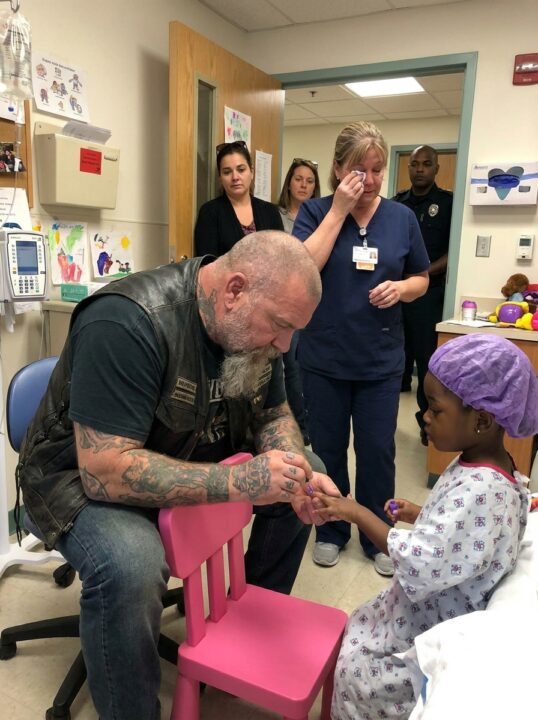
He never softened the story.
“I was there,” he told me. “I made the choice.”
Prison gave him the ink people feared. The spiderweb on his elbow marked years that stopped moving. The broken chain at his wrist covered a crude gang symbol he no longer wanted recognized. The numbers across his knuckles were the date he entered Riverbend, placed there by a cellmate with a sharpened guitar string and burned plastic.
After his release, most repair shops would not hire him.
An older biker named Franklin “Pops” Delaney did.
Pops owned a narrow garage near Lamar Avenue and believed a man should be judged by what he did after someone finally trusted him with the keys. He taught Wade to rebuild carburetors, read invoices, speak to customers without staring at the floor, and drink road coffee strong enough to remove paint.
When Pops died, he left Wade the shop.
Mercer Cycle Works now employed six former inmates, two veterans, a recovering addict, and one bookkeeper named Marsha who frightened all of them more than prison ever had. Wade expected clean work, exact hours, and honest invoices. If a mechanic stole from a customer, he was gone. If he relapsed, Wade drove him to treatment before deciding anything else.
Thursday was the one day the shop closed.
His club, the Iron Vultures, used Thursdays for a ride along Highway 51. Wade had once served as road captain, but for almost two years he had missed every one of those rides. His brothers believed he was attending court-mandated counseling or visiting a woman he did not want them to meet.
They called her “Thursday.”
Wade let them.
At Monroe, he arrived at exactly 9:17 a.m. because the morning laboratory draws ended around nine, and the children needed something that belonged to them after adults had spent hours choosing everything else.
He never called them brave.
He hated that word.
“Brave’s what adults call a kid when they need the kid to hold still,” he once told me.
Instead, Wade asked practical questions. Matte or glitter? One color or ten? Hands, toes, or just a thumb? Did they want conversation, music, or silence?
Every bottle in his case had been approved by infection control. He carried disposable brushes so nothing touched two children. He learned which treatments made nails brittle and when polish could hide medical changes doctors needed to see. He completed privacy training, child-protection training, sanitation training, and a four-hour course about central lines.
He took notes in block letters on the backs of old motorcycle invoices.
The children taught him the rest.
Six-year-old Caleb taught Wade that yellow required three coats. Nia taught him that black became “less lonely” with silver. Theo taught him never to touch a hidden hand. A teenage girl named Madison taught him how to paint small stars by cutting the tip of a toothpick.
They also painted Wade.
Every Thursday afternoon, one child chose a color for his left pinky. He left it there until the following week, even when customers stared at a massive mechanic whose smallest nail was coated in glittering coral.
The Iron Vultures noticed.
Pops’ son Rocco cornered him behind the shop one Friday. “Brother, either tell us what’s happening or stop hiding your hand like you stole jewelry.”
Wade showed him the coral nail.
Rocco waited.
Wade said nothing more.
Brotherhood has rules, even when no one writes them down. One is that silence earns space until it begins hurting the man keeping it. Another is that a brother’s day off belongs to him unless the club needs him.
For eighteen months, they gave Wade space.
Then a photograph appeared online.
It showed Wade crouched beside Nia, his prison ink exposed while her hand rested inside his. The caption identified him as a violent felon volunteering in a pediatric cancer unit. It did not mention the polish, his training, or the fact that Nia’s mother had taken the photograph.
By sunrise, strangers were calling the hospital.
By noon, parents were demanding answers.
By three, Monroe suspended Wade’s volunteer badge.
He placed it on the nurses’ desk without protest.
Nia watched from her doorway. “Next Thursday?”
Wade looked toward Claire.
Our supervisor could not answer.
He closed the black case, pulled on his leather cut, and walked to the elevator. The children heard his boots grow quieter down the hall.
Outside, the Harley’s V-twin started.
This time, no child ran to the window.
Part 3 — The Week the Harley Did Not Come
The following Thursday began with silence.
At 9:17, Nia turned her head toward Poplar Avenue. Theo rolled his wheelchair near the window. Caleb placed both hands flat on his blanket, displaying ten chipped colors Wade had promised to replace.
No engine came.
Nia’s blood counts had fallen overnight. Her temperature rose before breakfast, and by midmorning she was receiving antibiotics for a dangerous infection. She hated the mask over her face. She hated the pressure cuff tightening around her arm. Most of all, she hated that the adults had stopped asking before touching her.
“Call Grinder,” she told me.
I explained that he could not visit.
“Did he do something bad?”
“No.”
“Then call him.”
Her mother looked away.
The photograph had been taken by Celeste Brooks because she wanted to show her sister the strange volunteer Nia adored. A cousin reposted it publicly, someone copied Wade’s name from his badge, and an account that specialized in outrage found his prison record.
The story changed with each share.
A convicted killer had gained access to dying children.
He was recruiting for a motorcycle gang.
The black case contained drugs.
None of it was true. Truth moved slower.
Hospital administrators feared losing donors. Legal staff reviewed Wade’s file. Security received threats from people promising to remove him themselves. Until the review ended, the order stood.
No Wade.
At Mercer Cycle Works, the Iron Vultures finally learned where their former road captain spent Thursdays.
Rocco arrived with twelve bikes and a bad idea.
“We park at the hospital,” he said. “No trouble. Just let them see who stands with you.”
Wade continued tightening a bolt on a touring bike. “No.”
“They called you a predator.”
“Parking twelve cuts outside a children’s ward won’t improve the sentence.”
“We can talk to the press.”
“No.”
“Then what?”
Wade set down the wrench. His left pinky still carried chipped violet polish.
“We make it easy for them to say yes.”
He assigned jobs.
Marsha gathered every certification and background check. Rocco contacted parents willing to provide statements. Another rider obtained records from the rehabilitation program Wade had completed twenty-six years earlier. Pops’ widow brought tax documents showing Wade’s shop had quietly covered travel expenses for five Monroe families.
The club wanted to fight.
Wade made them organize paper.
That tested them more.
Back at Monroe, Nia worsened. Her infection moved quickly, and doctors transferred her to intensive care that afternoon. She became disoriented under the fever and kept asking why her smallest nail was empty.
The violet polish had chipped away.
Claire stood outside her room holding Wade’s suspended badge.
“I can request a clinical exception,” she said.
Administration refused.
Claire requested again.
They refused again.
At 6:40 p.m., I used my own phone.
Wade answered over the sound of tools. “How bad?”
I had not told him who I meant.
He knew.
“ICU. She keeps asking.”
“I’m suspended.”
“I know.”
A long metallic sound came through the phone as he dropped something onto the workbench.
Then silence.
“I won’t make it worse for her mother.”
Celeste took the phone from me. “You won’t.”
She told him she had signed responsibility for the photograph. She told him the hospital had warned her that allowing a suspended volunteer inside could complicate the review. Then she held the phone near Nia’s bed.
Nia’s voice was thin.
“Left pinky, Grinder.”
Wade arrived eighteen minutes later without his leather cut.
He wore a clean gray work shirt, plain jeans, and the same heavy boots. Rain darkened his shoulders. He carried only one sealed disposable brush and the violet bottle inside a clear evidence bag so security could see both.
Four Iron Vultures waited across the street.
They did not enter hospital property.
Claire met Wade at the service door with two administrators, an infectious-disease physician, and Dennis from security. The doctor explained that Nia could not tolerate a long visit. Wade agreed before the sentence ended.
He washed.
He wore a gown, mask, gloves, and face shield. His huge body looked awkward beneath pale disposable plastic, while the faded child’s bracelet remained protected under his cuff.
Inside intensive care, machines made every sound too important.
Nia opened her eyes when Wade sat beside her.
“You came.”
“Traffic.”
“You ride a motorcycle.”
“Still gets traffic.”
Her fingers were hot and swollen. The physician allowed only one nail, painted with a new brush under direct supervision.
Wade opened the violet bottle.
His hand shook.
I had never seen that before.
The brush tapped once against the rim. Wade stopped, closed his eyes, and pressed his thumb hard against the hospital bracelet.
Then he painted.
One stroke.
A second.
Nia watched the violet spread across her smallest nail.
“Pretty?” she asked.
Wade’s voice became rough. “Your decision.”
She considered it.
“Pretty.”
He nodded.
That was all.
Nia’s fever did not vanish because a biker painted her fingernail. The antibiotics worked slowly, the physicians adjusted treatment twice, and for thirty-one hours her condition remained critical.
Wade sat in the public parking area through the night.
He refused to enter again without permission. He drank machine coffee, slept with his back against a concrete wall, and answered every time Celeste sent an update.
At 4:12 the next afternoon, Nia’s temperature began falling.
At 7:30, she woke and demanded black polish for the other nine nails.
The crisis passed.
Everyone assumed that would solve Wade’s problem. The dramatic photograph had been corrected. Parents sent letters. Nia’s story softened administrators who preferred safer volunteers with cleaner histories.
But the hospital board still had one question.
Why had Wade started coming?
His application listed no family connection to Monroe. He had written only: I know how to do the work.
Claire knew more.
So did the violet bottle.
The following Monday, she unlocked an old cabinet in Treatment Room 14 and removed a cardboard box no one had opened in two years.
My name was written across the top.
Part 4 — The Child in Treatment Room 14
I carried the box into the staff lounge.
Inside lay a faded purple blanket, three disposable nail brushes, a plastic tiara missing two stones, and a photograph of Wade Mercer before any of us called him Grinder.
He was seated beside a bald nine-year-old girl.
She had his dark eyes, his stubborn chin, and one hand resting across his scarred knuckles. Her nails were violet, except for the left pinky, which remained bare. Wade’s own left pinky had been painted the same shade.
On the back, Claire had written a date.
Two years earlier.
The girl’s name was Lily Mercer.
Wade had not entered Monroe as a volunteer. He had entered as a father.
Lily was eight when persistent pain in her left leg led to scans, surgery, and a diagnosis of metastatic osteosarcoma. Her mother, Dana, had left when Lily was three and maintained occasional contact through birthday cards. Wade raised her above the motorcycle shop in an apartment that smelled of detergent, motor oil, and the cinnamon cereal she ate every morning.
He knew engines.
Cancer gave him nothing he could repair.
During Lily’s first admission, Wade frightened half the staff. He questioned every medication, slept upright beside her bed, and wrote laboratory numbers on his forearm because he did not trust himself to remember them. When an alarm sounded, he stood so quickly nurses thought he might become violent.
He never did.
He learned.
Lily lost her hair after the second cycle of chemotherapy. People brought scarves, hats, dolls, and brave little speeches she did not want. One afternoon, a volunteer offered to paint her nails.
Lily refused.
After the volunteer left, she looked at Wade.
“You do it.”
“I rebuild transmissions.”
“You have hands.”
“Debatable.”
She chose violet because it matched a plastic tiara hanging from her IV pole. Wade held the brush like a welding torch and painted more skin than nail. Lily laughed until her monitors shifted.
Claire brought remover.
Lily stopped her.
“Leave it. Dad did it.”
That became their ritual.
Before every major treatment, Lily chose a color. Wade practiced at night on plastic spoons, socket-wrench handles, and eventually his club brothers. Rocco once spent a full weekend with ten glittering green nails because Lily had demanded photographic proof.
Wade improved.
He learned to support her fingers without squeezing joints that hurt. He learned to wait through tremors. He learned that the left pinky came last because Lily liked saving one decision for the end.
Then treatment stopped working.
Lily’s cancer spread to her lungs. The doctors offered another trial, but the likely benefit was small and the burden severe. Wade wanted every treatment available. Lily wanted to go home long enough to hear the shop open beneath her bedroom one more morning.
They argued.
Not loudly.
That made it worse.
Wade asked the doctors to keep trying. Lily asked him whether trying was for her or for him. He left the room, walked to the parking garage, and struck a concrete pillar until two knuckles split.
Claire found him there.
He expected judgment.
She handed him gauze.
“Your daughter needs your hands,” she said.
Wade returned upstairs.
He listened.
Lily spent her final three weeks in Treatment Room 14 because respiratory support made the apartment above the shop unsafe. The Iron Vultures took turns bringing food, repairing hospital wagons, and sitting in the hallway so Wade could shower.
They did not wear their cuts inside.
Lily painted their pinkies anyway.
On her final Thursday, she chose the scratched violet bottle. Wade painted nine nails, saving the left pinky as always.
Before he could finish, Lily’s breathing changed.
Doctors entered. Alarms sounded. Wade was moved aside while the medical team stabilized her. When the room quieted, Lily’s smallest nail remained bare.
She noticed.
“Dad.”
Wade leaned over the bed.
“You forgot one.”
He wanted to call the nurse. Lily caught his wrist.
“No gloves. Just you.”
His hand shook so hard the brush struck the bottle twice. Violet spread across her nail and onto the skin below it.
“I messed it up.”
Lily looked at the crooked polish.
“No. It looks like yours.”
Then she asked him a question no one else heard.
“Who paints theirs when I’m gone?”
Wade told her not to speak that way.
Lily waited.
Children become skilled at waiting for adults to stop lying.
Finally, Wade said, “Nobody.”
“Then paint the other kids.”
“Lil—”
“They still want pretty nails.”
He bowed his head until his beard touched the blanket.
Lily squeezed one of his fingers.
“You always say a promise is work after words.”
That was something Pops had taught him in the garage. Wade had repeated it whenever Lily wanted to quit homework or leave a motorcycle part half-cleaned.
Now she gave it back.
Wade promised.
Lily died early Saturday morning with violet nails, one scarred hand beneath her cheek, and her father’s left pinky resting against her palm.
Claire removed the polish bottle before the room was cleared. She could not bear to throw it away, so she sealed it inside the cabinet with Lily’s belongings.
Three weeks after the funeral, Wade returned.
He had cut his beard, lost nearly thirty pounds, and carried an empty black case.
Claire assumed he had come for Lily’s things.
Instead, he asked when volunteers painted nails.
“We don’t have anyone assigned every week.”
“You do now.”
Claire told him grief did not require a schedule.
Wade looked through the glass at a child receiving treatment alone.
“This isn’t grief.”
“What is it?”
“Work after words.”
Claire opened the cabinet and gave him the violet bottle.
Wade placed it in the first slot of his case.
The nurses who later learned the truth did not break down because a large man cried or delivered a speech. Wade did neither.
They broke because Claire showed them his attendance record.
Ninety-four Thursdays.
Not one missed by choice.
Part 5 — What the Children Had Been Giving Back
When the hospital board asked Wade to explain his reason, he refused to turn Lily into a defense.
“My record’s mine,” he said. “Her death doesn’t erase it.”
The administrator across from him asked whether painting nails helped him process grief.
Wade’s expression hardened.
“I’m not using sick kids for therapy.”
The room fell silent.
He explained that the children received something small but real: a choice, a color, ten minutes when their hands belonged to them rather than to medicine. If Monroe decided his history made him unsuitable, he would accept it. He only asked them not to pretend the work had been for him.
Claire placed Lily’s photograph on the table.
“It began with her,” she said. “That doesn’t mean he takes from them.”
Celeste Brooks spoke next. She described Wade sitting through Nia’s fear without demanding gratitude. Theo’s father described the first blue thumbnail. Caleb’s mother produced twelve photographs of her son displaying colors Wade had mixed because no bottle matched the orange of his favorite truck.
Then Rocco entered carrying a plastic storage crate.
Wade stared at him. “What are you doing?”
“Making it easy to say yes.”
Inside were ninety-four envelopes, one for every Thursday Wade had volunteered. The Iron Vultures had found them inside a locked drawer at Mercer Cycle Works after gathering documents for the review.
Each envelope carried a child’s first name and date.
Wade had saved no medical information. He kept only small things patients gave him: color requests, drawings, paper rings, stickers, and handwritten notes. One envelope contained a napkin on which Nia had designed black nails with silver lightning. Another held the first disposable brush Theo had used to paint Wade’s thumb.
The board chair asked why Wade kept them.
He shrugged. “Kids notice if you forget.”
That answer wrecked Claire more than the photograph.
We had assumed Wade came to give.
The children had been rebuilding him in pieces so small no one noticed.
The hospital reinstated his badge with additional safeguards requested by Wade himself. No child would be photographed without written family permission. No volunteer name would appear in public posts. Two adults would remain present during visits, and every bottle would be logged.
Wade returned the next Thursday at 9:17.
The Harley’s V-twin rolled through the glass before the elevator opened. Nia waited at the nurses’ station with nine black nails and one violet pinky.
“You’re late,” she said.
“Clock says seventeen.”
“My clock says eighteen.”
“Your clock’s hostile.”
She handed him a folded paper.
It showed a small girl wearing a crooked tiara beside a giant man with colored fingers. Nia had never seen Lily’s photograph. Claire had only told her that Wade’s daughter once liked violet.
At the top, Nia had written: FOR THE GIRL WHO TAUGHT GRINDER.
Wade read it twice.
His eyes reddened, but he did not cry. He folded the picture into quarters, slid it beneath the inner lining of his leather cut, and opened the black case.
The violet bottle explained other things we had noticed.
Wade painted the left pinky last because Lily had wanted one final decision.
He cut his nails short because she once complained that a rough edge scratched her skin.
He pressed the hospital bracelet whenever his hand shook because it bore Lily’s name.
He never called a child brave because Lily hated being praised for pain she had not chosen.
He refused to promise everything would be all right because she had once asked him why adults said that while whispering different things in hallways.
Even the bottle names came from Lily.
Midnight Trouble. Saturday Sky. Dragon Breath. Cheap Crown. Diner Cherry. Bad Coffee Brown.
During her treatment, Lily renamed every color in the volunteer cart because ordinary names bored her. After her death, Wade ordered safe polish in matching shades and wrote her names on the labels.
The children never knew they were speaking Lily’s private language.
They only knew the names made them laugh.
Wade kept one rule about the scratched violet bottle. He did not use the original polish on patients; age and contamination made that unsafe. The bottle carried a sealed replacement insert matching Lily’s color. Her original dried polish remained inside a tiny glass capsule beneath the foam.
He preserved it the way another father might preserve a first tooth or lock of hair.
That evening, I watched Wade pack his case. The ward had emptied into the soft mechanical quiet that follows visiting hours.
I asked what he remembered most about Lily.
He did not say her final breath.
He did not say the funeral.
He pointed at a crescent of violet polish on his boot.
“First time she painted mine, she spilled half a bottle. Stain never came out.”
I looked down.
The mark was barely visible against old black leather.
Wade rubbed it once with his thumb.
“Good.”
Part 6 — Lily’s Drawer
The Thursday ritual grew without becoming a performance.
The Iron Vultures built a rolling polish cabinet narrow enough to pass between treatment chairs. Rocco painted it gray. Nia objected and demanded purple lightning along both sides.
Wade allowed one bolt-on metal plate.
It read Lily’s Drawer, but the lettering faced inward, where only children opening the cabinet could see it. Wade did not want strangers photographing her name.
Every shade remained inside.
Children chose freely. Parents sometimes joined. Nurses with twelve-hour shifts held out chipped nails during quiet minutes, and Wade complained that adults were worse customers because they moved too much.
Caleb finished treatment wearing ten different colors.
Theo began speaking again before his final chemotherapy cycle. He chose blue for himself and violet for Wade, then insisted on holding the brush.
The first stroke covered Wade’s entire pinky joint.
Wade examined the mess. “Professional work.”
Theo smiled. “Looks like yours.”
The words stopped Wade for half a second.
Then he nodded.
Nia’s treatment lasted another fourteen months. Some Thursdays she had enough energy to supervise everyone else. On harder weeks, Wade painted one nail while she slept and left the color name on a card for when she woke.
When scans finally showed no evidence of disease, Celeste planned a celebration. She expected Wade to ride at the front.
He refused.
“This one’s hers.”
So Nia sat in the sidecar of Rocco’s Harley while Wade followed at the back with forty other motorcycles. Their engines stayed low through the hospital driveway. Nurses stood along the curb, and Nia raised both hands above the sidecar windshield.
Nine nails were silver.
The left pinky was violet.
Wade still visited Lily’s grave after leaving Monroe. He rode fifteen miles east to a small cemetery near Bartlett, parked beneath an oak tree, and carried the black case to her marker.
He never painted the stone.
He sat beside it and cleaned the brushes. He read new color names from children who believed Hospital Beige sounded too depressing and had renamed it Pancake Smoke.
Sometimes he talked.
Mostly, he listened to traffic moving beyond the trees.
Before leaving, he placed his left hand against Lily’s name.
A different color touched the granite every week.
Part 7 — Work After Words
Two years after I mistook Wade’s black case for a threat, a new patient arrived at Monroe.
Her name was Sadie. She was seven, newly diagnosed, and furious at everyone who entered her room. She refused toys, music, food, and conversation. When Wade appeared, she threw a paper cup at him.
It struck his vest.
He picked it up and sat outside her door.
For three Thursdays, he never entered.
On the fourth, Sadie asked why his pinky was orange.
“Kid made a bad decision.”
“I like orange.”
“Then maybe it wasn’t bad.”
She allowed him to place one bottle near the threshold.
No brush.
No request.
The following week, she held out one finger.
Wade painted it orange.
Sadie studied the old ink running across his knuckles. “Were you bad?”
“I did bad things.”
“Are you scary?”
“Sometimes.”
She considered that answer longer than any adult would have.
Then she took the brush and painted his left pinky. Orange covered the nail, the skin, and part of the broken-chain tattoo near his wrist.
Wade did not correct her.
When the visit ended, he packed forty-three bottles into the black case. He kept the orange polish on his skin, pulled on his leather cut, and walked toward the elevator.
Claire called after him.
“Grinder, you’re leaking color.”
He looked at his hand.
“Leave it.”
Outside, his Harley started at 4:36 p.m. The deep V-twin pulse crossed the glass and faded toward Poplar Avenue.
Wade stopped at Lily’s grave before returning to the shop. He rested one orange finger against her name and told her about Sadie, the thrown cup, and the color that landed everywhere except where it was supposed to.
Then he repeated the only explanation he had ever given us.
“My girl’s gone. These kids still want pretty nails.”
He closed the case.
The engine turned over beneath the oak trees, and the orange mark remained on his hand as he rode away.
A promise was still working.
Follow our page for more biker stories about feared men, hidden scars, and the gentle promises they keep when no one is watching.