A 57-Year-Old Biker Dropped His Harley Across a Hospital Ambulance Lane — Then Police Read the Sentence He Had Been Unable to Shout
Part 2 — Six Fridays Beside the Blind Curve
The biker’s name was Dale Rourke, although the men who rode with him called him Mute.
They did not invent the name after his surgery. Dale had carried it since his twenties, when he worked nights towing wrecked cars from Interstate 40 and rarely spoke during club meetings. Back then, he had a deep voice that could be heard over an idling V-twin, but he preferred a wrench, a nod, or a hand placed on a brother’s shoulder.
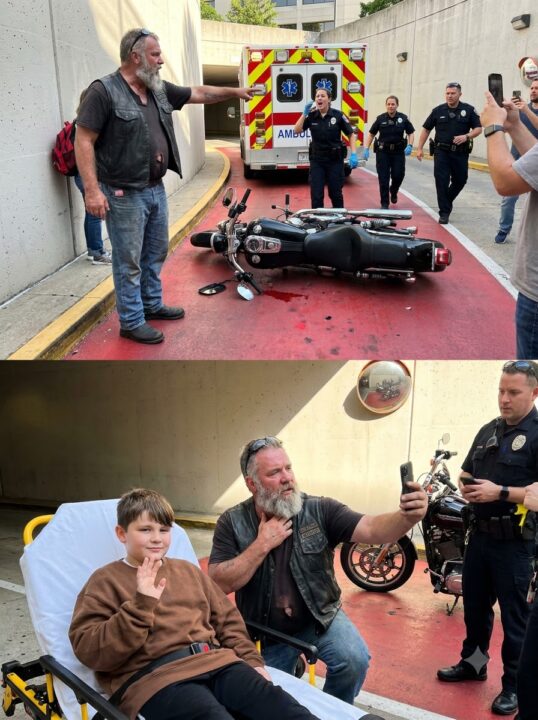
At fifty-seven, silence was no longer a preference.
Dale had undergone a total laryngectomy eleven months before I handcuffed him. Cancer took his larynx, part of his thyroid, and the voice his late wife, Maria, once described as “gravel dragged through warm coffee.”
The surgery left a permanent stoma at the base of his throat. He breathed through it. He carried cleaning supplies in his saddlebag, covered the opening with a soft black cloth when he rode, and used a phone or a small electronic speech device when strangers needed more than gestures.
He hated the device.
It gave every sentence a mechanical vibration. Children stared. Adults pretended not to.
Dale was at St. Anne’s that Friday for an oncology scan. Three members of the High Desert Saints had ridden with him because his previous scan contained a shadow near the surgical margin.
Nobody said recurrence.
Hawk Bell, the club president, brought two thermoses of road coffee and talked about a carburetor problem for most of the ride. Lewis “Doc” Haney carried Dale’s medical folder inside his vest. Benny Cruz kept enough distance behind the Road King to watch for dizziness, a complication Dale had experienced after radiation.
They were not escorting a fearless man.
They were escorting a frightened brother who could no longer hide fear behind his old voice.
Dale finished the scan at 2:38 p.m. The radiologist requested additional images, so Hawk and Doc remained upstairs. Dale went outside because the disinfectant smell reminded him of the night Maria died.
He had been returning to the same corner for six Fridays.
A boy had been waiting there.
The boy’s name was Micah Reed. He was eleven years old, though malnutrition made him appear younger. His mother, Tessa, moved between temporary shelters, weekly motels, and the back seat of an abandoned Buick after escaping a boyfriend who had broken her jaw.
Tessa washed dishes at a diner on Central Avenue when she could find someone to watch Micah. On the other days, the boy accompanied her and waited near the kitchen exit with a school workbook.
Then Tessa collapsed during a shift.
A customer called an ambulance. Tessa was brought to St. Anne’s without identification because her purse remained locked inside the diner office. Micah followed in a city bus but arrived after she had been taken for neurological imaging.
He was too afraid to enter the main hospital.
The last time he had asked an institution for help, a caseworker separated him from his mother for nine weeks. The placement had been safe, but Micah understood only that he had asked a question and lost her.
So he waited outside.
Dale first noticed him sitting behind the oxygen wall with a bruised apple and an empty water bottle. He offered the boy cash.
Micah refused.
Dale offered food.
The boy asked whether he would have to give his name.
Dale shook his head.
They ate two turkey sandwiches on opposite sides of the concrete strip. Dale communicated by typing into his phone. Micah answered mostly through shrugs.
Before leaving, Dale showed him the sign for water.
Micah copied it.
The next Friday, the boy returned. His mother had been discharged and was staying at a women’s shelter, but the shelter required residents to leave during daytime hours. Micah waited near St. Anne’s because Tessa attended treatment in the behavioral-health annex and feared losing her place if staff learned her son had nowhere to stay during appointments.
Dale brought a paper bag containing sandwiches, oranges, socks, and a cheap reusable bottle.
Micah noticed the scar.
“Does it hurt?”
Dale typed, NOT TODAY.
“What happened to your voice?”
Dale wrote, DOCTORS TRADED IT FOR MORE TIME.
Micah considered that.
“Was it a good trade?”
Dale looked toward the hospital windows before answering.
STILL COUNTING.
Their meetings became a quiet arrangement. Dale never photographed the child. He never asked Micah to perform gratitude. He kept food in the right saddlebag and sat far enough away that the boy could leave.
On the fourth Friday, Micah taught himself four signs from a library book: food, mother, safe, and thank you.
On the fifth, Dale gave him a card for the Mesa House family shelter. Micah put it in his backpack but made no promise.
On the sixth Friday, the temperature reached ninety-four degrees.
Dale emerged from the cancer clinic dizzy from contrast dye and saw Micah stumble behind the blind curve. He crossed the lane, but an ambulance entered before he reached the boy.
He waved.
The driver did not see him.
Dale pulled out his phone. One glove came off easily. The second caught on his silver skull ring. By the time the screen unlocked, the ambulance’s reverse lights were already glowing.
He typed two words.
LOOK BEHIND.
Then he heard the change in the engine as the driver shifted into reverse.
Dale looked at Micah.
He looked at the ambulance.
Then he looked at the Road King Maria had helped him buy twenty-nine years earlier.
The motorcycle was the last thing large enough.
He mounted, accelerated across the bay, cut the handlebars, stepped free, and drove his right boot into the crash bar. The Harley struck the concrete sideways.
The ambulance stopped.
That was the part the phones recorded.
They missed the six Fridays before it.
Part 3 — Twelve Feet and an Eight-Hundred-Pound Warning
Micah’s pulse was weak but present.
Grace and Devin moved him onto a pediatric stretcher while I cleared the receiving lane. The cardiac patient inside Unit 14 had remained connected to a monitor throughout the delay, and a second medical team reached him through the side door.
He arrived in the catheterization laboratory four minutes later.
He survived.
That mattered because the first online accounts claimed Dale’s obstruction had killed a patient. A woman beneath the awning posted a thirty-two-second video showing the fallen Harley, Grace shouting, and my partner pushing Dale against the cruiser.
Her caption called it an attack on emergency workers.
Within an hour, the clip had been shared more than twenty thousand times.
Dale’s motorcycle was still leaking fuel when Hawk, Doc, and Benny came down from oncology. Hawk saw the handcuff marks first.
“What happened?”
Dale pointed toward the pediatric entrance.
Benny saw the damaged Harley and moved toward me. He was sixty-three, broad across the chest, with a white braid hanging over one shoulder and prison ink fading across both forearms.
“Who put him against the car?”
“I did.”
Leather creaked behind him.
Hawk stepped between us.
He asked Dale one question in sign language.
Child safe?
Dale held one hand flat, meaning uncertain.
That ended the confrontation before it began. The three bikers turned away from the officers and walked toward the pediatric doors.
Security refused entry.
Hospital administrator Grant Leland had already watched the viral clip. He ordered every club member removed from the property until the obstruction was investigated. He also requested that Dale’s Road King be impounded as evidence.
Hawk wanted to argue.
Dale placed a scarred hand against his chest and shook his head.
Go, the gesture meant.
The brotherhood faced its first test in the parking lot.
Benny wanted to gather fifty riders outside St. Anne’s and force the hospital to release security footage. Doc knew an employee who could obtain the file before administrators restricted access. Hawk’s twenty-seven-year-old nephew, Caleb, had already found the woman who posted the accusation.
“Give me ten minutes,” Caleb said. “I can put her name beside the truth.”
Dale typed into his phone.
THE BOY IS THE TRUTH.
Caleb shook his head. “They’re calling you a terrorist.”
Dale added another sentence.
THEN DON’T BECOME A MOB FOR ME.
Nobody answered.
Dale removed the High Desert Saints road-captain pin from his cut and placed it in Hawk’s palm. If the club rode against his decision, it would ride without him leading.
That hurt the men more than an order.
Hawk closed his fist around the pin.
“No post,” he said. “No names. We wait.”
Inside the hospital, Micah’s temperature was 104.1 degrees. His blood sugar had fallen dangerously low, and laboratory tests showed dehydration, anemia, and an infection in a cut beneath one sock.
When nurses removed his brown sweatshirt, they found three hospital visitor stickers attached inside the lining. The oldest was dated six weeks earlier.
Micah had been entering the lobby to refill his water bottle, then slipping outside before anyone could question him.
A registration clerk recognized him.
She had assumed he belonged to a patient.
A cafeteria worker recognized him too.
He had asked whether unopened food from returned trays was thrown away.
Everyone had seen part of the boy.
Nobody had seen his life.
The bracelet around his wrist deepened the mystery. It carried the name OWEN ROURKE, age twenty-three, with an admission date from eighteen months earlier.
That was not Micah’s name.
It belonged to Dale’s son.
When Micah briefly regained consciousness, he clutched the bracelet and refused to let a nurse remove it. He asked for “the man with no voice,” then slipped back into fevered sleep.
I found Dale in the public parking lot across Central Avenue. He sat on a curb beside three Harleys while a tow operator loaded his damaged Road King.
I showed him a photograph of the bracelet.
His entire body went still.
Hawk reached for the phone. Dale would not let go.
Owen Rourke had been Dale and Maria’s only child. At nineteen, Owen injured his back unloading construction steel and became dependent on prescription painkillers. When the prescription stopped, pills from friends replaced it. Then heroin did.
Dale tried force.
He took Owen’s money, locked the garage, searched his pockets, and once pinned him against a kitchen wall while demanding that he choose between drugs and family.
Owen left that night.
For four years, father and son met through shelters, emergency rooms, and brief periods of recovery. Maria died from an aneurysm during the second year. Owen missed her funeral because he was in county jail under another name.
Dale blamed him.
Then blamed himself for blaming him.
Eighteen months before the ambulance-bay incident, Owen was admitted to St. Anne’s after being found behind a convenience store. He had pneumonia, heart-valve damage, and untreated sepsis.
He died before Dale reached the hospital.
The last item returned to Dale was a white patient bracelet cut from Owen’s wrist.
Dale kept it in the right saddlebag of his Harley.
That was the same saddlebag in which he carried food for Micah.
The bracelet must have fallen into one of the paper bags. Micah found it and wore it because, according to a sentence he later whispered to Grace, it proved somebody had once come looking for another person like him.
Dale asked to enter the pediatric unit.
Administrator Leland refused.
“The child isn’t family,” he said. “And your conduct is under review.”
Dale typed, HE ASKED FOR ME.
“That does not give you legal authority.”
Dale stood outside the locked doors for three hours.
He did not threaten.
He did not leave.
At 8:17 p.m., Micah woke and asked for his mother. Staff had no reliable contact information, but Mesa House recognized the emergency shelter card inside his backpack.
Tessa had checked in there that afternoon.
She had spent six hours searching bus stations, the diner, and the hospital’s main lobby while her son lay in a pediatric room three floors above her.
When she arrived, she ran past Dale without recognizing him.
Ten minutes later, she came back.
Micah had told her about the sandwiches, the signs, and the motorcycle that stopped an ambulance.
Tessa studied the enormous biker through the glass doors.
“You knew him six weeks?”
Dale nodded.
“You knew he was homeless?”
Another nod.
“Why didn’t you report us?”
Dale typed carefully.
I WAS WAITING UNTIL HELP LOOKED SAFER THAN HIDING.
Tessa’s face tightened.
“That almost got him killed.”
Dale accepted the words without defending himself.
She was right.
Kindness had kept Micah fed. It had not moved him out of the blind corner. Dale’s fear of repeating the institutions that failed Owen had become its own kind of hesitation.
He began typing again.
I SHOULD HAVE DONE MORE.
Tessa read the sentence.
Then she opened the door.
Part 4 — The Voice Dale Lost Before the Cancer Took It
Dale sat beside Micah’s bed without his leather cut.
He removed the skull ring because it frightened the boy when he woke confused. He placed both hands on top of the blanket where Micah could see them.
The room smelled of saline, disinfectant, and the turkey soup Tessa had not touched.
Micah opened his eyes.
He made the sign for motorcycle.
Dale tilted one hand sideways and let it fall.
Micah smiled weakly.
“Broken?”
Dale held two fingers a small distance apart.
A little.
The front fork was bent. The left engine guard had collapsed. The fuel tank was scraped to bare metal, and the saddlebag containing Dale’s stoma supplies had been crushed beneath the bike.
Insurance would not cover deliberate damage.
Dale did not care.
Tessa did.
“That motorcycle was your wife’s?”
Dale shook his head, then typed.
OURS.
Maria had chosen the black paint. She rode behind him for twenty-three years, tapping his right shoulder whenever he missed an exit and falling asleep against his back on long stretches of Interstate 25.
After her death, Dale stopped riding for eleven months.
Owen found the Road King beneath a tarp and repaired the fuel pump during one of his sober periods. Father and son spent three nights in the garage without discussing addiction, grief, or the four hundred dollars missing from Maria’s dresser.
For those three nights, they were simply two men with dirty hands.
Owen disappeared again a week later.
The Road King became the last thing they repaired together.
Micah had been carrying more than Owen’s bracelet.
Inside the red backpack, a social worker found a folded photograph protected by clear tape. It showed Dale beside the Road King at a winter outreach camp eighteen months earlier.
Owen stood in the background.
He was thinner than Dale remembered, wearing a donated green coat and holding two cups of coffee. Beside him was Tessa.
They had known each other.
That discovery pulled together two families who believed they were strangers.
Tessa met Owen at a highway underpass during the final winter of his life. He shared food, warned her which shelters separated mothers from older boys, and once stayed awake outside a motel room because Tessa’s former boyfriend had found her address.
Owen never told her his father’s name.
He spoke only about “an old man with a black Harley” who had kept showing up long after Owen gave him every reason to stop.
The photograph was taken during Dale’s search for him.
Owen saw his father approaching and left before Dale reached the camp. He gave Tessa the picture later because the Road King was clearly visible.
“If something happens,” Owen told her, “find that bike. He’ll act angry. Stay anyway.”
Tessa had kept the photograph.
Micah found it in her bag months later. When he first saw Dale behind St. Anne’s, he recognized the motorcycle but did not reveal how.
He was protecting his mother’s connection to Owen.
Dale stared at the photograph until his breathing through the stoma became rough.
He had believed his son’s final months contained only relapse and flight. Now he learned Owen had protected a woman and child while unable to save himself.
The reverse truth hurt.
It also returned something.
Owen had not become the ending Dale feared. Part of him had remained recognizable—quiet, stubborn, and unwilling to walk away from somebody cornered by danger.
Micah touched the bracelet.
“Was he bad?”
Dale’s thumbs hovered over the phone.
He erased his first answer.
Then the second.
Finally, he typed four words.
HE WAS STILL MINE.
Micah read them twice.
Tessa turned toward the window.
That should have been the story’s largest turn.
It wasn’t.
The following morning, a hospital investigator obtained footage from Unit 14’s rear safety camera. The recording showed Micah collapsing behind the curve, Dale running toward him, and the ambulance beginning its reverse approach.
It also revealed another person.
A man wearing hospital-maintenance coveralls had passed Micah forty-seven seconds before Dale arrived. He looked down at the boy, stepped over one outstretched hand, and continued through a secured door.
Administrator Leland initially described the employee as someone who might not have recognized a medical emergency. Then investigators enlarged the footage.
The man had turned back.
He had seen Micah.
A maintenance supervisor identified him as Curtis Vann, a subcontractor with no first-aid training. Curtis told police he assumed the boy was sleeping and feared being blamed for allowing a homeless person into a restricted area.
He had chosen his job over a question.
The clip changed public opinion instantly. Dale went from villain to hero before breakfast. News vans gathered outside St. Anne’s. Online pages stole photographs from the club’s social media accounts and placed halos, angel wings, and patriotic music over his face.
Dale hated that almost as much as the accusations.
Caleb wanted to release the entire rear-camera video to defend him.
Dale refused.
Micah’s collapse belonged to Micah.
The boy would not become evidence for Dale’s goodness.
Hawk backed him. Benny did not.
“People need the truth,” Benny said.
Dale typed, THEY NEED ENOUGH TRUTH.
“Enough for what?”
ENOUGH TO FIX THE CORNER.
Benny slammed a palm onto the clubhouse table. “They called you a killer.”
Dale turned the phone around.
AND NOW THEY WANT TO CALL ME AN ANGEL. BOTH ARE LAZY.
The room fell quiet.
Hawk returned Dale’s road-captain pin.
Dale closed Hawk’s fingers around it and shook his head.
The brotherhood had obeyed him when he asked them not to retaliate. Now he wanted something harder.
He wanted them to work without being seen.
The High Desert Saints paid for Micah and Tessa to stay at Mesa House for eight weeks. They did it through a local church account so no motorcycle-club name appeared on the receipt.
Doc arranged dental care.
Benny repaired the abandoned Buick.
Caleb deleted the post he had prepared about the woman who filmed Dale’s arrest. Then he spent three nights reporting copies of Micah’s hospital footage.
The men did not become gentler.
They became more precise.
Dale’s scan results arrived two days later.
The shadow was scar tissue.
No recurrence.
For the first time since the ambulance bay, his hands shook.
Micah saw it.
He reached across the bed and made the sign Dale had taught him.
Safe.
Part 5 — What the Cameras Left Outside the Frame
St. Anne’s released a statement clearing Dale of intentional interference with emergency operations.
The wording irritated everyone.
Dale had interfered intentionally.
That was the entire reason Micah survived.
The hospital meant that he had not acted maliciously, but legal language flattened the decision into a misunderstanding. It did not capture the reverse lights, the blind wall, the glove trapped on a skull ring, or an eight-hundred-pound motorcycle becoming the final sentence of a voiceless man.
Officer Ruiz—me—asked that my body-camera footage be included in the internal review.
It showed Dale complying.
It showed him pointing.
It showed me interpreting urgency as aggression because of his size, his tattoos, and the motorcycle lying across an emergency lane.
My actions followed policy.
That did not make every judgment correct.
I visited Dale at the High Desert Saints’ garage a week later. The Road King rested on a hydraulic lift, stripped of its bent fork and damaged saddlebag.
Six men worked around it.
No music played. The garage held only the clicks of cooling metal, the scrape of tools, and an occasional blast from the air compressor. Dale sat at a workbench repairing the cracked phone mount.
I apologized.
He read my message, then typed.
YOU STOPPED WHEN YOU SAW.
It was more generous than I deserved.
“I should have seen sooner.”
Dale looked toward the Road King.
SO SHOULD EVERYBODY.
He was not forgiving only me.
He included himself.
During the internal hearing, Dale admitted knowing that Micah had been sleeping near hospital property for weeks. He acknowledged that he had not contacted social services, hospital outreach, or law enforcement because Owen’s experience taught him to distrust systems.
Tessa sat beside him.
She told the review panel that Dale’s caution had allowed her son to trust one adult, but it had also left Micah outside during dangerous heat.
Both things were true.
The panel recommended a street-medicine referral program rather than punishment. St. Anne’s assigned two outreach nurses to walk the property each afternoon, including the blind spaces around the garage.
A convex safety mirror was installed at the curve.
Yellow crosshatching replaced the faded red line. Reverse cameras were recalibrated. A motion sensor activated a light whenever someone entered the hidden strip.
The hospital also placed a blue emergency call button low enough for a child to reach.
Curtis Vann lost his subcontract.
Dale opposed firing him.
Not because Curtis had acted well. He hadn’t. Dale believed dismissal allowed the hospital to pretend one frightened worker caused a design failure known to several departments.
The ambulance drivers had reported the blind curve three times.
Each report was marked low priority because no collision had occurred.
Micah nearly became the first number capable of changing that priority.
Dale typed a statement for the safety committee.
A NEAR MISS IS NOT PROOF THE SYSTEM WORKED.
IT IS PROOF SOMEONE RAN OUT OF LUCK SLOWLY.
Administrator Leland read it aloud because Dale’s electronic speech device malfunctioned midway through the meeting.
The room heard the words in the administrator’s polished voice.
Dale watched without expression.
Afterward, Leland asked whether the hospital could name the redesigned entrance “Rourke Lane.”
Dale refused.
He suggested Micah’s name.
Tessa refused too.
Micah settled the argument.
“Call it the Quiet Lane,” he said. “That way people remember to look when they don’t hear anything.”
The name remained unofficial, painted only on a small maintenance map inside the ambulance office. Drivers used it anyway.
“Clear the Quiet Lane,” dispatchers began saying.
The phrase traveled.
The cardiac patient from Unit 14 eventually contacted Dale. His name was Walter Ellison, a retired school custodian. He had required a stent but suffered no lasting heart damage from the delay.
Walter arrived at the garage carrying an envelope.
Inside was a check for the Road King’s repair.
Dale pushed it back.
Walter pushed harder.
“You saved a boy while I was in that ambulance.”
Dale typed, THE MEDICS SAVED BOTH.
“Then buy them lunch.”
Dale considered this and accepted one hundred dollars. He returned the remainder.
The next Friday, forty-three emergency workers found breakfast burritos waiting in the staff room. No card identified the donor.
Grace recognized the hot sauce.
Dale had asked her which brand Devin liked while she was cleaning the wound on his wrist.
Small details returned that way.
The shattered corner of Dale’s phone explained why he could not complete the warning. It had cracked two weeks earlier when radiation-related dizziness caused him to fall at a gas station.
The black cloth around his neck was not a gang symbol. It was a stoma cover filtering road dust from the opening through which he breathed.
The unfinished message on the dashboard showed he had tried words first.
The three strikes against the cruiser hood matched the emergency signal Dale and Owen once used while working together in the garage: three blows meant shut the machine down.
The red strap beneath the saddlebag had been the only part of Micah visible from the open lane.
And the Road King officially belonged to Maria Rourke because Dale had never transferred the title after her death. That was why an early police check listed the registered owner as deceased.
The rumors had built monsters out of paperwork.
The truth was smaller.
A widower kept his wife’s name on their motorcycle.
A sick man carried his dead son’s bracelet.
A homeless boy recognized a Harley from an old photograph.
And when nobody could hear danger, a biker put the loudest possession he owned in its path.
Part 6 — Rebuilding the Last Word Owen Left Behind
The High Desert Saints rebuilt the Road King over four months.
They could have replaced every damaged panel. Dale would not allow it.
The scrape across the fuel tank remained. The left crash bar was straightened but not rechromed. A shallow crease stayed in the repaired saddlebag beside the spot where Micah’s red backpack strap had caught the sunlight.
Hawk called the marks ugly.
Dale typed, SO ARE MOST TRUE THINGS.
Every Friday, Dale visited Mesa House with paper grocery bags packed inside the same saddlebag. He never arrived alone after Tessa reminded him that quiet help could become invisible help too easily.
An outreach nurse accompanied the club.
Micah returned to school. He entered sixth grade two months late and hated the required uniform, cafeteria peas, and the counselor who asked him how he felt before learning what music he liked.
He did well in mathematics.
He struggled to sleep indoors.
On difficult nights, Tessa found him on the shelter steps with Owen’s bracelet looped around two fingers. Dale never asked for it back.
Instead, he gave Micah a small metal tag cut from the bent Road King mirror. One side carried Micah’s emergency contact number. The other held a single stamped word.
LOOK.
Dale began using an electrolarynx more regularly. The device produced a flat mechanical voice, but Micah refused to let him hide it.
During one visit, the boy asked, “Why do you sound like a robot?”
Dale pressed the device against his throat.
“UPGRADE.”
Micah laughed until a shelter volunteer came outside to check on him.
That became their ritual. Micah asked one question. Dale answered with as few mechanical words as possible.
“Were you scared when the ambulance came?”
“YES.”
“Of the police?”
“LESS.”
“Of breaking the Harley?”
A pause.
“MARIA.”
Micah understood. Dale had not feared damaging metal. He feared destroying the last place where his wife’s hands and his son’s tools had once rested.
“Would she be mad?”
Dale looked at the scarred tank.
“FURIOUS.”
Then he added:
“PROUD LATER.”
On the anniversary of Owen’s death, Tessa brought Dale to the underpass where she had last seen his son. There was no memorial, only shopping carts, blankets, and names written in marker beneath the concrete.
Dale left no flowers.
He brought socks, water, wound-care kits, and twelve prepaid bus cards.
Before leaving, he pressed one palm against the pillar where Owen had slept.
His shoulders moved once.
No sound followed.
Micah waited beside the rebuilt Harley without looking away.
Some silence needed a witness.
Part 7 — When the Quiet Lane Went Silent Again
One year after the incident, St. Anne’s invited Dale to a safety demonstration for new ambulance drivers.
He declined the microphone.
Administrator Leland had expected that. A large screen displayed Dale’s prepared message while Grace stood beside the convex mirror and explained the blind approach.
Micah attended with Tessa.
He was taller, heavier, and wearing a clean red backpack. Owen’s bracelet remained inside its front pocket rather than around his wrist. The difference mattered to Dale.
The boy no longer needed to display proof that someone might search for him.
Three High Desert Saints waited across the street. Their engines were off, yet the cooling pipes ticked beneath the afternoon sun. Hawk had brought Dale’s road-captain pin again.
This time, Dale accepted it.
A trainee asked whether he regretted sacrificing the motorcycle.
Dale used the electrolarynx.
The artificial vibration filled the ambulance bay.
“IT WAS A MACHINE.”
Hawk coughed skeptically.
Dale looked toward him.
“A GOOD MACHINE.”
The paramedics laughed.
Then an alarm sounded from inside the hospital. Unit 22 started toward the receiving entrance while a delivery van mistakenly stopped across the yellow crosshatching.
Before anyone shouted, Micah ran to the call button and pressed it.
Red lights flashed above the Quiet Lane. The ambulance stopped. Security moved the van.
No collision.
No fallen motorcycle.
No handcuffs.
The system worked because a child’s hand could finally reach it.
Dale watched Micah step away from the button. The boy made the sign for safe.
Dale returned it.
After the demonstration, Tessa handed Dale a small envelope. Inside was a photocopy of the photograph showing Owen near the winter outreach camp. Micah had written three words on the back.
HE FOUND US.
Dale read them beside the Road King.
He placed the photograph inside the repaired right saddlebag, next to the stoma supplies, emergency cards, sandwiches, and a new phone protected by a heavy rubber case.
Then he removed Maria’s old title from his vest.
The Road King remained legally hers until that morning. Dale had finally transferred ownership—not because he was letting her go, but because the motorcycle had become part of a story she never lived to see.
He added two names beneath his own on a small card inside the saddlebag.
Maria.
Owen.
No public patch. No painted tribute. Nothing for strangers to photograph.
Just names carried close to the machine they had touched.
At sunset, Dale started the Harley.
The rebuilt V-twin filled the ambulance bay, shook the glass doors, and rolled beneath the concrete overhang. People turned instinctively toward the sound.
A year earlier, they had mistaken that motorcycle for an obstruction.
Now drivers checked the mirror before reversing.
Dale waited until Unit 22 cleared the curve. Micah stood beside Tessa and raised two fingers against his chest.
Thank you.
Dale answered, released the clutch, and led three motorcycles west along Central Avenue.
His voice remained behind.
The Harley carried the rest.
Follow the page and leave MUTE below for more stories about bikers whose quiet actions speak louder than their reputations.