Part 2: A 280-Pound Biker Snatched a Doll From a Crying Six-Year-Old and Threw It Across a Route 66 Diner — Then He Returned With a Box Nobody Expected
Part 2 — The Man Who Smelled the Heat
The doll burned for less than forty seconds, but those seconds changed the way everyone inside Rosie’s looked at Silas Mercer.
I grabbed Lucy beneath her arms before she could reach the side door. She kicked against me, screaming that Maisie needed help, while Stone pulled a compact extinguisher from one of the motorcycles and covered the doll with white powder.
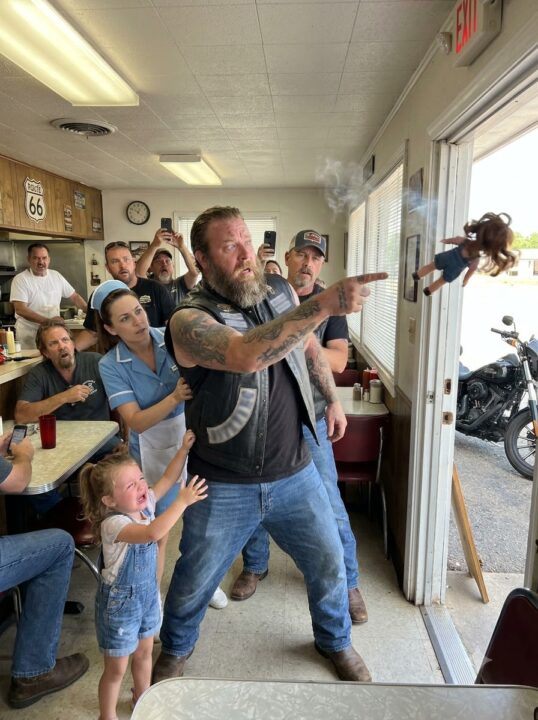
The flame died.
The smell remained.
Burned plastic entered the diner, thick and chemical, and settled above the smell of coffee and frying oil. Customers who had been prepared to fight Rook now backed away from the doorway.
Rook stood beside the pie case with a red mark from my hand across his face. Aaron still held part of his vest, though neither man seemed aware of it.
“You knew,” Aaron said.
Rook looked toward Lucy. “I suspected.”
“How?”
“Sound changed. Motor slowed. Smelled electrolyte.”
I did not understand the words. My daughter did.
“You broke Daddy.”
Her voice silenced him.
Rook lowered himself onto one knee, placing nearly three feet between them. He looked larger down there, not smaller. His leather creaked. Tattoos covered the backs of his hands, but his palms remained open.
“What’s your name?”
Lucy buried her face against my waist.
I answered for her. “Lucy.”
Rook nodded. “Lucy, I’m sorry I scared you.”
“You killed Maisie.”
“I stopped the fire.”
“My daddy was inside.”
He looked at me.
I did not want to explain anything to him. I still felt the sting in my palm from striking his face, and anger had not disappeared simply because smoke proved he had seen something I missed.
Yet the entire diner was waiting.
“Her father recorded a message in the doll,” I said. “He died nineteen months ago.”
Rook’s eyes returned to the burned shape outside.
“What kind of recording?”
“A little voice module. He installed it before his last deployment.”
“Original chip?”
“I don’t know.”
Stone moved toward the gravel.
Rook caught his wrist. “Battery could reignite.”
Stone stopped. He did not argue. That obedience told me more about Rook than any patch could have.
The police arrived seven minutes later. Officer Dana Ruiz entered through the front with one hand near her holster and found twelve people trying to explain the same three seconds.
Half said Rook attacked Lucy.
Half said he saved her.
Both statements felt true to the people saying them.
Officer Ruiz separated us. She photographed the doll from a distance, requested the fire department, and reviewed three phone videos. The first began after Rook reached for Maisie. The second showed me slapping him. The third captured the thin smoke beneath Lucy’s hand before he moved.
That third video ended the question of arrest.
It did not end the anger.
“You could have warned me,” I told him outside.
“I did.”
“You said it was cooking. Who says that about a doll?”
“Man watching a battery cook.”
“You could have explained.”
Rook looked at the blackened gravel. “How many seconds you want me to spend making fear sound polite?”
I had no answer.
The fire captain opened the burned battery compartment after checking its temperature. One rechargeable cell had split. A thin wire installed beside the voice unit had lost part of its insulation, probably after years of pressure and repeated drops. The exposed copper had touched the battery contact.
Heat had built inside the plastic torso.
The captain said Lucy could have suffered serious burns. If the synthetic dress had ignited against her body, the fire would have climbed quickly.
I pulled her closer.
Rook turned away.
At first, I thought he had lost interest. Then I saw his right hand shaking against the seam of his vest.
Stone saw it too.
“You good, brother?”
“Fine.”
“That ain’t an answer.”
“It’s the one I got.”
The Black River Riders gathered around the damaged doll. There were six of them: Stone, a retired welder with a gray beard; Hector “Fuse” Alvarez, an automotive electrician; Calvin “Preacher” Boone, who had not attended church in twenty years; Lenny Shaw, a former Army medic; Milo Grant, the youngest prospect; and Rook.
None touched Maisie until the fire captain declared the battery safe.
Rook crouched near it. The doll’s face had melted along one cheek. Its yellow dress was black around the back, and the voice box no longer spoke.
Lucy watched from behind my legs.
Rook removed a clean shop rag from his saddlebag and wrapped the doll carefully. When he lifted it, his scarred hands behaved as though he were carrying something alive.
“I’m taking it to Fuse,” he said.
“No.”
The word left me faster than thought.
Rook stopped.
“That doll belongs to Lucy.”
“Then come with us.”
“I’m not taking my daughter to a biker garage.”
Hector’s mouth tightened. Milo looked offended. Stone stepped between them before anyone answered.
Rook handed the wrapped doll to me.
“All right.”
That surrender surprised me.
I expected an argument. Instead, he wrote a phone number on the back of Rosie’s receipt and placed it beside the bundle.
“When you decide the voice matters more than where my boots have been, call.”
Then he mounted a black Harley-Davidson Road King. The engine started with a deep uneven pulse, followed by five others. The motorcycles left the gravel shoulder one by one, their exhaust rolling beneath the diner windows.
Lucy stood beside me with the burned doll in her arms.
“Is he coming back?”
“I don’t know.”
She studied the number.
“He said he was sorry.”
“Yes.”
“Do scary people say sorry?”
I watched Rook’s taillight disappear along Route 66.
“Sometimes.”
That evening, Lucy refused to sleep without Maisie. She placed the wrapped remains on Daniel’s pillow and pressed the burned plastic hand again and again, waiting for a voice that did not return.
At 2:14 in the morning, I called the number.
Rook answered before the first ring finished.
Part 3 — The Voice Beneath the Burned Plastic
The Black River garage occupied an old tire shop north of Tulsa, behind a feed warehouse and a row of rusting trailers. At nine the next morning, Lucy and I found eighteen motorcycles parked outside.
I almost drove away.
Then the garage door opened, and Rook walked toward us carrying no helmet, gloves, or leather vest. He wore a faded charcoal shirt, work pants, and reading glasses that made him look strangely older.
He stopped six feet from the car.
“You came.”
“You said Hector might recover the recording.”
“Might.”
Lucy held the wrapped doll against her chest.
Rook opened the passenger door but did not reach for it. “May I?”
She looked at me. I nodded.
Lucy handed him Maisie.
Inside, the garage smelled of motor oil, coffee, welding smoke, and old rubber. Engines rested on metal stands, but the center workbench had been cleared and covered with a white cotton sheet.
Hector wore magnifying lenses over his glasses. Beside him were tiny screwdrivers, insulated pliers, a soldering station, and three plastic containers labeled only with colored tape.
“No promises,” he said. “Heat may have cooked everything.”
Lucy climbed onto a stool.
Rook remained near the wall.
Hector removed the damaged dress and opened the doll’s torso. The split battery had melted part of the housing. The wire Daniel added had fused to the speaker lead, but a small memory chip remained attached to the edge of the board.
Hector pointed at it. “That’s where the voice probably lives.”
“Can you make it talk?” Lucy asked.
“Maybe. First, I have to convince it not to die.”
For four hours, the men worked around her.
Stone brought pancakes. Milo found a package of doll clothes at a discount store. Preacher sat on the floor and let Lucy cover the tattoos on his arm with purple adhesive stars.
Rook stayed apart.
Whenever the soldering iron touched the board, his shoulders tightened. Whenever Hector tested the damaged battery compartment, Rook moved closer to Lucy.
I began noticing things I had missed at the diner. A smoke detector hung above every work area. Metal battery boxes lined one wall. A fire blanket rested beside each exit. Even the club’s phone-charging station used timer plugs and heat-resistant mats.
“This place looks more inspected than my daughter’s school,” I said.
Stone poured coffee into a chipped mug. “Rook’s rules.”
“Why?”
Stone glanced toward him. “Ask Rook.”
Rook heard. “Because garages burn.”
“That isn’t the whole answer.”
“It’s enough.”
At 1:26, Hector connected the memory board to a small amplifier.
Static filled the garage.
Lucy held my hand.
A broken syllable emerged from the speaker. Then another.
“Dad… loves…”
The sound vanished.
Lucy leaned forward. “Again.”
Hector adjusted a wire. “Give me a minute.”
Rook left the garage.
I found him behind the building beside his motorcycle, gripping the handlebars hard enough to whiten the scars across his knuckles.
“You recognized the battery at Rosie’s.”
“Yes.”
“You have fire equipment everywhere.”
“Yes.”
“And you carry a burned pink bow inside your vest.”
His face closed.
I should have stopped.
I did not.
“Whose was it?”
Rook looked toward the garage door. Lucy’s faint laughter passed through the metal wall as Milo tried to pronounce the doll brand.
“My daughter’s.”
The word struck without warning.
Rook’s daughter, Ava Mercer, had been seven years old when a battery-powered toy caught fire in the back seat of his truck. It happened sixteen years earlier, before lithium battery warnings appeared everywhere, before Rook knew that a sweet solvent smell and a slowing motor could mean heat was building inside a sealed compartment.
Ava had been holding a toy carousel.
The music slowed.
She told him it felt warm.
Rook was driving through afternoon traffic and told her to set it beside her.
She did.
Less than a minute later, the battery ruptured.
The flash ignited the toy’s synthetic ribbons and the blanket across Ava’s lap. Rook stopped the truck, pulled her out, and smothered the flames with his leather jacket.
He saved her from the fire.
He could not save her from what followed.
Ava spent eleven days in a burn unit. Infection entered her lungs. On the final night, Rook sat beside her bed holding the pink bow nurses had cut from her hair.
She died before sunrise.
I looked at the huge man beside the Harley and understood the recognition I had seen at Rosie’s. Rook had not been guessing when Daniel’s voice slowed inside the doll.
He had been returned to the back seat of that truck.
“Was it the same kind of battery?” I asked.
“Close enough.”
“You could have told us.”
“Couldn’t tell a room while her hands were burning.”
“They weren’t burning yet.”
Rook’s eyes met mine. “That word matters.”
Yet.
The garage door opened. Stone called for him.
Inside, Hector had stabilized the memory chip. He pressed a key.
Daniel’s voice came through the speaker, thin and damaged but recognizable.
“Hey, Lucybug. If you’re hearing this, bedtime must be putting up a fight. Close those brown eyes. Daddy loves you past every road, past every star, and all the way home.”
Lucy covered her mouth.
I had not heard the full message in months. The doll’s weak batteries had swallowed the middle and final words so gradually that neither of us remembered what was missing.
Lucy cried.
So did I.
Rook stood behind us with his hands closed at his sides. He did not look away, but the muscles in his jaw moved beneath his beard.
Hector saved three copies of the recording.
“One for the new unit,” he said. “One for Mom. One stays in the fireproof box here.”
“What new unit?” I asked.
The bikers looked at Rook.
He set a cardboard box on the workbench.
Inside was another Maisie doll.
The face matched. The yellow dress matched. Even the brown hair and half-closed eye looked the same.
Lucy touched it carefully.
“They stopped making those eight years ago,” I said.
Rook nodded.
“Where did you find it?”
“Missouri.”
“This morning?”
“Club in Springfield had one.”
Stone added, “Rook rode halfway. Their road captain met him in Joplin at dawn.”
I stared at him. “You rode almost three hundred miles after leaving the diner?”
“Two hundred seventy-four.”
“To buy a doll?”
“No.”
Rook pointed toward the recovered memory chip.
“To bring her father home.”
We believed that was the end of the story.
It was only the first repair.
Part 4 — The Fire That Followed Him Home
News of the incident reached social media before we returned from the garage. The first video showed Rook taking the doll but ended before smoke appeared.
Its caption accused a biker of terrorizing a child inside a Route 66 diner.
By Sunday evening, it had been viewed more than a million times.
Strangers called him a monster. They posted the garage address. A local parent group demanded that police investigate the Black River Riders.
The full video existed, but outrage traveled faster.
Milo wanted to answer every comment. Preacher wanted to ride the entire club to Rosie’s and ask witnesses to speak publicly. A younger member suggested posting the name and workplace of the man who uploaded the clipped recording.
Rook stopped them.
“No threats. No rides. No names.”
“They’re calling you a child abuser,” Milo said.
“They don’t know.”
“Then make them know.”
Rook looked at the prospect. “We show up angry, they stop hearing facts.”
“What are we supposed to do?”
“Nothing.”
That order tested the club more than a fight would have.
The Black River Riders had spent years being judged by their leather, motorcycles, scars, and silence. Now their road captain had prevented a child from being burned, yet the world saw only the second when his large hands took something from her.
Stone disagreed with Rook privately. “Silence ain’t always discipline.”
“Noise ain’t always truth.”
“The garage got three threats today.”
“Lock the gate.”
“What about the kid?”
Rook looked toward the new doll on Hector’s bench. “Finish what we started.”
Officer Ruiz asked me to approve the release of the full diner footage. I hesitated because Lucy’s face and Daniel’s voice appeared in it.
Rook told her not to pressure me.
“He’s losing work because of that video,” Ruiz said. “The county canceled his safety presentation at two schools.”
I stared at her. “What safety presentation?”
Rook was not a firefighter, doctor, or celebrity rescuer. He repaired industrial refrigeration systems and rode with the Black River Riders on weekends.
After Ava died, however, he completed fire-behavior courses and battery-safety training. He began speaking at repair shops, community centers, motorcycle clubs, and schools about damaged rechargeable cells.
He never mentioned Ava by name.
He placed burned phones, power tools, toy compartments, and vape batteries on a metal table. Then he taught people to recognize warning signs: swelling, clicking, strange smells, excessive heat, slowed motors, distortion from speakers, and smoke.
The county fire marshal had used his demonstration kit for six years.
Rook carried a thermal blanket and extinguisher on every ride. The orange pouch in his saddlebag was not a first-aid kit, as I assumed.
It was a battery containment bag.
That was the first hidden truth.
The second came from Daniel’s doll.
When Hector examined the wiring, he discovered the rechargeable batteries were not part of the original toy. Someone had replaced the factory compartment with a homemade pack using cheap unprotected cells.
I recognized the handwriting on the small label.
Daniel’s.
He had modified Maisie before his final deployment because Lucy went through disposable batteries too quickly. He built the pack carefully, but years of drops, heat, spilled drinks, and pressure against the added voice module had damaged the insulation.
The fire was not caused by neglect.
It was caused by love that had remained in use too long.
I blamed myself anyway.
Rook found me sitting outside the garage with the charred compartment in my hand.
“I should have checked it.”
“You didn’t know.”
“I’m her mother.”
“Still don’t make you an electrician.”
“I heard the voice slowing.”
“So did twenty people.”
“You acted.”
Rook lowered himself onto the concrete step. “Because I paid for knowing.”
I looked toward the pink bow sewn inside his vest.
“Ava paid more.”
He did not answer.
Inside, the brotherhood faced another problem. The replacement doll used a newer voice mechanism. Hector could load Daniel’s recording, but Lucy wanted the original plastic hand and speaker because they carried the scratches her father had touched.
The speaker was damaged. The hand smelled of smoke. Rook refused to place any burned electrical component inside the new doll.
Lucy refused the replacement.
“That isn’t Maisie,” she said.
Rook knelt in front of her. “Looks like her.”
“No.”
“Same dress.”
“No.”
“Same voice.”
“It doesn’t have Daddy’s hand.”
The room waited for him to explain why safety mattered more than memory.
He did not.
He sat on the floor across from her.
“What makes it Daddy’s hand?”
Lucy showed him three scratches near the thumb. Daniel’s wedding ring had made them while he installed the recorder.
Rook studied the marks.
“Can copy those.”
“That’s cheating.”
“Yes.”
Lucy frowned at the honesty.
Rook removed his silver skull ring. He pressed it gently against a discarded plastic part, drawing three pale lines.
“Sometimes a mark isn’t the thing,” he said. “It’s where you remember the thing came from.”
Lucy touched the scratches.
Then she pointed toward the pink bow.
“Is that from your little girl?”
Rook became still.
I had not told her.
Children collect truths from rooms adults believe they have hidden.
“Yes.”
“Is it safe?”
“Safe enough.”
“Is it the whole bow?”
“No.”
“Then you kept a little piece.”
Rook looked down.
Lucy carried the new doll to Hector’s bench. “Can I keep a safe piece of old Maisie?”
They selected one yellow button untouched by heat. Hector cleaned it, sealed it, and stitched it inside the new dress.
The replacement contained Daniel’s restored voice, a factory-protected battery system, and one button from the doll he had held.
It was not the original.
It was not a lie either.
Before Lucy took it home, Rook placed a small smoke-resistant pouch in my hands. Inside were instructions for inspecting batteries, a simple temperature indicator, and three copies of Daniel’s recording.
“You keep one somewhere else,” he said.
“Why three?”
“Fire doesn’t care about only copies.”
That sentence explained his garage, the equipment, the rules, and perhaps his entire life.
Rook had spent sixteen years creating second copies of things he could not bear to lose again.
Part 5 — The Doll He Bought Twice
The full diner video was released on Monday morning with my permission. It showed the warning signs everyone missed, Rook asking me to take the doll, the smoke beneath Lucy’s fingers, the throw, and the flame outside.
Public opinion reversed before lunch.
The same people who called him dangerous began calling him a hero. News stations parked outside the garage. A toy-safety organization offered him an award. Three television producers requested interviews.
Rook refused them all.
“Yesterday I was a monster,” he told Stone. “Today they want me smiling between commercials.”
Stone shrugged. “You got a smile?”
“No.”
“Problem solved.”
One reporter came to Rosie’s anyway. She asked Lucy whether the biker had frightened her.
“Yes,” Lucy said.
“Did he save you?”
“Yes.”
“Is he a hero?”
Lucy studied the microphone. “He’s Rook.”
It was the only description he accepted.
The clipped-video uploader was a nineteen-year-old diner customer named Caleb Moss. He had not intended to lie. He began recording when Rook crossed the room, stopped after the doll was thrown, and uploaded the video before the fire department completed its inspection.
The angry caption was added by another account.
Caleb came to the garage to apologize.
Milo wanted him removed. Preacher called him a coward. Several club members believed the threats against their families were partly his fault.
Rook let Caleb speak.
“I thought you were hurting her,” the young man said.
“You knew that?”
“I thought I knew.”
“Different thing.”
“I should have waited.”
“Yes.”
Caleb looked at the motorcycles and men surrounding him. “What do you want me to do?”
Rook led him to the battery table.
“Learn.”
For eight hours, Caleb helped Hector dismantle damaged battery packs. Rook taught him to film swelling, insulation failure, heat damage, and venting without creating panic.
Then he asked Caleb to make a new video.
It did not praise Rook. It explained how ordinary devices warn people before they burn.
Lucy appeared only through a drawing she made of a yellow doll beside a black motorcycle. No face. No tears. No dramatic music.
The video reached more people than the accusation.
Schools reinstated Rook’s safety demonstrations. The county invited the Black River Riders to help distribute battery disposal containers across rural towns.
The brotherhood had wanted to fight.
Instead, they built boxes.
That was Rook’s kind of answer.
Three weeks after the diner incident, he returned to Rosie’s with twenty-seven motorcycles behind him. Their V-twin engines rolled across the windows, then stopped almost together.
Several customers stood.
This time, nobody left.
Rook entered carrying a plain cardboard box. The pink bow remained hidden inside his vest. A healing line crossed his cheek where my ring had struck him.
Lucy waited beside the register.
He placed the box on the counter.
“Bought you something.”
“You already bought Maisie.”
“That was replacing what I threw.”
Lucy opened the box.
Inside was a second doll—not another Maisie, but a small mechanic doll wearing blue coveralls, safety glasses, and miniature work boots.
Its plastic toolbox contained no batteries.
Lucy laughed.
“What’s her name?”
Rook shrugged. “Your doll.”
“You have to name her.”
“Why?”
“You bought her.”
Stone coughed behind him. “Call her Spark Plug.”
Rook turned. “Nobody asked you.”
Lucy considered the doll. “Ava.”
Silence spread through the diner.
Rook’s face did not change quickly. His eyes moved toward me, asking whether I had suggested it.
I shook my head.
Lucy touched the small pink bow inside his vest. “Then Maisie won’t be alone.”
Rook closed his hand around the edge of the counter.
“No,” he said. “Guess she won’t.”
That was when I learned the doll had been purchased twice.
Rook bought the first one from a collector in Springfield. The collector refused payment after hearing why it was needed.
Rook paid anyway.
Then the Black River Riders reimbursed him from their emergency fund without telling him. When he discovered it, he returned the money.
The club spent it again on battery containment bags for every diner, daycare, and school along their annual charity route.
Rook complained for two weeks.
Nobody returned the bags.
Rosie placed one beneath the register. We added a metal battery disposal container near the back door and trained every employee to recognize overheating devices.
Aaron Pike, the trucker who held Rook against the pie case, attended the first class.
So did I.
At the end, Rook passed around the burned remains of Maisie’s original battery compartment. Each person felt how little the damaged wire weighed.
“People expect danger to look big,” he said. “Usually starts smaller than your thumbnail.”
Aaron raised his hand. “What should somebody do if a child is holding it?”
“Get it away.”
“Even if the parent doesn’t understand?”
Rook looked at me.
“Especially then.”
After class, Aaron apologized for threatening him.
Rook shook his hand. “You thought you were protecting the kid.”
“I was protecting her from the wrong man.”
“Still stood up.”
That was all Rook needed.
He did not demand that those who misjudged him crawl beneath their own shame. He separated the instinct from the mistake.
Then he made the instinct useful.
Part 6 — The Name Hidden in the Yellow Dress
Months passed, but Rook continued visiting Rosie’s every second Saturday. He occupied the same booth with his back against the wall and ordered black coffee.
Lucy brought both dolls.
Maisie sat beside the sugar jar. Ava, the mechanic doll, inspected the napkin dispenser with a plastic wrench.
Rook pretended not to participate.
Then Lucy found a tiny motorcycle helmet inside his saddlebag. It fit Ava perfectly.
“You bought this,” she accused.
“Found it.”
“It has her name inside.”
“Coincidence.”
“You wrote it.”
“Prove it.”
The letters were blocky and uneven. Rook’s hands were built for tools heavier than a marker, but he had written AVA carefully beneath the helmet strap.
Lucy did not expose him.
She placed the helmet on the doll and ordered pancakes.
The ritual became ordinary. That mattered more than the news stories.
Rook taught Lucy to identify battery warnings without frightening her. She learned that heat, swelling, strange odors, clicks, hissing, and slowing motors meant she should set an object down, move away, and find an adult.
He never made her fear every toy.
He taught her to notice when a familiar thing changed.
In return, Lucy taught Rook how to brush synthetic doll hair without pulling it out. The first time he tried, he held the brush like a wrench and removed a clump.
“You’re bad at this,” she said.
“Yes.”
“My daddy was bad too.”
Rook stared at the brush.
“Then I’m in decent company.”
One October afternoon, he brought the original yellow button from Maisie’s burned dress. Hector had sealed it inside a clear, heat-safe pendant.
Rook had planned to give it to Lucy.
She pushed it back.
“You keep it.”
“Belongs to you.”
“You saved the voice. You should have a piece.”
Rook looked at me. I left the decision to him.
He placed the pendant inside his vest beside Ava’s pink bow. One piece came from the child he could not save. The other came from the child he reached in time.
He carried both.
Not as a trade.
Never as a replacement.
The club’s battery program grew across three counties. Caleb filmed the training sessions. Aaron distributed safety cards at truck stops. Rosie hosted collection days in the parking lot beneath a hand-painted sign with no photographs of Rook.
He insisted on that.
“Why don’t you want your face on it?” Lucy asked.
“Ugly.”
“That’s not the reason.”
Rook drank his coffee.
She waited.
Finally, he pointed toward the battery box. “Works without my face.”
Lucy nodded as if this were acceptable, then taped a tiny drawing of his beard beneath the lid where nobody could see it.
He found it two weeks later.
He left it there.
Part 7 — Past Every Road
One year after the fire, Lucy and I returned to Rosie’s before sunrise. The diner was closed, but thirty-one motorcycles waited along Route 66.
Rook stood beside his Harley in a plain leather vest. The yellow-button pendant and pink bow remained hidden over his heart.
The Black River Riders were beginning their annual safety run, carrying battery containers and fire blankets to rural schools across Oklahoma and Missouri.
Lucy had been given the first delivery.
It was a red metal box for her elementary-school office. She decorated one corner with a tiny yellow button and three black lines resembling motorcycle tire marks.
Rook checked the lid.
“No glitter near the hinge?”
“No.”
“Nothing blocking the seal?”
“No.”
“Good.”
Lucy lifted Maisie’s hand.
Daniel’s restored voice entered the cold morning air.
“Daddy loves you past every road, past every star, and all the way home.”
Rook lowered his head.
The recording finished.
Lucy held out Ava, the mechanic doll. “She wants to ride.”
“No.”
“She has a helmet.”
“Still no.”
“She says you’re scared.”
Rook looked at the doll. “She talks a lot.”
“Like me.”
“Yes.”
He opened the Road King’s hard saddlebag. Inside, secured away from tools and batteries, was a padded compartment Stone had built for one small doll.
Lucy placed Ava inside.
Rook closed the lid and checked it twice.
Before mounting the motorcycle, he handed me a new smoke-resistant pouch. The first one remained beneath Rosie’s counter, but this was for my car.
“You don’t have to keep buying things for us,” I said.
“I threw her doll.”
“You saved her hands.”
“Both happened.”
That was how Rook understood responsibility. A good reason did not erase the fear he caused. Saving Lucy did not return the toy intact. Buying a replacement did not make Ava’s death disappear.
He carried all of it.
The motorcycles started one after another. Deep V-twin pulses moved through the empty parking lot and into the diner windows.
Lucy covered her ears but smiled.
Rook rolled toward the highway, then stopped beside us. He lifted his visor and looked at the doll tucked beneath Lucy’s arm.
“Battery cool?”
She touched Maisie’s back.
“Cool.”
“Voice clear?”
“Yes.”
“Then you’re good.”
He lowered the visor.
Thirty-one motorcycles turned onto Route 66, their red taillights forming a broken line beneath the pale Oklahoma sky.
Lucy pressed the doll’s hand once more.
Her father’s voice followed them toward the horizon.
Follow the page and leave ROOK below for more stories about misunderstood bikers whose quickest actions reveal their quietest reasons.