A 10-Year-Old Mailed A Letter To “The Nearest Motorcycle Club” Begging Them To Find Her Dog — When The Bikers Brought Him Home, Her House Was Empty And Something Was Hidden In His Collar
Part 2
Let me back up to Monday. To the letter. And to the four days we spent looking.
When Otis said call everybody, I called everybody.
By that night, twenty-nine of our thirty-four members were sitting in the clubhouse. A couple of the guys’ wives came too. Miss Opal came, still in her postal uniform. She said she felt responsible.
I read the letter out loud.
When I got to the part about her mom, the room went quiet.
When I got to Bikers always help. She said that because her daddy was one, a man named Ronnie Swafford put his beer down and walked outside for a minute.
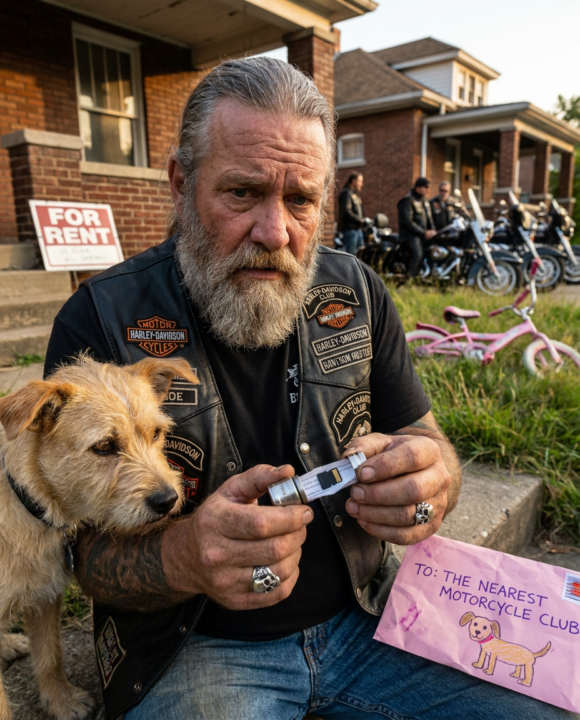
When I got to the part about the collar, Otis held up his hand.
“Read that again.”
Please, PLEASE do not take off his collar. It’s important. I can’t tell you why.
“Why would a ten-year-old say that?” Otis said.
Nobody knew.
We had a return address. We had a name. Avery C.
We had a rule we made right there, that night: we would not contact her. Not her house. Not her school. She’d asked us not to. Craig reads everything. Whatever was going on in that house, she didn’t want him knowing she’d written to us.
So we wouldn’t.
We’d just find the dog.
I’m a mechanic. I think in systems. So I made a map.
Avery said Craig took Biscuit in his truck on Saturday and came back later. She said somewhere far. That meant he’d driven a while. An hour, maybe more. Out and back.
You can cover a lot of ground in an hour from Calhoun. North up I-75 toward Dalton. South toward Cartersville. West on Highway 140 toward Rome.
Three counties, mostly. Gordon. Bartow. Floyd.
Six animal shelters. Two county pounds. Forty-some veterinary clinics. Countless back roads, church parking lots, feed stores, and gas stations where somebody might have seen a yellow dog wandering.
We split into teams. Four bikes each.
Ronnie printed flyers at the library. We used Avery’s drawing on them. A yellow dog with one floppy ear and a red collar.
LOST — BISCUIT. Yellow mixed breed. 6 yrs old. One floppy ear. Red collar with silver barrel tag. Do NOT remove collar. If found, call the Coosa Valley Riders.
We put my cell number on every one.
Tuesday, we hit every shelter in Gordon County. Nothing.
Tuesday night, it rained. We rode the back roads east of Calhoun anyway, in rain gear, flashlights on our handlebars. Nothing.
Wednesday, Bartow County. Cartersville animal control. Adairsville. Two vet clinics on Highway 41. A man at a feed store in Kingston thought he’d seen a yellow dog by the railroad tracks. We rode out there. It was a yellow Lab, somebody’s pet, on a porch.
Wednesday night, I sat in my garage looking at the map and thinking about that collar.
Here’s what we learned about Avery’s family that week. Just from asking around. Calhoun’s a small town.
Her mother’s name was Megan Collins. Thirty-four. A dental assistant. Pretty, funny, laughed loud. Her father, Avery’s grandfather, had been a biker. Rode with a club out of Dalton in the eighties. He passed in 2019.
Megan was killed last July on I-75 near Resaca. A tractor-trailer driver fell asleep at the wheel and crossed the median. She died at the scene.
There’d been a settlement. Big. Everybody in town knew about it, the way everybody in town knows everything. The trucking company’s insurance paid. All of it went into a trust for Avery. She’d get it at eighteen.
Until then, whoever had custody of Avery controlled it.
And right now, that was her stepfather.
Craig Dunleavy. Forty-four. Insurance adjuster. Married to Megan for two years. Neighbors said he was polite. Kept the lawn mowed. Didn’t go to church. Didn’t have friends over.
Avery’s real father, Luke Collins, lived in Chattanooga. Thirty miles north. A welder. He and Megan had split when Avery was three. He’d always had visitation. Every other weekend.
After Megan died, Avery stayed in Calhoun with Craig, at the house, so she wouldn’t have to change schools. Temporary.
Luke had filed for full custody in January.
The hearing was set for the following Monday.
I didn’t put any of that together on Wednesday night.
I should have.
Part 3
Thursday morning, Otis called me at six.
“Floyd County,” he said. “The holding facility out on Mathis Road. Ronnie’s sister works the front desk. She saw the flyer. They got a yellow dog came in Saturday night. Farmer found him on a dirt road off Highway 20.”
I was on my bike in eight minutes.
The Floyd County animal holding facility is a long, low metal building on a gravel lot west of Rome. Concrete runs. Chain-link. It smells like bleach and fear.
Ronnie’s sister, Tammy, walked us back.
At the end of the last row, in a run with a cracked water bowl and a blanket somebody had donated, a yellow dog was lying with his chin on his paws.
One ear up. One ear flopping.
Red collar.
Little silver barrel tag.
“Biscuit,” Otis said.
The dog’s head came up.
His ears went up. Both of them, for once. His tail started to go.
Otis got down on his knees on the concrete outside that chain-link. Sixty-four years old. His knees are shot. He did it anyway.
Biscuit came to the fence and licked his fingers through the wire.
Tammy said, quietly, “He was on the list. Tomorrow morning. We’re full. I’m sorry. We didn’t know anybody was looking.”
Otis didn’t say anything for a while.
Then he said, “We were looking.”
Nobody touched that collar.
We’d made a promise to a ten-year-old. We kept it.
Otis paid the fees. Signed the papers. Carried Biscuit out to his truck himself and set him on a horse blanket in the bed.
Then Otis made a phone call. And another.
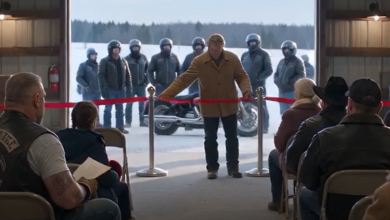
By noon, thirty-four members of the Coosa Valley Riders were lined up on the gravel outside that holding facility.
“She asked us to find her dog,” Otis said. “We’re gonna bring him home. All of us.”
We rode back to Calhoun in a column a quarter-mile long. Highway 140 to 53 to 41. People pulled over to watch. A little boy at a gas station in Plainville waved with both arms.
Biscuit rode in the truck bed with his nose in the wind and his floppy ear blowing inside out.
I rode right behind him the whole way.
I kept thinking about her face. I’d never seen it. I imagined it anyway. A ten-year-old girl opening her front door and seeing her dog. Seeing thirty-four bikers in her street. Seeing that somebody listened.
I thought that was going to be the end of the story.
The best thing any of us had ever done.
Then we turned onto her street.
The FOR RENT sign in the yard.
The empty carport. The bare windows. The pink bicycle lying in the weeds.
The neighbor in the housecoat. They left yesterday. He said Florida.
We stood in that front yard, thirty-four of us, in total silence.
We’d been one day late.
Biscuit had jumped down out of the truck bed. He ran to the front door. He scratched at it. He whined. He ran around to the back gate and whined there. He ran back to the front and sat down on the welcome mat and looked up at the door.
Waiting.
That’s when I couldn’t take it anymore. I sat down on the front steps next to him.
He leaned against me.
He shook his head. Hard. The way dogs do.
And I heard it. Clear as anything. Inside that little silver barrel on his collar.
A rattle.
A hard, small, plastic click.
Not paper.
Part 4
I looked at Otis.
“She said don’t take it off,” I said.
“She didn’t say don’t open it,” Otis said.
I didn’t take the collar off. I just turned the little barrel tag in my fingers and unscrewed it.
Inside, rolled up tight, was a strip of paper with a phone number on it in a woman’s handwriting. Megan’s, I’d learn later. And her name. Biscuit — call Megan.
And wrapped inside the paper, wedged so it wouldn’t move, was a tiny black rectangle.
A microSD memory card. The kind that goes in a phone or a tablet.
Ronnie had a laptop in his saddlebag. He uses it for work. He had an adapter in the case.
We sat on the tailgate of Otis’s truck in the driveway of that empty house, thirty-four bikers crowded around a laptop screen, and we put the card in.
There was one folder on it.
The folder was named PROOF.
Inside, three videos.
The first one was dark. Shaky. Shot from low down, like somebody was hiding a tablet behind something. A kitchen table. A man’s hands. Papers spread out.
You could see his face for a second when he leaned back. Forties. Clean-cut. Glasses.
He had a birthday card open on the table beside him. A kid’s birthday card with a cartoon bear on the front. Inside, a signature. Love, Daddy.
And he was tracing it.
Over and over, on a blank sheet of paper. Getting the loops right. Then he picked up an official-looking form and signed it.
I couldn’t read the form. Ronnie zoomed in.
U.S. Department of State. Statement of Consent: Issuance of a U.S. Passport to a Minor Under Age 16.
The space for the second parent’s signature.
Luke Collins.
The second video was audio, mostly. The tablet must have been in a drawer. Craig’s voice, on the phone. Calm. Businesslike.
“Thursday. Six-forty out of Atlanta. San José. No, she doesn’t know. I’m telling her it’s a vacation. Once we’re down there, the custody hearing doesn’t matter. I’m her guardian. The trust pays out for her care. Monthly. As long as she’s with me.”
A pause.
“No. Her father won’t find us. Not for a long time.”
The third video was the shortest.
A girl’s face. Close to the camera. Brown hair in a messy ponytail. Freckles. Red eyes. Whispering.
“My name is Avery Collins. I’m ten. That’s my stepdad Craig. He’s pretending to be my dad’s handwriting. He’s going to take me somewhere far away. He took my tablet so I’m putting this in Biscuit’s collar. If somebody finds this, please call my real dad. His name is Luke Collins. He lives in Chattanooga. Please.”
The screen went dark.
Nobody said anything.
Thirty-four men and women standing around a truck tailgate in an empty driveway in Calhoun, Georgia, and you could have heard a pin drop.
Then Otis looked at his watch.
It was 3:12 p.m.
Thursday.
The flight was at 6:40.
Hartsfield-Jackson Atlanta International Airport was seventy-five miles south.
Otis didn’t yell. He didn’t panic. He just started giving orders, one at a time, like a man who’d been in the Navy for twenty years.
“Hutch. Call 911. Gordon County Sheriff. Tell ’em everything. Tell ’em we got video.”
“Ronnie. Find Luke Collins. Welder. Chattanooga.”
“Everybody else. Mount up.”
I called 911 standing in that driveway. I told the dispatcher every word. I think she thought I was crazy for the first thirty seconds. Then I said forged passport consent and flight to Costa Rica tonight and ten-year-old girl and we have video, and her voice changed.
She transferred me to a sergeant at the Gordon County Sheriff’s Office.
The sergeant asked for the video. Ronnie emailed it while I was on the phone. Ten minutes later, the sergeant called back.
He’d called the FBI field office in Atlanta.
They’d called the Atlanta airport police.
Ronnie found Luke Collins in four minutes. Facebook. Then a phone number.
Luke picked up on the second ring. At work. Welding shop on Rossville Boulevard in Chattanooga.
Ronnie told him.
Ronnie told me later he could hear the welding torch hit the floor through the phone.
“I’m coming,” Luke said.
“Meet us at the airport,” Ronnie said. “International terminal.”
At 3:24 p.m., thirty-four motorcycles and a pickup truck pulled out of that empty driveway in Calhoun and turned south toward I-75.
Biscuit was in the truck bed.
The pink bicycle was still lying in the weeds.
I looked back at it as we turned the corner.
We’re coming, I thought.
Hold on.
Part 5
I’ve ridden I-75 between Calhoun and Atlanta a thousand times.
I’ve never ridden it like that.
We didn’t break any laws. I want to be honest about that. We weren’t going to get there faster than the police, and we knew it. The FBI and airport police were already moving. We weren’t the rescue.
But Otis said it on the gravel before we left, and every one of us felt it.
“She wrote to us,” he said. “She’s gonna see us there.”
Rush hour hit at Marietta. The interstate turned into a parking lot.
We split lanes where it was legal. We rode the shoulder where it was marked for it. A Georgia State Patrol trooper pulled up beside us at the I-285 interchange with his lights on, and I thought, This is it, they’re gonna stop us.
The trooper rolled down his window. “You the bikers with the dog?” he yelled.
Otis nodded.
“Sheriff’s office called it in,” the trooper said. “Follow me.”
He escorted us the last twenty-two miles. Lights going. Clearing lanes.
I’ve never been so grateful to see blue lights in my life.
We pulled into the international terminal curb at 5:31 p.m.
Thirty-four motorcycles. A pickup truck. A state trooper.
Airport police were waiting on the curb. Three officers. They didn’t stop us. One of them came over to Otis.
“FBI’s inside,” he said. “They pulled him out of the check-in line twenty minutes ago.”
Otis just stood there.
“The girl?” he said.
“She’s with an agent. She’s safe.”
Otis sat down on the curb. Right there on the concrete outside the international terminal. Sixty-four years old. Big hands over his face.
Luke Collins came running down the sidewalk at 5:48.
Thirty-eight. Welder’s jacket still on. Burn marks on the sleeves. Safety glasses still pushed up on his head. He’d driven the hundred and twenty miles from Chattanooga in an hour and fifty minutes and he didn’t remember any of it.
He saw the bikers. He saw the dog in the truck bed.
He didn’t say anything to us.
He went straight through the terminal doors.
At 6:12 p.m., the terminal doors slid open.
An FBI agent came out first. A woman. Then Luke Collins.
Holding the hand of a ten-year-old girl in a purple hoodie with a messy brown ponytail.
Avery.
She was crying. She’d been crying a long time. She looked scared and tired and confused.
Then she saw the curb.
Thirty-four motorcycles. Thirty-four bikers in leather standing beside them, in a long line along the international departures curb at the busiest airport in the world.
She stopped walking.
Then she saw the truck.
And the yellow dog in the back of it, standing up on the horse blanket, every inch of him shaking, one ear up and one ear flopping, making a sound I’ve never heard a dog make.
“BISCUIT!”
She let go of her father’s hand.
Biscuit came over the side of that truck bed in one jump. He hit the sidewalk running.
They met in the middle of the crosswalk.
She went down on her knees. He climbed all over her. She wrapped both arms around his neck and buried her face in his scruffy yellow fur and sobbed, and he licked her face and her ears and her hair, whining, crying, his whole body wagging.
Traffic stopped. A Delta shuttle bus stopped. People with rolling suitcases stopped.
Thirty-four bikers stood on that curb and watched.
Not one of us was dry-eyed. Not one.
Craig Dunleavy came out a few minutes later. Through a different door. In handcuffs. Between two FBI agents.
He saw the bikers. He saw the dog.
He looked confused.
He never figured out how they found out. Not until the trial.
Here’s what we learned, later, about Avery’s letter.
She’d seen Craig tracing her father’s signature one night in February, through the crack in the kitchen door. She didn’t understand exactly what it was. But she knew it was wrong. She knew her daddy’s handwriting from her birthday cards.
So she propped her school tablet behind the cereal boxes the next night and recorded.
Then she heard him on the phone. San José. Thursday.
A week later, Craig took her tablet. Said she spent too much time on it.
She’d already taken the memory card out.
She didn’t know where to hide it. Craig went through her room. Her backpack. Her shoes.
He never went through the dog.
So she unscrewed Biscuit’s barrel tag, the one her mom put on him when he was a puppy, and rolled the card up inside the paper with her mother’s handwriting.
Then, two days later, Craig figured out they couldn’t take a dog to Costa Rica. Or he figured the dog was a loose end.
He put Biscuit in the truck.
Avery stood at the window and watched.
The card went with him.
She thought she’d lost everything.
Then she remembered what her mom used to say.
If you’re ever in big trouble and there’s no police around, find a biker.
She didn’t know any bikers. She didn’t know any clubs. She didn’t know how to find one.
So she wrote a letter to the nearest motorcycle club and walked it to the blue mailbox outside the Dollar General on Red Bud Road with five of her mother’s flower stamps on it, because she didn’t know how many it needed.
She didn’t know if anybody would ever get it.
Part 6
Craig Dunleavy was indicted in federal court in Atlanta that summer. Passport fraud. Attempted international parental kidnapping. Forgery. Then the state brought charges on top. He took a plea in December. He’s serving eight years.
The trust is safe. A court-appointed trustee manages it now. It’ll pay for college someday. Maybe medical school. Avery says she wants to be a veterinarian.
Luke Collins was granted full custody at the hearing that Monday, in Gordon County. The judge watched the third video. Avery’s face. Her whisper.
Then the judge took off her glasses and asked for a recess.
Avery lives in Chattanooga now. With her dad. And Biscuit.
Luke brings her down to the clubhouse on Highway 53 one Saturday a month. Biscuit rides in the back seat of his truck with his head out the window.
The first time they came, the club gave Biscuit a present.
A new red collar. Same kind. Same little silver barrel tag.
On the collar, in tiny embroidered letters: COOSA VALLEY RIDERS — HONORARY MEMBER.
And inside the barrel tag, on a slip of paper in my handwriting, thirty-four phone numbers.
Something else changed.
Word got around. A local TV station did a story. Then a newspaper in Atlanta. Then the internet.
And kids started writing to us.
Pink envelopes. Notebook paper. Crayon. Addressed in a dozen different ways.
To the nearest motorcycle club.
To the bikers that found Biscuit.
To the motorcycle people, Calhoun Georgia.
Miss Opal brings them straight to the door. Every one. She won’t put them in the box. She walks them up herself.
Most of them aren’t emergencies. A boy in Ellijay wanted to know what kind of bike is fastest. A girl in Rome wanted to know if bikers have pets. A kid in Cartersville wanted us to come to his birthday.
Some of them are harder.
We read every one. We answer every one. I do the writing. That’s my job.
When one of them is hard, Otis calls everybody. And we make sure a grown-up who can help knows about it. A teacher. A sheriff. A counselor. Somebody.
We don’t ignore a single one.
Part 7
Last week, Miss Opal pulled her white truck up to the clubhouse and walked an envelope to the door.
Pink. Purple marker. One stamp this time. The right number.
TO: THE NEAREST MOTORCYCLE CLUB
FROM: AVERY C. AND BISCUIT
I opened it at the bar. Same place.
One page. Purple marker. Her handwriting is neater now. She’s eleven.
Dear Nearest Motorcycle Club,
My dad says I should say thank you in a letter because that’s how it started.
So thank you for finding Biscuit. And for not taking off his collar. And for coming to the airport.
My mom was right. Bikers always help.
I put a picture in for your wall.
Love, Avery
P.S. Biscuit says woof.
Inside the envelope was a photograph.
A girl with a brown ponytail and freckles, sitting on the tailgate of her dad’s truck. A yellow dog beside her with one floppy ear. A red collar.
And around the girl’s neck, on a thin chain, a little silver barrel tag.
The old one. Biscuit’s first one. Her mother’s handwriting still inside.
I pinned it on the clubhouse wall. Right next to the first letter. The pink one with five flower stamps.
Otis came over and stood beside me for a long time, looking at it.
“She put the card in the dog,” he said. “Ten years old.”
“Yep.”
“Smartest one of all of us.”
“Yep.”
He laughed. Rough and short.
Then he went out to the parking lot, fired up his Ultra, and sat there with it idling for a minute. Listening.
Then he rode out toward the mailbox at the end of the gravel drive.
Just to check.
👉 If this story stayed with you, follow our page for more stories from the road — and from the ones who always answer the letter. 🏍️🐾