A Biker Tore a Dog’s Adoption Papers in Half Before the New Family Could Leave — Then One Microchip Number Led Them to a Missing Veteran Everyone Had Stopped Searching For
Part 2 — The Number Hammer Had Carried for Nineteen Days
The sheriff’s deputy arrived eight minutes after I pressed the alarm, though the room had already changed by then.
Hammer stood with his back against the wall, hands visible and empty. Mateo had released his vest. Erin held Nora on the floor while Ranger lay across the girl’s legs, his head raised toward every new sound.
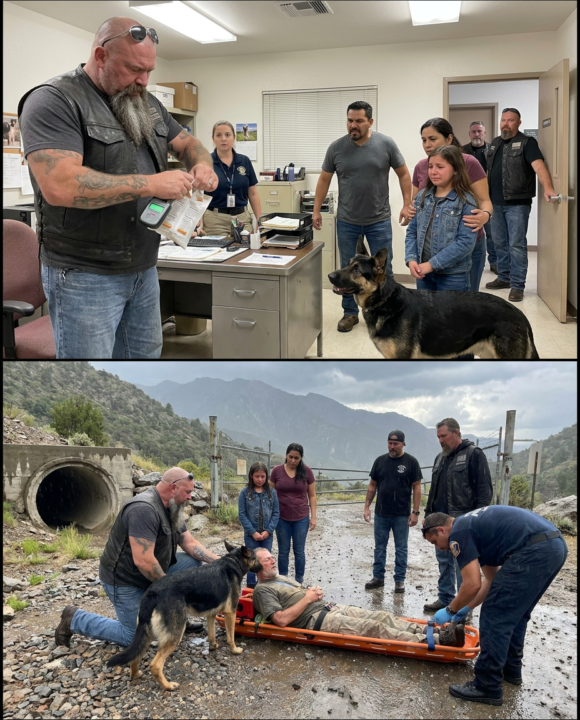
I picked up the torn adoption papers.
“You had no right,” I told Hammer.
“No.”
It was not the answer I expected.
“You destroyed a legal record.”
“I stopped a legal mistake.”
“You could have spoken.”
“You were putting him in a car.”
“We would have listened.”
He looked at the alarm button beneath my desk, then at the two kennel attendants still holding catch poles.
“Would you?”
I wanted to say yes.
I could not.
Deputy Lena Ortiz entered with one hand above her holster. She knew Hammer. Most law-enforcement officers in Yavapai County did.
His club, Iron Mercy Riders, had escorted veterans’ funerals, built wheelchair ramps, delivered food during wildfires and appeared at three scenes where nobody could clearly explain whether they were helping or making everything harder.
Hammer had also served six years in prison after a drunken motorcycle crash when he was thirty-nine.
Complex history follows a man longer than charity photographs.
Ortiz scanned the room. “Who was threatened?”
“Nobody,” Mateo said.
“Who was assaulted?”
He hesitated. “I grabbed him.”
“Who tore the paperwork?”
Hammer raised one hand.
Ortiz sighed. “Of course you did.”
I gave her the scanner, the chip number and the shelter intake records. She called county dispatch, then the national microchip registry. We waited beneath fluorescent lights while barking rolled through the kennel corridor.
Ranger did not relax.
When a file printer began rattling in the office, he stood and searched the room as if the sound required an answer. Hammer noticed.
“That’s his work switch,” he said.
“What does that mean?” Nora asked.
“He thinks a job started.”
“What job?”
Hammer looked at her. “Keeping Eli alive.”
The registry confirmed the chip at 11:26.
The owner was Staff Sergeant Elias Mercer, United States Army, retired. The dog’s registered name was Ranger. His task classification included seizure response, mobility support, interruption of dissociative episodes and emergency assistance retrieval.
The record carried a red law-enforcement hold.
Ortiz closed her eyes briefly.
“Eli’s case is still active.”
“Then reopen the ground search,” Hammer said.
“It was never closed.”
“You stopped walking.”
“We searched nine days.”
“Walk the tenth.”
Ortiz’s jaw tightened. She had been part of those teams. The bruise in her expression was not anger alone.
They had searched the area surrounding Eli’s pickup, a weathered green Ford found on an unmarked road below Mingus Mountain. His cane and medication bag were missing. The driver’s door had been locked. No sign of violence appeared inside.
The official theory split in two.
One group believed Eli had become disoriented and walked into the high desert, where heat and terrain had taken him. The other believed he had left deliberately.
Hammer believed neither.
Eli had survived two deployments, an improvised explosive device, eleven surgeries and the silence that came after people stopped knowing what to say around him. He had lost part of his left foot and developed seizures after a traumatic brain injury.
Ranger was not simply companionship.
He could detect the change in Eli’s scent before a seizure, brace his weight during transfers, bring medication, activate an emergency button and find another person when Eli could not recover alone.
“He doesn’t leave,” Hammer told us. “Not for food. Not for another dog. Not even if somebody opens a gate.”
“How do you know?” Erin asked.
“Because I helped train the fool.”
That was the first piece of Hammer we saw from the inside.
Eight years earlier, Iron Mercy had partnered with a nonprofit that trained service dogs for veterans. Hammer knew little about formal dog work, but he understood repetition. Every Tuesday and Thursday, he rode sixty miles to a rehabilitation center in Phoenix and let Ranger practice ignoring engine noise, leather smells and large men moving too fast.
Eli had hated him at first.
“Too loud,” Eli said during their first meeting.
Hammer pointed at Ranger. “Dog or bike?”
“You.”
They became brothers anyway.
Eli joined Iron Mercy without wearing a full patch. He did not like groups and never pretended otherwise. On rides, he remained at the rear in a modified trike with Ranger secured in a ventilated sidecar. At diners, he chose the booth facing the door. When someone dropped silverware, Ranger placed his chin on Eli’s knee before anybody else noticed his hands shaking.
Three weeks before he disappeared, Eli stopped attending club nights.
Hammer visited his house and found unopened mail beneath the porch light. Eli claimed he was tired. Ranger stood between them, watching both men.
Two nights later, Eli called Hammer.
Hammer did not answer.
He had been fighting with Boone Collins, Iron Mercy’s road captain, over whether to remove a younger rider who had been drinking before club runs. Hammer silenced his phone, finished the argument and forgot to call back.
Eli left a voicemail.
“Found something strange off 89A. Ranger won’t settle. Call me when you’re done being stubborn.”
That message was timestamped 6:14 p.m.
Eli disappeared the next morning.
Hammer had listened to the voicemail sixty-three times. He had ridden every public road between Prescott Valley and Cottonwood, taped missing cards to gas pumps, questioned ranchers, walked washes until his damaged knee swelled beneath his jeans, and carried Ranger’s chip number behind the inner seam of his vest.
That explained how he recognized it.
It did not explain why the dog had been missed.
Our clinic scanner had passed between Ranger’s shoulder blades exactly as protocol required. The microchip had migrated downward and inward, settling beside the right elbow where scar tissue held it against the muscle.
A second scanner would not have helped.
A wider search pattern would have.
I entered the error into Ranger’s file while Hammer watched. There was no satisfaction on his face.
Nora gathered the torn adoption pages and aligned their edges on my desk.
“Can tape fix them?” she asked.
Erin knelt beside her. “The paper, yes.”
“And the adoption?”
Nobody answered.
Ranger lowered his head into Nora’s lap.
Hammer turned toward the window.
Outside, the Arizona sun burned white across the motorcycles. His brothers waited beside the Harleys: Boone, a retired paramedic with a braided beard; Deacon Price, a mechanic whose right hand carried burn scars; and Cole Mercer, Eli’s twenty-seven-year-old nephew.
Cole had not entered the shelter.
He could see Ranger through the glass.
The young biker removed his sunglasses and began walking toward the door, then stopped. His knees folded beside a burgundy Road King.
Ranger heard something none of us did.
He rose, pulled the leash from Nora’s loosened hand and ran to the window.
Cole pressed one palm against the glass.
Ranger pressed his nose to the other side.
For nineteen days, Cole had believed his uncle and the dog were both dead. Now one had returned wearing another family’s blue bandanna.
The other was still somewhere beyond the window.
Part 3 — The Family Who Refused to Go Home Empty-Handed
County detectives arrived before noon and took custody of Ranger as evidence connected to a missing-person case.
That phrase sounded colder than the truth.
They photographed his paws, collected loose material from his coat, removed the blue bandanna and placed the damaged collar buckle inside an evidence bag. Ranger tolerated everything until a technician tried taking him away from Nora.
Then he planted his feet.
He did not growl. He backed against her legs and used his body as a brace, the same way he had been trained to stabilize Eli.
Nora held his face between her hands.
“You have to find your first person,” she whispered. “Then maybe you can come visit your second.”
Hammer heard her.
So did I.
The sheriff’s department requested that Hammer, Cole and the Alvarezes go home while evidence was processed. Hammer refused. Mateo did too.
Those two men had nearly fought an hour earlier. Now they stood on opposite sides of the same table studying a road map.
The blue paint changed everything.
Mateo Alvarez installed underground fiber for rural utilities. He had spent fourteen years driving service roads most residents never noticed. The color beneath Ranger’s collar was not common gate paint. It was a faded cobalt coating used on old water-district access posts installed during the 1980s.
Only three sections remained in that part of the county.
Two were far north of where Ranger had been found.
The third crossed a decommissioned pipeline road southwest of the official search zone.
Deputy Ortiz called the incident commander. His answer came through her expression.
“They’ll send a unit,” she said.
“When?” Hammer asked.
“As soon as one clears.”
“How soon?”
“Two hours, maybe three.”
Hammer folded the map.
“No.”
Ortiz blocked the door. “You are not riding into restricted terrain with a service dog held in an active case.”
“I don’t need the dog to find blue gates.”
“You will contaminate a search area.”
“You didn’t search it.”
“Because Eli’s truck was seven miles east.”
“Then he wasn’t walking from the truck.”
Ortiz pointed at his chest. “This is why people stop helping you, Ray. You turn every delay into betrayal.”
Hammer’s scarred hands curled once.
Then opened.
Behind him, Boone stepped closer. “She’s right about the terrain. Storm cells are building over Mingus.”
“He’s been out nineteen days.”
“If he’s there, one more hour—”
Hammer turned.
Boone did not finish.
The brotherhood had already spent nineteen days following Hammer through dry washes and false reports. Deacon had lost two weeks of work. Cole slept on Hammer’s garage floor because he could no longer enter his uncle’s empty house. Three club members had crashed on loose roads, and one had developed heat exhaustion.
Boone was not asking Hammer to stop caring.
He was asking him to survive it.
“If we go without authorization,” Boone said, “the club does not wear colors. No blocked roads. No engines past the gate. We follow search command.”
Hammer looked at the Iron Mercy patch across Boone’s chest.
“You staying?”
“I’m setting a boundary.”
“Same thing with cleaner words.”
Cole entered through the shelter doors.
He had Eli’s shoulders, his dark eyes and none of his patience. “If Uncle Eli is beyond that gate, I’m going.”
Boone faced him. “That road crosses an abandoned burn scar. Rain hits, the ground moves.”
“Then we move faster.”
“You think courage is being first through a bad door.”
“No. I think fear sounds intelligent when an old man says it.”
Boone flinched.
Iron Mercy began dividing in my lobby.
Deacon sided with Boone. Two riders waiting outside sided with Hammer. Cole announced that he did not care about the patch, the sheriff or any man who believed his uncle had intentionally vanished.
Then Nora unfolded one of the torn adoption pages.
“Can I say something?”
Nobody heard her except Erin.
She climbed onto a chair and said it louder.
“Ranger’s feet are dirty.”
Every adult looked at the dog.
His pads had been cleaned during intake. The county technician had collected fresh material from between the toes, but Nora pointed at his front nails. A reddish line remained deep beneath two claws.
“Most of the dirt near the blue gates is gray,” Mateo said.
Nora shook her head. “Not dirt. Little seeds.”
She had spent three visits sitting at kennel level. She remembered removing burrs from Ranger’s tail, dark triangular husks with tiny hooked edges.
I retrieved the bag of coat debris saved at intake. Among dry grass and asphalt grit were several red-stem filaree seeds and a cluster of pale, needlelike bracts.
Erin photographed them and sent the image to a botanist at Northern Arizona University whom she knew through a school program.
The answer returned fourteen minutes later.
The pale bracts came from Wright’s buckwheat, a plant common on higher rocky slopes near old mining cuts—not along the lower valley where Ranger had been found.
Mateo placed his finger on the map.
The pipeline road climbed from a blue gate toward an abandoned pump station above Hull Canyon. A series of dry channels descended from there to 89A.
A dog could follow water downhill.
A rancher could find him at the road.
Deputy Ortiz called search command again.
This time, they listened.
At 2:10 p.m., Ranger was released to a county K-9 handler, and a new search group assembled at the southern pipeline gate. The family could have gone home. Their adoption was void, their daughter exhausted and the dog they loved officially returned to another man.
Instead, Mateo loaded water, climbing rope and first-aid supplies into his SUV.
Erin brought food.
Nora carried Ranger’s blue bandanna in her pocket.
“You can’t take her into that terrain,” Hammer said.
“We won’t,” Erin answered. “She stays at command with me.”
Hammer looked toward Mateo. “And you?”
“I know the line.”
“You angry about the papers?”
“Yes.”
“You coming anyway?”
“Yes.”
“Why?”
Mateo closed the SUV hatch. “Because if I had been missing nineteen days, I’d want the man who hated me to keep looking.”
Hammer nodded once.
The county established a command point at the blue gate. Thunder rolled behind Mingus Mountain. Ranger stepped from the K-9 truck wearing a tracking harness and immediately turned away from the path leading toward Eli’s abandoned pickup.
The handler redirected him.
Ranger resisted.
She offered Eli’s glove, recovered from his home.
He sniffed it once, then pulled southwest along the pipeline.
Exactly where Nora’s seeds and Mateo’s paint had pointed.
We followed beneath a sky turning the color of old steel.
The first mile yielded nothing but tire ruts, elk tracks and rusted pipe markers. At the second, Ranger found a strip of black nylon caught beneath a gate hinge.
Cole recognized it.
Part of Eli’s medical bag.
The gate had closed on it hard enough to tear the strap.
Hammer found fresh scratches beneath the blue paint, three parallel lines where a metal buckle had dragged across the post.
Ranger’s collar.
The dog had passed through that gate.
So had Eli.
Half a mile higher, the pipeline road split. Searchers chose the wider branch toward the pump station. Ranger pulled toward the narrower trail.
Thunder cracked.
Rain began striking dust.
The incident commander ordered everyone back before the washes flooded.
Hammer unclipped his radio.
Boone caught his wrist. “Don’t.”
“He’s close.”
“You don’t know that.”
Ranger barked once into the rain.
Cole stepped between them. “I’m going with Hammer.”
Deacon removed his Iron Mercy vest and folded it into a saddlebag.
Boone stared at him.
“What are you doing?”
“Following as a private citizen.”
The same test reached every man standing there: protect the club, obey the retreat order, or follow a dog into a mountain storm.
Boone looked at Ranger.
Then at Nora waiting beneath the command tent, holding two pieces of paper taped together across the middle.
He removed his vest too.
“Ten minutes,” he said. “Then we drag Hammer back ourselves.”
We crossed the blue gate without patches, motorcycles or promises.
Only Ranger wore his working colors.
Part 4 — The Sound Beneath the Abandoned Pipeline
Rain changed the mountain in seconds.
Dust became paste beneath our boots. Water ran through shallow channels, gathered speed and carried pine needles across the road. The air smelled of wet stone, grease and creosote.
I had remained at command with Erin and Nora, but the radio carried every step.
Hammer’s breathing came through first, heavy and controlled. Boone called distances. Deacon reported the condition of the road while the K-9 handler warned that Ranger’s tracking behavior had changed.
“He’s no longer following ground scent,” she said.
“What is he following?” Ortiz asked.
“Possibly memory.”
Ranger had traveled this road before.
The narrow branch ended at an abandoned concrete pump station built into the slope. Rusted fencing leaned across the entrance. One wall had collapsed beneath a fall of black rock, and a drainage channel ran along the foundation.
Searchers found Eli’s collapsible cane beside it.
Cole made a sound over the radio that I did not recognize as a word.
The cane was bent near the handle. Dried blood marked one rubber grip. Several feet away lay Eli’s canvas jacket, caught beneath thorny brush.
The official search dog alerted near the drainage channel.
The false ending arrived quickly.
The handler believed Eli might have fallen into the wash before the earlier storms. The channel descended into a steep ravine filled with debris, fractured branches and dark water. If he had been carried down, nobody expected to find him alive.
Cole refused the conclusion.
“He wouldn’t leave the cane.”
“That may be where he fell,” Ortiz said.
“No. He wouldn’t leave Ranger.”
Hammer picked up the jacket. Ranger sniffed it, circled once and walked away.
That was wrong.
If Eli had gone into the ravine, Ranger should have followed the scent downhill. Instead, he returned to the concrete wall and scratched near a rusted vent cover.
The K-9 handler pulled him back.
“Possible rodents.”
Ranger lunged again.
Thunder swallowed his bark.
At command, Nora left the tent and stood in the rain before Erin caught her. She was watching the mountain through binoculars, though the pump station could not be seen from below.
“What is it?” I asked.
She pointed toward a county map taped across a folding table.
“This line doesn’t stop at the building.”
Mateo leaned over it.
The visible pipeline ended at the pump station, but an older engineering layer showed a maintenance conduit continuing beneath the slope. During the 1980s, workers could enter through a steel service hatch hidden behind the drainage wall.
The map labeled it TUNNEL B.
Ortiz relayed the information.
Hammer found the hatch under rock, brush and twenty years of rust.
It would not open.
Deacon struck the hinges with the back of a rescue axe. Boone cleared mud from the lower seam. Cole shouted Eli’s name through the vent.
Nothing answered.
Search command ordered them away from the unstable wall.
Hammer pressed his ear against the steel.
A faint sound came through.
Three taps.
Pause.
Three taps.
The radio went silent.
Cole dropped beside him. “Uncle Eli!”
Three taps answered again.
He was alive.
The rescue team moved fast after that, yet the mountain resisted every tool. The hatch had warped inward, and a slab of fallen rock pinned its lower corner. Sparks flew beneath a battery saw. Smoke mixed with rain.
Ranger lay flat against the opening.
He began whining.
Nobody at High Desert Haven had heard that sound from him. Not when he was found, not when strangers handled his injuries, not when Nora left after each visit.
Now his whole body trembled.
Hammer placed one hand on his back.
“Easy, brother.”
The dog looked at him.
“Yeah,” Hammer said. “We heard him.”
The hinge finally broke.
When Deacon and Boone pulled the hatch outward, muddy water rushed from the darkness. Ranger tried entering, but the opening was unstable and barely wide enough for one adult.
Hammer removed his leather cut.
Ortiz blocked him. “Rescue technicians go first.”
“They’re five minutes out.”
“The structure may collapse.”
“He’s tapping now.”
“You weigh nearly three hundred pounds.”
“Two-eighty-five.”
“This isn’t the time.”
“Never is.”
Hammer clipped a safety line around his waist. Boone held the opposite end while Deacon tested the surrounding concrete. Cole demanded to go, but Hammer shoved Ranger’s leash into his hand.
“You stay with the dog.”
“He’s my uncle.”
“And that’s his medic. Keep him ready.”
Hammer crawled inside.
His shoulders scraped both walls. The tunnel smelled of rust, stagnant water and human waste. Mud covered the bottom. Every few feet, he called Eli’s name.
Three taps guided him.
Then two.
Then one.
He found Eli eighty-seven feet beyond the hatch, trapped behind a fallen section of pipe.
Eli was conscious.
Barely.
His left ankle had been crushed beneath a support bracket. His medication bag sat beside him, empty of seizure tablets. He had survived on two emergency nutrition bars, rainwater dripping through a crack and the glucose packets he carried for Ranger.
He had given the last packet to the dog.
“About time,” Eli whispered.
Hammer’s voice broke over the radio. “Been busy.”
“You always are.”
Eli’s skin was cold. His pulse was irregular. Dried blood covered one side of his face. A strip torn from his shirt held his ankle against a broken length of pipe.
Hammer asked why Ranger had left.
Eli turned his head toward the tunnel entrance.
“Sent him.”
The word consumed nearly all his breath.
On the second night, after repeated seizures and no response to his emergency beacon, Eli realized he could not crawl free. He removed Ranger’s damaged collar, retightened it and gave the command they had practiced hundreds of times.
Find help.
Ranger refused.
Eli ordered him again.
The dog lay across his chest.
Finally, Eli used the one word Ranger had never been allowed to disobey.
“Home.”
Ranger left through a gap above the pipe.
He followed the conduit road downhill, squeezed beneath the blue gate and reached Route 89A. A rancher saw him limping beside traffic and loaded him into a pickup.
That rescue severed the dog’s return trail.
The rancher drove twenty-three miles to High Desert Haven. Our staff scanned the wrong place, found no chip and entered him as a stray.
Ranger had brought help to the road.
The help did not understand what he was asking.
Hammer crawled deeper, but the fallen pipe prevented him from reaching Eli’s ankle. He could touch one hand.
Nothing more.
Rescue technicians reached the hatch and began shoring the tunnel. Rain intensified. Mud pressed through cracks in the ceiling.
The structure shifted.
Boone ordered Hammer out.
Hammer did not move.
“If this comes down,” Boone said, “we lose both of you.”
“He stays alone again.”
“You can’t hold a mountain.”
“No.”
Hammer wrapped both hands around Eli’s.
“But I can hold him.”
Ranger began pawing beneath the vent. Cole knelt beside him, soaked and shaking.
Then Nora’s voice entered the radio from command.
“Put it near Ranger.”
Erin tried stopping her, but Ortiz understood. She carried a radio to the tunnel entrance and held it beside the dog.
Nora spoke from below.
“Ranger, find Eli.”
The shepherd’s ears rose.
“Find Eli.”
He lowered himself, pushed one front leg through the vent opening and barked into the darkness.
Far inside the tunnel, Eli heard him.
His fingers tightened around Hammer’s hand.
“That my dog?”
Hammer pressed the radio against the concrete.
“No,” he said. “That’s your whole search party.”
The rescuers cut through the pipe at 5:47 p.m.
Eli emerged at 6:19 on a litter, his body wrapped in thermal blankets and his crushed ankle secured. Ranger broke from Cole’s grip before anybody could stop him.
The dog reached the stretcher, placed both paws beside Eli’s shoulders and lowered his nose to the veteran’s mouth.
Eli opened his eyes.
“Bad home,” he whispered.
Ranger licked rain from his face.
Around them stood sheriff’s deputies, rescuers, five bikers without their patches, and the family whose adoption Hammer had destroyed.
Nobody corrected Eli.
Part 5 — Why Eli Had Driven Beyond the Blue Gate
Eli spent eleven days at Yavapai Regional Medical Center.
He was dehydrated, hypothermic and dangerously low on seizure medication. Surgeons repaired his ankle, treated an infection beneath the skin and told him that another forty-eight hours inside the tunnel might have killed him.
Ranger remained outside intensive care.
Hospital policy allowed service animals, but Ranger had open sores on his paws and required medical clearance. He stayed with a veterinary technician in a quiet room near the ambulance entrance.
Hammer slept in the chair beside him.
During daylight, he claimed he was guarding the dog.
At night, nurses found one scarred hand resting across Ranger’s back.
The Alvarezes visited every afternoon.
Nora never asked whether Ranger could still become hers. She brought the blue bandanna, repaired the torn edge and left it beside his water bowl. Mateo delivered photographs of the pipeline gates to investigators. Erin created a timeline using intake records, weather reports and the rancher’s statement.
Their work answered how Ranger reached the shelter.
Eli answered why he had entered the pipeline road.
He had not missed his VA appointment deliberately. He had left early because Ranger became agitated near Route 89A, barking toward a drainage channel and refusing to settle.
Eli stopped beside the road.
Inside the wash, he found a red child’s backpack.
A county alert issued the previous evening reported a thirteen-year-old foster boy missing from a group home near Cottonwood. Search teams believed the boy had traveled east.
Ranger’s behavior suggested otherwise.
Eli called dispatch, but poor reception cut the line after he gave only part of his location. He then called Hammer.
That was the voicemail Hammer ignored.
Eli followed small footprints toward the pipeline gate, believing he would find the child within minutes. Ranger led him to an abandoned maintenance shed two miles uphill.
The boy was inside.
He was frightened, dehydrated and hiding because he believed returning to the group home would result in punishment. Eli gave him water, covered him with his jacket and convinced him to walk back toward the road.
Then the storm arrived.
A flash of lightning struck the upper ridge. Loose rock moved beneath the pipeline. Eli pushed the boy away from the slope and took the falling debris across his left side.
The boy ran.
He reached a rural house near midnight but could not explain where Eli had fallen. Severe anxiety, exhaustion and a head injury left his account confused. He repeatedly mentioned a tunnel, a dog and a motorcycle.
Deputies interpreted the motorcycle as Hammer’s missing-person flyers.
The child was hospitalized under a confidentiality order, so neither Hammer nor Eli’s family learned that he existed. Investigators searched the area he indicated, but he pointed east rather than southwest.
Eli had entered the damaged tunnel for shelter and become trapped when a second rockfall closed the entrance.
He saved the boy.
The dog saved him.
The family who had nearly adopted Ranger saved the search from looking in the wrong place.
Each action had seemed incomplete until the others connected.
The details Hammer carried began returning with meaning.
The laminated chip number was not a symbol of obsession. Eli had asked every Iron Mercy rider to record it after Ranger briefly escaped during a wildfire evacuation three years earlier.
The blue gate paint had not come from a kennel or a ranch fence. It marked the point where Ranger’s collar buckle scraped while he crawled beneath the service gate.
The seeds beneath his nails were not ordinary debris. They came from the high mining slope above Tunnel B.
Even the empty band around his neck mattered. Eli had loosened the collar before sending him through the narrow pipe gap.
The shelter’s failure remained mine.
I met Hammer outside Eli’s hospital room on the sixth day and handed him the adoption papers taped across the middle.
He glanced at them. “You billing me?”
“I’m reminding you there are ways to stop paperwork without tearing it.”
“Slower ways.”
“Civilized ways.”
“Usually slower.”
I waited.
He looked through the small window at Eli sleeping.
“I scared the kid,” he said.
“Yes.”
“I didn’t mean to.”
“I know.”
“That doesn’t fix it.”
“No.”
Hammer folded the repaired papers and placed them inside his vest.
The next morning, he went to Nora’s school.
He did not enter wearing club colors. He wore a clean charcoal shirt, jeans and boots. The scar, beard and tattoos still caused the receptionist to reach toward the phone.
Nora met him outside with Erin.
Hammer crouched until they were nearly eye level.
He placed the old adoption packet in her hands.
“I broke something that belonged to you.”
Nora examined the taped seam. “You found Ranger’s person.”
“You did.”
“Dad found the gate.”
“You found the seeds.”
She considered that distinction.
“Is Eli going to be okay?”
“Mean enough to recover.”
“Will Ranger live with him?”
“Yes.”
Nora looked down at the papers.
Hammer waited for anger.
She tore the packet again.
Right across his tape.
Erin gasped.
Nora handed one half to him and kept the other.
“Now we both lost him.”
Hammer stared at the child.
Then she smiled.
“And we both found him.”
That afternoon, Eli met the Alvarez family from his hospital bed. His left leg was elevated inside a steel frame, and monitors surrounded his shoulders. Ranger rested beneath his right hand.
Nora stopped at the doorway.
Eli noticed.
“You the girl who stole my dog?”
Nora looked at Hammer.
He gave no rescue.
“I almost adopted him.”
“Same thing.”
“Your dog has bad manners.”
“He learned from bikers.”
Ranger’s tail struck the floor once.
Nora approached. Eli lifted his hand so she could touch the shepherd’s head.
“He protected me when everyone shouted,” she said.
“He does that.”
“I called him Scout.”
Eli frowned. “That’s terrible.”
“It’s better than Ranger.”
“No argument in a hospital room.”
“You started it.”
Eli looked toward Hammer. “She always like this?”
“Hope so.”
For the first time since the search, Eli laughed. It was quiet and painful, but Ranger heard the change and placed his chin on the bed.
Mateo asked what would happen after discharge.
Eli’s home had narrow doors and three steps at the entrance. His recovery would require months, perhaps longer. Ranger could assist only after his paws healed and his service training was evaluated.
Iron Mercy offered to rebuild the entrance.
The Alvarezes offered their guest room.
Everybody spoke at once.
Eli raised one hand.
“No.”
Ranger opened one eye.
Eli sighed. “Fine. But the family stays out of my refrigerator.”
Erin smiled. “That sounds like a yes.”
“It sounds like poor border control.”
Hammer said nothing.
He left the room, walked past the nurses’ desk and entered the stairwell. Boone found him sitting on the concrete steps, elbows on his knees, staring at his scarred hands.
“You crying?” Boone asked.
“No.”
“Good. Hate paperwork.”
Hammer wiped his face with one sleeve.
Boone sat beside him.
For several minutes, the two largest men in the hospital listened to Ranger’s tail striking Eli’s bed through the wall.
Part 6 — Two Families for One Working Dog
Eli moved into the Alvarezes’ guest room three weeks later.
Iron Mercy built a ramp before the hospital released him. Boone measured. Deacon welded. Cole installed handrails. Hammer tore out the first set because the slope exceeded Eli’s preferred angle by two degrees.
Mateo made him rebuild it himself.
They argued until midnight.
By morning, the ramp was perfect.
Ranger returned to work gradually. His paw injuries healed, but he hesitated near metal gates and became distressed whenever Eli disappeared behind a closed door.
Nora helped retrain him.
Every afternoon, Eli rolled into another room while Nora remained with Ranger. She counted to five, gave the release command and let him find Eli. Five seconds became ten. Ten became thirty.
The first time Ranger waited a full minute without whining, Eli gave him a piece of chicken.
Nora demanded one too.
Eli claimed service-dog handlers did not receive treats.
She threatened to rename Ranger again.
He surrendered the chicken.
The family never attempted to replace Eli. That mattered.
Nora understood that Ranger’s love was not an object divided into portions. When he worked, he belonged beside Eli. When his harness came off, he chased tennis balls with her, slept outside her bedroom and stole socks from Mateo’s laundry basket.
Erin called him their borrowed dog.
Eli called the Alvarezes his borrowed civilians.
Hammer visited every Sunday but never entered without knocking. He repaired Eli’s wheelchair, changed the oil in Mateo’s SUV and pretended not to notice the half adoption page framed beside Nora’s desk.
His half remained inside his vest.
High Desert Haven changed its scanning procedure. Every incoming dog was scanned from nose to tail, across both sides, down the legs and around old scars. We purchased a second universal scanner and trained every intake worker to repeat the examination after twenty-four hours.
Above the scanning station, I hung a copy of Ranger’s radiograph showing the migrated chip near his elbow.
No slogan.
No inspirational quote.
Only the image.
Four months after the rescue, Eli was strong enough to return home. Iron Mercy had widened the doors, lowered kitchen shelves and installed an emergency radio linked to Ranger’s harness.
The Alvarezes helped him unpack.
Nora stood in the empty guest room holding Ranger’s blue bandanna. She did not cry while Eli watched.
She waited until he turned away.
Ranger heard her breath change. He left Eli’s side, crossed the hallway and pressed his head against her chest.
Eli stopped his wheelchair.
The service harness remained on.
Technically, Ranger should not have left.
Eli looked at the dog, then at Nora.
“Good decision,” he said.
The following weekend, Hammer brought another shelter dog to the Alvarez house.
She was an eight-year-old Pit Bull mix with a white face, arthritic hips and little public interest. Her name was Mabel. She climbed from Deacon’s truck, walked directly past the adults and fell asleep on Nora’s shoes.
“This isn’t Ranger,” Hammer warned.
Nora knelt carefully.
“I know.”
“You don’t owe her anything.”
“I know.”
“She snores.”
“So does Dad.”
Mateo objected from the porch.
Mabel stayed.
Ranger visited every Sunday.
Two families had not divided one dog.
They had made room for another.
Part 7 — The Papers Hammer Never Tore Again
One year after Hammer entered my shelter, a line of Harleys rolled into the parking lot at 8:07 on a Saturday morning.
Their engines settled into a low V-twin pulse that moved through the kennel walls. Dogs barked. Chains rattled. Boots crossed pavement.
Nobody pressed the alarm.
Hammer entered first.
He wore the same weathered leather cut, faded charcoal shirt, blue jeans, motorcycle boots and silver skull ring. Ranger walked beside him in a service harness, matching Hammer’s pace while Eli followed in a modified three-wheel motorcycle with hand controls.
The Alvarezes arrived behind them.
Nora led Mabel.
High Desert Haven was holding a microchip clinic that day. Iron Mercy paid every registration fee. Mateo installed a shaded waiting area, Erin organized records, and Eli sat near the scanning table telling nervous owners that paperwork was only useful when somebody read it correctly.
Hammer handled the scanner.
He moved it across every shoulder, rib, leg and scar.
Slowly.
Nobody needed to remind him.
Near noon, an elderly man brought in a thin German Shepherd found beside a gas station. The first scan showed nothing.
The man shrugged. “Guess he doesn’t have one.”
Hammer continued.
Near the dog’s left hip, the scanner beeped.
Everyone in the room became quiet.
Hammer wrote down the number and handed it to me without touching the intake papers.
“You’ve changed,” I said.
“No.”
“You didn’t tear anything.”
“Kid’s watching.”
Nora stood across the room with Ranger and Mabel. She lifted the framed half of her old adoption packet.
Hammer carried his half beneath his vest, beside Eli’s original missing card.
The new shepherd’s chip led to a family in Nevada who had been searching for him for six months. When the owner answered our call, her voice collapsed after the first sentence.
Hammer stepped outside before she finished.
I found him beside his burgundy Harley, one hand resting on the seat. Eli rolled up behind him while Ranger settled between them.
“You leaving?” Eli asked.
“Too much noise.”
“You own a Harley.”
“Different noise.”
Nora came through the doors holding two fresh adoption forms.
One was for Mabel’s finalized record.
The other had no dog’s name.
She handed it to Hammer.
“What’s this?”
“Your foster application.”
“No.”
“You have a fenced yard.”
“No.”
“You volunteer here.”
“No.”
“Ranger likes you.”
“Ranger eats trash.”
Eli took the form and placed it against Hammer’s chest.
“Sign.”
Hammer looked at the family, the shelter and the row of motorcycles waiting beneath the Arizona sun.
Then he looked at the paper.
He did not tear it.
Three weeks later, Hammer fostered a scarred senior German Shepherd nobody could safely handle. The dog slept beside his toolbox, ignored every expensive bed and climbed into his saddlebag whenever the Harley started.
Hammer named him Paper.
On Sundays, Paper rode in a ventilated sidecar while Ranger traveled beside Eli and Mabel slept across Nora’s back seat. The group followed Route 89A to the blue pipeline gate, where they stopped without entering.
Eli would place one hand against Ranger’s neck.
Nora would check Mabel’s leash.
Hammer would touch the two torn halves of the old adoption held beneath his vest.
Then the engines started again.
One dog went home to the man who needed him.
Another found the girl who had made room.
And Paper stayed whole.
Drop HAMMER below and follow the page for more full stories about bikers whose roughest choices lead someone home.