Part 2: A Biker Refused to Start His Harley for a Dying Boy’s Final Ride—Then Forty Riders Shut Off Their Engines and Pushed Every Motorcycle Past His Hospital Bed
Part 2 — The Boy Behind the Sixth-Floor Window
My name is Claire Weston, and before Ray Dawson entered our lives, motorcycles were only sounds I asked drivers to keep away from the hospital.
Eli’s illness began with falls.
He stumbled during soccer practice, dropped cups at breakfast, and complained that ordinary sounds sometimes arrived inside his head like doors slamming.
Testing led to a diagnosis that changed the shape of our family’s future.
The disease progressed despite treatment. Seizures became part of our routines, then swallowing difficulties, weakness, wheelchairs, and conversations no parent expects to hold with a ten-year-old.
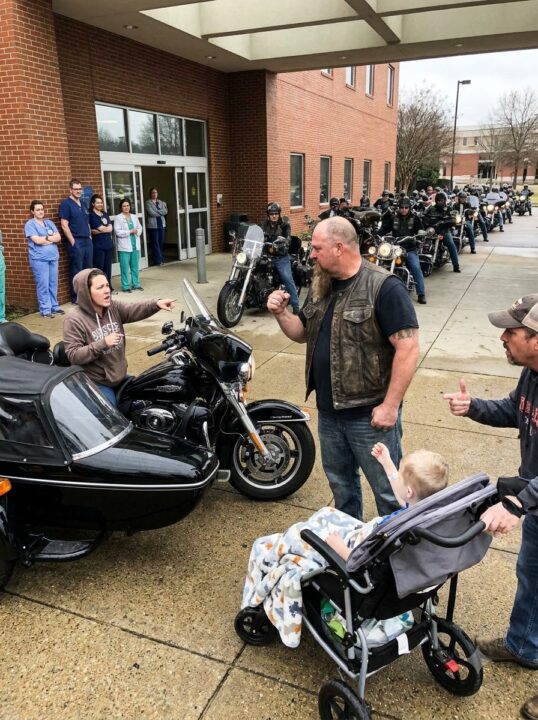
Eli despised being described as brave.
“Brave people choose scary things,” he told one social worker. “I’m just here.”
Ray liked that answer.
The Iron Lanterns first visited Mercy Children’s during a winter toy drive organized by a veteran nurse. Most riders left donated boxes at reception because infection-control rules limited visitors.
Ray was asked to carry one final carton upstairs.
Eli saw him through the open doorway.
The boy stared at the leather vest, tattoos, and enormous black boots before asking whether the biker had ever crashed.
Ray placed the toy box down.
“More than once.”
“Did it hurt?”
“Every time.”
“Why keep riding?”
Ray considered the question.
“Got better at respecting the machine.”
Eli glanced toward his unsteady legs.
“Wish I could trade machines.”
Ray did not answer with encouragement polished for hospital rooms. He pulled a chair beside the bed and asked what Eli missed most.
“Going somewhere nobody planned for me.”
That sentence brought Ray back the following Friday.
He carried a road map.
Together, they marked places Eli wanted to see: the Mississippi River at sunrise, the old bridge toward Arkansas, a Route 61 diner with milkshakes, and a motorcycle shop where nobody whispered.
Ray never promised those destinations.
He promised descriptions.
He rode before dawn, took photographs, and returned to tell Eli what the air smelled like. When rain soaked his vest, he let the boy touch the cold leather.
Their friendship developed through details.
Eli learned that Ray drank terrible coffee, hated elevators, and carried a faded photograph of a teenage girl inside his vest.
Her name was Nora.
She had been Ray’s daughter.
Nora died at seventeen after a seizure disorder complicated by an undiagnosed heart condition. Ray was thirty-nine, newly sober, and convinced that protecting her meant removing every ordinary risk.
He took away concerts, school dances, and eventually the motorcycle rides they once shared at low speed on private land.
During their final argument, Nora accused him of turning her remaining life into a waiting room.
Three days later, she died during a seizure unrelated to any forbidden activity.
Ray carried that argument for seventeen years.
It changed how he treated Eli.
He never told the boy that everything would be fine. He did not confuse safety with stillness or protection with ownership.
When Eli asked for the final ride, Ray’s first answer was no.
The boy turned toward the wall.
Ray waited.
Then Eli said, “You’re doing the waiting-room thing.”
Ray’s jaw tightened.
The accusation found its target.
He asked the medical team what might be possible. A hospital recreation therapist suggested a stationary motorcycle visit. Eli rejected that.
“A parked bike is furniture.”
Ray almost smiled.
Weeks of planning followed. The hospital approved a brief outdoor experience, then a closed route using a sidecar with proper restraints, medical supervision, emergency planning, and staff positioned throughout.
Eli’s condition remained unstable.
Approval could be withdrawn at any moment.
Ray accepted every rule except calling the event a final ride.
“Last is for later,” he said.
Eli corrected him.
“Later is running out.”
Eventually, Ray stopped arguing.
He invited forty riders because Eli had drawn that number in his notebook. The picture showed a child in a sidecar surrounded by motorcycles with enormous black sound lines above them.
Eli wanted thunder.
For most of the planning, doctors believed one idling motorcycle at a controlled distance might be tolerable. Forty engines would never be permitted near him, but the club could start beyond the hospital grounds after Eli returned inside.
Six days before the event, a metal meal tray fell outside Eli’s room.
The impact triggered a severe seizure.
His neurologist revised the plan.
No engine noise.
No horns.
No cheering.
The ride should be canceled unless the family and organizers accepted complete silence.
Ray heard the decision alone.
He looked at the drawing with forty black sound lines.
Then he asked one question.
“Can the wheels still move?”
Part 3 — The Night the Club Voted Against Thunder
Ray called the Iron Lanterns to Dawson Iron Works that evening.
Forty-seven riders attended, including men and women from Memphis, Jackson, Little Rock, Nashville, and smaller towns along Route 61. Several had already taken time off work and ridden hundreds of miles.
Ray placed Eli’s drawing on the workbench.
Then he explained the new restriction.
A rider named Clay Maddox objected first.
He owned a custom Harley with an exhaust system loud enough to announce him before he crossed a county line. He had promised Eli a coordinated start from the distant lot.
“What’s the boy expecting?” Clay asked.
“Engines,” Ray said.
“Then cancel. Don’t hand him something fake.”
Tiny Ruiz folded his arms.
“The ride ain’t fake because the engine’s off.”
Clay looked around the garage.
“These bikes weigh eight hundred pounds. Some more. You pushing them a mile?”
“Half mile,” Ray replied.
“With sidecars?”
“Extra hands.”
“In August heat?”
“Yes.”
Clay shook his head.
“A motorcycle moves under power. That’s what the kid asked for.”
Ray tapped Eli’s drawing.
“He asked to go somewhere.”
“He asked for thunder.”
“Thunder could hurt him.”
The argument split the room.
Some believed an honest cancellation respected Eli more than replacing the experience without his permission. Others said children in palliative care already lost enough plans to medical necessity.
Ray listened.
Then he placed his Harley key beside the drawing.
“I promised movement,” he said. “Sound was decoration.”
Clay disagreed.
“For us, maybe.”
Ray looked toward Nora’s photograph hanging above the workbench.
“Spent seventeen years thinking keeping a kid safe meant keeping her still. Not doing it again.”
The words ended several objections.
Not all.
Seven riders left.
They did not leave from cruelty. Some believed the plan could become unsafe if exhausted riders lost control of heavy motorcycles. That concern was legitimate.
Ray called the hospital’s safety coordinator and requested a test.
The following morning, the remaining riders gathered in an unused warehouse parking lot. Hospital staff, a motorcycle safety instructor, and two physical therapists observed.
The first attempt failed.
A sidecar rig drifted downhill and required three men to stop it. One rider became lightheaded. Another motorcycle tipped gently against a crash bar after its handler lost balance.
No one was injured.
Ray canceled practice immediately.
Clay, who had left the meeting, heard what happened and returned.
“Told you,” he said.
Ray handed him a clipboard.
“Fix it.”
Clay stared at him.
“You want my help after I walked?”
“Want the boy safe. Pride’s smaller.”
That was the brotherhood test.
Clay reviewed the route, slopes, motorcycle weights, braking plans, footwear, hydration, and staffing. He recommended reducing the distance, assigning two handlers to heavy touring bikes, using additional trained pushers for the sidecar, and excluding machines unsuitable for controlled manual movement.
The final parade still required forty motorcycles.
It required sixty-three people to move them safely.
Not all wore leather.
Hospital staff, former riders, family volunteers, and two physical therapists assisted from positions approved by the safety team.
The second practice succeeded.
Ray practiced separately with the Road King and sidecar. He loaded weighted medical equipment into the seat to approximate the approved configuration and pushed it across the route repeatedly.
His left knee swelled.
He wore a brace.
Every night, after the other riders left, he completed one more circuit.
Tiny caught him on the fourth night.
“You fall during the real thing, kid sees it.”
“Won’t fall.”
“Nora used to say that too.”
Ray stopped.
Tiny rarely used her name.
The older rider placed both hands on the sidecar frame.
“Brotherhood means you ain’t the only one holding this.”
Ray allowed him to help.
On the final practice night, forty Harley motorcycles moved across the warehouse lot without engines. The machines produced small sounds—tires turning, brakes brushing, leather shifting, and boots scraping pavement—but no roar.
Ray watched them pass.
It looked less like a parade than a funeral procession.
He hated that.
Eli’s ride could not become rehearsal for death.
Ray changed the formation. Instead of moving in two solemn lines behind the sidecar, the motorcycles would form a loose circle around designated points along the route.
Each rider would carry one small object representing a place Eli wanted to visit: river stones, postcards, diner menus, bridge photographs, pinecones, and sealed jars of red desert soil.
The road would come to him.
The bikes would move beside him.
At the final stop, each rider would place the object inside Ray’s saddlebags.
The silence would not symbolize absence.
It would make room for Eli’s voice.
On the morning of the ride, the riders started their engines three blocks from the hospital, then shut them down before entering the controlled area.
Forty ignition keys went onto the pavement.
Clay placed his down last.
He looked at Ray.
“Still think this is a real parade?”
Ray glanced toward the hospital doors.
“Ask the passenger.”
Part 4 — The Promise Hidden Inside the Refusal
Eli was weaker on the morning of the ride.
His medical team discussed canceling before taking him outside. His oxygen needs had increased, and he had slept only two hours.
When the nurse asked what he wanted, Eli wrote one word on a small dry-erase board.
Outside.
The team reassessed him and approved a shortened version with continuous monitoring, a rapid return plan, and no obligation to complete the route.
Ray received those instructions at the curb.
Then he stood beside the Road King and refused to start it.
From my perspective, he appeared stubborn.
In reality, Ray had built his refusal into the plan.
He knew grief might push Daniel or me to demand the engine. He knew riders might believe one quick start, one distant rev, or one horn blast would complete Eli’s dream.
Ray made himself the wall.
“No ignition,” he told every participant. “Not even after he goes inside until medical staff clear the area.”
The key line on the pavement was not ceremony.
It was enforcement.
Nobody could make an impulsive choice without crossing the entire group and retrieving a visible key.
Ray gave his key to Eli because the boy should hold the final authority over the motorcycle. The engine could not start while the key remained in his hand.
My anger began to change when I saw that.
Ray had not broken his promise at the hospital entrance.
He had protected it from us.
Eli was transferred into the sidecar using equipment and methods approved by his care team. The portable monitor traveled behind a covered panel, and a nurse walked within immediate reach.
Ray did not sit on the motorcycle.
He walked beside it.
Tiny and Clay supported the sidecar rig from the opposite side while two trained volunteers followed closely.
Eli touched the handlebar.
“Where’s the thunder?” he asked.
Ray pointed toward the approaching riders.
“In their legs.”
The boy watched forty Harleys move toward him.
Every rider had removed bells, loose chains, and unnecessary metal items. No patches carried readable club names. Nobody raised a fist or called his name.
They simply pushed.
The first rider carried a flat river stone from the Mississippi shoreline.
The second brought a postcard from Arizona.
Another carried a paper diner hat from a Route 61 restaurant. Clay brought a photograph of the old bridge at sunrise.
Each object entered Ray’s saddlebags as the parade passed.
Eli asked for them one by one.
His voice was faint.
The silence allowed us to hear it.
At the second turn, he said, “Faster.”
Ray looked at the nurse.
She smiled and permitted a slightly quicker walking pace.
Forty bikers leaned forward.
The motorcycles rolled faster, still controlled, their tires whispering across the closed road. Leather creaked. Boots struck pavement. Sweat darkened shirts beneath heavy vests.
No engines.
No applause.
Eli lifted his face into the wind created by movement.
For twelve seconds, he looked less like a patient and more like a child discovering speed.
Then the monitor changed.
The nurse raised one hand.
Every motorcycle stopped.
The precision stunned me. Forty machines became motionless before fear could become panic.
Eli’s heart rate settled.
The doctor asked whether he wanted to return inside.
He shook his head.
Ray crouched beside the sidecar.
“Ride’s yours. Stopping is yours too.”
Eli looked at the keys inside his fist.
“One more turn.”
The doctor approved the shortest path back toward the entrance.
Ray adjusted the blanket.
That was when Eli placed something inside the biker’s vest.
A folded piece of paper.
Ray did not open it.
The parade resumed.
At the hospital doors, the riders formed two silent lines. Eli passed between them while holding Ray’s key against his chest.
We expected the bikers to follow us inside.
They remained outside.
Ray alone entered the lobby.
Eli gave him back the key.
“Did I hear it?” he asked.
Ray did not pretend to misunderstand.
“The Harley?”
Eli nodded.
Ray pointed toward the boy’s hand.
“You held the loudest part.”
Eli smiled.
Later, after he returned to his room, Ray opened the folded paper.
It contained a drawing of forty motorcycles.
The black sound lines above them had been crossed out.
Beneath the picture, Eli had written:
I COULD HEAR EVERYBODY STAYING.
Part 5 — The Ride After Eli Could No Longer Travel
Eli lived for another nineteen days.
The silent parade did not cure him, prolong his life in any measurable way, or transform our grief into something easier.
It gave him nineteen days of corrections.
Whenever someone called the event a final ride, he wrote FIRST QUIET RIDE on his board.
He made Ray promise the parade would happen again for another child who could not tolerate engine noise.
Ray resisted.
“Your ride,” he said.
Eli shook his head.
“Road’s bigger.”
The phrase belonged to Ray, but Eli returned it sharpened.
During those nineteen days, he sorted the objects from the saddlebags. The river stone remained beside his bed. The Arizona postcard went to his nurse. He gave the paper diner hat to a younger patient who disliked hospital food.
The bridge photograph went inside Ray’s vest beside Nora’s picture.
Eli kept the ignition key until the night before he died.
He asked Daniel to return it.
Ray came to the hospital at two in the morning.
He entered without his leather vest because Eli’s skin had become sensitive to rough surfaces. The giant biker wore a plain gray sweatshirt and carried no club patches, rings, or motorcycle keys.
Eli’s eyes opened briefly.
Ray placed one hand beside him, palm upward.
The boy dropped the key into it.
“Start it later,” he whispered.
Ray understood.
“Not here.”
“Road.”
“Yeah.”
Eli’s fingers closed around Ray’s thumb.
“No loud funeral.”
My breath stopped.
We had not discussed funeral plans with him.
Eli had discussed them with the child-life specialist.
He wanted motorcycles but no engines near the service. Sudden noise would no longer hurt him, yet he did not want the sound that had been removed for his ride to return as proof that he was gone.
Ray nodded.
“No engines.”
Eli looked toward me.
“Mom likes quiet.”
That was not true before him.
It became true afterward.
Eli died with Daniel and me beside him, while Ray sat outside the room because he believed the final minutes belonged to family.
When we opened the door, he was still there.
He stood.
I placed my head against his leatherless shoulder.
For the first time since meeting him, I heard the biker cry.
The funeral took place at a small church near the Mississippi River. Forty motorcycles lined the road, but none arrived under power.
The riders transported them by trailers to a staging area, then pushed them into formation before guests arrived.
Clay organized the movement.
Tiny carried Eli’s river stone.
Ray pushed the Road King alone despite his injured knee.
After the service, the motorcycles formed a silent corridor from the church to the hearse. Riders stood beside them with ignition keys in their pockets.
No one treated the absence of sound as emptiness.
The silence belonged to Eli.
At the cemetery, Ray finally started his Harley from a distant road after our family had left and the service had ended.
One engine.
Not forty.
Daniel and I heard it through the closed car windows, softened by distance.
The V-twin rumble lasted several seconds.
Then Ray shut it down.
Inside his right saddlebag remained Eli’s drawing and thirty-nine road objects. Ray removed nothing.
For the following year, he rode with the weight of places a child had wanted to see.
Then the Iron Lanterns fulfilled the second promise.
Another pediatric patient needed a sensory-safe outdoor event. This child did not choose a sidecar, so the bikers pushed their motorcycles beside her wheelchair.
The parade remained quiet.
Ray placed Eli’s river stone at the first turn.
The program grew carefully, always under medical guidance and never assuming the same plan suited every child.
Some requested parked motorcycles.
Some wanted photographs.
One asked the riders to wear bright socks beneath their boots.
No child inherited Eli’s ride unchanged.
They inherited the right to choose what the road sounded like.
Part 6 — The Forty Keys in the Glass Case
The forty ignition keys from Eli’s ride were not the riders’ only keys.
Before the event, each participant had made a duplicate or selected an old key that no longer operated a motorcycle. After the parade, they placed those forty symbolic keys inside a wooden box.
Ray built the box at Dawson Iron Works.
The front held a glass panel, while the bottom contained one folded copy of Eli’s drawing. No photograph of his hospital chair appeared because we did not want his most fragile day turned into a display.
A small brass plate carried five words:
THE RIDE DOESN’T NEED THUNDER.
The box remained at Mercy Children’s recreation room, where families planning sensory-safe events could see it.
Ray visited every Friday.
At first, he came because Friday belonged to Eli.
Later, he came because other children began expecting him.
He learned quieter kinds of motorcycle stories. Instead of imitating engines, he described tires on wet roads, cool leather after rain, gasoline carried on a mechanic’s sleeve, and sunrise reflecting from chrome.
He carried textured gloves and clean pieces of old seat leather for children who could not go outside.
He never promised rides without speaking to the medical team.
That lesson stayed sharp.
The Iron Lanterns changed too. Clay replaced his loudest pipes with a quieter road-legal system, not because loud motorcycles were inherently cruel, but because he had finally understood that sound could close roads for other people.
Tiny began carrying ear protection during public events.
The club created a hand signal meaning engines stay dark.
Whenever Ray raised two fingers and closed his fist, every rider obeyed.
My family attended the third silent parade.
I stood beside the same hospital entrance where I had accused Ray of betraying my son. Another child held the Road King’s key while riders pushed past.
Ray’s left knee had worsened.
Clay walked beside him.
Brotherhood no longer meant pretending one man could carry the entire motorcycle alone.
As the parade turned, Ray looked toward the sixth-floor window where Eli once watched traffic.
He touched the bridge photograph inside his vest.
Then he kept pushing.
Part 7 — What Silence Carried Home
Five years have passed since Eli’s ride.
The silent parade now happens only when requested by a child, approved by medical staff, and designed around that child’s needs. It is not an annual memorial, charity spectacle, or performance for cameras.
Ray insists on those rules.
“Kid first,” he says. “Story later.”
Most families never share photographs.
The Iron Lanterns accept that.
Eli’s Road King key remains with Ray, scratched from the afternoon my son held it so tightly. Ray no longer uses it in the ignition because the metal began bending near the shoulder.
He carries it inside his vest.
A replacement starts the bike.
Once each year, on Eli’s birthday, Daniel and I meet Ray beside the Mississippi River. Forty bikers sometimes come, although no invitation is sent.
They park several blocks away.
Then they walk.
Each brings an object from somewhere traveled during the previous year: a motel matchbook, a smooth stone, a diner receipt, a photograph of desert rain, or a leaf pressed between paper.
We place the objects inside an old leather saddlebag.
The bag belongs to us now.
At home, we open it slowly and imagine Eli assigning each item to another child.
Ray never stays for that part.
He returns to the river, sits on his silent motorcycle, and watches traffic cross the bridge.
Last year, I asked whether he still regretted refusing to start the engine.
Ray looked toward the road.
“Regret you thought I quit on him.”
“You could have explained sooner.”
“Could’ve.”
“Why didn’t you?”
He turned the bent key inside his fingers.
“Because he was watching.”
Ray wanted Eli to see an adult choose safety even when the choice looked like disappointment. He wanted the boy to know promises could change shape without disappearing.
A line of motorcycles emerged from the far end of the river road.
Their engines shut off one by one before reaching us.
Forty riders dismounted and began pushing.
No horns.
No speeches.
Only boots, turning wheels, and chrome carrying sunlight through the quiet.
Ray stood beside his Harley and waited for them.
Then he joined the line.
Follow our page for more unforgettable biker stories about misunderstood promises, quiet brotherhood, and the rugged men who carry children’s dreams farther than engines can.