The Tattooed Biker Looked Absurd in a Pink Tea Hat at His Six-Year-Old Daughter’s Party — Until Her Hidden Designs Revealed Who the Hats Were Really Meant to Save
Part 2
Lily’s diagnosis began with bruises.
At first Natalie blamed the playground. Lily climbed everything, jumped from furniture, and treated every hallway as a racecourse. Then she developed a fever that disappeared and returned. She fell asleep during breakfast.
One morning, while Cole braided her hair for school, he noticed how pale the skin beneath her eyes had become.
The pediatrician ordered blood work.
By evening, the Mercer family was inside a children’s hospital learning words no parent expects to hear beside a six-year-old: blasts, bone marrow, central line, protocol, induction.
The physician explained that Lily had acute lymphoblastic leukemia. Treatment would begin quickly. The outlook could be hopeful, but the road would be long, structured, and uncertain.
Cole listened without moving.
Natalie asked questions and wrote every answer.
Lily colored on the paper covering the examination table.
When the doctor mentioned hair loss, her crayon stopped.
“All of it?” she asked.
The physician answered gently. “Maybe most of it for a while.”
Lily touched one braid.
Cole looked at the floor because his face had begun to change. He had survived motorcycle wrecks, street fights in his youth, layoffs, and the death of his younger brother.
None had prepared him to watch fear arrive through his daughter’s fingertips.
On the drive home, Lily sat silent behind him in Natalie’s car. The Harley remained at the hospital because Cole could not trust himself to ride.
That night, he entered the garage and tried to rebuild a carburetor he had already rebuilt. Metal parts clicked beneath fluorescent lights. He worked until Lily appeared on the steps in pajamas, carrying the pink hat.
“Will people stare?” she asked.
Cole put down the wrench.
“Some.”
“What if I don’t want them to?”
“I can’t stop every eye.”
Lily thought about that. “Can you make them look at you?”
She held out the hat.
The elastic barely reached beneath Cole’s beard. He put it on anyway.
Lily laughed for the first time since the hospital.
That was the beginning of the promise.
Cole had belonged to the Hells Angels for years, though fatherhood had changed the distance between him and the life people imagined from his vest. He still rode with brothers who had known him before sobriety, marriage, and school pickup.
They had seen him face dangerous situations without hesitation.
Before Lily, Cole had organized his life around machines because machines revealed what was wrong if a person listened long enough. A vibration had a source. A damaged thread could be replaced. A stalled engine could be divided into systems until the failure became visible.
Cancer offered none of that comfort.
He could not inspect Lily’s blood and locate one broken part with a wrench. He could not bargain with laboratory results or stand between her and the medicine.
The hat became useful because it was a task with edges.
Lily chose.
Cole wore.
The promise gave his hands something to do when they could not repair the thing frightening him most.
Natalie recognized this and never mocked the seriousness with which he treated each design. She bought a clear storage box, fabric-safe labels, and a small sewing kit. Cole learned to reinforce ribbons so they would survive motorcycle wind.
On nights when Lily slept, husband and wife sat at the kitchen table building hats instead of discussing every possible outcome.
None of Cole’s brothers had seen him frightened by a six-year-old’s silence.
Two days after the diagnosis, Cole entered the clubhouse wearing the pink hat.
Conversation stopped.
One younger rider laughed before understanding. Cole crossed the room, set Lily’s hospital wristband on the table, and said four words.
“Her hair. My hat.”
The laughter ended.
Miguel, the oldest rider there, removed his black bandanna and asked where he could buy a pink one.
Cole told him not yet.
“She asked me,” he said.
The distinction mattered. This was not a club gesture to claim. It was Lily’s decision about how her father would share the discomfort of being seen.
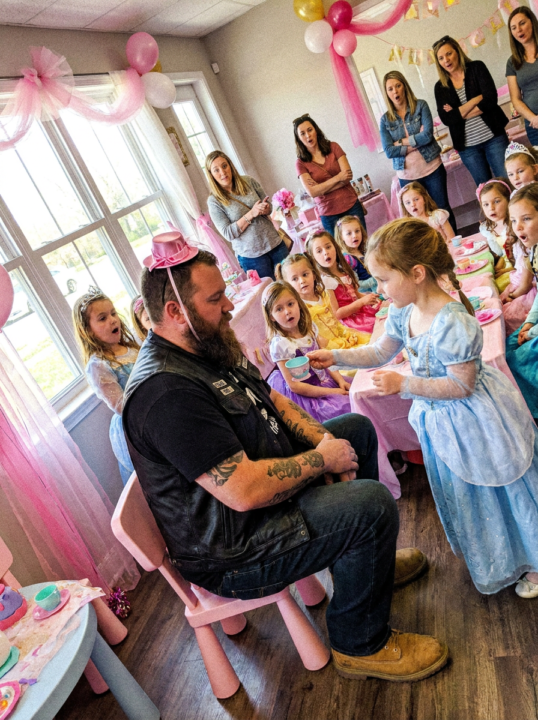
The tea party was moved forward so it could happen before treatment weakened her immune system. Twelve girls arrived in princess dresses.
Cole came directly from the clubhouse, full leather over a black shirt, pink hat tied beneath his beard.
He remained through cake, gifts, and two hours of imaginary tea.
After the final guest left, Lily removed the hat and wrote a date inside the brim.
Cole asked whether she wanted to cancel her actual birthday three weeks later. Lily said no, but she wanted only family, vanilla pudding, and no candles because the smell of smoke might make her nauseated.
“How do you know that?” he asked.
“The nurse told Mommy.”
Cole realized Lily had been listening to every conversation adults assumed passed over her head. From then on, he and Natalie stopped speaking around the diagnosis as though their daughter were absent.
They explained what they knew, admitted what they did not, and allowed Lily to make choices wherever treatment permitted.
The hats became one of those choices.
Inside the pink brim, Lily wrote her diagnosis date.
Then she added a number.
Hat One.
Part 3
Chemotherapy began Monday at 7:15 a.m.
Cole arrived wearing Hat Two: a purple felt hat with silver stars glued around the brim. Lily had designed it the night before.
The stars shed glitter onto his leather vest and the hospital elevator.
People stared.
Cole looked at Lily. “Working?”
She nodded.
The first weeks reorganized the family’s life around laboratory results, medication schedules, hand sanitizer, and the temperature displayed on a digital thermometer.
Natalie slept beside Lily in the hospital. Cole managed the motorcycle shop during the day, then arrived for evening appointments wearing whichever hat Lily had selected.
Hat Three was yellow with two enormous fabric sunflowers.
Hat Four had cat ears.
Hat Five was a blue cowboy hat covered in plastic pearls.
Hat Six was a knitted strawberry cap that made Cole’s beard look even larger.
He wore each without irony.
The nurses began checking the hat before checking his visitor badge. Children peeked from treatment bays to see what had arrived. Parents smiled on days they had forgotten how.
Not every reaction was kind.
A man in the parking garage photographed Cole in the sunflower hat and posted it with a joke about biker masculinity. The image traveled through local social media before anyone knew Lily was receiving treatment upstairs.
Cole’s club brothers wanted the post removed. One offered to find the man.
Cole refused.
“He looked at me,” Cole said. “That was the job.”
Lily later saw the photograph and asked whether the joke hurt.
Cole told her the truth: a little.
Then he showed her the treatment bay behind him, blurred in the distance.
“But they didn’t photograph you,” he said.
That was enough.
Lily’s hair began falling during the third week.
It appeared first on her pillow, then in the bathtub, then between Cole’s fingers while he tried to make one final braid.
Lily watched the hair gather on the towel.
“Stop pulling,” she said.
Cole froze.
He had barely touched it.
Natalie sat beside them, crying silently. Lily saw her mother’s reflection in the bathroom mirror and became angry.
“Everybody stop looking sad.”
Cole placed Hat Seven—a soft pink beanie with a satin crown—on his own head.
“Better?”
Lily almost smiled.
The next morning, she asked him to shave what remained.
Cole laid towels across the kitchen floor. His hands, steady around engines and handlebars, shook while holding the clippers.
Lily sat on a stool wearing a cape made from an old princess sheet.
“You can stop,” she told him.
“Your call.”
“Keep going.”
When it was finished, Lily rubbed her head and looked into the mirror. She did not cry immediately. She studied the shape of herself, trying to decide whether she still belonged to the face looking back.
Cole removed his hat.
His own head was already shaved, but he passed the clippers over it anyway. Then Natalie allowed Lily to cut a short lock from her hair.
“Everybody different,” Natalie said. “Everybody still us.”
At the hospital, Hat Eight became the first design that included another name.
Lily had met Mateo, a seven-year-old being treated two bays away. He hated the sound of infusion pumps and loved dinosaurs.
She taped a green paper dinosaur onto Cole’s hat and wrote MATEO beneath the brim.
Cole did not notice the name until a nurse pointed it out.
“Who’s Mateo?” he asked.
Lily nodded toward the next bay. “He was scared.”
Cole walked over, stopped outside the curtain, and waited for permission to enter.
Mateo’s mother stared at the giant biker in leather and pulled her chair closer to her son.
Cole pointed to the paper dinosaur.
“Heard you know more about these than my kid.”
Mateo corrected the dinosaur’s species.
Ten minutes later, he was drawing teeth on Cole’s hat.
The promise began expanding.
Mateo’s mother, Sofia, later told me that her first fear had not been Cole’s tattoos.
It had been hope.
She had learned to distrust cheerful strangers who entered the hospital, offered encouragement, then disappeared when treatment became repetitive or frightening.
Cole did not promise Mateo would be fine.
He returned the following week wearing a triceratops hat after the boy corrected him. He returned again with a stegosaurus.
By the fourth visit, Mateo had appointed himself Cole’s official dinosaur consultant.
Consistency made the difference. The hats were funny, but the returning man beneath them became the reassurance.
Lily designed hats for children who cried during needle changes, children who missed school, and siblings tired of being told to wait quietly.
Each hat gave Cole a reason to cross the treatment floor looking ridiculous enough to interrupt fear.
The club wanted to help.
Cole resisted until Lily invited them herself.
She assigned rules.
No loud engines near the hospital.
No scary jokes.
No photographs unless the child said yes.
Every rider had to let a patient choose the hat.
Twelve men who had ignored instructions from judges, bosses, and ex-wives obeyed a six-year-old without argument.
Before their first visit, hospital staff met the riders in a conference room and explained infection precautions, privacy rules, and why a child might ask them to leave without warning.
Cole sat in the front row taking notes.
Anyone unwilling to follow the rules did not participate.
The men removed chains that could scratch equipment, cleaned their leather, silenced their phones, and walked from the distant parking area rather than riding to the entrance.
Brotherhood was measured not by how loudly they arrived, but by how much of themselves they were willing to quiet.
For one Saturday, the hospital lobby filled with leather vests and hats shaped like cupcakes, frogs, unicorns, and crowns.
Lily called it the Brave Parade.
Cole called it Tuesday practice.
He still believed the promise ended when her hair returned.
Lily had begun planning something else.
Part 4
Month four brought the first serious setback.
Lily developed a fever after midnight. Natalie called the hospital while Cole carried their daughter to the car wrapped in a blanket.
Her body felt too light against his chest.
The pink beanie sat forgotten on the kitchen table.
At the emergency entrance, staff moved quickly. Tests suggested an infection while Lily’s immune system was dangerously low. She was admitted to isolation.
Cole stood outside the glass door because only one parent could remain during the first evaluation.
He wore no hat.
For the first time since treatment began, he looked exactly as strangers expected: huge, tattooed, leather vest open, fists closed, face hard enough to frighten anyone approaching.
Inside, Lily saw him through the window and pointed at his bare head.
Natalie understood. She called his phone.
“She wants the hat.”
“It’s at home.”
Lily spoke from the bed, her voice small through the speaker.
“You forgot the promise.”
Cole left the hospital.
The elevator took too long, so he used the stairs, descending six floors while guilt struck harder than his boots.
He knew forgetting one hat did not mean forgetting his daughter.
Fear did not respect that distinction.
Lily had asked for one visible proof that he would share the staring, and on the night she felt worst, his head had been bare.
In the parking garage, he stopped beside the Harley and called Miguel.
“I forgot it.”
Miguel did not ask what. “Go get it.”
“She thinks I forgot everything.”
“Then come back wearing the promise.”
Cole rode the Harley through cold rain because driving the car felt too slow. The V-twin hammered beneath him along Interstate 40. Water entered his gloves.
He reached the house, found the pink beanie, then noticed a cardboard box beneath Lily’s desk.
Inside were seventeen hat designs.
Some were drawn carefully with labels and color arrows. Others were crayon circles made during appointments when Lily’s hands were tired.
A small envelope attached to each page contained scraps: ribbon, a sticker, a feather, or a note about what frightened that child.
Rosa hated quiet elevators.
Eli missed his dog.
Hannah did not want anyone to say she looked brave when she felt angry.
Lily had been gathering details the way Cole gathered tools. She could not change their medicine, but she could give her father instructions for entering their fear without pretending to fix it.
Each page included colors, decorations, and a child’s name.
Mateo — dinosaur captain.
Rosa — purple butterfly.
Eli — astronaut with one red planet.
Hannah — orange cat ears.
Beside some names Lily had written dates.
Beside others, question marks.
At the bottom of the box was a drawing of Cole standing in the hospital lobby wearing all seventeen hats stacked on his head.
Across the top she had written:
DADDY KEEPS GOING WHEN I AM DONE.
Cole sat on the bedroom floor.
Rainwater dripped from his vest. The pink beanie remained in one hand. The drawings covered his knees.
Until then, he had believed he was helping Lily survive being seen.
The designs revealed that Lily had been watching everyone else. She had noticed which children cried, which parents sat alone, and which siblings looked invisible.
She was not collecting hats.
She was assigning him people.
Cole returned to the hospital carrying the entire box beneath his vest to keep it dry.
Security had called ahead, and a nurse met him with a towel because rain ran from his jeans. Cole changed into hospital scrubs in a supply room, disinfected the plastic box, and waited through every required precaution.
The promise did not permit him to endanger Lily for the sake of a dramatic entrance.
By the time he reached the glass door, nearly an hour had passed. Lily had fallen asleep.
Cole sat outside wearing the hat until she opened her eyes.
He entered isolation wearing the pink beanie, disposable gown, gloves, and mask. The beanie sat over the hood like a small flag.
Lily opened her eyes.
“You remembered.”
“I found the box.”
She looked worried. “Was it hiding bad?”
“Good enough.”
“Are you mad?”
Cole placed the designs beside her bed. “Seventeen is a lot of hats.”
“There’ll be more kids.”
He could not answer immediately.
Lily mistook his silence for refusal.
“You said every day until my hair comes back.”
“That was the deal.”
“But when mine comes back, somebody else’s might go away.”
Cole lowered his head.
The promise had changed without asking him. Not because Lily was demanding more, but because she had understood something adults on the hospital floor tried not to say aloud:
Remission for one child does not empty the chairs.
Cole lifted the dinosaur design.
“We start with Mateo?”
Lily smiled weakly. “He likes T. rex, but don’t call everything T. rex.”
The fever lasted three days. Cole wore a different hat outside the isolation room each morning, holding the drawings against the glass when Lily was awake.
At night, he slept in a vinyl chair with his leather vest folded beneath his head. Natalie remained inside the room.
Husband and wife spoke by phone through the glass, sometimes about medication and sometimes about ordinary things—the leaking garage faucet, a school library book, whether Lily’s unfinished cake remained safe in the freezer.
Ordinary conversation became another form of resistance.
Illness occupied the room, but it did not receive every sentence.
The club riders delivered supplies but did not enter. Miguel left boxes of felt, ribbons, foam shapes, and washable fabric glue with security.
A note on top read:
ORDERS FROM THE BOSS.
Lily recovered from the infection.
The false climax arrived two months later when her tests showed treatment was working well. Family members celebrated. Cole’s club planned a ride. Mothers from the tea party brought food.
Lily did not celebrate immediately.
She asked about Mateo.
His treatment had become more complicated. His mother had stopped answering messages because every conversation required energy she no longer possessed.
Cole found Hat Eighteen in Lily’s box.
It was not labeled with Lily’s name.
It read:
FOR THE PARENT WHO CAN’T SAY THEY’RE SCARED.
Cole wore it to Mateo’s room and sat beside his mother without speaking.
The hat was plain black with one pink ribbon.
For twenty minutes, neither adult said a word.
Then Mateo’s mother leaned against the biker’s leather shoulder and cried.
Cole did not tell her to stay strong. He did not compare Mateo with Lily or offer statistics.
He sat beneath the plain black hat until Sofia’s breathing slowed, then asked whether she wanted coffee.
That hat never went onto the public cart. It remained in Cole’s truck for the parents who needed permission to look afraid without becoming a lesson for anyone else.
Part 5
By month eight, Lily’s hair had begun returning as a soft brown shadow.
The first time she noticed it, she ran into the garage without shoes and demanded Cole inspect her head beneath the fluorescent lights.
He knelt beside the workbench, rubbed one scarred palm carefully over the new growth, and nodded as if confirming an engine had started after a long repair.
“It’s back,” she said.
“Starting.”
“That means you can stop wearing hats.”
Cole was wearing Hat Twenty-Three, a lavender cap decorated with foam moons for a girl named Avery.
He touched the brim.
“You sure?”
Lily nodded. “Promise finished.”
The following Monday, Cole arrived at the hospital bareheaded.
He had spent twenty minutes in the garage deciding whether stopping was another way to honor Lily’s control. The original promise belonged to her. If she said it was complete, continuing without asking could turn her gift into his identity.
So he left every hat on the workbench.
The bareheaded walk from the elevator felt stranger than any pink ribbon. Parents who knew him searched for the missing color. A nurse glanced behind Cole as though the hat might arrive separately.
Without it, Cole appeared more intimidating, not because his face had changed, but because the bright interruption was missing.
Lily walked beside him wearing a yellow headband over her new hair.
At the treatment floor, she stopped.
Mateo sat near the window. A younger child cried behind a curtain. Avery’s father slept upright with both arms crossed. On a chair beside the nurses’ station lay an unfinished hat shaped like a ladybug.
Lily looked at Cole.
“It feels wrong.”
“You told me to stop.”
“I thought I wanted normal.”
Cole crouched. “Normal can change.”
Lily touched the yellow headband. “Do you want to wear them?”
He considered the question seriously.
At first, the hats had been armor for his daughter. Then they became a task, a route through helplessness, and a way for children to control one small detail in rooms where adults controlled nearly everything else.
“Yes,” he said.
“Even when my hair is long?”
“Especially then.”
Lily smiled. “Why?”
Cole lifted the unfinished ladybug hat.
“Because one day you’ll need me to look foolish beside you again. I want you to know I didn’t forget how.”
That afternoon, Lily and the nurses completed the ladybug hat. Cole wore it through the cafeteria, into the parking garage, and back to his shop.
The riders pretended not to notice until Miguel placed a jar on the counter labeled HAT PARTS.
Every mechanic began dropping spare change inside.
Cole established limits before the idea became a charity campaign. No child’s diagnosis would appear on fundraising material without family consent. No volunteer would promise an outcome.
Nobody would call a child a fighter unless that child liked the word.
Lily approved every rule except one.
Cole wanted all hats to remain anonymous. Lily argued that makers should sign the inside so frightened children knew another person had spent time on them.
They compromised: first names only, written beneath the brim where the wearer could choose whether to reveal them.
The original mothers from the tea party formed a sewing group.
I joined despite knowing almost nothing about sewing.
Natalie taught us how to reinforce brims and remove anything unsafe for immunocompromised children. We washed fabrics, avoided loose glitter, and let each child approve a design.
The program became Hats On, Fear Off.
Cole refused to put his name on it.
Lily insisted her name stay off too.
“It’s everybody’s,” she said.
The first official hat cart entered the hospital two weeks later. It carried forty designs and a small mirror. Children could choose a finished hat, create one, or assign one to a biker volunteer.
The mirror was Lily’s idea. She disliked adults placing things on her head and immediately declaring her beautiful.
She wanted every child to look first and decide.
Some chose no hat.
Cole respected that answer too.
One teenager assigned him a plain gray cap because she was tired of cheerful colors. Another child requested a crown so tall Cole had to remove it before entering elevators.
A toddler placed stickers directly onto his shaved head after rejecting every hat on the cart.
The program worked because the object was never the point.
Choice was.
Cole received the most assignments.
He wore a flamingo hat to a school meeting, a silver crown to the grocery store, and a fuzzy blue monster cap during a charity motorcycle repair day.
He never acted as if the hat made him less serious.
That was part of its power.
When strangers laughed, Cole let them.
When children laughed, he joined them.
When parents cried, he stayed quiet.
Lily completed the most intense phase of treatment with encouraging results. Her doctors used careful language, and so did the family.
They celebrated milestones without pretending uncertainty had vanished.
On the final appointment of that eight-month stretch, Lily selected the original pink tea hat.
The satin had faded. The fabric rose leaned farther forward. Inside, the purple-crayon message remained visible:
FOR WHEN BRAVE FEELS SCARED.
Cole wore it into the clinic.
Every nurse recognized it.
So did the mothers from the party, standing near the elevator with twelve girls who had grown eight months older.
Nobody laughed this time.
They raised empty plastic teacups.
Cole raised one scarred little finger.
Part 6
The tea party became a monthly ritual on the treatment floor.
Lily insisted it never be called a celebration unless the children chose that word. Some gatherings happened after good laboratory results.
Others happened on days when a family had received news that left no room for cheerfulness.
The teacups were available for both.
At one party, nobody played. Five parents sat around the low table while their children slept or remained in treatment rooms.
Cole poured imaginary tea for the adults and asked no questions.
The absurdity of a huge biker silently serving empty cups allowed them to sit together without inventing optimism.
There were no elaborate decorations and no expectation that children feel cheerful. Some months only three families attended. Other months the playroom filled.
Tea remained imaginary because dietary restrictions differed, but the cups were real, bright, and unbreakable.
Cole occupied the thirteenth chair whenever he could.
His Harley remained parked far from the hospital entrance so the engine would not disturb patients. He entered through the main doors wearing full leather and whatever hat had been assigned that week.
One month it was a sunflower.
Another month, a pirate ship.
At Christmas, Lily designed a hat resembling a chimney with felt boots sticking from the top. Cole wore it through an entire club meeting before taking it to the hospital.
The Hells Angels riders who participated followed Lily’s original rules. No loud entrances. No photographs without permission. No treating sick children as inspiration for social media.
They arrived to take instructions, pour imaginary tea, repair toy wheels, and leave when families needed quiet.
Hospital staff initially worried the leather vests might frighten families. Cole suggested orientation badges with first names only and allowed the staff to decide when riders entered.
Trust grew through repetition.
The men who once attracted security calls became the people nurses contacted when a wagon wheel broke, a sibling needed distraction, or a parent needed a ride home after midnight.
Mateo eventually returned to the party wearing a dinosaur cap. His road remained harder than Lily’s, and nobody used her progress to tell his family how to feel.
Cole sat beside Mateo’s mother with the plain black hat and pink ribbon resting on his knee.
Some hats were for laughter.
That one was for silence.
Lily’s hair grew past her ears, then to her chin. The first time she could tie a tiny ponytail, Natalie photographed it privately.
Cole did not wear a hat in the picture.
He held the original pink one against his chest.
The cardboard box beneath Lily’s desk was replaced by a filing cabinet in the garage. Each drawer contained designs, names, sizes, washable materials, and notes about what made a child smile.
One drawer was labeled QUIET HATS.
It held soft caps without bells, glitter, slogans, or bright colors. Lily had learned that not every frightened child wanted attention redirected through laughter.
Sometimes the kindest design was the one that asked nothing from its wearer.
Cole still kept Lily’s hospital wristband inside his vest.
Beside it, he stored the purple-crayon note.
He did not need either to remember the diagnosis.
He kept them to remember the first night Lily turned fear into instructions he could follow.
Part 7
Four years after the princess tea party, Lily turned ten.
Her treatment calendar no longer controlled every week, though follow-up appointments remained part of the family’s life. Cole never used the word cured carelessly.
He had learned that families could be grateful and still afraid, hopeful and still tired.
Lily had learned something similar about her father.
The leather vest did not make him fearless, and the pink hat did not make him gentle. He had contained both qualities before the party.
The promise merely gave everyone else a way to see them at the same time.
Her birthday was smaller. No paper castle. No twelve princess dresses. She invited three friends to the garage, where they painted hats at a folding table between two motorcycles.
Her brown hair reached her shoulders.
Cole entered carrying a tray of cupcakes and wearing the original pink tea hat.
The elastic had been replaced twice. The satin ribbon was faded, and the fabric rose had lost one petal.
It still looked far too small on him.
Lily looked up.
“You know you don’t have to wear that anymore.”
Cole set down the cupcakes. “I know.”
“Then why do you?”
He adjusted the brim with one scarred finger.
“Because there’ll be another day you need me. Maybe not for medicine. Maybe for something I don’t understand yet.”
Lily considered that, then pointed toward a new drawing on the table. It showed a wide green hat covered in question marks.
“That one’s for middle school,” she said.
Cole studied the design. “How bad is middle school?”
“Mom says we should start preparing now.”
Natalie laughed from the garage doorway.
Cole did not.
He placed the drawing inside his vest beside the hospital wristband as though accepting another assignment.
Outside, the Harley cooled beneath the Nashville evening, metal ticking softly near the open garage door.
Inside, Lily tied a fresh ribbon beneath her father’s beard.
On the workbench stood the thirteenth plastic teacup.
Cole lifted it.
“Strong strawberry air?” he asked.
“The strongest.”
Follow the page for more stories about bikers whose quiet promises reveal the people beneath the leather.
The hair returned.
The promise stayed.